From Surf Wiki (app.surf) — the open knowledge base
M2 4.2-inch mortar
American mortar

American mortar
| Field | Value | |
|---|---|---|
| name | M2 4.2-inch mortar | |
| image | M2_107mm_Mortar_NOLA.png | |
| image_size | 300 | |
| origin | United States | |
| type | Mortar | |
| is_explosive | yes | |
| is_artillery | yes | |
| is_UK | ||
| service | 1943–1974 (United States) | |
| 1943–present | ||
| used_by | U.S. Army | |
| U.S. Marine Corps | ||
| wars | World War II | |
| Korean War | ||
| First Indochina War | ||
| Vietnam War | ||
| Cambodian Civil War | ||
| Laotian Civil War | ||
| Portuguese Colonial War | ||
| <!-- Production history --> | designer | U.S. Chemical Warfare Service |
| variants | ||
| weight | 151 kg (332.89 lbs) | |
| length | 1.22 m (4 ft) | |
| part_length | 1 m | |
| crew | ||
| cartridge | 11-13 kg | |
| caliber | 107 mm (4.2 in) | |
| rate | 5 rpm for 20 minutes | |
| 1 rpm indefinitely | ||
| velocity | 250-256 m/s | |
| range | 515 m (563.21 yd) | |
| max_range | 4.4 km | |
| sights | ||
| traverse | ||
| haft_type | ||
| yield |
1943–present U.S. Marine Corps Korean War First Indochina War Vietnam War Cambodian Civil War Laotian Civil War Portuguese Colonial War 1 rpm indefinitely
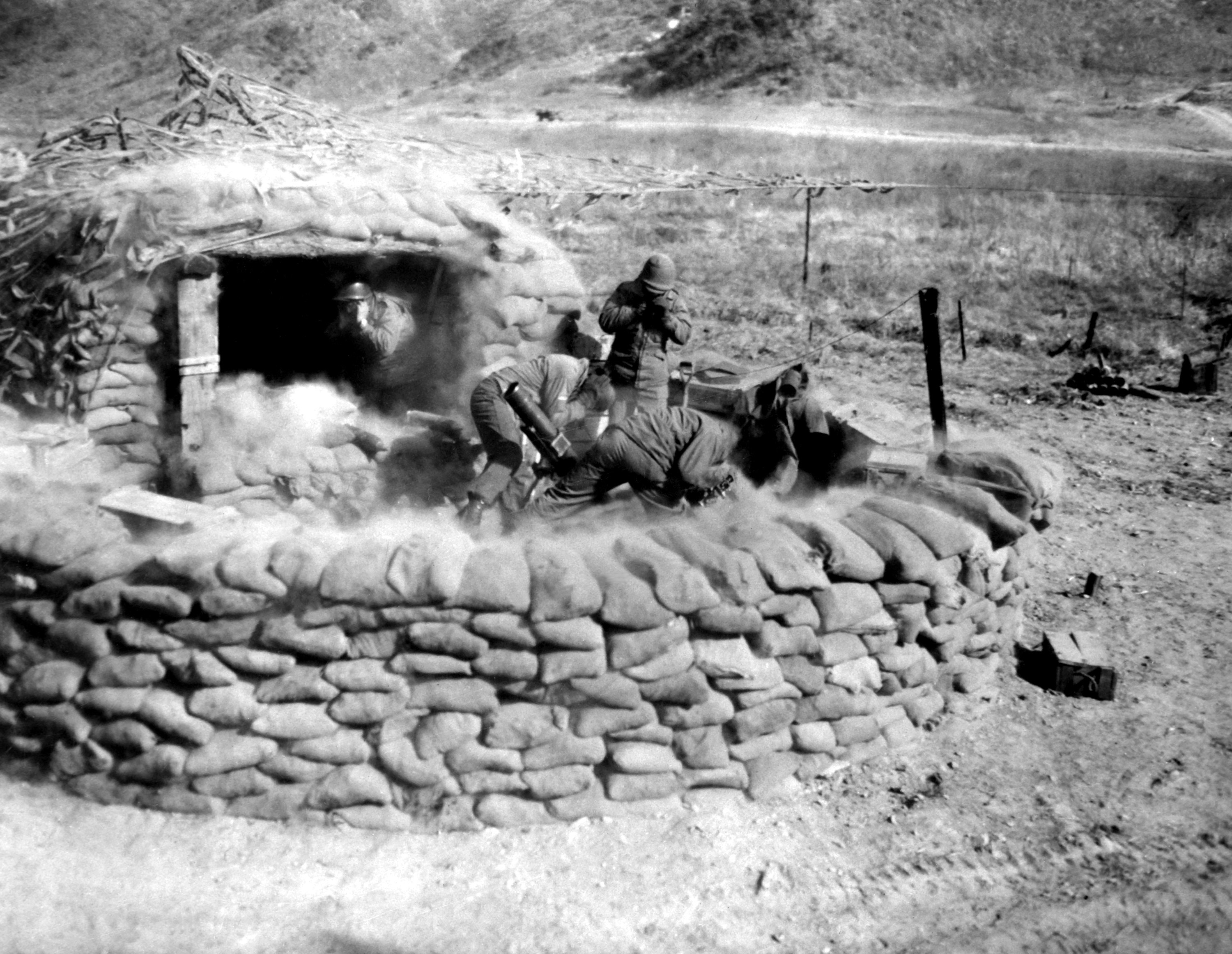
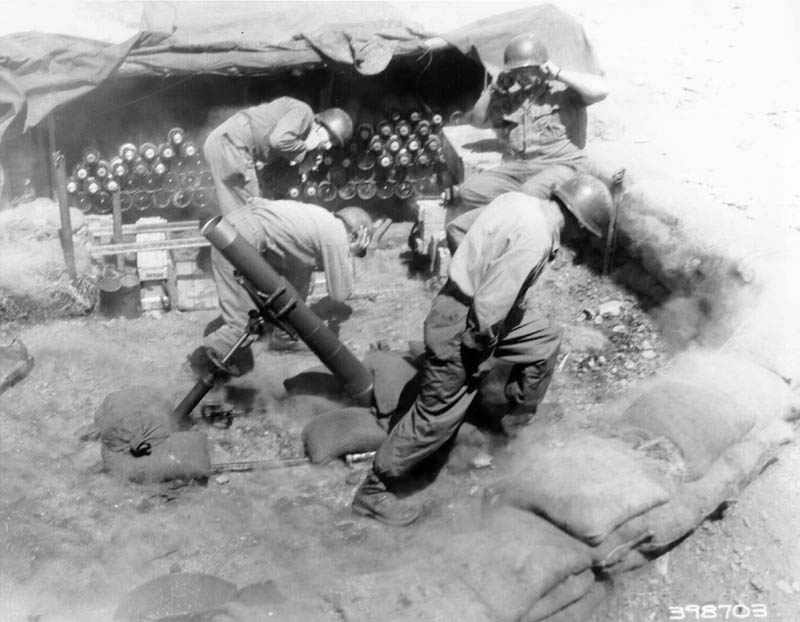
The M2 4.2-inch mortar was a U.S. rifled 4.2-inch (107 mm) mortar used during the Second World War, the Korean War, and the Vietnam War. It entered service in 1943. It was nicknamed the "Goon Gun" (from its large bullet-shaped shells, monopod, and rifled bore) or the "Four-Deuce" (from its bore size in inches). In 1951, it began to be phased out in favor of the M30 mortar of the same caliber.
History
The first 4.2 in mortar in U.S. service was introduced in 1928 and was designated the M1 Chemical Mortar. Development began in 1924 from the British 4-inch (102 mm) Mk I smooth-bore mortar. The addition of rifling increased the caliber to 4.2 in. The M1 fired chemical shells to a range of 2400 yards. It was ostensibly meant to fire only smoke shells, as the postwar peace lobby opposed military spending on explosive or poison gas shells.
The M2 could be disassembled into three parts to allow it to be carried by its crew. The mortar tube weighed 105 lb, including a screw-in cap at the bottom. The cap contained a built-in fixed firing pin. The standard, a recoiling hydraulic monopod that could be adjusted for elevation, weighed 53 lb. The baseplate had long handles on either side to make it easier to carry; it weighed 175 lb.
Upon the entry of the United States into World War II, the U.S. Army decided to develop a high explosive round for the mortar so that it could be used in a fragmentation role against enemy personnel. In order to extend the range to 3200 yards, more propellant charge was used and parts of the mortar were strengthened. Eventually, the range of the mortar was extended to 4400 yards. The modified mortar was redesignated the M2. The M2 was first used in the Sicilian Campaign, where some 35,000 rounds of ammunition were fired from the new weapon. Subsequently, the mortar proved to be an especially useful weapon in areas of rough terrain such as mountains and jungle, into which artillery pieces could not be moved. The M2 was gradually replaced in U.S. service from 1951 by the M30 mortar.
Starting in December 1942, the US Army experimented with self-propelled 4.2 in mortar carriers. Two pilot vehicles based on the M3A1 halftrack were built, designated 4.2 in Mortar Carriers T21 and T21E1. The program was cancelled in 1945.
Before the invasion of Peleliu in September, 1944, the U.S. Navy mounted three mortars each on the decks of four Landing Craft Infantry and designated them LCI(M). They provided useful fire support in situations where conventional naval gunfire, with its flat trajectory, was not effective. Increased numbers of LCI(M) were used in the invasions of the Philippines and Iwo Jima. Sixty LCI(M) were used during the invasion of Okinawa and adjoining islands with Navy personnel operating the mortars.
Tactical organization
4.2 in mortars were employed by chemical mortar battalions. Each battalion was authorized forty-eight M2 4.2 in mortars organized into four companies with three four-tube platoons. Between December 1944 and February 1945, the battalions’ Companies D were inactivated to organize additional battalions. In World War II, an infantry division was often supported by one or two chemical mortar companies with twelve mortars each. In some instances an entire battalion was attached to a division. In the Korean War, an organic heavy mortar company of eight 4.2 in mortars was assigned each infantry regiment while Marine regiments had a mortar company with twelve mortars.
Ammunition
The M2 has a rifled barrel, unusual for a mortar. Thus its ammunition lacks stabilizing tailfins common to most mortars.
The mortar's M3 high explosive (HE) shell packed 3.64 kg of explosive charge, placing it between the M1 105-mm HE shell (2.18 kg of charge) and M102 155-mm HE shell (6.88 kg of charge) in terms of blast effect. The mortar could also fire white phosphorus-based smoke shells and mustard gas shells. The official designation of the latter was Cartridge, Mortar, 4.2-inch. Mustard gas was not used in these wars and the U.S. ended up with a large number of these shells, declaring over 450,000 of them in stockpile in 1997 when the Chemical Weapons Treaty came into force. Destruction efforts to eliminate this stockpile are continuing with a few of these aged shells occasionally found to be leaking.
| Chemical | H M2 Shell | 13 kg | HD, 2.7 kg or |
|---|---|---|---|
| HT, 2.6 kg | 256 m/s | 4.4 km |
Users
- : used
- : used
- : used
- : used
- Republic of China (1912-1949): used in the Burma campaign
- : used
- : used
- : used
- France
- : used
- Guatemala: used
- : used All M2s were replaced by MO-120-RT by 2010.
- : used
- North Vietnam
- Used by the Panama Defense Forces
- : used
- Philippines: used
- : known as m/951
- : The Armed Forces began receiving M2s after the outbreak of the Korean War, and 254 were in service by the end of the war. Began replacing with M30 or KM30 in 1970s.
- South Vietnam}}
- : used
- : used
Notes
Notes
References
- Infantry Weapons of the KOREAN WAR Mortars: 4.2-inch M2 Mortar
- History of the 4.2-inch mortar
- Jane's Infantry Weapons 1984–1985, Ian Hogg (ed.), London: Jane's Publishing Company Ltd., 1984. .
- Army Service Forces Catalog CW 11-1
References
- Chamberlain, Peter. (1975). "Mortars and rockets". Arco Pub. Co.
- "History of the 4.2" Chemical Mortar".
- "'Mortars: 4.2-inch M2 Mortar". Infantry Weapons of the Korean War.
- (1990). "The Chemical Warfare Service: Chemicals in Combat". Center of Military History.
- [https://fas.org/man/dod-101/sys/land/mortar_c.htm Mortar Cartridges], 1998, Federation of American Scientists
- U.S. Army TM 43-0001-28, p. 4-84, April 1994.
- Janes, pp. 918–926
- Philip Jowett. (2005). "The Chinese Army 1937–49: World War II and Civil War". Osprey Publishing.
- "Vũ khí Việt Nam trong hai cuộc kháng chiến".
- "107 mm Mortar M2". Gallery Rightwing.
- (2007). "Just Cause 'Intervention in Panama 1989-90'". Concord Publications Company.
- (1998). "Modern African Wars 2: Angola and Mozambique 1961–74". Osprey Publishing.
- Bak, Dongchan. (March 2021). "Korean War : Weapons of the United Nations". Ministry of Defense Institute for Military History.
- Rottman, Gordon L.. (2010). "Army of the Republic of Vietnam 1955–75". [[Osprey Publishing]].
This article was imported from Wikipedia and is available under the Creative Commons Attribution-ShareAlike 4.0 License. Content has been adapted to SurfDoc format. Original contributors can be found on the article history page.
Ask Mako anything about M2 4.2-inch mortar — get instant answers, deeper analysis, and related topics.
Research with MakoFree with your Surf account
Create a free account to save articles, ask Mako questions, and organize your research.
Sign up freeThis content may have been generated or modified by AI. CloudSurf Software LLC is not responsible for the accuracy, completeness, or reliability of AI-generated content. Always verify important information from primary sources.
Report