From Surf Wiki (app.surf) — the open knowledge base
M-102 (Michigan highway)
State highway in Michigan, United States
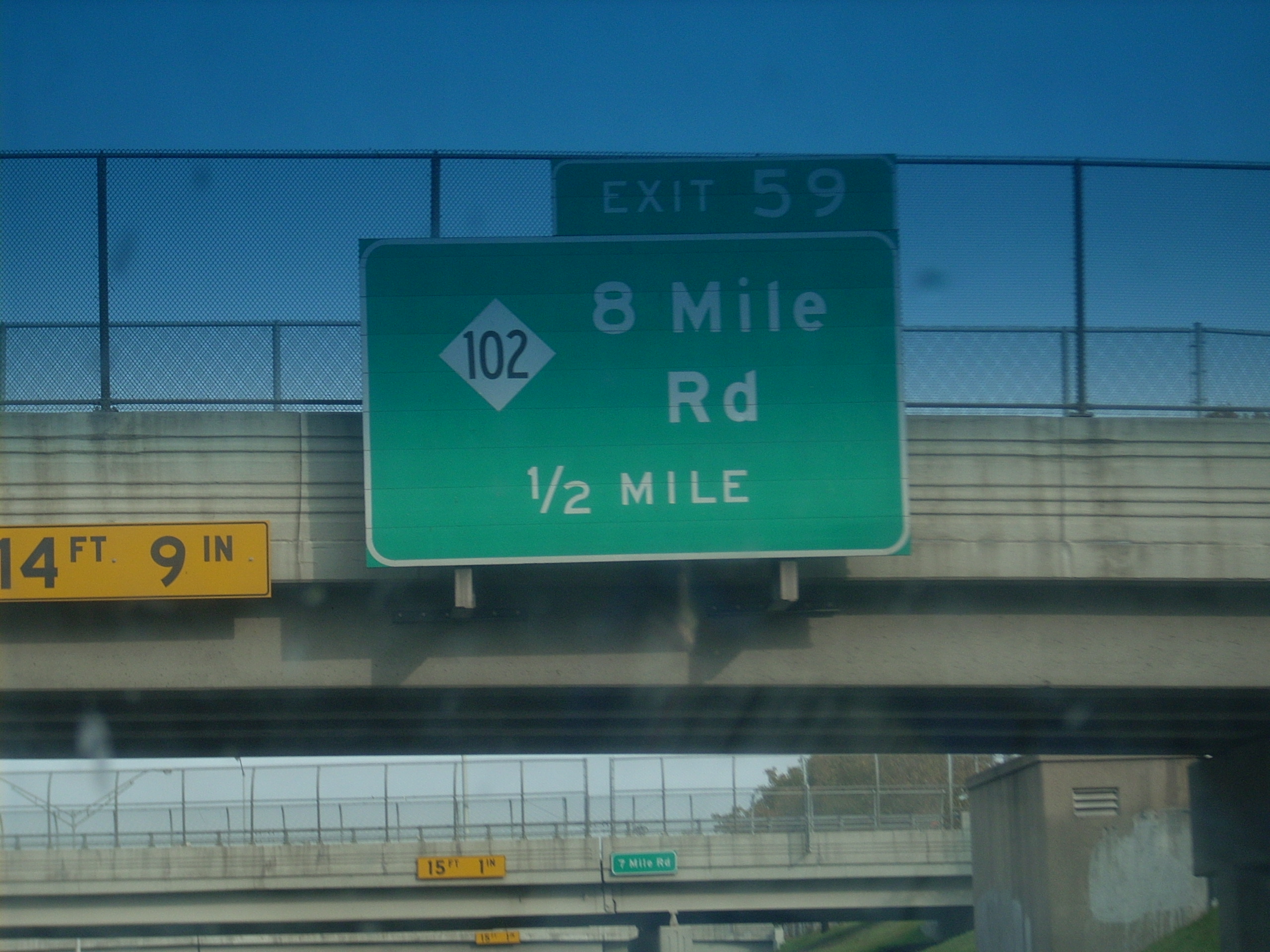
State highway in Michigan, United States
| Field | Value | |||||
|---|---|---|---|---|---|---|
| state | MI | |||||
| type | M | |||||
| route | 102 | |||||
| alternate_name | 8 Mile Road | |||||
| map | ||||||
| map_custom | yes | |||||
| map_notes | M-102 highlighted in red | |||||
| length_mi | 20.804 | |||||
| length_ref | ||||||
| established | ||||||
| direction_a | West | |||||
| terminus_a | at Livonia | |||||
| junction | {{plainlist | 1= | ||||
| *{{jct | state | MI | US | 24}} at Southfield | ||
| *{{jct | state | MI | M | 39 | M | 10}} at Southfield |
| *{{jct | state | MI | I | 75 | M | 1}} at Detroit |
| *{{jct | state | MI | M | 53 | M | 97}} at Warren |
| *{{jct | state | MI | M | 3}} at Eastpointe }} | ||
| direction_b | East | |||||
| terminus_b | at Harper Woods | |||||
| counties | Wayne, Oakland, Macomb | |||||
| previous_type | US 1926 | |||||
| previous_route | 102 | |||||
| next_type | M | |||||
| next_route | 103 |
- at Southfield
- at Southfield
- at Detroit
- at Warren
- at Eastpointe }} M-102 is an east–west state trunkline highway in the US state of Michigan that runs along the northern boundary of Detroit following 8 Mile Road. The highway follows the Michigan Baseline, a part of the land survey of the state, and the roadway is also called Base Line Road in places. As a county road or city street, 8 Mile Road extends both east and west of the M-102 designation, which leaves 8 Mile on the eastern end to follow Vernier Road. The western terminus of M-102 is at the junction of 8 Mile Road and M-5 (Grand River Avenue) and the opposite end is at Vernier Road and Interstate 94 (I-94). The 8 Mile Road name extends west to Pontiac Trail near South Lyon with a discontinuous segment located west of US Highway 23 (US 23). The eastern end of 8 Mile Road is in Grosse Pointe Woods, near I-94, with a short, discontinuous segment east of Mack Avenue.
The highway was first designated in the late 1920s, connecting US 10 (Woodward Avenue, now M-1) with US 25 (Gratiot Avenue, now M-3). Extensions to the highway designation moved the termini in the 1930s and 1940s east to M-29 (Jefferson Avenue) and US 16 (Grand River Avenue, now M-5). A change in the 1960s added a section of north–south roadway to the eastern end of M-102; that change was reversed within about a year. A western extension along Grand River Avenue in 1977 was reversed in 1994, and M-102 has remained the same since.
As the long northern border of the city of Detroit, 8 Mile Road has carried major cultural significance; since the mid-20th century parts of the road has served as a physical and cultural dividing line between the wealthier, predominantly white northern suburbs of Detroit and the poorer, predominantly black city. The racial patterns have changed somewhat as middle-class African Americans have also moved north of 8 Mile, but the socioeconomic divide between the city and suburbs remains.
Route description
Starting at an intersection with Hamburg Road along the Livingston–Washtenaw county line, 8 Mile Road runs eastward to an interchange with US 23 near Whitmore Lake. There is a gap before 8 Mile Road resumes at Pontiac Trail along the Oakland–Washtenaw county line. Near the suburb of Northville, the road curves northward into Oakland County, and Base Line Road follows the county line for about 1 mi. The road meets I-96/I-275 at that freeway's exit 167 along the border between Livonia and Farmington Hills. As its name implies, 8 Mile Road runs east–west 8 mi north of the origin of the Mile Road System at Michigan and Woodward avenues.
M-102 starts at the intersection between M-5 (Grand River Avenue) and 8 Mile Road and runs eastward along 8 Mile Road. The highway widens out into a boulevard setup with each direction divided by a central median. Motorists that want to make a left turn along 8 Mile Road have to perform a Michigan left to do so. Starting at the Inkster Road intersection, M-102 forms the boundary between Redford to the south and Southfield to the north. East of Five Points Road, the 8 Mile follows the northern city limits of Detroit. On either side of 8 Mile Road, the area is filled with residential neighborhoods of the two cities with commercial businesses immediately adjacent to the highway. About 2 mi east of its starting point, M-102 intersects US 24 (Telegraph Road) at a cloverleaf interchange near Frisbee-Pembroke Park and Plum Hollow Country Club.
Continuing east, M-102 intersects M-39 (Southfield Freeway) and M-10 (Lodge Freeway) south of the Southfield campus of Oakland Community College and the Northland Center Mall. As the highway approaches M-1 (Woodward Avenue), there are a pair of service drives that split from the main roadway in each direction to provide access through the interchange with M-1. The main lanes of M-102 pass under M-1 and its ramp connections before the service drives merge back in on the other side. This interchange is located adjacent to the Michigan State Fairgrounds, former site of the now-defunct Michigan State Fair, and Woodlawn Cemetery. the line is south of a rail terminal in Ferndale. Further east, M-102 meets I-75 before intersecting Dequindre Road. Dequindre is the boundary between Oakland and Macomb counties.
Now following the Wayne–Macomb county line, M-102 separates Warren from Detroit. The highway also runs parallel to, and about a half mile (0.8 km) north of Outer Drive, The road passes the Mound Road Engine facility, a former Chrysler plant next to the Mound Road intersection. East of the plant, the highway crosses a branch line of the Conrail Shared Assets Operations on the east side of the plant complex before intersecting M-53 (Van Dyke Road). Further east, 8 Mile Road passes north of the Bel Air Center Shopping Center before crossing another Canadian National Railway line next to the intersection with M-97 (Groesbeck Highway).

On the far east side of Detroit, M-102 separates the city from the suburb of Eastpointe once near the intersection with M-3 (Gratiot Avenue). Near Kelly Road and the Eastland Center, the highway turns southeasterly along Vernier Road to enter Harper Woods in Wayne County; 8 Mile Road continues due eastward along the county line in this suburb as a four-lane undivided urban arterial street. The eastern terminus of M-102 is at the interchange between Vernier Road and I-94 about 1700 ft south of 8 Mile Road near the boundary with Grosse Pointe Woods.
History
M-102 was first designated along 8 Mile Road from US 10 (Woodward Avenue, now M-1) to US 25 (Gratiot Avenue, now M-3) in late 1928 or early 1929. In 1939, the eastern terminus was moved as M-102 was extended along 8 Mile and Vernier Roads to end in Grosse Pointe Shores at M-29 (Jefferson Avenue). The highway was extended in the early 1940s from Woodward westward to US 16 (Grand River Avenue, now M-5).
During 1963, the M-102 designation was extended northerly along Jefferson Avenue through St. Clair Shores, replacing the M-29 designation to the Shook Road interchange at the northern end of the then-existing I-94 freeway. That extension was reversed the next year, and M-102 was scaled back to end at US 25 (Gratiot Avenue); the rest of 8 Mile and Vernier roads plus the Jefferson Avenue segment are added to M-29 instead. M-102 was re-extended along 8 Mile and Vernier roads to the I-94 interchange in Harper Woods in 1970 replacing M-29; the remainder of that other highway along Vernier Road and Jefferson Avenue to Shook Road that was once part of M-102 was transferred to local control.
When I-96 was completed in 1977, several highway designations were shifted in the Metro Detroit area. The Business Spur I-96 designation that had replaced US 16 was removed from Grand River Avenue. That roadway was signed as M-5 southward between 8 Mile Road and its present eastern terminus at I-96 while the remainder of Grand River Avenue and the stub freeway formerly part of I-96 that continued out to I-275 became part of M-102. This extension to M-102 was reversed in October 1994 when M-5 was extended northwesterly along Grand River Avenue, the freeway and up the Haggerty Connector north of I-96 in Novi, replacing part of M-102 in the process.
Cultural impact
Racial and economic divide

(Each dot represents 25 people)]]
The road has long served as a de facto cultural dividing line between the predominantly poor black city and its wealthier, predominantly white northern suburbs. The perception of 8 Mile as the chief dividing line between racial groups and classes persists, in part because the suburban counties of Oakland and Macomb remain, on the whole, significantly whiter and more prosperous than the city of Detroit. However, in recent years increasing numbers of whites have moved into Detroit, especially around the downtown area, and other neighborhoods in the region have become more ethnically diverse as well.
According to the 2000 U.S. census, the median family income for the city of Detroit, whose population was 81.55% African-American, was $33,853, and 26.1% of the population lived below the poverty line. By contrast, the median family income for Oakland County, whose population was 82.75% white, was $75,540, and only 5.5% of residents lived below the poverty line. These results were compiled into an Index of Dissimilarity of 85.9 by researchers with Brown University and Florida State University, the highest score for a metropolitan area in the United States. After the 2010 Census, the index was computed as 79.6, which was a "substantial decline" in the words of the study's authors.
The movie 8 Mile, starring Detroit-area hip hop artist Eminem, who lived near 8 Mile as a child, as well as his songs "Lose Yourself" and "8 Mile", take their names and cultural subject matter from the roadway.
In surveying

8 Mile Road is also known as Base Line Road, for it was used to set the baseline for the Public Land Survey System in Michigan. The system helped bring order to county boundaries, which had often been set in other states by geographic markers such as rivers, hills, and trees, and were therefore rather irregular. Today, the baseline forms the northern or southern boundary of many southern Michigan counties.
Major intersections
8 Mile Road west Vernier Road east
References
References
- {{cite MDOT PRFA
- {{cite MDOT map. (2012)
- (2000). "The Detroit Almanac: 300 Years of Life in the Motor City". Detroit Free Press.
- Alpert, Steve. "M-102, 8 Mile Road". Alp's Roads.
- {{cite MDOT map. (2012)
- "Overview Map of M-102 (8 Mile Road)".
- {{cite MDOT map. (1928-10-01)
- {{cite MDOT map. (1929-05-01)
- {{cite MDOT map. (1939-04-15)
- {{cite MDOT map. (1939-12-01)
- {{cite MDOT map. (1941-07-01)
- {{cite MDOT map. (1942-06-01)
- {{cite MDOT map. (1963)
- {{cite MDOT map. (1964)
- (1965)
- {{cite MDOT map. (1970)
- {{cite MDOT map. (1971)
- {{cite MDOT map. (1977)
- {{cite MDOT map. (1978)
- Greenwood, Tom. (January 28, 1999). "M-5 'Haggerty Connector' Work To Be Done by 2001". The Detroit News.
- (September 28, 2008). "Blacks, whites show prejudices along racial divide". [[Honolulu Advertiser]].
- "U.S. Census website". [[United States Census Bureau]].
- (2011). "The Persistence of Segregation in the Metropolis: New Findings from the 2010 Census". Project US2010.
- Abbey-Lambertz, Kate. (December 6, 2017). "Eminem's Childhood Home in Detroit Burns After Woman Tried to Purchase It". HuffPost.
- Chinni, Dante. (November 15, 2002). "Along Detroit's Eight Mile Road, a stark racial split". [[The Christian Science Monitor]].
- Jacobson, Daniel. (July–August 1988). "Michigan Meridian and Base Line: A Teaching Formulation for the Secondary School". Journal of Geography.
This article was imported from Wikipedia and is available under the Creative Commons Attribution-ShareAlike 4.0 License. Content has been adapted to SurfDoc format. Original contributors can be found on the article history page.
Ask Mako anything about M-102 (Michigan highway) — get instant answers, deeper analysis, and related topics.
Research with MakoFree with your Surf account
Create a free account to save articles, ask Mako questions, and organize your research.
Sign up freeThis content may have been generated or modified by AI. CloudSurf Software LLC is not responsible for the accuracy, completeness, or reliability of AI-generated content. Always verify important information from primary sources.
Report