From Surf Wiki (app.surf) — the open knowledge base
Lviv Oblast
Oblast (region) of Ukraine
_p286_-_BEŁZ.jpg)
Oblast (region) of Ukraine
| Field | Value |
|---|---|
| name | Lviv Oblast |
| native_name | Львівська область |
| native_name_lang | uk |
| nickname | Львівщина (uk) |
| settlement_type | Oblast |
| image_flag | Flag of Lviv Oblast (2001).svg |
| flag_alt | Flag of Lviv Oblast |
| image_shield | Coat of Arms of Lviv Oblast (2001).svg |
| shield_alt | Coat of arms of Lviv Oblast |
| shield_link | Ruthenian lion |
| image_map | Lviv in Ukraine.svg |
| mapsize | 275px |
| subdivision_type | Country |
| subdivision_name | Ukraine |
| parts_type | Largest cities |
| parts_style | para |
| seat_type | Administrative center |
| seat | Lviv |
| leader_title | Governor |
| leader_name | Maksym Kozytskyy |
| leader_title1 | Oblast council |
| leader_name1 | 84 seats |
| leader_title2 | Chairperson |
| leader_name2 | Yurii Kholod (acting) |
| unit_pref | Metric |
| area_total_km2 | 21833 |
| area_rank | Ranked 17th |
| elevation_ft | 971 |
| elevation_m | 296 |
| population_footnotes | |
| population_total | 2478133 |
| population_as_of | 2022 |
| population_blank1_title | Annual growth |
| population_density_km2 | auto |
| demographics1_footnotes | tags -- |
| demographics1_title1 | Official language(s) |
| demographics1_title2 | Average salary |
| demographics1_title3 | Salary growth |
| demographics_type2 | GDP |
| demographics2_footnotes | |
| demographics2_title1 | Total |
| demographics2_info1 | ₴ 296 billion |
| (€7.7 billion) | |
| demographics2_title2 | Per capita |
| demographics2_info2 | ₴ 119,049 |
| (€3,100) | |
| blank2_name_sec1 | HDI (2022) |
| blank2_info_sec1 | 0.722 |
| blank_name_sec1 | Raions |
| blank_info_sec1 | 7 |
| blank1_name_sec1 | Hromadas |
| blank1_info_sec1 | 73 |
| timezone1 | EET |
| utc_offset1 | +2 |
| timezone1_DST | EEST |
| utc_offset1_DST | +3 |
| postal_code_type | Postal code |
| postal_code | 79-82 |
| area_code_type | Area code |
| area_code | +380-32 |
| iso_code | UA-46 |
| registration_plate_type | Vehicle registration |
| blank_name_sec2 | FIPS 10-4 |
| blank_info_sec2 | UP15 |
| blank1_name_sec2 | NUTS statistical regions of Ukraine |
| blank1_info_sec2 | UA73 |
| website | |
| official_name | Lvivska oblast |
(€7.7 billion) (€3,100)
Lviv Oblast (, ), also referred to as Lvivshchyna (, ), is an oblast in western Ukraine. The administrative center of the oblast is the city of Lviv. The current population is
History
Name
The region is named after the city of Lviv which was founded by Daniel of Galicia, the King of Galicia, in the 13th century, where it became the capital of Galicia-Volhynia. Daniel named the city after his son, Leo. During this time, the general region around Lviv was known as Galicia–Volhynia, one of the strongest and most stable kingdoms in Eastern Europe of that time.
Early history
The oblast's strategic position at the heart of central Europe and as the gateway to the Carpathians has caused it to change hands many times over the centuries. In the Early Middle Ages, the territory was inhabited by the Lendians, an old Polish tribe. It was ruled variously by Great Moravia, Poland, Kievan Rus', the Kingdom of Galicia–Volhynia (circa 1200 to 1340; from 1246 under the suzerainty of the Golden Horde), and then ruled by the Kingdom of Poland and Polish–Lithuanian Commonwealth (1340 to 1772). Apart from the Polish and Ruthenian population, there were sizeable Scottish and Armenian communities in Lviv and Brody during Polish rule. Following the First Partition of Poland it passed to the Austro-Hungarian Empire (1772 to 1918), then the West Ukrainian People's Republic and Poland (1919 to 1939), when it was part of the Lwów Voivodeship of the Second Republic of Poland. The region's historically dominant Ukrainian population declared the area to be a part of an independent West Ukrainian People's Republic in November 1918 until June 1919, but this endured only briefly. Local autonomy was provided in international treaties but later on those were not honoured by the Polish government and the area experienced much ethnic tension between the Polish and Ukrainian populations.
Establishment
The oblast was created as part of the Ukrainian Soviet Socialist Republic on 4 December 1939 following the Soviet invasion of eastern Poland and annexation of Eastern Galicia and Volhynia. Several NKVD prisoner massacres were committed in the area in 1941, including at Lviv, Sambir and Dobromyl.
It was occupied by Nazi Germany from 1941 to 1944 following the start of Operation Barbarossa, where most of the local Jewish population were killed. The Germans also established several prisoner-of-war camps with multiple forced labour subcamps in the region for Soviet, French and Belgian POWs, who were subjected to beatings, hunger, epidemics and executions, resulting in a high death rate. Following the end of World War II, the region remained in Soviet hands as was arranged in the Tehran and Yalta conferences. Most local Poles were expelled and Ukrainians expelled from Poland arrived.
As a result of the 1951 Polish–Soviet territorial exchange the area of Belz passed from Poland to the Lviv Oblast, whereas the area of Ustrzyki Dolne passed from the Drohobych Oblast to Poland. In 1959, Drohobych Oblast was incorporated into Lviv Oblast.
Present day
Given its historical development, Lviv Oblast is one of the least Russified and Sovietized parts of Ukraine, with much of its Polish and Habsburg heritage still visible today.
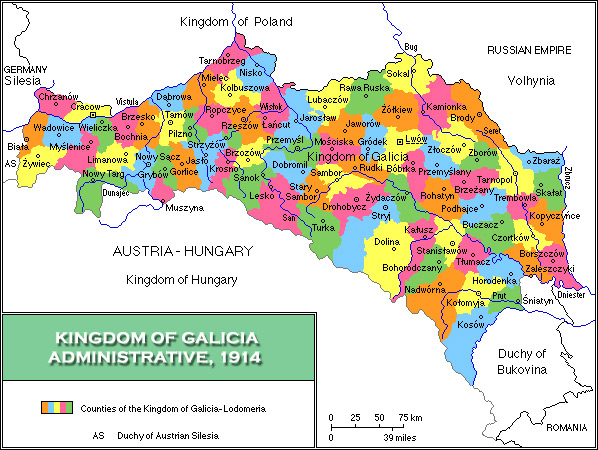
In Ukraine today, there are three provinces (oblasts) that formed the eastern part of the Kingdom of Galicia and Lodomeria. Two of these, Lviv Oblast and Ivano-Frankivsk Oblast were entirely contained in the kingdom; the third oblast of Ternopil was mainly in the kingdom apart from four of its most northerly counties (raions). The counties of the Kingdom of Galicia remained largely unchanged when they were incorporated into successor states; with minor changes as detailed below, the current counties are almost co-extensive with those of the Kingdom.
During the 2014 Euromaidan protests, the region is also notable for having declared independence from the central government led by Viktor Yanukovych who started to use active military force against protestors. During Ukraine's decommunization process that accelerated after 2014, Lviv Oblast became the first region of Ukraine to remove all its Soviet-era monuments by January 2024.
Geography
The terrain of Lviv Oblast is highly varied. The southern part is occupied by the low Beskids mountain chains running parallel to each other from northwest to southeast and covered with secondary coniferous forests as part of the Eastern Carpathians; the highest point is Pikui (1408 m). North from there are the wide upper Dniester river valley and much smaller upper San River valley. These rivers have flat bottoms covered with alluvial deposits, and are susceptible to floods. Between these valleys and Beskyd lies the Precarpathian upland covered with deciduous forests, with well-known mineral spa resorts (see Truskavets, Morshyn). It's also the area of one of the earliest industrial petroleum and gas extraction. These deposits are all but depleted by now.
In the central part of the region lie Roztochchia, Opillia, and part of the Podolia uplands. Rich sulphur deposits were mined here during the Soviet era. Roztocze is densely forested, while Opillia and Podolia (being covered with loess on which fertile soils develop) are densely populated and mostly covered by arable land. In the central-north part of the region lies the Small Polesia lowland, geographically isolated from the rest of Polesia but with similar terrain and landscapes (flat plains with sandy fluvioglacial deposits and pine forests). The far North of the region lies on the Volhynia upland, which is also covered with loess; coal is mined in this area. File:Вигляд на Розточчя згори.jpg|Roztochchia Biosphere Reserve File:Сколівські Бескиди. Вид на Тухольку..JPG|Skole Beskids. View of the village Tukholka. File:Sielec 009-Sielec 011.jpg|Grassy flatlands with rolling hills in the Drohobych Raion File:Вид з гори Парашка.jpg|Mount Parashka, the highest peak of the Parashka Range in the Skole Beskids File:Zashkiv1.JPG|Zashkiv village in the former Lviv Raion File:Вариант Тустани.jpg|Ukrainian Carpathians within the Lviv Oblast File:М 06-3.jpg|Motorway in Stryi Raion
Climate
The climate of Lviv Oblast is moderately cool and humid. The average January temperatures range from -7 °C in the Carpathians to -3 C in the Dniester and San River valleys while in July the average temperatures are from 14 - in the Carpathians to 16 - in Roztochchia and 19 °C in the lower part of the Dniester valley. The average annual precipitation is 600 - in the lowlands, 650 – in the highlands and up to 1000 mm in the Carpathians, with the majority of precipitation occurring in summer. Prolonged droughts are uncommon, while strong rainfalls can cause floods in river valleys. Severe winds during storms can also cause damage, especially in the highlands. The climate is favourable for the cultivation of sugar beets, winter wheat, flax, rye, cabbage, apples, and for dairy farming. It is still too cold to successfully cultivate maize, sunflower, grapes, melon, watermelon or peaches in Lviv Oblast. In the Carpathians conditions are favourable for Alpine skiing 3–4 months a year.
Demographics
According to the 2001 Ukrainian census, ethnic Ukrainians accounted for 94.8% of the population of Lviv Oblast, ethnic Russians for 3.6%, and ethnic Poles for 0.7%. Notably, the comparison of the 2001 Ukrainian census (mentioned above), with the last Soviet census of 1989 reveals that in those 12 years the number of Poles in the Lviv Oblast declined by 29.7% which, in the opinion of "Wspólnota Polska" Society defies explanation, and could possibly be attributed to the intensive Ukrainization of the Roman Catholic Church.
Language

Lviv Oblast was one of the few oblasts of the Ukrainian SSR where the share of Ukrainian speakers was increasing despite the Russification of Ukraine carried out in the USSR. Native language of the population of Lviv Oblast according to the results of population censuses:
| 1959 | 1970 | 1979 | 1989 | 2001 | ||||||
|---|---|---|---|---|---|---|---|---|---|---|
| Ukrainian | ||||||||||
| Russian | ||||||||||
| Other |
Native language of the population of the raions, cities, and city councils of Lviv Oblast according to the 2001 Ukrainian census:
| Ukrainian | Russian | |||
|---|---|---|---|---|
| Lviv Oblast | ||||
| Lviv (city council) | ||||
| Boryslav (city council) | ||||
| Drohobych (city council) | ||||
| Chervonohrad (city council) | ||||
| City of Sambir | ||||
| City of Stryi | ||||
| City of Truskavets | ||||
| Brody Raion | ||||
| Busk Raion | ||||
| Horodok Raion | ||||
| Drohobych Raion | ||||
| (in pre-2020 borders) | ||||
| Zhydachiv Raion | ||||
| Zhovkva Raion | ||||
| Zolochiv Raion | ||||
| (in pre-2020 borders) | ||||
| Kamianka-Buzka Raion | ||||
| Mostyska Raion | ||||
| Mykolaiv Raion | ||||
| Peremyshliany Raion | ||||
| Pustomyty Raion | ||||
| Radekhiv Raion | ||||
| Sambir Raion | ||||
| (in pre-2020 borders) | ||||
| Skole Raion | ||||
| Sokal Raion | ||||
| Staryi Sambir Raion | ||||
| Stryi Raion | ||||
| (in pre-2020 borders) | ||||
| Turka Raion | ||||
| Yavoriv Raion | ||||
| (in pre-2020 borders) |
Ukrainian is the only official language on the whole territory of Lviv Oblast.
On 18 September 2018, a moratorium on the public use of Russian-language cultural products was imposed in Lviv Oblast by a decision of the Lviv Oblast Council.
According to a poll conducted by Rating from 16 November to 10 December 2018 as part of the project «Portraits of Regions», 90% of the residents of Lviv Oblast believed that the Ukrainian language should be the only state language on the entire territory of Ukraine. 7% believed that Ukrainian should be the only state language, while Russian should be the second official language in some regions of the country. 1% believed that Russian should become the second state language of the country. 2% found it difficult to answer.
On 20 September 2022, Lviv Oblast Council approved the «Comprehensive Programme for Strengthening of the Ukrainian Language for 2023—2026», the main objectives of which are to strengthen the positions of the Ukrainian language in various spheres of public life in the oblast and to Ukrainianize the refugees from other regions of Ukraine.
According to the research of the Content Analysis Centre, conducted from 15 August to 15 September 2024, the topic of which was the ratio of Ukrainian and Russian languages in the Ukrainian segment of social media, 93.9% of posts from Lviv Oblast were written in Ukrainian (87.3% in 2023, 86.0% in 2022, 52.4% in 2020), while 6.1% were written in Russian (12.7% in 2023, 14.0% in 2022, 47.6% in 2020).
After Ukraine declared independence in 1991, Lviv Oblast, as well as Ukraine as a whole, experienced a gradual Ukrainization of the education system, which had been Russified during the Soviet era. Dynamics of the ratio of the languages of instruction in general secondary education institutions in Lviv Oblast:
According to the State Statistics Service of Ukraine, in the 2023—2024 school year, of the 286,111 pupils in general secondary education institutions in Lviv Oblast, 285,367 (99.74%) were studying in classes where Ukrainian was the language of instruction, while 744 (0.26%) were studying in classes where Polish was the language of instruction.
Age structure
: 0-14 years: 15.7% (male 202,923/female 193,000) : 15-64 years: 70.0% (male 867,699/female 897,788) : 65 years and over: 14.3% (male 122,906/female 238,016) (2013 official)
Median age
: total: 38.0 years : male: 35.2 years : female: 40.9 years (2013 official)
Politics

Governors
- Chairmen of the Executive Committee
| Term start | Term end | Name | Year of birth | Year of death |
|---|---|---|---|---|
| March 1991 | 6 April 1992 | Vyacheslav Chornovil | b. 1937 | d. 1999 |
| June 1994 | July 1995 | Mykola Horyn | b. 1945 |
- Representative of the President
| Term start | Term end | Name | Year of birth |
|---|---|---|---|
| 20 March 1992 | June 1994 | Stepan Davymuka | b. 1947 |
- Heads of the Administration
| Term start | Term end | Name | Year of birth | Year of death |
|---|---|---|---|---|
| 7 July 1995 | 6 Feb. 1997 | Mykola Horyn | b. 1945 | |
| 6 Feb. 1997 | 14 Jan. 1999 | Mykhailo Hladiy | b. 1952 | |
| 15 Jan. 1999 | 19 March 2001 | Stepan Senchuk | b. 1955 | d. 2005 |
| 26 March 2001 | 26 April 2002 | Mykhailo Hladiy | b. 1952 | |
| 26 April 2002 | 4 June 2003 | Myron Yankiv | b. 1951 | |
| 9 June 2003 | 20 Dec. 2004 | Oleksandr Sendeha | b. 1953 | |
| 20 Dec. 2004 | 4 Feb. 2005 | Bohdan Matolych (acting) | b. 1955 | |
| 4 Feb. 2005 | 20 Feb. 2008 | Petro Oliynyk | b. 1957 | d. 2011 |
| 20 Feb. 2008 | 27 Feb. 2008 | Valery Pyatak (acting) | b. 1959 | |
| 27 Feb. 2008 | 20 April 2010? | Mykola Kmit | ||
| (acting to 1 Sep 2008) | b. 1966 | |||
| 20 April 2010 | 21 December 2010 | Vasyl Horbal | b. 1971 | |
| 21 December 2010 | 2 November 2011 | Mykhailo Tsymbaliuk | b. 1964 | |
| 2 November 2011 | 4 March 2013 | Mykhailo Kostiuk | b. 1961 | |
| 4 March 2013 | 31 October 2013 | Viktor Shemchuk | b. 1970 | |
| 31 October 2013 | 23 January 2014 | Oleh Salo | b. 1968 | |
| 2 March 2014 | 14 August 2014 | Iryna Sekh | b. 1970 | |
| 14 August 2014 | 26 December 2014 | Yuriy Turyanskyi (acting) | b. 1975 | |
| 26 December 2014 | 11 June 2019 | Oleh Synyutka | b. 1970 | |
| 11 June 2019 | 5 July 2019 | Rostyslav Zamlynsky (acting) | b. 1976 | |
| 5 July 2019 | 5 February 2020 | Markiyan Malsky | b. 1984 | |
| 5 February 2020 | Maksym Kozytsky | b. 1981 |
Subdivisions
Main article: Administrative divisions of Lviv Oblast


| Number of hromadas (громади) | 73 |
|---|
Until the big district reform on July 18, 2020, Lviv Oblast was administratively subdivided into 20 raions (districts), as well as 9 city (municipalities) which are directly subordinate to the oblast government: Boryslav, Sheptytskyi, Drohobych, Morshyn, Novyi Rozdil, Sambir, Stryi, Truskavets, and the administrative center of the oblast, Lviv.

On 18 July 2020, the number of districts was reduced to seven. These are:
- Drohobych Raion (Дрогобицький район), the center is in the town of Drohobych;
- Lviv Raion (Львівський район), the center is in the city of Lviv;
- Sambir Raion (Самбірський район), the center is in the town of Sambir;
- Sheptytskyi Raion (Шептицький район), the center is in the town of Sheptytsky;
- Stryi Raion (Стрийський район), the center is in the town of Stryi;
- Yavoriv Raion (Яворівський район), the center is in the town of Yavoriv;
- Zolochiv Raion (Золочівський район), the center is in the town of Zolochiv.
In addition, there are the city raions of the city of Lviv.
| style="text-align:left; font-weight:normal;" | In English | In Ukrainian | Administrative Center | ||
|---|---|---|---|---|---|
| Brody Raion | Бродівський район | ||||
| Brodivskyi raion | |||||
| Busk Raion | Буський район | ||||
| Buskyi raion | |||||
| Drohobych Raion | Дрогобицький район | ||||
| Drohobytskyi raion | |||||
| Horodok Raion | Городоцький район | ||||
| Horodotskyi raion | |||||
| Kamianka-Buzka Raion | Кам'янка-Бузький район | ||||
| Kamianka-Buzkyi raion | |||||
| Mostyska Raion | Мостиський район | ||||
| Mostyskyi raion | |||||
| Mykolaiv Raion | Миколаївський район | ||||
| Mykolaivskyi raion | |||||
| Peremyshliany Raion | Перемишлянський район | ||||
| Peremyshlianskyi raion | |||||
| Pustomyty Raion | Пустомитівський район | ||||
| Pustomytivskyi raion | |||||
| Radekhiv Raion | Радехівський район | ||||
| Radekhivskyi raion | |||||
| Sambir Raion | Самбірський район | ||||
| Sambirskyi raion | |||||
| Skole Raion | Сколівський район | ||||
| Skolivskyi raion | |||||
| Sokal Raion | Сокальський район | ||||
| Sokalskyi raion | |||||
| Staryi Sambir Raion | Старосамбірський район | ||||
| Starosambirskyi raion | |||||
| Stryi Raion | Стрийський район | ||||
| Stryiskyi raion | |||||
| Turka Raion | Турківський район | ||||
| Turkivskyi raion | |||||
| Yavoriv Raion | Яворівський район | ||||
| Yavorivskyi raion | |||||
| Zhovkva Raion | Жовківський район | ||||
| Zhovkivskyi raion | |||||
| Zhydachiv Raion | Жидачівський район | ||||
| Zhydachivskyi raion | |||||
| Zolochiv Raion | Золочівський район | ||||
| Zolochivskyi raion |
Religion
Fifty-nine percent of the religious organisations active in the Lviv Oblast adhere to the Ukrainian Greek Catholic Church. The Ukrainian Autocephalous Orthodox Church is the second largest religious body. The followers of the Latin Church and the Ukrainian Orthodox Church (Moscow Patriarchate) are mostly from the Polish, and Russian or non-Galician Ukrainian minorities respectively. File:Жолква. Василианский монастырь..jpg|Zhovkva. Temple of the Sacred Heart of Jesus File:Peterpaulchurch.jpg|Church of Sts. Peter & Paul in Sokal File:Стрийський костел.jpg|Church of Our Lady Protectress in Stryi File:Борислав. Церква св. Анни. Cerkiew Sw. Anny (do r. 1945 kosciol Sw. Barbary).jpg|Church of St. Anna in Boryslav File:Church of the Blessed Eucharist, Klymets (a wooden 1825).jpg|Church of the Blessed Eucharist, Klymets, Stryi Raion File:ZolochivChurch2018.jpg|Church of Assumption of the Holy Virgin (1731-1763) in Zolochiv
Historical and cultural sites
The city of Lviv contains a well-preserved main square (Rynok) and numerous historical churches. Other sites of interest are the historic Lychakiv Cemetery, the local museum of folklore, and the ruins of the famous Vysokyi Zamok. The name of the castle is closely tied to the name of the city. There is also a museum of military artifacts, the "Arsenal".
Well-preserved local wooden churches, castles, and monasteries can be found throughout the Oblast. One of them is the Olesko Castle which is first recorded in 1327. Another castle that was built at the end of the 15th century is Svirzh Castle in the village of Svirzh. One more and no less famous castle is the Pidhirtsi Castle. Its architectural complex consists of the three-story palace, Kostel, and small park. In Roztochia is also located the Krekhivsky monastery in the beech-pine grove at the foot of the Pobiina mount. The whole complex consists of the Saint Nicholas Church, the bell tower, numerous service structures, and defensive walls with towers. Another site worth of mentioning is the Tustan city-fortress which is built in the rock. The site was nominated as the historical and as the natural wonder of Ukraine. There also a nature complex in the valley of the Kamianka river in Stryi Raion. Another natural wonder of the region is the Kamin-Veleten (Rock-Giant in English) which is located near city of Pidkamin in Zolochiv Raion. The name of the local city means Under the Rock. A local museum of Ukrainian art and an institution of higher learning (Ivan Franko State University) are also present.
Gallery
File:Жолква. Троицкая церковь..jpg|Trinity Church in Zhovkva File:Жолква. Замок..jpg|Zhovkva Castle File:Дрогобыч. Вилла..jpg|Villa in Drohobych File:Svirzh.jpg|Svirzh Castle File:Самбор. Бывшее казначейство..jpg|Former Treasury building in Sambir File:Tustan1.jpg|Morning in Tustan File:Government House in Lviv-2013.JPG|Building of the Lviv Regional Council File:Pidhirtsi Castle.jpg|Pidhirtsi Casle File:2023-12-30 Lviv old town - Lviv City Council - 1.jpg|Lviv Town Hall File:Золочівський замок збоку.jpg|Zolochiv Castle File:Львів Вірменський собор.jpg|Armenian Cathedral of Lviv File:7. Судова Вишня Будинок, в якому виступав Франко І.Я.jpg|Narodnyi dim in Sudova Vyshnia File:Олеський замок на світанку.jpg|Olesko Castle File:Церква святого Юра (Дрогобич) 2.jpg|Church of St. George in Drohobych File:Кропивницького пл., 1, церква св. Ольги і Єлизавети, 9109-HDR-Edit.jpg|Church of Sts. Olha and Elizabeth in Lviv
Economy
The most important research into cereal epidemics in the country is undertaken here. The National Academy of Agrarian Sciences of Ukraine's Institute of Agriculture in Obroshino is the center of study for cereal pathogens including powdery mildew of barley. In the early 2000s the most active researchers here were Olga Vronska and G. Kosilovich at the IoA. | | |
| Puccinia recondita, Blumeria graminis and various Pseudocercosporella spp. are present and are significant in winter wheat in this oblast. | |
Two introduced banded land snails, the Grove Snail (Cepaea nemoralis) and White-Lipped Snail (C. hortensis) are found here. C. n. was intentionally brought here in the late 1800s, but the genetic analysis of Gural-Sverlova et al., 2021 shows continued introductions have also occurred ever since. (The geographic distribution of both suggests they arrive through the gardening trade, as is known from other countries.) This analysis shows several distinct arrivals of C. n. yielding several present-day populations in and around Lviv. | |
References
- Source for statistics used: Lviv Regional State Administration Website – accessed February 29, 2004.
References
- [https://www.ukrinform.net/rubric-polytics/2871042-zelensky-introduces-new-head-of-lviv-regional-state-administration.html Zelensky introduces new head of Lviv Regional State Administration], [[Ukrinform]] (6 February 2020)
- "Валовии регіональнии продукт".
- "Sub-national HDI - Area Database - Global Data Lab".
- (2011). "Toponymic Guidelines for Map and Other Editors for International Use". DerzhHeoKadastr and Kartographia.
- Buko, Andrzej. (2008). "The Archeology of Early Medieval Poland". Brill.
- Wijaczka, Jacek. (2010). "Pod wspólnym niebem. Narody dawnej Rzeczypospolitej". Muzeum Historii Polski, Bellona.
- Stopka, Krzysztof. (2010). "Pod wspólnym niebem. Narody dawnej Rzeczypospolitej". Muzeum Historii Polski, Bellona.
- (2022). "The United States Holocaust Memorial Museum Encyclopedia of Camps and Ghettos 1933–1945. Volume IV". Indiana University Press, United States Holocaust Memorial Museum.
- Mezzofiore, Gianluca. (February 19, 2014). "Ukraine Facing Civil War: Lviv Declares Independence from Yanukovich Rule".
- Peleschuk, Dan. (30 January 2024). "Ukraine's Lviv becomes first region to remove all Soviet-era monuments". Reuters.
- "LVOV USSR, Weather History and Climate Data".
- {{in lang. uk [http://pop-stat.mashke.org/ukraine-ethnic2001.htm Етнічний склад населення України, 2001 рік]
- [http://db.ukrcensus.gov.ua/MULT/Database/Census/databasetree_en.asp Банк даних, перепис 2001 року]
- Державний комітет статистики України. (2004). "Національний склад населення / Львівська область". Internet Archive.
- Polonia w opracowaniach. (2013). "Zmiany w liczebności ludności polskiej na Ukrainie w okresie 1989-2001". Stowarzyszenie "Wspólnota Polska".
- "Динамика численности этнических украинцев в УССР: на основе итогов Всесоюзных переписей населения 1959 г., 1970 г. и 1979 г.".
- Итоги Всесоюзной переписи населения 1959 года: Украинская ССР, стр. 168—193
- Численность и состав населения СССР: по данным Всесоюзной переписи населения 1979 года. Центральное статистическое управление СССР, 1984
- ''Чорний С.'' Національний склад населення України в ХХ сторіччі (2001)
- Итоги Всесоюзной переписи населения 1970 года. Том IV — М., Статистика, 1973
- "Всеукраїнський перепис населення 2001. Розподіл населення за національністю та рідною мовою".
- "Перепис 1989. Розподіл населення за національністю та рідною мовою (0,1)".
- "Розподіл населення за національністю та рідною мовою, Львівська область".
- "Про забезпечення функціонування української мови як державної".
- "Про мораторій на публічне використання російськомовного культурного продукту на території Львівської області". Львівська обласна рада.
- "Львівська облрада — за мораторій на російськомовний продукт". [[Deutsche Welle]].
- (2018-12-26). "«ПОРТРЕТИ РЕГІОНІВ»: ПІДСУМКИ. Зведені дані, порівняльний аналіз між областями". [[Rating (sociological group).
- (2022-09-20). "На Львівщині з'явилася програма популяризації української мови". Твоє Місто.
- (2022-09-20). "Комплексна програма утвердження української мови на 2023—2026 роки". Львівська обласна рада.
- (2024-10-28). "Частка дописів українською мовою в соцмережах зросла до 56 %, — Центр контент-аналізу".
- ""Радикальний прогрес". У соцмережах української стало набагато більше, — дослідження".
- Barbara A. Anderson and Brian D. Silver, "Equality, Efficiency, and Politics in Soviet Bilingual Education Policy, 1934-1980," American Political Science Review 78 (December 1984): 1019-1039.
- "Джерело".
- "Збірник «Статистичний щорічник України» за 2008 рік". [[State Statistics Service of Ukraine.
- "Збірник «Статистичний щорічник України» за 2012 рік". [[State Statistics Service of Ukraine.
- "Збірник «Статистичний щорічник України» за 2018 рік". [[State Statistics Service of Ukraine.
- link. (). . link. ()
- . link. (). . link. ()
- "Збірник «Статистичний щорічник України» за 2022 рік". [[State Statistics Service of Ukraine.
- 814 pupils (0.28%) received general secondary education in Polish.
- 709 pupils (0.36%) received general secondary education in Polish.
- "Загальна середня освіта в Україні у 2023 році".
- [http://www.worldstatesmen.org/Ukraine_prov.html#Lviv Lviv], worldstatesmen.org
- [http://www.kyivpost.com/news/politics/detail/116168/ Yanukovych appoints ex-Ukrzaliznytsia head Kostiuk governor of Lviv region], [[Kyiv Post]] (2 November 2011)
- [http://www.kyivpost.com/news/nation/detail/64470/ Horbal appointed Lviv regional governor], [[Kyiv Post]] (April 20, 2010)
- [http://www.kyivpost.com/content/politics/deputy-premier-introduces-new-lviv-regional-governor-to-local-officials-321256.html Gryshchenko introduces new Lviv regional governor to local officials], [[Kyiv Post]] (4 March 2013)
- [http://www.ukrinform.ua/eng/news/yanukovych_appoints_salo_as_governor_of_lviv_region_312250 Yanukovych appoints Salo as governor of Lviv region], [[UKRINFORM]] (23 January 2014)
- [http://www.unian.info/politics/875661-lviv-governor-salo-resigns-mass-media.html Lviv governor Salo resigns – mass media], [[Unian]] (23 January 2013)
- [https://www.kyivpost.com/article/content/ukraine-politics/poroshenko-dismisses-sekh-as-lviv-region-governor-appoints-turiansky-as-acting-governor-360743.html Poroshenko dismisses Sekh as Lviv region governor, appoints Turiansky as acting governor], kyivpost.com (15 August 2014)
- (2020-07-18). "Про утворення та ліквідацію районів. Постанова Верховної Ради України № 807-ІХ.".
- "Нові райони: карти + склад". Міністерство розвитку громад та територій України.
This article was imported from Wikipedia and is available under the Creative Commons Attribution-ShareAlike 4.0 License. Content has been adapted to SurfDoc format. Original contributors can be found on the article history page.
Ask Mako anything about Lviv Oblast — get instant answers, deeper analysis, and related topics.
Research with MakoFree with your Surf account
Create a free account to save articles, ask Mako questions, and organize your research.
Sign up freeThis content may have been generated or modified by AI. CloudSurf Software LLC is not responsible for the accuracy, completeness, or reliability of AI-generated content. Always verify important information from primary sources.
Report