From Surf Wiki (app.surf) — the open knowledge base
Luxembourg railway station
Railway station in Luxembourg

Railway station in Luxembourg
| Field | Value | ||||
|---|---|---|---|---|---|
| name | Luxembourg | ||||
| native_name | Lëtzebuerg | ||||
| style | CFL | ||||
| image | LUXGARE8.jpg | ||||
| caption | The station's facade at Place de la Gare is in the traditional Moselle Baroque Revival style. | ||||
| address | 11 place de la Gare, L-1616 | ||||
| borough | Gare | ||||
| country | Luxembourg | ||||
| coordinates | |||||
| owned | Luxembourg | ||||
| operator | CFL | ||||
| passengers | 15,765,929 | ||||
| pass_year | 2022 | ||||
| pass_rank | 1 of 60 | ||||
| platforms | 6 | ||||
| tracks | 13 | ||||
| train_operators | {{plainlist | ||||
| opened | |||||
| services_collapsible | yes | ||||
| services | {{Adjacent stations | ||||
| system1 | CFL | ||||
| line1 | 10 | right1=Pfaffenthal-Kirchberg | |||
| line2 | 30 | right2=Cents-Hamm | |||
| line3 | 50 | right3=Bertrange-Strassen | |||
| line4 | 60 | right4=Howald | |||
| line5 | 70 | right5=Hollerich | |||
| system8 | DB Fernverkehr | line8=IC 37 | note-mid8=Operated in cooperation with DB | right8=Wasserbillig | to-right8=Düsseldorf |
| system10 | SNCF | ||||
| line10 | TGV inOui | type10=Paris–Luxembourg | left10=Thionville | ||
| system11 | TER Grand Est | ||||
| line11 | L01b | left11=Howald | right11= | ||
| system31 | DB Regio Mitte | ||||
| line31 | RE 11 | right31=Sandweiler-Contern | |||
| line32 | RB 83 | right32=Cents-Hamm | |||
| system41 | BE | ||||
| line41 | IC 16 | left41=Arlon | note-mid41=IC "des Ardennes" & Luxembourg | ||
| line42 | IC 33 | right42=Mersch | type42=reverse |
the railway station in Luxembourg City
- CFL
- SNCF
- SNCB
- DB
Luxembourg railway station ( , , ) is the main railway station serving Luxembourg City, in southern Luxembourg. It is operated by Chemins de Fer Luxembourgeois, the state-owned railway company. In 2022, the station was used by 52,000 passengers every weekday, making it by far the busiest in the country.
It is the hub of Luxembourg's domestic railway network, serving as a point of call on all of Luxembourg's railway lines. It also functions as the country's international railway hub, with services to the surrounding countries: Belgium, France, and Germany. Since June 2007, the LGV Est has connected the station to the French TGV network.
The station is located 2 km south of the city centre (Ville Haute), to the south of the River Pétrusse. The station gives its name to Gare, one of the Quarters of Luxembourg City.
The railway station serves as the central hub for all modes of transport within Luxembourg, with a tram stop and a bus hub for buses operated by the City of Luxembourg and buses of the RGTR network.
History

In 1846, with a vision to create an international line between the North Sea ports, the Alps and the Mediterranean, the Grande Compagnie du Luxembourg, a Belgian company, obtained a concession from the Luxembourgish government for a railway line between Arlon and Thionville, with Luxembourg City as its central point, and a branch line to Trier. Unable to fulfil its obligations, it was stripped of its concessions in 1848.
The creation of Luxembourg's first rail network was finally awarded in the 1850s to a French-funded company, the Société royale grand-ducale des chemins de fer Guillaume-Luxembourg.
In 1857, the location of the city's future railway station was the subject of debate, with five possibilities being considered. One of these, which was favoured by city authorities, was the , at the southeastern edge of the Ville Haute - now the site of the Judiciary City - but it was ultimately turned down for military reasons. Other rejected proposals included establishing the station between the northern city gates and the Limpertsberg (around the site of the current square), to the west of the fortress (at the modern-day ), or down in the valley, in the Clausen district, which would have involved digging a tunnel under the Ville-Haute.
The first station was built entirely out of wood, and was opened on 11 August 1859 (at the same time as the country's inaugural line, from Luxembourg to Bettembourg and the French border); the patriotic song (The Chariot of Fire), which was briefly considered Luxembourg's national anthem, was composed and performed for the occasion. The position of the new station on the south bank of the Pétrusse river, away from the urban sprawl of the time, was due to the city still being a Prussian-held fortress at the time. In 1860, the completion of the line from Luxembourg to Kleinbettingen enabled trains to run to Arlon, Brussels, Antwerp and Ostend. The first link between the city and northern Luxembourg came in 1861, with the construction of a viaduct over the Alzette river. After the 1867 Treaty of London, the fortifications were dismantled, mainly to allow the city to expand around the railway station.
The old wooden station was replaced by a modern building built between 1907 and 1913 (during an economic boom fuelled by iron production in the Red Lands). The new building was designed by a trio of German architects (Rüdell, Jüsgen and Scheuffel), in a neo-Baroque style - an imitation of the architecture popular in the 17th century in what is now the Moselle department of France - that dominates Luxembourg City's major public buildings.
The installations underwent a major overhaul during the electrification of the Luxembourgish railway network, which began in 1956. Because of the voltage difference between line 5 and the rest of the network, Luxembourg station was switchable.
The passenger building has been listed as a national monument since 13 January 1989.
The computerisation of the interlocking installations in the 1990s made it possible to do away with the station's specific signalling for switchable tracks, which could, for example, prevent an electric train from shunting because the track was not at the right voltage, but allow a diesel train to pass; the new computer system can manage these movements with conventional signalling.
Since 2006, under the patronage of the Ministry of Transport, the station has undergone a major refurbishment which, by 2009, had already resulted in the creation of the new ticket sales facilities inside the main concourse, the widening of platforms, the installation of new lifts and a new underpass. Further work included renewing the overhead electrical wiring, installing two escalators at platform level, a new entrance gantry and the reconfiguration of the forecourt. Works in 2011 included a glass passenger concourse and a four-story car park. The new passenger concourse was inaugurated on 21 September 2012.
In anticipation of the arrival of the TGV connexion to Paris in 2007, round trips by TGV on conventional lines were operated from 25 June 2006.
The weekend night train connexion between Metz and Portbou was extended to Luxembourg on 13 December 2009; however, it was suspended on 26 June 2016.
It 2016, the Luxembourg-Blankenberge express, a summer train to the coastal town of Blankenberghe, was also suspended due to works on the Belgian rail network.
Modernisation work
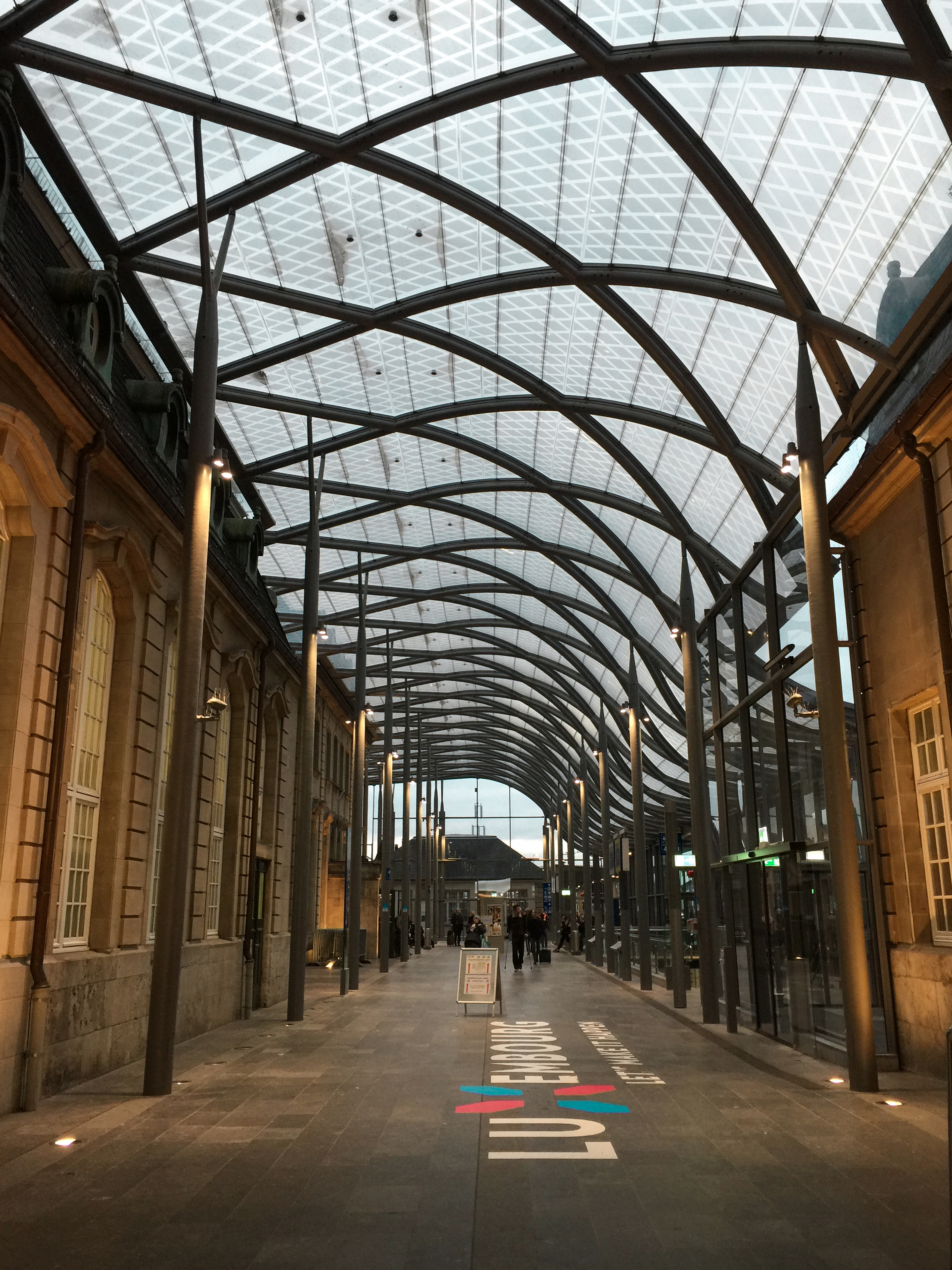
In 2006, the Ministry of Transport began a six-year renovation project on Luxembourg station that totaled €95 million. The improvements included new ticketing and sales facilities inside the main hall, expanding platforms, new lifts, a new passenger subway, upgraded overhead electrical wiring, installation of two platform escalators, a new entrance porch, a redesigned forecourt, a glass passenger hall, and a four-storey car park.
Train services
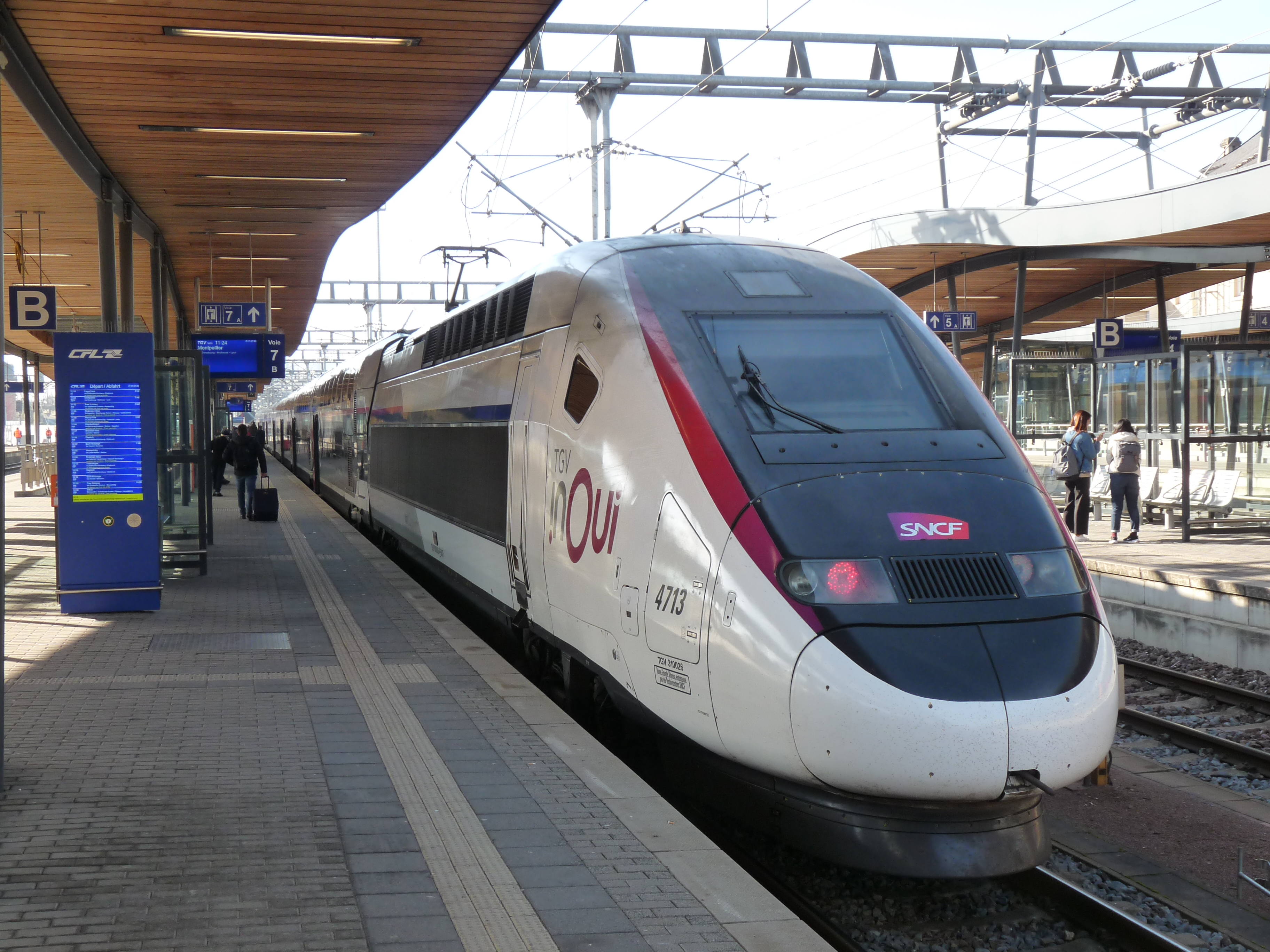
_2b_(cropped).JPG)
As of December 2025, the station is served by the following services:
- High speed (TGV) services Luxembourg - Thionville - Metz - Paris
- TGV services Luxembourg - Thionville - Metz - Strasbourg - Lyon - Marseille
- TGV services Luxembourg - Thionville - Metz - Strasbourg - Lyon - Montpellier
- Intercity (IC) services Luxembourg - Ettelbruck - Troisvierges - Gouvy - Liège
- IC services Luxembourg - Arlon (- Namur - Brussels)
- Regional Express (RE) services Luxembourg - Ettelbruck - Troisvierges
- RE services Luxembourg - Wasserbillig - Trier - Koblenz - Düsseldorf
- RE services Luxembourg - Bettembourg - Esch-sur-Alzette - Pétange - Rodange
- RE services Rodange - Pétange - Esch-sur-Alzette - Bettembourg - Luxembourg - Mersch - Ettelbruck - Troisvierges
- RE services Pétange - Esch-sur-Alzette - Bettembourg - Luxembourg - Mersch
- RE services Luxembourg - Dippach-Reckange - Pétange - Rodange - Longwy
- RE services Luxembourg - Kleinbettingen - Arlon
- Regional (RB) services Luxembourg - Ettelbruck - Diekirch
- RB services Luxembourg - Wasserbillig - Trier - Wittlich
- RB services Luxembourg - Sandweiler-Contern- Wasserbillig
- RB services Luxembourg - Bettembourg - Esch-sur-Alzette - Pétange - Rodange
- RB services Luxembourg - Dippach-Reckange - Pétange - Rodange - Athus
- RB services Luxembourg - Kleinbettingen - Arlon
- TER Grand Est services Luxembourg - Bettembourg - Thionville - Metz
- TER Grand Est services Luxembourg - Bettembourg - Thionville - Metz - Nancy
References
References
- "Observatoire digital de la mobilité".
- [[Jean Ulveling]], « Exposé des bons résultats de notre économie », ''Publications de la société pour la recherche et la conservation des monuments historiques dans le Grand-Duché de Luxembourg, XXII, année 1866'', imprimerie-librairie V. Buck, Luxembourg, 1867, {{p.. 30 novembre 2020).
- (2008). "150 ans de train en Luxembourg belge (1858 - 2008)". Weyrich.
- Philippart, Robert L.. (November 2025). "Aux origines du tram".
- Calmes, Albert. (1961-03-01). "Le choix de l’emplacement de la gare de Luxembourg en 1858". [[Luxemburger Wort]].
- "Ligne Luxembourg - Bettembourg - frontière française".
- (16 January 2019). "Liste des immeubles et objets classés monuments nationaux ou inscrits à l'inventaire supplémentaire".
- (30 May 2009). "Basic Railway Signals of Luxembourg - CFL Special Signal Aspects".
- Camille Frati. (19 June 2019). "Le Blankenberge Express restera à quai cet été".
- (18 June 2019). "Le Blankenberge-Express ne roulera pas cet été".
- (21 September 2012). "Une nouvelle gare pour fêter son centenaire". [[L'essentiel (newspaper).
This article was imported from Wikipedia and is available under the Creative Commons Attribution-ShareAlike 4.0 License. Content has been adapted to SurfDoc format. Original contributors can be found on the article history page.
Ask Mako anything about Luxembourg railway station — get instant answers, deeper analysis, and related topics.
Research with MakoFree with your Surf account
Create a free account to save articles, ask Mako questions, and organize your research.
Sign up freeThis content may have been generated or modified by AI. CloudSurf Software LLC is not responsible for the accuracy, completeness, or reliability of AI-generated content. Always verify important information from primary sources.
Report