From Surf Wiki (app.surf) — the open knowledge base
Luvisol
Soil type
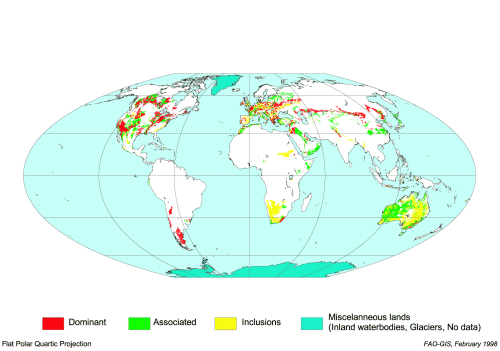
Soil type
| Field | Value |
|---|---|
| name | Luvisol |
| image | ISRIC monolith NL-001.jpg |
| image_size | 250px |
| image_caption | Luvisol from the Netherlands |
| classification_system | WRB, other |
| profile | AhEBtC |
| code | LV |
| climate | Humid temperate climate |
Luvisols are a group of soils, comprising one of the 32 Reference Soil Groups in the international system of soil classification, the World Reference Base for Soil Resources (WRB). They are widespread, especially in temperate climates, and are generally fertile. Luvisols are widely used for agriculture.
Distribution
Luvisols cover 500–600 million ha of land area, mainly in the temperate zones. They form on a wide variety of mineral parent materials. In Mediterranean regions, the formation of hematite can produce red-coloured Chromic Luvisols.
Description and formation
The main characteristic of Luvisols is an argic horizon, a subsurface zone with higher clay content than the material above it. This typically arises as clay is washed downward by water and accumulates at greater depth. The clay minerals have not been extensively weathered and are therefore of the high-activity, 2:1 type, giving these soils high cation exchange capacities and high base saturation. In uneroded landscapes, a lighter, clay-depleted eluvial horizon occurs above the argic horizon.
In other classification systems
The Canadian system of soil classification includes Luvisols. In the USDA Soil Taxonomy, Luvisols are typically classified as Alfisols.
References
References
- IUSS Working Group WRB. (2022). "World Reference Base for Soil Resources, fourth edition". International Union of Soil Sciences, Vienna.
- (2014). "Böden der Welt". Springer Spektrum.
This article was imported from Wikipedia and is available under the Creative Commons Attribution-ShareAlike 4.0 License. Content has been adapted to SurfDoc format. Original contributors can be found on the article history page.
Ask Mako anything about Luvisol — get instant answers, deeper analysis, and related topics.
Research with MakoFree with your Surf account
Create a free account to save articles, ask Mako questions, and organize your research.
Sign up freeThis content may have been generated or modified by AI. CloudSurf Software LLC is not responsible for the accuracy, completeness, or reliability of AI-generated content. Always verify important information from primary sources.
Report