From Surf Wiki (app.surf) — the open knowledge base
Lusitania
Roman province in Hispania (27 BC – c. 410 AD)
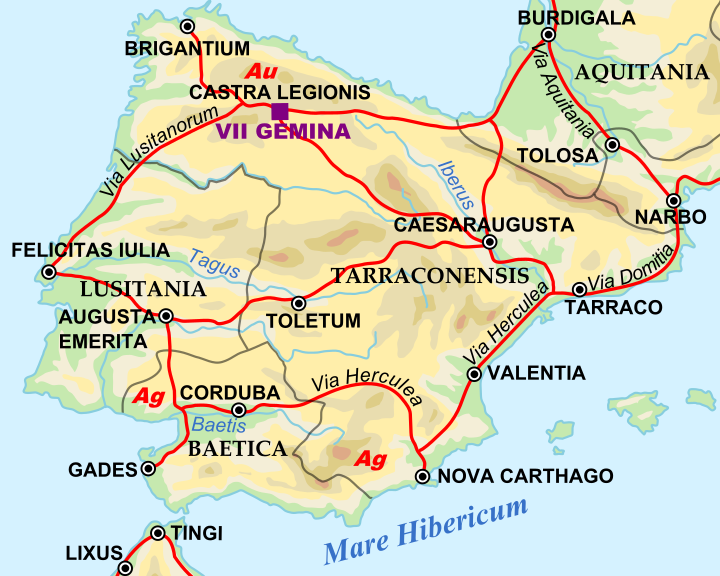
Roman province in Hispania (27 BC – c. 410 AD)
| Field | Value |
|---|---|
| native_name | |
| common_name | Lusitania |
| subdivision | Province |
| nation | the Roman Empire |
| p1 | Lusitanians |
| s1 | Alans |
| s2 | Suebi |
| s3 | Vandals |
| s4 | Visigoths |
| capital | Emerita Augusta (Mérida) |
| today | Portugal |
| Spain | |
| year_start | 27 BC |
| year_end | AD 438 |
| era | Roman Empire |
| image_map | Roman Empire - Lusitania (125 AD).svg |
Spain
Lusitania (; ) was an ancient Roman province encompassing most of modern-day Portugal (south of the Douro River) and a large portion of western Spain (the present Extremadura and Province of Salamanca). Romans named the region after the Lusitanians, an Indo-European tribe inhabiting the lands.
The capital Emerita Augusta was initially part of the Roman Republic province of Hispania Ulterior before becoming a province of its own during the Roman Empire.
After Romans arrived in the territory during the 2nd century BC, a war with Lusitanian tribes ensued between 155 and 139 BC, with the Roman province eventually established in 27 BC.
In modern parlance, Lusitania is often synonymous with Portugal, despite the Roman province's capital being located in modern Mérida, Spain.
Etymology
The etymology of the name of the Lusitani (who gave the Roman province its name) remains unclear. Popular etymology connected the name to a supposed Roman demigod Lusus, whereas some early-modern scholars suggested that Lus was a form of the Celtic Lugus followed by another (unattested) root **tan-*, supposed to mean "tribe", while others derived the name from Lucis, an ancient people mentioned in Avienius' Ora Maritima (4th century AD) and from tan (-stan in Iranian), or from tain, meaning "a region" or implying "a country of waters", a root word that formerly meant a prince or sovereign governor of a region.
Ancient Romans, such as Pliny the Elder (Natural History, 3.5) and Varro (116 – 27 BC, cited by Pliny), speculated that the name Lusitania had Roman origins, as when Pliny says "lusum enim Liberi Patris aut lyssam cum eo bacchantium nomen dedisse Lusitaniae et Pana praefectum eius universae" Lusitania takes its name from the [Lusus associated with Bacchus and the Lyssa of his Bacchantes, and Pan is its governor].
Lusus is usually translated as "game" or "play", while lyssa is a borrowing from the Greek λυσσα, "frenzy" or "rage", and sometimes Rage personified; for later poets, Lusus and Lyssa become flesh-and-blood companions (even children) of Bacchus. Luís de Camões' epic Os Lusíadas (1572), which portrays Lusus as the founder of Lusitania, extends these ideas, which have no connection with modern etymology.
In his work, Geography, the classical geographer Strabo (died ca. 24 AD) suggests a change had occurred in the use of the name "Lusitanian". He mentions a group who had once been called "Lusitanians" living north of the Douro river but were called in his day "Callacans".
Lusitanians
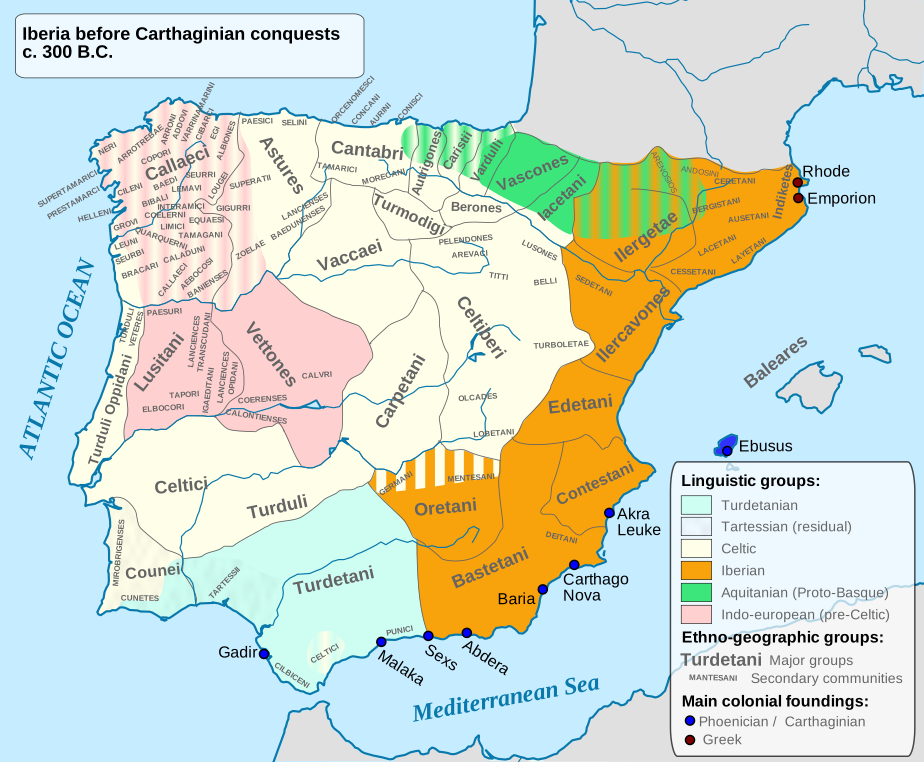
Main article: Lusitanians
The Lusitani established themselves in the region in the 6th century BC, but historians and archeologists are still undecided about their ethnogenesis. Some modern authors consider them to be an indigenous people who were Celticized culturally and possibly also through intermarriage.
The archeologist Scarlat Lambrino defended the position that the Lusitanians were a tribal group of Celtic origin related to the Lusones (a tribe that inhabited the east of Iberia). Some have claimed that both tribes came from the Swiss mountains. Others argue that the evidence points to the Lusitanians being a native Iberian tribe, resulting from intermarriage between different local tribes.
The first area colonized by the Lusitani was probably the Douro valley and the region of Beira Alta (present day Portugal); in Beira, they stayed until they defeated the Celtici and other tribes, then they expanded to cover a territory that reached Estremadura before the arrival of the Romans.
War against Rome
Main article: Lusitanian War
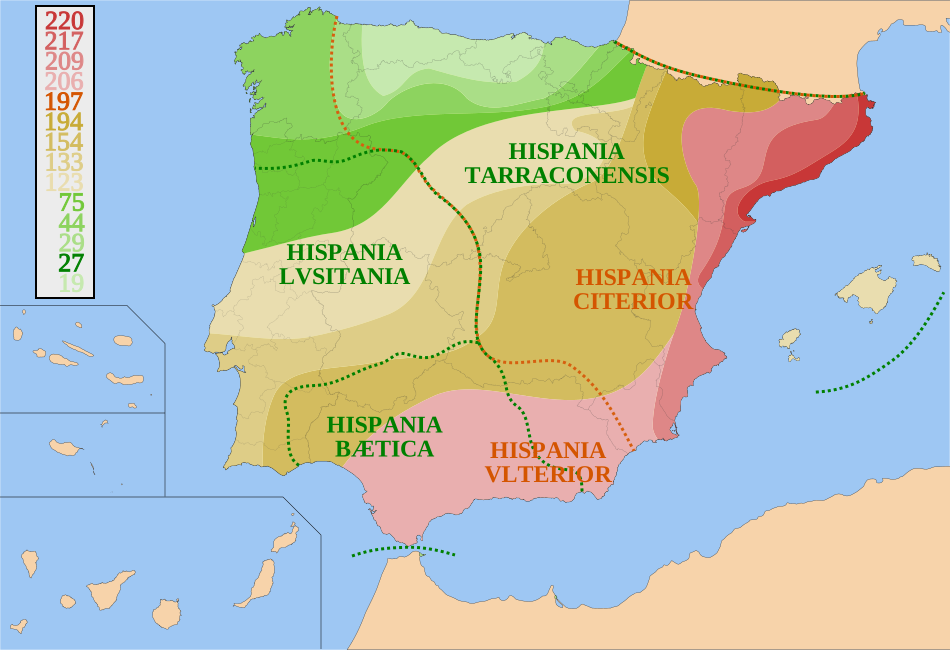
The Lusitani are mentioned for the first time in Livy who describes them as fighting for the Carthaginians in 218 BCE; they are reported as fighting against Rome in 194 BC, sometimes allied with Celtiberian tribes.
In 179 BC, the praetor Lucius Postumius Albinus celebrated a triumph over the Lusitani, but in 155 BC, on the command of Punicus (Πουνίκου, perhaps a Carthaginian) first and Caesarus (Καίσαρος) after, the Lusitani reached Gibraltar. Here they were defeated by the praetor Lucius Mummius.
From 152 BC onwards, the Roman Republic had difficulties in recruiting soldiers for the wars in Hispania, deemed particularly brutal. In 150 BC, Servius Sulpicius Galba organised a false armistice. While the Lusitani celebrated this new alliance, he massacred them, selling the survivors as slaves; this caused a new rebellion led by Viriathus, who was after many attempts killed by traitors paid by the Romans in 139 BC, after having led a successful guerrilla campaign against Rome and their local allies. Two years after, in 137 BC Decimus Junius Brutus Callaicus led a successful campaign against the Lusitani, reaching as far north as the Minho river.
Romans scored other victories with proconsul Decimus Junius Brutus Callaicus and Gaius Marius (elected in 113 BC), but still the Lusitani resisted with a long guerilla war; they later joined Sertorius' (a renegade Roman General) troops (around 80 BC) and Julius Caesar conducted a successful campaign against them in 61-60 BC, but they were not finally defeated until the reign of Augustus (around 28–24 BC).
Roman province
Territory
Under Augustus
With Lusitania (and Asturia and Gallaecia), Rome had completed the conquest of the Iberian Peninsula, which was then divided by Augustus (25–20 BC or 16–13 BC) into the eastern and northern Hispania Tarraconensis, the southwestern Hispania Baetica and the western Provincia Lusitana. Originally, Lusitania included the territories of Asturia and Gallaecia, but these were later ceded to the jurisdiction of the new Provincia Tarraconensis and the former remained as Provincia Lusitania et Vettones. Its northern border was along the Douro River, while on its eastern side its border passed through Salmantica (Salamanca) and Caesarobriga (Talavera de la Reina) to the Anas (Guadiana) river.
Between 28 and 24 BC Augustus' military campaigns pacified all Iberia under Roman rule, with the foundation of Roman cities like Asturica Augusta (Astorga) and Bracara Augusta (Braga) to the north, and to the south Emerita Augusta (Mérida) (settled with the emeriti of the Legio V Alaudae and Legio X Gemina legions).
''Conventus Iuridicus''
Between the time of Augustus and Claudius, the province was divided into three conventus iuridicus, territorial units presided by capital cities with a court of justice and joint Roman/indigenous people assemblies (conventus), that counseled the Governor:
- Conventus Emeritensis, with capital in Emerita Augusta (Mérida, Spain)
- Conventus Scalabitanus, with capital in Scalabis Iulia (Santarém, Portugal)
- Conventus Pacensis, with capital in Pax Iulia (Beja, Portugal)
The conventus ruled of a total of forty-six populis. Five were Roman colonies: Emerita Augusta (Mérida, Spain), Pax Iulia (Beja), Scalabis (Santarém), Norba Caesarina (Cáceres) and Metellinum (Medellín). Felicitas Iulia Olisipo (Lisbon, which was a Roman law municipality) and three other towns had the old Latin status: Ebora (Évora), Myrtilis Iulia (Mértola) and Salacia (Alcácer do Sal). The other thirty-seven were of stipendiarii class, among which Aeminium (Coimbra), Balsa (Tavira), or Mirobriga (Santiago do Cacém). Other cities include Ossonoba (Faro), Cetobriga (Setúbal), Collippo (Leiria) or Arabriga (Alenquer).
Under Diocletian
Under Diocletian, Lusitania kept its borders and was ruled by a praeses, later by a consularis.
Roman diocese
Finally, in 298 AD, Lusitania was united with the other provinces to form the Diocesis Hispaniarum ("Diocese of the Hispanias"). File:Hispania 2a division provincial.svg|Roman Iberia under Augustus: Tarraconensis, Baetica and Lusitana File:Conventushispanus.svg|Roman Iberia after Claudius: Conventus juridici (Emeritensis, Scalabitanus and Pacensis) File:Iberia 293.svg|Roman Iberia under Diocletian: Lusitania found in the west File:Roman Empire with dioceses in 300 AD.png|Roman Empire in 300 AD: Diocesis Hispaniarum in the west
Known governors
1st century BC
- Quintus Acutius Faienanus, legatus Augusti pro praetore, 19 – 1 BC.
- Quintus Articuleius Regulus, 2 BC – AD 14.
1st century
- Gaius Ummidius Durmius Quadratus, c. 37
- Lucius Caecilius Rufus, early 1st century
- Lucius Calventius Vetus Carminius, legatus Augusti pro praetore, 44 – 45
- [Marcus?] [Porcius?] Cato, c. 46
- [[File:Oth001 cropped.jpg|thumb|[[Otho|Marcus Salvius Otho Caesar Augustus]], governor of Lusitania between 58 and 68.]]Marcus Salvius Otho Caesar Augustus, 58 – 68
- Gaius Catellius Celer, 75/76 – 77/78
- Quintus Acutius Faienanus, 78 – 119
2nd century
- ? Gaius Calpurnius Flaccus, 119/120 – 120/121
- Gaius Oppius Sabinus Julius Nepos Manius Vibius Sollemnis Severus, 128 – 130
- Lucius Roscius Maecius Celer Postumus Mamilianus Vergilius Staberianus, under Hadrian
- Gaius Javolenus Calvinus, 138 – 140
- [Aulus Avillius Urina]tius Quadratus, c.151 – c.154
- Sextus Tigidius Perennis, before 185
- ? Cornelius Repentinus, c.185 – c.188
- Publius Septimius Geta, c.188 – c.191
- Gaius Caesonius Macer Rufinianus, 193/194 – 197
- Gaius Junius Faustinus [Pl]a[cidus] Postumianus, c.197 – c.200
3rd century
- Decimus Iun[ius? ...] Coelianus, c.201 – 209
- Sextus Furnius Julianus, c.211
- Rutilius Pudens Crispinus, c.225 – c.227
- Aemilius Aemilianus, late 3rd century
- Datianus, 286 – 293
4th century
- Iulius Saturninus, c.337 – c. 340
- Vettius Agorius Praetextatus, 361– 362
''Coloniae'' and ''Municipia''
| Iberia
- Colonia Augusta Emerita (Mérida) - provincial capital,
- Colonia Metellinum (Medellín),
- Colonia Norba Caesarina (Cáceres),
- Colonia Civitas Pacensis (Beja),
- Colonia Scalabis Praesidium Iulium (Santarém),
- Municipium Caesarobriga (Talavera de la Reina),
- Municipium Augustobriga (Talavera la Vieja),
- Municipium Aeminium (Coimbra),
- Municipium Conímbriga (Condeixa-a-Nova),
- Municipium Salmantica (Salamanca),
- Municipium Caurium (Coria),
- Municipium Turgalium (Trujillo),
- Municipium Capara (Cáparra),
- Municipium Olisipo (Lisbon),
- Municipium Egitandiorum (Idanha-a-Velha),
- Municipium Regina Turdulorum (Casas de Reina),
- Municipium Lacobriga (Lagos), File:Merida Roman Theatre2.jpg|Roman Theatre of Augusta Emerita (Mérida) File:Teatro Romano de Medellín 23.jpg|Roman Theatre of Metellinum (Medellín) File:Arco Romano.jpg|Roman arch of Pax Iulia (Beja) File:Cryptoporticus of Aeminium - Museu Nacional de Machado de Castro - Coimbra, Portugal - DSC09856.jpg|Cryptoporticus of the ancient forum of Aeminium (Coimbra) File:Conimbriga.jpg|Ruins of Conimbriga File:Pont romain et cathédrales vieille et nouvelle de Salamanque (1967-08-07).jpg|Roman bridge of Salmantica (Salamanca) File:Coria - Murallas 1.jpg|Roman walls of Caurium (Coria) File:Ciudad Romana de Caparra - 011 (30618914251).jpg|Forum gate of Capara (Cáparra) File:Cerca Velha - Portas do Sol.JPG|Roman walls of Olisipo (Lisbon) File:Roman arch, Egitania, Idanha-a-Velha, Lusitania, Portugal (13249368064).jpg|Roman arch of Egitandiorum (Idanha-a-Velha)
Notable Lusitanians
- Viriathus
- Gaius Appuleius Diocles
- Pope Damasus I
Legacy of the name
As with the Roman names of many European countries, Lusitania was and is often used as an alternative name for Portugal, especially in formal or literary and poetic contexts. The 16th-century colony that would eventually become Brazil was initially founded as "New Lusitania". In common use are such terms as Lusophone, meaning Portuguese-speaking, and Lusitanic, referring to the Community of Portuguese Language Countries—once Portugal's colonies and presently independent countries still sharing some common heritage. Prior to his invasion in 1807, Napoleon Bonaparte proposed the establishment of a French-backed puppet Kingdom of Northern Lusitania as one of the successor states to Portugal under the assumption that such a campaign would result in an easy French victory.
The province was also the namesake of the North Atlantic Ocean liner RMS Lusitania infamous for being torpedoed by a German U-boat in 1915. Cunard, the ship's owner, commonly named its vessels after Roman provinces with the Lusitania so being called after the Roman Iberian province to the north of the Strait of Gibraltar while her sister ship RMS Mauretania was named after the Roman North African province on the south side of the strait.
References
References
- Garcia, José Manuel. (1989). "História de Portugal: Uma Visão Global". Editorial Presença.
- Alan W. Ertl. (2008). "Toward an Understanding of Europe: A Political Economic Précis of Continental Integration". Universal-Publishers.
- Room, Adrian. (2006). "Placenames of the World". McFarland Inc..
- (1747). "An Universal History from the Earliest Account of Time". T. Osborne, A. Millar, and J. Osborn.
- Piers, Henry. (1786). "Collectanea de Rebus Hibernicis". Luke White.
- O'Brien, John. (1768). "Focalóir gaoidhilge-sax-bhéarla, or An Irish-English dictionary". Nicolas-Francis Valleyre.
- "Strabo, ''Geography'', Book III, Chapter 4, paragraph 20".
- "Ethnographic Map of Pre-Roman Iberia (circa 200 b". Arkeotavira.com.
- "Strabo.Geography". Penelope.uchicago.edu.
- Suetonius, Cae, 18; Appian, BH, 102; Plut, Cae., 12; Dio, 37 & 52, 153-154, Valleius Patraculus, II, 52-5; Antonio Santosuosso, Storming the Heavans: Soldiers, Emperors, and Civilians in the Roman Empire (London: Pilmico/Random House, 2011), p. 57-58; Casey Simpson, "Caesar or Rex?" (Honors thesis, Ball State University, 2004); Stephen Dando-Collins, Legions of Rome (New York: Thomas Dunne/St. Martin's, 2010), pp. 28, 61-63; CAH, both editions
- "The Ancient Lusitanian World".
- García y Bellido, Antonio. (1958). "Las colonias romanas de la provincia Lusitania". Gabinete de Antigüedades de la Real Academia de la Historia.
- (1996-02-08). "The Cambridge Ancient History". Cambridge University Press.
- [[Géza Alföldy]], ''Fasti Hispanienses'', Steiner, Wiesbaden (1969).
- Thomas Elliott. (2004). "Epigraphic Evidence for Boundary Disputes in the Roman Empire". University of North Carolina.
- {{CIL. 2
- Abascal, J. M.. "Lucius Caecilius Rufus". Real Academia de la Historia.
- ''Der Neue Pauly'', Stuttgart 1999, T. 2, c. 951-992
- Abascal, J. M.. "Lucius Calventius Vetus Carminius". Real Academia de la Historia.
- Abascal, J. M.. ["[Marcus?] Porcius?] Cato"](http://dbe.rah.es/biografias/23218/marcus-porcius-cato). Real Academia de la Historia.
- Suetonius. (25 October 2007). "The Twelve Caesars". Penguin.
- Abascal, J. M.. "Otón". Real Academia de la Historia.
- Unless otherwise noted, the governors from 75 to the end of Hadrian's reign are taken from Werner Eck, "Jahres- und Provinzialfasten der senatorischen Statthalter von 69/70 bis 138/139", ''[[Chiron (journal). Chiron]]'', '''12''' (1982), pp. 281-362; '''13''' (1983), pp. 147-237.
- Abascal, J. M.. "Quintus Acutius Faienanus". Real Academia de la Historia.
- Abascal, J. M.. "Caius Oppius Sabinus". Real Academia de la Historia.
- Géza Alföldy, ''Konsulat und Senatorenstand unter der Antoninen'' (Bonn: Rudolf Habelt Verlag, 1977), p. 256
- Abascal, J. M.. "Quadratus". Real Academia de la Historia.
- Abascal, J. M.. "Sextus Tigidius Perennis". Real Academia de la Historia.
- Leunissen, ''Konsuln und Konsulare'', p. 290
- Paul Leunissen, ''Konsuln und Konsulare in der Zeit von Commodus bis Severus Alexander'' (Amsterdam: J.C. Gieben, 1989), p. 289
- Abascal, J. M.. "Decimus Iunius Coelianus". Real Academia de la Historia.
- Paul Leunissen, ''Konsuln und Konsulare in der Zeit von Commodus bis Severus Alexander'' (Amsterdam: J.C. Gieben, 1989), p. 289.
- Abascal, J. M.. "Rutilus Pudens Crispinus". Real Academia de la Historia.
- Abascal, J. M.. "Aemilius Aemilianus". Real Academia de la Historia.
- Abascal, J. M.. "Datianus". Real Academia de la Historia.
- Abascal, J. M.. "Iulius Saturninus". Real Academia de la Historia.
- Abascal, J. M.. "Vettius Agorius Praetextatus". Real Academia de la Historia.
This article was imported from Wikipedia and is available under the Creative Commons Attribution-ShareAlike 4.0 License. Content has been adapted to SurfDoc format. Original contributors can be found on the article history page.
Ask Mako anything about Lusitania — get instant answers, deeper analysis, and related topics.
Research with MakoFree with your Surf account
Create a free account to save articles, ask Mako questions, and organize your research.
Sign up freeThis content may have been generated or modified by AI. CloudSurf Software LLC is not responsible for the accuracy, completeness, or reliability of AI-generated content. Always verify important information from primary sources.
Report