From Surf Wiki (app.surf) — the open knowledge base
Lunca de Jos
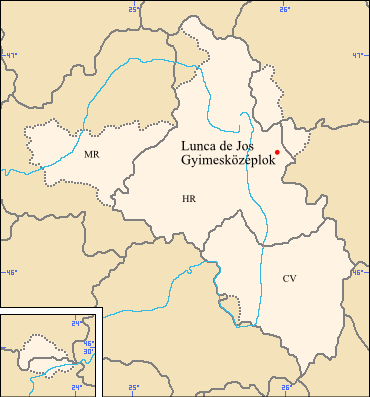
| Field | Value |
|---|---|
| type | commune |
| county | Harghita |
| official_name | Lunca de Jos |
| other_name | Gyimesközéplok |
| image_shield | ROU HR Lunca de Jos CoA.PNG |
| image_skyline | Gyimes Landscape.jpg |
| image_map | Lunca de Jos jud Harghita.png |
| map_caption | Location in Harghita County |
| leader_name | Karoly Gergely |
| leader_party | UDMR |
| term | 2020–2024 |
| coordinates | |
| elevation | 930 |
| area_total | 59.06 |
| population_total | auto |
| postal_code | 537145 |
| area_code | +(40) 266 |
| website |
Lunca de Jos (, Hungarian pronunciation: , colloquially Középlok) is a commune in Harghita County, Transylvania, Romania. It lies in the ethno-cultural region Székely Land. The commune is composed of nine villages: Barațcoș (Barackospatak), Lunca de Jos, Puntea Lupului (Farkaspalló), Poiana Fagului (Bükkhavaspataka), Valea Boroș (Borospataka), Valea Capelei (Kápolnáspataka), Valea Întunecoasă (Sötétpataka), Valea lui Antaloc (Antalokpataka), and Valea Rece (Hidegség).
Geography
Lunca de Jos is situated at the foot of the Ciuc Mountains, at an altitude of 930 m, on the banks of the river Dămuc and the river Valea Rece and its right tributary, the Iavardi. It is located in the eastern part of Harghita County, 37 km northeast of the county seat, Miercurea Ciuc, on the border with Bacău and Neamț counties.
The commune is crossed by the national road , which connects Miercurea Ciuc with Onești, Bacău County, crossing the Eastern Carpathians through the nearby Ghimeș-Palanca Pass. The Lunca de Mijloc train station serves the CFR railway line 501, which runs parallel with the road and connects Siculeni to Adjud, Vrancea County.
History
The village was historically part of the Székely Land region of Transylvania province. The first reports of settlers in the area was from 1721. It became independent from Gyimesbükk in 1795. The birth registry starts from 1854. The village belonged to Csíkszék district until the administrative reform of Transylvania in 1876, when they fell within the Csík County in the Kingdom of Hungary. In the aftermath of World War I, the Union of Transylvania with Romania was declared in December 1918. At the start of the Hungarian–Romanian War of 1918–1919, the locality passed under Romanian administration. After the Treaty of Trianon of 1920, it became part of the Kingdom of Romania and fell within plasa Frumoasa of Ciuc County during the interwar period.
In 1940, the Second Vienna Award granted Northern Transylvania to Hungary. Towards the end of World War II, Romanian and Soviet armies entered the area in September 1944. The territory of Northern Transylvania remained under Soviet military administration until 9 March 1945, after which it became again part of Romania. In 1950, after Communist Romania was established, Lunca de Jos became part of the Ciuc Raion of Stalin Region. Between 1952 and 1960, the commune fell within the Magyar Autonomous Region, between 1960 and 1968 the Mureș-Magyar Autonomous Region. After the administrative reform of 1968, the region was abolished, and since then, the commune has been part of Harghita County.
Demographics
|1850 |770 |1857 |1113 |1881 |1824 |1890 |1984 |1900 |2628 |1910 |3080 |1930 |4870 |1941 |5366 |1981 |5528 |1992 |5317 |2002 |5227 |2011 |5328 |2021 |5093 At the 2011 census, the commune had a population of 5,328; out of them, 97.84% were Hungarians and 0.7% were Romanians. At the 2021 census, Lunca de Jos had 5,093 inhabitants; of those, 92.72% were Hungarians and 1.47% Roma.
Economy
Until 1989, it was the center of local timber manufacturing with a board and since 1976 a furniture factory. The main activity of the villagers is cattle herding and potato production. Industrial activity has decreased significantly after 1990.
References
References
- "Results of the 2020 local elections". Central Electoral Bureau.
- [http://www.recensamantromania.ro/rezultate-2/ Tab8. Populația stabilă după etnie – județe, municipii, orașe, comune], 2011 census results, [[National Institute of Statistics (Romania). Institutul Național de Statistică]], accessed 20 February 2020.
- (31 May 2023). "Populația rezidentă după grupa de vârstă, pe județe și municipii, orașe, comune, la 1 decembrie 2021". [[National Institute of Statistics (Romania).
- (2008). "Gyimesek vidéke: Gyimesi csángók (The Gyimes area, the Csángó's of Gyimes". Erdély Fotóalbumok 2008.
This article was imported from Wikipedia and is available under the Creative Commons Attribution-ShareAlike 4.0 License. Content has been adapted to SurfDoc format. Original contributors can be found on the article history page.
Ask Mako anything about Lunca de Jos — get instant answers, deeper analysis, and related topics.
Research with MakoFree with your Surf account
Create a free account to save articles, ask Mako questions, and organize your research.
Sign up freeThis content may have been generated or modified by AI. CloudSurf Software LLC is not responsible for the accuracy, completeness, or reliability of AI-generated content. Always verify important information from primary sources.
Report