From Surf Wiki (app.surf) — the open knowledge base
Luna 17
1970 Soviet uncrewed lunar mission
.jpg)
1970 Soviet uncrewed lunar mission
| Field | Value | |||||||
|---|---|---|---|---|---|---|---|---|
| name | Luna 17 | |||||||
| names_list | ||||||||
| <!--image of the spacecraft/mission--> | image | M127159138LC Luna 17 lander.jpg | ||||||
| image_caption | Luna 17 imaged by the LRO in 2010 | |||||||
| image_alt | ||||||||
| image_size | ||||||||
| <!--Basic details--> | mission_type | Planetary Science | ||||||
| operator | Soviet space program | |||||||
| Harvard_designation | ||||||||
| COSPAR_ID | 1970-095A | |||||||
| SATCAT | 04691 | |||||||
| website | ||||||||
| mission_duration | days | |||||||
| distance_travelled | ||||||||
| orbits_completed | ||||||||
| suborbital_range | ||||||||
| suborbital_apogee | ||||||||
| <!--Spacecraft properties--> | spacecraft | |||||||
| spacecraft_type | ||||||||
| spacecraft_bus | ||||||||
| manufacturer | GSMZ Lavochkin | |||||||
| launch_mass | 5700 kg | |||||||
| BOL_mass | ||||||||
| landing_mass | ||||||||
| dry_mass | ||||||||
| payload_mass | ||||||||
| dimensions | ||||||||
| power | ||||||||
| <!--Launch details--> | launch_date | |||||||
| launch_rocket | Proton 8K82K with Blok D upper stage | |||||||
| launch_site | Baikonur Cosmodrome | |||||||
| launch_contractor | ||||||||
| deployment_from | ||||||||
| deployment_date | ||||||||
| entered_service | ||||||||
| <!--end of mission--> | disposal_type | |||||||
| deactivated | ||||||||
| destroyed | ||||||||
| last_contact | ||||||||
| recovery_by | ||||||||
| recovery_date | ||||||||
| decay_date | ||||||||
| landing_date | ||||||||
| landing_site | ||||||||
| {{end date | YYYY | MM | DD | hh | mm | ss | TZ | Z}} (for Zulu/UTC) or (if time unknown) |
| <!--as science-related articles, SI units should be the principal units of measurement, however we usually use to display imperial units in parentheses after the initial values--> | orbit_reference | |||||||
| orbit_regime | ||||||||
| orbit_longitude | ||||||||
| orbit_slot | ||||||||
| orbit_semimajor | ||||||||
| orbit_eccentricity | ||||||||
| orbit_periapsis | ||||||||
| orbit_apoapsis | ||||||||
| orbit_inclination | ||||||||
| orbit_period | ||||||||
| orbit_RAAN | ||||||||
| orbit_arg_periapsis | ||||||||
| orbit_mean_anomaly | ||||||||
| orbit_mean_motion | ||||||||
| orbit_repeat | ||||||||
| orbit_velocity | ||||||||
| orbit_epoch | ||||||||
| orbit_rev_number | ||||||||
| apsis | ||||||||
| interplanetary | ||||||||
| type | orbiter | |||||||
| object | Moon | |||||||
| orbits | ||||||||
| arrival_date | 15 November 1970 | |||||||
| departure_date | ||||||||
| distance | ||||||||
| sample_mass | ||||||||
| surface_EVAs | ||||||||
| surface_EVA_time | ||||||||
| periapsis | ||||||||
| apoapsis | ||||||||
| inclination | ||||||||
| apsis | selene | |||||||
| type | lander | |||||||
| object | Moon | |||||||
| orbits | ||||||||
| arrival_date | 03:46:50, 17 November 1970 | |||||||
| departure_date | ||||||||
| location | ||||||||
| distance | ||||||||
| periapsis | ||||||||
| apoapsis | ||||||||
| inclination | ||||||||
| apsis | ||||||||
| type | rover | |||||||
| object | Moon | |||||||
| orbits | ||||||||
| component | Lunokhod 1 | |||||||
| arrival_date | 06:28, 17 November 1970 | |||||||
| departure_date | ||||||||
| distance | 10.54 km | |||||||
| periapsis | ||||||||
| apoapsis | ||||||||
| inclination | ||||||||
| apsis | ||||||||
| <!--transponder parameters--> | trans_band | |||||||
| trans_frequency | ||||||||
| trans_bandwidth | ||||||||
| trans_capacity | ||||||||
| trans_coverage | ||||||||
| trans_TWTA | ||||||||
| trans_EIRP | ||||||||
| trans_HPBW | ||||||||
| programme | Luna programme | |||||||
| previous_mission | Luna 16 | |||||||
| next_mission | Luna 18 | |||||||
| insignia | ||||||||
| insignia_caption | ||||||||
| insignia_alt | ||||||||
| insignia_size | ||||||||
| instruments_list | {{Infobox spaceflight/Instruments | |||||||
| name1 | Photographic imaging system | |||||||
| name2 | X-ray spectrometer | |||||||
| name3 | Penetrometer | |||||||
| name4 | Laser reflector | |||||||
| name5 | Radiation detectors | |||||||
| name6 | X-ray telescope | |||||||
| name7 | Odometer/Speedometer |
Include the dates applicable if possible, and separate each name with a linebreak. Omit if the spacecraft has only ever been known by one name. Do not include Harvard, COSPAR/NSSDC or SATCAT/NORAD/NASA designations as alternative names--
The following template should be used for ONE of the three above fields "end_of_mission", "decay" or "landing" if the spacecraft is no longer operational. If it landed intact, use it for the landing time, otherwise for the date it ceased operations, or the decay date if it was still operational when it re-entered. (for Zulu/UTC) or (if time unknown)
If in doubt, leave it out--
Luna 17 (Ye-8 series) was an uncrewed space mission of the Luna program, also called Lunik 17. It deployed the first robotic rover onto the surface of the Moon.
Launch
Luna 17 was launched from the Baikonur cosmodrome on 10 November 1970. A Proton K launch vehicle brought the spacecraft to a parking orbit around the Earth. The upper stage of the launch vehicle then sent the spacecraft through trans-lunar injection. Luna 17 inserted into orbit around the Moon on 15 November. The spacecraft softly landed in Mare Imbrium (the Sea of Rains) on 17 November 1970.
Payload
Main article: Lunokhod 1
The spacecraft had dual ramps by which the payload, Lunokhod 1, descended to the lunar surface. Lunokhod 1 was a lunar vehicle formed of a tub-like compartment with a large convex lid on eight independently powered wheels. Lunokhod 1 was equipped with a cone-shaped antenna, a highly directional helical antenna, four teleray spectrometer, an x-ray telescope, cosmic-ray detectors, and a laser retro-reflector (supplied by France) was also included. The vehicle was powered by a solar cell array mounted on the underside of the lid.
Lunokhod 1 was intended to operate through three lunar days but actually operated for eleven lunar days (eleven Earth months). The operations of Lunokhod officially ceased on 4 October 1971, the anniversary of Sputnik 1, after having traveled over 10.5 km while taking pictures and performing numerous tests.
Luna 17 continued the spate of successes in Soviet lunar exploration begun by Luna 16 and Zond 8. Luna 17 carried Lunokhod 1, the first in a series of robot lunar roving vehicles whose conception had begun in the early 1960s, originally as part of the piloted lunar landing operations. This was the second attempt to land such a vehicle on the Moon after a failure in February 1969.
The descent stage was equipped with two landing ramps for the rover, to disembark onto the Moon's surface.
The 756 kg rover stood about 1.35 m high and was 2.15 m across. Each of its eight wheels could be controlled independently for two forward and two reverse speeds. Its top speed was about 100 m/h, with commands issued by a five-man team of "drivers" on Earth who had to deal with the 5-second delay. The set of scientific instruments was powered by solar cells (installed on the inside of the hinged top lid of the rover) and chemical batteries.
After two mid-course corrections en route to the Moon, Luna 17 entered lunar orbit and then landed on the lunar surface at 03:46:50 UT on 17 November 1970 at 38°17' north latitude and 35° west longitude, about 2500 km from the Luna 16 site in the Sea of Rains.

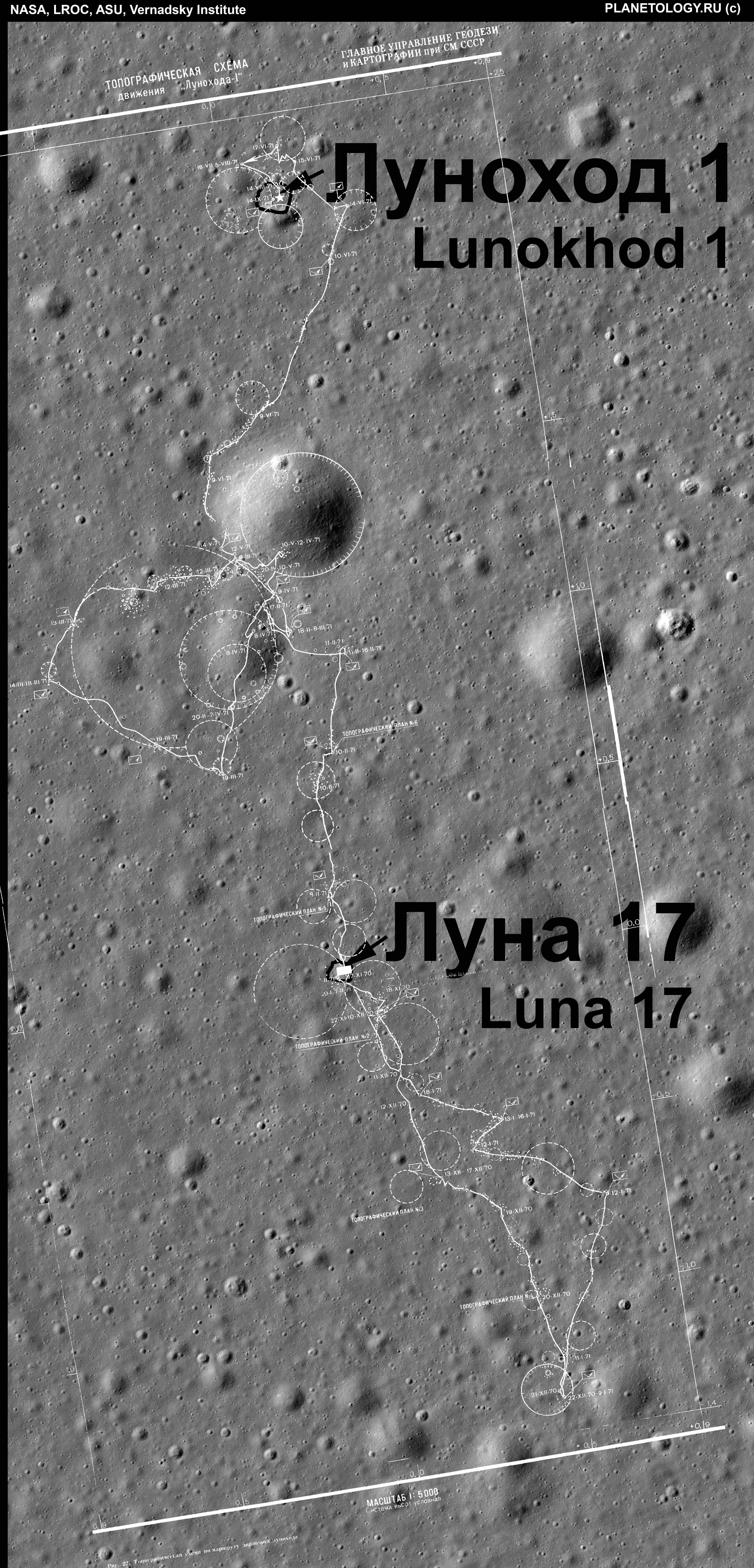
The Lunokhod 1 rover rolled over the ramps and onto the lunar surface at 06:28 UT. During its 322 Earth days of operation, the rover traveled 10.54 km and returned more than 20,000 TV images and 206 high-resolution panoramas.
In addition, Lunokhod 1 performed twenty-five soil analyses with its RIFMA X-ray fluorescence spectrometer and used its penetrometer at 500 different locations.
Controllers finished the last communications session with Lunokhod 1 at 13:05 UT on 14 September 1971. Attempts to reestablish contact were finally discontinued on 4 October.
In March 2010, the Lunar Reconnaissance Orbiter photographed the landing site of Luna 17, showing the lander and tracks of the rover. In April 2010, the Apache Point Observatory Lunar Laser-ranging Operation team announced that with the aid of these photos, they had found the long-lost Lunokhod 1 rover and had received returns from the laser retroreflector.
References
References
- (2018). "Beyond Earth: A Chronicle of Deep Space Exploration, 1958–2016". NASA History Program Office.
- "NASA NSSDC Master Catalog - Luna 17/Lunokhod 1".
- "Luna Ye-8 (Luna 17, 21 / Lunokhod 1, 2)".
- "USSR - Luna 17".
- Leonard David. (May 6, 2013). "Scientists Bounce Laser Beams Off Old Soviet Moon Rover". Space News.
- "Soviet Union Lunar Rovers".
- "LOST AND FOUND: SOVIET LUNAR ROVER".
This article was imported from Wikipedia and is available under the Creative Commons Attribution-ShareAlike 4.0 License. Content has been adapted to SurfDoc format. Original contributors can be found on the article history page.
Ask Mako anything about Luna 17 — get instant answers, deeper analysis, and related topics.
Research with MakoFree with your Surf account
Create a free account to save articles, ask Mako questions, and organize your research.
Sign up freeThis content may have been generated or modified by AI. CloudSurf Software LLC is not responsible for the accuracy, completeness, or reliability of AI-generated content. Always verify important information from primary sources.
Report