From Surf Wiki (app.surf) — the open knowledge base
Luna 1
Soviet spacecraft

Soviet spacecraft
| Field | Value |
|---|---|
| name | Luna 1 |
| image | RIAN archive 510848 Interplanetary station Luna 1 - blacked.jpg |
| image_caption | A museum replica |
| mission_type | Lunar impactor |
| operator | Soviet space program |
| Harvard_designation | 1959 Mu 1 |
| COSPAR_ID | 1959-012A |
| SATCAT | 00112 |
| mission_duration | Approximately 62 hours |
| spacecraft_type | Ye-1 |
| manufacturer | OKB-1 |
| launch_mass | 361.3 kg |
| launch_date | UTC |
| launch_rocket | Luna 8K72 |
| launch_site | Baikonur, Site 1/5 |
| last_contact | 5 January 1959 |
| orbit_epoch | 1 January 1959, 19:00:00 GMT |
| orbit_reference | Heliocentric |
| orbit_periapsis | 0.9766 AU |
| orbit_apoapsis | 1.315 AU |
| orbit_inclination | 0.01° |
| orbit_semimajor | 1.146 AU |
| orbit_eccentricity | 0.14767 |
| orbit_period | 450 days |
| apsis | helion |
| programme | Luna programme |
| previous_mission | Luna E-1 No.3 |
| next_mission | Luna E-1A No.1 |
| type | impactor_flyby |
| object | Lunar |
| arrival_date | 4 January 1959 |
| distance | 5995 km |
Luna 1, also known as Mechta ( , lit.: Dream), E-1 No.4 and First Lunar Rover, was the first spacecraft to reach the vicinity of Earth's Moon, the first spacecraft to leave Earth's orbit, and the first to be placed in heliocentric orbit. Intended as a Moon impactor, Luna 1 was launched as part of the Soviet Luna programme in 1959.
A malfunction in the ground-based control system caused an error in the upper stage rocket's burn time, and the spacecraft missed the Moon by 5,900 km (more than three times the Moon's radius). Luna 1 became the first human-made object to reach heliocentric orbit and was dubbed "Artificial Planet 1" and renamed Mechta (Dream). Luna 1 was also referred to as the "First Cosmic Ship", in reference to its achievement of Earth escape velocity.
Spacecraft
The satellite and rocket carrying Luna 1 was originally referred to as the Soviet Space Rocket by the Soviet Press. Pravda writer Alexander Kazantsev called it Mechta (, meaning 'dream'). Citizens of Moscow unofficially deemed it Lunik, a combination of Luna (Moon) and Sputnik. It was renamed to Luna 1 in 1963.
The spherical satellite was powered by mercury-oxide batteries and silver-zinc accumulators. There were five antennas on one hemisphere, four whip-style and one rigid, for communication purposes. The spacecraft also contained radio equipment including a tracking transmitter and telemetry system. There was no propulsion system.
Luna 1 was designed to impact the Moon, delivering two metallic pennants with the Soviet coat of arms that were included into its payload package. Two micrometeorite detectors, developed by Tatiana Nazarova of the Vernadsky Institute, were installed on the spacecraft. They each consisted of a metal plate with springs and could detect small impacts. Four ion traps, used to measure solar wind and plasma, were included. They were developed by Konstantin Gringauz. The scientific payload also included two gas-discharge Geiger counters, a sodium-iodide scintillation counter, and a Cherenkov detector. The upper stage of the rocket contained a scintillation counter and 1 kg of sodium for a gas-dispersion experiment.
The spacecraft weighed 361.3 kg at launch. It was about 1.22 m in diameter.
Launch
Luna 1 was launched at 16:41 GMT (22:41 local time) on 2 January 1959 from Site 1/5 at the Baikonur Cosmodrome by a Luna 8K72 rocket. The first three stages operated nominally. The Soviet engineers did not trust automated systems for controlling the engine burns, so they communicated to the rocket via radio. The signal to stop firing the engine Block E stage was delayed, and the prolonged burn imparted an extra 175 m/s to Luna 1.
Consequently Luna 1 missed its target by 5995 km. The spacecraft passed within 5995 - of the Moon's surface on 4 January after 34 hours of flight, and then became the first human made object to leave Earth's orbit on January 6, 1959. Luna 1 ran out of battery power on 5 January, when it was 597000 km from Earth, making it impossible to track further. The batteries were designed for a minimum of 40 hours but lasted for 62.
Luna 1 became the first artificial object to reach the escape velocity of the Earth, along with its carrier rocket's 1472 kg
Experiment results
At 00:57 GMT on 3 January 1959, at a distance of 113000 km from Earth, 1 kg of sodium gas was released by the spacecraft, forming a cloud behind it to serve as an artificial comet. The cloud was released for two purposes: to allow visual tracking of the spacecraft's trajectory and to observe the behavior of gas in space. This glowing orange trail of gas, visible over the Indian Ocean with the brightness of a sixth-magnitude star for a few minutes, was photographed by Mstislav Gnevyshev at the Mountain Station of the Main Astronomical Observatory of the Academy of Sciences of the USSR near Kislovodsk.
While traveling through the outer Van Allen radiation belt, the spacecraft's scintillator made observations indicating that a small number of high-energy particles exist in the outer belt. The measurements obtained during this mission provided new data on the Earth's radiation belt and outer space. The craft was unable to detect a lunar magnetic field which placed an upper limit on its strength of 1/10,000th of Earth's. The first-ever direct observations and measurements of solar wind, The spacecraft also marked the first instance of radio communication at the half-million-kilometer distance.
Reaction
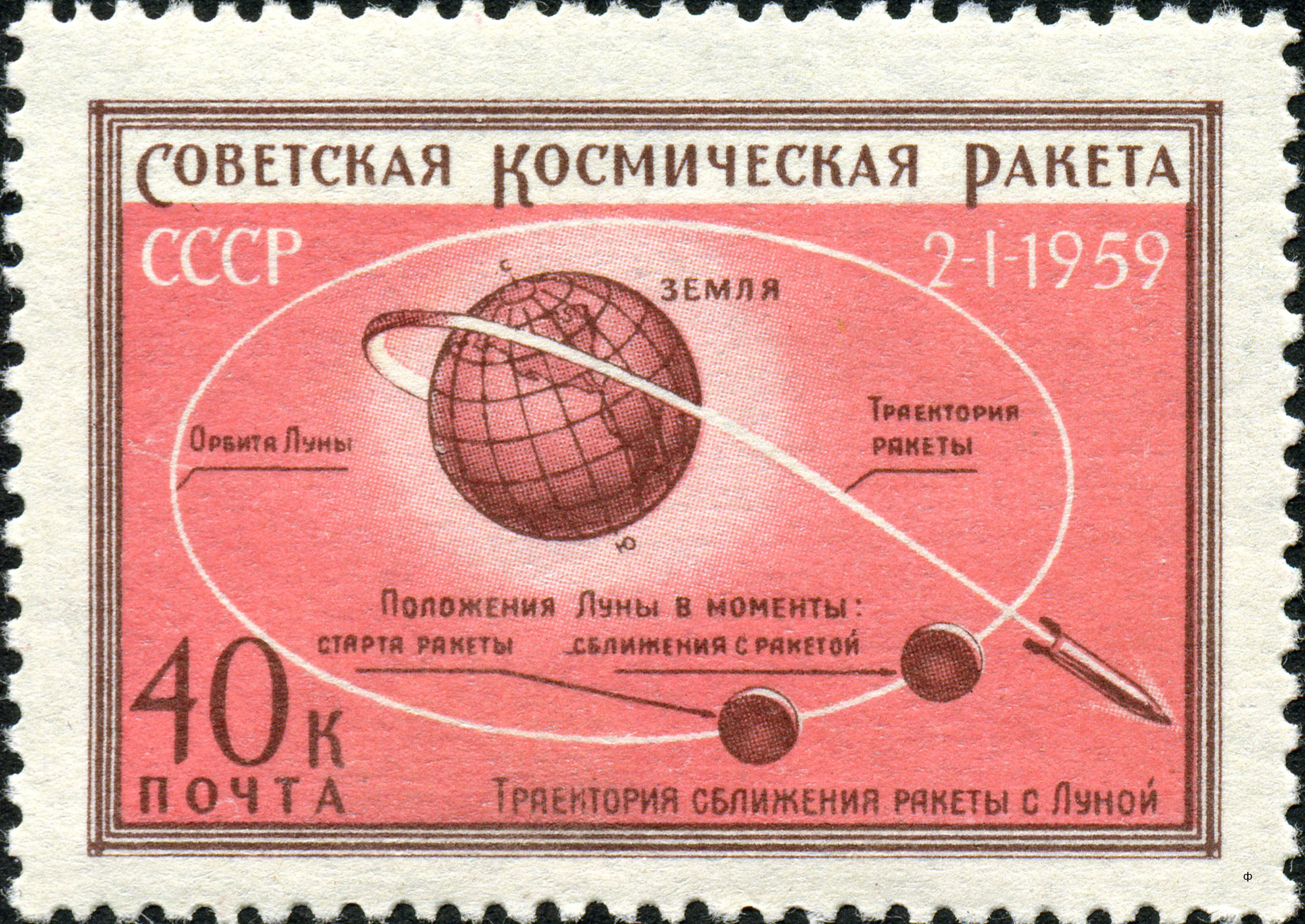
Some doubted the veracity of the Soviets' claim of mission success. Lloyd Mallan wrote about it in a book called The Big Red Lie. Many in the West did not receive transmissions from the spacecraft even though the Soviets publicized them before the flight. By the time the Earth rotated so that scientists in the United States could pick up signals from the spacecraft, it was already 171000 km away. In May 1959 several hearings Soviet Space Technology before the Committee on Science and Astronautics and Special Subcommittee on Lunik Probe of the United States House of Representatives attested the achievements of the Soviet mission and its sophisticated guidance technology.
The Soviet Union issued stamps to commemorate their success.
Subsequent missions
Luna 2, the second spacecraft of the Ye-1A series, successfully completed the mission on 13 September 1959.
References
References
- "Luna 1 Launch and Trajectory Information".
- "Spacecraft - Details". [[NASA]].
- (5 January 1959). "New Soviet Rocket Given Name 'Mechta'". The Plain Speaker.
- (28 October 2022). "Triaxial Fluxgate Magnetometer".
- Reichhardt, Tony. (January 2, 2013). "The Luna 1 Hoax Hoax". Smithsonian Magazine.
- (3 January 1959). "Soviet Moon Rocket Releases Sodium Cloud as 'Tail Light'". St. Louis Post Dispatch.
- Mitchell, Don P.. (1959-01-02). "Lunar Impact".
- (1959). "Soviet Space Technology". CIA.
- (21 October 2008). "Chronology – Five key dates in the race to the moon".
This article was imported from Wikipedia and is available under the Creative Commons Attribution-ShareAlike 4.0 License. Content has been adapted to SurfDoc format. Original contributors can be found on the article history page.
Ask Mako anything about Luna 1 — get instant answers, deeper analysis, and related topics.
Research with MakoFree with your Surf account
Create a free account to save articles, ask Mako questions, and organize your research.
Sign up freeThis content may have been generated or modified by AI. CloudSurf Software LLC is not responsible for the accuracy, completeness, or reliability of AI-generated content. Always verify important information from primary sources.
Report