From Surf Wiki (app.surf) — the open knowledge base
Luke 23
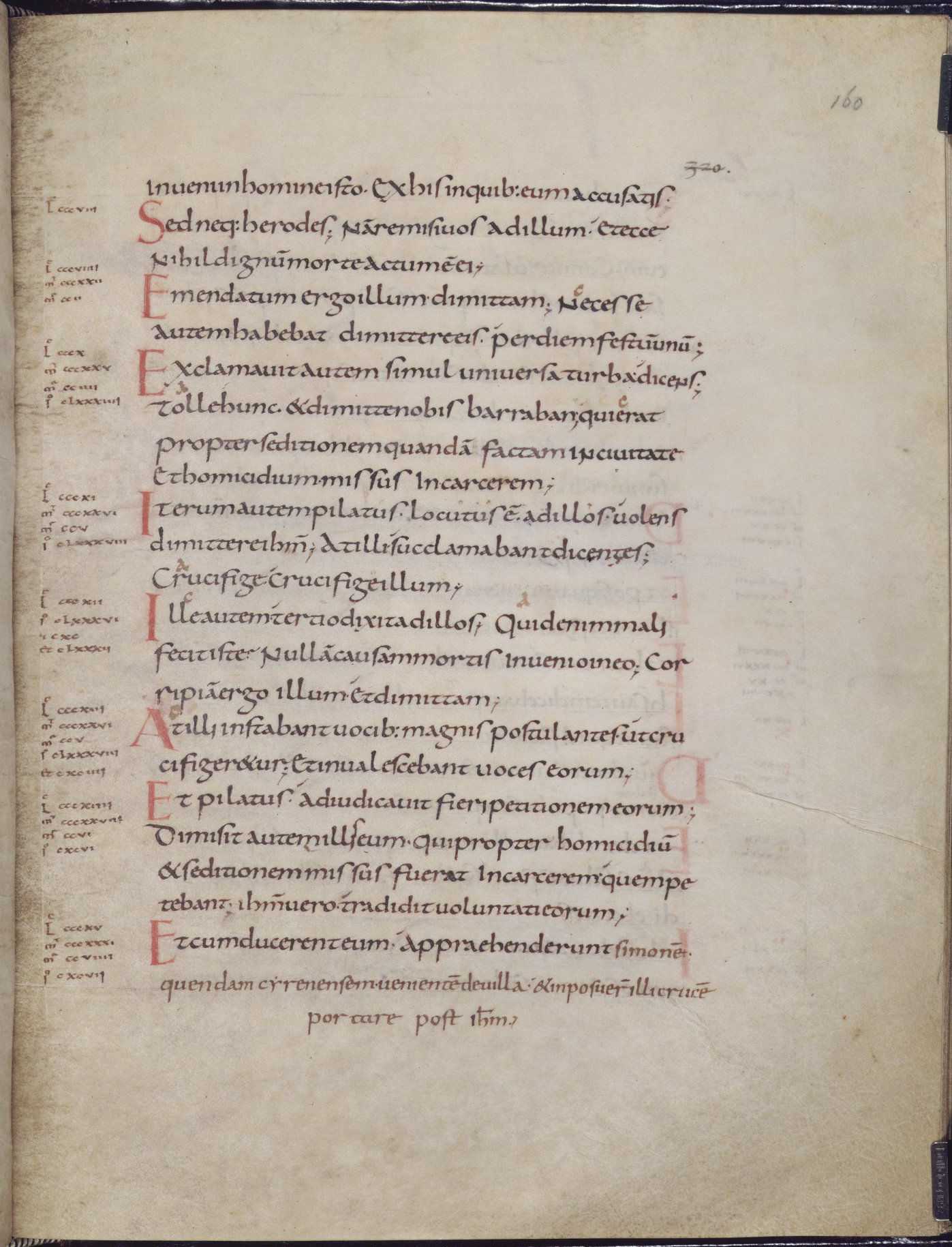
Luke 23 is the twenty-third chapter of the Gospel of Luke in the New Testament of the Christian Bible. The book containing this chapter is anonymous, but early Christian tradition uniformly affirmed that Luke the Evangelist composed this Gospel as well as the Acts of the Apostles. This chapter records the trial of Jesus Christ before Pontius Pilate, Jesus' meeting with Herod Antipas, and his crucifixion, death and burial.
Text
The original text was written in Koine Greek. Some early manuscripts containing the text of this chapter are:
- Papyrus 75 (AD 175–225)
- Codex Vaticanus (325–350)
- Codex Sinaiticus (330–360)
- Codex Bezae ()
- Codex Washingtonianus ()
- Codex Alexandrinus (400–440)
- Codex Ephraemi Rescriptus (c. 450; extant verses 26–56).
This chapter is divided into 56 verses.
Old Testament references
- : Psalm
- : Psalm
- : Psalm a
- : Psalm a; Psalm
New Testament parallels
- : ; ;
- : ; ;
- : ; ;
- : ; ;
Jesus before Pilate (verses 1-5)
Verse 1
:And the whole multitude of them arose, and led him unto Pilate. "The whole multitude of them" (, hapan to plēthos) may also be translated as "the whole assembly", or "the whole Council". Luke uses τὸ πλῆθος (rather than το ὄχλος, to ochlos) to signify a multitude in number. They led Jesus to Pontius Pilate, the provincial governor (prefect) of Judaea.
Verse 2: the charges against Jesus
Irish archbishop John McEvilly notes that Luke provides more specific details of the charges against Jesus than either Matthew or Mark, who refer to "many charges" brought against him. There are three specific charges: :We found this man subverting our nation, opposing payment of taxes to Caesar, and saying that He Himself is the Messiah, a King. McEvilly refers to a fourth charge mentioned in Pilate's letter to Tiberius, "that He practised magic, in virtue of which, He performed some miraculous wonders". "had the advantage of being perfectly vague".
Verse 3

: Then Pilate asked him, "Are you the king of the Jews?" : He answered, "You say so". (NRSV) Cross reference: Matthew 27:11; Mark 15:2; John 18:37
Verse 3 in Greek
Textus Receptus/Majority Text: : ὁ δὲ Πιλάτος ἐπηρώτησεν αὐτόν, λέγων, Σὺ εἶ ὁ βασιλεὺς τῶν Ἰουδαίων; : ὁ δὲ ἀποκριθεὶς αὐτῷ ἔφη, Σὺ λέγεις. Transliteration: : Ho de Pilatos epērōtēsen auton, legōn, "Su ei ho basileus tōn Ioudaiōn?": : Ho de apokritheis autō ephē, "Su legeis."
Verse 3 in Latin
Biblia Sacra Vulgata: : Pilatus autem interrogavit eum dicens tu es rex Iudaeorum : at ille respondens ait tu dicis.
The style of response is the same as in Luke 22:70, where Jesus answers the Sanhedrin's question, "Are you the Son of God?"
Verse 5
:But they were the more fierce, saying, “He stirs up the people, teaching throughout all Judea, beginning from Galilee to this place.” Traditionally, "throughout all Judea" has been rendered as "throughout all Jewry". Farrar suggests that these words imply a "Judean ministry" which the synoptic gospels do not narrate, which term would therefore include the area of Perea east of the Jordan River. Matthew, Mark and John all refer to Jesus' stay in Perea, and Lucan scholars generally assume that the route Jesus followed from Galilee to Jerusalem passed through this region. The reference to Jesus' ministry "beginning from Galilee" relates back to Luke 4:14, where Jesus begins to teach in the synagogues there.
Jesus meets with Herod (verses 6-12)
According to a passage which is unique to Luke's Gospel,
Jesus returns to Pilate (verses 13-25)
Herod finds no fault with Jesus (verse 15) and returns him to Pilate's jurisdiction.
Verse 14
:[Pilate] said to them, "You have brought this Man to me, as one who misleads the people. And indeed, having examined Him in your presence, I have found no fault in this Man concerning those things of which you accuse Him." Luke's version of the trial scene "emphasizes Pilate's reluctance to act against Jesus".
Verse 22
:Then he said to them the third time, "Why, what evil has He done? I have found no reason for death in Him. I will therefore chastise Him and let Him go." This "third time" of declaring Jesus' innocence follows the previous declarations in verses 4 and 14–15.
Verse 24
:* So Pilate gave sentence that it should be as they requested.* This verse reads ο δε πιλατος επεκρινεν γενεσθαι το αιτημα αυτων in the Textus Receptus, matching the opening words of , ο δε πιλατος ("so Pilate ..."), but the sentence begins καὶ Πιλᾶτος ... ("and Pilate ...") in critical texts such as Westcott-Hort. Pilate's "official decision" was to comply with the request of the crowd. The word ἐπέκρινεν (epekrinen, "pronounced sentence") is specific to Luke, although it also appears in the apocryphal , where innocent men are condemned to death.
The way to Calvary (verses 26-32)
Verse 27
:And there followed him a great company of people, and of women, which also bewailed and lamented him. Matthew's parallel passage, Matthew 27:34, notes that on his arrival at the place of his crucifixion, Jesus was offered wine mixed with gall to drink. Luke does not include this, a reference to Proverbs 31:6–7, Give strong drink to him that is perishing ..., but his reference to women in attendance en route may include their role in fulfilling this observance.
Verse 29
:"For behold, the days are coming in which they shall say, 'Blessed are the barren, and the wombs that never bore and the breasts which never gave suck.'" The prophet Hosea spoke in similar language, when recognising that the disobedience of the Israelites required God's punishment, but calling for some mitigation: :Give them, O Lord — :what will you give? :Give them a miscarrying womb :and dry breasts.
Verse 31
:"For if they do these things when the wood is green, what will happen when it is dry?" The green wood represents those who are innocent (referring to Jesus' condemnation to death), while the dry wood represents "the truly guilty".
Verses 39–43

.jpg)
One of the two thieves who die with Jesus reviles him, the other contemplates the justice of his own death sentence and appeals to Jesus to be "remembered" in the kingdom. The authors of the Geneva Bible (1599) note that the latter is "saved by faith".
Verse 44
:Now it was about the sixth hour, and there was darkness over all the earth until the ninth hour. Like , Luke records three hours of darkness, which signify "the awesomeness of what is taking place".
Verse 46
:And when Jesus had cried out with a loud voice, He said, “Father, ‘into Your hands I commit My spirit.’ ” Having said this, He breathed His last. Jesus' crying "with a loud voice" is not, as in , one of desolation (why have you forsaken me?), but of "secure confidence". Jesus quotes , rather than which appears in Mark's gospel.
Verse 48
:And the whole crowd who came together to that sight, seeing what had been done, beat their breasts and returned. Nicoll understands the phrase "the things that had happened" (, tà genómena) "comprehensively, including the crucifixion and all its accompaniments". Albert Barnes refers to "the earthquake, the darkness, and the sufferings of Jesus" as the "things which were done". The earthquake is only recorded in Matthew's Gospel, but the third century historian Sextus Julius Africanus also refers to an earthquake on or around the day of the crucifixion.
Verse 49
:And all his acquaintance, and the women that followed him from Galilee, stood afar off, beholding these things. "The women" that followed Jesus from Galilee (also in Luke 23:55) were "Mary Magdalene, Joanna, Mary the mother of James, and the other women with them" according to Luke 24:10. Matthew 27:55 lists "Mary Magdalene, Mary the mother of James and Joseph, and the mother of the sons of Zebedee", whereas Mark 15:40 names "Mary Magdalene, Mary the mother of James the little and Joses, and Salome".
Verse 55
:And the women who had come with Him from Galilee followed after, and they observed the tomb and how His body was laid. According to Luke 24:10, "the women" (also in Luke 23:49) were "Mary Magdalene, Joanna, Mary the mother of James, and the other women with them". Matthew 27:61 lists "Mary Magdalene, and the other Mary", whereas Mark 15:47 names "Mary Magdalene, and Mary the mother of Joses".
References
Bibliography
References
- Holman Illustrated Bible Handbook. Holman Bible Publishers, Nashville, Tennessee. 2012.
- Halley, Henry H. ''Halley's Bible Handbook'': an Abbreviated Bible Commentary. 23rd edition. Zondervan Publishing House. 1962.
- {{bibleverse. Luke. 23:1. KJV: [[King James Version. KJV]], also in the [[New King James Version]]
- {{bibleverse. Luke. 23:1. NABRE: [[New American Bible Revised Edition]]
- {{bibleverse. Luke. 23:1. VOICE: [[The Voice (Bible translation). The Voice]]
- Farrar, F. W. (1891), [https://biblehub.com/commentaries/cambridge/luke/23.htm Cambridge Bible for Schools and Colleges] on Luke 23, accessed 10 February 2022
- McEvilly, J., [https://www.ecatholic2000.com/macevilly2/untitled-35.shtml An Exposition Of The Gospels by The Most Rev. John Macevilly D.D.] on Matthew 27, accessed 4 November 2023
- {{bibleverse. Luke. 23:2. HCSB: [[Holman Christian Standard Bible]]
- For [[Frederic Farrar. F. W. Farrar]], the first charge, translated in the [[King James Version]] as ''perverting the nation'',{{bibleverse. Luke. 23:2. KJV: KJV
- {{bibleverse. Luke. 23:3. NRSV: [[New Revised Standard Version]]
- {{bibleverse. Luke. 23:5. NKJV: NKJV
- {{bibleverse. Luke. 23:5. KJV: [[King James Version]]
- Jordan]]", see [[Josephus]], ''Antiquities of the Jews'', XII, 4.11,Riggs, S. J. (1894), [https://www.jstor.org/stable/3135423 Studies in Palestinian Geography], Auburn Theological Seminary, accessed 11 February 2022
- ''Mercer Dictionary of the Bible'' by Watson E. Mills, Roger Aubrey Bullard 1998, {{ISBN. 0-86554-373-9, p. 929
- responsibility for the interrogation of Jesus is transferred from Pilate to [[Herod Antipas]]. The editors of the [[Jerusalem Bible]] suggest that Luke may have obtained this information from [[Manahen. Manaen]], who according to [[Acts 13]]:1, "had been brought up with Herod the tetrarch".Jerusalem Bible (1966), footnote b at Luke 23:8
- {{bibleverse. Luke. 23:14. NKJV: NKJV
- Franklin, E., ''59. Luke'' in Barton, J. and Muddiman, J. (2001), [https://b-ok.org/dl/946961/8f5f43 The Oxford Bible Commentary] {{Webarchive. link. (2017-11-22 , p. 956-7)
- {{bibleverse. Luke. 23:22. NKJV: NKJV
- {{bibleverse. Luke. 23:24. NKJV: NKJV
- Meyer, H. A. W., [https://biblehub.com/commentaries/meyer/luke/23.htm Meyer's NT Commentary] on Luke 23, accessed 23 August 2020
- {{bibleverse. Luke. 23:24. PHILLIPS: [[J. B. Phillips]]' translation
- [https://biblehub.com/greek/epekrinen_1948.htm Englishman's Concordance: ἐπέκρινεν], accessed 23 August 2020
- {{bibleverse. 2. Maccabees. 4:47. NABRE: [[New American Bible, Revised Edition]]
- {{bibleverse. Luke. 23:27. KJV: KJV
- {{bibleverse. Matthew. 27-33-34. ESV: [[English Standard Version]] (ESV)
- {{bibleverse. Luke. 23:29. KJ21: [[21st Century King James Version]]
- {{bibleverse. Hosea. 9:14. ESV: ESV
- {{bibleverse. Luke. 23:31. ESV: ESV
- Jerusalem Bible (1966), footnote h at Luke 23:31
- {{bibleverse. Luke. 23:41-42. ESV: ESV
- {{bibleverse. Luke. 23:1-56. GNV: [[Geneva Bible]], summary of chapter 23
- {{bibleverse. Luke. 23:44. NKJV
- {{bibleverse. Luke. 23:46. NKJV
- {{bibleverse. Luke. 23:48. NKJV NKJV
- Nicoll, W. R., [https://biblehub.com/commentaries/egt/luke/23.htm Expositor's Greek Testament] on Luke 23: The Passion Continued, accessed 13 February 2022
- Barnes, A., [https://biblehub.com/commentaries/barnes/luke/23.htm Barnes' Notes on the Bible] on Luke 23, accessed 13 February 2022
- Wikipedia Foundation, [[Crucifixion of Jesus#Temple veil, earthquake and resurrection of dead saints. Crucifixion of Jesus]], accessed 13 February 2022
- {{bibleverse. Luke. 23:49. KJV KJV
- {{bibleref2. Luke. 23:55. NKJV NKJV
This article was imported from Wikipedia and is available under the Creative Commons Attribution-ShareAlike 4.0 License. Content has been adapted to SurfDoc format. Original contributors can be found on the article history page.
Ask Mako anything about Luke 23 — get instant answers, deeper analysis, and related topics.
Research with MakoFree with your Surf account
Create a free account to save articles, ask Mako questions, and organize your research.
Sign up freeThis content may have been generated or modified by AI. CloudSurf Software LLC is not responsible for the accuracy, completeness, or reliability of AI-generated content. Always verify important information from primary sources.
Report