From Surf Wiki (app.surf) — the open knowledge base
Luke 16

Luke 16 is the sixteenth chapter of the Gospel of Luke in the New Testament of the Christian Bible. It records the teachings and parables of Jesus Christ, including the account of the "rich man and Lazarus". There is an "overriding concern with riches" in this chapter, although other topics are also covered.
Text
The original text was written in Koine Greek. Some early manuscripts containing the text of this chapter are:
- Papyrus 75 (AD 175–225)
- Codex Vaticanus (325–350)
- Codex Sinaiticus (330–360)
- Codex Bezae (~400)
- Codex Washingtonianus (~400)
- Codex Alexandrinus (400–440).
This chapter is divided into 31 verses.
Parable of the unjust steward
Main article: Parable of the Unjust Steward
This parable of Jesus appears in Luke, but not in the other canonical gospels of the New Testament. Verse 1 affirms that the parable is for Jesus' disciples, reflecting the wording of verse 8a where "the master commended the dishonest manager because he had acted shrewdly". According to Eric Franklin, this parable is "noteworthy for its obscurity".
The "certain rich man" who was about to dismiss his steward, is not identified. Friedrich Schleiermacher linked him with the Romans, and Christian Grossmann refers to a Roman emperor who dismissed a provincial governor. Heinrich Meyer also refers to a "usual explanation" that the rich man is God, but he is critical of all three of these interpretations.
Verse 8b
:For the people of this world are more shrewd in dealing with their own kind than are the people of the light. This part-verse and the succeeding verses may be treated as part of the parable or as separate additions: translators and commentators vary in their assessment of where the parable ends, for example the New American Bible Revised Edition clearly begins its "application of the parable" at this point.
Verse 9
:"And I say to you, make friends for yourselves by unrighteous mammon, that when you fail, they may receive you into an everlasting home." "Unrighteous mammon" (, tou mamōna tēs adikias) refers to wealth, or "money" in paraphrases such as that of J. B. Phillips, although the debts which had been written down in verses 6 and 7 had been expressed as debts payable in measures of oil and wheat.
An encounter with the Pharisees
Verse 14
:Now the Pharisees, who were lovers of money, also heard all these things, and they derided Him. The parable and the subsequent guidance were both directed to the disciples (see verse 1) but were also heard by the Pharisees, who were φιλάργυροι (philarguroi, either "lovers of money" or "covetous").
Johann Bengel suggests that along with their "covetous" nature, "they fancied themselves to be accomplished in (furnished with) such prudence as to be able admirably to combine the service of God and that of mammon", whereas the teaching of Jesus required "singleness of heart", a quality they also despised.
Anglican bishop Harvey Goodwin comments that the derision shown by the Pharisees confirms that they had been "touched by our Lord's teaching; they adopted the fool's course of mocking at that which they could not deny to be true, but whose truth they did not like to follow into its consequences".
Verse 16
:The law and the prophets [were] until John. There is no verb in the original Greek: the word were is generally added to make sense of the sentence. The ISV says they were fulfilled with John. The NIV says they were proclaimed until John. Matthew's text says: :All the prophets and the law prophesied (ἐπροφήτευσαν, eprophēteusan) until John.
Account of the Rich Man and Lazarus
Main article: Rich man and Lazarus
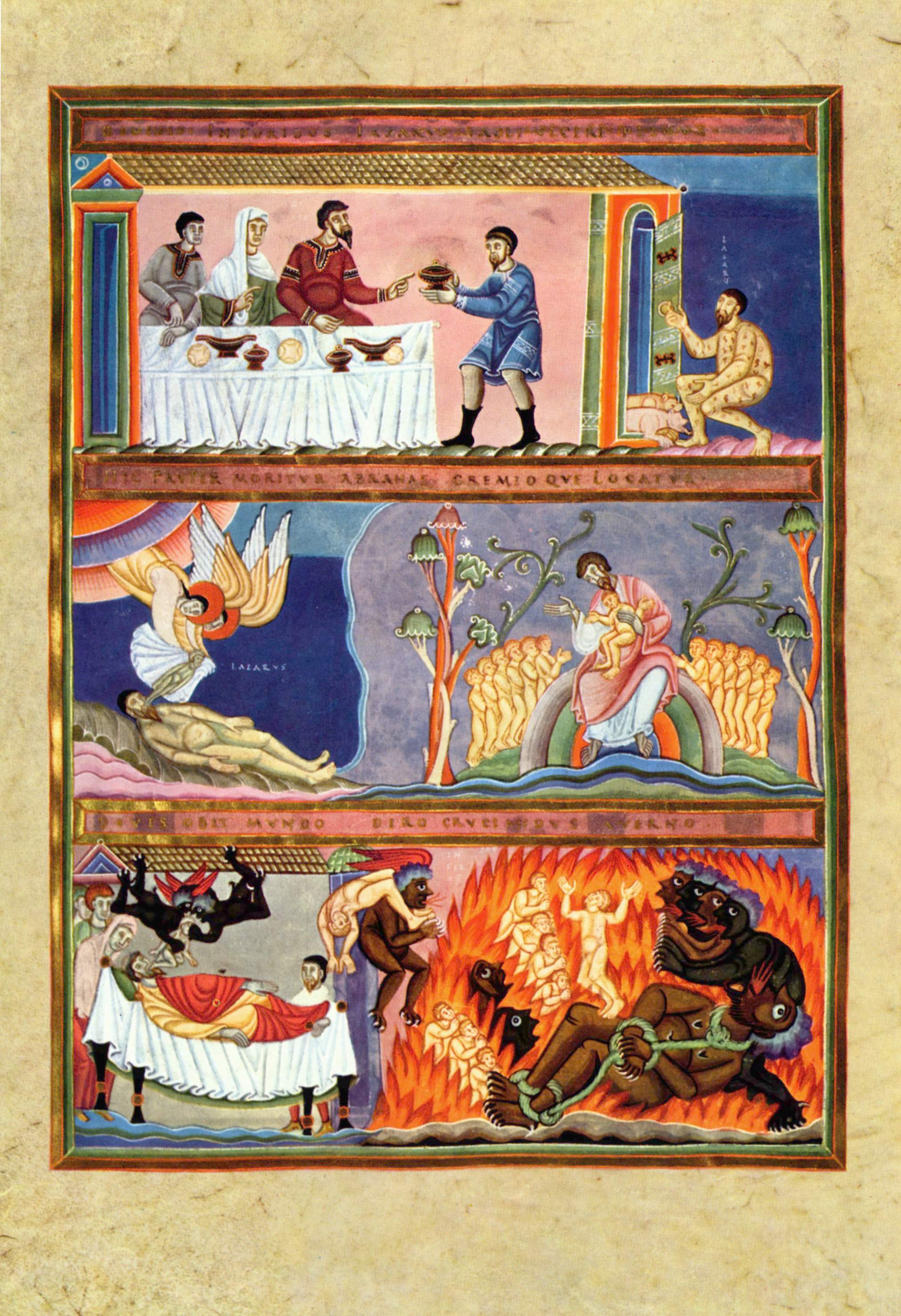
The account of the rich man and Lazarus (also called the Dives and Lazarus or Lazarus and Dives) is a well-known teachings along with the parables of Jesus appearing in the Gospel of Luke. It tells of the relationship, in life and in death, between an unnamed rich man and a poor beggar named Lazarus. The traditional name, Dives, is not actually a name, but instead a word for "rich man", dives, in the text of the Latin Bible, the Vulgate. The rich man was also given the names Neuēs (i.e. Nineveh) and Fineas (i.e. Phineas) in the 3rd and 4th centuries.
Along with the parables of the Ten Virgins, Prodigal Son, and Good Samaritan, it was one of the most frequently illustrated teachings in medieval art, perhaps because of its vivid account of an afterlife. Despite being labeled as a parable by some, there is no introduction in Luke's account to certify that it was just a parable.
The name Lazarus, from the Hebrew: אלעזר, Elʿāzār, Eleazar—"God is my help", also belongs to the more famous biblical character Lazarus of Bethany, known as "Lazarus of the Four Days", who is the subject of a prominent miracle attributed to Jesus in the Gospel of John, in which Jesus resurrects him four days after his death.
References
References
- Halley, Henry H. ''Halley's Bible Handbook'': an Abbreviated Bible Commentary. 23rd edition. Zondervan Publishing House. 1962.
- The book containing this chapter is [[anonymity
- and as far as verse 8a contains a story about a [[Steward (office)
- {{bibleverse. Luke. 16:8. NIV: NIV
- Meyer, H. A. W. (1880), [https://biblehub.com/commentaries/meyer/luke/16.htm Meyer's NT Commentary] on Luke 16, translated from the sixth German edition, accessed 30 September 2023
- Franklin, E., ''59. Luke'' in Barton, J. and Muddiman, J. (2001), [https://b-ok.org/dl/946961/8f5f43 The Oxford Bible Commentary], p. 948
- Sub-heading at {{bibleverse. Luke. 16:8. NABRE after the words "the master commended that dishonest steward for acting prudently".
- {{bibleverse. Luke. 16:9. NKJV: NKJV
- {{bibleverse. Luke. 16:1-9. PHILLIPS: J. B. Phillips' [[Phillips New Testament in Modern English. New Testament in Modern English]], 1960, 1972
- {{bibleverse. Luke. 16:6-7. NKJV: NKJV
- {{bibleverse. Luke. 16:14. NKJV: NKJV
- [[Strong's Concordance]], [https://biblehub.com/greek/5366.htm 5366. philarguros], accessed on 30 April 2025
- Bengel, J. A. (1742), [https://biblehub.com/commentaries/bengel/luke/16.htm Bengel's Gnomon of the New Testament] on Luke 16, accessed 2 October 2023
- Goodwin, H. (1847–62), [https://biblehub.com/commentaries/sermon/luke/16.htm Parish Sermons, 5th series], p. 233, accessed on 30 April 2025
- {{bibleverse. Luke. 16:16. NKJV: NKJV
- Palmer, D. R., [http://www.bibletranslation.ws/trans/luke.pdf ''The Gospel of Luke: a Translation From the Greek''], February 2018 edition, accessed 1 July 2018
- {{bibleverse. Luke. 16:16. ISV: ISV
- {{bibleverse. Luke. 16:16. ISV: NIV
- {{bibleverse. Matthew. 11:13. NKJV: NKJV
- (2002-01-01). "The Parables of Jesus: A Commentary".
- "Luke, chapter 16 verse 19". The Vatican.
- (1995-03-01). "The Gospel According to Luke (I-IX)".
- Fitzmyer IX, Ad populum I ([[CSEL]] 18.91), spelled Finees; and in [[Pseudo-Cyprian. Ps.-Cyprian]], De pascha computus 17 (CSEL 3/3.265), spelled Finaeus
- (1961). "The Gothic Image: Religious Art in France of the Thirteenth Century".
- (1999-02-01). "The Parables of Jesus".
- Gavrilova, L. V., [https://core.ac.uk/download/pdf/38640754.pdf From the History of Artistic Interpretations of the Biblical Story about the Lazarus Resurrection], ''Journal of [[Siberian Federal University]], Humanities & Social Sciences'' 1 (2014 7), 20–29, accessed 2 July 2018
- (2008). "All the People in the Bible: An A-z Guide to the Saints, Scoundrels, and Other Characters in Scripture".
This article was imported from Wikipedia and is available under the Creative Commons Attribution-ShareAlike 4.0 License. Content has been adapted to SurfDoc format. Original contributors can be found on the article history page.
Ask Mako anything about Luke 16 — get instant answers, deeper analysis, and related topics.
Research with MakoFree with your Surf account
Create a free account to save articles, ask Mako questions, and organize your research.
Sign up freeThis content may have been generated or modified by AI. CloudSurf Software LLC is not responsible for the accuracy, completeness, or reliability of AI-generated content. Always verify important information from primary sources.
Report