From Surf Wiki (app.surf) — the open knowledge base
Luke 14
_140.jpg)
Luke 14 is the fourteenth chapter of the Gospel of Luke in the New Testament of the Christian Bible. It records one miracle performed by Jesus Christ on a Sabbath day, followed by his teachings and parables, where he "inculcates humility ... and points out whom we should invite to our feasts, if we expect spiritual remuneration". The book containing this chapter is anonymous, but early Christian tradition uniformly affirmed that Luke the Evangelist composed this Gospel as well as the Acts of the Apostles.
Text
The original text was written in Koine Greek. Some early manuscripts containing the text of this chapter are:
- Papyrus 75 (AD 175–225; verse 27 contains a staurogram)
- Papyrus 45 (~250)
- Codex Vaticanus (325–350)
- Codex Sinaiticus (330–360)
- Codex Bezae (~400)
- Codex Washingtonianus (~400)
- Codex Alexandrinus (400–440)
- Papyrus 97 (~600; extant verses 7–14)
This chapter is divided into 35 verses.
Jesus being carefully watched
The chapter opens on a Sabbath day when Jesus has been invited into the home of one of the rulers of the Pharisees, presumably directly after the synagogue service. He is 'watched carefully' or 'craftily'. F. W. Farrar in the Cambridge Bible for Schools and Colleges notes a resonance with the words of : :The wicked watches the righteous, and seeks to slay him. A man with dropsy (swellings caused by bodily fluids, also called edema) is there. While he may have come as one "well known to the family", Irish Archbishop John McEvilly suggests that he may have been "introduced by the Pharisees on purpose to see if our Lord would cure him on the Sabbath".
Verses 3–6
:And Jesus, answering, spoke to the lawyers and Pharisees, saying, “Is it lawful to heal on the Sabbath?” Nothing had been said; Jesus responds to the thoughts of his adversaries. He heals the man, and lets him go (or sends him away). A further dialogue follows: :"Which of you, having a son or an ox that has fallen into a well, will not immediately pull him out on a sabbath day?" :And they could not reply to this. Some manuscripts, in place of "a son", refer to a donkey.
Go and sit in the lowest place
Main article: Parable of the Wedding Feast
This pericope (verses 7 to 14), also known as the Parable of the Wedding Feast, is one of the parables of Jesus which is only found in the Gospel of Luke in the New Testament and directly precedes the Parable of the Great Banquet in . In Matthew's Gospel, the parallel passage to Luke's Parable of the Great Banquet is also set as a wedding feast (Matthew 22:1–14).
Jesus always made his parables relatable to the layman. A wedding, in the days of the Jews, was a very sacred and joyous thing. Some even lasted up to or more than a week. When Jesus told this parable, many people were able to understand the picture he was trying to create because he used a Jewish wedding as the setting of the story.
Luke's saying that "Everyone that exalteth himself shall be humbled, but he that humbleth himself shall be exalted" is also found in and . It is similar to Matthew 18:4.
David Brown notes that this parable includes "a reproduction" of Proverbs 25:6–7.
Parable of the Great Supper
Main article: Parable of the Great Banquet
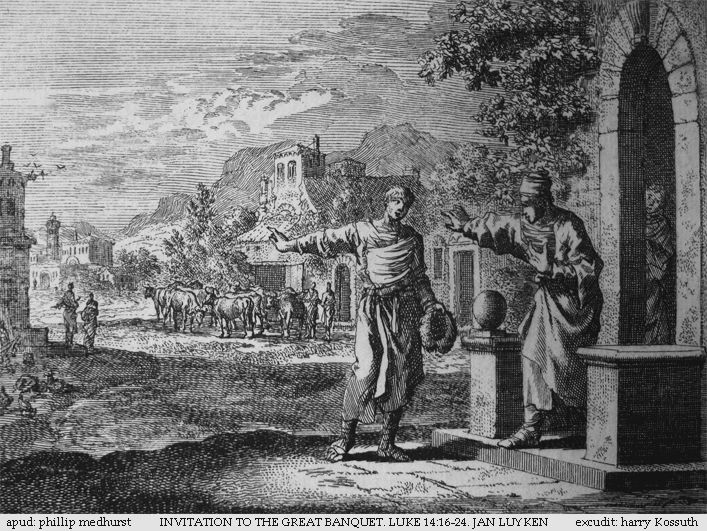
The Parable of the Great Banquet or the Wedding Feast or the Marriage of the King's Son (verses 16–24) is also found in Matthew . A variant of the parable also appears in Saying 64 of the Gnostic Gospel of Thomas. "Everything is now ready" (verse 17) and many guests are invited to the banquet, but they "all alike" offered excuses, of which three examples are given.
St Cyril of Jerusalem sees the servant who was sent to invite the guests as Christ and interprets "everything is now ready" to encompass "the good things bestowed upon the world through Him, the removal of sins, the participation of the Holy Spirit, [and] the glory of adoption".
The eschatological image of a wedding also occurs in the parable of the Faithful Servant and the parable of the Ten Virgins. Here, it includes the extension of the original invitation (to Jews) to also include Gentiles. In Luke, the invitation is extended particularly to "the poor, the crippled, the blind and the lame" (), evidencing explicit concern for the "poor and the outcasts".
Leaving All to Follow Christ
Main article: Counting the Cost
Counting the Cost, or in the NIV: The Cost of Being a Disciple or in the NRSV: The Cost of Discipleship or in the NKJV: Leaving All to Follow Christ, are titles given to verses 25–33 in this chapter, which include a pair of illustrations of the importance of deliberating in advance "whether they were able and prepared to bear all their losses and persecutions to which the profession of the gospel would expose them". The first title comes from the phrase "count the cost", which occurs in the King James Version of the passage, as well as some other versions.
Eric Franklin argues that the requirement to "hate" in verse 26 is "Semitic exaggeration",; the Jerusalem Bible calls it a "Hebraism" whose call is "not for hate, but for total detachment, and Joseph Benson envisages that hatred "signifies only an inferior degree of love".
American New Testament scholar Joel B. Green suggests that it is unclear what kind of tower is being referred to in the first illustration, but notes that the message is that a "thoroughgoing fidelity to God's salvific aim" is required, "manifest in one's identity as a disciple of Jesus". This involves putting family and possessions second, as in Matthew 8:18–22 and . This command is interpreted and practised in different ways by different Christians. Some groups, such as the Bruderhof or Hutterites see it as a call to forsake all possessions to follow Jesus. Others read it simply as a matter of having Christ be the center of one's heart.
Salt
:34 Salt is good; but if the salt has lost its flavor, how shall it be seasoned? 35 It is neither fit for the land nor for the dunghill, but men throw it out. He who has ears to hear, let him hear! Salt is 'good' in biblical thought for giving taste where there is none. Job asks Can flavorless food be eaten without salt? Salt preserves what would otherwise perish, and Numbers 18:19 refers to a covenant of salt between the and Aaron and his descendants, but "whether salt can lose its flavour has been much debated".
References
References
- Halley, Henry H. ''Halley's Bible Handbook'': an Abbreviated Bible Commentary. 23rd edition. Zondervan Publishing House. 1962.
- McEvilly, J., [https://www.ecatholic2000.com/macevilly2/untitled-74.shtml An Exposition of the Gospels by The Most Rev. John Macevilly D.D.] on Luke 14, accessed 27 September 2023
- Holman Illustrated Bible Handbook. Holman Bible Publishers, Nashville, Tennessee. 2012.
- [[Kurt Aland. Aland, Kurt]], ''Synopsis Quattuor Evangeliorum. Locis parallelis evangeliorum apocryphorum et patrum adhibitis edidit'', Deutsche Bibelgesellschaft, Stuttgart 1996, p. XXIΙΙ.
- Buls, H., [http://www.iclnet.org/pub/resources/text/wittenberg/bul/trin-17.html The Sermon Notes of Harold Buls], text from Luke 14:1-11, for Trinity XVII, accessed 26 June 2018
- {{bibleverse. Luke. 14:1. ESV: ESV translation
- [[Johann Albrecht Bengel. Bengel, J. A.]], [https://biblehub.com/commentaries/bengel/luke/14.htm Bengel's Gnomon of the New Testament] on Luke 14, accessed 1 August 2020
- [http://biblehub.com/commentaries/cambridge/luke/14.htm Cambridge Bible for Schools and Colleges] on Luke 14, accessed 26 June 2018
- {{bibleverse. Luke. 14:3. NKJV
- {{bibleverse. Luke. 14:5-6. RSV: [[Revised Standard Version]]
- The Voice Translation]], accessed 27 September 2023
- J. Dwight Pentecost, 1998 ''The Parables of Jesus: lessons in life from the Master Teacher'', {{ISBN. 0-8254-3458-0, pp. 85–86.
- ''Luke'' by Sharon H. Ringe 1995, {{ISBN. 0-664-25259-1, p. 195.
- Aland, Kurt, ed. Synopsis of the Four Gospels: Completely Revised based on the Greek Text of the Nestle-Aland, 26th Edition, and Greek New Testament, 3rd Edition, English Edition. 1st ed. United Bible Societies, 1982. Print. pericope 216.
- Bauckham, Richard. (Autumn 1996). "The Parable of the Royal Wedding Feast (Matthew 22:1-14) and the Parable of the Lame Man and the Blind Man (Apocryphon of Ezekiel)". Journal of Biblical Literature.
- {{bibleverse. Luke. 14:11. NKJV
- Brown, D., [https://biblehub.com/commentaries/jfb/luke/14.htm Jamieson-Fausset-Brown Bible Commentary: Luke 14], accessed 3 May 2021
- ''Gospel of Thomas'': [http://www.gnosis.org/naghamm/gthlamb.html Lamb translation] and [http://www.gnosis.org/naghamm/gosthom.html Patterson/Meyer translation].
- {{bibleverse. Luke. 14:18. NIV: NIV
- Cyril of Jerusalem, quoted by [[Thomas Aquinas]] in [https://archive.org/details/The-catena-aurea-of-blessed-Thomas/Catena%20Aurea%20Luke%20Pt.%202/page/510/mode/2up Catena aurea: commentary on the four Gospels, collected out of the works of the fathers], Luke, Part 2, p. 386, edited by [[John Henry Newman]], Oxford, 1841, accessed on 24 April 2025
- 0-664-24390-8, pp. 82–91.
- Benson, J., [https://biblehub.com/commentaries/benson/luke/14.htm Benson Commentary] on Luke 14, accessed 2 August 2020
- Franklin, E., ''Luke'' in Barton, J. and Muddiman, J. (2001), [https://b-ok.org/dl/946961/8f5f43 The Oxford Bible Commentary], p. 946
- Jerusalem Bible (1966), Footnote c at Luke 14:26
- 0-8028-2315-7, pp. 566–567.
- 1-55145-563-3, pp. 94–95.
- "Learning from the Bruderhof: An Intentional Christian Community". ChristLife.
- "Commentary on Luke 14:25-33 by Jeannine K. Brown".
- {{bibleverse. Luke. 14:34-35. NKJV: NKJV
- {{bibleverse. Job. 6:6. NKJV: NKJV
- Franklin, E., ''Luke'' in Barton, J. and Muddiman, J. (2001), [https://b-ok.org/dl/946961/8f5f43 The Oxford Bible Commentary], p. 947
- {{bibleverse. Numbers. 18:19. NKJV: NKJV
This article was imported from Wikipedia and is available under the Creative Commons Attribution-ShareAlike 4.0 License. Content has been adapted to SurfDoc format. Original contributors can be found on the article history page.
Ask Mako anything about Luke 14 — get instant answers, deeper analysis, and related topics.
Research with MakoFree with your Surf account
Create a free account to save articles, ask Mako questions, and organize your research.
Sign up freeThis content may have been generated or modified by AI. CloudSurf Software LLC is not responsible for the accuracy, completeness, or reliability of AI-generated content. Always verify important information from primary sources.
Report