From Surf Wiki (app.surf) — the open knowledge base
Lug nut
Fastener, specifically a nut, used to secure a wheel on a vehicle

Fastener, specifically a nut, used to secure a wheel on a vehicle

A lug nut or wheel nut is a fastener, specifically a nut, used to secure a wheel on a vehicle. Typically, lug nuts are found on automobiles, trucks (lorries), and other large vehicles using rubber tires.
Design
A lug nut is a nut fastener with one rounded or conical (tapered) end, used on steel and most aluminum wheels. A set of lug nuts is typically used to secure a wheel to threaded wheel studs and thereby to a vehicle's axles. Some designs (Audi, BMW, Mercedes-Benz, Saab, Volkswagen) use lug bolts or wheel bolts instead of nuts, which screw into a tapped (threaded) hole in the wheel's hub or brake drum or brake disc.
The conical lug's taper is normally 60 degrees (although 45 degrees is common for wheels designed for racing applications), and is designed to help center the wheel accurately on the axle, and to reduce the tendency for the nut to loosen due to fretting induced precession, as the car is driven. One popular alternative to the conical lug seating design is the rounded, hemispherical, or ball seat. Automotive manufacturers such as Audi, BMW, and Honda use this design rather than a tapered seat, but the nut performs the same function. Older style (non-ferrous) alloy wheels use nuts with a 1/2 to cylindrical shank slipping into the wheel to center it and a washer that applies pressure to clamp the wheel to the axle.
Wheel lug nuts may have different shapes. Aftermarket alloy and forged wheels often require specific lug nuts to match their mounting holes, so it is often necessary to get a new set of lug nuts when the wheels are changed.
There are four common lug nut types:
- cone seat
- bulge cone seat
- under hub cap
- spline drive.
The lug nut thread type varies between car brands and models. Examples of commonly used metric threads include:
- M10×1.25 mm
- M12 (1.25, 1.5 or 1.75 mm thread pitch, with M12x1.5 mm being the most common)
- M14 (1.25, 1.5 or 2 mm pitch, with M14×1.5 mm being the most common)
- M16×1.5 mm
Some older American cars use inch threads, for example ″-20 (11.1 mm), ″-20 (12.7 mm), or ″-20 (14.3 mm).
Andreas Mikkelsen's Car at Service in Gap (4), Rallye Monte-Carlo 2019.jpg|Car with wheel studs for use with lug nuts TSM350 - 2015 - Stierch 19.jpg|Five yellow lug nuts for use on a car with wheel studs Give me a... yeah, alright. (15694589508).jpg|Car without wheels studs for use with lug bolts Kugelbundschrauben-92154.jpg|Four lug bolts, from left: Three M12×1.5 mm bolts with different length and one M14×1.5 mm bolt
Removal and installation
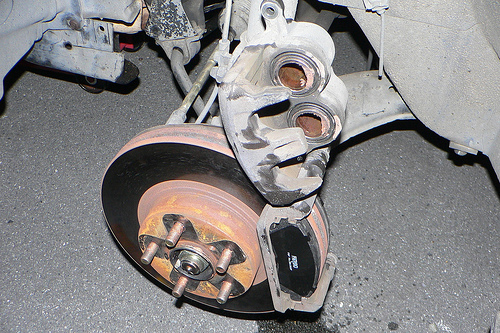
Lug nuts may be removed using a lug, socket, or impact wrench. If the wheel is to be removed, an automotive jack to raise the vehicle and some wheel chocks would be used as well. Wheels that have hubcaps or wheel covers need these removed beforehand, typically with a screwdriver,{{cite web |access-date = October 4, 2007
Lug nuts must be installed in an alternating pattern, commonly referred to as a star pattern. This ensures a uniform distribution of load across the wheel mounting surface. When installing lug nuts, it is recommended to tighten them with a calibrated torque wrench. While a lug, socket, or impact wrench may be used to tighten lug nuts, the final tightening should be performed by a torque wrench, ensuring an accurate and adequate load is applied. Torque specifications vary by vehicle and wheel type. Both vehicle and wheel manufacturers provide recommended torque values which should be consulted when an installation is done. Failure to abide by the recommended torque value can result in damage to the wheel and brake rotor/drum. Additionally, under-tightened lug nuts may come loose with time.
The tool size needed for removal and installation depends on the type of lug nut. The three most common hex sizes for lug nuts are 17 mm, 19 mm, and 21 mm, while 22 mm, 23 mm, inch (17.5 mm), and inch (20.6 mm) are less commonly used.
Detecting loose nuts
In order to allow early detection of loose lug nuts, some large vehicles are fitted with loose wheel nut indicators. The indicator spins with the nut so that loosening can be detected with a visual inspection.
Anti-theft nuts or bolts
In countries where the theft of alloy wheels is a serious problem, locking nuts (or bolts, as applicable) are available — or already fitted by the vehicle manufacturer — which require a special adaptor ("key") between the nut and the wrench to fit and remove. The key is normally unique to each set of nuts. Only one locking nut per wheel is normally used, so they are sold in sets of four. Most designs can be defeated using a hardened removal tool which uses a left-hand self-cutting thread to grip the locking nut, although more advanced designs have a spinning outer ring to frustrate such techniques. An older technique for removal was to simply hammer a slightly smaller socket over the locking wheel nut to be able to remove it. However, with the newer design of locking wheel nuts this is no longer possible. Removal nowadays requires special equipment that is not available to the general public. This helps to prevent thieves from obtaining the tools to be able to remove the lock nuts themselves.
History
In the United States, vehicles manufactured prior to 1975 by the Chrysler Corporation used left-hand and right-hand screw thread for different sides of the vehicle to prevent loosening. Most Buicks, Pontiacs, and Oldsmobiles used both left-handed and right-handed lug nuts prior to model year 1965.{{cite web | access-date = December 8, 2016
References
References
- [http://www.boltsirkel.no/ Boltsirkel.no]
- [https://cartreatments.com/lug-nut-sizes-types/ Lug Nut Sizes (w/ Chart For All Car Manufacturers through 2020)]
- [https://www.floorjackshop.com/lug-nut-sizes/ Lug Nut Sizes for All Car Manufacturers (with Chart)]
- Wright, Matthew. "What Order Do I Tighten My Lug Nuts?". About.com.
This article was imported from Wikipedia and is available under the Creative Commons Attribution-ShareAlike 4.0 License. Content has been adapted to SurfDoc format. Original contributors can be found on the article history page.
Ask Mako anything about Lug nut — get instant answers, deeper analysis, and related topics.
Research with MakoFree with your Surf account
Create a free account to save articles, ask Mako questions, and organize your research.
Sign up freeThis content may have been generated or modified by AI. CloudSurf Software LLC is not responsible for the accuracy, completeness, or reliability of AI-generated content. Always verify important information from primary sources.
Report