From Surf Wiki (app.surf) — the open knowledge base
Luddite
Member of an 1810s English anti-textile-machinery organisation
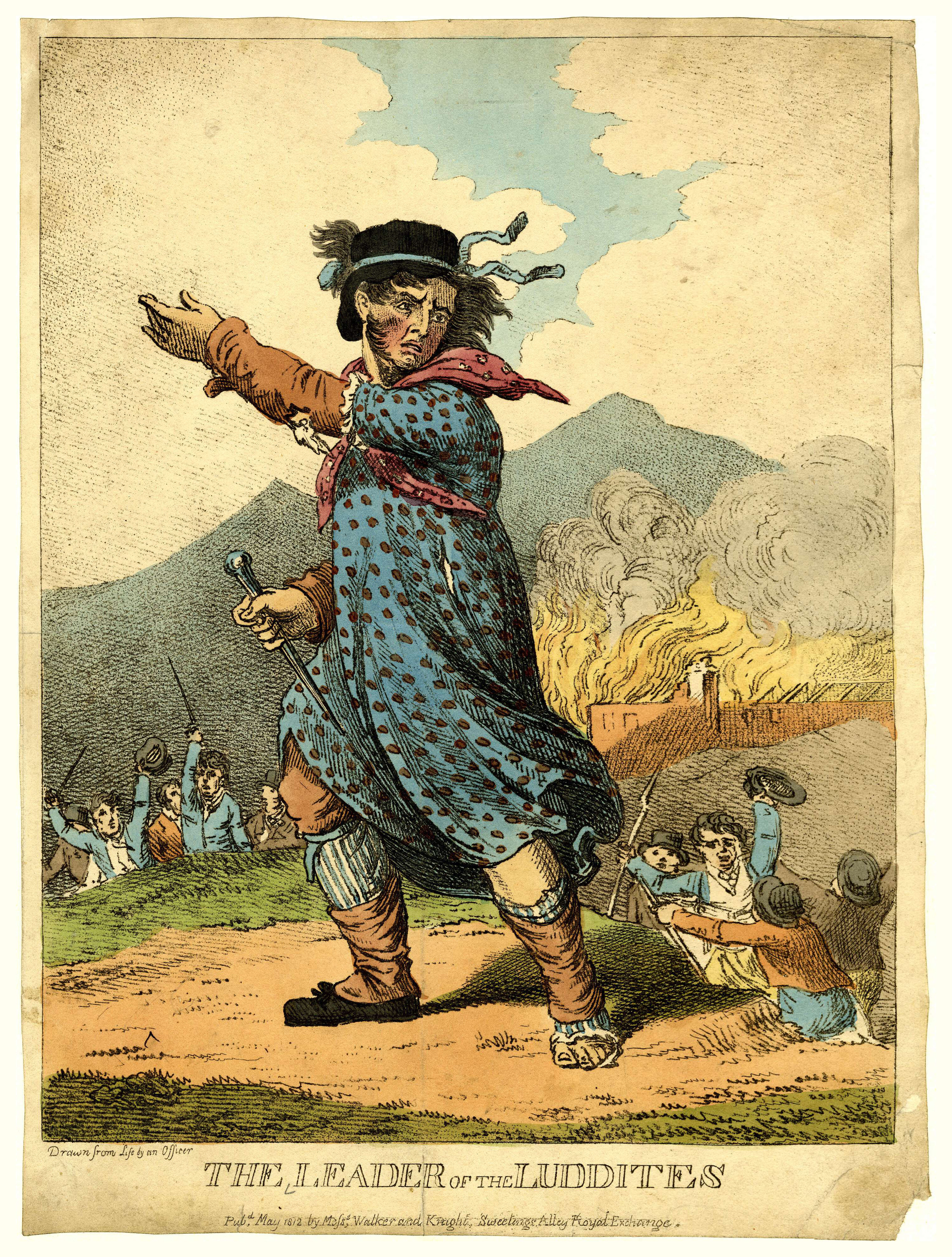
Member of an 1810s English anti-textile-machinery organisation
The Luddites were members of a 19th-century movement of English textile workers who opposed the use of certain types of automated machinery due to concerns relating to worker pay and output quality. They often destroyed the machines in organised raids. Members of the group referred to themselves as Luddites, self-described followers of "Ned Ludd", a legendary weaver whose name was used as a pseudonym in threatening letters to mill owners and government officials.
The Luddite movement began in Nottingham, England, and spread to the North West and Yorkshire between 1811 and 1816. Mill and factory owners took to shooting protesters and eventually the movement was suppressed by legal and military force, which included execution and penal transportation of accused and convicted Luddites.
Over time, the term has been used to refer to those opposed to the introduction of new technologies.
Etymology
The name Luddite ( ) occurs in the movement's writings as early as 1811. The movement utilised the eponym of Ned Ludd, an apocryphal apprentice who allegedly smashed two stocking frames in 1779 after being criticised and instructed to change his method. The name often appears as Captain, General, or King Ludd. Different versions of the legends place his residence in Anstey, near Leicester, or Sherwood Forest.
History
Background
In the 18th century, occupations that arose from the growth of trade and shipping in ports, also as "domestic" manufacturers, were notorious for precarious employment prospects. Underemployment was chronic during this period, and it was common practice to retain a larger workforce than was typically necessary for insurance against labour shortages in boom times.
Moreover, the organisation of manufacture by merchant capitalists in the textile industry was inherently unstable. While the financiers' capital was still largely invested in raw materials, it was easy to increase commitment when trade was good and almost as easy to cut back when times were bad. Merchant capitalists lacked the incentive of later factory owners, whose capital was invested in buildings and plants, to maintain a steady rate of production and return on fixed capital. The combination of seasonal variations in wage rates and violent short-term fluctuations springing from harvests and war produced periodic outbreaks of violence.
Historical precedents
The machine-breaking of the Luddites followed from previous outbreaks of sabotage in the English textile industry, especially in the hosiery and woollen trades. Organised action by stockingers had occurred at various times since 1675. In Lancashire, new cotton spinning technologies were met with violent resistance in 1768 and 1779. These new inventions produced textiles faster and cheaper because they could be operated by less-skilled, low-wage labourers. These struggles sometimes resulted in government suppression, via acts of Parliament such as the Protection of Stocking Frames, etc. Act 1788.
Periodic uprisings relating to asset prices also occurred in other contexts in the century before Luddism. Irregular rises in food prices provoked the Keelmen to riot in the port of Tyne in 1710 and tin miners to steal from granaries at Falmouth in 1727. There was a rebellion in Northumberland and Durham in 1740, and an assault on Quaker corn dealers in 1756.
Malcolm L. Thomas argued in his 1970 history The Luddites that machine-breaking was one of the very few tactics that workers could use to increase pressure on employers, undermine lower-paid competing workers, and create solidarity among workers. "These attacks on machines did not imply any necessary hostility to machinery as such; machinery was just a conveniently exposed target against which an attack could be made." Historian Eric Hobsbawm has called their machine wrecking "collective bargaining by riot", which had been a tactic used in Britain since the Restoration because manufactories were scattered throughout the country, and that made it impractical to hold large-scale strikes. An agricultural variant of Luddism occurred during the widespread Swing Riots of 1830 in southern and eastern England, centring on breaking threshing machines.
Peak activity: 1811–1817
The Luddite movement emerged during the harsh economic climate of the Napoleonic Wars, which saw a rise in difficult working conditions in the new textile factories paired with decreasing birth rates and a rise in education standards in England and Wales. Luddites were not opposed to the use of machines per se (many were skilled operators in the textile industry); they attacked manufacturers who were trying to circumvent standard labor practices of the time. The movement began in Arnold, Nottinghamshire, on 11 March 1811 and spread rapidly throughout England over the following two years.
The Luddites met at night on the moors surrounding industrial towns to practise military-like drills and manoeuvres. Their main areas of operation began in Nottinghamshire in November 1811, followed by the West Riding of Yorkshire in early 1812, and then Lancashire by March 1813. They wrecked specific types of machinery that posed a threat to the particular industrial interests in each region. In the Midlands, these were the "wide" knitting frames used to make cheap and inferior lace articles. In the North West, weavers sought to eliminate the steam-powered looms threatening wages in the cotton trade. In Yorkshire, workers opposed the use of shearing frames and gig mills to finish woollen cloth.
Many Luddite groups were highly organised and pursued machine-breaking as one of several tools for achieving specific political ends. In addition to the raids, Luddites coordinated public demonstrations and the mailing of letters to local industrialists and government officials. These letters explained their reasons for destroying the machinery and threatened further action if the use of "obnoxious" machines continued. The writings of Midlands Luddites often justified their demands through the legitimacy of the Company of Framework Knitters, a recognised public body that already openly negotiated with masters through named representatives. In North West England, textile workers lacked these long-standing trade institutions and their letters composed an attempt to achieve recognition as a united body of tradespeople. As such, they were more likely to include petitions for governmental reforms, such as increased minimum wages and the cessation of child labor. Northwestern Luddites were also more likely to use radical language linking their movement to that of American and French revolutionaries. In Yorkshire, the letter-writing campaign shifted to more violent threats against local authorities viewed as complicit in the use of offensive machinery to exert greater commercial control over the labour market.
In Yorkshire, the croppers (highly skilled workers who trimmed the nap from fabric to produce smooth, finished cloth) faced mass unemployment due to the introduction of cropping machines by Enoch Taylor of Marsden. This sparked the Luddite movement among the croppers of Yorkshire, who used a hammer dubbed "Enoch" to break the frames of the cropping machines. They called it Enoch to mock Enoch Taylor, and when they broke the frames they purportedly shouted "Enoch made them, and Enoch shall break them."
Luddites clashed with government troops at Burton's Mill in Middleton and at Westhoughton Mill, both in Lancashire. The Luddites and their supporters anonymously sent death threats to, and possibly attacked, magistrates and food merchants. Activists smashed Heathcote's lace making machine in Loughborough in 1816. He and other industrialists had secret chambers constructed in their buildings that could be used as hiding places during an attack.
In 1817 Jeremiah Brandreth, an unemployed Nottingham stockinger and probable ex-Luddite, led the Pentrich Rising. While this was a general uprising unrelated to machinery, it can be viewed as the last major Luddite act.
Government response
12,000 government troops, most of them belonging to militia or yeomanry units, were involved in suppression of Luddite activity, which historian Eric Hobsbawm wrote was a larger number than the army that the Duke of Wellington led into Portugal in 1808 during the Peninsular War. Four Luddites, led by a man named George Mellor, ambushed and assassinated mill owner William Horsfall of Ottiwells Mill in Marsden, West Yorkshire, at Crosland Moor in Huddersfield. Horsfall had remarked that he would "Ride up to his saddle in Luddite blood". Mellor fired the fatal shot to Horsfall's groin, and all four men were arrested. One of the men, Benjamin Walker, turned informant, and the other three were hanged. Lord Byron denounced what he considered to be the plight of the working class, the government's inane policies and ruthless repression in the House of Lords on 27 February 1812:
Government officials sought to suppress the Luddite movement with a mass trial at York in January 1813, following the attack on Cartwrights Mill at Rawfolds near Cleckheaton. The government charged over 60 men, including Mellor and his companions, with various crimes in connection with Luddite activities. While some of those charged were actual Luddites, many had no connection to the movement. Although the proceedings were legitimate jury trials, many were abandoned due to lack of evidence and 30 men were acquitted. These trials were intended to act as show trials to deter other Luddites from continuing their activities. The harsh sentences of those found guilty, which included execution and penal transportation, quickly ended the movement. Parliament made "machine breaking" (i.e. industrial sabotage) a capital crime with the Destruction of Stocking Frames, etc. Act 1812. Lord Byron opposed this legislation, becoming one of the few prominent defenders of the Luddites after the treatment of the defendants at the York trials.
Legacy
The Luddites (specifically the croppers, those who operated cropping machinery) are memorialised in the Yorkshire-area folk song "The Cropper Lads", which has been recorded by artists including Lou Killen and Maddy Prior. The croppers were very highly skilled and highly paid before the introduction of cropping machinery, and thus had more to lose and more reason to rebel against the factory owners' use of machinery. Another traditional song which celebrates the Luddites is the song "The Triumph of General Ludd", which was recorded by Chumbawamba for their 1988 album English Rebel Songs.
Modern usage
Nowadays, the term "Luddite" is often used to describe someone who either opposes or is resistant to the use of new technologies.
In 1956, during a British Parliamentary debate, a Labour spokesman said that "organised workers were by no means wedded to a 'Luddite Philosophy'." By 2006, the term neo-Luddism had emerged to describe opposition to many forms of technology. According to a manifesto drawn up by the Second Luddite Congress (April 1996; Barnesville, Ohio), neo-Luddism is "a leaderless movement of passive resistance to consumerism and the increasingly bizarre and frightening technologies of the Computer Age".
The term "Luddite fallacy" is used by economists about the fear that technological unemployment inevitably generates structural unemployment and is consequently macroeconomically injurious. If a technological innovation reduces necessary labour inputs in a given sector, then the industry-wide cost of production falls, which lowers the competitive price and increases the equilibrium supply point that, theoretically, will require an increase in aggregate labour inputs. During the 20th century and the first decade of the 21st century, the dominant view among economists has been that belief in long-term technological unemployment was indeed a fallacy. More recently, there has been increased support for the view that the benefits of automation are not equally distributed.{{cite web |access-date= 14 July 2015 |author-link= Robert Skidelsky, Baron Skidelsky |archive-date= 14 July 2015 |archive-url= https://web.archive.org/web/20150714220548/http://www.project-syndicate.org/commentary/robert-skidelsky-revisits-the-luddites--claim-that-automation-depresses-real-wages |url-status= live
Explanatory notes
References
Sources
References
- "Who were the Luddites?". History.com.
- Binfield, Kevin. (2004). "Writings of the Luddites". Johns Hopkins University Press.
- Linton, David. (Fall 1992). "The Luddites: How Did They Get That Bad Reputation?". Labor History.
- {{Cite OED. Luddite (n.), sense 1.b. 5449079592. (March 2024)
- "Power, Politics and Protest | the Luddites". The National Archives.
- Charles Wilson, ''England's Apprenticeship, 1603–1763'' (1965), pp. 344–345. PRO, SP 36/4/22.
- Binfield, Kevin. (2004). "Luddites and Luddism". The Johns Hopkins University Press.
- Rude, George. (2001). "The Crowd in History: A Study of Popular Disturbances in France and England, 1730–1848". Serif.
- Merchant, Brian. (2 September 2014). "You've Got Luddites All Wrong".
- (2003-06-22). "Historical events – 1685–1782 | Historical Account of Newcastle-upon-Tyne (pp. 47–65)". British History Online.
- Thomis, Malcolm. (1970). "The Luddites: Machine Breaking in Regency England". Shocken.
- (2003-11-01). "The Skill Content of Recent Technological Change: An Empirical Exploration". The Quarterly Journal of Economics.
- Harrison, J. F. C.. (1984). "The Common People: A History from the Norman Conquest to the Present". Croom Helm.
- O'Rourke, Kevin Hjortshøj. (2013). "Luddites, the industrial revolution, and the demographic transition". Journal of Economic Growth.
- Conniff, Richard. (March 2011). "What the Luddites Fought Against". [[Smithsonian (magazine).
- "Luddites". [[Thoroton Society of Nottinghamshire]].
- Francois Crouzet, ''Britain Ascendant'' (1990) pp. 277–279
- (2012). "Why nations fail: the origins of power, prosperity, and poverty". Crown Publishing.
- Binfield, Kevin. (2004). "Writings of the Luddites". Johns Hopkins University Press.
- Sale, Kirkpatrick. (1996). "Rebels against the future: the Luddites and their war on the Industrial Revolution: lessons for the computer age". Addison-Wesley Publishing Company.
- Mueller, Gavin. (2021). "Breaking Things at Work: The Luddites Are Right About Why You Hate Your Job". Verso.
- "Marsden History Group".
- "Enoch the Power Hammer".
- Dinwiddy, J. R.. (1992). "Radicalism and Reform in Britain, 1780–1850". Hambledon Press.
- "Workmen discover secret chambers". [[BBC]].
- Summer D. Leibensperger, "Brandreth, Jeremiah (1790–1817) and the Pentrich Rising". ''The International Encyclopedia of Revolution and Protest'' (2009): 1–2.
- Sharp, Alan. (2015). "Grim Almanac of York". The History Press.
- "Murder of William Horsfall by Luddites, 1812".
- "William Horsfall (1770–1812) – Huddersfield Exposed: Exploring the History of the Huddersfield Area".
- (8 January 2013). "8th January 1813: The execution of George Mellor, William Thorpe & Thomas Smith". The Luddite Bicentenary – 1811–1817.
- (27 February 1812). "Frame Work Bill. (Hansard, 27 February 1812)".
- "Luddites in Marsden: Trials at York".
- Elizabeth Gaskell, ''The Life of Charlotte Bronte'', Vol. 1, Ch. 6, for a contemporaneous description of the attack on Cartwright.
- [https://books.google.com/books?id=8adFAAAAcAAJ&dq=%22destruction%22%20%22stocking-frames%22%20parliamentary&pg=PA633 "Destruction of Stocking Frames, etc. Act 1812"] at books.google.com
- "Lord Byron and the Luddites {{!}} The Socialist Party of Great Britain".
- "The Cropper Lads (Roud -; TYG 62)".
- "General Ludd's Triumph".
- "Luddite Definition & Meaning".
- Sale, Kirkpatrick. (1997-02-01). "America's New Luddites". [[Le Monde diplomatique]].
- (1934). "Mechanization in Industry, National Bureau of Economic Research".
- Krugman, Paul. (2013-06-12). "Sympathy for the Luddites". [[The New York Times]].
- {{Harvnb. Ford. 2009
This article was imported from Wikipedia and is available under the Creative Commons Attribution-ShareAlike 4.0 License. Content has been adapted to SurfDoc format. Original contributors can be found on the article history page.
Ask Mako anything about Luddite — get instant answers, deeper analysis, and related topics.
Research with MakoFree with your Surf account
Create a free account to save articles, ask Mako questions, and organize your research.
Sign up freeThis content may have been generated or modified by AI. CloudSurf Software LLC is not responsible for the accuracy, completeness, or reliability of AI-generated content. Always verify important information from primary sources.
Report