From Surf Wiki (app.surf) — the open knowledge base
Lucifer
Mythological and religious figure

Mythological and religious figure
the mythological and religious figure
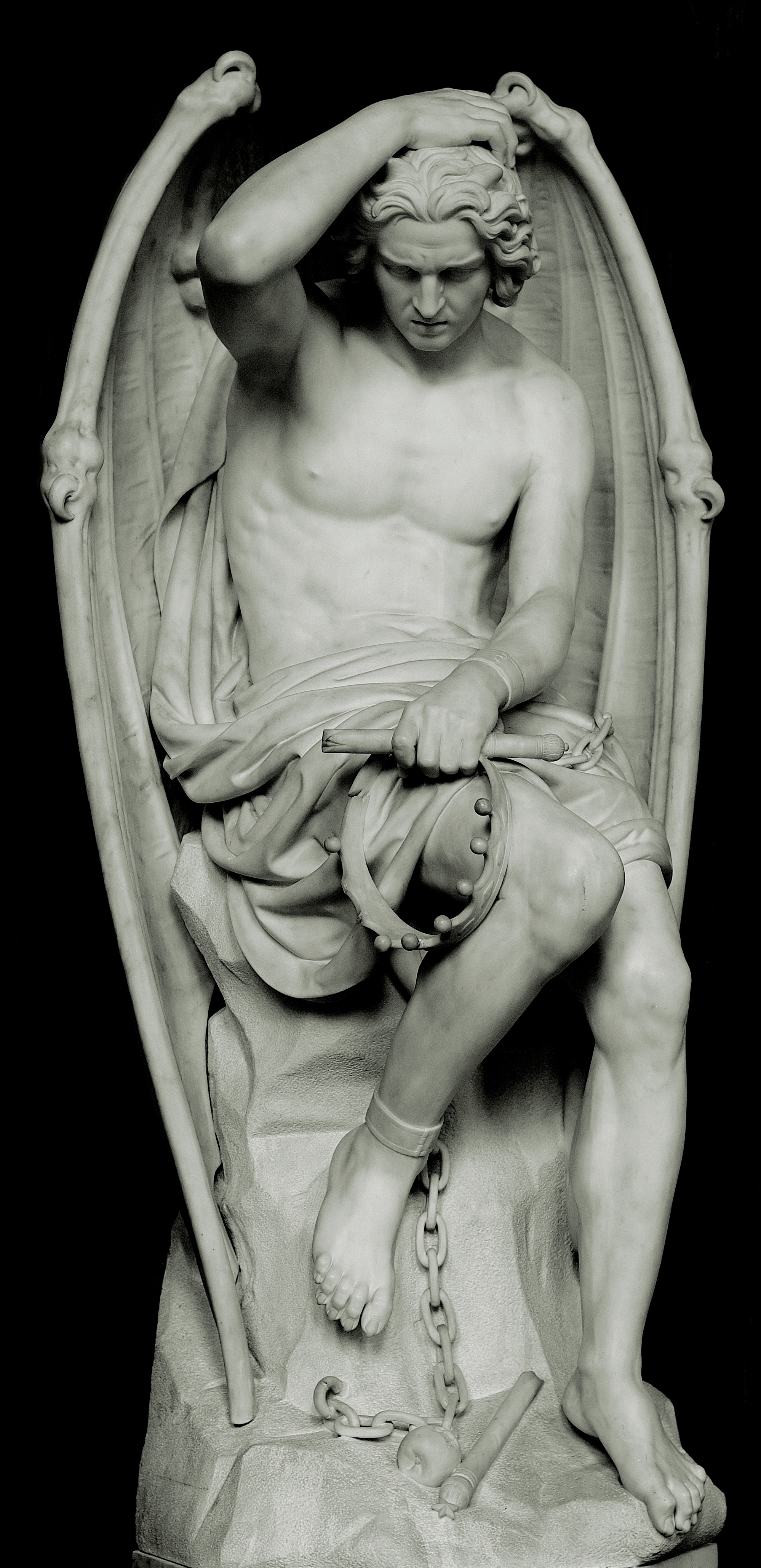
Lucifer is believed to be a fallen angel and the Devil in Christian theology. Lucifer is associated with the sin of pride and believed to have attempted a usurpation of God, whereafter being banished to hell.
The concept of a fallen angel attempting to overthrow the highest deity parallels Attar's attempt to overthrow Ba'al in Canaanite mythology; Attar is thrown into the underworld as a result of his failure. The story is alluded to in the Book of Isaiah and transferred to Christian beliefs, and is also used in the Vulgate (the late-4th-century Latin translation of the Bible).
As Lucifer is the antagonist of God in Christian beliefs, some sects of Satanism began to venerate him as a bringer of freedom. Other religious communities, such as the Gnostics and Freemasons, have been accused of worshipping Lucifer as their deity.
Lucifer frequently appears in popular media to this day.
Roman folklore and etymology
._Engraving_by_G.H._Frezza,_1704,_Wellcome_V0035916.jpg)
In Roman folklore, Lucifer ("light-bringer" in Latin) was the name of the planet Venus, though it was often personified as a male figure bearing a torch. The Greek name for this planet was variously Phosphoros Φωσφόρος (also meaning "light-bringer") or Heosphoros/Eosphoros Ἑωσφόρος (meaning "dawn-bringer"). Lucifer was said to be "the fabled son of Aurora and Cephalus, and father of Ceyx". He was often presented in poetry as heralding the dawn.[[File:Mercury, Venus and the Moon Align.jpg|thumb|Planet Venus in alignment with Mercury (above) and the Moon (below)]] The Latin word corresponding to Greek grc is Lucifer. It is used in its astronomical sense both in prose and poetry.{{efn|Virgil wrote: carpamus, dum mane novum, dum gramina canent}}}} ("Let us hasten, when first the Morning Star appears, to the cool pastures, while the day is new, while the grass is dewy")}}{{efn|Marcus Annaeus Lucanus: misit in Aegypton primo quoque sole calentem}}}} ("The morning-star looked forth from Mount Casius and sent the daylight over Egypt, where even sunrise is hot")}} Poets sometimes personify the star, placing it in a mythological context. As the Latin name for the morning appearances of the planet Venus, it corresponds not only to the Greek names Phosphoros and Eosphoros, but also to the Egyptian name Tioumoutiri, and the Old English term Morgensteorra (morning star).
A similar name used by the Roman poet Catullus for the planet in its evening aspect is "Noctifer" (Night-Bringer). This name respectively corresponded to not only the Greek name Hesperus Ἕσπερος (star of the evening), but also the Egyptian name Ouaiti, and the Old English term Æfensteorra (evening star).
Latin Lūcifer “light-bringer, morning star” (lux + ferre); used in the Vulgate for Isaiah 14:12 (Hebrew ; translates to "Shining One, Son of the morning/dawn"), later applied to Satan in Christian tradition.{{efn|Ovid wrote: purpureas Aurora fores et plena rosarum atria: diffugiunt stellae, quarum agmina cogit Lucifer et caeli statione novissimus exit}}}} ("Aurora, awake in the glowing east, opens wide her bright doors, and her rose-filled courts. The stars, whose ranks are shepherded by Lucifer the morning star, vanish, and he, last of all, leaves his station in the sky")}}{{efn|Statius: impulerat caelo gelidas Aurora tenebras, rorantes excussa comas multumque sequenti sole rubens; illi roseus per nubila seras aduertit flammas alienumque aethera tardo Lucifer exit equo, donec pater igneus orbem impleat atque ipsi radios uetet esse sorori}}}} ("And now Aurora rising from her Mygdonian couch had driven the cold darkness on from high in the heavens, shaking out her dewy hair, her face blushing red at the pursuing sun – from him roseate Lucifer averts his fires lingering in the clouds and with reluctant horse leaves the heavens no longer his, until the blazing father make full his orb and forbid even his sister her beams")}} The translation of the Hebrew word means "Shining One".
The 2nd-century Roman mythographer Hyginus said of the planet:
The Latin poet Ovid, in his 1st-century epic Metamorphoses, describes Lucifer as ordering the heavens:
Ovid, speaking of Phosphorus and Hesperus (the Evening Star, the evening appearance of the planet Venus) as identical, makes him the father of Daedalion. Ovid also makes him the father of Ceyx, while the Latin grammarian Servius makes him the father of the Hesperides or of Hesperis.
In the classical Roman period, Lucifer was not typically regarded as a deity and had few, if any, myths,
Planet Venus, Sumerian folklore, and fall from heaven motif
Main article: Venus in culture#Canaanite mythology
The motif of a heavenly being striving for the highest seat of heaven only to be cast down to the underworld has its origins in the motions of the planet Venus, known as the morning star.
A similar theme is present in the Babylonian myth of Etana. The Jewish Encyclopedia comments:
The fall from heaven motif also has a parallel in Canaanite mythology. In ancient Canaanite religion, the morning star is personified as the god, who attempted to occupy the throne of Ba'al and, finding he was unable to do so, descended and ruled the underworld. The original myth may have been about the lesser god Helel trying to dethrone the Canaanite high god El, who lived on a mountain to the north. Hermann Gunkel's reconstruction of the myth told of a mighty warrior called Hêlal, whose ambition was to ascend higher than all the other stellar divinities, but who had to descend to the depths; it thus portrayed as a battle the process by which the bright morning star fails to reach the highest point in the sky before being faded out by the rising sun.
This Jewish tradition has echoes also in Jewish pseudepigrapha such as 2 Enoch and the Life of Adam and Eve. The Life of Adam and Eve, in turn, shaped the idea of Iblis in the Quran.
Christianity
Main article: Devil in Christianity
In the Bible
In the Book of Isaiah, chapter 14, the king of Babylon is condemned in a prophetic vision by the prophet Isaiah and is called הֵילֵל בֶּן-שָׁחַר (he, Hebrew for "shining one, son of the morning"), who is addressed as הילל בן שחר (he). The title he refers to the planet Venus as the morning star, and that is how the Hebrew word is usually interpreted. The Hebrew word transliterated as he or he occurs only once in the Hebrew Bible. The Septuagint renders הֵילֵל in Greek as Ἑωσφόρος (grc), "bringer of dawn", the Ancient Greek name for the morning star. Similarly the Vulgate renders הֵילֵל in Latin as Lucifer, the name in that language for the morning star. According to the King James Bible-based Strong's Concordance, the original Hebrew word means "shining one, light-bearer", and the English translation given in the King James text is the Latin name for the planet Venus, "Lucifer", as it was already in the Wycliffe Bible.
However, the translation of הֵילֵל as "Lucifer" has been abandoned in modern English translations of Isaiah 14:12. Present-day translations render הֵילֵל as "morning star" (New International Version, New Century Version, New American Standard Bible, Good News Translation, Holman Christian Standard Bible, Contemporary English Version, Common English Bible, Complete Jewish Bible), "daystar" (New Jerusalem Bible, The Message), "Day Star" (New Revised Standard Version, English Standard Version), "shining one" (New Life Version, New World Translation, JPS Tanakh), or "shining star" (New Living Translation).
In a modern translation from the original Hebrew, the passage in which the phrase "Lucifer" or "morning star" occurs begins with the statement: "On the day the Lord gives you relief from your suffering and turmoil and from the harsh labour forced on you, you will take up this taunt against the king of Babylon: How the oppressor has come to an end! How his fury has ended!" After describing the death of the king, the taunt continues:
For the unnamed "king of Babylon", a wide range of identifications have been proposed. They include a Babylonian ruler of the prophet Isaiah's own time, or Nabonidus, and the Assyrian kings Tiglath-Pileser, Sargon II and Sennacherib. Verse 20 says that this king of Babylon will not be "joined with them [all the kings of the nations] in burial, because thou hast destroyed thy land, thou hast slain thy people; the seed of evil-doers shall not be named for ever", but rather be cast out of the grave, while "All the kings of the nations, all of them, sleep in glory, every one in his own house." Herbert Wolf held that the "king of Babylon" was not a specific ruler but a generic representation of the whole line of rulers.
Isaiah 14:12 became a source for the popular conception of the fallen angel motif. Rabbinic Judaism has rejected any belief in rebel or fallen angels. In the 11th century, the Pirkei De-Rabbi Eliezer illustrates the origin of the "fallen angel myth" by giving two accounts, one relates to the angel in the Garden of Eden who seduces Eve, and the other relates to the angels, the he who cohabit with the daughters of man (Genesis 6:1–4). An association of Isaiah 14:12–18 with a personification of evil, called the devil, developed outside of mainstream Rabbinic Judaism in pseudepigrapha, and later in Christian writings, particularly with the apocalypses.
The metaphor of the morning star that Isaiah 14:12 applied to a king of Babylon gave rise to the general use of the Latin word for "morning star", capitalized, as the original name of the devil before his fall from grace, linking Isaiah 14:12 with Luke 10 ("I saw Satan fall like lightning from heaven") and interpreting the passage in Isaiah as an allegory of Satan's fall from heaven.
Considering pride as a major sin peaking in self-deification, Lucifer (he) became the template for the devil. As a result, Lucifer was identified with the devil in Christianity and in Christian popular literature, Early medieval Christianity fairly distinguished between Lucifer and Satan. While Lucifer, as the devil, is fixated in hell, Satan executes the desires of Lucifer as his vassal.
Interpretations

Aquila of Sinope derives the word he, the Hebrew name for the morning star, from the verb he (to lament). This derivation was adopted as a proper name for an angel who laments the loss of his former beauty. The Christian church fathers – for example Jerome, in his Vulgate – translated this as Lucifer.
Some Christian writers have applied the name "Lucifer" as used in the Book of Isaiah, and the motif of a heavenly being cast down to the earth, to the devil. Sigve K. Tonstad argues that the New Testament War in Heaven theme of Revelation 12, in which the dragon "who is called the devil and Satan [...] was thrown down to the earth", was derived from the passage about the Babylonian king in Isaiah 14. Origen (184/185–253/254) interpreted such Old Testament passages as being about manifestations of the devil. Origen was not the first to interpret the Isaiah 14 passage as referring to the devil: he was preceded by at least Tertullian (), who in his Adversus Marcionem (book 5, chapters 11 and 17) twice presents as spoken by the devil the words of Isaiah 14:14: "I will ascend above the tops of the clouds; I will make myself like the Most High". Though Tertullian was a speaker of the language in which the word was created, "Lucifer" is not among the numerous names and phrases he used to describe the devil. Even at the time of Augustine of Hippo (354–430), a contemporary of the composition of the Vulgate, "Lucifer" had not yet become a common name for the devil.
Augustine's work Civitas Dei (5th century) became the major opinion of Western demonology including in the Catholic Church. For Augustine, the rebellion of the Devil was the first and final cause of evil. By this he rejected some earlier teachings about Satan having fallen when the world was already created. Further, Augustine rejects the idea that envy could have been the first sin (as some early Christians believed, evident from sources like the Cave of Treasures in which Satan has fallen because he envies humans and refused to prostrate himself before Adam), since pride ("loving yourself more than others and God") is required to be envious ("hatred for the happiness of others"). He argues that evil came first into existence by the free will of Satan. His attempt to take God's throne is not an assault on the gates of heaven, but a turn to solipsism in which the Devil becomes God in his world. When the king of Babylon uttered his phrase in Isaiah, he was speaking through the sprite of Lucifer, the head of devils. He concluded that everyone who falls away from God are within the body of Lucifer, and is a devil.
Adherents of the King James Only movement and others who hold that Isaiah 14:12 does indeed refer to the Devil have decried the modern translations. An opposing view attributes to Origen the first identification of the "Lucifer" of Isaiah 14:12 with the Devil and to Tertullian and Augustine of Hippo the spread of the story of Lucifer as fallen through pride, envy of God and jealousy of humans.
The 1409 Lollard manuscript titled Lanterne of Light associated Lucifer with the deadly sin of pride.
Protestant theologian John Calvin rejected the identification of Lucifer with Satan or the Devil. He said: "The exposition of this passage, which some have given, as if it referred to Satan, has arisen from ignorance: for the context plainly shows these statements must be understood in reference to the king of the Babylonians." Martin Luther also considered it a gross error to refer this verse to the Devil.
Counter-Reformation writers, like Albertanus of Brescia, classified the seven deadly sins each to a specific Biblical demon. He, as well as Peter Binsfield, assigned Lucifer to the sin of pride.
Gnosticism
Since Lucifer's sin mainly consists of self-deification, some Gnostic sects identified Lucifer with the creator deity in the Old Testament. In the Bogomil and Cathar text Gospel of the Secret Supper, Lucifer is a glorified angel but fell from heaven to establish his own kingdom and became the Demiurge who created the material world and trapped souls from heaven inside matter. Jesus descended to earth to free the captured souls. In contrast to mainstream Christianity, the cross was denounced as a symbol of Lucifer and his instrument in an attempt to kill Jesus.
Latter Day Saint movement
Lucifer is regarded within the Latter Day Saint movement as the pre-mortal name of the Devil. Latter-day Saint theology teaches that in a heavenly council, Lucifer rebelled against the plan of God the Father and was subsequently cast out. The Doctrine and Covenants reads:
After becoming Satan by his fall, Lucifer "goeth up and down, to and fro in the earth, seeking to destroy the souls of men." Members of the Church of Jesus Christ of Latter-day Saints consider Isaiah 14:12 to be referring to both the king of the Babylonians and the Devil.
Other occurrences
Arabian legends
According to Arabian legend the star Suhail (Canopus) was cast down from a his original place to a lower place in heaven; a story parallel to that of Lucifer. As recorded by Ibn Abbas, a companion of the Islamic prophet Muhammad, Suhail has once been the intermediary between the authority of command and the stars which had the position of soldiers. From that place he become the originator of rebellion and was eventually degraded and cast down to the southern sky.
The notion that the stars are soldiers may originate from Persian beliefs, but also appear in the Ethopian Book of Enoch: "And the stars which roll over the fire are they which have been transgressed the commandment of the Lord in the beginning of their rising, because they did not come forth at their appointed time."
Another legend states that Suhail has once been a Yemenite tithe-collector, but transformed into a star as means of punishment for his injust dealings. The idea that people turn into stars as a form of punishment is common in Arabian legend. The planet Venus was, according to Arabian legend, once a beautiful woman who has been transformed into a star as means of punishment when she seduced two angels.
Satanism
Luciferianism is a belief structure that venerates the fundamental traits that are attributed to Lucifer. The custom usually reveres Lucifer not as the Devil, but as a savior, a guardian or instructing spirit or even the true god as opposed to Jehovah.
In LaVeyan Satanism, Lucifer is described by The Satanic Bible as one of the four crown princes of hell, particularly that of the East, the "lord of the air", and is called the bringer of light, the morning star, intellectualism, and enlightenment.
Anthroposophy
Rudolf Steiner's writings, which formed the basis for Anthroposophy, characterised Lucifer as a spiritual opposite to Ahriman, with Christ between the two forces, mediating a balanced path for humanity. Lucifer represents an intellectual, imaginative, delusional, otherworldly force which might be associated with visions, subjectivity, psychosis and fantasy. He associated Lucifer with the religious/philosophical cultures of Egypt, Rome and Greece. Steiner believed that Lucifer, as a supersensible Being, had incarnated in China about 3000 years before the birth of Christ.
Freemasonry
Léo Taxil (1854–1907) claimed that Freemasonry is associated with worshipping Lucifer. In what is known as the Taxil hoax, he alleged that leading Freemason Albert Pike had addressed "The 23 Supreme Confederated Councils of the World" (an invention of Taxil), instructing them that Lucifer was God, and was in opposition to the evil god Adonai. Taxil promoted a book by Diana Vaughan (actually written by Taxil, as he later confessed publicly) that purported to reveal a highly secret ruling body called the Palladium, which controlled the organization and had a satanic agenda. As described by Freemasonry Disclosed in 1897:
Supporters of Freemasonry assert that, when Albert Pike and other Masonic scholars spoke about the "Luciferian path," or the "energies of Lucifer," they were referring to the Morning Star, the light bearer, the search for light; the very antithesis of dark. Pike says in Morals and Dogma, "Lucifer, the Son of the Morning! Is it he who bears the Light, and with its splendors intolerable blinds feeble, sensual, or selfish Souls? Doubt it not!" Much has been made of this quote.
Taxil's work and Pike's address continue to be quoted by anti-masonic groups.
In Devil-Worship in France, Arthur Edward Waite compared Taxil's work to today's tabloid journalism, replete with logical and factual inconsistencies.
Charles Godfrey Leland
In a collection of folklore and magical practices supposedly collected in Italy by Charles Godfrey Leland and published in his Aradia, or the Gospel of the Witches, the figure of Lucifer is featured prominently as both the brother and consort of the goddess Diana, and father of Aradia, at the center of an alleged Italian witch-cult. In Leland's mythology, Diana pursued her brother Lucifer across the sky as a cat pursues a mouse. According to Leland, after dividing herself into light and darkness:
Here, the motions of Diana and Lucifer once again mirror the celestial motions of the moon and Venus, respectively. Though Leland's Lucifer is based on the classical personification of the planet Venus, he also incorporates elements from Christian tradition, as in the following passage:
In the several modern Wiccan traditions based in part on Leland's work, the figure of Lucifer is usually either omitted or replaced as Diana's consort with either the Etruscan god Tagni, or Dianus (Janus, following the work of folklorist James Frazer in The Golden Bough).
Modern popular culture
In modern popular culture, Lucifer is often depicted as a charismatic, complex, and sometimes sympathetic figure rather than a purely evil being. He is frequently portrayed as a fallen angel with a rebellious streak, and may be intelligent, witty, and even morally conflicted.
In the TV series Supernatural, Lucifer is the main antagonist of the fifth season. The conflict between the good and evil angels is portrayed as a conflict between brothers. Despite being the villain in the story, he is held in higher regards than the antagonistic deities, as Lucifer defeats the pagan gods alone in one episode. His background story further adds to his moral ambiguity. His evil motivations are said to stem from his love to God: when God shows love for humanity and orders the angels to bow before them, Lucifer refuses, because he could only love God. His depictions are inspired by the Islamic traditions about Iblis and Satanael as a son of God in Bogomilism.
Notable examples of Lucifer in popular culture include the television series Lucifer (2016–2021), where he is a suave nightclub owner who rebelled against his lord-father and abandoned the role as Hell's warden, and The Sandman comics, which present him as a refined ruler of hell seeking independence, both stemming from DC Comics' interpretation of the religious figure. These portrayals emphasize his free will, disdain for authority, and struggle with his identity, often blending elements of myth, theology, and contemporary storytelling.
Gallery
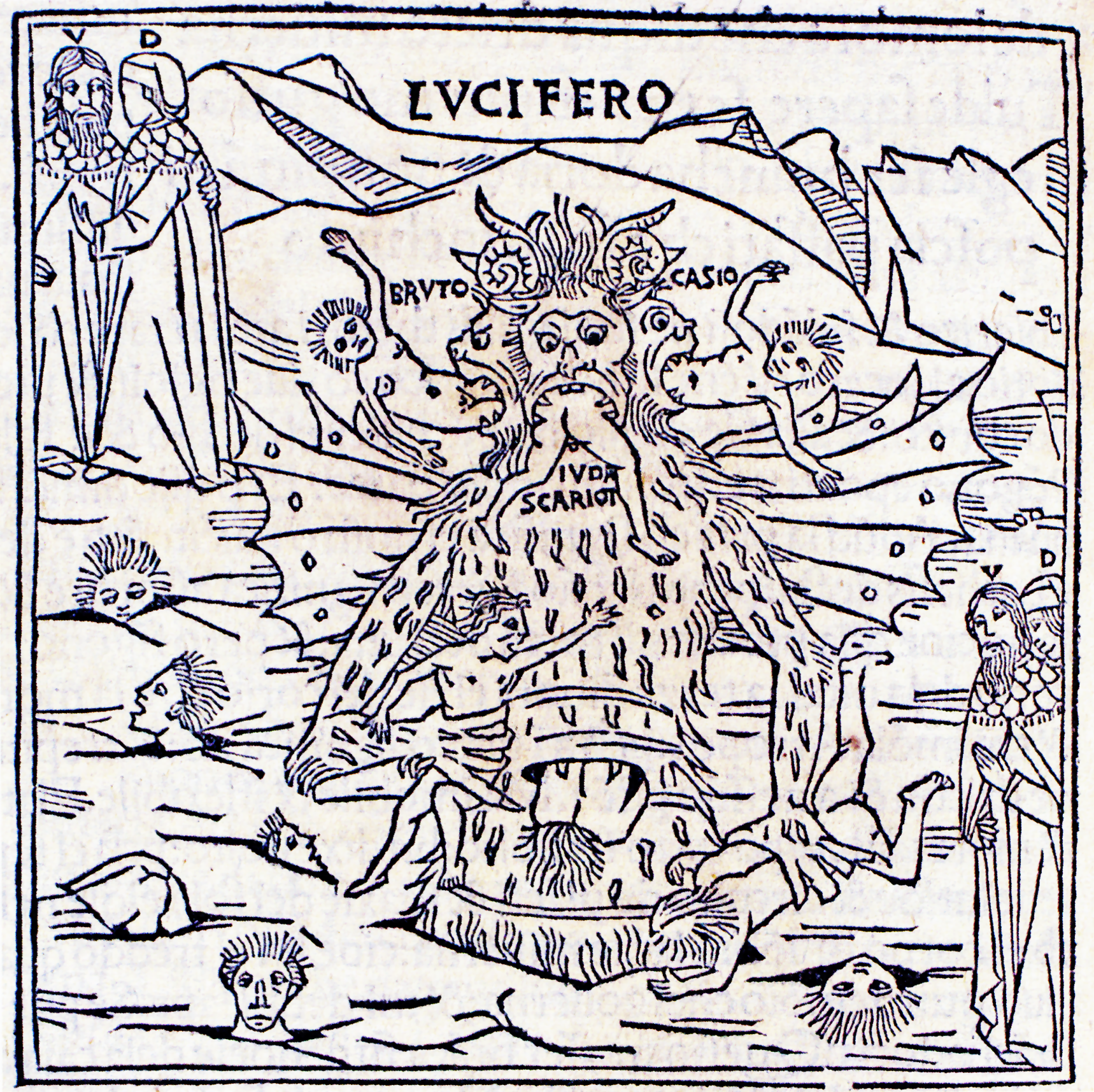
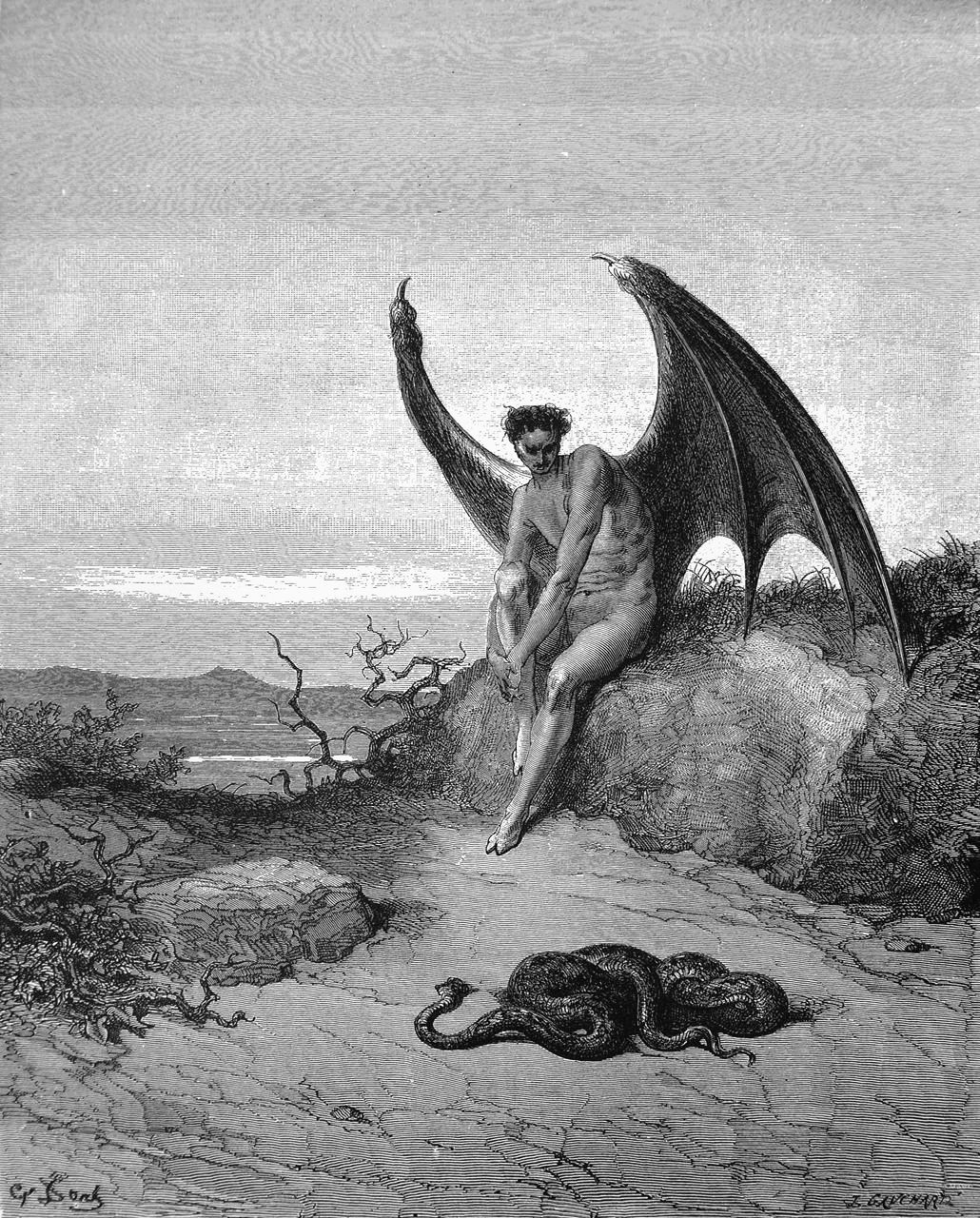
File:Inf. 34 Alessandro Vellutello, Lucifero (1534).jpg|Lucifer, by Alessandro Vellutello (1534), for Dante's Inferno, canto 34 File:Illustrations to Dante's Divine Comedy, object 72 Butlin 812-69 recto Lucifer.jpg|Lucifer, by William Blake, for Dante's Inferno, canto 34 File:ParadiseLButts1.jpg|Satan arousing rebel angels in Milton's Paradise Lost, by William Blake File:Copertina_Lucifero.jpg|Cover of 1887 edition of Mario Rapisardi's poem Lucifero File:Zichy,Mihaly - Lucifer az urral szemben (Madach).jpg|Lucifer before the Lord, by Mihály Zichy (19th century) File:Punchinello Mayor Hall.png|Mayor Hall and Lucifer, by an unknown artist (1870) File:Paradise Lost 12.jpg|Gustave Doré's illustration for Milton's Paradise Lost, III, 739–742: Satan on his way to bring about the fall of man File:Paradise Lost 19.jpg|Gustave Doré's illustration for Milton's Paradise Lost, V, 1006–1015: Satan yielding before Gabriel File:Arnold Rechberg - Lucifer 1906.jpg|Lucifer, by Arnold Rechberg (1906)
Notes
References
References
- Kohler, Kaufmann. (2006). "Heaven and Hell in Comparative Religion with Special Reference to Dante's Divine Comedy". [[Kessinger Publishing]].
- [https://www.britannica.com/topic/Lucifer-classical-mythology "Lucifer] {{Webarchive. link. (2020-01-24 " in ''Encyclopaedia Britannica''].)
- (2004). "The Fall of the Angels". BRILL.
- Smith, William. (1878). "A Smaller Classical Dictionary of Biography, Mythology, and Geography". Harper.
- Cicero. [http://www.thelatinlibrary.com/cicero/nd2.shtml#53. ''De Natura Deorum'', Book 2, Ch. 20. 53]
- [https://www.perseus.tufts.edu/cgi-bin/ptext?doc=Perseus%3Atext%3A1999.02.0004&query=id%3D%23927 Natural History 2, 36].
- [http://www.thelatinlibrary.com/vergil/geo3.shtml] {{Webarchive. link. (2019-11-15 [[Georgics]]3:324–325.)
- [http://www.thelatinlibrary.com/lucan/lucan10.shtml Lucan, ''Pharsalia'', 10:434–435] {{Webarchive. link. (2019-01-30 ; [https://archive.org/stream/lucancivilwarboo00lucauoft/lucancivilwarboo00lucauoft_djvu.txt English translation by J. D. Duff (Loeb Classical Library)].)
- "Catullus 62 - Wikisource, the free online library".
- {{cite encyclopedia. link
- Ovid. ''Metamorphoses'', [https://ovid.lib.virginia.edu/trans/Metamorph2.htm#476707493 Book 2, ln. 114-115; translation by A. S. Kline]. {{Webarchive. link. (2012-06-09)
- [http://www.thelatinlibrary.com/statius/theb2.shtml] {{Webarchive. link. (2019-03-30 [[Thebaid (Latin poem)). Statius, ''Thebaid'']] 2, 134–150
- P. Papinius Statius. (2007). "Thebaid and Achilleid". Cambridge Scholars Publisher.
- [https://www.studylight.org/lexicons/hebrew/1966.html Old Testament Hebrew Lexical Dictionary] {{Webarchive. link. (2019-04-02.)
- [https://topostext.org/work/207#2.42.4 ''Astronomica'' Book 2, Ch. 42.4 (trans. Grant)].
- Ovid, ''Metamorphoses'', [http://www.theoi.com/Titan/AstraPlaneta.html Book 2, ln. 112 ff (trans. Melville)] {{Webarchive. link. (2014-12-11.)
- ''[[Metamorphoses]]'', Book 11, ln. 295
- ''Metamorphoses'', Book 11, ln. 271
- [[Bibliotheca (Pseudo-Apollodorus). link. (2021-02-25 .)
- "EOSPHORUS & HESPERUS (Eosphoros & Hesperos) – Greek Gods of the Morning & Evening Stars".
- "Cicero, ''De Natura Deorum'' Book 3, Ch. 19".
- "Lucifer".
- Day, John. (2002). "Yahweh and the gods and goddesses of Canaan". [[Continuum International Publishing Group]].
- Boyd, Gregory A.. (1997). "God at War: The Bible & Spiritual Conflict". InterVarsity Press.
- (1955). "El in the Ugaritic Texts".
- (30 August 2007). "Isaiah 1–30". B&H Publishing Group.
- Gunkel, Hermann. (2006). "Creation And Chaos in the Primeval Era And the Eschaton. A Religio-historical Study of Genesis 1 and Revelation 12". [[William B. Eerdmans Publishing Company]].
- Schwartz, Howard. (2004). "Tree of souls: The mythology of Judaism". OUP.
- (2016). "Religious Stories in Transformation: Conflict, Revision and Reception". [[Brill Publishers]].
- (2003). "Eerdmans Commentary on the Bible". [[William B. Eerdmans Publishing Company]].
- "Isaiah 14 Biblos Interlinear Bible". Interlinearbible.org.
- "Isaiah 14 Hebrew OT: Westminster Leningrad Codex". Wlc.hebrewtanakh.com.
- "Astronomy – Helel, Son of Dawn".
- Wilken, Robert. (2007). "Isaiah: Interpreted by Early Christian and Medieval Commentators". Wm Eerdmans Publishing.
- "Isaiah Chapter 14". The Mamre Institute.
- Gunkel expressly states that "the name Helel ben Shahar clearly states that it is a question of a nature myth. Morning Star, son of Dawn has a curious fate. He rushes gleaming up towards heaven, but never reaches the heights; the sunlight fades him away." ([https://archive.org/details/schpfungundchao01zimmgoog/page/n151 ''Schöpfung und Chaos'', p. 133])
- "Hebrew Concordance: hê·lêl – 1 Occurrence – Bible Suite". Biblos.com.
- "Strong's Concordance, H1966".
- "LXX Isaiah 14". Septuagint.org.
- "Greek OT (Septuagint/LXX): Isaiah 14". Bibledatabase.net.
- "LXX Isaiah 14". Biblos.com.
- "Septuagint Isaiah 14". Sacred Texts.
- "Greek Septuagint (LXX) Isaiah – Chapter 14". Blue Letter Bible.
- Neil Forsyth. (1989). "The Old Enemy: Satan and the Combat Myth". [[Princeton University Press]].
- Nwaocha Ogechukwu Friday. (30 May 2012). "The Devil: What Does He Look Like?". American Book Publishing.
- Taylor, Bernard A.; with word definitions by J. Lust. (2009). "Analytical lexicon to the Septuagint". Hendrickson Publishers, Inc..
- {{bibleverse. Isaiah. 14:3–4. NIV
- {{bibleverse. Isaiah. 14:12–17. NIV
- Carol J. Dempsey. (2010). "Isaiah: God's Poet of Light". Chalice Press.
- (1995). "Isaiah through the Ages". St Vladimir's Seminary Press.
- (1997). "The seductiveness of Jewish myth : challenge or response?". State University of New York Press.
- Laney, J. Carl. (1997). "Answers to Tough Questions from Every Book of the Bible". Kregel Publications.
- Doorly, William J.. (1992). "Isaiah of Jerusalem". Paulist Press.
- Isaiah 14:18
- Wolf, Herbert M.. (1985). "Interpreting Isaiah: The Suffering and Glory of the Messiah". Academie Books.
- Herzog, Schaff-. (1909). "The New Schaff-Herzog Encyclopedia of Religious Thought: Chamier-Draendorf". Funk & Wagnalls Co..
- Bamberger, Bernard J.. (2006). "Fallen Angels: Soldiers of Satan's Realm". Jewish Publ. Soc. of America.
- Adelman, Rachel (2009). pp. [https://books.google.com/books?id=Z7Ue5kAkw20C&pg=PA62&dq=%22+Book+of+Enoch%22 61–62].
- (January 1, 1912). "The Jewish Encyclopedia, Volume 8".
- David L. Jeffrey. (1992). "A Dictionary of Biblical Tradition in English Literature". Eerdmans.
- (2011). "The Oxford Dictionary of the Jewish Religion". [[Oxford University Press]].
- {{bibleverse. Luke. 10:18. NIV
- (1991). "The Merriam-Webster New Book of Word Histories". Merriam-Webster.
- Harold Bloom. (2005). "Satan". Infobase Publishing.
- Litwa, M. David (2016). Desiring Divinity: Self-deification in Early Jewish and Christian Mythmaking. Oxford University Press. ISBN 978-0-19-046717-3. p. 46
- Adelman, Rachel. (2009). "The Return of the Repressed: Pirqe De-Rabbi Eliezer and the Pseudepigrapha". [[Brill Publishers.
- "John Milton on Satan's Reign in Hell".
- Jeffrey Burton Russell: Biographie des Teufels: das radikal Böse und die Macht des Guten in der Welt. Böhlau Verlag Wien, 2000, retrieved 19 October 2020.
- Dendle, Peter (2001). Satan Unbound: The Devil in Old English Narrative Literature. University of Toronto Press. ISBN 978-0-8020-8369-2.p. 10
- Bonnetain, Yvonne S (2015). Loki: Beweger der Geschichten [Loki: Movers of the stories] {{in lang. de. Roter Drache; ISBN 978-3-939459-68-2 / OCLC 935942344. pg. 263
- (20 January 2007). "Saving God's Reputation". [[Continuum International Publishing Group.
- Kelly, Joseph Francis. (2002). "The Problem of Evil in the Western Tradition". [[Liturgical Press]].
- Auffarth, Christoph; Stuckenbruck, Loren T., eds. (2004). p. [https://books.google.com/books?id=lhNyGFkT3QYC&pg=PA62&dq=Origen+Lucifer 62].
- Fekkes, Jan. (1994). "Isaiah and Prophetic Traditions in the Book of Revelation". Continuum.
- {{bibleverse. Isaiah. 14:14. NIV
- Migne, [https://archive.org/details/patrologiaecurs51unkngoog/page/n260 ''Patrologia latina''], vol. 2, cols. 500 and 514
- "Tertullian : Ernest Evans, Adversus Marcionem. Book 5 (English)".
- Jeffrey Burton Russell. (1987). "Satan: The Early Christian Tradition". [[Cornell University Press]].
- Link, Luther. (1995). "The Devil: A Mask without a Face". [[Reaktion Books]].
- Schreckenberg, Heinz; Schubert, Kurt (1992). ''Jewish Historiography and Iconography in Early and Medieval Christianity''. Augsburg Fortress, Publishers; ISBN 978-0-8006-2519-1. pg. 253
- (1988). "Augustine on the Origin and Progress of Evil". The Journal of Religious Ethics.
- (1988). "Augustine on Sin and Moral Agency". The Journal of Religious Ethics.
- (2010). "The Man Plague: Disco, the Lucifer Myth, and the Theology of 'It's Raining Men': The Man Plague". The Journal of Popular Culture.
- Hollerich, M. J.; Christman, A. R. (2007). ''Isaiah: Interpreted by Early Christian Medieval Commentators''. Cambridge: Eerdmans. pp. 175–176
- Larry Alavezos. (29 September 2010). "A Primer on Salvation and Bible Prophecy". TEACH Services.
- David W. Daniels. (2003). "Answers to Your Bible Version Questions". Chick Publications.
- William Dembski. (2009). "The End of Christianity". B&H Publishing Group.
- Cain, Andrew. (2011). "The fathers of the church. Jerome. Commentary on Galatians". [[Catholic University of America Press.
- (2012). "A Companion to Angels in Medieval Philosophy". BRILL.
- Nicolas de Dijon. (1730). "Prediche Quaresimali: Divise In Due Tomi". Storti.
- Corson, Ron. (2008). "Who is Lucifer...or Satan misidentified". newprotestants.com.
- Calvin, John. (2007). "Commentary on Isaiah". Forgotten Books.
- Ridderbos, Jan. (1985). "The Bible Student's Commentary: Isaiah". Regency.
- Patrick Gilli (ed.). ''La pathologie du pouvoir: vices, crimes et délits des gouvernants: antiquité, moyen âge, époque moderne'' (2016). Studies in Medieval and Reformation Traditions, vol. 198. Brill. pg. 494
- Levack, B. (2013). ''The Devil Within: Possession and Exorcism in the Christian West''. Yale University Press. pg. 278
- Litwa, M. David (2016). ''Desiring Divinity: Self-deification in Early Jewish and Christian Mythmaking''. Oxford University Press. {{ISBN. 978-0-19-046717-3. p. 46
- Michael C. Thomsett (2011). ''Heresy in the Roman Catholic Church: A History''. McFarland. {{ISBN. 978-0-786-48539-0 p. 71
- Willis Barnstone, Marvin Meyer (2009). ''The Gnostic Bible: Revised and Expanded Edition''. Shambhala. {{ISBN. 978-0-834-82414-0. p. 745–755, 831
- Willis Barnstone, Marvin Meyer (2009). ''The Gnostic Bible: Revised and Expanded Edition''. Shambhala. {{ISBN. 978-0-834-82414-0. p. 745–755, 751
- "Devils".
- "Doctrine and Covenants 76".
- "Doctrine and Covenants 10".
- "Lucifer".
- "Isaiah 14".
- ANTON M. HEINEN ISLAMIC COSMOLOGY A STUDY OF AS-SUYUTI'S al-Hay'a as-samya fi l-hay'a as-sunmya with critical edition, translation, and commentary ANTON M. HEINEN BEIRUT 1982 pp. 96-97
- ANTON M. HEINEN ISLAMIC COSMOLOGY A STUDY OF AS-SUYUTI'S al-Hay'a as-samya fi l-hay'a as-sunmya with critical edition, translation, and commentary ANTON M. HEINEN BEIRUT 1982 pp. 220-221
- ANTON M. HEINEN ISLAMIC COSMOLOGY A STUDY OF AS-SUYUTI'S al-Hay'a as-samya fi l-hay'a as-sunmya with critical edition, translation, and commentary ANTON M. HEINEN BEIRUT 1982 p. 96
- Rhys, Dani. (2023-02-22). "Understanding the Sigil of Lucifer: A Symbol Misunderstood".
- Michelle Belanger. (2007). "Vampires in Their Own Words: An Anthology of Vampire Voices". [[Llewellyn Worldwide]].
- Spence, L.. (1993). "An Encyclopedia of Occultism". Carol Publishing.
- LaVey, Anton Szandor. (1969). "The Satanic Bible". Avon.
- (2 April 2001). "Leo Taxil's confession". Grand Lodge of British Columbia and Yukon.
- ''Freemasonry Disclosed'' April 1897
- (Albert Pike, ''Morals and Dogma'', p. 321).
- ([http://www.masonicinfo.com/lucifer.htm Masonic information: Lucifer] {{Webarchive. link. (2022-01-27 ).)
- "Leo Taxil: The tale of the Pope and the Pornographer".
- Magliocco, Sabina. (2009). Aradia in Sardinia: The Archaeology of a Folk Character. Pp. 40–60 in ''Ten Years of Triumph of the Moon''. Hidden Publishing.
- Charles G. Leland, ''Aradia: The Gospel of Witches'', Theophania Publishing, US, 2010.
- Magliocco, Sabina. (2006). [https://www.academia.edu/584607/Italian_American_Stregheria_and_Wicca_Ethnic_ambivalence_in_American_Neopaganism Italian American Stregheria and Wicca: Ethnic Ambivalence in American Neopaganism] {{Webarchive. link. (2019-08-09 . Pp. 55–86 in Michael Strmiska, ed., ''Modern Paganism in World Cultures: Comparative Perspectives''. Santa Barbara, CA: ABC-Clio.)
- Nosachev, Pavel. (2020-12-04). "Theology of Supernatural". Religions.
- (10 November 2023). "From Olympian to Christ-figure: Lucifer (2016 – 2021)". Thersites.
- (June 2013). "Neil Gaiman's Lucifer: Reconsidering Milton's Satan". The Journal of Religion and Popular Culture.
- (2011-07-08). "Paradise Lost: Illustrations by Gustave Doré".
- (2010-09-23). "Paradise Lost: Illustrations by Gustave Doré".
This article was imported from Wikipedia and is available under the Creative Commons Attribution-ShareAlike 4.0 License. Content has been adapted to SurfDoc format. Original contributors can be found on the article history page.
Ask Mako anything about Lucifer — get instant answers, deeper analysis, and related topics.
Research with MakoFree with your Surf account
Create a free account to save articles, ask Mako questions, and organize your research.
Sign up freeThis content may have been generated or modified by AI. CloudSurf Software LLC is not responsible for the accuracy, completeness, or reliability of AI-generated content. Always verify important information from primary sources.
Report