From Surf Wiki (app.surf) — the open knowledge base
Lovech Province
| Field | Value |
|---|---|
| name | Lovech Province |
| native_name | Oбласт Ловеч |
| native_name_lang | bul |
| settlement_type | Province |
| image_skyline | View of the Balkan Mountains - panoramio (5).jpg |
| image_caption | A view to the Balkan Mountains in Lovech Province |
| image_flag | Flag of Lovech.svg |
| image_map | Lovech in Bulgaria.svg |
| map_caption | Location of Lovech Province in Bulgaria |
| subdivision_type | Country |
| subdivision_name | Bulgaria |
| seat_type | Capital |
| seat | Lovech |
| parts_type | Municipalities |
| parts_style | para |
| p1 | 8 |
| leader_title | Governor |
| leader_name | Georgi Terziyski |
| area_total_km2 | 4,128 |
| population_total | 113,356 |
| population_as_of | December 2022 |
| population_density_km2 | auto |
| timezone1 | EET |
| utc_offset1 | +2 |
| timezone1_DST | EEST |
| utc_offset1_DST | +3 |
| blank_name_sec1 | License plate |
| blank_info_sec1 | OB |
| website |
Lovech Province (, former name Lovech okrug) is one of the 28 provinces of Bulgaria, lying at the northern centre of the country. It is named after its main city: Lovech. As of December 2009, the population of the area was 151,153. It covers a total area of approximately 4,129 square km and includes 8 municipalities.
Geography and Nature
The region is characterized by a mix of mountainous and lowland terrain, with significant rivers including the Osam, Vit, and Zlatna Panega flowing through it. Much of the province lies within the northern foothills of the Balkan Mountains, contributing to a varied landscape of forests, rivers, and karst formations.
Lovech Province is home to parts of the Central Balkan National Park, one of the largest protected areas in Bulgaria. The park includes several reserves such as:
- Steneto Reserve – known for its deep gorges and rich biodiversity.
- Boatin Reserve – featuring ancient beech forests and habitats for rare bird species.
- Tsarichina Reserve – preserving typical Central Balkan flora and fauna.
Numerous karst caves can be found in the region, including:
- Devetashka Cave – one of the largest caves in Bulgaria, known for its impressive natural arches and archaeological significance.
- Prohodna Cave – known for the two eye-like holes in its ceiling, called God's eyes.
- Saeva Dupka Cave – famous for its beautiful stalactites and stalagmites, and acoustics suitable for concerts.
Cultural and Historical Sites
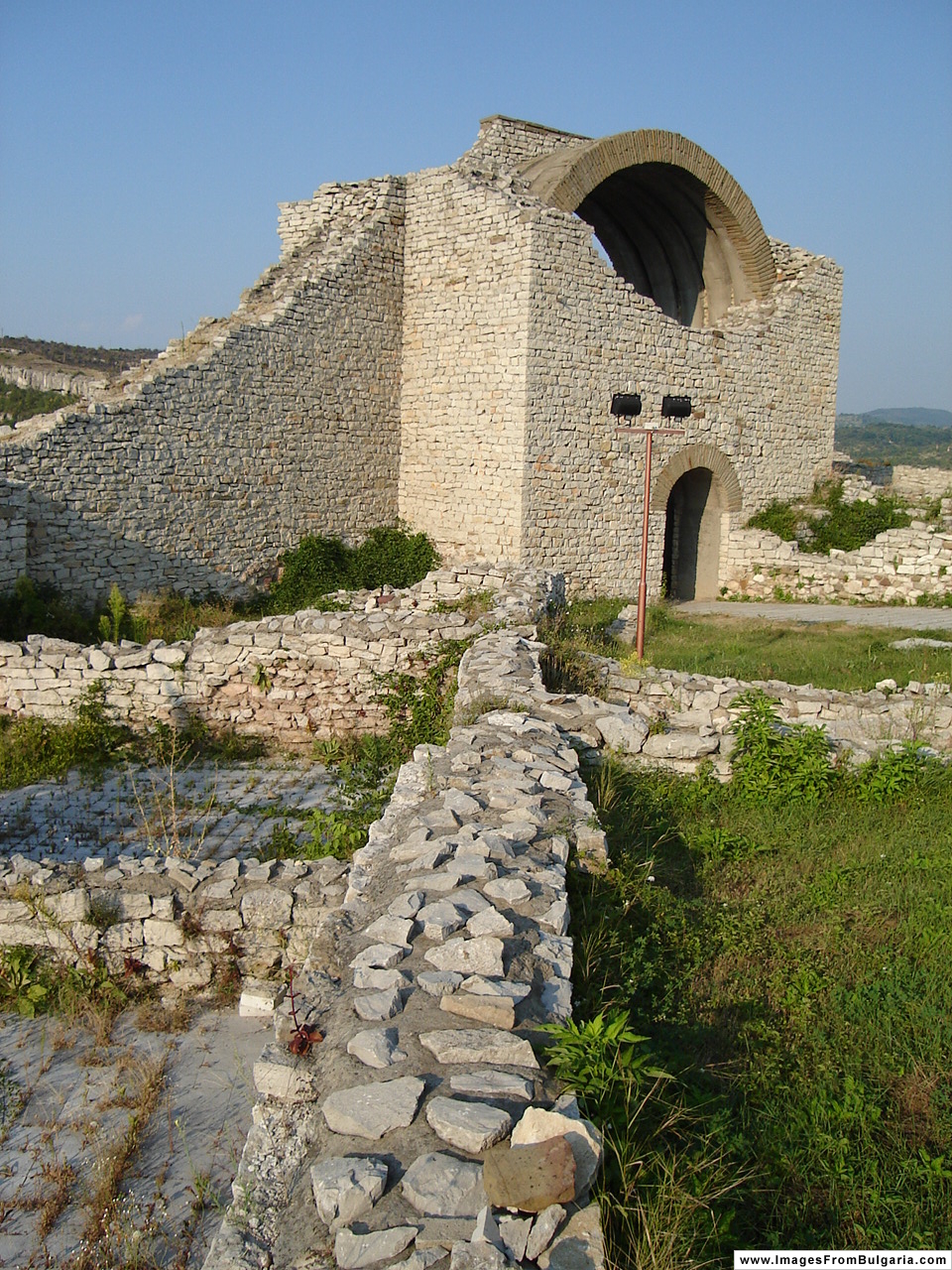
The province has a rich historical heritage with over 600 cultural monuments, ranging from Thracian and Roman times to the Bulgarian National Revival. Notable landmarks include:
- Troyan Monastery – the third largest monastery in Bulgaria, founded in the 16th century, known for its frescoes by Zahari Zograf.
- Glozhene Monastery – perched on a cliff near the village of Glozhene, offering panoramic views and historical significance.
- The Covered Bridge, Lovech – a unique structure built by Bulgarian master Kolyu Ficheto in the 19th century, connecting the old town (Varosha) with the new part of the city.
The architectural reserve Varosha, located in Lovech, preserves numerous Revival-style houses and churches, and the Vasil Levski Museum honors the legacy of Bulgaria’s national hero.
Tourism and Economy
Lovech Province is a growing tourist destination, attracting visitors with its natural beauty, cultural landmarks, and thermal springs. The village of Shipkovo is known for its mineral water and balneotherapy, while Apriltsi, Teteven, and Troyan offer mountain tourism, hiking, and traditional crafts.
Economically, the province is supported by industries such as food processing, woodworking, and machine-building, with tourism playing an increasingly important role.
Municipalities
The Lovech Province (област, oblast) contains eight municipalities (singular: община, obshtina - plural: общини, obshtini). The following table shows the names of each municipality in English and Cyrillic, the main town or village (in bold), and the population as of December 2009.
| Municipality | Cyrillic | Pop. | Town/Village | en}} Bulgarian National Statistical Institute - Bulgarian towns in 2009 |
|---|---|---|---|---|
| Apriltsi | Априлци | 3,554 | Apriltsi | 3,207 |
| Letnitsa | Летница | 5,101 | Letnitsa | 3,739 |
| Lovech | Ловеч | 53,578 | Lovech | 38,579 |
| Lukovit | Луковит | 19,469 | Lukovit | 9,630 |
| Teteven | Тетевен | 22,016 | Teteven | 10,613 |
| Troyan | Троян | 33,827 | Troyan | 21,997 |
| Ugarchin | Угърчин | 7,181 | Ugarchin | 2,832 |
| Yablanitsa | Ябланица | 6,427 | Yablanitsa | 2,896 |
Demographics

As of the end of 2009, the population of the province, announced by the Bulgarian National Statistical Institute, numbered 151,153 of which are inhabitants aged over 60 years.
Ethnic groups
Total population (2011 census): 141 422
Ethnic groups (2011 census): Identified themselves: 130 180 persons:
- Bulgarians: 118 346 (90,91%)
- Romani: 5 705 (4,38%)
- Turks: 4 337 (3,33%)
- Others and indefinable: 1 792 (1,38%) A further 11,000 persons in the Province did not declare their ethnic group at the 2011 census
In the 2001 census, 167,877 people of the population of 169,951 of Lovech Province identified themselves as belonging to one of the following ethnic groups (with percentage of total population):
| Ethnic group | Population | Percentage |
|---|---|---|
| Bulgarians | 152,194 | |
| Turkish | 8,476 | |
| Romani | 6,316 | |
| Russians | 269 | |
| Armenians | 12 | |
| Vlachs (Aromanians, Romanians, Romanian-speaking Boyash) | 458 | |
| Macedonians | 7 | |
| Greeks | 21 | |
| Ukrainians | 29 | |
| Jewish | 1 | |
| Romanians (self-declared) | 3 | |
| Other | 91 |
Language
In the 2001 census, 168,307 people of the population of 169,951 of Lovech Province identified one of the following as their mother tongue (with percentage of total population): 154,157 Bulgarian (), 6,994 Turkish (), 6,033 Romani (), and 1,123 other ().
Religion
Religious adherence in the province according to 2001 census:
| Census 2001 | religious adherence | population | % |
|---|---|---|---|
| Orthodox Christians | 146,778 | 86.36% | |
| Muslims | 10,501 | 6.18% | |
| Protestants | 879 | 0.52% | |
| Roman Catholics | 366 | 0.22% | |
| Other | 688 | 0.40% | |
| Religion not mentioned | 10,739 | 6.32% | |
| total | 169,951 | 100% |
References
References
- {{in lang. link. (2010-11-13)
- {{in lang. en [http://www.citypopulation.de/Bulgaria-Cities.html „WorldCityPopulation“]
- [http://pop-stat.mashke.org/bulgaria-division.htm „pop-stat.mashke.org“]
- {{in lang. link. (2010-11-13)
- [http://pop-stat.mashke.org/bulgaria-cities.htm „pop-stat.mashke.org“]
- (2024-04-03). "Divisions of Bulgaria".
- {{in lang. bg [http://www.nsi.bg/Census/PopObl.htm Population to 01.03.2001 by Area and Sex] {{Webarchive. link. (2019-03-22 from [http://www.nsi.bg/Census/nav.htm Bulgarian ''National Statistical Institute'': Census 2001] {{Webarchive). link. (2017-11-10)
- {{in lang. link. (2012-05-13)
- [http://www.nsi.bg/ORPDOCS/Census2011_4.pop_by_ethnos.xls Population by province, municipality, settlement and ethnic identification, by 01.02.2011; Bulgarian National Statistical Institute] {{webarchive. link. (2013-05-21 {{in lang). bg
- {{in lang. bg [http://www.nsi.bg/Census/Ethnos.htm Population to 01.03.2001 by District and Ethnic Group] from [http://www.nsi.bg/Census/nav.htm Bulgarian ''National Statistical Institute'': Census 2001] {{Webarchive. link. (2017-11-10)
- {{in lang. bg [http://www.nsi.bg/Census/Ethnos.htm Population to 01.03.2001 by District and Mother Tongue] from [http://www.nsi.bg/Census/nav.htm Bulgarian ''National Statistical Institute'': Census 2001] {{Webarchive. link. (2017-11-10)
- ""Religious composition: 2011 census"". pop-stat.mashke.org.
- {{in lang. bg [http://www.nsi.bg/Census/Religion.htm Religious adherence in Bulgaria - census 2001] {{Webarchive. link. (2010-09-07)
This article was imported from Wikipedia and is available under the Creative Commons Attribution-ShareAlike 4.0 License. Content has been adapted to SurfDoc format. Original contributors can be found on the article history page.
Ask Mako anything about Lovech Province — get instant answers, deeper analysis, and related topics.
Research with MakoFree with your Surf account
Create a free account to save articles, ask Mako questions, and organize your research.
Sign up freeThis content may have been generated or modified by AI. CloudSurf Software LLC is not responsible for the accuracy, completeness, or reliability of AI-generated content. Always verify important information from primary sources.
Report