From Surf Wiki (app.surf) — the open knowledge base
Lovech
City in Bulgaria
City in Bulgaria
| Field | Value |
|---|---|
| official_name | Lovech |
| image_skyline | LovechStratesh.jpg |
| image_flag | Flag of Lovech.svg |
| subdivision_type | Country |
| subdivision_name | Bulgaria |
| subdivision_type1 | Province |
| (Oblast) | |
| timezone | EET |
| utc_offset | +2 |
| timezone_DST | EEST |
| utc_offset_DST | +3 |
| map_caption | Location of Lovech |
| pushpin_map | Bulgaria |
| pushpin_label_position | |
| pushpin_map_caption | Location of Lovech |
| leader_title | Mayor |
| leader_name | Stratsimir Petkov |
| postal_code_type | Postal Code |
| subdivision_name1 | Lovech |
| image_shield | Lovech-coat-of-arms.svg |
| native_name | Ловеч |
| area_total_km2 | 70.001 |
| population_total | 27,910 |
| population_urban | 37,448 |
| population_footnotes | |
| population_as_of | 2022 |
| elevation_m | 200 |
| postal_code | 5500 |
| area_code | 068 |
| coordinates |
(Oblast)
Lovech (, ) is a city in north-central Bulgaria. It is the administrative centre of the Lovech Province and of the subordinate Lovech Municipality. The city is located about 150 km northeast of the capital city of Sofia. Near Lovech are the towns of Pleven, Troyan and Teteven.
Name
The name is possibly derived from the Slavic root lov, "hunting" + the Slavic suffix -ech.
Geography
Lovech is situated in the Forebalkan area of northern Bulgaria, on both sides of the river Osam, and unifies both mountainous and plain relief. The eastern part of the town is surrounded by a 250 m high plateau, where the largest park in Lovech, Stratesh, is located, and the southwestern part is surrounded by the hills Hisarya and Bash Bunar. In the northwest the relief gradually changes to the plains of the neighbouring Pleven Province. The average altitude of Lovech is about 200 m above mean sea level. The highest point of the town is Akbair Hill at 450 m.
In Stratesh Park, the highest place in the town, there are a great number of lilac bushes, easily seen from the whole town, which present a wonderful view in the spring. Due to this, Lovech is well known as the town of the lilacs.
| Jan record high C =22.0 | Feb record high C =25.0 | Mar record high C =30.0 | Apr record high C =33.1 | May record high C =34.0 | Jun record high C =39.8 | Jul record high C =43.3 | Aug record high C =41.3 | Sep record high C =39.0 | Oct record high C =37.6 | Nov record high C =28.5 | Dec record high C =22.6 | Jan record low C =-20.0 | Feb record low C =-19.7 | Mar record low C =-20.0 | Apr record low C =-2.9 | May record low C =1.2 | Jun record low C =2.2 | Jul record low C =8.0 | Aug record low C =7.7 | Sep record low C =1.2 | Oct record low C =-4.9 | Nov record low C =-15.8 | Dec record low C =-22.0
Population
According to the census, held in February, 2011, Lovech is populated by 36,600 inhabitants within city limits. In the 1880s the population of Lovech numbered about 7,000. Since then it started growing decade by decade, mostly because of the migrants from the rural areas and the surrounding smaller towns, with a peak in the period 1987-1991 when it exceeded 50,000 residents. After this time, the population has started decreasing rapidly in consequence of the poor economic situation in the Bulgarian provinces during the 1990s that led to a new migration in the direction of the country capital Sofia and abroad.
Ethnic, linguistic, and religious composition
According to the latest 2011 census data, the individuals who declared their ethnic identity were distributed as follows:
- Bulgarians: 32,706 (95.2%)
- Turks: 919 (2.7%)
- Romani: 411 (1.2%)
- Others: 120 (0.3%)
- Indefinable: 201 (0.6%)
- Undeclared: 2,243 (6.1%) Total: 36,600
The ethnic composition of Lovech Municipality is 43,223 Bulgarians, 2,321 Turks, and 665 Romani among others.
Following the census of 1926 Professor Anastas Ishirkov noted the homogeneity of the population which is 95% of Bulgarian origin.
History
Ancient history
Lovech is one of the oldest towns in Bulgaria. Traces of human activities from very ancient times were found in the region, mainly in the caves near the town. The reason was the comfortable location between the mountains and the flat country, and the presence of a river.
The first inhabitants of the town were the Thracian tribe of the Meldi, whose traces date back to the 4th or 3rd centuries BC. They founded their capital, called Melta, in the area, which was situated at the place of today's neighbourhood and architecture reserve Varosha. Later, when the Balkans were occupied by the Roman Empire, a military station called Prezidium was founded near the modern town, which was situated at an important strategic position on one of the main Roman roads. Parts of this road are to be seen in the territory of Lovech today.
Middle Ages
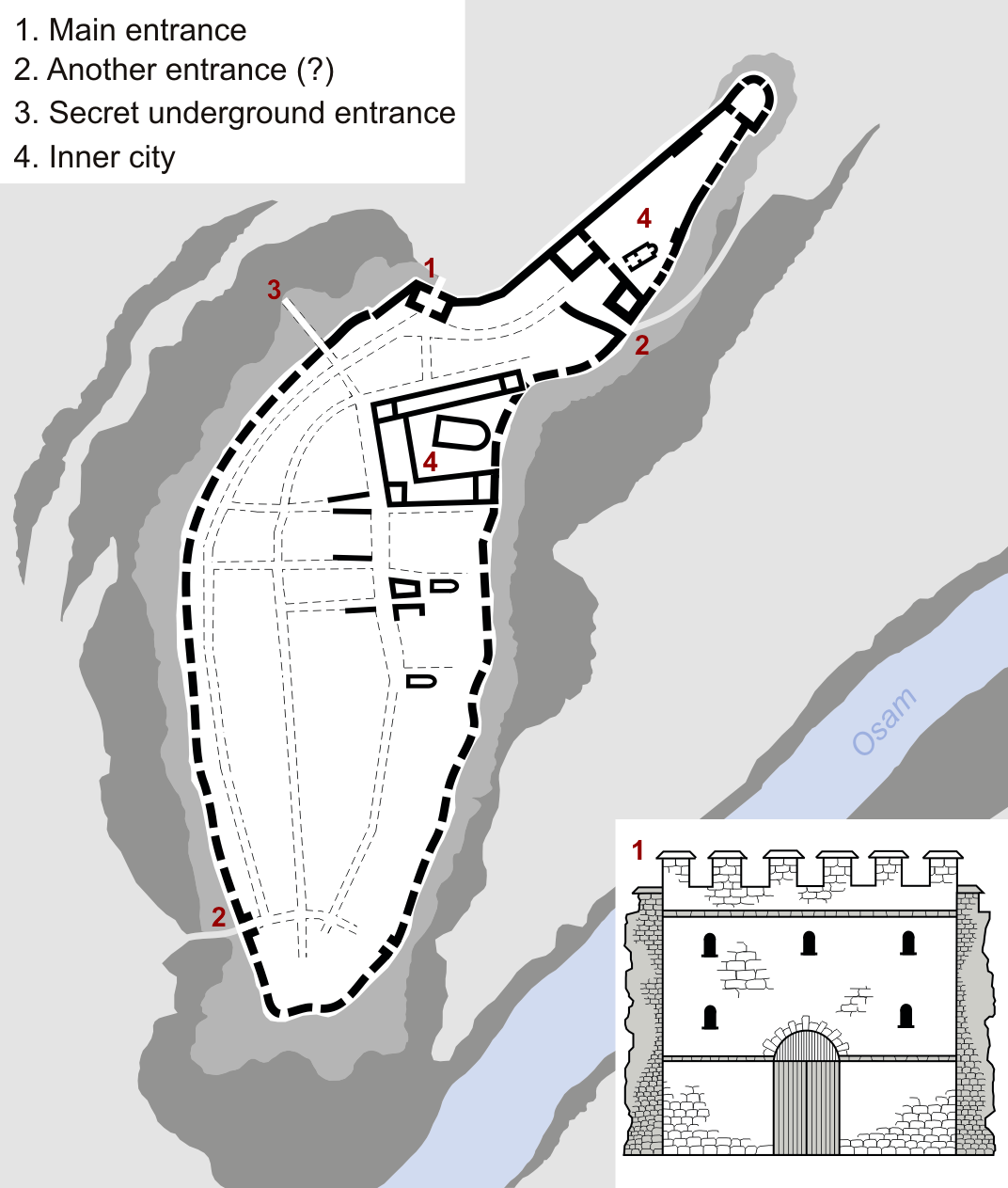
The former Roman citadel Hisarya, which is situated on the hill of the same name, was the place where in 1187 the peace treaty between the Bulgarian Empire and the Byzantine Empire was signed and the returning of Bulgaria on the European map was officially declared, marking the beginning of the Second Bulgarian Empire. In the 12th century, Lovech was a great trade centre and one of the most famous towns in Bulgaria. Ivan Alexander was appointed to govern the city by 1330, most likely being appointed due to Lovech being a major city that controlled commercial passage through the Stara Planina passes, and the migration of intellectuals to Moldavia and Wallachia, due to Ottoman conquests, resulting in the beginning of the Despotate of Lovech.
The Turkish invasion in the middle of the 14th century did not pass the town, but the Hisarya fortress was captured last of all, in 1446.
Ottoman rule
For a long time after conquest, the town enjoyed some privileges such as a prohibition on Turkish people to settle in the town or to take Bulgarian children as janissaries.
In the 17th century, Lovech (Lofça in Turkish) was once again an important trade centre and one of the richest towns in Bulgaria, a reason for the town being called Altın Lofça (Golden Lovech, from Turkish) at the time.
In the times of revolutionary organisations against the Ottoman rule, Lovech was the centre of operations of the Internal Revolutionary Organisation of Vasil Levski, called the Secret Revolutionary Committee. He was arrested by the Turkish military in a village near Lovech called Kakrina and later hanged in Sofia. The biggest museum of Vasil Levski in Bulgaria, which contains several personal items such as notebooks, clothes, and weapons. It is situated in the old town part of Lovech.
Between 1872 and 1874, the Bulgarian master-builder Nikola Fichev, known also as Kolyu Ficheto, built the famous Covered Bridge (Покрит мост) over the river Osam, the only one of its kind in the Balkans. The bridge was burned out in 1925, but rebuilt in 1931. Now it connects the new and the old part of the town and it's full of cafes, small restaurants and many souvenir shops.
During the Russo-Turkish War of 1877–1878, an important battle was held at Lovech, known as the Battle of Lovcha. The war and several plagues and migrations in Wallachia drastically reduced the population. There was a substantial number of victims from the Bulgarian population. Many Turkish families were expelled by the Russian army and the Muslims of Lovech known to be "Lofçalılar" have immigrated to several parts of Turkey (mainly Istanbul, Edirne and Bursa).
Modern times
In more recent times, Lovech was the place where modern foreign language education in Bulgaria started. Taking over from the American college established there in 1881, the first foreign language school in Bulgaria was set up in Lovech in 1950. Initially three languages were taught in this school: English, French and German. However soon after that the teaching of English and French was moved to Sofia and Varna respectively, founding the first language schools in these cities: the First English Language School in Sofia in 1954 and the French Language School in Varna in 1958. Since for the period 1959-1984 German was the only language taught, the school in Lovech was informally known as The German School (Немската гимназия).
Economy
On April 9, 2009, Great Wall Motor and the Bulgarian company Litex Motors signed a contract for building a production base that would manufacture three models of the Chinese manufacturer near Lovech. The new plant was opened on February 21, 2012.
The investment is worth around 97 million euros and will create 2,000 new jobs over the first four years. It will be Great Wall Motor's gate of entering the European Union market, thanks to the zero tariff levels.
Main sights


- The Covered Bridge by Kolyu Ficheto
- The monument of Vasil Levski
- The monuments to Russian soldiers killed in the Russo-Turkish War of 1877-78
- The Varosha old town part
- Stratesh Park with Lovech Zoo, the biggest zoo in the province
- Bash Bunar Park
- The baroque buildings in the town's central parts
- The Varosha architectural and historical reserve, with Drasova and Rashova memorial houses
Theatres
- Lovech Drama Theatre
- Theatre by the Nauka Community Centre
- The summer theatre in Stratesh Park
Museums
- Museum of Vasil Levski
- Lovech Historical Museum
- Drasova Memorial House
- Rashova Memorial House
- Saint Kliment Ohridski School
Sports
- PFC Litex Lovech, one of Bulgaria's top football clubs
- Osam, a men's handball club
- Lovech '98, a women's handball club
- Eagles, a baseball club
- A wrestling club
- A kyokushin karate club
- Progress, a chess club
- Fencing club
- Acrobatic rock’n’roll club “Rocksmile”
Notable people
- Joseph I of Bulgaria — Bulgarian exarch
- Georgi Ivanov — the first Bulgarian cosmonaut
- Dimitar Dimov — Bulgarian author
- Simeon Djankov — economist
- Anastas Ishirkov — noted geographer
- Panayot Pipkov — composer
- Ahmed Cevdet Pasha — Ottoman scholar, intellectual, bureaucrat, administrator, and historian
Partner towns
- ALB Berat, Albania
- GER Erfurt, Germany
- UKR Iziaslav, Ukraine
- MNE Kolašin, Montenegro
- FRA Laval, France
- RUS Lotoshino, Russia
- RUS Ryazan, Russia
- RUS Syktyvkar, Russia
- ESP Valladolid, Spain
Honours
Lovech Heights in Graham Land, Antarctica is named after the city, and Melta Point on Livingston Island in the South Shetland Islands, Antarctica is named after the ancient Melta.
Gallery
File:Lovech-centre-imagesfrombulgaria.JPG|Central Lovech File:Lovech-centre-imagesfrombulgaria2.JPG|Central Lovech File:Lovech-oldtown-imagesfrombulgaria.JPG|Bulgarian National Revival quarter, Varosha File:Lovech-fortress-imagesfrombulgaria.JPG|The Hisarya Fortress File:Bulgaria-Lovech-03.jpg|The Covered Bridge File:Bulgaria-Lovech-04.jpg File:Bulgaria-Lovech-05.jpg File:Bulgaria-Lovech-06.jpg File:Lovech.jpg
References
References
- [https://nsi.bg/bg/content/2975/%D0%BD%D0%B0%D1%81%D0%B5%D0%BB%D0%B5%D0%BD%D0%B8%D0%B5-%D0%BF%D0%BE-%D0%BE%D0%B1%D0%BB%D0%B0%D1%81%D1%82%D0%B8-%D0%BE%D0%B1%D1%89%D0%B8%D0%BD%D0%B8-%D0%BC%D0%B5%D1%81%D1%82%D0%BE%D0%B6%D0%B8%D0%B2%D0%B5%D0%B5%D0%BD%D0%B5-%D0%B8-%D0%BF%D0%BE%D0%BB НАСЕЛЕНИЕ КЪМ 31.12.2022 Г. ПО ОБЛАСТИ, ОБЩИНИ, МЕСТОЖИВЕЕНЕ И ПОЛ] nsi.bg
- "Climate normals for 1991-2020: Lovech". NOAA.
- "LOVETCH - Weather data by month".
- "National Statistical Institute - Main Towns Census 2011".
- {{in lang. (May 2017)
- "Bulgarian National Statistical Institute - towns in 2009".
- "Bulgaria: Major Cities - Population Statistics, Maps, Charts, Weather and Web Information".
- "Cities of Bulgaria".
- {{in lang. bg [http://www.geography.iit.bas.bg/2009/1-09/13-17.pdf Bulgarian Academy of Sciences] {{webarchive. link. (2011-07-06)
- "Population on 01.02.2011 by provinces, municipalities, settlements and age; National Statistical Institute".
- "Population by province, municipality, settlement and ethnic identification, by 01.02.2011; Bulgarian National Statistical Institute".
- Petkov, Kiril. (2008-08-31). "The Voices of Medieval Bulgaria, Seventh-Fifteenth Century: The Records of a Bygone Culture". BRILL.
- "PalmBeachPost.com".
- SCAR]] [[Composite Antarctic Gazetteer]].
- SCAR]] [[Composite Antarctic Gazetteer]].
This article was imported from Wikipedia and is available under the Creative Commons Attribution-ShareAlike 4.0 License. Content has been adapted to SurfDoc format. Original contributors can be found on the article history page.
Ask Mako anything about Lovech — get instant answers, deeper analysis, and related topics.
Research with MakoFree with your Surf account
Create a free account to save articles, ask Mako questions, and organize your research.
Sign up freeThis content may have been generated or modified by AI. CloudSurf Software LLC is not responsible for the accuracy, completeness, or reliability of AI-generated content. Always verify important information from primary sources.
Report