From Surf Wiki (app.surf) — the open knowledge base
Louisville, Mississippi
Town in Winston County
Town in Winston County
| Field | Value | |
|---|---|---|
| name | Louisville, Mississippi | |
| settlement_type | City | |
| motto | ||
| image_skyline | Louisville mississippi.jpg | |
| image_caption | Main Street in Louisville, 2008 | |
| image_flag | Flag of Louisville, Mississippi.png | |
| image_blank_emblem | Logo of Louisville, Mississippi.png | |
| blank_emblem_type | Logo | |
| <!-- Maps --> | image_map | Winston_County_Mississippi_Incorporated_and_Unincorporated_areas_Louisville_Highlighted.svg |
| mapsize | 250px | |
| map_caption | Location of Louisville, Mississippi | |
| pushpin_map | USA | |
| pushpin_map_caption | Location in the United States | |
| <!-- Location --> | subdivision_type | Country |
| subdivision_name | United States | |
| subdivision_type1 | State | |
| subdivision_name1 | Mississippi | |
| subdivision_type2 | County | |
| subdivision_name2 | Winston | |
| leader_title | Mayor | |
| leader_name | William A. Hill (D) | |
| established_date | ||
| unit_pref | Imperial | |
| area_footnotes | ||
| area_total_km2 | 39.56 | |
| area_land_km2 | 39.10 | |
| area_water_km2 | 0.46 | |
| area_total_sq_mi | 15.27 | |
| area_land_sq_mi | 15.10 | |
| area_water_sq_mi | 0.18 | |
| <!-- Population --> | population_as_of | 2020 |
| population_total | 6072 | |
| population_density_km2 | 155.28 | |
| population_density_sq_mi | 402.17 | |
| <!-- General information --> | timezone | Central (CST) |
| utc_offset | -6 | |
| timezone_DST | CDT | |
| utc_offset_DST | -5 | |
| elevation_m | 174 | |
| elevation_ft | 571 | |
| coordinates | ||
| postal_code_type | ZIP code | |
| postal_code | 39339 | |
| area_code | 662 | |
| blank_name | FIPS code | |
| blank_info | 28-42280 | |
| blank1_name | GNIS feature ID | |
| blank1_info | 0693835 | |
| website | City Website |
Louisville (pronounced LEW-iss-vill) is a city in and the county seat of Winston County, Mississippi. The population was 6,072 at the 2020 census.
History
Like Winston County, Louisville is named for Louis Winston (1784–1824), a colonel in the militia, a prominent lawyer, and a judge of the Mississippi Supreme Court. In 1863 Union Colonel Benjamin Grierson marched 900 troops through Louisville during his raid through Mississippi. There was no fighting in Winston County.
In 1927, a mob of 1,000 white men from Louisville, lynched two African-Americans, Jim and Mark Fox by wrapping them in barbed wire and setting them on fire. The Foxes were accused of killing Clarence Nichols, a white man who started a fight with them because they would not let him pass their Ford touring car in his Chevrolet.
On April 28, 2014, Louisville was hit by an EF4 tornado, resulting in ten fatalities.
Geography
Louisville is located at (33.122931, -89.056182). According to the United States Census Bureau, the city has a total area of 15.3 sqmi, of which 15.1 sqmi is land and 0.2 sqmi (1.44%) is water. It is known by many as the "Front porch of the South".
Climate
| Jan record high F = 84 | Feb record high F = 87 | Mar record high F = 92 | Apr record high F = 92 | May record high F = 101 | Jun record high F = 105 | Jul record high F = 107 | Aug record high F = 107 | Sep record high F = 106 | Oct record high F = 97 | Nov record high F = 88 | Dec record high F = 83 | year record high F = | Jan record low F = -3 | Feb record low F = -13 | Mar record low F = 12 | Apr record low F = 26 | May record low F = 37 | Jun record low F = 43 | Jul record low F = 52 | Aug record low F = 46 | Sep record low F = 37 | Oct record low F = 24 | Nov record low F = 10 | Dec record low F = -3 | year record low F = |access-date = October 31, 2023}}{{cite web |access-date = October 31, 2023}}
Demographics
2020 census
| Race | Num. | Perc. |
|---|---|---|
| Black or African American | 3,895 | 64.15% |
| White | 1,925 | 31.7% |
| Other/Mixed | 120 | 1.98% |
| Hispanic or Latino | 96 | 1.58% |
| Asian | 28 | 0.46% |
| Native American | 7 | 0.12% |
| Pacific Islander | 1 | 0.02% |
As of the 2020 United States census, there were 6,072 people, 2,309 households, and 1,589 families residing in the city.
2000 census
As of the census of 2000, there were 7,006 people, 2,641 households, and 1,817 families living in the city. The population density was 464.5 PD/sqmi. There were 2,884 housing units at an average density of 191.2 /sqmi. The racial makeup of the city was 46.29% White, 52.46% African American, 0.13% Native American, 0.17% Asian, 0.44% from other races, and 0.51% from two or more races. Hispanic or Latino of any race were 1.66% of the population.
There were 2,641 households, out of which 34.3% had children under the age of 18 living with them, 40.4% were married couples living together, 25.0% had a female householder with no husband present, and 31.2% were non-families. 28.2% of all households were made up of individuals, and 14.4% had someone living alone who was 65 years of age or older. The average household size was 2.55 and the average family size was 3.12.
In the city, the population was spread out, with 28.9% under the age of 18, 9.3% from 18 to 24, 24.7% from 25 to 44, 19.8% from 45 to 64, and 17.3% who were 65 years of age or older. The median age was 35 years. For every 100 females, there were 80.6 males. For every 100 females age 18 and over, there were 73.8 males.
The median income for a household in the city was $27,485, and the median income for a family was $31,750. Males had a median income of $29,951 versus $17,491 for females. The per capita income for the city was $15,857. About 24.8% of families and 28.5% of the population were below the poverty line, including 39.3% of those under age 18 and 20.9% of those age 65 or over.
Education
Prior to 1970, Louisville maintained a dual system of schools for White and Black students. Black students were educated at the Louisville Colored School, also known as Camile Street School, whereas White students had their own schools, including Louisville High School. Several federal laws and U.S. Supreme Court decisions forced this to change. In 1967, due to the Civil Rights Act of 1964, the school adopted a desegregation plan that in theory allowed students to choose which schools to attend. When the courts mandated that the schools be integrated, students from Louisville Colored School were allowed to attend Louisville High School. In order to preserve a segregated education for White students only, a segregation academy, Winston Academy was created. The City of Louisville is now served by the Louisville Municipal School District and Louisville High School. Private schools in Louisville include Winston Academy, which as of 2020 was still over 99% white, and Grace Christian School.
Culture
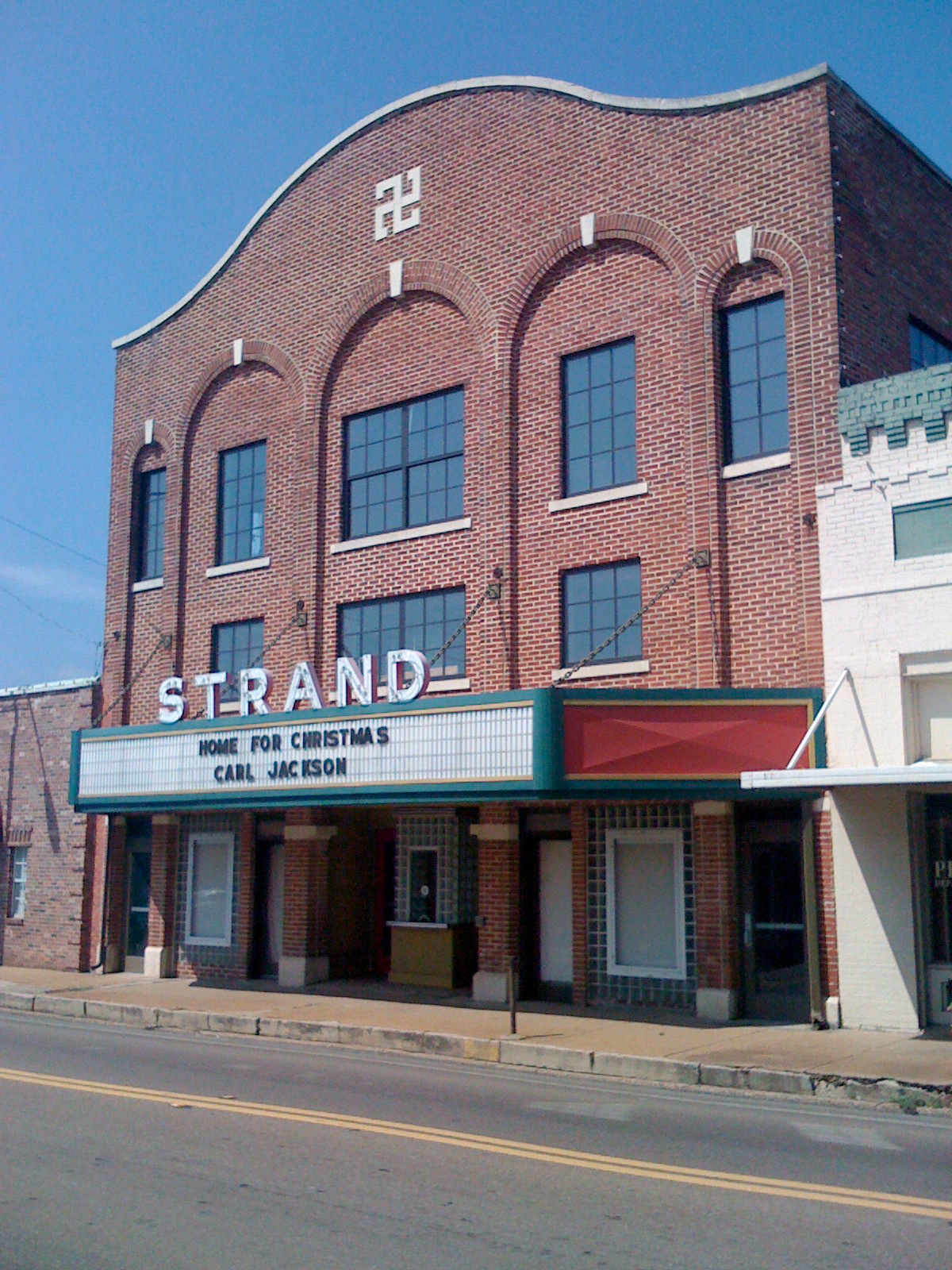
The American Heritage "Big Red" Fire Museum is located in Louisville. This museum features a collection of restored antique fire equipment and fire engines. The Strand Theatre, in downtown Louisville, is an historic movie theater which now serves as an art and music venue. Louisville native Carl Jackson plays an annual Christmas concert at the theater to raise money for the building's restoration.
Transportation
Mississippi Highway 14 enters east from the Alabama state line through Macon and when it enters in Louisville it is also known as Main Street. It leaves westbound eventually traveling to the Mississippi River where it ends.
Mississippi Highway 15 enters from the north from Ackerman, MS, then meets up with Mississippi Highway 25 just north of Louisville. M.S. 25 enters from the north from Starkville. M.S. 15 and 25 travel together along the western side of town. At the southern edge of town they separate: M.S. 15 traveling to Philadelphia & Interstate 20; and M.S. 25 to Jackson.
Notable people
- Van Chancellor, basketball coach
- Thomas D. Clark, noted historian
- Doug Cunningham, former professional football player
- Olu Dara (born Charles Jones), jazz musician, father of the rapper Nas
- Drew Eubanks, American basketball player
- Mark Hudspeth, football coach
- Carl Jackson, country music songwriter
- E. Grady Jolly, U.S. circuit judge
- Andy Kennedy, basketball coach
- Coby Miller, Olympic athlete
- Matthew Mitchell, basketball coach
- Kim Rosamond, basketball coach for Tennessee Tech Golden Eagles
- Lisa Stewart, country music singer and TV host
- Marcus Thames, Major League Baseball player and coach
- Taylor McNeel, United States District Judge
References
References
- "Mayor".
- "Official Recapitulation".
- "2020 U.S. Gazetteer Files". United States Census Bureau.
- (27 January 2018). "The Hard To Pronounce Town In Every Single State".
- "Find a County". National Association of Counties.
- Gannett, Henry. (1905). "The Origin of Certain Place Names in the United States". Govt. Print. Off..
- "Winston County".
- (June 17, 1927). "Man Killed: Mob Negroes". Winston County Journal.
- (June 17, 1927). "Shal Law or Criminal Rule". Winston County Journal.
- (June 16, 1927). "Shall the law rule?". Newton Record.
- (June 14, 1927). "Winston mob burns negroes at the stake". Clarion-Ledger.
- "Winston Tornado".
- "Tornado Kills Nearly 220,000 Chickens in Direct Hit on Mississippi Farm".
- (2011-02-12). "US Gazetteer files: 2010, 2000, and 1990". [[United States Census Bureau]].
- (3 September 2014). "Louisville among top 5 safest cities in MS".
- "Census of Population and Housing". Census.gov.
- "Explore Census Data".
- "U.S. Census website". [[United States Census Bureau]].
- (April 27, 1967). "Notice of School Desegregation Plan". Winston County Journal.
- (January 2014). "From Segregation To Integration: A Historical Study Of Music Education In The Colored School In Louisville, Mississippi Through 1970". Electronic Theses and Dissertations.
- (June 12, 1969). "300 Attend Foundation Meet Friday". The Winston County Journal.
- "Search for Private Schools - School Detail for WINSTON ACADEMY".
- [http://www.taylorbigred.com/fire_museum.html The American Heritage "Big Red" Fire Museum] in Louisville
- McCain, Joseph. (December 13, 2006). "Strong cast of musicians serves up Christmas joy". Winston County Journal.
- https://www.ttusports.com/sports/wbkb/coaches/rosamond_kim?view=bio Kim Rosamond
- "District Judge Taylor B. McNeel {{!}} Southern District of Mississippi {{!}} United States District Court".
This article was imported from Wikipedia and is available under the Creative Commons Attribution-ShareAlike 4.0 License. Content has been adapted to SurfDoc format. Original contributors can be found on the article history page.
Ask Mako anything about Louisville, Mississippi — get instant answers, deeper analysis, and related topics.
Research with MakoFree with your Surf account
Create a free account to save articles, ask Mako questions, and organize your research.
Sign up freeThis content may have been generated or modified by AI. CloudSurf Software LLC is not responsible for the accuracy, completeness, or reliability of AI-generated content. Always verify important information from primary sources.
Report