From Surf Wiki (app.surf) — the open knowledge base
Louis Botha
1st prime minister of South Africa from 1910 to 1919
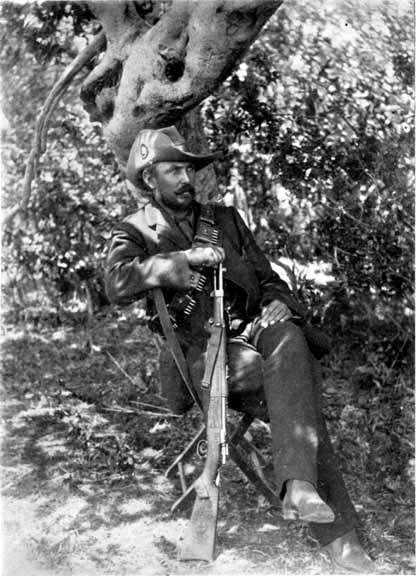
1st prime minister of South Africa from 1910 to 1919
| Field | Value | |
|---|---|---|
| honorific-prefix | General The Right Honourable | |
| image | [[File:Louisbotha (cropped).jpg | 220px]] |
| caption | Botha in the 1910s | |
| order | 1st | |
| office | Prime Minister of South Africa | |
| term_start | 31 May 1910 | |
| term_end | 27 August 1919 | |
| monarch | George V | |
| governor-general | ||
| predecessor | Position established | |
| successor | Jan Smuts | |
| office2 | Prime Minister of the Transvaal | |
| term_start2 | 4 March 1907 | |
| term_end2 | 31 May 1910 | |
| monarch2 | Edward VII | |
| George V | ||
| governor2 | The Earl of Selborne | |
| predecessor2 | Position established | |
| successor2 | Himself (as Prime Minister of South Africa) | |
| birth_date | 27 September 1862 | |
| birth_place | Greytown, Colony of Natal | |
| death_date | ||
| death_place | Pretoria, Transvaal, Union of South Africa | |
| restingplace | Rebecca Street Cemetery, Pretoria, South Africa | |
| party | South African Party | |
| otherparty | Het Volk Party | |
| spouse | ||
| profession | Career military officer, politician | |
| footnotes | ||
| allegiance | South African Republic | |
| Union of South Africa | ||
| British Commonwealth | ||
| serviceyears | 1899–1902 (Transvaal Commandos) | |
| 1902–1919 (British Imperial Armies) | ||
| rank | General | |
| commands | Boer, South African Republic | |
| battles | ||
| signature | Louis Botha sign.png |
| honorific-prefix = General The Right Honourable | governor-general = George V Union of South Africa British Commonwealth 1902–1919 (British Imperial Armies)
- Second Boer War
- Battle of Colenso
- Battle of Spion Kop
- Battle of Vaal Krantz
- World War I
- South-West Africa Campaign
- Maritz rebellion Louis Botha ( , ; 27 September 1862 – 27 August 1919) was a South African politician who was the first prime minister of the Union of South Africa, the forerunner of the modern South African state. A Boer war veteran during the Second Boer War, Botha eventually fought to have South Africa become a British Dominion.
- South-West Africa Campaign
Early life
Louis Botha was born in Greytown, Natal one of seven sons and eight daughters born to Louis Botha Senior (Somerset East, Eastern Cape, 26 March 1827 – Harrismith, Orange Free State, 5 July 1883) and Salomina Adriana van Rooyen (Somerset East, 31 March 1829 – Harrismith, 9 January 1886). Louis Botha briefly attended the school at Hermannsburg before his family relocated to the Orange Free State. The name Louis runs throughout the family, with every generation since General Louis Botha having the eldest son named Louis. Botha had three brothers who also served as generals in the Second Boer War: an older brother Philip Rudolf (1851–1901), and two younger brothers, Chris (1864–1902), a police officer, and Theunis Jacobus Botha (1867–1930).
Zulu conflict
Louis Botha led "Dinuzulu's Volunteers", a group of Boers that had supported Dinuzulu against Zibhebhu in 1884.
Politician
Botha later became a member of the parliament of Transvaal in 1897, representing the district of Vryheid.
Second Boer War
Early battles
In 1899, Louis Botha fought in the Second Boer War, initially joining the Krugersdorp Commando, continuing to fight under Lucas Meyer in Northern Natal, and later as a general commanding and leading Boer forces impressively at Colenso and Spion Kop. On the death of P. J. Joubert, he was made commander-in-chief of the Transvaal Boers, where he demonstrated his abilities again at Belfast-Dalmanutha. After one of the battles at the Tugela River, Botha granted a twenty-four-hour armistice to General Buller to enable him to bury his dead.
Capture of Winston Churchill
Winston Churchill revealed that General Botha was the man who captured him at the Battle of Chieveley. also claims that Botha captured Churchill at train ambush 15 November 1899. Churchill was not aware of the man's identity until 1902, when Botha travelled to London seeking loans to assist his country's reconstruction, and the two met at a private luncheon. The incident is also mentioned in Arthur Conan Doyle's book, The Great Boer War, published in 1902. However more recent sources claim that Field cornet Sarel Oosthuizen was in fact the Boer soldier who, at gunpoint, captured Churchill. Another version claims that the unit to capture Churchill was the Italian Volunteer Legion and its commander, Camillo Ricchiardi.
Later campaigns
After the fall of Pretoria in June 1900, Louis Botha led a concentrated guerrilla campaign against the British together with Koos de la Rey and Christiaan de Wet. The success of his measures was seen in the steady resistance offered by the Boers to the very close of the three-year war.
Role after the Boer War
Botha was prominent in efforts to achieve a peace with the British, representing the Boers at the peace negotiations in 1902, and was signatory to the Treaty of Vereeniging. In the period of reconstruction under British rule, Botha went to Europe with de Wet and de la Rey to raise funds to enable the Boers to resume their former avocations. Botha, who was still looked upon as the leader of the Boer people, took a prominent part in politics, advocating always measures which he considered as tending to the maintenance of peace and good order and the re-establishment of prosperity in the Transvaal. His war record made him prominent in the politics of Transvaal and he was a major player in the postwar reconstruction of that country, founding with Jan Smuts the Het Volk Party in the Transvaal Colony in 1904, which served as a springboard to campaign for responsible self-government for the colony.
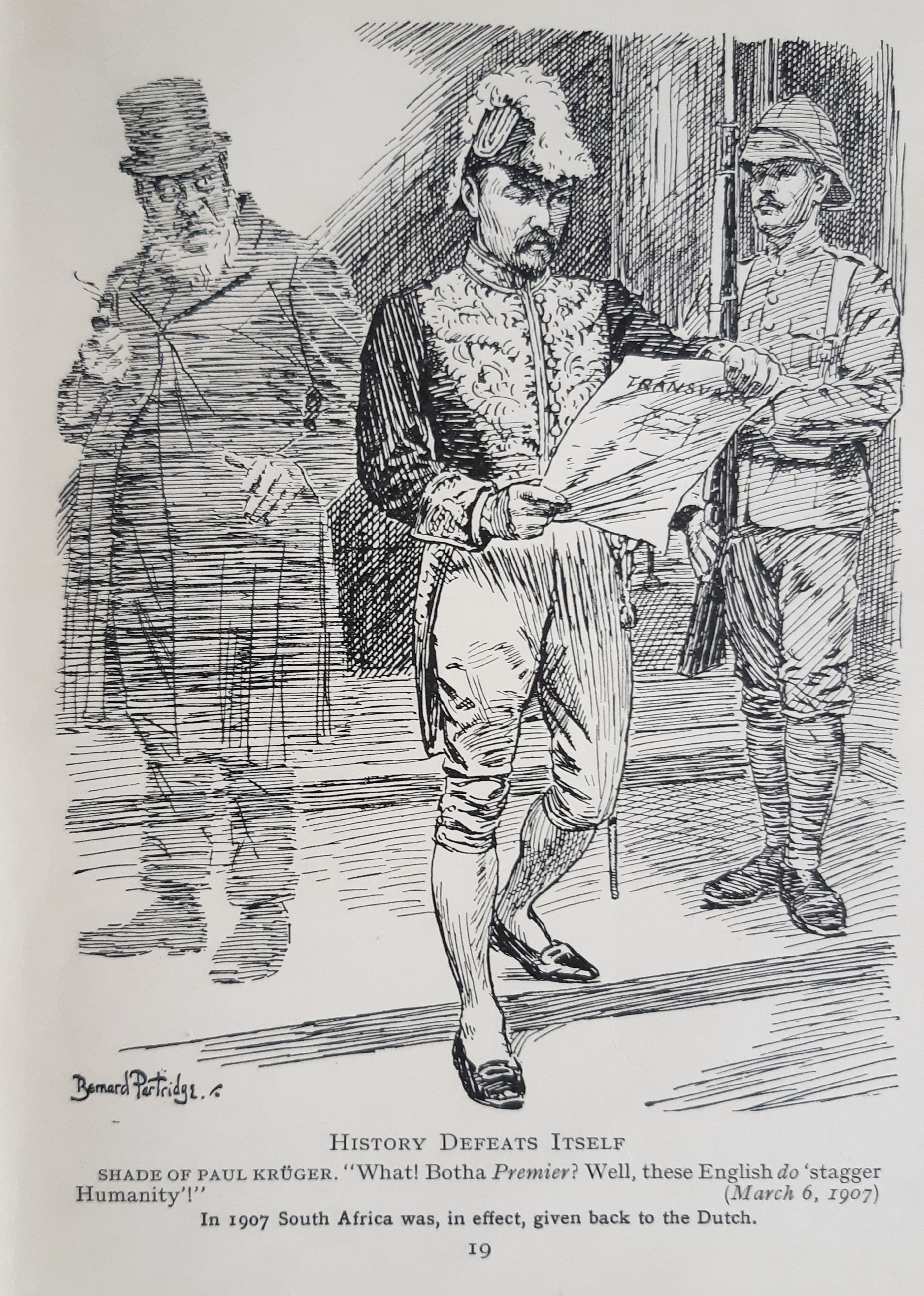
After the grant of self-government to the Transvaal on 6 December 1906 and the success of his Het Volk Party at the first elections in February 1907, Botha was called upon by Lord Selborne to form a government as Prime Minister on 4 March 1907, and in the spring of the same year he took part in the conference of colonial premiers held in London. During his visit to England on this occasion General Botha declared the wholehearted adhesion of the Transvaal to the British Empire, and his intention to work for the welfare of the country regardless of racial differences. The following year Botha participated in the National Convention (South Africa) which opened up the way for the passage of the South Africa Act of 1909 by the British parliament which in turn allowed for the formation of the Union of South Africa.
When South Africa obtained dominion status in 1910, Botha became the first Prime Minister of the Union of South Africa. In 1911, together with another Boer war hero, Jan Smuts, he formed the South African Party, or SAP. Widely viewed as too conciliatory with Britain, Botha faced revolts from within his own party and opposition from James Barry Munnik Hertzog's National Party. He was a South African Freemason. Botha, like Hertzog, advocated for the preservation of black traditions, which ultimately led to the segregation of the black and white races.
Later career
After the First World War started, he sent troops to take German South-West Africa, a move unpopular among Boers, which provoked the Boer Revolt.
Praise for the British
At Versailles on 1 June 1919, 17 years after the signing of the Treaty of Vereeniging, General Botha, now a member of the British Empire Delegation, put his hand on Lord Milner's shoulder, and said:
At the end of the War he briefly led a British Military Mission to Poland during the Polish–Soviet War. He argued that the terms of the Versailles Treaty were too harsh on the Central Powers, but signed the treaty. Botha was unwell for most of 1919. He was plagued by fatigue and ill health that arose from his robust waistline.
Marriage and children
Botha married Annie Emmett at the Dutch Reformed Church in Vryheid on 13 December 1886. Annie Botha later converted from Anglicanism to Dutch Reformed Protestantism. Shortly after their wedding, they settled on the Waterval Farm in Vryheid. They had five children together, three sons and two daughters.
Death
_2018_033.jpg)
General Louis Botha died of heart failure at his home following an attack of Spanish influenza on 27 August 1919 in the early hours of the morning. He was 56. His wife Annie was at home and was joined by Engelenburg who had acted as a private secretary to Botha. Botha was laid to rest in the Rebecca Street Cemetery in Pretoria.
Of Botha, Winston Churchill wrote in Great Contemporaries "The three most famous generals I have known in my life won no great battles over a foreign foe. Yet their names, which all begin with a 'B', are household words. They are General Booth, General Botha and General Baden-Powell..."
After Botha's death in 1919, Annie Botha settled on a farm in Rusthof and spent winters in Sezela, where she died in 1937.
Honours
Sculptor Raffaello Romanelli won the competition to create the equestrian statue of Botha that stands in front of the South African Parliament building but died before completing it. His son Romano Romanelli, and his grandson's family Arend Botha was contracted to finish his father's work.
In 1917, parts of the M11 route in Johannesburg, previously named Morgan Road and Pretoria Main Road,were renamed to Louis Botha Avenue.
Sculptor Anton van Wouw created a statue of Botha in Durban unveiled in 1921.
Sculptor Coert Steynberg was commissioned to create the equestrian statue of Botha in front of the Union Buildings in Pretoria. It was unveiled in 1946.
The General Botha Regiment of the South African Army is named after Botha.
References
Sources
- {{Wikisource-inline|list=
- Peace of Vereeniging
- Wrench, John Evelyn, Alfred Lord Milner, Eyre & Spottiswoode, London, 1958, pg. 238. OCLC Number: 1630758}}
References
- (9 April 2015). "Political parties condemned the defacing of the Louis Botha statue - YouTube".
- (2 May 2022). "Genl. Louis Botha". Geni. A MyHeritage Company.
- (16 August 2019). "Louis Botha". South African History Online.
- "Louis Botha {{!}} South African History Online".
- Wrench, John Evelyn, ''Alfred Lord Milner'', pg. 238
- Steyn, Richard. (17 September 2018). "Louis Botha: A Man Apart". Jonathan Ball Publishers.
- "Louis Botha Avenue Development Corridor". SAJR.
- (19 February 2017). "Orange Grove Precinct. Heritage Impact Assessment & Conservation Management Plan. Report Phase 3. Volume 1". Johannesburg Development Agency.
- (17 June 2010). "Fact file: Regiment Botha".
- "Renaming process has resulted in an Army structure that truly represents SA".
- (14 July 2013). "Churchill, Sir Winston". Prominent people.
- "Italian participation in the Anglo-Boer War". The South African Military History Society.
- (30 July 1902). "Boer Leaders Coming Here: Botha and De la Rey to Visit America". The New York Times.
- "Italian Volunteer Legion (The English War 1899–1902) – Piet Rudolph".
- "Notable South African Freemasons". Freemasons.org.za.
This article was imported from Wikipedia and is available under the Creative Commons Attribution-ShareAlike 4.0 License. Content has been adapted to SurfDoc format. Original contributors can be found on the article history page.
Ask Mako anything about Louis Botha — get instant answers, deeper analysis, and related topics.
Research with MakoFree with your Surf account
Create a free account to save articles, ask Mako questions, and organize your research.
Sign up freeThis content may have been generated or modified by AI. CloudSurf Software LLC is not responsible for the accuracy, completeness, or reliability of AI-generated content. Always verify important information from primary sources.
Report