From Surf Wiki (app.surf) — the open knowledge base
Lotus 102

| Field | Value | |
|---|---|---|
| Car_name | Lotus 102 | |
| Lotus 102B | ||
| Lotus 102D | ||
| Image | [[File:Lotus-Lamborghini 102.jpg | 250px]] |
| Caption | The demonstration of the 102 at the Goodwood Festival of Speed | |
| Category | Formula One | |
| Constructor | Lotus | |
| Designer | Frank Dernie (Technical Director) | |
| Mike Coughlan (Chief Designer) | ||
| Mauro Forghieri (Chief Engine Designer (Lamborghini)) | ||
| Predecessor | 101 | |
| Successor | 107 | |
| Team | Camel Team Lotus (1990) | |
| Team Lotus | ||
| Drivers | 11. GBR Derek Warwick | |
| 11. FIN Mika Häkkinen | ||
| 12. GBR Martin Donnelly | ||
| 12. GBR Johnny Herbert | ||
| 12. GBR Julian Bailey | ||
| 12. GER Michael Bartels | ||
| Technical ref | ||
| Chassis | Carbon fibre monocoque | |
| Front suspension | Double wishbones, pull-rod dampers | |
| Rear suspension | Double wishbones, push-rod dampers | |
| Engine name | : Lamborghini LE3512, 3493 cc, mid-engine, longitudinally mounted, NA 80° V12 | |
| : Judd EV, 3496 cc, mid-engine, longitudinally mounted, NA 76° V8 | ||
| : Ford HBA5, 3494 cc, mid-engine, longitudinally mounted, 75° NA V8 | ||
| Gearbox name | Lotus / Lamborghini | |
| Gears | 6 speed | |
| Type | manual | |
| Fuel | BP | |
| Tyres | Goodyear | |
| Debut | 1990 United States Grand Prix | |
| Last_event | 1992 Australian Grand Prix | |
| Races | 37 | |
| Wins | 0 | |
| Cons_champ | 0 | |
| Drivers_champ | 0 | |
| Poles | 0 | |
| Fastest_laps | 0 | |
| Podiums | 0 |
Lotus 102B Lotus 102D Mike Coughlan (Chief Designer) Mauro Forghieri (Chief Engine Designer (Lamborghini)) Team Lotus 11. FIN Mika Häkkinen 12. GBR Martin Donnelly 12. GBR Johnny Herbert 12. GBR Julian Bailey 12. GER Michael Bartels : Judd EV, 3496 cc, mid-engine, longitudinally mounted, NA 76° V8 : Ford HBA5, 3494 cc, mid-engine, longitudinally mounted, 75° NA V8 | Turbo/NA =
The Lotus 102 was a Formula One racing car designed by Lotus for use in the 1990 Formula One season and would eventually go on to compete in three seasons until .
Development
Frank Dernie and Mike Coughlan incorporated the 640 bhp Lamborghini V12 engine that had been used by the Larrousse Lola team during . Its use made the 102 the only Lotus to race with a V12 engine. The engine had several drawbacks, principally its size, weight and fuel economy. However, it was believed that the increases in power would offset these drawbacks. The engine's size meant it had to be located lower in the chassis, which also had to be designed to its widest permitted dimensions in order to incorporate larger fuel tanks. Furthermore, due to the engine's mass every component on the car had to be scrutinised to investigate whether any further weight reductions could be made elsewhere.
The departure of Nelson Piquet to Benetton and Satoru Nakajima to Tyrrell at the end of brought in the experienced Derek Warwick, and promoted test driver Martin Donnelly to fill the other vacant drivers seat. The inclusion of these drivers, who were taller than Piquet and Nakajima, incurred another design compromise as the car had to be taller than was desired.
Former boss Peter Warr had been close to negotiating large sponsorship deals with Coca-Cola and BP fuels for 1990, but the fallout from the DeLorean scandal nixed those plans, leaving the team underfunded.
Team Lotus's manager Rupert Mainwarring confidently predicted that the team would score 40 championship points. By the first round of the championship it was apparent that this confidence was sadly misplaced.
Racing history
1990
Team Lotus were to struggle throughout the season to score three points, its lowest score since . Warwick scored all three points with a 6th place in Canada and a 5th-place finish in Hungary, while Donnelly failed to score at all. More often than not, it was the unreliability of the Lamborghini 3512 engine which cost Lotus in 1990. Ultimately this performance was to witness the departure of the lucrative Camel sponsorship the team had enjoyed since 1987 and almost cost the team its existence. Ironically, the planned use of the Lamborghini V12 was also the major reason why triple World Champion Nelson Piquet chose not to re-sign with the team after 1989 with the Brazilian correctly predicting that the under-developed engine would hamper both his and the team's chances. While the Lamborghini, one of only two V12 engines in Formula One at the time (the other being Ferrari), had shown promise with the Larrousse team in its debut season 1989, it still lagged behind the V12 Ferrari, the V10 engines from Honda and Renault, and even the Cosworth built and developed Ford V8 engine in both power (it only produced around 620 bhp compared to the closer to 700 bhp for Honda, Renault and Ferrari) and more importantly reliability. Derek Warwick disliked the car, feeling the engine was poor and the monocoque was unsafe stating: I didn't like to drive it. I was scared to be in it.
The 102 ultimately saw the end of Martin Donnelly's brief F1 career in a crash which almost cost him his life. During the 1990 Spanish Grand Prix at Jerez, Donnelly had a horrific crash during Friday practice when he left the circuit in the fast right hand turn behind the pits and the car hit the barriers at speed. The poor build quality of the car was proven in the horrific impact. The 102 broke in half and the seat of the car broke free and was flung clear of the wreck with Martin still strapped in. Donnelly, who ended up lying in the middle of the track, received serious injuries that took months of recovery. Two races previous in Italy, Warwick also had a monumental crash on the first lap of the race at Monza when he ran wide on the exit to the Parabolica and clouted the barriers at speed. Although the car overturned and slid down the middle of the circuit upside down, Warwick was unharmed. He climbed out of his car, which following cars avoided, ran back to the pits (where he told the team and reporters that the crash was his own fault for running too wide at the Parabolica) and started the race in the spare car.
After Donnelly's career ending crash at Jerez, he was replaced for the final two races in Japan and Australia by British driver Johnny Herbert.
In December 1990, Peter Collins and Peter Wright headed a consortium which bought the team. Due to the timing of the takeover the team were unable to start the season with sufficient sponsorship. In addition, the planned introduction of Dernie's type 103 was shelved, the team instead opting to refresh the 102 to B standards.
In a 2014 interview when talking about his time at Lotus and with the Lamborghini engine, Derek Warwick said that the car was poor and that it would "flex all over the place, it would break, it was unreliable" before adding that the V12 engine was "all noise and no go".
1991
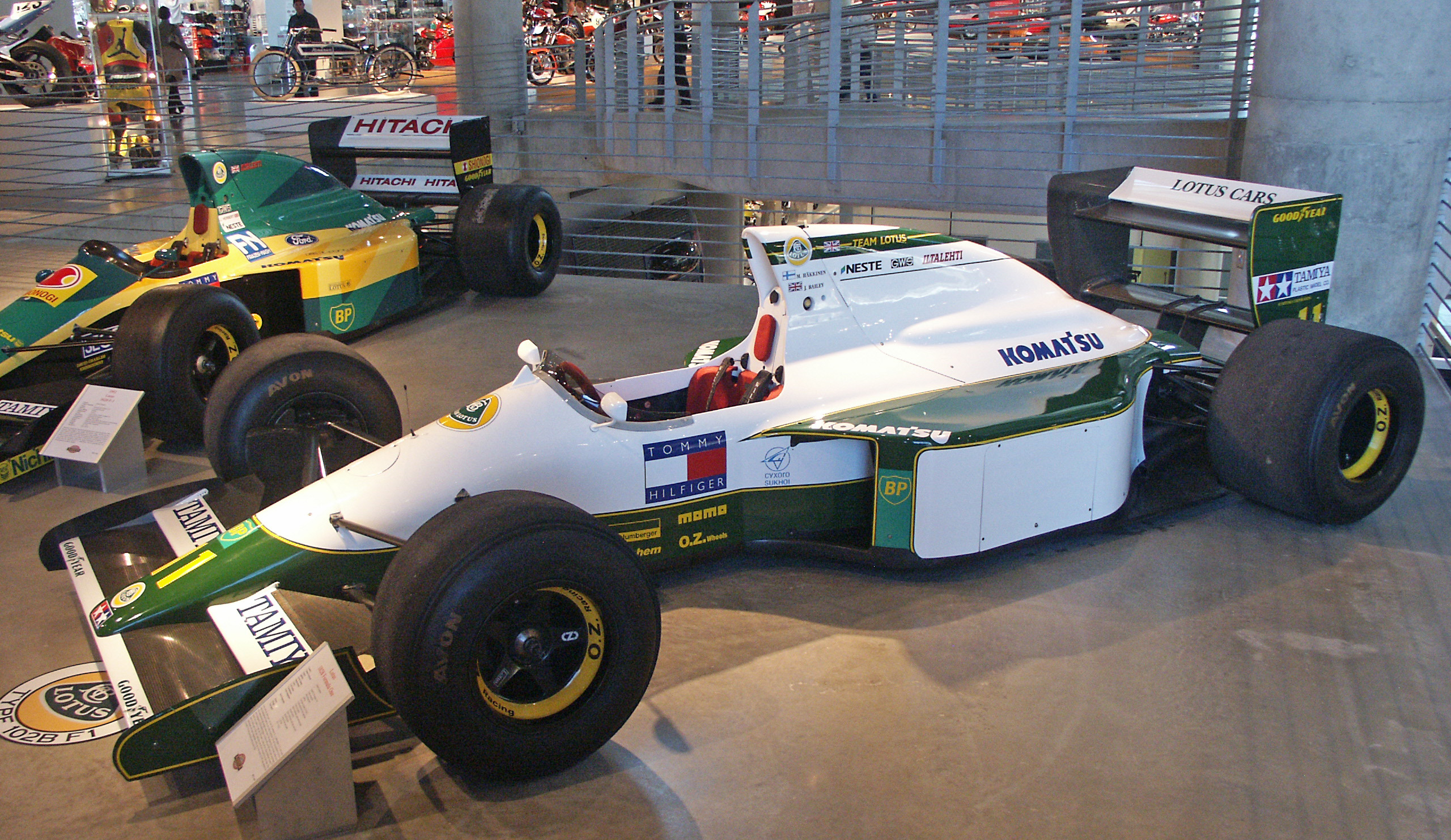
The heavy and ultimately unreliable (in Lotus usage at least; the Larrouse-Lola outfit found better results having used the engine since 1989) Lamborghini engine was replaced by the Judd EV V8, the successor of the Judd CV V8 that had been used in the 101 in 1989. The driver line-up was also changed. Martin Donnelly stated that he was due to be kept on for 1991 as lead driver, but the injuries he sustained in his accident at Jerez the previous year put paid to that. Future world champion Mika Häkkinen and Julian Bailey filled the seats vacated by a frustrated Derek Warwick and injured Donnelly. It was apparent that the car was nowhere near the pace setters of the McLaren MP4/6 and the Williams FW14 at the opening round in Phoenix. The quality control was still not up to standard; Häkkinen would go on to describe that during this race his steering wheel actually came off. Bailey's failure to qualify for the Monaco Grand Prix prompted his departure and replacement with test driver Johnny Herbert for the remainder of the season. Due to Herbert's Japanese Formula 3000 commitments the German driver Michael Bartels raced in his absence but failed to qualify.
The 102B enabled the team to equal their 1990 points total of three points. With increased sponsorship and the delay of the 107 it was to continue racing for the first four races of the 1992 season in D specification. The C specification incorporated the P799WE Isuzu V12 F1 engine that had been developed throughout the season but never raced. The new engine produced impressive power, with rumours of around 750bhp reported. In the engine's one and only track test, the car was six seconds off the pace however. Ultimately, Collins decided against a deal to use the unproven engine and Isuzu decided against entering Formula One anyway.
1992

Complete results
(key)
| Year | Entrant | Chassis | Engine | Tyres | Drivers | 1 | 2 | 3 | 4 | 5 | 6 | 7 | 8 | 9 | 10 | 11 | 12 | 13 | 14 | 15 | 16 | Pts. | WCC | 3 | 8th | 3 | 9th | 13* | 5th |
|---|---|---|---|---|---|---|---|---|---|---|---|---|---|---|---|---|---|---|---|---|---|---|---|---|---|---|---|---|---|
| Camel Team Lotus | 102 | Lamborghini 3512 | |||||||||||||||||||||||||||
| V12 | USA | BRA | SMR | MON | CAN | MEX | FRA | GBR | GER | HUN | BEL | ITA | POR | ESP | JPN | AUS | |||||||||||||
| Derek Warwick | Ret | Ret | 7 | Ret | 6 | 10 | 11 | Ret | 8 | 5 | 11 | Ret | Ret | Ret | Ret | Ret | |||||||||||||
| Martin Donnelly | DNS | Ret | 8 | Ret | Ret | 8 | 12 | Ret | Ret | 7 | 12 | Ret | Ret | DNS | |||||||||||||||
| Johnny Herbert | Ret | Ret | |||||||||||||||||||||||||||
| Team Lotus | 102B | Judd EV | |||||||||||||||||||||||||||
| V8 | USA | BRA | SMR | MON | CAN | MEX | FRA | GBR | GER | HUN | BEL | ITA | POR | ESP | JPN | AUS | |||||||||||||
| Mika Häkkinen | 13 | 9 | 5 | Ret | Ret | 9 | DNQ | 12 | Ret | 14 | Ret | 14 | 14 | Ret | Ret | 19 | |||||||||||||
| Julian Bailey | DNQ | DNQ | 6 | DNQ | |||||||||||||||||||||||||
| Johnny Herbert | DNQ | 10 | 10 | 14 | 7 | Ret | Ret | 11 | |||||||||||||||||||||
| Michael Bartels | DNQ | DNQ | DNQ | DNQ | |||||||||||||||||||||||||
| Team Lotus | 102D | Ford HB | |||||||||||||||||||||||||||
| V8 | RSA | MEX | BRA | ESP | SMR | MON | CAN | FRA | GBR | GER | HUN | BEL | ITA | POR | JPN | AUS | |||||||||||||
| Mika Häkkinen | 9 | 6 | 10 | Ret | DNQ | ||||||||||||||||||||||||
| Johnny Herbert | 6 | 7 | Ret | Ret |
- 11 points scored in using the Lotus 107.
References
References
- "1990 Lotus 102 Lamborghini - Images, Specifications and Information". Ultimatecarpage.com.
- "STATS F1 • Lotus - Models". Statsf1.com.
- (7 July 2014). "Lunch with... Peter Warr".
- (18 November 2013). "Lotus Motorsport update with Rupert Manwaring".
- (24 February 2015). "Derek Warwick".
- Collantine, Keith. (16 January 2010). "Martin Donnelly on the crash that almost killed him".
- (7 July 2014). "Lunch With... Derek Warwick".
- "Peter Collins".
- (July 2014). "Derek Warwick - Raw Racing".
- (21 April 2015). "The last great Lotus driver".
- Smit, Dylan. (30 September 2018). "Butterfly Effect - 1991 Lotus 102B Judd".
- [https://www.youtube.com/watch?time_continue=207&v=XN7Co7Rn2w4&ab_channel=webAUTOSPORT 幻のF1エンジンISUZU P799WE] - Autosports Web(2014年12月24日公開/2017年8月12閲覧)
- "Sidelined Samurai - 1991 Lotus 102C Isuzu".
This article was imported from Wikipedia and is available under the Creative Commons Attribution-ShareAlike 4.0 License. Content has been adapted to SurfDoc format. Original contributors can be found on the article history page.
Ask Mako anything about Lotus 102 — get instant answers, deeper analysis, and related topics.
Research with MakoFree with your Surf account
Create a free account to save articles, ask Mako questions, and organize your research.
Sign up freeThis content may have been generated or modified by AI. CloudSurf Software LLC is not responsible for the accuracy, completeness, or reliability of AI-generated content. Always verify important information from primary sources.
Report