From Surf Wiki (app.surf) — the open knowledge base
Los Angeles Metro Rail
Urban rail transit system serving Los Angeles County, California

Urban rail transit system serving Los Angeles County, California
| Field | Value | |
|---|---|---|
| name | Metro Rail | |
| image | LAMetroLogo.svg | |
| imagesize | 100px | |
| image2 | {{photo montage | |
| photo1a | CRRC HR4000 at Union Station, April 2025 (cropped).png | |
| photo1b | Gold Line train leaving Downtown Santa Monica station, July 2017.JPG | |
| spacing | 1 | |
| size | 300 | |
| color | transparent | |
| border | 0 | |
| area served | Los Angeles County, California | |
| transit_type | ||
| lines | ||
| stations | 107 | |
| daily_ridership | () | |
| annual_ridership | () | |
| website | ||
| began_operation | ||
| operator | Los Angeles Metro | |
| system_length | 121.2 mi | |
| track_gauge | ||
| el | Overhead line (light rail) or third rail (rapid transit), | |
| average_speed | ||
| top_speed | ||
| map | {{switcher | |
| {{maplink-road | from | Los Angeles Metro Rail.map}} |
| {{Los Angeles Metro Rail | inline | yes}} |
| caption2 | Metro Rail subway (left) and light rail (right) trains |
| | Show interactive map | [[File:Los Angeles Metro System Map.png|275px]] | Show static map | | Show route diagram Metro Rail is an urban rail transit system serving Los Angeles County, California, United States, consisting of six lines: four light rail lines (the A, C, E, and K lines) and two rapid transit lines (the B and D lines), serving a total of 107 stations (24 underground, 6 trenched, 57 at grade, and 23 elevated). The system connects with the Metro Busway bus rapid transit system (the G and J lines), the Metrolink commuter rail system, as well as several Amtrak lines. Metro Rail is owned and operated by Los Angeles Metro.
Metro Rail has been extended significantly since it started service in 1990, and several further extensions are either in the works or being considered. In , the system had a ridership of or about per weekday as of . Metro Rail operates the busiest light rail system in the United States.
Los Angeles had two previous rail transit systems, the Pacific Electric Red Car and Los Angeles Railway Yellow Car lines, which operated between the late 19th century and the 1960s. The Metro Rail system uses many of their former rights of way, and thus can be considered their indirect successor.
Current system
Lines
In Los Angeles Metro terminology, common with most other metro systems, a line is a named service, defined by a route and set of stations served by trains on that route. (The word does not refer to a physical rail corridor, as it does in New York City Subway nomenclature.)
Metro also uses the same line letter naming system for its Metro Busway services (which are bus rapid transit routes operating in transitways).
Six Metro Rail lines operate in Los Angeles County:
| Line name | Stations | Termini | Type | Western/Northern | Eastern/Southern |
|---|---|---|---|---|---|
| 48 | Light rail | ||||
| 14 | Heavy rail | ||||
| 12 | Light rail | ||||
| 8 | Union Station | Heavy rail | |||
| 29 | Light rail | ||||
| 13 | Light rail |
The B and D lines follow a fully underground route, and the C Line follows a fully grade-separated route. The A, E, and K lines run in a mix of environments, including at-grade in an exclusive corridor, street running, elevated, and underground.
The two rapid transit (subway) lines (B and D) share tracks between and . Two of the light rail lines (A and E) share tracks between and , while two others (C and K) share tracks between Aviation/Century and LAX/Metro Transit Center.
Stations


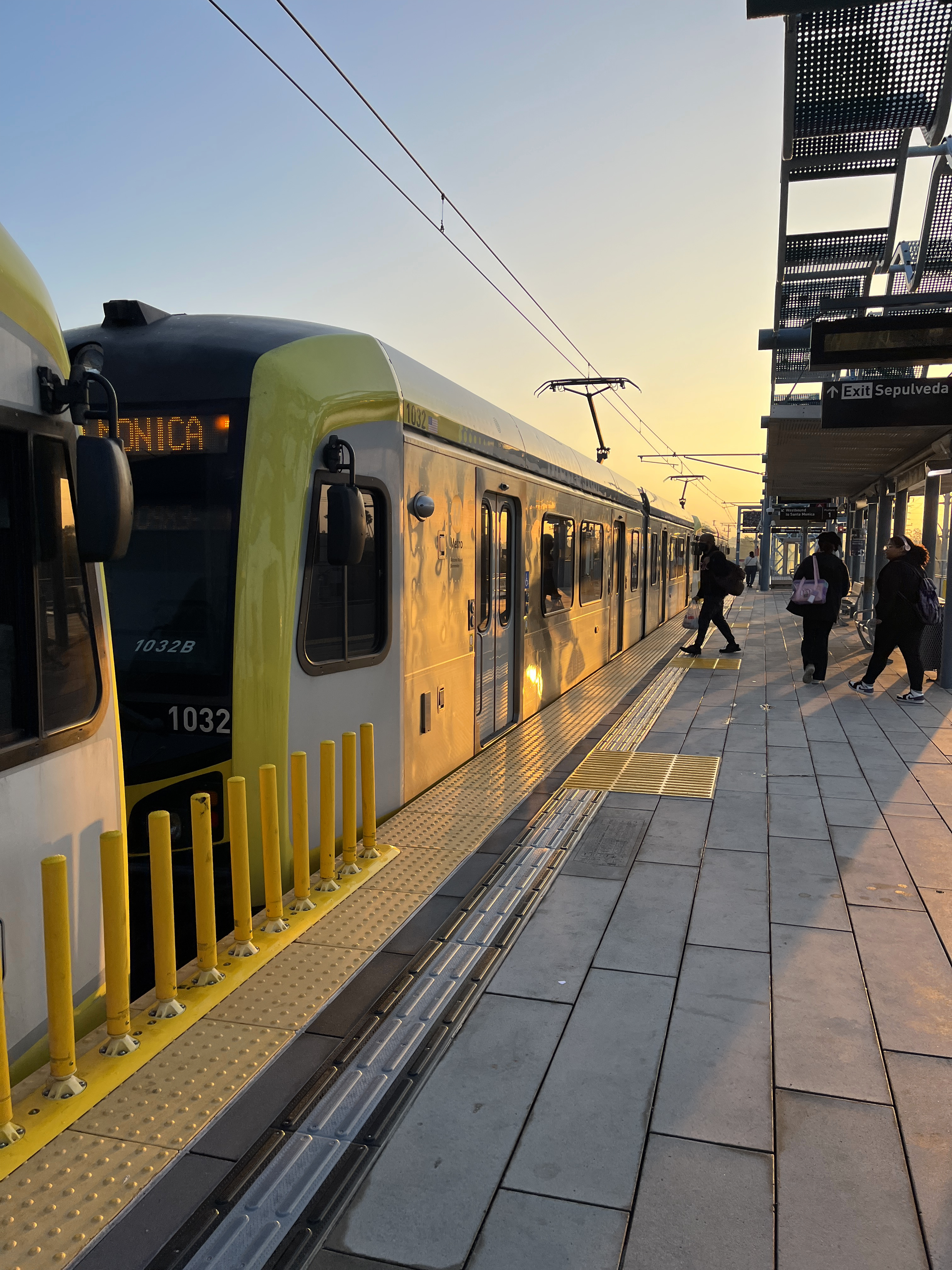


Main article: List of Los Angeles Metro Rail stations
The Metro Rail system consists of 107 stations. Metro Rail light rail stations are at ground level, elevated, trenched, or fully underground. All rapid transit stations are fully underground.
Stations include at least two ticket vending machines, wayfinding maps, electronic message displays, and bench seating. Call boxes are available at stations to allow employees at the Metro Rail Operations Control Center to assist passengers with concerns. Unique artwork is integrated into every station, showcasing local culture and improving the aesthetic of the system.
Street-level stations are typically simpler with platforms designed with shade canopies, separated from nearby roads and sidewalks, where passengers can purchase fares and board a train. Free or paid park and ride lots are available at 44 stations and most have bike storage available.
Underground stations are typically larger with a mezzanine level for fare sales and collection above a platform level where passengers board trains. Underground stations and tunnels are designed to resist ground shaking that could occur at a specific location. There is no general magnitude of an earthquake that the entire system is expected to withstand. However, the Metro Rail system has not suffered any damage from earthquakes since its opening in 1990.
Metro Rail uses a proof-of-payment fare system, with Metro's fare inspectors randomly inspecting trains and stations to ensure passengers have a valid fare product on their electronic fare TAP card. When passengers enter a station, they encounter TAP card validators which collect fares when a customer places their card on top. Additionally, fare gates (turnstiles) connected to TAP card validators are at all underground stations, all elevated stations, and some surface stations. Once passengers pass these validators or board a train, they have entered the "fare paid zone", where fare inspectors may check their TAP card to ensure they have a valid fare. Passengers who fail to comply may be penalized and removed from the system.
Rolling stock
Metro Rail maintains two distinct systems of rail: a light rail system and a rapid transit (subway) system, which use incompatible technologies, even though they both use and use 750 V power. Metro's rapid transit lines are powered by third rail, whereas its light rail lines are powered by overhead catenary. Also, the two separate systems have different loading gauge, and platforms are designed to match the separate car widths.
Hours of operation
The Los Angeles Metro Rail system runs for about 19 hours each day between 5:00 am and 11:45 pm. Limited service on particular segments is provided after midnight and before 5:00 am. There is no rail service between 2:00 am and 3:30 am, except on special occasions such as New Year's Eve. Before the COVID-19 pandemic in March 2020, service operated until approximately 2:00 am on Fridays and Saturdays. The Saturday service after midnight was ended during the pandemic to accommodate train cleaning during those hours.
Service frequency was increased in December 2023 when pandemic conditions were ending. Trains operate more frequently during weekday peak hours and less at other times. During peak hours, the light rail A and E lines run every 8 minutes and the light rail C and K lines run every 10 minutes. The light rail lines operate on 10-minute headways during off-peak periods and weekends. The B and D rapid transit lines operate every 12 minutes throughout the day. During early morning and late night hours, train frequency on all Metro Rail lines is reduced to every 20 minutes.
Metro plans to increase train frequencies, proposing to further reduce headways on the B, C, D, and K lines in 2025.
Fares and fare collection
The standard Metro base fare applies for all trips. Fare collection is based on a partial proof-of-payment system. At least two fare machines are at each station. Fare inspectors, local police, and deputy sheriffs police the system and cite individuals without proof of payment. Passengers are required to purchase a TAP card to ride Metro Rail. Passengers using a TAP card can transfer between Metro routes for free within 2 hours from the first tap.
Metro introduced daily and weekly fare caps in July 2023, replacing daily, weekly, and monthly passes. With fare capping, the cost of each trip is credited towards the cost of a daily or weekly unlimited pass, automatically ensuring that all passengers pay the lowest fare possible. Due to this, passengers will never pay more than $5 (3 rides) in a day or $18 (11 rides) within seven days; rides are free once the cap is reached. Discounted or free fares are available for seniors, disabled individuals, Medicare recipients, low-income individuals, and students.
The following table shows Metro fares, effective July 1, 2023 (in US dollars):
| Fare type | Regular | Senior (62+) | ||
|---|---|---|---|---|
| Disabled | ||||
| Medicare | Student K-12/ | Low Income (LIFE) | ||
| Base fare | $1.75 | $0.35 (off-peak) | ||
| $0.75 (peak) | $0.75 | 20 Free Rides then Regular fare | ||
| 1-Day Cap | $5 | $2.50 | $2.50 | |
| 7-Day Cap | $18 | $5 | $6 | |
| Metro-to-Muni Transfer | $0.50 | $0.25 | — | — |
TAP card and fare gates
Metro has implemented a system of electronic fare collection using a stored-value smartcard called the TAP card. This card was intended to simplify fare collection and reduce costs. In 2012, paper monthly passes were phased out and replaced with the TAP Card. As of September 2013, first-time Metro riders must deposit an additional $2 (or $1 at TAP vending machines) on top of their first fare payment to obtain a reloadable TAP Card. In addition, in 2008 Metro began installing fare gates at all underground stations, all elevated stations, and some surface stations. Implementation of both programs (the TAP Card and the fare gate program) has turned out to be expensive ($154 million in total, so far) and its initial rollout was problematic.
Ridership
In , the Metro Rail system had a ridership of .
As of , the combined Metro B and D lines averaged a weekday ridership of , making it the ninth busiest rapid transit system in the United States. Taking overall track length into consideration, Metro Rail's rapid transit lines transport 7,960 passengers per route mile, making this the fifth busiest U.S. rapid transit system on a per mile basis, yet at just 70% of pre-pandemic ridership levels. Metro's light rail system is the second-busiest in the United States with average weekday boardings as of . In terms of route length, Metro's light rail system is the largest in the United States.
| Year | Bus | Rail | Total | Change | 2009 | 2010 | 2011 | 2012 | 2013 | 2014 | 2015 | 2016 | 2017 | 2018 | 2019 | 2020 | 2021 | 2022 | 2023 | 2024 |
|---|---|---|---|---|---|---|---|---|---|---|---|---|---|---|---|---|---|---|---|---|
| 370,983,141 | 92,540,577 | 463,523,718 | n/a | |||||||||||||||||
| 358,228,816 | 95,596,698 | 453,825,514 | 2.09% | |||||||||||||||||
| 359,604,569 | 97,762,378 | 457,366,947 | 0.78% | |||||||||||||||||
| 360,076,040 | 108,879,123 | 468,955,163 | 2.53% | |||||||||||||||||
| 363,319,498 | 114,790,046 | 478,109,544 | 1.95% | |||||||||||||||||
| 352,058,138 | 112,535,260 | 464,593,398 | 2.83% | |||||||||||||||||
| 333,971,187 | 106,974,667 | 440,945,854 | 5.09% | |||||||||||||||||
| 304,160,857 | 111,458,473 | 415,619,330 | 5.74% | |||||||||||||||||
| 284,708,290 | 112,783,075 | 397,491,365 | 4.36% | |||||||||||||||||
| 275,777,661 | 108,017,525 | 383,795,186 | 3.45% | |||||||||||||||||
| 277,308,845 | 93,171,898 | 370,480,743 | 3.47% | |||||||||||||||||
| 161,171,528 | 51,918,949 | 213,090,477 | 42.48% | |||||||||||||||||
| 179,859,174 | 47,866,883 | 227,726,057 | 6.87% | |||||||||||||||||
| 197,952,375 | 60,565,995 | 258,518,370 | 12.78% | |||||||||||||||||
| 222,922,677 | 65,165,346 | 288,088,023 | 10.99% | |||||||||||||||||
| 242,602,853 | 68,650,712 | 311,253,565 | 8.04% |
Security and safety
Half of the Metro Rail's trains and stations are patrolled by the Los Angeles County Sheriff's Department under a law enforcement contract. The Los Angeles Police Department and Long Beach Police Department patrol stations within their respective cities, also under contract. The system is monitored by security personnel through closed-circuit television cameras. Metro Ambassadors are an in-house outreach team to provide a better user experience. They help riders navigate and provide information about the system.
In June 2024, the Metro Executive Board voted 10-0 to create their own transit police force. A cited reason included frustration with a lack of control over the existing contracts. This force is planned to consist of officers, crisis workers, and homelessness outreach teams.
History
Main article: History of Los Angeles Metro Rail and Busway

In the early 20th century, Southern California had an extensive privately owned rail transit network with over 1000 mi of track, operated by Pacific Electric (Red Cars) and Los Angeles Railway (Yellow Cars). However, from 1927 revenue shortfall caused Pacific Electric to begin replacing lightly used rail lines with buses. In 1958, the remnants of the privately owned rail and bus systems were consolidated into a government agency known as the Los Angeles Metropolitan Transit Authority or MTA. By 1963, the remaining rail lines were completely removed and replaced with bus service.
In the following decades, growing traffic congestion led to increased public support for rail transit's return. Beginning in the 1970s, a variety of factors, including environmental concerns, an increasing population, and the price of gasoline led to calls for mass transit other than buses. Los Angeles Metro began construction of the initial lines throughout the 1980s using revenues from a voter-approved increase in sales tax. The Blue (A) Line opened on July 14, 1990, 27 years after the final streetcar line closed. The system has been progressively expanded since. The following table shows this expansion's timeline:
Just before the opening of the Metro Rail, Proposition U passed, which halved the allowable residential density throughout much of Los Angeles. This reduced the viability of the Metro Rail by limiting dense residential housing near transit stations. Before 2000, none of the land near the stations was converted to residential use.
| Segment description | Date opened | Current line(s) | ||||||||||||||||||
|---|---|---|---|---|---|---|---|---|---|---|---|---|---|---|---|---|---|---|---|---|
| on segment | Endpoints | Number of | ||||||||||||||||||
| new stations | Length | |||||||||||||||||||
| (miles) | Construction cost | Total | 107 | 124.8 | $23.9 billion | |||||||||||||||
| Blue Line Initial Segment | July 14, 1990 | – | 17 | 19.1 | $2.2 billion | |||||||||||||||
| Blue Line Long Beach Loop | September 1, 1990 | – | 4 | 2.2 | ||||||||||||||||
| Blue Line To Financial District | February 15, 1991 | – | 1 | 0.7 | ||||||||||||||||
| Red Line MOS-1 | January 30, 1993 | – | 3 | 4.4 | $3.1 billion | |||||||||||||||
| Green Line | August 12, 1995 | – | 13 | 20.0 | $1.5 billion | |||||||||||||||
| Red Line MOS-2 West | July 13, 1996 | – | 3 | 2.0 | $3.4 billion | |||||||||||||||
| Red Line MOS-2 North | June 12, 1999 | – | 5 | 4.7 | ||||||||||||||||
| Red Line MOS-3 | June 24, 2000 | – | 3 | 6.3 | $2.3 billion | |||||||||||||||
| Gold Line Initial Segment | July 26, 2003 | – | 12 | 13.7 | $721 million | |||||||||||||||
| Gold Line Eastside Extension | November 15, 2009 | – | 8 | 6.0 | $887 million | |||||||||||||||
| Expo Line Phase 1 | April 28, 2012 | Flower/Washington – | 8 | 7.6 | $1.3 billion | |||||||||||||||
| Expo Line To Culver City | June 20, 2012 | – | 1 | 1.0 | ||||||||||||||||
| Farmdale station | 1 | – | ||||||||||||||||||
| Gold Line Foothill Extension Phase 2A | last=Nelson | first=Laura | title=San Gabriel commuters cheer as Gold Line rail extension officially opens | url=https://www.latimes.com/local/lanow/la-me-ln-san-gabriel-commuters-officials-cheer-gold-line-extension-20160305-story.html | work=Los Angeles Times | date=March 5, 2016 | access-date=March 6, 2016 | archive-date=March 5, 2016 | archive-url=https://web.archive.org/web/20160305221842/http://www.latimes.com/local/lanow/la-me-ln-san-gabriel-commuters-officials-cheer-gold-line-extension-20160305-story.html | url-status=live}} | – | 6 | 11.5 | $714 million | ||||||
| Expo Line Phase 2 | last=Hymon | first=Steve | title=17 things to know about Expo 2 opening on May 20 | url=http://thesource.metro.net/2016/02/25/17-things-to-know-about-the-expo-phase-2-opening/ | work=The Source | publisher=Los Angeles Metro | date=February 25, 2016 | access-date=May 21, 2016 | archive-date=February 22, 2017 | archive-url=https://web.archive.org/web/20170222040748/http://thesource.metro.net/2016/02/25/17-things-to-know-about-the-expo-phase-2-opening/ | url-status=live}} | – | 7 | 6.6 | $1.5 billion | |||||
| L Line Little Tokyo Closure | October 24, 2020 | – | -1 | -0.3 | – | |||||||||||||||
| K Line Initial Segment | last=Patel | first=Tine | title=LA Metro's new K Line opens today | url=https://www.cbsnews.com/losangeles/video/la-metros-new-k-line-opens-today/ | publisher=CBS | date=October 7, 2022 | access-date=October 7, 2022 | archive-date=October 7, 2022 | archive-url=https://web.archive.org/web/20221007154926/https://www.cbsnews.com/losangeles/video/la-metros-new-k-line-opens-today/ | url-status=live}} | – | 6 | 5.9 | $2.1 billion | ||||||
| Regional Connector | June 16, 2023 | – | 3 | 1.9 | $1.8 billion | |||||||||||||||
| Aviation/Century station | November 3, 2024 | 1 | 1.2 | – | ||||||||||||||||
| LAX/Metro Transit Center | June 6, 2025 | – | 1 | 1.2 | $900 million | |||||||||||||||
| Foothill Extension Phase 2B to Pomona | September 19, 2025 | – | 4 | 9.1 | $1.5 billion |
Planned expansion
Metro has worked to plan and prioritize project funding and implementation. Metro's 2009 Long Range Transportation Plan (LRTP) was developed to provide a long-term vision of transportation system development for the next 30 years. Metro worked to update the 2009 LRTP citing new housing trends and fiscal changes. Metro released the updated LRTP in 2020.
Beginning in 2014, Metro saw its ridership numbers begin to decline. Many explanations exist for the decline, including safety concerns, an increase in ride-hailing service usage, low-income housing opportunities drying up in L.A. because of the increase in rents, and a shortage of housing. Ridership declines also coincide with passage of AB 60, signed into law by Governor Jerry Brown in 2013, which provides for issuance of a driver's license regardless of immigration status.
The fiscal changes are the passage of Measure R, a countywide incremental sales tax increase passed by voters in 2008, providing funding for many of the highest priority projects in the LRTP. On November 6, 2012, Metro attempted to pass Measure J, but failed as it did not reach the two-thirds majority needed to pass. In the November 2016 election, Metro decided to place another sales tax on the ballot. The voters then approved Measure M, a half-cent permanent sales tax increase to fund many local projects, including Metro Rail expansion.
In 2018, Metro approved renaming its rail lines using a letter-based scheme, similar to those in New York City. Metro recommended the opening of the refurbished A Line in 2019 as a starting point to rename the lines, and then continuing with the opening of the K line, finishing in time for the opening of the Regional Connector in 2023.
LA Metro also plans to expand Union Station tracks and service. Metro has proposed "Link Union Station" to extend tracks 3-10 as run thru tracks. Phase one to be completed by 2028. Other phases include adding a California High-Speed Rail platform area, a Southeast Gateway line termini station, and renovate the concourse areas.
Current and priority projects
The following rail projects have been given high priority by Metro. They all appear in the 2009 LRTP constrained plan, and all have funding earmarked from Measure R. With the passage of Measure M in 2016, Metro released an updated Long Range Transportation Plan in February 2017, and released a full report in 2020, along with its Twenty-eight by '28 initiative.
| Concept name | Description | Construction | Operational | Status | Ref. | ||||||||||
|---|---|---|---|---|---|---|---|---|---|---|---|---|---|---|---|
| D Line Subway Extension Project | Section 1 extends the D Line west along Wilshire Blvd to La Cienega, Section 2 extends a further three miles west from La Cienega through Beverly Hills to Century City. Section 3 extends west to Westwood/UCLA and the VA Medical Center. All phases are under construction with plans to finish in time for the 2028 Summer Olympics. | 2015–2027 | 2026 (Section 1) / 2026 (Section 2) / 2027 (Section 3) | Under construction | url=https://www.metro.net/projects/westside/ | title=Purple (D Line) Extension Transit Project | work=LA Metro | date= | publisher=Los Angeles Metro | access-date=November 20, 2021 | archive-date=September 29, 2019 | archive-url=https://web.archive.org/web/20190929035532/https://www.metro.net/projects/westside/ | url-status=live}} | ||
| East San Fernando Valley Light Rail Transit Project | Constructs a light rail line connecting the east San Fernando Valley to the G Line, largely along the median of Van Nuys Blvd and San Fernando Road. The line will connect with Metrolink and Amtrak at the Van Nuys station and the future Sepulveda Transit Corridor. | 2024 | 2031 | Under construction | url=https://www.metro.net/projects/east-sfv/ | title=East San Fernando Valley Transit Corridor | publisher=Los Angeles Metro | date=July 8, 2014 | access-date=August 16, 2014 | archive-date=August 19, 2014 | archive-url=https://web.archive.org/web/20140819125445/http://www.metro.net/projects/east-sfv/ | url-status=live }} | |||
| Southeast Gateway Line | Creates a new light rail line connecting Downtown Los Angeles to Artesia and the Gateway Cities, much of it along the West Santa Ana Branch. | 2025 | 2035 | Under construction | url=https://www.metro.net/projects/west-santa-ana/ | title=West Santa Ana Transit Corridor | work=LA Metro | publisher=Los Angeles Metro | access-date=June 12, 2018 | archive-date=June 13, 2018 | archive-url=https://web.archive.org/web/20180613040936/https://www.metro.net/projects/west-santa-ana/ | url-status=live }} | |||
| Foothill Extension Phase 2B to Claremont | Further extends the A Line east from to . | 2027 | 2031 | LPA adopted / EIR Completed | last=Pacheco | first=Antonio | url=https://archpaper.com/2017/06/la-gold-line-extension/ | title=L.A. pushes ahead with $1.4 billion Gold Line extension | publisher=Archpaper.com | date=June 28, 2017 | access-date=February 15, 2020 | archive-date=August 8, 2020 | archive-url=https://web.archive.org/web/20200808213921/https://www.archpaper.com/2017/06/la-gold-line-extension/ | url-status=live }} | |
| Eastside Transit Corridor Phase 2 | Further extends the E Line southeast from East Los Angeles to Whittier. | 2029 | 2035 | LPA adopted / EIR Completed | url=https://www.metro.net/projects/eastside_phase2/ | title=Eastside Transit Corridor Phase 2 | publisher=Los Angeles Metro | date=May 6, 2014 | access-date=August 16, 2014 | archive-date=August 5, 2014 | archive-url=https://web.archive.org/web/20140805072042/http://www.metro.net/projects/eastside_phase2/ | url-status=live }} | |||
| C Line Extension to Torrance | Extends the K Line from its current terminus in Redondo Beach southeast towards Torrance and South Bay cities. | 2027 | 2036 | LPA adopted / EIR Completed | |||||||||||
| Sepulveda Transit Corridor | A automated heavy rail single-bore tunnel connection between the G Line and the East San Fernando Valley Transit Corridor (see above) in the Valley to the D and E lines on the Westside. Existing local funding will provide approximately $5.7 billion for the project for a scheduled opening in the early 2030s; additional funds, including from public–private partnerships, are being sought. Estimated to cost around $24 billion. | 2033 | 2033–2035 (Phase 1) / 2057–2059 (Phase 2) | LPA adopted / EIR in progress | |||||||||||
| K Line Northern Extension | Extends the K Line north via a new fully underground alignment connecting the B Line's Hollywood/Highland station south to the D Line, and the K Line's Expo/Crenshaw station via Santa Monica Boulevard in West Hollywood. Possible north–south routes include Fairfax, La Brea, and San Vicente Boulevard. An extension north of the K Line is included as a Tier 1 Strategic Unfunded Plan project in the 2009 Long Range Transportation Plan. | 2041 | 2047 | Three LPA's analysis in progress / Draft EIR Completed | url=http://media.metro.net/projects_studies/images/final-2009-LRTP.pdf | title=2009 Long Range Transportation Plan | publisher=Los Angeles Metro | page=31 | year=2010 | access-date=January 9, 2016 | archive-date=February 26, 2015 | archive-url=https://web.archive.org/web/20150226145318/http://media.metro.net/projects_studies/images/final-2009-LRTP.pdf | url-status=live }} | ||
| Arts District/6th Street station | Extends the B and D rapid transit lines south from Union Station along the L.A. River to the Arts District, and possibly across the river along Whittier Boulevard to the Eastside. However, Metro is studying the possibility of adding one or two stops along the river in the Arts District as part of a project to improve and expand the rail yard already in the area to accommodate increased headways once the D Line extension west is completed. | Unknown | Unknown | Draft EIR in progress | |||||||||||
| Create a new East/West Bus Rapid Transit route connecting Metro's station in San Gabriel Valley to the North Hollywood station in Los Angeles' San Fernando Valley along State Route 134 with possible stops in Eagle Rock, Glendale and Burbank. Metro currently has Measure M and SB-1 state funds to create the line. Projected is set to cost under $267 million to construct. The BRT is expected to begin construction by 2020 and open by 2024 with approximately 13 stations. Part of the Twenty-eight by '28 initiative. | BRT 2020; LRT Unknown | BRT 2023; LRT Unknown | Three BRT LPA's analysis in progress / Draft EIR in progress | first=Steven | last=Sharp | url=https://urbanize.la/post/planning-north-hollywood-pasadena-bus-rapid-transit-line-moves-forward | title=Planning for North Hollywood – Pasadena Bus Rapid Transit Line Moves Forward | publisher=Urbanize LA | date=October 1, 2018 | access-date=February 15, 2020}} | |||||
| North San Fernando Valley Transit Corridor | Create a new East/West Bus Rapid Transit route connecting Metro's Chatsworth's Metrolink Station to the North Hollywood station in Los Angeles' San Fernando Valley along Nordhoff Street or Roscoe Boulevard primarily. Once the BRT Line reaches Laurel Canyon Boulevard or Lankershim Boulevard in Sun Valley district in LA, it would proceed south to North Hollywood with possible stations at Strathern Avenue, Saticoy Street, Sherman Way, Vanowen Street, Victory Boulevard, Oxnard Street, and Burbank Boulevard. Metro currently has Measure M funds for project. Project is set to cost under $267 million to construct. The BRT is expected to begin construction by 2021 and open by 2024. Part of the Twenty-eight by '28 initiative. LRT funds are not currently available. | BRT 2021 ; LRT Unknown | BRT 2024; LRT Unknown | Various BRT LPA's analysis in progress / Pending Draft EIR for BRT | |||||||||||
| Vermont Transit Corridor | Create a new north–south route down Vermont Avenue between Wilshire/Vermont station, the Metro E Line and C Line. Included as a Tier 2 Strategic Unfunded Plan project in 2009 Long Range Transportation Plan; a bus rapid transit line has been funded in the near term by Measure M, but studies will be conducted for possible heavy rail rapid transit, as the Vermont corridor is Metro's second busiest public transportation corridor. | BRT 2020; HRT 2060 | BRT 2028–2030; HRT 2067 | Three LPA's analysis funded / Pending Draft EIR for BRT | |||||||||||
| G Line LRT conversion | Converting the current G Line bus rapid transit route into light rail. Made possible after the 2014 repeal of state legislation prohibiting light rail along the G Line right of way, which had been enacted due to neighborhood opposition in the 1990s. Long term plans include complete conversion in phases with full replacement by 2057. Metro commenced BRT upgrades in 2018 to add grade crossing gates, and two new elevated segments at Van Nuys Bl and Sepulveda Bl, reducing travel time by 20%. | 2051 | 2057 | No current funds available for LRT until 2051 | first=Steve | last=Hymon | url=http://thesource.metro.net/2015/10/22/gold-line-to-azusa-to-open-march-5-ten-things-to-know-about-the-foothill-extension/ | title=Transportation headlines, Wednesday, July 9 | work=The Source | publisher=Los Angeles Metro | date=July 9, 2014 | access-date=January 19, 2016 | archive-date=January 11, 2016 | archive-url=https://web.archive.org/web/20160111063508/http://thesource.metro.net/2015/10/22/gold-line-to-azusa-to-open-march-5-ten-things-to-know-about-the-foothill-extension/ | url-status=live }} |
| Lincoln Boulevard Transit Corridor | BRT with eventual LRT conversion along Lincoln Boulevard from to . The C Line was originally engineered to maintain compatibility with this extension. Included in City of Los Angeles Westside Mobility Plan, and as a Tier 2 Strategic Unfunded Plan project in 2009 Long Range Transportation Plan. | BRT 2043; LRT Unknown | BRT 2047; LRT Unknown | No LPA or EIR conducted | url=https://thesource.metro.net/2016/11/08/measure-m-project-descriptions/ | title=Measure M project descriptions – The Source | newspaper=The Source | publisher=Thesource.metro.net | date=November 8, 2016 | access-date=February 15, 2020 | archive-date=September 8, 2020 | archive-url=https://web.archive.org/web/20200908062056/https://thesource.metro.net/2016/11/08/measure-m-project-descriptions/ | url-status=live }} | ||
| North Hollywood to Pasadena Bus Rapid Transit Project | BRT with potential LRT conversion. Connecting North Hollywood to Memorial Park in Pasadena. Feasibility Study for Rail requested in May of 2024. | BRT 2025; LRT Unknown | BRT 2027; LRT Unknown | No LPA or EIR conducted |
Other expansion concepts
Metro's Long Range Transportation Plan was published in 2009, and was updated in 2020. The following proposed line/system expansions do not have funding or high priority in Metro's long-range plans. Some are listed as "strategic unfunded" in the last Long Range Transportation Plan, indicating some possibility they could be constructed should additional funding materialize. Others have been the subject of Metro Board discussion, with the possibility of future feasibility studies. (More information on each project can be found in the references.)
| Concept name | Description | Source |
|---|---|---|
| Burbank–Glendale Line | Would connect Downtown Los Angeles to Glendale and Burbank. Studied in the 1990s, and included as a Tier 1 Strategic Unfunded Plan project in 2009 Long Range Transportation Plan. | |
| B Line To Burbank Airport | Extend the Metro B Line 3.2 mi from its northwestern terminus to Hollywood Burbank Airport. Included as a Tier 1 Strategic Unfunded Plan project in 2009 Long Range Transportation Plan. | |
| C Line To Norwalk Metrolink | Extend the C Line east to Norwalk/Santa Fe Springs station (Metrolink). Included as a Tier 1 Strategic Unfunded Plan project in 2009 Long Range Transportation Plan, but is included among the Major Transit Projects (Figure 8) in the 2020 Long Range Transportation Plan with an estimated "open year" of 2052. | |
| "Pink Line"/"Silver Line" (former names) | DTLA Union Station thru Hollywood to Beverly Hills terminating at the under construction D Line Century City Station. Stops in or near Silver Lake, Dodger Stadium, Echo Park, West Hollywood and Century City. Mostly a Sunset Boulevard and Santa Monica Boulevard east–west route. Possibly using the already built HRT B Line tracks thru Hollywood or the LRT K Line under consideration in West Hollywood. East of Union Station would head to the City of La Puente or El Monte, CA. With possible stops in East L.A., Cal State LA, San Gabriel and Baldwin Park. No LPAs listed. No funds available. Listed as one of several "Strategic Unfunded Plan" project in the 2009 Long Range Transportation Plan, Tier 2. Eastside route no longer met by the removed Eastside Transit Corridor option along The 60 Freeway. | |
| Harbor Line | Light rail line to connect harbor area (San Pedro) to Metro A Line or C Line. Floated in LA City Council motions and Metro Harbor Subdivision studies. Also, a further southward extension of the C Line is included as a Tier 1 Strategic Unfunded Plan project in the 2009 Long Range Transportation Plan. Other plans could lead to the J Line being converted to rail. | |
| D Line Extension Phase 4 | Extend the Metro D Line 3.5 mi from its under construction western terminus, Westwood/VA Hospital station to Downtown Santa Monica station. No funds available. | |
| Venice Boulevard Corridor | Restore the Venice Boulevard right-of-way train service from Venice Beach in the west to Culver Junction area possibly heading north on La Brea Avenue to Hollywood or east into Downtown Los Angeles. Would service the westside and Central Los Angeles. Pacific Electric Venice Short Line was last used in the 1950s. |
References
References
- https://www.metro.net/projects/foothill-extension/
- (Feb 19, 2025). "American Public Transportation Association Q4 2024 Ridership Report".
- (November 12, 2024). "Facts At A Glance". [[Los Angeles Metro]].
- (2024-05-20). "Art – Los Angeles Metro".
- "Metro Parking Lots by Line".
- Hymon, Steve. (August 10, 2012). "Designing a subway to withstand an earthquake".
- (2024-03-25). "A beginner's guide to Metro".
- (June 1, 2018). "Metro Customer Code of Conduct". Los Angeles Metro.
- (December 10, 2023). "Metro Maps and Schedules". Los Angeles Metro.
- Mitteenn, Mey Lyn. (December 21, 2023). "Go Metro for free on Christmas Eve and New Year's Eve".
- (March 21, 2020). "Coronavirus: Metro to end late-night rail service on Saturday".
- (November 7, 2023). "Metro December 2023 Service Change". Los Angeles Metro.
- (May 24, 2024). "FY 25 Proposed Budget". Los Angeles Metro.
- "Fares - LA Metro".
- (2023-06-07). "L.A. Metro Fare Capping Starts July 1 - Streetsblog California".
- "Fare Capping".
- (August 21, 2010). "MTA's $46M system of locking turnstiles sits unused, waiting for fare cards to be adopted – LA Daily News". Dailynews.com.
- "LA Metro Ridership Statistics".
- (2025-02-19). "2024 Q4 Ridership report". [[American Public Transportation Association.
- (February 23, 2017). "LAPD Officers to Patrol Metro Buses, Trains in the City of Los Angeles". Mayor Eric Garcetti.
- (September 13, 2006). "Riders with Other Forms of Transport Switching to Metro". www.metro.net.
- "Meet Our Metro Ambassadors".
- (June 27, 2024). "Metro OKs plan to start its own police agency, wind down contracts with sheriff, LAPD". [[Los Angeles Times]].
- Taplin, Michael. (1991). "City of the Automobile: Los Angeles looks to Light Rail London". Platform 5 Publishing/[[Light Rail Transit Association]].
- . (March 31, 1963). ["Streetcars Go for Last Ride"](https://documents.latimes.com/1948-1963-los-angeles-streetcar-coverage/). *[[Los Angeles Times]]*.
- Severen, Christopher. (2023). "Commuting, Labor, and Housing Market Effects of Mass Transportation: Welfare and Identification". Review of Economics and Statistics.
- Nelson, Laura. (March 5, 2016). "San Gabriel commuters cheer as Gold Line rail extension officially opens". [[Los Angeles Times]].
- Hymon, Steve. (February 25, 2016). "17 things to know about Expo 2 opening on May 20". [[Los Angeles Metro]].
- "Building the Last Phase of the Regional Connector Transit Project Requires A 22-Month Closure of Little Tokyo/Arts District Station Effective Saturday, Oct. 24 through Fall 2022".
- Patel, Tine. (October 7, 2022). "LA Metro's new K Line opens today". CBS.
- (June 16, 2023). "Metro Regional Connector opens in Los Angeles, bringing more direct access to downtown". [[Nexstar Media Group]].
- Hymon, Steve. (October 14, 2024). "Changes are coming Sunday, Nov. 3, to the C and K Lines as we open the new Aviation/Century Station".
- (June 6, 2025). "Metro’s LAX Mega-Station is Open". [[OpenPlans]].
- (September 19, 2025). "LA Metro’s long-awaited Pomona extension welcomes first riders". [[Nexstar Media Group]].
- "Foothill Extension".
- (2020). "2020 Long Range Transportation Plan". Metro.
- Chiland, Elijah. (May 22, 2019). "Is Metro ridership down because low-income passengers are leaving LA?".
- "AB 60 Driver Licenses".
- "L.A. Metro Ridership".
- "Measure R". [[Los Angeles Metro]].
- "Measure J". [[Los Angeles Metro]].
- "Measure J Fails". County of Los Angeles Registrar-Recorder.
- (December 4, 2012). "Transit Backers Seek to Change State Law". [[Los Angeles Times]].
- Nelson, Laura J.. (June 23, 2016). "Metro puts half-cent sales tax increase for transportation projects on November ballot". Los Angeles Times.
- Hymon, Steve. (April 7, 2015). "PowerPoint: Metro staffs proposal to rename rail and BRT lines". [[Los Angeles Metro]].
- (April 3, 2015). "LA Metro Could Switch Rail Line Names From Colors To Letters". Curbed Staff.
- "More intersection, road closures for Blue Line upgrades".
- (November 15, 2018). "Plan 2018-0684 – Metro Board". Boardagendas.metro.net.
- (June 12, 2023). "Transit Maps: New Official Map: Los Angeles Metro with Regional Connector, 2023".
- "Link Union Station (Link US)". [[Los Angeles Metro]].
- Sharp, Stephen. (2022-05-31). "$2.3B Union Station makeover takes another step forward".
- (June 19, 2014). "Transit Program – Project Management – Project Budget and Schedule Status". [[Los Angeles Metro]].
- "Long Range Transportation Plan". Metro.net.
- "Twenty-Eight by '28 Initiative". Metro.net.
- "Purple (D Line) Extension Transit Project". [[Los Angeles Metro]].
- "Summer 2013 – General Fact Sheet – Purple Line Extension". [[Los Angeles Metro]].
- [http://thesource.metro.net/2017/04/27/notice-to-proceed-issued-for-section-2-of-purple-line-extension/ Notice to proceed issued for section 2 of the Purple Line Extension] {{Webarchive. link. (November 25, 2020 , the source.metro.net, 2017/04/27.)
- Sotero, Dave. (November 10, 2014). "Long wait over: groundbreaking held for Wilshire Boulevard subway extension". [[Los Angeles Metro]].
- (July 23, 2025). "D Line Subway Extension Section 1 update: Ninety-eight percent finished and counting". [[Los Angeles Metro]].
- (October 15, 2025). "The opening for the first part of LA Metro's D Line extension is delayed until early next year". [[Southern California Public Radio]].
- (July 8, 2014). "East San Fernando Valley Transit Corridor". [[Los Angeles Metro]].
- (June 28, 2018). "The Valley will get light rail: Metro board approves north–south line along Van Nuys Boulevard".
- Sotero, Dave. (December 3, 2020). "Metro Board approves Final EIR for East San Fernando Valley Light Rail Transit Project". [[Los Angeles Metro]].
- (June 28, 2022). "Updates on LA Metro's East SFV rail project schedule were provided recently at an employee meeting. Current schedule is start receiving construction (PDB) contract bids in Summer 2022, award contract in 2023, and complete project in 2028.".
- (November 27, 2023). "October 2023 status report for LA Metro's East San Fernando Valley line. Contractor's initial schedule shows line opening at end of 2031, Metro is targeting summer 2031.".
- (July 28, 2024). "Metro gets rolling on San Fernando Valley light rail construction". [[MediaNews Group]].
- (January 28, 2022). "Metro Board approves route for initial segment for West Santa Ana Branch Project and Union Station as northern terminus". The Source.
- "West Santa Ana Transit Corridor". [[Los Angeles Metro]].
- "Home".
- (April 2017 <!--). "West Santa Ana Branch Transit Corridor". Los Angeles Metro.
- "West Santa Ana Branch Transit Corridor". Los Angeles Metro.
- "EIS_EIR".
- (April 25, 2024). "Metro certifies environmental impact report for Southeast Gateway Rail Line". [[MediaNews Group]].
- (April 25, 2024). "LA Metro has released the RFP for a contractor for "Advanced Works" for Southeast Gateway Line, to prepare alignment for main project construction (utility relocations, soil abatement, freight relocation, etc.). Contract might also include building C Line infill transfer station.".
- (October 31, 2024). "Metro Breaks Ground on Early Phase of Southeast Gateway Light Rail Construction". [[OpenPlans]].
- Pacheco, Antonio. (June 28, 2017). "L.A. pushes ahead with $1.4 billion Gold Line extension". Archpaper.com.
- Márquez, Liset. (April 26, 2018). "There's now enough money to build the Gold Line through to Montclair – Daily Bulletin". Dailybulletin.com.
- (June 23, 2017). "Metro approves $1.4B construction plan for Gold Line extension to Claremont". Curbed.
- (January 3, 2025). "Foothill Gold Line from Glendora to Pomona Reaches Substantial Completion".
- (January 4, 2025). "A Line light-rail extension from Azusa to Pomona set to open in late summer". [[Digital First Media]].
- Levy Buch, Lisa. (September 12, 2025). "Claremont and Montclair Segments to Be Built Separately".
- (May 6, 2014). "Eastside Transit Corridor Phase 2". [[Los Angeles Metro]].
- Metro, L. A.. (2022-07-01). "Draft Environmental Impact Report (EIR) released for extension of L Line to Whittier".
- "Final EIR (April 2024)". [[Los Angeles Metro]].
- (May 24, 2024). "Metro moves forward with Eastside and South Bay rail extensions Neither project is expected to open for passengers". Urbanize Media LLC.
- (March 2019). "Green Line Extension to Torrance Fact Sheet". Metro.
- "C Line (Green) Extension to Torrance".
- "Final EIR". [[Los Angeles Metro]].
- (2025-09-12). "The Final Environmental Impact Report (EIR) for the C Line Extension to Torrance has been released {{!}} The Source".
- (May 20, 2024). "We're exploring alternatives to the 405".
- (June 7, 2018). "Rail concepts released for Sepulveda Transit Corridor project – The Source". Thesource.metro.net.
- "Sepulveda Transit Corridor Project".
- "Refined Valley-Westside Transit Concepts".
- (2010). "2009 Long Range Transportation Plan". [[Los Angeles Metro]].
- "WHAM – West Hollywood Advocates for Metro Rail". Whamrail.com.
- Sharp, Steven. (July 23, 2018). "Five Options Under Consideration for the Crenshaw/LAX Line's Northern Extension". Urbanize LA.
- (May 24, 2018). "Actions taken by Metro Board today – The Source". Thesource.metro.net.
- Hymon, Steve. (August 17, 2020). "Three routes recommended for further study on K Line Northern Extension project". [[Los Angeles Metro]].
- "KNE_DraftEIR". [[Los Angeles Metro]].
- (May 27, 2010). "Los Angeles Downtown News and Information". Ladowntownnews.com.
- Nelson, Laura J.. (March 18, 2015). "Metro could expand subway service to the downtown L.A. Arts District". [[Los Angeles Times]].
- (June 20, 2018). "Metro Board considers item for formal study of Arts District Station – The Source". Thesource.metro.net.
- (30 March 2021). "Scoping meetings in April for upcoming Arts District Station environmental report". The Source.
- Sharp, Steven. (October 1, 2018). "Planning for North Hollywood – Pasadena Bus Rapid Transit Line Moves Forward". Urbanize LA.
- (September 25, 2018). "Community meetings begin this month for NoHo to Pasadena Bus Rapid Transit project – The Source". Thesource.metro.net.
- "North San Fernando Valley Bus Rapid Transit Improvements News". Urbanize.la.
- Hymon, Steve. (July 9, 2014). "Transportation headlines, Wednesday, July 9". [[Los Angeles Metro]].
- (July 17, 2018). "LA's Metro says improvements are in the works for the Orange Line, with light rail in mind".
- (October 12, 2018). "Metro breaks ground on Orange Line Improvements Project – The Source". Thesource.metro.net.
- (November 8, 2016). "Measure M project descriptions – The Source". Thesource.metro.net.
- @numble. (2025-02-08). "LA Metro has started a feasibility study of implementing rail between North Hollywood and Pasadena. Expected to be done in 2026. Documents from bidders that competed on study contract show some initial analysis. They may consider routes that don't always match planned BRT route.".
- "North Hollywood to Pasadena Transit Corridor - LA Metro". LA Metro.
- (1992). "BURBANK-GLENDALE-LOS ANGELES RAIL TRANSIT PROJECT". Metro.
- Weikel, Dan. (January 10, 2016). "Closing 2.8-mile transit gap in Norwalk could smooth regional commute". [[Los Angeles Times]].
- "Metro Silver Line – Los Angeles Light Rail Trains from El Monte to Silver Lake // Silverline, Mass Transit". metrosilverline.com.
- "The National Transit Coalition". thetransitcoalition.us.
- Freemark, Yonah. (October 18, 2010). "Realizing the Impossible: Los Angeles' Subway Extension « The Transport Politic". Thetransportpolitic.com.
- "harborline". harborline.blogspot.com.
- (January 31, 2017). "Does L.A. Need the Santa Monica Purple Line Extension?".
- (November 8, 2014). "L.A.'s not-quite 'subway to the sea' finally breaks ground".
- (January 9, 2020). "Who Are We Building Transit For?".

This article was imported from Wikipedia and is available under the Creative Commons Attribution-ShareAlike 4.0 License. Content has been adapted to SurfDoc format. Original contributors can be found on the article history page.
Ask Mako anything about Los Angeles Metro Rail — get instant answers, deeper analysis, and related topics.
Research with MakoFree with your Surf account
Create a free account to save articles, ask Mako questions, and organize your research.
Sign up freeThis content may have been generated or modified by AI. CloudSurf Software LLC is not responsible for the accuracy, completeness, or reliability of AI-generated content. Always verify important information from primary sources.
Report