From Surf Wiki (app.surf) — the open knowledge base
Los Angeles Metro Busway
Bus rapid transit system in Los Angeles County, California

Bus rapid transit system in Los Angeles County, California
| Field | Value | |
|---|---|---|
| name | Metro Busway | |
| image | LAMetroLogo.svg | |
| imagesize | 100px | |
| image2 | 19500 Westbound.jpg | |
| caption2 | G Line | |
| image3 | K9M J Line (3-2 crop).jpg | |
| caption3 | J Line | |
| locale | Los Angeles County, California | |
| transit_type | Bus rapid transit | |
| system_length | 55.7 mi | |
| lines | 2 | |
| stations | 29 | |
| operator | Los Angeles Metro | |
| map | {{switcher | |
| {{maplink-road | from | Los Angeles Metro Busway.map}} |
| {{Los Angeles Metro Busway | inline | yes}} |
| began_operation | (G Line) | |
| (J Line) | ||
| website |
| | Show interactive map | [[File:Los Angeles Metro System Map.png|275px]] | Show static map | | Show route diagram (J Line) Metro Busway (formerly known as Metro Liner and Metro Transitway) is a system of bus rapid transit (BRT) routes operated by Los Angeles Metro. The system primarily uses exclusive or semi-exclusive roadways, referred to locally as a busway or transitway. It currently consists of two lines serving 29 stations, not including surface street stops: the G Line in the San Fernando Valley and the J Line, which serves El Monte, Downtown Los Angeles, Gardena, and San Pedro.
The G Line, which operates on a exclusive busway, was the first to open, beginning service on October 29, 2005. The J Line launched on December 13, 2009, utilizing the pre-existing Harbor Transitway and El Monte Busway, semi-exclusive corridors that are used by both buses and as high-occupancy toll lanes under the Metro ExpressLanes program.
Metro Busway services are designed to mimic Metro Rail services, in both the vehicles' design and their operation. Buses feature a silver livery similar to that used on Metro Rail vehicles, offer all-door boarding, and receive signal priority at intersections. Both lines operate on a proof-of-payment system; passengers with valid fare loaded on a TAP card may board through any door. TAP cards can be purchased and reloaded at ticket vending machines located at most stations.
System
Lines
Metro Busway lines are named as part of the naming scheme used for Metro Rail lines, however, the colored icons for the Metro Busway lines are squares instead of the circles used for Metro Rail lines.
Two Metro Busway lines operate in Los Angeles County:
| Line name | Opening | Length | Stations | Termini |
|---|---|---|---|---|
| 2005 | 17.7 mi | 17 | (west) | |
| (east) | ||||
| 2009 | 38 mi | 12 | (north) | |
| (south) | ||||
| (south) |
Corridors
These services operate on three primary corridors (in addition to city streets, where necessary):
- G Line Busway
- El Monte Busway
- Harbor Transitway/Harbor Freeway
History
Main article: History of Los Angeles Metro Rail and Busway

The first busway in the Los Angeles area was the El Monte Busway, which opened in January 1973. The El Monte Busway, which runs parallel to the San Bernardino Freeway, offered an 18-minute trip between El Monte and Downtown Los Angeles, compared to 35–45 minutes in the general-purpose lanes. The facility was a success with about 32,000 boardings per day on lines that used the busway as of November 2000.
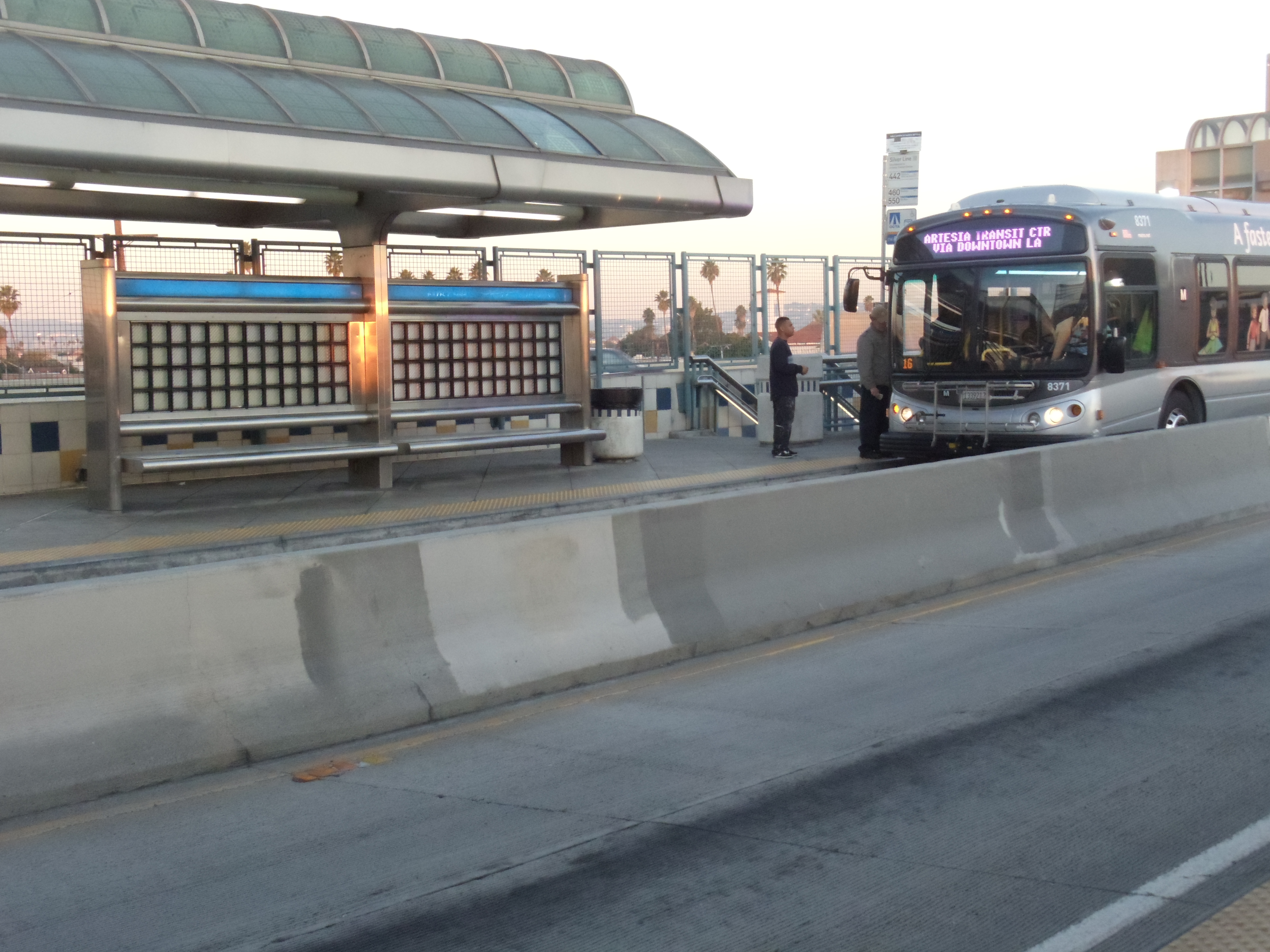
The area's second busway, the Harbor Transitway, opened in 1996 offering a new connection between Gardena and Downtown Los Angeles. Ridership on the Harbor Transitway was radically lower than expected: Caltrans had projected that 65,200 passengers would travel along the Harbor Transitway each day, but after 10 years, the facility had only attracted 3,000 passengers per weekday.
A third busway to be built in the region came after community revolt against a proposed light rail line in the San Fernando Valley. Los Angeles Metro acquired the Southern Pacific Burbank Branch right of way in 1991, intending to utilize the corridor for light rail trains. Neighbors successfully petitioned lawmakers to pass a ban on utilizing transit tax revenue for anything other than an extension of the existing subway into the San Fernando Valley. However, the passage of Proposition A in 1998 cut off funding for any subway projects. With both subway and light rail now legally prohibited, but with growing political pressure to utilize the former railbed, the last available option was a dedicated busway. This proposal was also opposed by neighborhood groups; however, since the previous law did not prohibit it, it moved forward. The busway opened as the Orange Line (now G Line) on October 29, 2005. The line was a success, attracting nearly 23,000 boardings per day in the first year it was open, and nearly 30,000 boardings per day by 2013. The line is so popular, that in 2014 users petitioned lawmakers to repeal the ban on light rail, and Metro now plans to convert the busway to light rail by 2050.
After the successful launch of the busway in the San Fernando Valley, Metro decided to rebrand the county's other busways in an attempt to increase awareness. In March 2006, Metro decided that the Harbor Transitway would be colored bronze and the El Monte Busway would be colored silver on Metro's maps and the two would be marketed as a "Combined Transitway Service." No changes were made in the operations of the bus routes operated on either facility. The changes were criticized as being difficult to understand for irregular and new riders.
In 2009, Metro returned to plan it first proposed in 1993 and created a new bus rapid transit service called the Silver Line (now J Line) utilizing both the Harbor Transitway and the El Monte Busway. The new higher frequency service would be funded by converting both corridors into high occupancy toll (HOT) lanes, to be branded as the Metro ExpressLanes. The bus route began operations on December 13, 2009. Since the J Line's start, Metro has refurbished the aging stations along both the Harbor Transitway and the El Monte Busway, bringing them closer to the amenities provided along the G Line's busway. The plan has led to higher ridership along the corridor, especially along the Harbor Transitway.
On June 30, 2012, the busway used by the G Line buses was extended northward to the Chatsworth Metrolink station, continuing to follow the former Southern Pacific Burbank Branch right-of-way owned by Metro.
The Siliver Line and Orange Line were renamed in 2020, as part of a systemwide rebranding. The Orange Line was renamed the G Line, and the Silver Line became the J Line.
The following table shows the timeline of BRT expansions:
| Segment description | Date opened | Line(s) | Endpoints | # of new | |
|---|---|---|---|---|---|
| stations | Busway | ||||
| length | |||||
| (miles) | |||||
| Metro Orange Line initial segment | October 29, 2005 | – | 13 | 14 | |
| Canoga station | December 27, 2006 | 1 | − | ||
| Metro Silver Line initial segment | December 13, 2009 | – | 9 | 26 | |
| station | December 12, 2010 | 1 | − | ||
| Metro Orange Line Chatsworth Extension | June 30, 2012 | Canoga – | 4 | 4 | |
| Metro Silver Line San Pedro Extension | December 13, 2015 | Harbor Gateway Transit Center – (Pacific/21st Street) | 2 | 8 | |
| Warner Center Shuttle | June 24, 2018 | Warner Center station removed | -1 | − | |
| TOTAL | 29 | 44 |
Notes:
Future
Metro plans to add additional Metro Busway lines; some projects may have their timelines accelerated under its Twenty-eight by '28 initiative.
On March 17, 2021, Metro staff came forward with five corridors that the agency could pursue to have bus rapid transit implemented in them.
| Concept | Description | Construction | Operational | Status | Ref. | |||||||
|---|---|---|---|---|---|---|---|---|---|---|---|---|
| North San Fernando Valley Transit Corridor | This project was supposed to be a new east-west bus rapid transit (BRT) route connecting Metro's Chatsworth's Metrolink Station to the North Hollywood station in Los Angeles' San Fernando Valley. As of May 2022, Metro has dropped the single BRT line approach and instead focuses on improving local bus service via peak hour bus lanes on Roscoe Boulevard and signal priority on seven other lines. The project also adds around 400 bus shelters and 80 bus bulbs throughout the San Fernando Valley. Five major bus stops will receive key improvements (two at CSUN), including larger shelters, more seating, new real-time and wayfinding information, and better lighting. Project implementation is expected to begin in fall 2023 and be completed by winter 2025. | 2023 | 2025 | Under Construction | ||||||||
| North Hollywood to Pasadena Bus Rapid Transit Project | Creates a new east–west BRT route connecting Metro's Memorial Park station in Pasadena to the North Hollywood station in Los Angeles' San Fernando Valley with stops in Eagle Rock, Glendale and Burbank. Metro currently has Measure M and SB-1 state funds to create the line. Project is set to cost under $267 million to construct. The BRT is expected to begin construction by 2024 and open by 2027 with approximately 22 stations. Part of the Twenty-eight by '28 initiative. | 2024 | 2027 | Pre Construction | url=http://media.metro.net/projects_studies/images/final-2009-LRTP.pdf | title=2009 Long Range Transportation Plan | publisher=Los Angeles Metro | page=31 | year=2010 | access-date=January 9, 2016}} | ||
| Vermont Transit Corridor | Create a new north–south subway route down Vermont Avenue extending the HRT B Line at the Wilshire/Vermont Station south, to the Metro E Line and C Line. Included as a Tier 2 Strategic Unfunded Plan project in 2009 Long Range Transportation Plan; a Bus rapid transit line has been funded in the near term by Measure M, but studies will be conducted for possible heavy rail transit, as the Vermont corridor is Metro's second busiest public transportation corridor. | 2020 | 2028 | Three LPA analysis funded / Pending Draft EIR for BRT | url=https://la.curbed.com/2018/5/7/17317100/los-angeles-subway-vermont-rail | title=A subway on Vermont? Metro is considering it - Curbed LA | date=7 May 2018 | publisher=La.curbed.com | access-date=February 15, 2020}} | |||
| G LRT conversion | Converting the current G Line Bus Rapid Transit route into LRT. Made possible after the 2014 repeal of state legislation prohibiting LRT along the G Line right of way, which had been enacted due to neighborhood opposition in the 1990s. Bridges along the busway are designed to LRT standards, but the project would require substantial service disruption as the roadway is replaced by rails and catenary wire installed. Some Valley politicians and pressure groups have endorsed the proposal; critics have suggested funding would be better spent on adding new lines along other corridors in the Valley. Long-term plans include complete conversion in phases with full replacement by 2057. Metro began BRT upgrades in 2018 by adding more grade crossing gates, two new viaducts at Van Nuys Blvd and Sepulveda Blvd, reducing travel time by 20%. | 2051 | 2057 | No current funds available for LRT until 2051 | first=Steve | last=Hymon | url=http://thesource.metro.net/2015/10/22/gold-line-to-azusa-to-open-march-5-ten-things-to-know-about-the-foothill-extension/ | title=Transportation headlines, Wednesday, July 9 | work=The Source | publisher=Los Angeles Metro | date=July 9, 2014 | access-date=January 19, 2016}} |
| Lincoln Blvd BRT/LRT Line | Extend the LRT C Line from LAX northwest to Venice and Santa Monica Beach and possibly connect with the E Line's western terminus. The C Line was originally engineered to maintain compatibility with this extension. Included in City of Los Angeles Westside Mobility Plan, and as a Tier 2 Strategic Unfunded Plan project in 2009 Long Range Transportation Plan. | 2043 | 2047 | No LPA or EIR conducted | url=https://thesource.metro.net/2016/11/08/measure-m-project-descriptions/ | title=Measure M project descriptions - The Source | publisher=Thesource.metro.net | date=November 8, 2016 | access-date=February 15, 2020}} |
References
References
- (June 2023). "Facts At A Glance". [[Los Angeles Metro]].
- (January 24, 2012). "40 Years Ago This Week: Groundbreaking For El Monte Busway — California's First Multi-Modal System & The World's First Bus Rapid Transit Station".
- Shuit, Douglas P.. (November 20, 2000). "Harbor Transitway Has Everything but Riders". Los Angeles Times.
- (7 April 1996). "Tracks to the Past". Los Angeles Times.
- Broverman, Neal. (February 4, 2014). "State Could be About to Repeal Ban on Light Rail in the Valley". LA Curbed.
- "Public utilities code section 130250-130265".
- "Legal arguments against the busway".
- (February 2020). "Metro Ridership". [[Los Angeles Metro]].
- Broverman, Neal. (July 8, 2014). "It's Now Legal to Build Light Rail in the San Fernando Valley". LA Curbed.
- (July 17, 2018). "LA's Metro says improvements are in the works for the Orange Line, with light rail in mind".
- Emsden, Maya. (March 16, 2006). "Approve color designations for Metro lines and fixed guideways". [[Los Angeles Metro]].
- Freemark, Yonah. (December 10, 2009). "Los Angeles Integrates Service on Two Busways, with Plans to Implement Congestion Pricing". The Transport Politic.
- (August 1993). "Dual Hub High Occupancy Vehicle Transitway Report". Los Angeles Metro Scheduling and Operations Planning Staff.
- (January 18, 2012). "Item 44 Program Management Project Budget and Schedule Status". Metro.
- Fonseca, Ryan. (2020-01-08). "LA Metro's New Train And Bus Names Are Official. Time To Learn Your Transit ABCs".
- (March 17, 2021). "Metro Staff Recommend Five Corridors". Urbanize.
- "North San Fernando Valley Bus Rapid Transit Improvements News". Urbanize.la.
- "North San Fernando Valley Transit Corridor – Project Update Summer 2022".
- "North San Fernando Valley Transit Corridor".
- (2010). "2009 Long Range Transportation Plan". [[Los Angeles Metro]].
- Sharp, Steven. (October 1, 2018). "Planning for North Hollywood - Pasadena Bus Rapid Transit Line Moves Forward". Urbanize LA.
- (September 25, 2018). "Community meetings begin this month for NoHo to Pasadena Bus Rapid Transit project - The Source". Thesource.metro.net.
- "That Rapid Bus Line from North Hollywood to Pasadena is Officially Happening".
- (March 29, 2023). "Update on LA Metro’s North Hollywood to Pasadena BRT project".
- (7 May 2018). "A subway on Vermont? Metro is considering it - Curbed LA". La.curbed.com.
- Hymon, Steve. (July 9, 2014). "Transportation headlines, Wednesday, July 9". [[Los Angeles Metro]].
- (October 12, 2018). "Metro breaks ground on Orange Line Improvements Project - The Source". Thesource.metro.net.
- (November 8, 2016). "Measure M project descriptions - The Source". Thesource.metro.net.
This article was imported from Wikipedia and is available under the Creative Commons Attribution-ShareAlike 4.0 License. Content has been adapted to SurfDoc format. Original contributors can be found on the article history page.
Ask Mako anything about Los Angeles Metro Busway — get instant answers, deeper analysis, and related topics.
Research with MakoFree with your Surf account
Create a free account to save articles, ask Mako questions, and organize your research.
Sign up freeThis content may have been generated or modified by AI. CloudSurf Software LLC is not responsible for the accuracy, completeness, or reliability of AI-generated content. Always verify important information from primary sources.
Report