From Surf Wiki (app.surf) — the open knowledge base
London Overground
London suburban rail network

London suburban rail network
| Field | Value | |
|---|---|---|
| name | London Overground | |
| image | Overground roundel.svg | |
| imagesize | 150px | |
| image2 | Liverpool Street Station London 1 February 2023.jpg | |
| caption2 | A pair of London Overground Class 710s at | |
| owner | Transport for London | |
| locale | Greater London and Hertfordshire | |
| transit_type | Suburban rail | |
| lines | 6 | |
| stations | 113 served (81 operated) | |
| annual_ridership | 189 million | |
| website | ||
| began_operation | ||
| operator | Arriva Rail London (2016–2026) | |
| marks | LO (National Rail) | |
| system_length | 167 km | |
| track_gauge | ||
| el | {{plainlist | |
| * {{25 kV 50 Hz | conductor | overhead}} |
| * {{750 V DC | conductor | third rail}} |
The London Overground (also known simply as the Overground) is a suburban rail network serving London and its environs. Established in 2007 to take over Silverlink Metro routes, it now serves a large part of Greater London as well as Hertfordshire, with 113 stations on the six lines that make up the network.
The Overground forms part of the United Kingdom's National Rail network but it is under the concession control and branding of Transport for London (TfL). Operation has been contracted to Arriva Rail London since 2016. TfL previously assigned orange as a mode-specific colour for the Overground in branding and publicity including the roundel, on the Tube map, trains and stations.
In 2024, each of the six Overground lines was given a distinct colour and name: Lioness (yellow), Mildmay (blue), Windrush (red), Weaver (purple), Suffragette (green), and Liberty (grey).
History
Pre-1999

Rail services in Great Britain are mostly run under franchises operated by private train operating companies, marketed together as National Rail.
The concept of developing a network of orbital services around London goes back to the independently produced Ringrail proposals in the early 1970s. Some of these were evaluated in the London Rail Study of 1974 (the Barren Report) and Barren suggested consideration of a North London Network of orbital services, based on a later suggestion by the Ringrail Group, which involved using many existing rail routes, rather than the new construction suggested in earlier drafts of the Ringrail Plan.
The proposal from Barren was for several overlapping services mainly using the North London line, generally at 20-minute intervals. The suggested routes followed the original North London line service from to , new services from to , and a third service from to . Nothing came of these proposals.
In 1979, the Greater London Council (GLC) decided to sponsor an improved service from , on the North London line, to North Woolwich, opening up a previously freight-only line between and and linking it to an improved Stratford – North Woolwich service. This was given the marketing name Crosstown Linkline, and operated with basic two-car diesel multiple units.
The next initiative came from the GLC in 1984, when the government supported the Broadgate development that would entail the demolition of Broad Street station. The closure process was convoluted because of problems in making alternative arrangements for the North London line, and the remaining services operating from to the City. These eventually ran to and from via a new section of track, the Graham Road Curve.
British Rail replaced the existing three-car electric trains (built 1957) with slightly newer but shorter two-car electric trains (built 1959), leading to overcrowding. In 1988, by reorganising and reducing services on the Great Northern routes from , about 18 relatively modern dual-voltage electric trains were transferred to operate the North London and Watford services, from both and Liverpool Street.
Several voluntary sector groups, the Railway Development Society (RDS, later Railfuture), Transport 2000's then London groups, and the Capital Transport Campaign, launched a series of leaflets and briefings promoting a concept called Outer Circle. This name had once been used for a semi-circular service from Broad Street to , which ceased during World War I.
Mayor of London and GLA

The pamphlets and briefings, first issued in 1997, initially suggested a route from Clapham Junction to the Greenwich Peninsula, intended to improve access from south London to the Millennium Dome. However, this was thwarted by architect Richard Rogers who considered that a railway route on a viaduct could cause "community severance", and so the Victorian brick viaduct was demolished. Nothing further happened to develop this network until after the new Greater London Authority (GLA) was launched in 2000. But the lobbying discreetly continued, with a series of short briefings published by one RDS member based in North London. Mayoral and GLA candidates were approached to discuss the viability of the Outer Circle concept. The principle was widely supported and was adopted into the first Mayor's Transport Plan, published in 2001.
Meanwhile, a pilot scheme was launched in 2003 to bring several National Rail local services, mainly in South London, operated by Connex South Eastern, Southern and South West Trains under the ON – Overground Network brand. TfL introduced consistent information displays, station signage and maps on the selected routes in South London. Although this pilot was primarily an exercise in branding, some service improvements were introduced, and it was the first instance of the newly created TfL having a visible influence over National Rail services. The pilot scheme was later dropped.
The Silverlink franchise on the North London line was frequently regarded by travellers as having offered a poor service, complaints centring around extremely congested trains and unreliable service. The quality of the Class 313 trains used were also criticised; its interiors were of noticeably lower quality compared to that of newer trains and the trains themselves were viewed as unwelcoming to passengers, particularly during late hours.
In January 2004 the Department for Transport (DfT) announced a review of the rail industry in Great Britain. As part of that review, TfL proposed a "London Regional Rail Authority" to give TfL regulatory powers over rail services in and around Greater London. A result of this consultation was agreement by the Secretary of State for Transport, Alistair Darling, to transfer the Silverlink Metro services from DfT to TfL control.
Silverlink had two areas of operation: Silverlink County regional services from to , , and ; and Silverlink Metro within the London urban area. When the franchise was split up in 2007, County services were taken over by the London Midland franchise, and the Metro services came under TfL control. TfL decided to let this franchise as a management contract, with TfL taking the revenue risk.
Announcements and launch
On 20 February 2006, the DfT announced that TfL would take over management of services then provided by Silverlink Metro. Tenders were invited to operate the service under the provisional name of the North London Railway. Four bidders were shortlisted – Govia, MTR/Laing Rail, National Express and NedRail. In August 2006, a contract worth £223 million was signed with rolling stock manufacturer Bombardier for new trains, with an initial batch of 152 individual cars to be delivered from September 2008, as well as options to purchase additional cars.
On 5 September 2006, TfL announced that the extended East London line would be included, and the operation would be branded as London Overground. In June 2007, TfL announced that London Overground Rail Operations (a joint venture of Laing Rail and MTR Corporation) had been awarded the contract, with TfL promising "more staff, new trains, a vastly upgraded service, and refurbished and new stations" when they took over in November 2007. On 25 June 2007, a statutory instrument was laid before parliament to exclude the ex-Silverlink metro lines from the franchising process, which enabled them to be operated as a concession.

On 11 November 2007, TfL took over suburban services previously operated by Silverlink Metro. The following day there was an official launch ceremony at with the Mayor of London, Ken Livingstone; there was also a later media event on the bay platform at . The launch was accompanied by a marketing campaign entitled "London's new train set", with posters and leaflets carrying an image of model railway packaging containing new Overground trains, tracks and staff. TfL undertook to revamp the routes by improving service frequencies and station facilities, staffing all stations, introducing new rolling stock and allowing Oyster pay as you go throughout the network from the outset.
After the takeover, all stations were "deep-cleaned", and Silverlink branding removed. Station signage was replaced with Overground-branded signs using TfL's corporate New Johnston typeface. In July 2009, the first of the new Class 378 trains entered service.
On 15 April 2009, the North London line trains at Stratford moved to new high-level platforms 1 and 2 from low-level platforms 1 and 2, which were needed to allow the construction of an extension of the Docklands Light Railway to . The new platforms 1 and 2 are an island platform with step-free access to platform 12 and subway links to platforms 3–11. On 27 September 2009, opened on the West London line, between and .
East London line extension
Main article: East London line extension
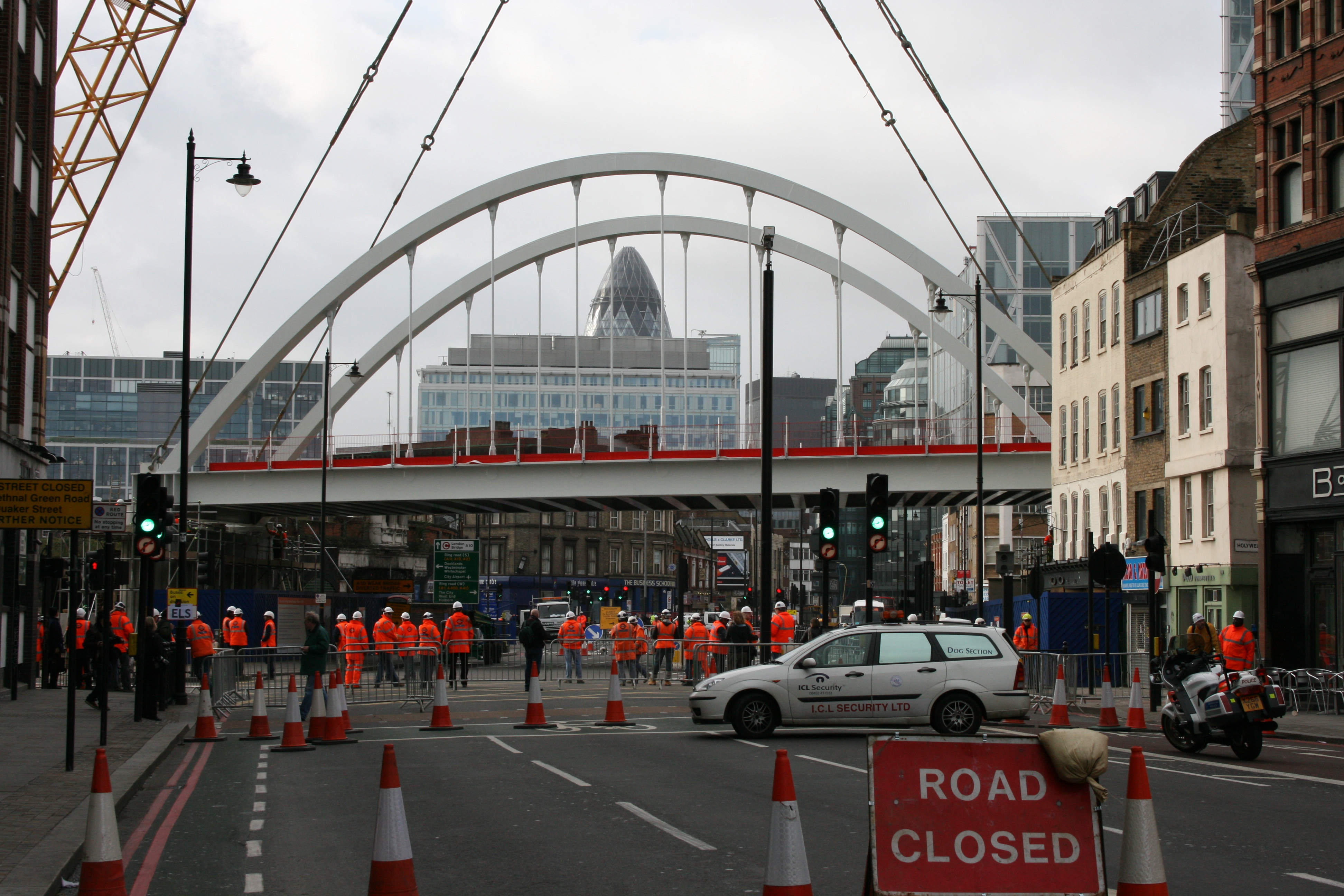
On 27 April 2010, the East London line became part of the London Overground network when the Phase 1 extension was completed. The former London Underground line was extended northwards, mostly along the former viaduct of the North London line, to the re-opened , and southwards to and .
Operations began with a limited preview service between Dalston Junction and New Cross/New Cross Gate, with full operation between Dalston Junction and West Croydon/Crystal Palace on 23 May. On 28 February 2011, the line between Dalston Junction and Highbury & Islington was opened. In attendance were the Mayor of London and London Underground's Managing Director. TfL announced in November 2010 that ridership was ahead of forecast at 92,000 a day, and that patronage at had "gone through the roof".
The incorporation of the East London line into the Overground network has added substantial sections of line in tunnel, including the historic Thames Tunnel, the oldest tunnel under a navigable river in the world. A peculiarity is that at the London Overground runs below the London Underground (though there are other parts of the network where this occurs, e.g. the Watford Junction to Euston route between and – shared with the Bakerloo line – passes under the Metropolitan line between and ).
South London line extension
Main article: South London line

The next addition opened on 9 December 2012, from to via the South London line, calling at , , , and . The extension uses an alignment between Surrey Quays and just north of that had been disused since 1911; new track was laid after some major civil engineering works. Passive provision has also been made for a new station at , to be constructed when funding becomes fully available. This was put on hold in 2009, although a suitable station 'foundation structure' has been built to facilitate completion in the future.
Funding for the railway rebuilding project was secured in February 2009, including £64 million from the DfT and £15 million from TfL, and construction began in May 2011.
The route passes over both and stations without stopping, and this lack of interchange stations was criticised by local politicians during the planning phase of the project. No stations are planned at these locations as the line is on high railway arches, making the cost of any station construction prohibitive.
Liverpool Street station services
On 31 May 2015, the to , (via ) and services, (formerly known as the Lea Valley Lines, and currently known as the Weaver line) as well as the to service, (now the Liberty line) were transferred from Greater Anglia to TfL to become part of the London Overground network.London Overground operator appointed to run additional services for TfL Travel & Tour World 4 June 2013
Network
Introduction
The initial network, service levels and timetables were a continuation of Silverlink Metro services, a set of routes primarily built and electrified by the North London and London & North Western railway companies in the 19th and early 20th centuries. As the Overground name implies, the majority of the network is above ground, and it mostly consists of railway lines that connect areas outside Central London, with a considerable portion of the network in London fare zone 2. The network also uses in central London, the southern terminus of the Watford DC line.
The network interchanges with the Bakerloo, Central, Circle, District, Hammersmith & City, Jubilee, Metropolitan, Northern and Victoria tube lines, and also with the Docklands Light Railway, Elizabeth line and Tramlink networks. The Overground lines appear on Tube maps issued by TfL, and a separate map of the system is available.
Much of London Overground passes through less affluent areas, and is seen as contributing to their regeneration. The North London and Gospel Oak to Barking lines were previously considered by the Transport Committee of the London Assembly to be neglected and not developed to their full potential. |File:London Overground map sb.svg|Schematic map of the London Overground network |File:Geographical Overground map 2025 with new lines.svg|Geographic map of the London Overground network
Services
, the typical off-peak service pattern is:
| London Overground | SE}}; border-width:3px 0px" | Windrush line | Route | tph | Calling at | London Overground | NW}}; border-width:3px 0px" | Mildmay line | Route | tph | Calling at | London Overground | Watford DC}}; border-width:3px 0px" | Lioness line | Route | tph | Calling at | London Overground | goblin}}; border-width:3px 0px" | Suffragette line | Route | tph | Calling at | London Overground | Chingford}}; border-width:3px 0px" | Weaver line | Route | tph | Calling at | London Overground | Romford to Upminster}}; border-width:3px 0px" | Liberty line | Route | tph | Calling at | ||||||||||
|---|---|---|---|---|---|---|---|---|---|---|---|---|---|---|---|---|---|---|---|---|---|---|---|---|---|---|---|---|---|---|---|---|---|---|---|---|---|---|---|---|---|---|---|---|---|
| to | 4 | ||||||||||||||||||||||||||||||||||||||||||||
| Dalston Junction to | 4 | ||||||||||||||||||||||||||||||||||||||||||||
| to | 4 | ||||||||||||||||||||||||||||||||||||||||||||
| Highbury & Islington to | 4 | ||||||||||||||||||||||||||||||||||||||||||||
| {{station | Richmond | London}} to | 4 | {{cslist | {{station | Kew Gardens | London}} | , | }} | ||||||||||||||||||||||||||||||||||||
| to Stratford | 4 | ||||||||||||||||||||||||||||||||||||||||||||
| to {{stnlnk | Euston | London Euston}} | 4 | ||||||||||||||||||||||||||||||||||||||||||
| to | 4 | ||||||||||||||||||||||||||||||||||||||||||||
| London Liverpool Street to | 2 | ||||||||||||||||||||||||||||||||||||||||||||
| London Liverpool Street to | 2 | ||||||||||||||||||||||||||||||||||||||||||||
| London Liverpool Street to | 4 | ||||||||||||||||||||||||||||||||||||||||||||
| to | 2 |
Battersea Park railway station is served by an infrequent parliamentary train service from , which terminates at Battersea Park instead of . Since the reorganisation of services into the London Overground network, this has been the only service to use the link from platform 2 at Battersea Park to .
Depots
Windrush Line services are served by New Cross Gate Depot. Mildmay, Lioness, and Suffragette Line services are served by Willesden Traction Maintenance Depot. Weaver and Liberty Line are served by Ilford EMU Depot, Chingford Sidings and Gidea Park Sidings.
Operations


London Overground's head office and control centre are at Swiss Cottage. Rolling stock is maintained at Willesden Junction and New Cross Gate TMDs, the latter being newly built for the extended East London line. There are also sidings at Silwood Triangle (just north of New Cross depot), built in 2013–14. Satellite locations for stabling trains include Stratford, London Euston and sidings (mainly used by London Northwestern Railway), and c2c's East Ham Depot. Train crews are based at stations including Euston, Willesden Junction, Watford Junction, New Cross, Stratford and Gospel Oak. Up to the early 2010s, London Overground operated with a conductor or guard on its North London, West London and Gospel Oak services. With the other 60% of Overground services already operated by only a driver, it was decided in 2013 to convert these remaining two-person operated trains to driver only.
Operator
The London Overground is currently operated by Arriva Rail London under a contract with TfL which expires in 2026. Following a model similar to that used for the Docklands Light Railway, TfL invited tenders for operation of the Overground. Unlike other National Rail operators under the franchise control of the DfT, TfL sets fares, procures rolling stock and decides service levels. The operator takes only a small element of revenue risk, with TfL taking 90% and the operator 10%.
The first operator, London Overground Rail Operations, a 50:50 joint venture between Laing Rail and MTR Corporation, was chosen by TfL on 19 June 2007. Four bidders had been shortlisted to operate the concession – Govia, MTR/Laing Rail, National Express and NedRail. The contract was signed on 2 July 2007 for seven years with the option of a two-year extension. In preparation for the launch of the Overground, MTR Laing renamed itself London Overground Rail Operations. In February 2013, it was awarded a concession extension until 14 November 2016.
In April 2015, TfL placed a notice in the Official Journal of the European Union, inviting expressions of interest in operating the next concession. TfL starts search for next operator to run Overground Transport for London 9 April 2015 In July 2015, TfL announced the shortlisted bidders for the next concession were Arriva UK Trains, ComfortDelGro, a Keolis/Go-Ahead joint venture and MTR Corporation. In March 2016, TfL announced that Arriva Rail London had won the right to operate the London Overground concession, starting from 13 November 2016. In June 2023, Arriva announced a contract extension had been secured with TfL, pushing the expiry date to May 2026.
In November 2024, TfL invited expressions of interest in operating the next concession. In March 2025, four bidders were shortlisted. In December 2025, TfL announced that First Rail London had been awarded the contract the London Overground concession, starting from 3 May 2026.
Ticketing

Ticketing is a mix of paper, Oyster cards, electronic smart cards and contactless payment cards for "pay-as-you-go" travel. As with all National Rail and TfL services in London, passengers can use a Travelcard (daily, seven-day, monthly or annual); as on other National Rail services in London, paper single, return and cheap day return tickets priced under the zonal fare scheme are also available.
As part of an effort to improve safety and protect revenue, TfL has announced that it will introduce ticket barriers at a number of stations. The stations that did not have barriers when TfL took over have been fitted with standalone Oyster card readers similar to those at ungated Underground and DLR stations. The validators at which were needed to enter/exit the Oyster card system when changing to and from the Victoria line were replaced with route validators, coloured pink: these are used to show that a traveller using Oyster PAYG changed lines at that station, showing which of the possible routes was used. Typically, this avoids paying for zone 1 when the passenger did not travel into it.
Ticket stock is common National Rail stock, as Overground services remain part of the National Rail network, but sometimes with a large TfL roundel in the centre and the repeated legend "Rail Settlement Plan" or on newer versions "National Rail" on a light green background. This ticket stock, coded "TFL" on the reverse, was introduced in November 2007.
Ticket pricing
Oyster PAYG is charged on the same zone-based rules as for the Underground and the Docklands Light Railway. Stations outside Greater London (except Watford Junction) are included in the new London fare zones 7-9. On 2 January 2008 Acton Central was moved from zone 2 to 3, Hampstead Heath from 3 to 2 and Willesden Junction from 3 to both 2 and 3.
Paper tickets are charged on the same zone-based rules as for Underground and DLR paper tickets, which were expanded to take in the extra zones covered. Watford Junction has its own fare scale. Paper tickets are significantly more expensive than using Oyster PAYG.
Performance
Although a TfL service, the Overground is part of the National Rail network, unlike the Underground. The most recent figures released by Network Rail (NR), for period 7 (20132014), showed that it had achieved 96.6% of the Public Performance Measure (PPM) target for punctuality and reliability set by the ORR – down 0.9 percentage points on the period last year. The moving annual average (MAA) of the PPM for the 12 months to 12 October 2013 was 96.5%. TfL, in conjunction with the Massachusetts Institute of Technology, has investigated the use of data from the Oyster smartcard ticketing system to measure the performance of the Overground explicitly from the passenger perspective.{{cite web |access-date=10 November 2008 |archive-date=13 November 2008 |archive-url=https://web.archive.org/web/20081113141617/http://frumin.net/ation/2008/11/what_i_did_last_summer.html |url-status=live
In the autumn 2011 National Passenger Survey, conducted by Passenger Focus, London Overground received an overall satisfaction rating of 92%, a 7% improvement on the previous survey. However, a survey in February 2014 by the consumer group Which? found that customer satisfaction of London Overground was at sixth place (out of 20 train operators) with a satisfaction percentage of 58%.
Branding

Public presentation is visually associated with TfL design standards, using similar graphic design elements to those used on the Underground. These design standards have been applied to London Overground stations, signage, rolling stock and publicity. London Overground also uses the TfL corporate typeface, New Johnston, on its signage, publicity, and stationery and on its fleet of trains. Overground signage is in a vivid orange shade (Pantone 158C). The orange colour was inherited from the former East London line prior to its transfer from Underground to Overground.
Before 2024, London Overground lines tube map did not use colours to distinguish between the different Overground lines. Like the Docklands Light Railway and the Elizabeth line, the Overground is represented by a double line rather than a solid single line, to distinguish it from the colour-coded Underground lines. The London Overground also uses a variant of the TfL roundel. TfL denotes its different transport modes such as London Underground and London Buses with variants of the roundel device using a range of colours, and the London Overground version consists of an orange ring with a blue bar. The roundel has its origins in a 1933 design by the London Passenger Transport Board and has spawned many variations.
Unlike other National Rail stations, London Overground stations which are not served by another National Rail operator now omit the red National Rail "double arrow" logo from signage outside the stations, using only the Overground roundel instead. A few refurbished or new stations on the reopened East London line display the station name in large orange three-dimensional uppercase letters.
Line names
Before 2024 the Overground lines were also not officially distinguished by individual names, unlike the Underground. To provide more clarity to the London Overground network, making it easier for passengers to navigate their way around the system, it was decided to give each route its own name and colour on maps, signage and in digital information. Mayor of London Sadiq Khan pledged in April 2022 that he would invite Londoners to suggest new Overground lines individual names to reflect their "diverse history".{{cite news|url=https://www.standard.co.uk/news/mayor/london-overground-renamed-sadiq-khan-diversity-b930046.html|title=London Overground lines to be renamed as Sadiq Khan expands plans to reflect capital's historic diversity|work=Evening Standard|location=London so that a shortlist could be established.
In February 2024, TfL announced names for each of London Overground's routes, intended to celebrate events from London's history, and these new names took effect in November 2024.{{cite web|url=https://www.standard.co.uk/news/transport/london-overground-new-line-names-colours-stations-tfl-b1194893.html|title=London Overground: New names and colours to be revealed at stations today after £6.3million rebrand
| Name | Indicated by | Route | Reason for name |
|---|---|---|---|
| Lioness line | (yellow parallel lines) | Euston to Watford, including Wembley Central | Intended to honour the England women's football team, including their win in UEFA Women's Euro 2022 at Wembley Stadium |
| Mildmay line | (blue parallel lines) | Stratford to Richmond/Clapham Junction | Intended to honour the work of the Mildmay Mission Hospital, a charitable HIV hospital located in Shoreditch |
| Windrush line | (red parallel lines) | Highbury & Islington to Clapham Junction/New Cross/Crystal Palace/West Croydon | Intended to honour the Caribbean communities (particularly the "Windrush generation" of 1940s and 1950s arrivals, named after the ship HMT Empire Windrush) that the route runs through |
| Weaver line | (maroon parallel lines) | Liverpool Street to Cheshunt/Enfield Town/Chingford | Runs through parts of London known for the textile trade, especially the historic area of the Huguenot weavers |
| Suffragette line | (green parallel lines) | Gospel Oak to Barking Riverside | Barking was the home of the longest-lived women's suffragette, Annie Huggett |
| Liberty line | (grey parallel lines) | Romford to Upminster | Referencing the Royal Liberty of Havering, and the wider freedom that is a "defining feature of London". |
Passenger numbers
Passenger numbers have grown very quickly since the start of London Overground in 2007. There were big increases in 2010/11 and 2011/12 owing to the opening of the extensions of the East London line and South London line. The transfer of some suburban services from Liverpool Street in May 2015 from the Greater Anglia franchise to London Overground also distorted numbers, contributing to a very large growth between 2014/15 and 2015/16.
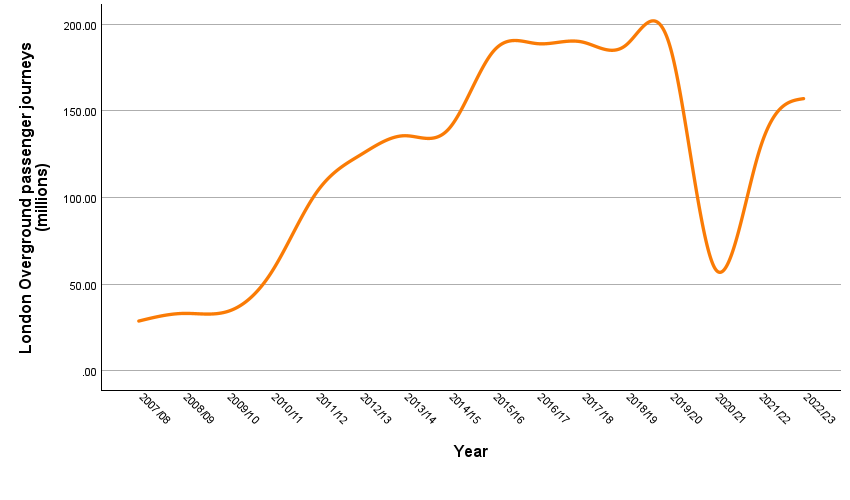
| Year | Passengers | |
|---|---|---|
| (millions) | % Change | |
| 2007–08 | 28.8 | N/A |
| 2008–09 | 33.2 | 15.3 |
| 2009–10 | 34.3 | 3.3 |
| 2010–11 | 57.2 | 66.8 |
| 2011–12 | 102.6 | 79.4 |
| 2012–13 | 124.6 | 21.4 |
| 2013–14 | 135.7 | 8.9 |
| 2014–15 | 139.8 | 3.0 |
| 2015–16 | 184.4 | 31.9 |
| 2016–17 | 188.8 | 2.4 |
| 2017–18 | 189.8 | 0.9 |
| 2018–19 | 188.1 | |
| 2019–20 | 186.0 | |
| 2020–21 | 59.2 | |
| 2021–22 | 126.9 | 114.3 |
| 2022–23 | 157.1 | 23.7 |
| 2023–24 | 181.4 | 15.5 |
| 2024–25 | 180.4 | 0.6 |
Rolling stock


Since the London Overground took over from Silverlink, TfL has pursued a programme of rolling-stock replacement in order to remove from service the ageing second-generation EMUs and Class 150 DMUs it inherited from Silverlink. In 2009, Class 378 Capitalstars built by Bombardier's Derby Litchurch Lane Works were introduced on the electrified lines to replace the and units used previously, while the Class 150s were replaced by new Class 172 Turbostar units on the non-electrified Gospel Oak to Barking line. By October 2010, the new rolling stock had completely replaced the units previously operated by Silverlink. The Class 313 and 150s were cascaded to other train operating companies Southern, First Capital Connect and First Great Western. The Class 508 units were stored at Eastleigh Works but were subsequently scrapped in 2013 after being deemed unfit.
Before its closure to become part of the London Overground, services on the East London line were operated with London Underground A60 and A62 Stock.
The Class 378 trains were officially unveiled at on 13 July 2009. They include a number of tube-style features, including longitudinal seating and increased standing room to provide a high-capacity metro service. They also benefit from walk-through carriage interiors and air conditioning. The North London line has a base fleet of 24 four-car units, Class 378/2. However, these were delivered as three-car units (378/0), with the extended trains being introduced from September 2010, following platform extension works and delivery of the first 20 four-car units (378/1) for the East London line. A further 13 dual-voltage units were delivered to expand services, taking the total fleet to 57 four-car units. These trains are to be extended to five-car sets towards the end of 2014, starting with the East London line sets.
The trains are leased from newly formed rolling stock company (ROSCO) QW Rail Leasing until 2027. TfL planned initially to buy the new fleet outright, but in February 2008 announced that it would lease the trains in order to free up the £250 million capital cost of purchase, combined with reducing the risk of making a loss through any future sell-on of the fleet.
Eight two-car Class 172/0 units, leased from Angel Trains, entered service in 2010. At first their speed was restricted to 40 mph but the restriction was lifted when a test was found to be flawed.
TfL invited expressions of interest for a total of 39 four-car EMUs in April 2014, with 30 required for the Lea Valley lines, eight for the Gospel Oak to Barking line, and one for the Romford–Upminster line all to replace older Class 172, Class 315 and Class 317 trains. Since then the planned procurement was increased to 45 four-car EMUs, with the additional six units intended for the Watford DC line. In July 2015, TfL announced that it had placed a £260M order for 45 four-car Bombardier Aventra EMUs, with an option for 24 more, for use on the Lea Valley lines and the Watford DC line, Gospel Oak to Barking line and Romford–Upminster line from 2018. The type will be known as the and will be similar to the used by Crossrail. Nine further units were ordered in February 2018, split between an additional three Class 710/2 units for use on the extended Gospel Oak to Barking line, and six 5-car units to allow Class 378 units to be cascaded to strengthened East London line services.
On 22 May 2019, TfL announced that approval had been gained for the Class 710s to enter passenger service. The first two units entered service on the Gospel Oak to Barking line on Thursday 23 May 2019 and the remaining six were in service by August 2019, with the first unit entering service on the Watford DC line on 9 September 2019. The first units on the Lea Valley lines entered service on 3 March 2020 after a first attempt on 24 February 2020. Their use on Romford–Upminster line services began in October 2020.
Current fleet
| Family | Class | Image | Type | Top speed | Number | Coaches | Years built | mph | km/h | |||
|---|---|---|---|---|---|---|---|---|---|---|---|---|
| Bombardier Electrostar | 378 Capitalstar | [[File:378135 at Wandsworth Road 21-09-18.jpg | frameless | upright | alt=]] | EMU | 75 | 120 | 57 | 5 | 20082011 | |
| [[File:London_Overground_Class_378-1.png | 650x650px]] | |||||||||||
| Bombardier Aventra | 710 Aventra | [[File:710122 Hackney Downs.jpg | alt= | frameless | upright]] | 48 | 4 | 20172020 | ||||
| 6 | 5 | 2020 | ||||||||||
| [[File:LO Class 710-1 w-pantograph.png | 496x496px | alt=]] [[File:LO Class 710-2 5 Car w-pantograph.png | 620x620px]] |
Past fleet
Former train types operated by London Overground include:
| Family | Class | Image | Type | Top speed | Number | Coaches | Routes operated | Years built | Years operated | mph | km/h | ||||
|---|---|---|---|---|---|---|---|---|---|---|---|---|---|---|---|
| Sprinter | 150/1 | [[File:Leytonstone High Road railway station MMB 04A 150130.jpg | frameless | upright | alt=]] | DMU | 75 | 120 | 6 | 2 | Gospel Oak to Barking line | 19841987 | 20072010 | ||
| Bombardier Turbostar | 172/0 | [[File:Overground-Class172-Gospel-Oak.jpg | frameless | upright | alt=]] | 100 | 160 | 8 | 2010 | 20102019 | |||||
| [[File:Class 172 LO Diagram with correct wheels.PNG | 400px]] | ||||||||||||||
| BREL 1972 | 313/1 | [[File:Hackney Central railway station MMB 05 313123.jpg | frameless | upright | alt=]] | EMU | 75 | 120 | 23 | 3 | 19761977 | 20072010 | |||
| [[File:313_Silverlink_Metro_and_London_Overground.png | 600x600px]] | ||||||||||||||
| 315 | [[File:Unit 315817 at Chingford 2015.JPG | frameless | upright | alt=]] | 17 | 4 | 19801981 | 20152020 | |||||||
| [[File:315LO.png | alt= | 901x901px]] | |||||||||||||
| BR Second Generation (Mark 3) | 317/7 | [[File:London Overground train at Upminster.jpg | frameless | upright | alt=]] | 100 | 161 | 8 | 4 | Lea Valley lines | 19811982 | 20152020 | |||
| [[File:Class 317 London Overground.png | 400px]] | ||||||||||||||
| 317/8 | [[File:London_Overground_317891_at_Enfield_Town.jpg | frameless | upright | alt=]] | 6 | 4 | Lea Valley lines | 19811982 | 20152020 | ||||||
| 321/4 | [[File:321 413 Gypsy Lane.jpg | frameless | upright | alt=]] | 2 | Romford–Upminster line | 19881990 | 20152016 | |||||||
| BREL 1972 | 508/3 | [[File:Willesden Junction station MMB 03 508303.jpg | frameless | upright | alt=]] | 75 | 120 | 3 | 3 | Watford DC line | 19791980 | 20072010 | |||
| [[File:508Silverlink.png | alt= | 600px]] |
Livery


All Capitalstar and Aventra stock in service now carries Overground livery. It is similar to Underground livery, and consists of white and black coaches, a longitudinal thick blue stripe and a thin orange stripe along the bottom, London Overground roundels at midpoints along the coaches, black window-surrounds and orange doors. The ends of each Class 378 unit are painted yellow to comply with the National Rail standards that existed when the first wave of new trains began to enter service in 2009. However, Class 710 units do not have this as they were introduced into service after new standards released by the RSSB since most trains now have European-styled headlights allowing for better visibility from afar, unlike before when they needed the yellow fronts for visibility. The seat upholstery features a moquette by fabric designers Wallace Sewell.
As railway lines have been transferred to London Overground operation, services are sometimes operated using rolling stock inherited from the previous train operating company, and for a temporary period these trains have been branded with transitional livery until they are replaced with newer rolling stock. When the first London Overground services began, they were operated using Silverlink rolling stock which retained Silverlink's purple and lime green livery with yellow doors. The Silverlink logos were removed and Overground banners were added. This rolling stock was eventually completely replaced with new, Overground-branded trains.
Similarly, since the takeover of the Lea Valley lines, Overground services are being run with trains inherited from Abellio Greater Anglia which are mostly in a plain white livery with red doors. Prior to replacement of this rolling stock, the trains were repainted with full Overground livery and the interiors refurbished with Wallace Sewell upholstery and TfL standard signage and route maps.
In June 2018, London Overground unveiled its first complete Class 710 unit, complete with a newly designed livery and moquette. In October, it then began a programme to refresh the Class 378 fleet, giving them a livery designed to appear similar to the one designed for the Class 710.
Recent developments
Gospel Oak to Barking line
Main article: Gospel Oak to Barking line
Electrification
It was announced in June 2013 that £115 million of funding for electrification was being made available as part of upgrades to rail infrastructure included in the government's 2013 spending round. At the same time Transport for London announced that they had obtained a £90 million commitment from the Chancellor of the Exchequer and the Secretary of State for Transport.
In September 2015, Network Rail awarded the £56.9m contract to electrify the line to J. Murphy & Sons. Part closures (on weekends and from South Tottenham to Barking) were planned from June to late September 2016, followed by a full closure from October to February 2017, and further evening and weekend works until late June 2017, and finally around four months of further work to add the wires so that electric Class 710 trains can run from early 2018. The line was to be electrified using the NR Series 2 OLE range.
Extension to Barking Riverside
It was announced as part of the 2014 United Kingdom budget that the Gospel Oak to Barking line would be extended to Barking Riverside station. £263 million was to be spent to extend the line to the brownfield 10,800-home Barking Riverside housing development, which Barking and Dagenham Council did not believe to be viable without improved transport connections. The developers of the site, Barking Riverside Limited, would provide £172million towards the project, with the remainder coming from Transport for London. Construction started in 2017 and was planned to be completed by 2021. London Overground services started running to Barking Riverside on 18 July 2022.
Night service

London Overground began running 24-hour trains on Friday and Saturday nights, similar to the Night Tube of London Underground, between Dalston Junction and New Cross Gate from 15 December 2017. In February 2018 the service was extended to Highbury & Islington, which interchanges with overnight services of the Victoria line.
Proposed developments
Watford DC line move to Bakerloo
In 2007, TfL proposed re-extending the Bakerloo line to . It was suggested that most or all of the line from to Watford Junction would be used exclusively by the London Underground; London Overground services would be withdrawn.
As part of this change, Overground services would have been diverted at Primrose Hill Junction via (closed to passengers since 1992) to , providing a new service between Queen's Park and Stratford. Had this change taken place, and would no longer have had direct services to Euston station, hindering access to central London.
The official Croxley Rail document states, "Bakerloo Line extension to Watford Unlikely" and "TfL’s plans to extend the Bakerloo Line to Watford Junction are on hold indefinitely due to funding and business case constraints".
Croxley Link
Plans were approved in 2011 for the Croxley Rail Link, diverting the Watford branch of London Underground's Metropolitan line to Watford Junction via , where it would share tracks with the Overground. However, in early 2017 this scheme was paused due to funding issues.
Old Oak Common interchange
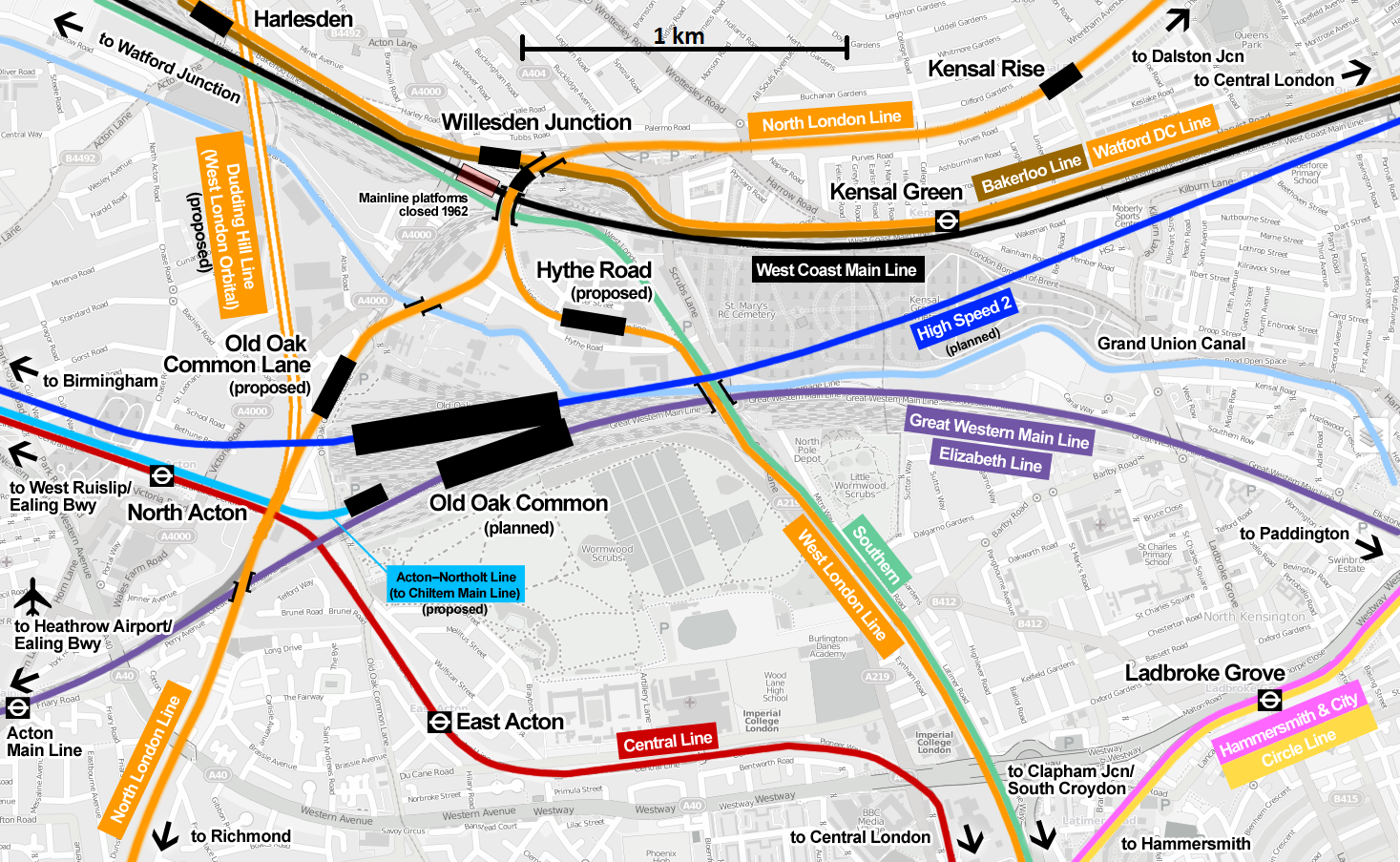
A long-term plan exists to create an interchange with High Speed 2 at the proposed Old Oak Common station. Planning documents issued by the DfT suggest that the new station, on a site just south of , could open by 2025 and offer connections with the Overground on both the Lioness and Mildmay lines.
The station would also be served by the Elizabeth line, Great Western Main Line services and the proposals indicate the possibility of interchange with the Bakerloo and Central lines. The plans are supported by the London Borough of Hammersmith and Fulham.
In June 2013, the Mayor of London and the London Boroughs of Brent, Ealing and Hammersmith & Fulham released 'vision' consultation documents about the Old Oak Common area. These documents mention various connections to the London Overground system, linking Old Oak to the North London line, West London line, and to two new London Overground branches, to Hounslow, and – via the Dudding Hill line – to Thameslink stations on the Midland Main Line.
In October 2017, TfL began a public consultation on the construction of two new Overground stations, on the West London line and on the North London line. If built, these stations would provide interchange between London Overground and Old Oak Common station.
Thamesmead extension
In addition to the plan to extend the Gospel Oak to Barking line to Barking Riverside, there are also proposals to extend it further under the River Thames to a station in Thamesmead, and then on Abbey Wood to connect with the Elizabeth line.
Transport for London has confirmed that the Mayor has asked them to look at both the Overground extension from Barking Riverside and a DLR extension, for connecting to Thamesmead.
In February 2024, a public consultation began on a DLR extension to Thamesmead from Gallions Reach, which had been favoured over the previous London Overground proposal due to cost and service frequency.
Future acquisitions
Following the completion of the first phase of the London Overground network in December 2012, TfL has expressed its intention to take over the operation of other suburban lines in the London area. As with the original London Overground system, this would involve devolving National Rail services from the DfT's franchising system to a TfL-managed concession.
On 21 January 2016, it was announced consideration was being given to the possibility of gradually transferring the suburban services operated by Southeastern, South West Trains and Govia Thameslink Railway (Great Northern and Southern) to TfL to create a London Suburban Metro.
Great Northern Inners Takeover
On 20 September 2025, TfL submitted an outline business case to take over Great Northern services from Moorgate to Welwyn Garden City, Hertford North, and Stevenage and integrate it into the London Overground network. TfL wants to increase the number of trains from two trains per hour to four trains per hour, standardise fares across the route, serve a 21,000 home development at Crews Hill, and boost growth in North London and Hertfordshire. The takeover could occur in autumn 2027, after Govia Thameslink Railway's contract ends, if approval is given by DfT; however, the Overground services would use the existing Class 717 stock.
Past attempts on acquiring routes
In 20122013, TfL and the Greater London Authority publicised a proposal for further expansion, identifying a number of services in North-East and South-East London as suitable candidates. Part of this proposal was fulfilled in May 2015 with the transfer of the Lea Valley (Weaver) and Romford-Upminster (Liberty) Lines out of to the London Overground network, but TfL's aim of acquiring Southeastern metro services currently remains at the proposal stage. Under this scheme, TfL would take over rail services out of , and to , , and , but this was rejected following spending cuts imposed by the 2013 United Kingdom budget. The possibility of TfL acquiring routes out of London Bridge has also been discussed.
In October 2015, the prospect of London Overground expansion was raised again when the London Assembly Transport Committee published a report which advocated the devolution of a number of commuter rail services and the creation of a "South London Metro". In particular, the report identified four rail franchises due for renewal which could be taken over by TfL:
- the South Western franchise from to South West London suburbs
- the Thameslink, Southern and Great Northern franchise (Great Northern and Southern metro services) out of to North London and out of London Bridge/Victoria to South London suburbs
- the Integrated Kent franchise (Southeastern metro services) out of Victoria/Charing Cross/Cannon Street/London Bridge to South East London suburbs
Kent County Council had initially expressed opposition to the Dartford route plans on account of limited capacity for Kent express trains being lost to expanded TfL services. However, after negotiations with the London Assembly, the council reached an agreement to support the proposals.
Greenford branch
The DfT has proposed that TfL should take over the Greenford to West Ealing line in West London. This would bring Greenford, , , and into the Overground network. Trains on this branch used to run directly to Paddington, but were curtailed at West Ealing in order to free up line capacity for the forthcoming Crossrail services, with West Ealing reconstructed to allow Greenford branch trains to terminate there. If this proposal were to go ahead, it would happen when the Greater Western franchise ends in 2023.
West London Orbital

Main article: West London Orbital
Proposals to reopen the Dudding Hill line to passenger services as part of the London Overground have been mooted for several years. In June 2019, TfL published a report examining the possibility of opening the line as a London Overground branch line connecting Hounslow with Cricklewood and Hendon, with stations at , Lionel Road, , and .
Crowd information
In 2017 it was reported that a system is being trialled at Shoreditch High Street station that indicates the crowding in each train carriage. The technology, already in use on Thameslink trains, helps passengers find the least crowded carriage when boarding a train and should reduce dwell times at stations. If the trial is successful, it will be rolled out across the London Overground network.
References
References
- (5 December 2016). "Station Usage 15-16 | Office of Rail and Road".
- "London Overground – Transport for London". Tfl.gov.uk.
- "LOROL takes over West Anglia routes".
- "London Overground".
- "The law and our duties". Office of Rail and Road.
- (May 2023). "A new RingRail for London : the key to an integrated public transport system". Just and Company Limited.
- "Central London Rail Study :: The Railways Archive".
- (1989). "British Rail Fleet Survey 10: Third Rail DC Electric Multiple-Units". [[Ian Allan Publishing.
- {{harvnb. Haresnape. Swain. 1989
- Sharp, Rachel. (24 October 2007). "TfL to take on rail network". Ealing Times.
- (26 October 2007). "Braced for rail strikes". Hackney Gazette.
- Clinnick, Richard. (30 December 2009). "A benchmark for inner suburban trains".
- (15 July 2004). "The Future of Rail – White Paper CM 6233". Department for Transport.
- (23 March 2004). "Bob Kiley outlines proposals for London Regional Rail Authority". Transport for London.
- (7 September 2006). "London Rail Authority". AlwaysTouchOut.com.
- (21 June 2007). "New trains and more services for the Midlands". Department for Transport.
- Darling, Alistair. (14 February 2006). "Silverlink Metro". Hansard.
- (7 June 2006). "Four bidders on TfL London Rail Concession shortlist". Transport for London.
- (7 June 2006). "Firms compete for rail contracts". BBC News.
- (31 August 2006). "Bombardier Wins a £223 Million Order from Transport for London for 152 Electric Multiple Unit Cars for the United Kingdom". Bombardier Transportation.
- (5 September 2006). "London Overground plans unveiled". BBC News.
- (5 September 2006). "Introducing London Overground – a new era for London Rail". [[Transport for London]].
- (19 June 2007). "New operator for London railway". BBC News.
- (13 February 2006). "Terms of Transfer relating to the transfer of the Silverlink Metro Network". GOV.UK.
- {{Cite legislation UK. (2007). (25 June 2007)
- (2007). "London Overground network map". Transport for London.
- (11 November 2007). "London Overground services begin". BBC News.
- (January 2008). "London's new train set". Transport for London.
- (2007). "Creating London Overground". Transport for London.
- (November 2007). "All Change". Greater London Authority.
- [http://www.tfl.gov.uk/assets/livetravelnews/realtime/rail/London-Overground-Stratford-leaflet.pdf London Overground: Stratford Platform Changes] {{Webarchive. link. (18 January 2012 (Information leaflet, TfL January 2009))
- (29 September 2009). "Boost for West London as Mayor opens new Imperial Wharf station". Transport for London.
- (27 April 2010). "East London line officially opens". BBC News.
- (27 April 2010). "New era of rail travel as London Overground's east London route opens to the public". Transport for London.
- (23 May 2010). "Full service begins on newly extended East London Line". BBC News.
- Abbott, James. (December 2010). "Overground champion bows out".
- (12 February 2009). "Final section of Capital's orbital railway gets the go-ahead". Transport for London.
- (24 April 2004). "Junction joy South". [[South London Press]].
- Martin Linton MP. (4 August 2006). "Parliamentary Debate: London Orbital Rail Network". Hansard.
- (9 November 2006). "East London Line Extensions – Loughborough Junction". AlwaysTouchOut.
- (29 May 2015). "Clean, reliable and integrated: all change for neglected rail services in London". The Guardian.
- (December 2013). "Tube Map". Transport for London.
- (December 2013). "London Overground". Transport for London.
- (February 2006). "Response to Network Rail's Draft Cross London Route Utilisation Strategy". Transport for London.
- (March 2006). "London's Forgotten Railway: The Transport Committee's Review of the North London Railway". [[Greater London Authority]].
- "London Overground timetables". [[Transport for London]].
- "Warning over passenger safety as union vows to fight driver only trains plan (From East London and West Essex Guardian Series)".
- (19 June 2007). "Milestone reached in transformation of London's overland rail network as operator is announced". [[Greater London Authority]].
- (19 June 2007). "MTR Laing beats Go-Ahead unit Govia to win North London rail franchise". London South East.
- (29 June 2015). "Four bidders shortlisted for London Overground operating concession".
- (18 March 2016). "Arriva named as new operator for London Overground". Transport for London.
- . (18 March 2016). ["Arriva wins London Overground concession"](http://www.railwaygazette.com/news/passenger/single-view/view/arriva-wins-london-overground-concession.html).
- Vitale, Cat. (28 June 2023). "Arriva extends London overground contract with TfL". Railway Technology.
- (26 November 2024). "Next London Overground operator sought".
- (2 December 2025). "Finance Committee Chair's Action London Overground Concession 3".
- Wilcock, Rich. (10 December 2025). "FirstGroup wins London Overground concession, replacing Arriva".
- (10 December 2025). "First Rail London Limited named as TfL's preferred operator for London Overground".
- (December 2007). "National Rail News". Transport Ticket Society.
- (November 2007). "Your guide to fares and tickets (2 January 2008 until further notice)". Transport for London.
- "Rail performance results period 7". Network Rail.
- (26 January 2012). "National Passenger Survey Autumn 2011 Main Report". Passenger Focus.
- (17 February 2014). "Best and worst UK train companies". Which?.
- "TfL Colour standards". Transport for London.
- "Design standards". Transport for London.
- (January 2009). "London Overground Basic Elements Standard – Issue 2". Transport for London.
- "Designing Modern Britain – London Transport". Design Museum.
- (3 August 2009). "London Overground Signs Standard – Issue 3". Transport for London.
- Vickers, Noah. (24 August 2023). "Project to name each London Overground line underway".
- Topham, Gwyn. (15 February 2024). "London Overground: new names and colours for six lines revealed". [[The Guardian]].
- (28 November 2024). "London Overground lines named in ceremony in Dalston".
- "London Overground rebrand goes live: Here are the new names and colours of the lines".
- (18 February 2024). "London Underground: How the Overground's new names were chosen". BBC News.
- Williams, Megan. (15 February 2024). "How London Overground's new names were chosen".
- England Women's Football Team. (15 February 2024). "THE LIONESS LINE: The Euston to Watford Junction London Overground - which runs through Wembley - has been renamed to honour our historic #WEURO2022 win, achievements and lasting legacy.".
- "Annual Report and Statement of Accounts 2015/16". Transport for London.
- "Annual Report and Statement of Accounts 2011/12". Transport for London.
- Office of Rail and Road. (3 August 2023). "Train Operating Company key statistics - April 2022 to March 2023 - 3 August 2023 - London Overground".
- (29 July 2021). "Train Operating Company Key Statistics 2020-21 - London Overground".
- Miles, Tony. (December 2010). "LOROL Class 150s all with FGW".
- "Focus on 313s". Inter City Railway Society.
- (13 July 2009). "In Pictures: Mayor Unveils New London Overground Train". The Londonist.
- (13 July 2009). "London Overground introduces Class 378 train fleet". Transport Briefing.
- (15 September 2010). "trains extended London Overground's electric train fleet". Transport for London.
- (20 February 2008). "Transport for London signs new train leasing contract". Transport for London.
- {{Cite magazine. (July 2010{{full citation needed). (July 2019)
- Miles, Tony. (August 2010). "Class 172 ready for introduction".
- . (9 April 2014). ["More EMUs for London Overground"](http://www.railwaygazette.com/news/passenger/single-view/view/more-emus-for-london-overground.html).
- {{cite magazine
- (April 2018). "Class 710 delivery delays push back introduction".
- (4 March 2020). "Bombardier Class 710/1s finally make their passenger debut on West Anglia suburban routes". Rail.
- "New London Overground electric trains enter service".
- (January 2009). "London Overground Train Graphics Standard – Issue 2". Transport for London.
- "London Transport Museum – our moquette range". London Transport Museum.
- Burroughs, David. (20 June 2018). "TfL unveils class 710 EMUs for London Overground".
- (December 2018). "Stock Changes".
- HM Treasury. (June 2013). "Investing in Britain's future". [[The Stationery Office]].
- (26 June 2013). "Mayor secures 'unprecedented' transport settlement for London to support long-term economic growth". [[Greater London Authority]].
- (29 September 2015). "J Murphy & Sons to carry out electrification of Gospel Oak-Barking route".
- "London Overground closure".
- (2 February 2016). "TfL tries to reduce line-closure time for GOBLIN electrification".
- (June 2015). "CP5 Enhancements Delivery Plan June 2015". [[Network Rail]].
- Freddy Mayhew. (19 March 2014). "Budget 2014: Commitment to Overground extension to Barking Riverside announced alongside funding for new homes". Barking and Dagenham Post.
- "London Overground Barking Riverside extension approved". International Railway Journal.
- (15 December 2017). "London Overground goes 24-hour, joining night tube". The Guardian.
- "London Overground Night Service".
- (3 June 2017). "London Overground to run a 24-hour service just like the Night Tube". [[Metro (British newspaper).
- (March 2006). "Scenario Testing for the Further Alterations to the London Plan". [[Greater London Authority]].
- (9 November 2006). "East London Line Extensions". alwaystouchout.com.
- "Croxly Rail Link – Value for Money Annex Report September 2011".
- Binnie, Adam. (13 December 2011). "Croxley Rail Link plan approved by Government". Watford Observer.
- (25 January 2017). "UPDATE: Met Line extension: Mayor confirms work has stopped".
- "Update on High Speed 2". [[Transport for London]].
- (December 2009). "Old Oak Common: The Transport and Regeneration Case for a HS2 Interchange". London Borough of Hammersmith & Fulham.
- "Old Oak Common (Park Royal/ Willesden Junction)".
- "First glimpse of how two new London Overground stations could look". Evening Standard.
- "Have your say on two potential new London Overground stations at Old Oak".
- (22 September 2014). "Call to bring London Overground to Thamesmead – south east London's largest town with no trains". This is London Local.
- (3 January 2019). "New river crossings for London". TfL website.
- (13 February 2024). "Other options we considered - supplementary information".
- "A new approach to rail passenger services in London and the South East". [[Transport for London]].
- Lawrence, India. (2025-12-05). "North London could be getting a new Overground line".
- (2025-12-04). "TfL bids to take over Moorgate mainline with plan to increase Great Northern services".
- Khan, Shan Ahmed. (2025-12-05). "TfL’s Moorgate Takeover Bid: Full List of Great Northern Stations That Could Join London Overground by 2027".
- (2 December 2025). "FOI request detail: Great Northern 'Inners' business case".
- (February 2012). "The Mayor's Rail Vision". Greater London Authority.
- "Expanding TfL's rail network". TfL.
- Waterson, James. (29 November 2012). "TfL hopes to push Overground onto key suburban rail routes". [[City A.M.]].
- (26 June 2013). "London's major transport projects spared axe but City Hall faces big cuts". [[Evening Standard]].
- (October 2015). "Devolving Rail Services to London: Towards a South London Metro". London Assembly Transport Committee.
- (16 October 2015). "Devocalypse Now: Taking Control of South London's Railways".
- (19 April 2013). "TfL's takeover proposal for Kent trains 'unacceptable'". [[BBC News]].
- (15 June 2015). "TfL could take over some Kent rail lines". BBC News.
- "The Price of Oranges: DfT ask TfL to take on Greenford and Upminster". London Reconnections.
- (June 2019). "West London Orbital – Strategic Outline Business Case". Transport for London.
- Elledge, Jonn. (17 October 2017). "London Overground is experimenting with telling passengers which bits of the next train is busiest".
This article was imported from Wikipedia and is available under the Creative Commons Attribution-ShareAlike 4.0 License. Content has been adapted to SurfDoc format. Original contributors can be found on the article history page.
Ask Mako anything about London Overground — get instant answers, deeper analysis, and related topics.
Research with MakoFree with your Surf account
Create a free account to save articles, ask Mako questions, and organize your research.
Sign up freeThis content may have been generated or modified by AI. CloudSurf Software LLC is not responsible for the accuracy, completeness, or reliability of AI-generated content. Always verify important information from primary sources.
Report