From Surf Wiki (app.surf) — the open knowledge base
London City Airport
Regional airport in London, England, United Kingdom
Regional airport in London, England, United Kingdom
| Field | Value |
|---|---|
| name | London City Airport |
| image | London City Airport logo.svg |
| image-width | 100 |
| image2 | London City Airport (December 2025).jpg |
| image2-width | 250 |
| IATA | LCY |
| ICAO | EGLC |
| type | Public |
| operating_base | BA CityFlyer |
| city-served | London |
| location | Royal Docks, Newham, London, England |
| opened | |
| elevation-f | 19 |
| elevation-m | 6 |
| coordinates | |
| pushpin_map | Greater London#England |
| pushpin_label | LCY/EGLC |
| pushpin_map_caption | Location within Greater London |
| website | |
| metric-rwy | yes |
| r1-number | 09/27 |
| r1-length-f | 4,948 |
| r1-length-m | 1,508 |
| r1-surface | Asphalt |
| stat-year | 2022 |
| stat1-header | Passengers |
| stat1-data | 3,009,313 |
| stat2-header | Passenger change 21-22 |
| stat2-data | 318% |
| stat3-header | Aircraft movements |
| stat3-data | 44,731 |
| stat4-header | Movements change 21-22 |
| stat4-data | 246% |
| footnotes | Sources: UK AIP at NATS WAD |
| <br />Statistics from the UK Civil Aviation Authority<ref name | "www.caa.co.uk"/ |
| owner-oper | London City Airport Limited |
| image-width = 100 | image2-width = 250 | city-served = London | elevation-f = 19 | elevation-m = 6 | metric-rwy = yes | r1-number = 09/27 | r1-length-f = 4,948 | r1-length-m = 1,508 | r1-surface = Asphalt | stat-year = 2022 | stat1-header = Passengers | stat1-data = 3,009,313 | stat2-header = Passenger change 21-22 | stat2-data = 318% | stat3-header = Aircraft movements | stat3-data = 44,731 | stat4-header = Movements change 21-22 | stat4-data = 246%
Statistics from the UK Civil Aviation Authority | owner-oper = London City Airport Limited
London City Airport is an international airport in London, England. It is located in the Royal Docks in the Borough of Newham, about 6 mi east of the City of London and 3 mi east of Canary Wharf. These are the two centres of London's financial industry, which is a major user of the airport. The airport was developed by the engineering company Mowlem between 1986 and 1987. The airport is owned and operated by London City Airport Limited.
London City Airport has a single 1508 m runway, and a CAA Public Use Aerodrome Licence (Number P728) that allows flights for the public transport of passengers; this licence also allows training flights, but only for the purpose of training pilots to operate at this specific airport. Only multi-engine, fixed-wing aircraft up to Embraer E195-E2, Airbus A220 and A318 size, with special aircrew and aircraft-certification to fly 5.5° approaches, strict noise limitations and further restrictions are allowed to conduct operations at London City Airport. the airport is about 60 hectare in size.
London City had 5.1 and 3.57 million passenger movements in 2019 and 2024, respectively. It is the fifth-busiest airport by passengers and aircraft movements serving the London area—after Heathrow, Gatwick, Stansted and Luton—and was the 14th-busiest in the UK in 2017.
History
Proposal and construction
The airport was first proposed in 1981 by Reg Ward, who was Chief Executive of the newly formed London Docklands Development Corporation (LDDC) that was responsible for the regeneration of the area. He in turn discussed the proposal with chairman of John Mowlem & Co Sir Philip Beck and the idea of an airport for Docklands was born. By November of that year Mowlem and Bill Bryce of Brymon Airways had submitted an outline proposal to the LDDC for a Docklands STOLport city centre gateway.
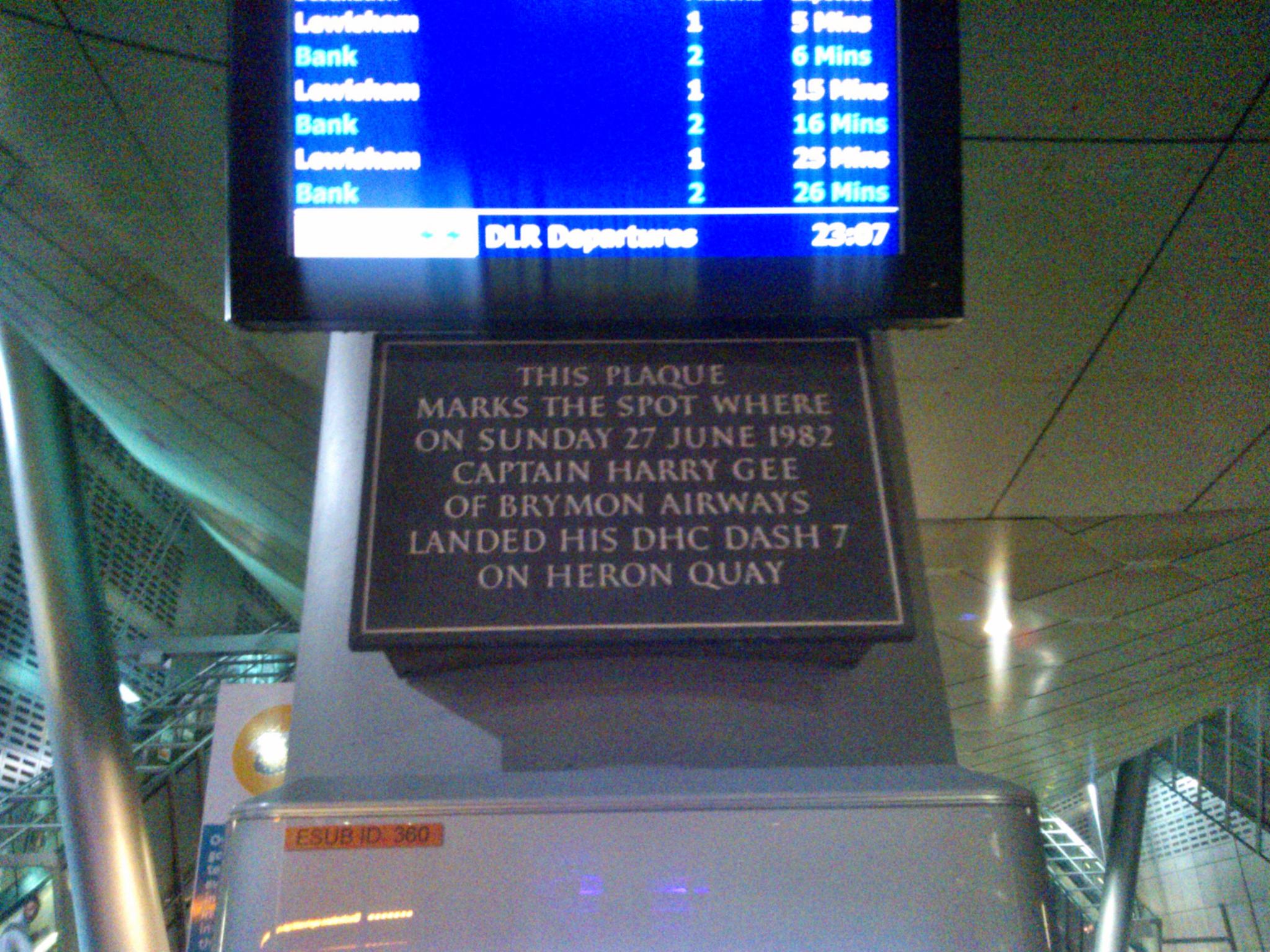
On 27 June 1982 Brymon's Captain Harry Gee landed a de Havilland Canada Dash 7 turboprop aircraft on Heron Quays, in the nearby West India Docks, in order to demonstrate the feasibility of the STOLport project. Later that year the LDDC published a feasibility study, an opinion poll amongst local residents showed a majority in favour of the development of the airport, and Mowlem submitted an application for planning permission.
A 63-day planning inquiry started on 6 June 1983. By the middle of the following year, Nicholas Ridley the Secretary of State for Transport had indicated that he was "disposed to agree the application", but asked for further details. The Greater London Council brought an action in the High Court of Justice to reopen the inquiry. After the High Court dismissed the action in March 1985, outline planning permission was granted in May of that year, followed by the grant of detailed planning permission in early 1986. The airport site had an initial footprint of 92 acre in area.
Construction began on the site shortly after permission was granted, with Charles, Prince of Wales laying the foundation stone of the terminal building, designed by R Seifert and Partners, on 2 May 1986. The first aircraft landed on 31 May 1987.
Opening and runway extension
The first commercial services began operating from the airport on 26 October 1987. Queen Elizabeth II officially opened London City Airport in November of the same year.
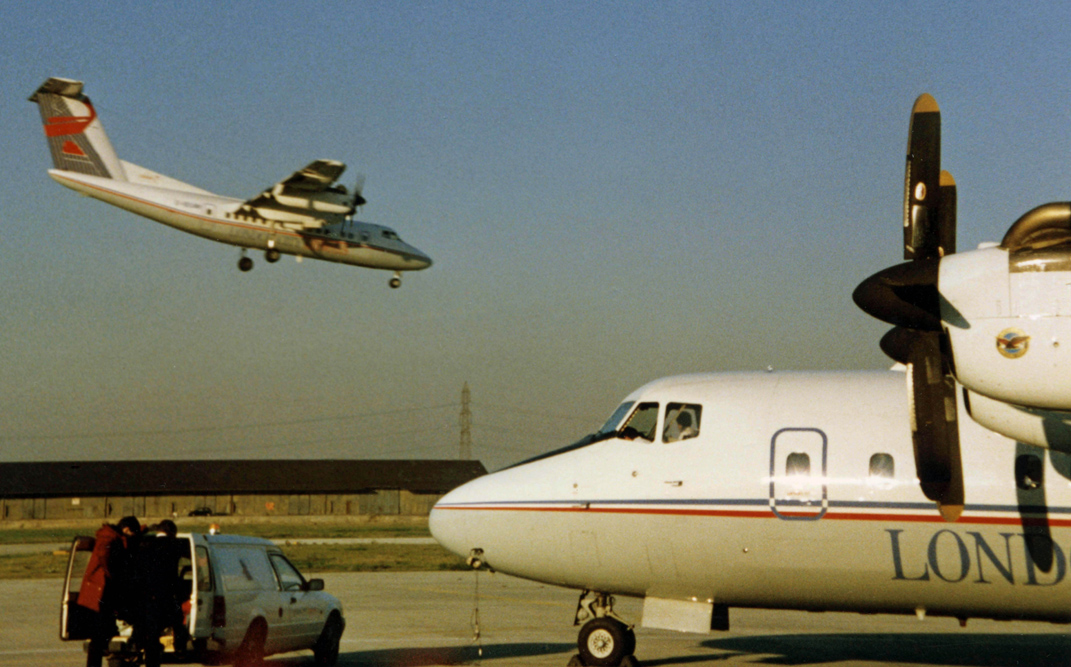
In 1988 – the first full year of operation – the airport handled 133,000 passengers. The earliest scheduled flights were operated to and from Plymouth, Paris, Amsterdam and Rotterdam. With a runway of only 1080 m in length, and a slope of the glidepath of 7.5° (for noise abatement reasons), the airport could only be used by a very limited number of aircraft types, principally 50-seat de Havilland Canada Dash 7 and 19-seat Dornier 228 turboprops. In 1989, the airport submitted a planning application to extend the runway, allowing the use of a larger number of aircraft types.
In 1990, the airport handled 230,000 passengers, but the figures fell drastically after the Gulf War and did not recover until 1993, when 245,000 passengers were carried. By this time the extended runway had been approved, opening on 5 March 1992. At the same time the glide path was reduced to 5.5°, still steep for a European airport (the slope of an airport glide path is normally 3.0°), but sufficient to allow a larger range of aircraft, including the British Aerospace 146 and Airbus A318, to serve the airport.
By 1995, passenger numbers reached half a million, and Mowlem sold the airport to Irish businessman Dermot Desmond. Five years later passenger numbers had climbed to 1.58 million, and over 30,000 flights were operated. In 2002, a jet centre catering to corporate aviation was opened, as well as additional aircraft stands at the western end of the apron. In 2003, a new ground holding point was established at the eastern end of the runway, enabling aircraft awaiting takeoff to hold there whilst other aircraft landed.
Further expansion
On 2 December 2005, London City Airport DLR station opened on a branch of the Docklands Light Railway, providing rail access to the airport for the first time, and providing fast rail links to Canary Wharf and the City of London. By 2006, more than 2.3 million passengers used London City Airport.
In October 2006, the airport was purchased from Dermot Desmond by a consortium comprising insurer AIG Financial Products and Global Infrastructure Partners (GIP). In the final quarter of 2008 GIP increased its stake in the airport to 75%, the remaining 25% belonging to Highstar Capital.
London City Airport was granted planning permission to construct an extended apron with four additional aircraft parking stands and four new gates to the east of the terminal in 2001; they became operational on 30 May 2008. They are carried on piles above the water of the King George V Dock.
British Airways commenced the first scheduled transatlantic flights from the airport in September 2009, with a twice a day service to New York City's John F. Kennedy International Airport via Shannon using a specially configured Airbus A318 aircraft. The A318 is the smallest airliner to operate transatlantic services since BA's corporate predecessor, BOAC, began transatlantic jet flights on 4 October 1958, with the de Havilland Comet 4.
The first day of the service, one week after Willie Walsh of British Airways pledged to the United Nations that aviation would deliver deep cuts in carbon emissions, was disrupted by activists from Plane Stupid and Fight the Flights dressed up in business suits.
London Olympics 2012


Before the 2012 Summer Olympics in London, it was reported that over £7 million (in 2011) was invested in the terminal to extend the Central Search area and adding other improvements. During the Games, however, the airport was only open for a few hours with strict restrictions (for security), and the small apron and short runway excluded most long-range arrivals. However, it was the closest airport to Olympic Park, with normal scheduled travel by road of 15 minutes.
2010s expansion
In early 2013, work was expected to start on a £15 million investment programme to refurbish the western pier with new departure gates and improved lounges and to redevelop the international arrivals hall and baggage handling areas. In response to the UK government white paper The Future of Air Transport, the airport operators produced a master plan outlining their vision for growth up to 2030. The plan was subject to public consultation during spring 2006, and was republished incorporating comments from this consultation. The master plan shows a phased expansion of the airport, giving the capability of handling 8 million passengers per annum by 2030. It does not propose the addition of a second runway, or significant expansion of the airport boundaries. Phase 1 of this development would be undertaken by 2015. It would include the in-progress construction of the eastern apron extension and provision of a finger pier to the south of this apron to provide passenger access to aircraft using the new parking stands. The terminal building would also be extended to use the triangle of land between it and the railway station. The existing jet centre serving corporate aviation would be extended, a new hangar built to allow aircraft maintenance, and a replacement fire station provided.
Phases 2 and 3 would be undertaken between 2015 and 2030. Further aircraft parking stands would be built to the east of the terminal, and a taxiway would be constructed alongside and to the south of the runway, to avoid the need for aircraft to back-track on the runway. Both these developments would involve further reduction in the water area of the King George V Dock. The existing fuel farm would be relocated to a site at the east of the airport, where it could be supplied by barge, and linked to a hydrant based supply system, thus eliminating both road tanker deliveries and on-airport fuel bowser movements. The existing surface car park would be replaced by a multi-storey car park, allowing extension of the vehicle drop-off and pick up area. The jet centre and hangar facilities would be further extended. Finally the existing terminal building would be replaced.
In line with phase 1 of the master plan, London City Airport made a planning application to the London Borough of Newham in August 2007. This would allow it to increase the number of flights per year from 80,000 to 120,000 by 2010. In July 2008, the Planning Officer for Newham Council produced a report on the Planning Application, recommending that planning permission be granted. The decision was deferred by the council's Development Control Committee at their meeting on 30 July 2008, following a request from Boris Johnson, the Mayor of London, that the decision be delayed until after a study by the National Air Traffic Services (NATS) has been published.
Over 10,000 local residents were consulted by Newham Council over the plan, of which 1,109 replied, 801 with objections and 308 in support. The 801 objections mainly concerned increase in noise, increase in air pollution, surface transport, socio-economics and regeneration. The 308 supporters mainly concerned the reduction of air pollution, an alternative London and 2012 Olympic gateway, additional jobs, and benefits to the local economy. The residents campaign group HACAN East (formerly Fight the Flights) was opposed to expansion due to noise and pollution issues.
On 29 September 2009, Fight the Flights took Newham Council to court in order to challenge their decision to allow a 50% increase from 76,000 to 120,000 flights. On 20 January 2010, the challenge was dismissed, and a deadline of 14 days to appeal was set. The plan was given the go-ahead in February 2015. However this was overturned by Boris Johnson in March 2015. On 27 July 2016 London City Airport was given approval by authorities to implement the £344 million expansion plan.
Latest developments
In October 2015, Global Infrastructure Partners which owned 75% of the facility, put it up for sale, with the agreement of Oaktree Capital Management which held the remaining 25%. A sale to a Canadian-led consortium of Alberta Investment Management Corporation, OMERS, the Ontario Teachers' Pension Plan and Wren House Infrastructure Management of the Kuwait Investment Authority for £2 billion was confirmed in February 2016, taking a 25% stake each. The sale was completed on 10 March 2016.
In September 2016, British Airways announced the termination of one of its two daily long-haul all-business class Airbus A318 services from the airport to New York City, citing economic reasons.
Green Party of England and Wales candidate for the 2016 London mayoral election and member of the London Assembly Siân Berry has been vocal in calling for the closure of London City Airport and subsequent redevelopment of the area it occupies. Caroline Russell, the leader of the Green Party on the London Assembly and Scott Ainslie, former Green MEP for London and councillor on Lambeth Council have both called for its closure.
In March 2020, British Airways suspended its daily service to New York due to the COVID-19 pandemic. In September 2020, the airline confirmed the service would not return.
In November 2020, the new parallel taxiway and eight additional aircraft parking stands were declared operational. These were delivered as part of the first phase of the City Airport Development Programme (CADP). Both the new stands and the parallel taxiway were constructed on a concrete deck mounted on piles driven in to the bed of the King George V Dock.
In January 2021, after a delay due to the COVID-19 pandemic, London City became the first major airport controlled by a remote air traffic control tower. The airport had previously decided to relocate the control tower to a site 80 miles away at Swanwick, Hampshire, utilising three cable links providing live video to air traffic controllers.
In July 2023, the revised operating distances for the runway became operational following the introduction of Engineered Material Arresting Systems (EMAS) in the Runway Safety Areas at each end of the runway.
Plans were approved to increase the passenger cap at the airport from 6.5 million to 9 million passengers, with the number of morning flights increasing between 06:00 to 09:00.
In June 2025, Australian company Macquarie Asset Management acquired a 25% stake in the airport from Ontario Teacher's Pension Plan. In October 2025, Macquarie took an additional 50% stake in the airport from Alberta Investment Management Corporation and OMERS.
Operations

.jpg)
Destinations served
Owing to London City Airport's proximity to London's Docklands and financial district, the airport's primary users are business travellers with destinations such as Luxembourg and Frankfurt, although the number of leisure destinations served like Palma de Mallorca, Málaga or Chambéry has increased. London City is at its busiest during the winter months, when a number of airlines, most notably British Airways and Swiss International Air Lines, fly to ski resort gateway destinations. Zürich, Geneva, and Milan are among the destinations popular among winter sports enthusiasts.
Facilities and aircraft types
As the airport is close to Central London, it has stringent rules imposed to limit the noise impact from aircraft operations. This, together with the physical dimensions of the 1508 m runway and the steep glideslope, limits the aircraft types that can use the airport. The size and layout of the airport, and the overall complexity caused by the lack of taxiways, mean that the airport gets very busy during peak hours. The air traffic controllers have to deal with over 38 flights per hour on a runway which, prior to the opening of the full length taxiway at the end of 2020, required a lengthy backtrack for each aircraft needing to depart from runway 27 or land on runway 09. Operations are restricted to 06:30 to 22:30 Monday to Friday, 06:30 to 13:00 on Saturdays and 12:30 to 22:30 on Sundays. These restrictions are related to noise. On 19 December 2022, the airport applied for the restriction on Saturday afternoon to be removed. This application was rejected by Newham Council on 10 July 2023, citing "continued concerns over the noise and environmental impact of the airport on those living nearby."
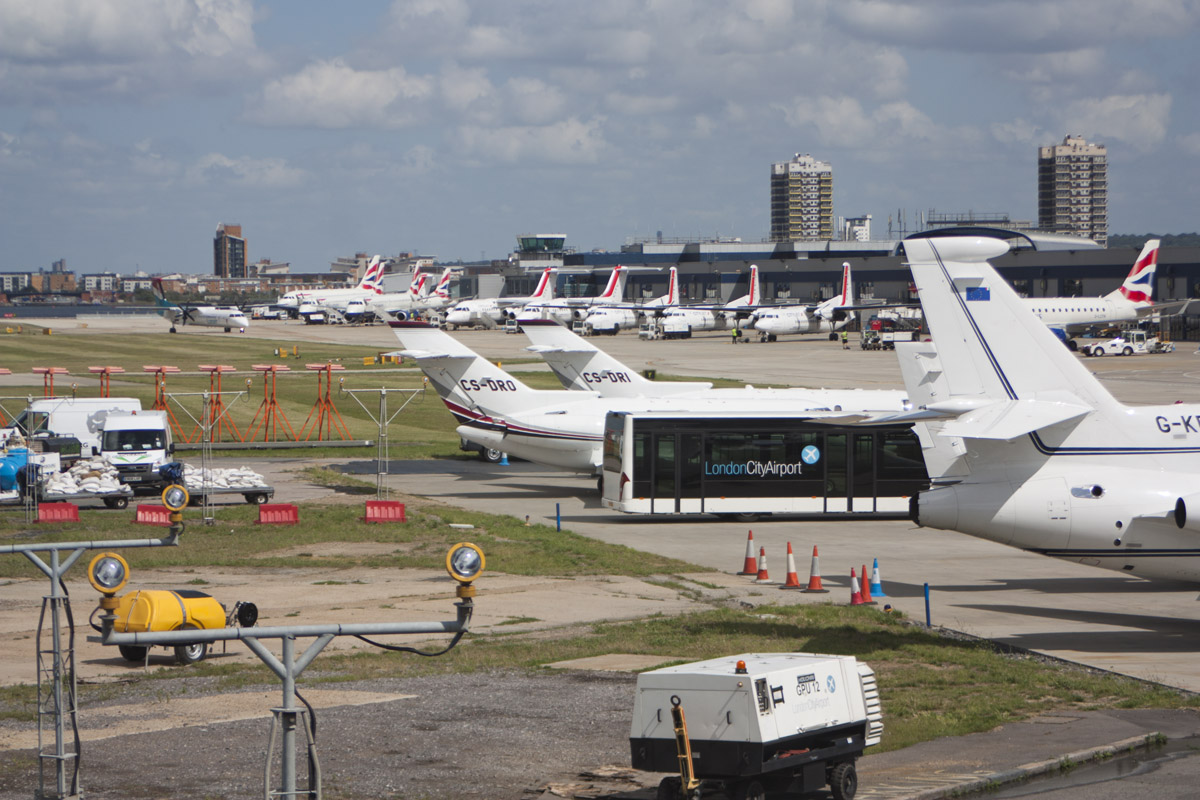
Mid-range airliners seen at London City include the ATR 42 (both −300 and −500 variants), ATR 72, Airbus A318, Bombardier Dash 8 Q400, BAe 146/Avro RJ, Dornier 328, Embraer ERJ 135, Embraer 170, Embraer 190 and Fokker 50. On 30 January 2009, trials were completed successfully with the ATR 72–500, leading to its approval for use at the airport. The Embraer 190SR underwent trials from 28 March 2009, and thereafter gained approval. The Fokker 70, BAe Jetstream 41, Saab 340 and Saab 2000 also have approval for scheduled operations at the airport. A number of airlines including Swiss and Odyssey have ordered the Airbus A220 with the intention of operating it from London City once delivered and approved. A220-100 operations for Swiss from City commenced in late 2017.
On 22–23 March 2017, the A220-100 completed tests for the 5.5-degree approach in Wichita and Salina, Kansas. The A220-100 was certified for the steep approach landing for London City in April 2017. In 2023, Airbus confirmed working on certifying the larger A220-300 for operation at the airport. Corporate aircraft such as the Beechcraft Super King Air, Cessna CitationJet series, Hawker 400, Hawker 800, Piaggio Avanti and variants of the Dassault Falcon business jets are increasingly common. The airport is not available for use by single-engine aircraft or helicopters; recreational flights and single-pilot operations are also not permitted. In 2025, the airport authority applied for approval of the significantly larger Airbus A320neo to be operated into the airport.
On 26 March 2025, an Embraer E195-E2 operated by Helvetic Airways landed at London City Airport for the first time. The E195-E2 is the largest certified aircraft at the airport.
The size of the airport, constrained by the water-filled Royal Albert and King George V docks to the north and south respectively, also means that there are no covered maintenance facilities for aircraft. In the late 2000s, AirSea Lines envisaged using the airport as a seaplane base.
Terminal
With space limited in East London, and comparatively low passenger volumes, London City Airport is small compared with other airports serving London. The airport has a single, two-storey passenger terminal building with 15 gates, all hardstands. The ground floor contains the check-in desks and some service facilities as well as a staircase leading to the security control on the upper level, after which the airside waiting area and several more shops can be found. The waiting area is connected to piers on both sides where corridors on the upper floor lead to the departure gates on the ground level. As the airport has no jet bridges, walk-boarding is used on all stands.
Airlines and destinations
The following airlines operate regular services to and from London City Airport:
| Air Dolomiti | Frankfurt | Aurigny | Guernsey | British Airways | Amsterdam, Belfast-City, Berlin, Dublin, Edinburgh, Florence, Frankfurt (ends 28 March 2026), Glasgow, Ibiza, Madrid, Málaga, Milan–Linate, Nice, Palma de Mallorca, Rotterdam/The Hague, Zürich Seasonal: Barcelona, Bergerac, Chambery, Faro, Geneva, Olbia, San Sebastián, Skiathos, Split, Toulon (begins 23 May 2026) | ITA Airways | Milan–Linate, Rome–Fiumicino (ends 28 March 2026) | KLM | Amsterdam | Loganair | Isle of Man | LOT Polish Airlines | Vilnius (ends 27 March 2026) | Luxair | Luxembourg | Swiss International Air Lines |Geneva, Zurich
Statistics
Passengers
Passenger numbers at London City Airport saw rapid growth between 2003 and 2008, doubling from around 1.5 million per year to over 3 million. Totals declined in 2009 and 2010, but have since recovered and in 2019 over 5.1 million passengers passed through London City. In 2020, passenger numbers sharply dropped to below 1 million annually during the COVID-19 pandemic.
| Year | Passengers | Movements | 1997 | 1998 | 1999 | 2000 | 2001 | 2002 | 2003 | 2004 | 2005 | 2006 | 2007 | 2008 | 2009 | 2010 | 2011 | 2012 | 2013 | 2014 | 2015 | 2016 | 2017 | 2018 | 2019 | 2020 | 2021 | 2022 | 2023 | 2024 |
|---|---|---|---|---|---|---|---|---|---|---|---|---|---|---|---|---|---|---|---|---|---|---|---|---|---|---|---|---|---|---|
| 1,161,116 | 34,605 | |||||||||||||||||||||||||||||
| 1,360,187 | 39,078 | |||||||||||||||||||||||||||||
| 1,385,965 | 44,376 | |||||||||||||||||||||||||||||
| 1,583,843 | 52,643 | |||||||||||||||||||||||||||||
| 1,618,833 | 57,361 | |||||||||||||||||||||||||||||
| 1,602,335 | 56,291 | |||||||||||||||||||||||||||||
| 1,470,576 | 52,856 | |||||||||||||||||||||||||||||
| 1,674,807 | 61,029 | |||||||||||||||||||||||||||||
| 1,996,397 | 71,105 | |||||||||||||||||||||||||||||
| 2,377,318 | 79,436 | |||||||||||||||||||||||||||||
| 2,928,820 | 91,177 | |||||||||||||||||||||||||||||
| 3,271,716 | 94,516 | |||||||||||||||||||||||||||||
| 2,802,296 | 76,861 | |||||||||||||||||||||||||||||
| 2,793,813 | 68,640 | |||||||||||||||||||||||||||||
| 3,009,783 | 68,792 | |||||||||||||||||||||||||||||
| 3,030,005 | 70,781 | |||||||||||||||||||||||||||||
| 3,390,264 | 74,006 | |||||||||||||||||||||||||||||
| 3,702,032 | 76,260 | |||||||||||||||||||||||||||||
| 4,319,749 | 84,753 | |||||||||||||||||||||||||||||
| 4,526,059 | 85,169 | |||||||||||||||||||||||||||||
| 4,511,107 | 80,490 | |||||||||||||||||||||||||||||
| 4,800,190 | 78,036 | |||||||||||||||||||||||||||||
| 5,100,025 | 80,751 | |||||||||||||||||||||||||||||
| 905,326 | 18,850 | |||||||||||||||||||||||||||||
| 713,969 | 12,921 | |||||||||||||||||||||||||||||
| 2,990,201 | 44,731 | |||||||||||||||||||||||||||||
| 3,412,122 | 52,101 | |||||||||||||||||||||||||||||
| 3,569,871 | ||||||||||||||||||||||||||||||
| Source: UK Civil Aviation Authority |
Routes
| Rank | Airport | Total | ||
|---|---|---|---|---|
| passengers | Change | |||
| 2023–2024 | ||||
| 1 | ||||
| 2 | ||||
| 3 | ||||
| 4 | ||||
| 5 | ||||
| 6 | ||||
| 7 | ||||
| 8 | ||||
| 9 | ||||
| 10 |
Ground transport
Docklands Light Railway

London City Airport is served by London City Airport DLR station, which is an elevated station adjoining the terminal building. The station is on a branch of the Docklands Light Railway, which links the airport to Canary Wharf and the City of London as well as to and stations with interchanges to London Underground, London Overground, Elizabeth line, Greater Anglia, c2c, Thameslink and Southeastern High Speed train services.
Elizabeth line

Until 2006, Silvertown railway station on the North London line served the airport, but it was closed during the construction of Crossrail. The Elizabeth line, which opened in May 2022, passes around 300 m to the south of the airport, but does not stop there. Proposals were put forward that a new station should be opened on the Elizabeth line to serve the airport, but a London City Airport station was not included in TfL's Crossrail plans. In 2025, TfL set out that they did not support an additional Elizabeth line station in the area, as it could lead to increased operating costs and slower journeys for existing passengers using the line.
Road access
The airport is served by the A1020 road and the A112 road. These give fast links to Canning Town, the City of London and Stratford, as well as connecting to the A13 and the North Circular Road, London (A406). Also the A13 provides easy access to the M25 motorway, as with the A406 connecting to the M11 motorway. The airport has both a short-term and a long-term car park, both within walking distance of the terminal and a taxi rank outside the terminal door.
Local buses
The airport is served by London Buses services. The express shuttle buses, which formerly ran to various destinations, were withdrawn after the DLR line was built.
River bus
Thames Clippers services call at a pier at the nearby residential development Royal Wharf, allowing travel into Central London using an Oyster card or contactless smart card.
Accidents and incidents
- On 13 February 2009, BA CityFlyer Flight 8456 (an Avro RJ100, registered G-BXAR, flying from Amsterdam) suffered a nose-gear collapse while landing at London City. None of the 67 passengers or five crew members were seriously injured in the incident, but three passengers suffered minor injuries; two of them were kept in hospital overnight. The aircraft was damaged beyond economic repair, and was written off by insurers in May 2009.
- On 21 October 2016, 27 people were injured, two of them seriously, when a tear gas substance was released in London City Airport. Hundreds of other passengers reported experiencing temporary blindness and itching. Many flights were cancelled, leaving thousands stranded and causing major disruption around Europe. A few days later, police arrested a suspect under "terror offences" and the media referred to the incident as a terror attack. Police later confirmed that tear gas bottles had deliberately been placed to "cause harm or disruption". Security was increased at the airport in the days following the attack.
References
References
- "Annual airport data 2022 | Civil Aviation Authority".
- "London/City – EGLC". Nats-uk.ead-it.com.
- "CITY". WorldAeroData.com.
- [https://www.londoncityairport.com/corporate/environment/noise-management-and-monitoring/new-generation-aircraft New generation aircraft] {{Webarchive. link. (20 July 2024 London City Airport)
- Wallsworth, Dave. (7 November 2017). "Airbus A318 at London City Airport".
- "Certification requirements for London City Airport". Isle of Man Aircraft Registry.
- "London City Airport master plan 2020". London City Airport.
- [https://www.londoncityairport.com/corporate/corporate-info/facts-and-figures Discover the data behind LCY] {{Webarchive. link. (19 February 2024 London City Airport)
- "Airport History". London City Airport Consultative Committee.
- Warden, Anne. "Traffic jams today, transport tomorrow". [[The Times]].
- "Constructing the Airport". London City Airport Consultative Committee.
- (May 1992). "London City jet services begin". Aerospace Publications.
- "London City Airport: Corporate Information".
- (November 2006). "London City Airport Master Plan". London City Airport.
- (27 May 2009). "BA aims to launch London City–JFK A318 service in Oct". Flightglobal.com.
- (26 September 2009). "Can 'son of Concorde' succeed?". The Independent.
- (29 September 2009). "Green groups slam BA over new business class-only flights". The Guardian.
- "London City Airport expects Olympics boost". Candm.co.uk.
- Jason Hayward. (16 January 2012). "6 Important Tips for Successful 2012 London Olympic Games Planning". Universalweather.com.
- (February 2013). "London City Airport". Airliner World.
- "London City Airport Master Plan". London City Airport.
- (November 2006). "London City Airport Master Plan". London City Airport.
- "London City Airport Planning Application". London City Airport.
- "Planning Officer's report on Planning Application". London Borough of Newham.
- (30 July 2008). "City flights decision is delayed". BBC.
- (29 September 2009). "Council sued on City flights rise". BBC.
- (20 January 2011). "Residents lose City Airport flights court battle". BBC News.
- (7 February 2015). "Plan agreed for London City Airport despite objections". BBC News.
- (27 March 2015). "London City Airport: Mayor rejects expansion plan". BBC News.
- Tovey, Alan. (13 August 2020). "London City airport puts expansion on hold". The Telegraph.
- (October 2015). "City Airport on the Market". Airliner World.
- (26 February 2016). "London City Airport bought for £2bn by Canadian-led group". BBC News.
- "London City Airport Limited Annual Report and Financial Statements for the year ended 31 December 2024".
- (26 February 2016). "Global Infrastructure Partners Announces The Sale of London City Airport". Global Infrastructure Partners.
- (31 August 2016). "British Airways cancels one of its London City to New York all-business class services". Businesstraveller.com.
- (9 July 2018). "News from Caroline Russell: London no place for expanded City Airport".
- (3 August 2020). "British Airways confirms end of all business class LCY-JFK service".
- "London City Airport releases update on its development programme".
- "London City airport".
- (30 April 2021). "London City Becomes First Major Airport Controlled by Remote Digital Tower - Travel Radar".
- (19 May 2017). "London City first UK airport to get remote digital air traffic control". BBC News.
- Amy. (17 October 2022). "blu-3 secures landmark aviation contract for London City Airport - Premier Construction News". Premier Construction News.
- (19 August 2024). "London City Airport passenger cap to rise from 6.5 to 9m".
- (15 October 2025). "Macquarie agrees to acquire additional stake in London City Airport".
- "History of London City Airport". Flightsnetwork.co.uk.
- Orban, André. (23 December 2022). "London City Airport requests authorisation of Saturday flights and increase of passenger cap".
- (10 July 2023). "Airport's bid to extend flying times is rejected".
- (22 June 2007). "ERJ 170 Approved for LCY". Aviation Today.
- Kaminski-Morrow, David. (10 February 2009). "Authorities clear ATR 72 for London City operations". Flightglobal.
- Ghim-Lay Yeo. (2 June 2013). "Bombardier appears to name Odyssey as CSeries customer". Flightglobal.
- Ghim-Lay Yeo. (17 June 2013). "Odyssey confirmed as CSeries customer". Flightglobal.
- Kraft, Melanie. (28 March 2017). "Airlive".
- Boynton, Christine. "Air Baltic orders 30 A220-300 as Airbus works on LCY certification".
- "The UK Integrated Aeronautical Information Package (IAIP) – London/City (EGLC)". Nats-uk.ead-it.com.
- [https://www.londoncityairport.com/media-centre/press-releases/london-city-airport-submits-application-to-accommodate-the-a320neo londoncityairport.com - London City Airport submits application to accommodate the A320neo] 27 January 2025
- (6 March 2025). "Helvetic Airways Operates Largest Ever Jet into London City Airport".
- (26 March 2025). "Embraer 195-E2 makes first commercial landing at London City Airport".
- (22 April 2007). "Seaplanes to fly once more".
- "London City Airport Gates and Boarding {{!}} London City Airport".
- "Terminal Map".
- [https://www.londoncityairport.com/flight-info/destinations londoncityairport.com - Destinations] retrieved 26 March 2025
- [https://www.aerotelegraph.com/ticker/air-dolomiti-verbindet-frankfurt-mit-london-city/nt2h7ge aerotelegraph.com - "Air Dolomiti connects Frankfurt with London City"] 24 November 2023
- (22 February 2024). "Flights to London City relaunched by Aurigny". BBC News.
- https://mediacentre.britishairways.com/news/05112024/25-per-cent-off-to-mark-25-years-british-airways-celebrates-its-silver-anniversary-at-london-city-airport
- https://www.flightradar24.com/blog/aviation-news/airport-news/embraer-e195-e2-certification-enables-growth-at-london-city/
- https://www.flightradar24.com/blog/aviation-news/airport-news/embraer-e195-e2-certification-enables-growth-at-london-city/
- (2020-06-08). "Flights from London City to Dublin: LCY to DUB Flights + Flight Schedule".
- https://mediacentre.britishairways.com/news/05112024/25-per-cent-off-to-mark-25-years-british-airways-celebrates-its-silver-anniversary-at-london-city-airport
- https://firenze-airport.it/en/news/british-ariways-per-la-prima-volta-nella-storia-a-firenze-al-via-i-collegamenti-con-london-city-airport
- "Bits: BA drops four European routes, London City Airport to introduce drop-off charge".
- https://mediacentre.britishairways.com/news/05112024/25-per-cent-off-to-mark-25-years-british-airways-celebrates-its-silver-anniversary-at-london-city-airport
- https://www.flightradar24.com/blog/aviation-news/airport-news/embraer-e195-e2-certification-enables-growth-at-london-city/
- "BA restores Madrid flights from London City".
- (20 May 2025). "When will BA take London City airport more seriously?".
- (3 August 2023). "British Airways adds flights to capital cities - Selling Travel".
- https://mediacentre.britishairways.com/news/05112024/25-per-cent-off-to-mark-25-years-british-airways-celebrates-its-silver-anniversary-at-london-city-airport
- (14 January 2024). "London City Airport 2024 destinations from Mykonos to Croatia".
- (17 October 2024). "Transavia to launch Stansted-Rotterdam route".
- (6 September 2021). "BA and Lufthansa resume flights from London City airport". The Guardian.
- https://mediacentre.britishairways.com/news/12012022/ba-city-flyer-offers-up-new-european-routes-for-summer-2022
- https://mediacentre.britishairways.com/news/04122025/british-airways-announces-a-further-three-new-european-routes-for-summer-2026
- https://mediacentre.britishairways.com/news/04122025/british-airways-announces-a-further-three-new-european-routes-for-summer-2026
- https://mediacentre.britishairways.com/news/05112024/25-per-cent-off-to-mark-25-years-british-airways-celebrates-its-silver-anniversary-at-london-city-airport
- https://mediacentre.britishairways.com/news/26112024/la-dolce-vita-british-airways-welcomes-three-new-italian-routes-to-its-network
- (14 January 2024). "London City Airport 2024 destinations from Mykonos to Croatia".
- (14 January 2024). "London City Airport 2024 destinations from Mykonos to Croatia".
- "British Airways announces a further three new European routes for summer 2026".
- Italiavola, Pubblicato da. (28 October 2025). "ITA Airways : dalla summer 2026 apre da Roma su Heathrow e chiude la Roma – London City".
- "Direct (non-stop) flights from London City to Amsterdam".
- "Direct (non-stop) flights from London City to Isle of Man".
- "Bits: LOT to end Vilnius–London City route".
- . (November 2023). "Luxembourg". *OAG Aviation Worldwide Limited*.
- (30 November 2006). "Interesting: Swiss Expands at London City".
- "Direct (non-stop) flights from London City to Zurich".
- (10 January 2020). "More than 5m passengers traveled through London City Airport in 2019".
- "Aircraft Movements 2023".
- "London City Airport Facts and Figures".
- (12 August 2025). "Annual airport data 2024". UK Civil Aviation Authority.
- (2011). "London's Airports". Casemate Publishers.
- "Phased Opening".
- Smale, Katherine. (21 May 2019). "London City Airport in talks with TfL about Crossrail station".
- "Transforming East London Together 2013–2023". London City Airport.
- (31 May 2016). "Why is TfL so hostile to a Crossrail station at LCY?". InYourArea.co.uk.
- "Regeneration".
- [http://74f85f59f39b887b696f-ab656259048fb93837ecc0ecbcf0c557.r23.cf3.rackcdn.com/assets/library/document/s/original/silvertown_station.pdf Silvertown Station - Crossrail Proposals] {{webarchive. link. (5 July 2015 - ''Crossrail Ltd.'' January 2012)
- (4 April 2025). "Statement of Common Ground between London Borough of Newham and Transport for London".
- "Buses from London City Airport". [[Transport for London]].
- (10 January 2019). "Work begins on new riverboat stop near London City Airport".
- (13 February 2009). "Air Accidents Investigation: Avro 146-RJ100, G-BXAR". Aaib.gov.uk.
- (25 May 2009). "BA jobs go after plane write-off". BBC News.
- (24 October 2016). "Chemical attack at London City Airport 'was terror incident'". The Independent.
This article was imported from Wikipedia and is available under the Creative Commons Attribution-ShareAlike 4.0 License. Content has been adapted to SurfDoc format. Original contributors can be found on the article history page.
Ask Mako anything about London City Airport — get instant answers, deeper analysis, and related topics.
Research with MakoFree with your Surf account
Create a free account to save articles, ask Mako questions, and organize your research.
Sign up freeThis content may have been generated or modified by AI. CloudSurf Software LLC is not responsible for the accuracy, completeness, or reliability of AI-generated content. Always verify important information from primary sources.
Report