From Surf Wiki (app.surf) — the open knowledge base
London Borough of Tower Hamlets
Borough in east London, England
Borough in east London, England
| Field | Value | |||||||
|---|---|---|---|---|---|---|---|---|
| name | Tower Hamlets | |||||||
| settlement_type | London borough | |||||||
| image_skyline | {{multiple images | align=center | perrow=2 | total_width=270 | image1=Royal London Hospital - 6784689521.jpg | image2=Tower Bridge from Shad Thames.jpg | image3 =Canary Wharf from Limehouse London June 2016 HDR.jpg | image4 = Thames barges at St Katherine Docks.jpg |
| image5 | Tower of London from the Shard (8515883950).jpg | image6=The Royal Mint, London (378803870).jpg}} | ||||||
| image_caption | ||||||||
| image_shield | Coat of arms of the London Borough of Tower Hamlets.svg | |||||||
| shield_size | 170px | |||||||
| image_blank_emblem | Lb tower hamlets.svg | |||||||
| blank_emblem_type | Council logo | |||||||
| blank_emblem_size | 100px | |||||||
| motto | From Great Things to Greater | |||||||
| image_map | Tower Hamlets in Greater London.svg | |||||||
| map_caption | Tower Hamlets shown within Greater London | |||||||
| coor_pinpoint | ||||||||
| coordinates | ||||||||
| coordinates_footnotes | tags -- | |||||||
| subdivision_type | Sovereign state | |||||||
| subdivision_name | United Kingdom | |||||||
| subdivision_type2 | Constituent country | |||||||
| subdivision_name2 | England | |||||||
| subdivision_type3 | Region | |||||||
| subdivision_name3 | London | |||||||
| subdivision_type4 | Ceremonial county | |||||||
| subdivision_name4 | Greater London | |||||||
| established_title | Created | |||||||
| established_date | 1 April 1965 | |||||||
| seat_type | Admin HQ | |||||||
| seat | 160 Whitechapel Rd, London E1 1BJ | |||||||
| government_footnotes | tags -- | |||||||
| government_type | London borough council | |||||||
| governing_body | Tower Hamlets London Borough Council | |||||||
| leader_title1 | Mayor | |||||||
| leader_name1 | Lutfur Rahman | |||||||
| leader_title2 | London Assembly | |||||||
| leader_name2 | Unmesh Desai (Labour) AM for City and East | |||||||
| leader_title3 | MPs | |||||||
| leader_name3 | Rushanara Ali (Labour) | |||||||
| Apsana Begum (Independent) | ||||||||
| Uma Kumaran (Labour, partly in Newham) | ||||||||
| total_type | ||||||||
| unit_pref | ||||||||
| area_total_km2 | 19.77 | |||||||
| area_total_sq_mi | ||||||||
| area_rank | (of ) | |||||||
| population_footnotes | tags -- | |||||||
| population_total | ||||||||
| population_as_of | ||||||||
| population_rank | (of ) | |||||||
| population_density_km2 | auto | |||||||
| timezone | GMT | |||||||
| utc_offset | ±00:00UTC | |||||||
| timezone_DST | BST | |||||||
| utc_offset_DST | +1 | |||||||
| postal_code_type | Postcodes | |||||||
| postal_code | , | |||||||
| iso_code | GB-TWH | |||||||
| blank1_name | ONS code | |||||||
| blank1_info | 00BG | |||||||
| blank2_name | GSS code | |||||||
| blank2_info | E09000030 | |||||||
| blank_name_sec2 | Police | |||||||
| blank_info_sec2 | Metropolitan Police | |||||||
| website |
Apsana Begum (Independent) Uma Kumaran (Labour, partly in Newham)
The London Borough of Tower Hamlets is a borough in London, England. Situated on the north bank of the River Thames and immediately east of the City of London, the borough spans much of the traditional East End of London and includes much of the regenerated London Docklands area. The 2019 mid-year population for the borough is estimated at 324,745.
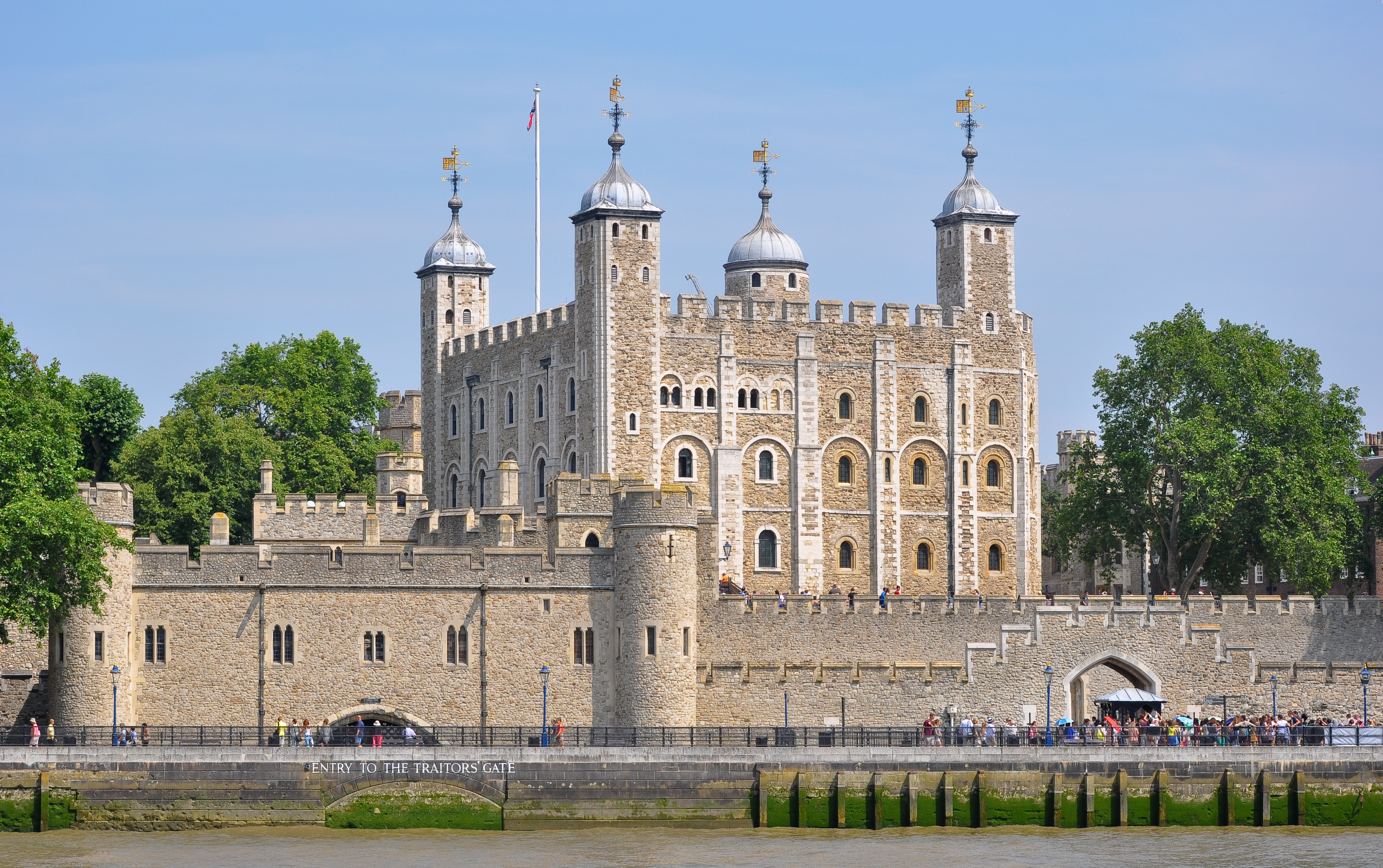
The borough was formed in 1965 by merger of the former metropolitan boroughs of Stepney, Poplar, and Bethnal Green. 'Tower Hamlets' was originally an alternative name for the historic Tower Division; the area of south-east Middlesex, focused on (but not limited to) the area of the modern borough, which owed military service to the Tower of London. The Tower of London itself is located in the borough, adjacent to its western boundary with the City of London.
The local authority is Tower Hamlets London Borough Council. In 2017, a joint study by Trust for London and New Policy Institute found Tower Hamlets to be the 2nd most deprived London borough (after Barking and Dagenham) based on an average calculated across a range of indicators; with high rates of child poverty, unemployment and pay inequality compared to other London boroughs. However, it has the lowest gap for educational outcomes at secondary level.
Some of the world's major headquarters and tallest buildings in London occupy Canary Wharf, the country's second largest financial district, and Aldgate East. Between 2014 and 2024, Tower Hamlets saw the completion of 71 skyscrapers, more than any other London borough. Also, part of the Queen Elizabeth Olympic Park is in the borough.
Demographically, Tower Hamlets has a large population of British Bangladeshis, forming the largest single ethnic group in the borough at 32%. The 2011 census showed Tower Hamlets to have the highest proportion of Muslims of any English local authority and was the only location where Islam outnumbered Christianity. The borough has 50 Mosques and many madrasahs, including the East London Mosque, the country's largest. Whitechapel restaurants, neighbouring street market and shops provide the largest range of Bangladeshi cuisine, woodwork, carpets and clothes in Europe. Brick Lane is also a major centre of hipster subculture.
History
The earliest reference to the name "Tower Hamlets" was in 1554, when the Council of the Tower of London ordered a muster of "men of the hamlets which owe their service to the tower". This covered a wider area than the present-day borough, and its military relationship with the Tower is thought to have been several centuries earlier than the 1554 record.
In 1605, the Lieutenant of the Tower was given the right to muster the militia and the area east of the tower came to be a distinct military unit, officially called Tower Hamlets (or the Tower Division). The Hamlets of the Tower paid taxes for the militia in 1646.
The London Borough of Tower Hamlets forms the core of the East End. The population of the area grew enormously in the 19th century, leading to extreme overcrowding and a concentration of poor people and immigrants throughout the area. These problems were exacerbated by the construction of St Katharine Docks (1827) and the central London railway termini (1840–1875) with many displaced people moving into the area following the clearance of former slums and rookeries. Over the course of a century, the East End became synonymous with poverty, overcrowding, disease and criminality.
The area was once characterised by rural settlements clustered around the City walls or along the main roads, surrounded by farmland, with marshes and small communities by the River, serving the needs of shipping and the Royal Navy. Until the arrival of formal docks, shipping was required to land goods in the Pool of London, but industries related to construction, repair, and victualling of ships flourished in the area from Tudor times. The area attracted large numbers of rural people looking for employment. Successive waves of foreign immigration began with Huguenot refugees creating a new extramural suburb in Spitalfields in the 17th century. They were followed by Irish weavers, Ashkenazi Jews and, in the 20th century, Bangladeshis.

Many of these immigrants worked in the clothing industry. The abundance of semi- and unskilled labour led to low wages and poor conditions throughout the East End. This brought the attentions of social reformers during the mid-18th century and led to the formation of unions and workers associations at the end of the century. The radicalism of the East End contributed to the formation of the Labour Party and demands for the enfranchisement of women.
Official attempts to address the overcrowded housing began at the beginning of the 20th century under the London County Council. Aerial bombing in World War II devastated much of the East End, with its docks, railways and industry forming a continual target. In the separate boroughs making up today's Tower Hamlets a total of 2,221 civilians were killed and 7,472 were injured, with 46,482 houses destroyed and 47,574 damaged. This led to some dispersal of the population to outlying suburbs. New housing was built in the 1950s for those that remained.
The closure of the last of the East End docks in the Port of London in 1980 created further challenges and led to attempts at regeneration and the formation of the London Docklands Development Corporation. The Canary Wharf development, improved infrastructure, and the Queen Elizabeth Olympic Park mean that the East End is undergoing further change, but some of its districts continue to see some of the worst poverty in Britain.
Administrative history
The area of the modern borough had historically been part of the hundred of Ossulstone in county of Middlesex. Ossulstone was subsequently divided into four divisions, one of which was the Tower Division, also known as the Tower Hamlets, which covered a larger area than the modern borough, also including parts of Hackney. From at least the 17th century the Tower Division was a liberty with judicial and administrative independence from the rest of the county. The liberty appears to have arisen from much older obligations on inhabitants of the area to provide military service to the Constable of the Tower of London.
From 1856 the area was governed by the Metropolitan Board of Works, which was established to provide services across the metropolis of London. In 1889 the Metropolitan Board of Works' area was made the County of London. From 1856 until 1900 the lower tier of local government within the metropolis comprised various parish vestries and district boards. In 1900 the lower tier was reorganised into metropolitan boroughs, including the Metropolitan Borough of Bethnal Green, the Metropolitan Borough of Poplar and the Metropolitan Borough of Stepney.
The modern borough was created in 1965 under the London Government Act 1963. It was a merger of the old boroughs of Bethnal Green, Poplar and Stepney, and was named Tower Hamlets after the historic liberty.
Geography
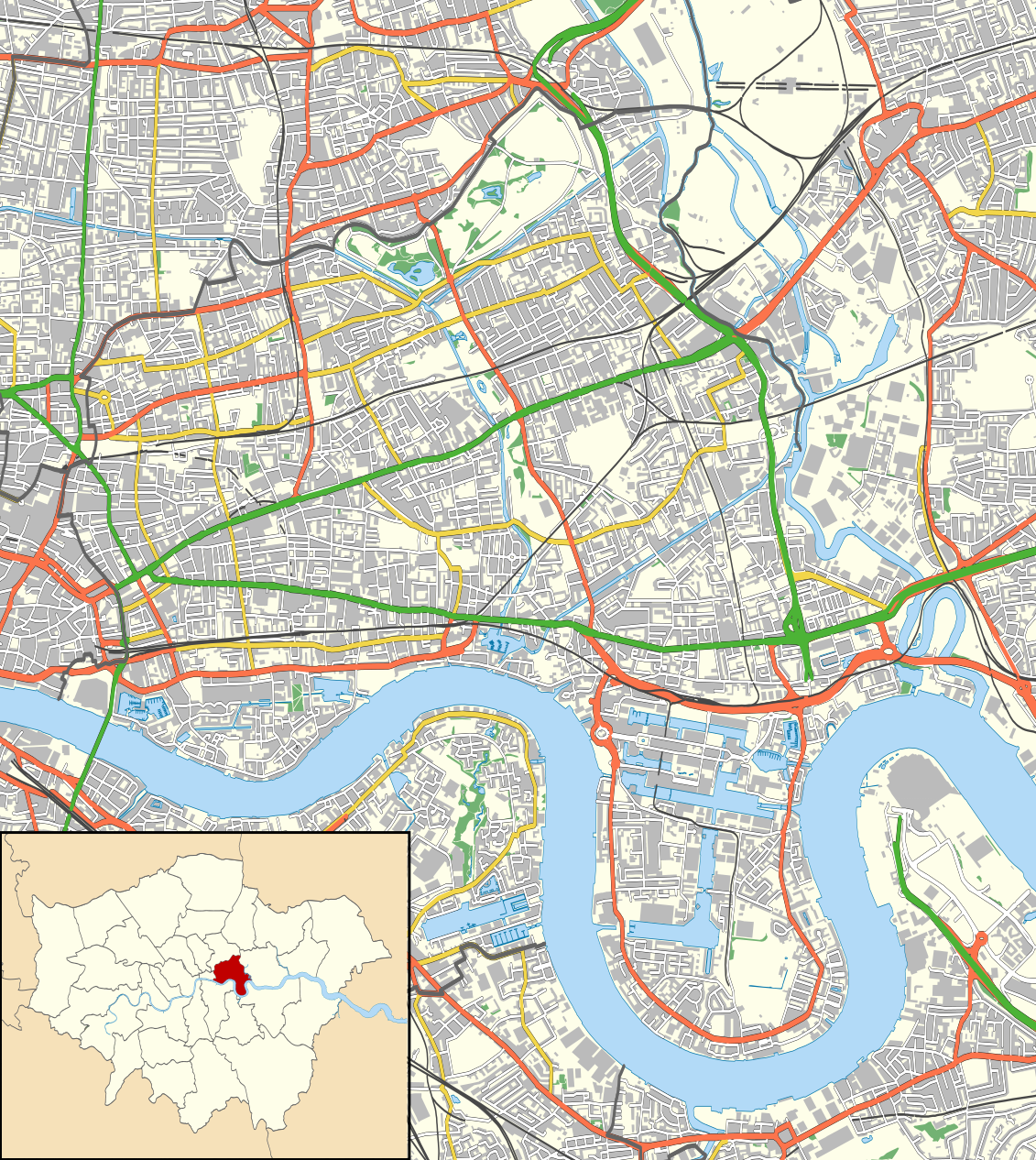
Tower Hamlets is in East London, north of the River Thames. The City of London lies to the west, the London Borough of Hackney to the north, while the River Lea forms the boundary with the London Borough of Newham to the east. The River Lea also forms the boundary between the historic counties of Middlesex and Essex. The borough's Thames frontage extends from the Tower Dock inlet, immediately west of the Tower of London, through several miles of former docklands, including the Isle of Dogs peninsula, to the confluence of the Thames and Lea at Blackwall. Areas along the Thames and Lea flood plains were historically frequently flooded, but the Thames Barrier, further east, has reduced that risk.
Regent's Canal enters the borough from Hackney to meet the River Thames at Limehouse Basin. A stretch of the Hertford Union Canal leads from the Regent's canal, at a basin in the north of Mile End, to join the River Lea at Old Ford. A further canal, Limehouse Cut, London's oldest, leads from locks at Bromley-by-Bow to Limehouse Basin. Most of the canal tow-paths are open to both pedestrians and cyclists.
The borough includes open spaces such as Victoria Park, King Edward Memorial Park, Mile End Park, Island Gardens and part of the Queen Elizabeth Olympic Park.
Districts within the borough
Areas within the borough include:
- Bethnal Green
- Blackwall
- Bow
- Bromley-by-Bow
- East Smithfield
- Fish Island
- Isle of Dogs, including Canary Wharf
- Limehouse
- Mile End
- Poplar
- Ratcliff
- Shadwell
- Spitalfields
- St George in the East
- St Katharine's
- Stepney
- The Tower Liberty, taking in Tower Hill
- Wapping
- Whitechapel
Landmarks
- Brick Lane
- Cable Street - site of the Battle of Cable Street
- Hawksmoor's Christ Church, Spitalfields
- Site of two historic Royal Mints
- Tower of London
- Tower Bridge
- Victoria Park
- Roman Road
- Columbia Road
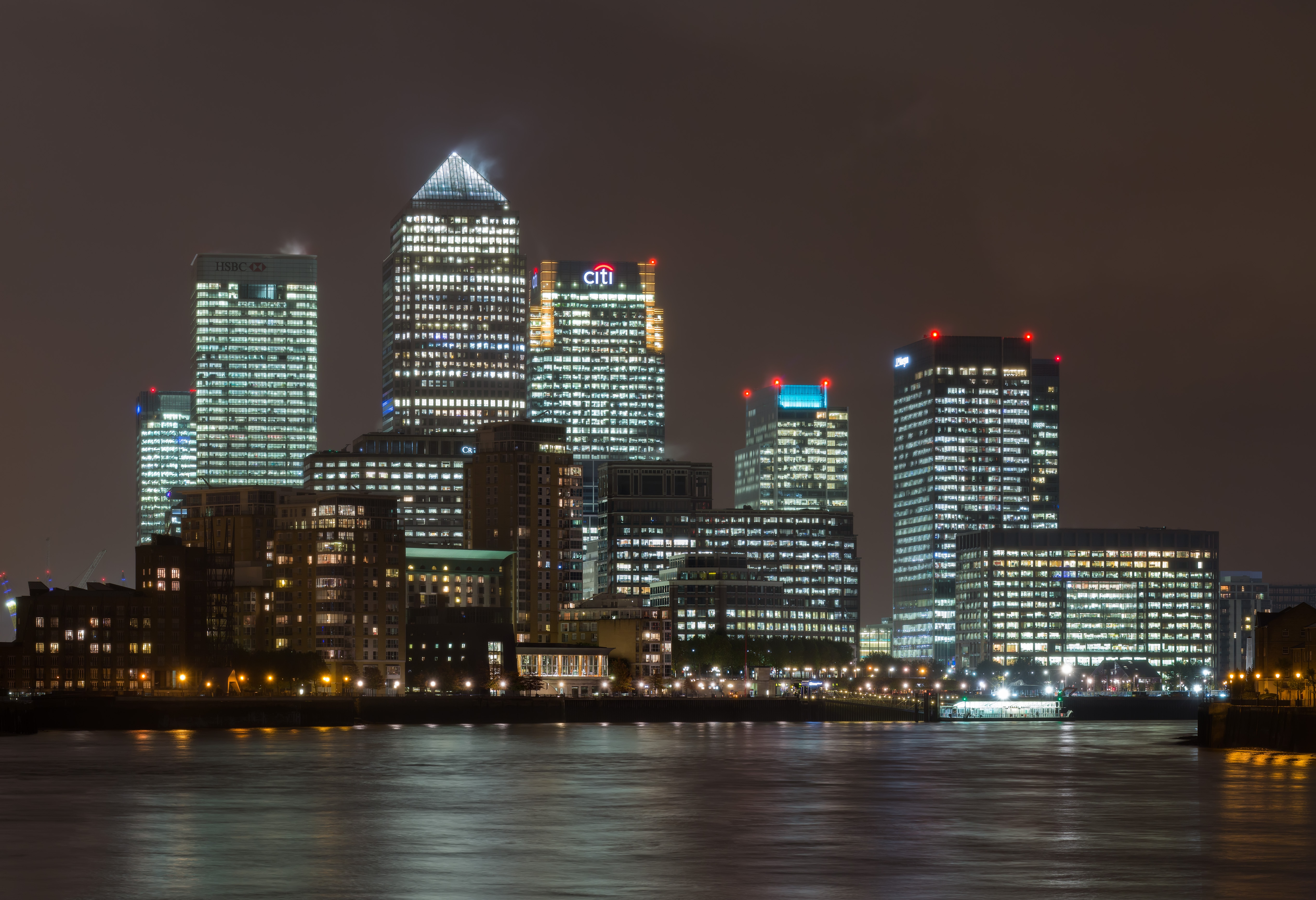
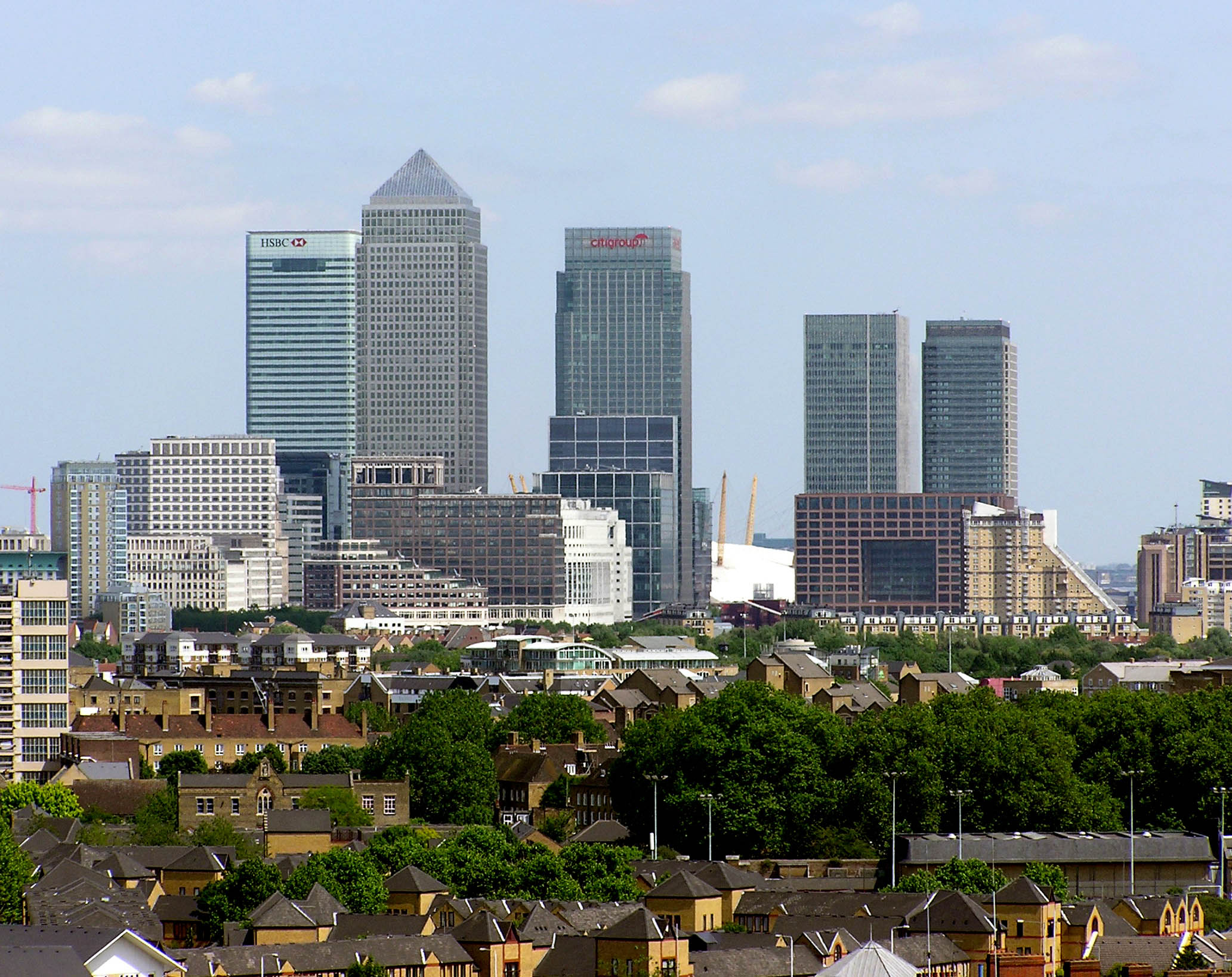
- Poplar Baths The Canary Wharf district on the Isle of Dogs in the Docklands forms a group of some of the tallest buildings in Europe. One Canada Square was the first skyscraper to be constructed and is the third tallest in London. Nearby are the HSBC Tower, Citigroup Centres and One Churchill Place, headquarters of Barclays Bank. Within the same complex are the Heron Quays offices.
Part of the Queen Elizabeth Olympic Park, developed for the London 2012 Olympics, lies within the borders of Tower Hamlets.
In 2021 the Embassy of China in London was proposed to move in to the former Royal Mint building in East Smithfield, however these plans were later rejected unanimously by the Tower Hamlets council.
Governance
Main article: Tower Hamlets London Borough Council
.jpg)
The local authority is Tower Hamlets Council, based at Tower Hamlets Town Hall on Whitechapel Road. Since 2010 the council has been led by the directly elected Mayor of Tower Hamlets.
Greater London representation
Since 2000, the borough lies within the City and East constituency, one of fourteen constituencies which make up the London Assembly, and is represented by Unmesh Desai of the Labour Party.
UK Parliament
For the 2019 general election, the borough was split into two constituencies:
- Bethnal Green & Bow, represented by Rushanara Ali (Labour).
- Poplar & Limehouse, represented by Apsana Begum (Labour).
Due to the 2023 Periodic Review of Westminster constituencies, the subsequent general election saw Tower Hamlets elect MPs in three constituencies. These are:
- Stratford and Bow (partly in Newham as well as Tower Hamlets), represented by Uma Kumaran (Labour).
- Bethnal Green and Stepney, represented by Rushanara Ali.
- Poplar and Limehouse (under amended boundaries), represented by Apsana Begum.
Climate
The data below were taken between 1971 and 2000 at the weather station in Greenwich, around 1 mi south of the borough's former town hall, at Mulberry Place:
Demographics

| 1801 |130871 | 1811 |160718 | 1821 |195941 | 1831 |231534 | 1841 |275250 | 1851 |330548 | 1861 |410101 | 1871 |489653 | 1881 |569205 | 1891 |584936 | 1901 |578143 | 1911 |571438 | 1921 |529114 | 1931 |489956 | 1941 |337774 | 1951 |232860 | 1961 |195883 | 1971 |164699 | 1981 |139989 | 1991 |167985 | 2001 |196121 | 2011 |254096 | 2021 |310300
By 1891, Tower Hamlets – roughly the ancient civil parish of Stepney – was already one of the most populated areas in London. Throughout the nineteenth century, the local population increased by an average of 20% every ten years. The building of the docks intensified land use and caused the last marshy areas in the south of the parish to be drained for housing and industry. In the north of the borough, employment was principally in weaving, small household industries like boot and furniture making and new industrial enterprises like Bryant and May. The availability of cheap labour drew in many employers. To the south, employment was in the docks and related industries – such as chandlery and rope making.
By the middle of the nineteenth century, the district now recognised as Tower Hamlets was characterised by overcrowding and poverty. The construction of the railways caused many more displaced people to settle in the area, and a massive influx of Eastern European Jews at the latter part of the nineteenth century added to the population growth. This migration peaked at the end of that century and population growth entered a long decline through to the 1960s, as people moved away eastwards to newer suburbs of London and Essex. The area's population had neared 600,000 around the end of the nineteenth century, but fell to a low of less than 140,000 by the early 1980s.
The metropolitan boroughs suffered very badly during World War II, during which considerable numbers of houses were destroyed or damaged beyond use due to heavy aerial bombing. This coincided with a decline in work in the docks, and the closure of many traditional industries. The Abercrombie Plan for London (1944) began an exodus from London towards the new towns.
This decline began to reverse with the establishment of the London Docklands Development Corporation bringing new industries and housing to the brownfield sites along the river. Also contributing was new immigration from Asia beginning in the 1970s. According to the 2001 UK Census the population of the borough is approximately 196,106. According to the ONS estimate, the population is 237,900, as of 2010.
Crime in the borough increased by 3.5% from 2009 to 2010, according to figures from the Metropolitan Police, having decreased by 24% between 2003/04 and 2007/08.
Tower Hamlets has one of the smallest White British populations of any local authority in the United Kingdom. No ethnic group forms a majority of the population; a plurality of residents are white (45%), a little over two thirds of whom are White British. 32% of residents are Bangladeshi, which is the largest ethnic minority group in the borough, with Asians as a whole forming 41% of the population. A smaller proportion are of Black African and Caribbean descent (7%), Those of mixed ethnic backgrounds form 4%, while other ethnic groups form 2%. The White British proportion was recorded as 31.2% in the 2011 UK Census, a decrease from 42.9% in 2001.
In 2018, Tower Hamlets had the lowest life expectancy and the highest rate of heart disease of all London boroughs, along with Newham.
The 2021 census found that the borough has one of the lowest proportions of population over the age of 65 or older in England and Wales, at 5.6%.
Ethnicity

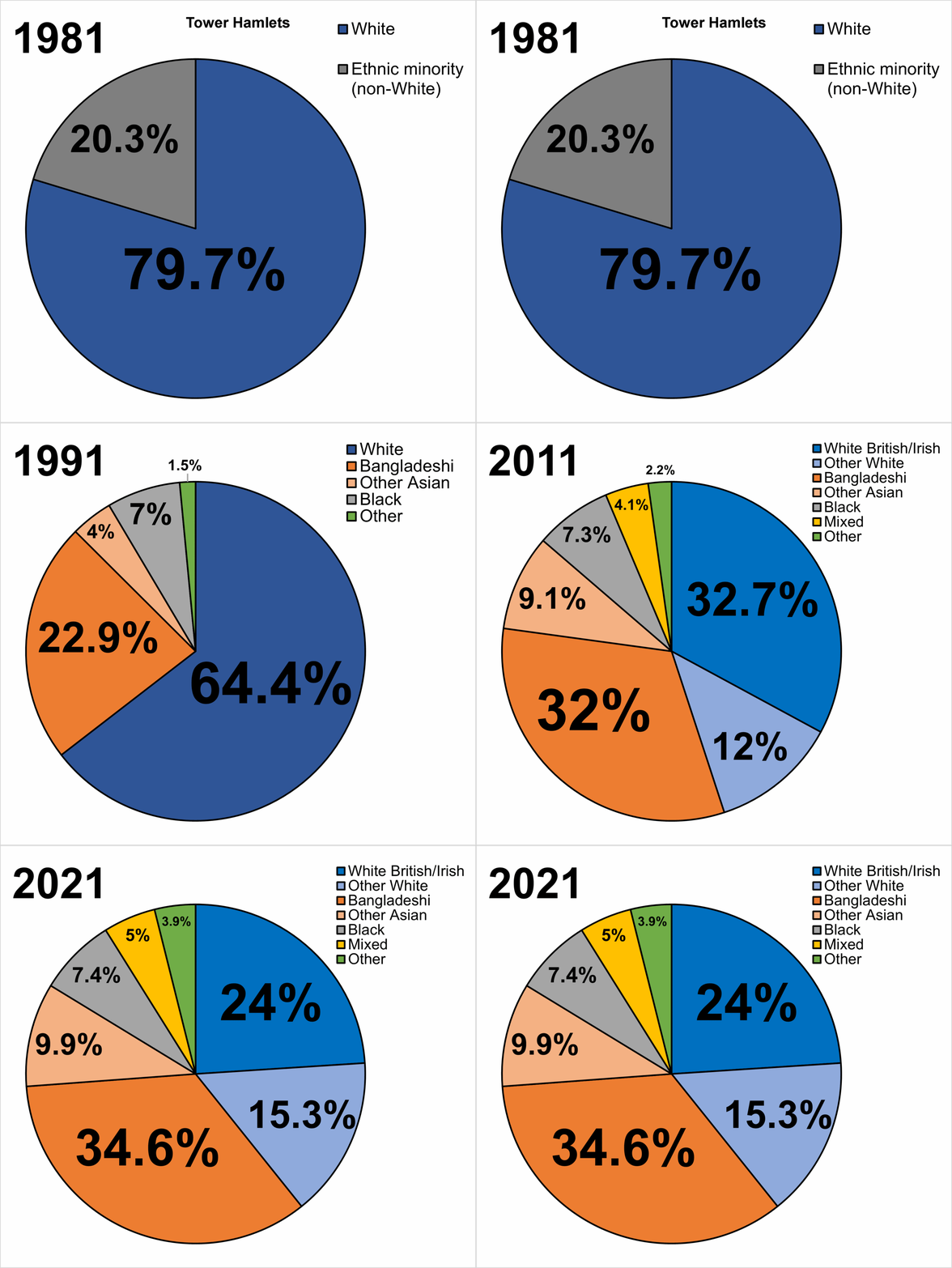
| Ethnic Group | Year | 1966 estimations | 1971 estimations | 1981 estimations | 1991 census | 2001 census | 2011 census | 2021 census | Number | % | Number | % | Number | % | Number | % | Number | % | Number | % | Number | % | White: Total | – | 95.7% | – | 91.4% | 108,776 | 76.2% | 107,481 | 63.9% | 100,799 | 51% | 114,819 | 45% | 122,266 | 39.3% | Asian or Asian British: Total | – | 2.3% | – | – | 23,234 | 16.3% | 46,084 | 27.4% | 75,380 | 38% | 104,501 | 41% | 137,856 | 44.5% | Black or Black British: Total | – | 2% | – | – | 9,011 | 6.3% | 11,940 | 7.1% | 12,742 | 6% | 18,629 | 7% | 22,693 | 7.4% | Mixed or British Mixed: Total | – | – | – | – | – | – | – | – | 4,873 | 2% | 10,360 | 4% | 15,409 | 5% | Other: Total | – | – | – | – | 1,702 | 2,584 | 2,312 | 1% | 5,787 | 3% | 12,082, | 3.9% | Ethnic minority: Total | – | 4.3% | – | 8.6% | 33,947 | 23.8% | 60,608 | 36% | 95,307 | 49% | 139,277 | 55% | 188,040 | 60.8% | Total | – | 100% | – | 100% | 142,723 | 100% | 168,089 | 100% | 196,106 | 100.00% | 254,096 | 100.00% | 310,306 | 100% |
|---|---|---|---|---|---|---|---|---|---|---|---|---|---|---|---|---|---|---|---|---|---|---|---|---|---|---|---|---|---|---|---|---|---|---|---|---|---|---|---|---|---|---|---|---|---|---|---|---|---|---|---|---|---|---|---|---|---|---|---|---|---|---|---|---|---|---|---|---|---|---|---|---|---|---|---|---|---|---|---|---|---|---|---|---|---|---|---|---|---|---|---|---|---|---|---|---|---|---|---|---|---|---|---|---|---|---|---|---|---|---|---|---|---|---|---|---|---|---|---|---|---|---|---|---|---|
| White: British | – | – | – | – | – | – | – | – | 84,151 | 43% | 79,231 | 31% | 71,177 | 22.9% | |||||||||||||||||||||||||||||||||||||||||||||||||||||||||||||||||||||||||||||||||||||||||||||||||||||||||||||||
| White: Irish | – | 1.4% | – | – | – | – | – | – | 3,823 | 2% | 3,863 | 2% | 3,567 | 1.1% | |||||||||||||||||||||||||||||||||||||||||||||||||||||||||||||||||||||||||||||||||||||||||||||||||||||||||||||||
| White: Gypsy or Irish Traveller | – | – | – | – | – | – | – | – | – | – | 175 | 0% | 110 | 0.0% | |||||||||||||||||||||||||||||||||||||||||||||||||||||||||||||||||||||||||||||||||||||||||||||||||||||||||||||||
| White: Roma | – | – | – | – | – | – | – | – | – | – | – | – | 2,225 | 0.7% | |||||||||||||||||||||||||||||||||||||||||||||||||||||||||||||||||||||||||||||||||||||||||||||||||||||||||||||||
| White: Other | – | – | – | – | – | – | – | – | 12,825 | 7% | 31,550 | 12% | 45,187 | 14.6% | |||||||||||||||||||||||||||||||||||||||||||||||||||||||||||||||||||||||||||||||||||||||||||||||||||||||||||||||
| Asian or Asian British: Indian | – | – | – | – | 1,378 | 1,730 | 3,001 | 2% | 6,787 | 3% | 10,135 | 3.3% | |||||||||||||||||||||||||||||||||||||||||||||||||||||||||||||||||||||||||||||||||||||||||||||||||||||||||||||||||
| Asian or Asian British: Pakistani | – | – | – | – | 990 | 1,239 | 1,486 | 1% | 2,442 | 1% | 3,341 | 1.1% | |||||||||||||||||||||||||||||||||||||||||||||||||||||||||||||||||||||||||||||||||||||||||||||||||||||||||||||||||
| Asian or Asian British: Bangladeshi | – | – | – | – | 18,888 | 13.2% | 39,429 | 23.5% | 65,553 | 33% | 81,377 | 32% | 107,333 | 34.6% | |||||||||||||||||||||||||||||||||||||||||||||||||||||||||||||||||||||||||||||||||||||||||||||||||||||||||||||||
| Asian or Asian British: Chinese | – | – | – | – | 1,056 | 1,825 | 3,573 | 2% | 8,109 | 3% | 10,279 | 3.3% | |||||||||||||||||||||||||||||||||||||||||||||||||||||||||||||||||||||||||||||||||||||||||||||||||||||||||||||||||
| Asian or Asian British: Other Asian | – | – | – | – | 922 | 1,861 | 1,767 | 1% | 5,786 | 2% | 6,768 | 2.2% | |||||||||||||||||||||||||||||||||||||||||||||||||||||||||||||||||||||||||||||||||||||||||||||||||||||||||||||||||
| Black or Black British: African | – | 0.2% | – | – | 2,363 | 3,969 | 6,596 | 3% | 9,495 | 4% | 15,373 | 5.0% | |||||||||||||||||||||||||||||||||||||||||||||||||||||||||||||||||||||||||||||||||||||||||||||||||||||||||||||||||
| Black or Black British: Caribbean | – | 1.8% | – | – | 5,270 | 6,055 | 5,225 | 3% | 5,341 | 2% | 4,930 | 1.6% | |||||||||||||||||||||||||||||||||||||||||||||||||||||||||||||||||||||||||||||||||||||||||||||||||||||||||||||||||
| Black or Black British: Other Black | – | – | – | – | 1,378 | 1,916 | 921 | 0% | 3,793 | 1% | 2,390 | 0.8% | |||||||||||||||||||||||||||||||||||||||||||||||||||||||||||||||||||||||||||||||||||||||||||||||||||||||||||||||||
| Mixed: White and Black Caribbean | – | – | – | – | – | – | – | – | 1,568 | 1% | 2,837 | 1% | 3,593 | 1.2% | |||||||||||||||||||||||||||||||||||||||||||||||||||||||||||||||||||||||||||||||||||||||||||||||||||||||||||||||
| Mixed: White and Black African | – | – | – | – | – | – | – | – | 789 | 0% | 1,509 | 1% | 2,236 | 0.7% | |||||||||||||||||||||||||||||||||||||||||||||||||||||||||||||||||||||||||||||||||||||||||||||||||||||||||||||||
| Mixed: White and Asian | – | – | – | – | – | – | – | – | 1,348 | 1% | 2,961 | 1% | 4,374 | 1.4% | |||||||||||||||||||||||||||||||||||||||||||||||||||||||||||||||||||||||||||||||||||||||||||||||||||||||||||||||
| Mixed: Other Mixed | – | – | – | – | – | – | – | – | 1,168 | 1% | 3,053 | 1% | 5,206 | 1.7% | |||||||||||||||||||||||||||||||||||||||||||||||||||||||||||||||||||||||||||||||||||||||||||||||||||||||||||||||
| Other: Arab | – | – | – | – | – | – | – | – | – | – | 2,573 | 1% | 3,588 | 1.2% | |||||||||||||||||||||||||||||||||||||||||||||||||||||||||||||||||||||||||||||||||||||||||||||||||||||||||||||||
| Other: Any other ethnic group | – | – | – | – | – | – | – | – | 2,312 | 1% | 3,214 | 1% | 8,494 | 2.7% |
Sex and Gender
The 2021 census also provided gender and sex profiles of the Tower Hamlets borough: SEX
| Male | 155869 | 50.2% |
|---|
GENDER
| Not answered | 20975 | 8.3% |
|---|
Age
The 2021 census additionally provided age profiles of the Tower Hamlets borough: AGE
| Ages 65+ | 17471 | 5.6% |
|---|
Religion and religious sites


Tower Hamlets is a religious diverse borough with various places of worship. According to the 2021 census, 39.9% of the population was Muslim, 22.3% Christian, 2.0% Hindu, 1.0% Buddhist, 0.4% Jewish, 0.3% Sikh, 0.5% followed some other religion, 26.6% were not affiliated to a religion and 6.9% did not state their religious views.
The following table shows the religious identity of residents residing in Tower Hamlets according to the 2001, 2011 and the 2021 censuses.
| Religion | 1995 estimates | 2001 census | 2011 census | 2021 census | Number | % | Number | % | Number | % | Number | % | Holds religious beliefs | – | – | 153,692 | 78.4 | 166,359 | 65.5 | 206,347 | 66.5 | No religion | – | – | 27,823 | 14.2 | 48,648 | 19.1 | 82,635 | 26.6 | Religion not stated | – | – | 14,591 | 7.4 | 39,089 | 15.4 | 21,318 | 6.9 | Total population | – | 100% | 196,106 | 100.0 | 254,096 | 100.0 | 310,300 | 100.0 |
|---|---|---|---|---|---|---|---|---|---|---|---|---|---|---|---|---|---|---|---|---|---|---|---|---|---|---|---|---|---|---|---|---|---|---|---|---|---|---|---|---|---|---|---|---|---|---|---|---|
| Muslim | – | – | 71,389 | 36.4 | 87,696 | 34.5 | 123,912 | 39.9 | ||||||||||||||||||||||||||||||||||||||||
| Christian | – | – | 75,783 | 38.6 | 68,808 | 27.1 | 69,223 | 22.3 | ||||||||||||||||||||||||||||||||||||||||
| Hindu | – | – | 1,544 | 0.8 | 4,200 | 1.7 | 6,298 | 2.0 | ||||||||||||||||||||||||||||||||||||||||
| Buddhist | – | – | 1,938 | 1.0 | 2,726 | 1.1 | 2,961 | 1.0 | ||||||||||||||||||||||||||||||||||||||||
| Jewish | 6,000 | 3.7% | 1,831 | 0.9 | 1,283 | 0.5 | 1,341 | 0.4 | ||||||||||||||||||||||||||||||||||||||||
| Sikh | – | – | 682 | 0.3 | 821 | 0.3 | 966 | 0.3 | ||||||||||||||||||||||||||||||||||||||||
| Other religion | – | – | 525 | 0.3 | 825 | 0.3 | 1,652 | 0.5 |
Places of worship
There are 21 active churches, affiliated with the Church of England, which include Christ Church of Spitalfields, St Paul's Church of Shadwell and St Dunstan's of Stepney; and there are also churches of many other Christian denominations.
There are more than 40 mosques and Islamic centres in Tower Hamlets. The most famous is the East London Mosque, one of the first mosques in Britain allowed to broadcast the adhan, and one of the biggest Islamic centres in Europe. The Maryam Centre, a part of the mosque, is the biggest Islamic centre for women in Europe. Opened in 2013, it features a main prayer hall, ameliorated funeral services, education facilities, a fitness centre and support services. The East London Mosque has been visited by several notable people, including Prince Charles, Boris Johnson, many foreign government officials and world-renowned imams and Muslim scholars. Other notable mosques are Brick Lane Mosque, Darul Ummah Masjid, Esha Atul Islam Mosque, Markazi Masjid, Stepney Shahjalal Mosque and Poplar Central Mosque. Mosques in Tower Hamlets, Muslimsinbritain.org. Retrieved 27 June 2011.
Other notable religious buildings include the Fieldgate Street Great Synagogue, the Congregation of Jacob Synagogue, the London Buddhist Centre, the Hindu Pragati Sangha Temple, and the Gurdwara Sikh Sangat. The Great Synagogue of London, which was destroyed during the Second World War, is located just outside the borough's boundaries, in the City.
Economy


The borough hosts the world headquarters of many global financial businesses, employing some of the highest paid workers in London, but also has high rates of long-term illness and premature death and the 2nd highest unemployment rate in London.
Canary Wharf is home to many of the world and European headquarters of numerous major banks and professional services firms including Barclays, Citigroup, Clifford Chance, Credit Suisse, Infosys, Fitch Ratings, HSBC, J.P. Morgan, KPMG, MetLife, Morgan Stanley, RBC, Skadden, State Street and Thomson Reuters. Savills, a top-end estate agency recommends that 'extreme luxury' and ultra-modern residential properties are to be found at Canary Riverside, West India Quay, Pan Peninsula and Neo Bankside. Tower Hamlets is the earliest borough where the first skyscrapers were built and since 2014 it saw the completion of over seventy skyscrapers, more than any other place in the UK
The End Child Poverty coalition published that Tower Hamlets has the highest proportion of children in poverty of any local authority in the UK at 49% (and as high as 54.5% in the Bethnal Green South ward).
Surveys and interviews conducted by the Child Poverty Action group for the council found that the Universal Credit system was deeply unpopular with low-income families in the borough and that most claimants who have used the system found it difficult to understand and experienced frequent payment errors.
Media
The East London Advertiser and Social Streets provide local news in print and online. There are also several Bengali print and online newspapers published in the borough.
Education

The London Borough of Tower Hamlets is the local education authority for state schools within the borough. In January 2008, there were 19,890 primary-school pupils and 15,262 secondary-school pupils attending state schools there."Pupil projections" , Tower Hamlets Council. Retrieved 27 June 2011.
- See also: "DfE: Schools, Pupils and their Characteristics, January 2011", Department for Education, data released on 22 June 2011. Retrieved 11 July 2011. Private-school pupils account for 2.4 per cent of schoolchildren in the borough. In 2010, 51.8 per cent of pupils achieved 5 A*–C GCSEs including Mathematics and English – the highest results in the borough's history – compared to the national average of 53.4 per cent."Secondary schools and colleges in Tower Hamlets", BBC News, 12 January 2011. Retrieved 11 July 2011. See also:
- "Guide: Secondary league tables", BBC News, 12 January 2011. Retrieved 11 July 2011.
- "Tower Hamlets: GCSE and A-level results for 2009-2010", The Guardian, 12 January 2011. Retrieved 11 July 2011.
- For highest results, see: "Tower Hamlets scores record GCSE results", Tower Hamlets London Borough Council, 25 August 2010. Retrieved 11 July 2010. Archived 11 July 2011. Seventy-four per cent achieved 5 A*–C GCSEs for all subjects (the same as the English average); the figure in 1997 was 26 per cent. The percentage of pupils on free school meals in the borough is the highest in England and Wales. In 2007, the council rejected proposals to build a Goldman Sachs-sponsored academy.
Schools in the borough have high levels of racial segregation. The Times reported in 2006 that 47 per cent of secondary schools were exclusively non-white, and that 33 per cent had a white majority.Frean, Alexandra. "Race quotas 'needed to end divide in schools'". The Times. 12 October 2006. Retrieved 21 July 2011.
- See also: "Schools in the East End dividing by race". Evening Standard. 29 May 2007. Retrieved 21 July 2011. About 60 per cent of pupils entering primary and secondary school are Bangladeshi. 78% of primary-school pupils speak English as a second language.

The council runs several Idea Stores in the borough, which combine traditional library and computer services with other resources, and are designed to attract more diverse members. The flagship Whitechapel store was designed by David Adjaye, and cost £16 million to build.
Universities
- Queen Mary University of London, a constituent college of the University of London, which includes Barts and The London, Queen Mary's School of Medicine and Dentistry
- London Metropolitan University
- UCL School of Management, located in One Canada Square, Canary Wharf
- The London Interdisciplinary School, located on Whitechapel Road
- Northeastern University - London, located in St, Katherines docks
Further education colleges
- Tower Hamlets College, which in 2017 merged with Hackney Community College and Redbridge College to form New City College, the second largest college in London with over 20,000 students.
Schools and sixth form colleges
- Bishop Challoner Catholic School
- Bow School
- Central Foundation Girls' School
- George Green's School
- Ibrahim College
- Jamiatul Ummah School and Sixth Form
- Langdon Park School
- Lansbury Lawrence School
- London East Academy (East London Mosque)
- London Enterprise Academy
- Mazahirul uloom London
- Morpeth School
- Mulberry Academy Shoreditch
- Mulberry School for Girls
- Oaklands School
- St Paul's Way Trust School
- Stepney All Saints School
- Stepney Green Maths, Computing & Science College
- Swanlea School, Business and Enterprise College
- Wapping High School
Volunteering
- Volunteer Centre Tower Hamlets helps residents find volunteering work and provides support to organisations involving students volunteers.
Sports

Mile End Stadium within Mile End Park hosts an athletics stadium and facilities for football and basketball. Two football clubs, Tower Hamlets F.C. (formerly Bethnal Green United) and Sporting Bengal United F.C., are based there, playing in the Essex Senior Football League.
John Orwell Sports Centre in Wapping is the base of Wapping Hockey Club. In 2014, the club secured over £300,000 of investment to designate the centre a hockey priority facility.
A leisure centre including a swimming pool at Mile End Stadium was completed in 2006. Other pools are located at St Georges, Limehouse and York Hall, in Bethnal Green. York Hall is also a regular venue for boxing tournaments, and in May 2007 a public spa was opened in the building's renovated Victorian-style Turkish baths.
KO Muay Thai Gym and Apolaki Krav Maga & Dirty Boxing Academy. in Bethnal Green are the main sources for martial arts and combat sports training in the area.
The unusual Green Bridge, opened in 2000, links sections of Mile End Park that would otherwise be divided by Mile End Road. The bridge contains gardens, water features and trees around the path.
Queen Elizabeth Olympic Park
Main article: Queen Elizabeth Olympic Park
Tower Hamlets was one of five host boroughs for the 2012 Summer Olympics; the Queen Elizabeth Olympic Park was constructed in the Lea Valley. As such, the borough's involvement in the Olympics includes:
- A small part of the Olympic Park is in Bow, a district of the borough, which makes the borough a host borough.
- The energy centre (King's Yard Energy Centre) of the Olympic Park is in the London Borough of Tower Hamlets, and gives energy to all the venues, none of which are located in Tower Hamlets.
- The world square and the London 2012 mega-store is also in the borough. The world square is for spectators, who can buy food or drink; the world's biggest McDonald's is in the world square in Tower Hamlets.
- The London 2012 mega-store provides official gifts and souvenirs. High Street, which is the main road to the Olympic park from west and central London, combines Whitechapel Road, Mile End Road and Bow Road.
- Victoria Park, in Tower Hamlets, is an important part of the Olympics because spectators without tickets can watch the games on big screens (London live 2012); that park is less than a mile away from the Olympic park. The main spectator cycle park is located in Victoria park. One of the entrances to the Olympic park is in Tower Hamlets, and is called the Victoria gate.
- A few schools in Tower Hamlets have taken part in the opening and closing ceremonies of the Olympic and Paralympic games as well as all the other host boroughs. The section of the Olympic Park in Tower Hamlets will be named "Sweetwater", one of the 5 new neighbourhoods after the games. Sweetwater will cover Tower Hamlets' part of the Olympic Park near Old Ford.
- The Olympic marathon was planned to run through the borough but later ran through the City and Westminster. However, the U-turn was located in the borough near The Tower of London.
- Danny Boyle, the artistic director of the London 2012 opening ceremony, lives in Mile End.
- A large number of Tower Hamlets' residents became Olympic volunteers; Tower Hamlets ranks second, after neighbouring borough Newham, for the number of volunteers from the borough.
Leisure
Parks in Tower Hamlets
Main article: Tower Hamlets parks and open spaces

There are over one hundred parks and open spaces in Tower Hamlets ranging from the large Victoria Park, to numerous small gardens and squares. The second largest, Mile End Park, separated from Victoria Park by a canal, includes The Green Bridge that carries the park across the busy Mile End Road. One of the smallest at 1.19 ha is the decorative Grove Hall Park off Fairfield Road, Bow, which was once the site of a lunatic asylum. Other parks include Altab Ali Park, Mudchute Park and Grove Hall Park.
Museums
- Island History Trust
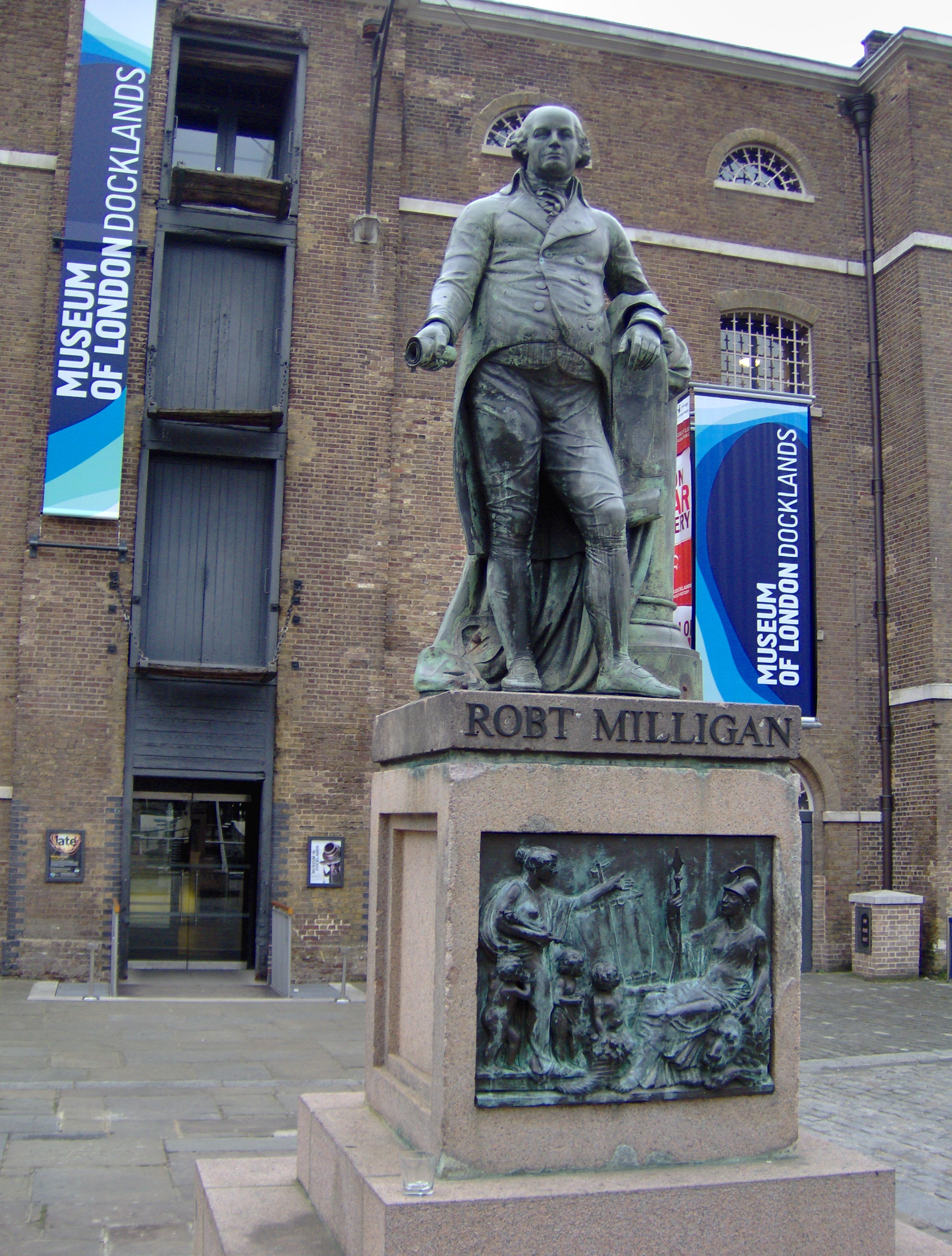
- Museum of London Docklands
- Ragged School Museum
- V&A Museum of Childhood
- Whitechapel Art Gallery
- Vagina Museum
Transport
Road
As with most of the transport network in Tower Hamlets, several roads radiate across the Borough from the City of London. East–west routes include:
- the A11, which runs from Aldgate to the A12 near Stratford, passing through Whitechapel, Mile End, and Bow.
- the A13 (Commercial Road/East India Dock Road), which runs from Aldgate to Poplar. East of Poplar, the route continues towards Barking, Tilbury, and Southend.
- the A1203 (The Highway), which runs from Tower Hill, through Wapping, to Limehouse and Canary Wharf.
There are several north–south routes in the Borough, including:
- the A12, which begins at the A13 in Poplar and runs along the eastern edge of the Borough. The route carries traffic towards the M11 (for Stansted Airport ), Romford, and destinations in Essex, including Chelmsford and Harwich International Port. The route ultimately runs to Lowestoft in Suffolk.
- the London Inner Ring Road from Old Street to Tower Bridge.
There are three River Thames road crossings in the Borough. From west-east, these are:
- Tower Bridge (Tower Hill to Southwark and Bermondsey)
- Rotherhithe Tunnel (the A13 at Limehouse to Canada Water)
- Blackwall Tunnel (the A12 and A13 at Poplar to Greenwich)
Rail

The principal rail services commence in the City at Fenchurch Street, with one stop at Limehouse; and Liverpool Street, with stops at Bethnal Green and Cambridge Heath. The East London Line passes from north to south through Tower Hamlets with stations at Whitechapel, Shadwell and Wapping. One entrance to Shoreditch High Street station is inside the Borough. And the North London Line passes the very north in Tower Hamlets with one entrance to Hackney Wick inside the Borough. Since 2022, the Elizabeth line has two stops at Whitechapel and Canary Wharf.
Metro
The Docklands Light Railway was built to serve the docklands areas of the borough, with a principal terminus at Bank and Tower Gateway. An interchange at Poplar allows trains to proceed north to Stratford, south via Canary Wharf towards Lewisham, and east either via the London City Airport to Woolwich Arsenal or via ExCeL London to Beckton.
Three London Underground services cross the district, serving a total of 8 stations: the District and Hammersmith and City lines share track between Aldgate East and Barking. The Central line has stations at Bethnal Green and Mile End - where there is an interchange to the District line. The Jubilee line has one stop at Canary Wharf.
List of stations
- Aldgate East station
- All Saints DLR station
- Bethnal Green railway station
- Bethnal Green tube station
- Blackwall DLR station
- Bow Church station
- Bow Road station
- Bromley-by-Bow station
- Cambridge Heath railway station
- Canary Wharf DLR station
- Canary Wharf railway station
- Canary Wharf tube station
- Crossharbour DLR station
- Devons Road DLR station
- East India DLR station
- Hackney Wick railway station
- Heron Quays DLR station
- Island Gardens DLR station
- Langdon Park DLR station
- Limehouse station (Rail and DLR)
- Mile End station
- Mudchute DLR station
- Poplar DLR station
- Shadwell railway station
- Shadwell DLR station
- Shoreditch High Street railway station
- South Quay DLR station
- Stepney Green tube station
- Tower Gateway DLR station
- Tower Hill tube station
- Wapping railway station
- West India Quay DLR station
- Westferry DLR station
- Whitechapel station
In March 2011, the main forms of transport that residents used to travel to work were: underground, light rail, 24.0% of all residents aged 16–74; on foot, 7.5%; bus, minibus or coach, 7.5%; driving a car or van, 6.9%; bicycle, 4.1%; train, 3.8%; work mainly at or from home, 2.3%.
Tower Hamlets Borough Council operates a walking bus service for school pupils on agreed routes with some running every school day while and others once or twice a week depending on the number of adult volunteers involved.
Coat of arms
The coat of arms of the Borough of Tower Hamlets was granted by the College of Arms in 1965 and is composed of elements representing the maritime trades and heritage of the area. The strong links to the former manor and ancient parish of Stepney and to St Dunstan's church in Stepney known as the Church of the High Seas are represented. The manor and parish did not have a coat of arms but the (smaller) subsequent Metropolitan Borough of Stepney did, and elements from that have been incorporated into the current design.
The shield features:
- A ship, representing the maritime trades.
- A sprig of mulberry and a weaver's shuttle, representing the silk and other weaving activities once so important to the borough. The use of mulberry also honours the Huguenot refugees who first brought silk weaving to Tower Hamlets, and to England generally. Many council staff wear mulberry coloured (claret\maroon) uniforms. The weaving and textile industry (colloquially "the Rag Trade") is also commemorated in the name of the Weaver Line which passes through the borough.
- Blacksmith's fire tongs, the emblem of St Dunstan, the patron saint of Stepney, who had close ties to the area. Dunstan famously grabbed the devil by the nose with his tongs when he tried to tempt Dunstan. The crest features:
- A silver representation of the (originally whitewashed) White Tower of the Tower of London, to which the original Tower Hamlets (or Tower division) was intimately linked.
- Crossed gold anchors, again representing the area's position in the Port of London. Supporters:
- A seahorse, representing the maritime trades.
- A talbot dog, representing the Isle of Dogs. Motto: From great things to greater, an anglicised version of the Latin motto on the arms of the Metropolitan Borough of Stepney.
The council's logo is used as an alternative to the coat of arms. It features a simplified White Tower, above a stylised representation of the Thames. This was a development of the previous logo of the White Tower, in mulberry and presented in a three-tower form, as if seen from certain quarters which obscured the furthest corner tower—and a geographically accurate representation of the local part of the Thames. This older version is still seen on many street signs.
Freedom of the Borough
The following people and military units have received the Freedom of the Borough of Tower Hamlets.
Individuals
- Commander John Ludgate: 25 May 2018.
Military units
- HMS Crane, RN: 1942.
- 114 (1st London) Army Engineer Regiment (TA): 27 April 1961.
Notes
References
Citations
Sources
- Cornwell, Jocelyn (1984). Hard-Earned Lives: Accounts of Health and Illness from East London, Tavistock Publications.
- Dancygier, Rafaela M. (2010). Immigration and Conflict in Europe, Cambridge University Press.
- Hill, Dave. "Tower Hamlets: politics, poverty and faith", The Guardian, 19 September 2010. Retrieved 11 July 2011.
References
- "London's Poverty Profile 2017 report (page 18)".
- "London's Poverty Profile".
- Austin, Jon. (30 October 2024). "The UK city dubbed 'another Manhattan' as 600 skyscrapers poised to go up". [[Daily Express]].
- "Borough Profile 2020".
- (February 2015). "Religion in Tower Hamlets, 2011 Census Update".
- "Bangla Stories". banglastories.org.
- (1996). "Making Muslim Space in North America and Europe". [[University of California Press]].
- Garbin, David. [http://www.surrey.ac.uk/cronem/files/BE04B01Ed01.pdf "Bangladeshi diaspora in the UK: some observations on socio-cultural dynamics, religious trends and transnational politics"] {{Webarchive. link. (4 January 2017 , Conference Human Rights and Bangladesh, [[SOAS, University of London). School of African and Oriental Studies]], June 2005, p. 1. Retrieved 16 August 2011.
- link. (5 August 2014)
- (2016). "Hipsters on Our High Streets: Consuming the Gentrification Frontier". Sociological Research Online.
- "Framing Banglatown - Arts & Entertainment".
- Blunden, Mark. (21 August 2018). "Tourist favour hipster East End over central London, Airbnb reveals". [[Evening Standard]].
- Power, M. J. (1965). "The origin and early use of the name 'Tower Hamlets'". East London Papers. 8: 67–80.
- [http://www.british-history.ac.uk/no-series/acts-ordinances-interregnum/pp1057-1058 1648 Ordinance for Militia within the Hamblets of the Tower of London] British History Online
- ''The East End'' Alan Palmer, (John Murray, London 1989) {{ISBN. 0-7195-5666-X
- [http://www.british-history.ac.uk/report.asp?compid=22743 ''Bethnal Green: Settlement and Building to 1836'', A History of the County of Middlesex: Volume 11: Stepney, Bethnal Green (1998), pp. 91–5] Date accessed: 17 April 2007
- ''Irish in Britain'' John A. Jackson, pp. 137–139, 150 (Routledge & Kegan Paul, 1964)
- [http://www.british-history.ac.uk/report.asp?compid=22113 ''The Jews'', A History of the County of Middlesex: Volume 1: Physique, Archaeology, Domesday, Ecclesiastical Organization, The Jews, Religious Houses, Education of Working Classes to 1870, Private Education from Sixteenth Century (1969), pp. 149–51] Date accessed: 17 April 2007
- [http://www.spacesyntax.tudelft.nl/media/prcdngsabstracts/izaaftab.pdf ''The Spatial Form of Bangladeshi Community in London's East End'' Iza Aftab] (UCL) (particularly background of Bangladeshi immigration to the East End). Date accessed: 17 April 2007
- ''The East End at War'' Rosemary Taylor and Christopher Lloyd (Sutton Publishing, 2007) {{ISBN. 0-7509-4913-9
- [http://www.london2012.com/plans/olympic-park/legacy/index.php ''Olympic Park: Legacy''] {{Webarchive. link. (20 November 2009 (London 2012) accessed 20 September 2007)
- Chris Hammett ''Unequal City: London in the Global Arena'' (2003) Routledge; {{ISBN. 0-415-31730-4
- (1898). "Middlesex and Hertfordshire Notes and Queries: Volume 4".
- [[Metropolis Management Act 1855]] (18 & 19 Vict. c. 120)
- Youngs, Frederic. (1979). "Guide to the Local Administrative Units of England". [[Royal Historical Society]].
- [[London Government Act 1899]] (62 & 63 Vict. c. 14)
- (2021-03-19). "Tiananmen Square, Uyghur Court: Tower Hamlets plans name changes in solidarity". [[The Guardian]].
- Abdul, Geneva. (2022-12-02). "London council rejects new Chinese embassy amid residents' safety fears". The Guardian.
- (1 March 2023). "Historic Whitechapel building reopens as Tower Hamlets' new town hall". East London Lines.
- Gilligan, Andrew. (17 October 2010). "Tower Hamlets extremist vote poses Ed Miliband's first big election test". Sunday Telegraph.
- "Tower Hamlets: Total Population". Great Britain Historical GIS Project.
- [http://www.visionofbritain.org.uk/data_cube_table_page.jsp?data_theme=T_POP&data_cube=N_TPop&u_id=10056858&c_id=10001043&add=N ''A Vision of Britain through time'']. Retrieved 20 February 2009.
- link. (12 January 2012 ONS.)
- Kleebauer, Alistair. [http://www.eastlondonadvertiser.co.uk/news/crime_went_up_by_3_5_in_tower_hamlets_last_year_according_to_met_figures_1_781216 "Crime went up by 3.5% in Tower Hamlets last year, according to Met figures"]. ''[[East London Advertiser]]''. 23 January 2011. Retrieved 21 July 2011. [https://web.archive.org/web/20120303030254/http://www.eastlondonadvertiser.co.uk/news/crime_went_up_by_3_5_in_tower_hamlets_last_year_according_to_met_figures_1_781216 Archived] 21 July 2011.
- link. (20 March 2012 . Tower Hamlets Partnership. Retrieved 21 July 2011.)
- [http://www.towerhamlets.gov.uk/Documents/Borough_statistics/Ward_profiles/Census-2011/RB-Census2011-Ethnicity-2013-01.pdf Ethnicity in Tower Hamlets] TowerHamlets.gov.uk.
- "census_information/2011".
- "Audit Commission". audit-commission.gov.uk.
- "Diabetes and heart disease in Bangladeshis and Pakistanis {{!}} East London Genes & Health".
- "Age - Census Maps, ONS".
- "Ethnic minorities in Britain".
- Tim Butler, Chris Hamnett. "Ethnicity, class and aspiration".
- (1996). "Ethnicity in the 1991 Census". His Majesty's Stationery Office (HMSO).
- "2001 Census Key Statistics". Office of National Statistics.
- "2011 Census: Ethnic Group, local authorities in England and Wales". Office of National Statistics.
- "Ethnic group". Office of National Statistics.
- "Sex - Office for National Statistics".
- "Gender identity (detailed) - Office for National Statistics".
- "Age by single year - Office for National Statistics".
- "Religion - Census Maps, ONS".
- "A PROFILE OF BRITISH JEWRY - 1995".
- "KS007 - Religion - Nomis - 2001".
- "KS209EW (Religion) - Nomis - 2011".
- (29 Nov 2022). "Religion - 2021 census". Office of National Statistics.
- [http://www.london.anglican.org/ChurchList_07 Church List: Tower Hamlets] {{Webarchive. link. (19 April 2009 The Diocese of London. Retrieved on 27 March 2009.)
- (1996). "Making Muslim Space in North America and Europe". [[University of California Press]].
- "mcrlive.net about".
- "Islamic Forum of Europe". islamicforumeurope.com.
- "mcrlive.net images".
- [http://news.bbc.co.uk/1/hi/england/1671797.stm Prince joins Ramadan ceremony] BBC website
- "Poverty Indicator - Tower Hamlets". Londons Poverty Profile.
- (31 August 2009}}{{Dead link). "China to invest in Canary Wharf". China Economic Review.
- "UK city dubbed 'another Manhattan' as 600 skyscrapers poised to go up | UK | News | Express.co.uk".
- (October 2014). "Poverty in your area". End Child Poverty.
- Butler, Patrick. (2019-10-16). "Universal credit 'leaving families depressed' in poorest London borough". [[The Guardian]].
- "Janomot".
- Fergusson, Rachel. (2024-02-14). "Janomot: The UK's oldest Bengali newspaper".
- Naylor Marlow, Felix. (2024-04-25). "Bengali press fighting to keep Bangla alive and relevant".
- See [http://www.towerhamlets.gov.uk/lgsl/1-50/17_schools/schools_in_tower_hamlets.aspx list of education authority schools] {{Webarchive. link. (27 January 2012 .)
- [https://www.economist.com/blogs/blighty/2011/06/private-schools "Private schools: capital spending"], ''[[The Economist]]'', 22 June 2011. Retrieved 11 July 2011. [https://web.archive.org/web/20110708020050/http://www.economist.com/blogs/blighty/2011/06/private-schools Archived] 11 July 2011.
- [http://www.education.gov.uk/rsgateway/DB/SFR/s000963/sfr30-2010t317.xls GCSE information] ([[XLS (file format). XLS]]) (364 KB). [[Department_for_Education]]. Table 16. 21 October 2010. Retrieved 21 July 2011. See [http://www.education.gov.uk/rsgateway/DB/SFR/s000963/index.shtml publication page].
- Cavendish, Camilla. [http://www.timesonline.co.uk/tol/life_and_style/article1115572.ece "You don't need the middle class"]{{dead link. (September 2024)
- [http://www.londonspovertyprofile.org.uk/indicators/topics/low-educational-outcomes/attainment-at-age-11/ "Attainment at age 11 by borough"], londonspovertyprofile.org.uk, 13 July 2010. Retrieved 11 July 2011.
- Garner, Richard. [https://www.independent.co.uk/news/education/education-news/tower-hamlets-rejects-goldman-sachs-offer-to-sponsor-academy-454007.html "Tower Hamlets rejects Goldman Sachs' offer to sponsor academy"]{{dead link. (August 2021)
- Johnston, Ron; Burgess, Simon; Harris, Richard; Wilson, Deborah. [http://www.bristol.ac.uk/cmpo/publications/papers/2006/wp155.pdf "'Sleep-Walking Towards Segregation?' The Changing Ethnic Composition of English Schools, 1997-2003: An Entry Cohort Analysis"]. Centre for Market and Public Organisation. [[University of Bristol]]. September 2006. p. 6.
- [http://news.bbc.co.uk/1/hi/education/8194464.stm "More pupils can claim free meals"], [[BBC News]], 11 August 2009. Retrieved 11 July 2011.
- (2014). "[[Library Beyond the Book]]". [[Harvard University Press]].
- Sudjic, Deyan. [https://www.theguardian.com/artanddesign/2005/nov/06/architecture.communities "Just give him some space"]. ''[[The Guardian]]''. 6 November 2005. Retrieved 21 July 2011.
- [http://www.ideastore.co.uk/en/articles/about_us_faqs_admin_maintenance "Administration and Maintenance"]. [[Idea Store]]. Retrieved 21 July 2011. [https://web.archive.org/web/20110930061232/http://www.ideastore.co.uk/en/articles/about_us_faqs_admin_maintenance Archived] 21 July 2011.
- "New City College".
- "Volunteer Centre Tower Hamlets".
- Gilmour, Rod (3 March 2014) [https://www.telegraph.co.uk/sport/olympics/hockey/10673497/Wappings-hockey-revolution-bears-fruits-as-London-club-goes-business-savvy.html "Wapping's Hockey Revolution Bears Fruits as London Club Goes Business Savvy"]. ''The Daily Telegraph''. Retrieved on 24 August 2014.
- [http://www.goodspaguide.co.uk/spas/reviews/203-Spa-London.cfm "Spa London, Bethnal Green - 3 bubbles"], The Good Spa Guide. Retrieved 27 June 2011.
- "KO Gym - Combat Academy - Muay Thai - Kick Boxing - London".
- "Apolaki Krav Maga London".
- [http://www.towerhamlets.gov.uk/lgsl/451-500/461_parks/mile_end_park/history_and_background.aspx "History and Background"] {{Webarchive. link. (23 March 2012 . [[Tower Hamlets London Borough Council]]. Retrieved 21 July 2011. See PDF files.)
- [https://www.economist.com/britain/2010/07/22/the-greatest-sideshow-on-earth "The 2012 Olympics: The greatest sideshow on Earth"], ''[[The Economist]]'', 22 July 2010. Retrieved 13 July 2011.
- Tower Hamlets Council. AZ of Parks. [http://www.towerhamlets.gov.uk/lgnl/leisure_and_culture/parks_and_open_spaces/a_-_z_of_parks.aspx Retrieved 4 July 2014.]
- (25 October 2023). "London Borough of Tower Hamlets".
- "2011 Census: QS701EW Method of travel to work, local authorities in England and Wales". Office for National Statistics.
- "Cycling and walking to school".
- "Tower Hamlets".
- White, Anna. (2018-03-19). "How London's newest developments are harnessing the history they were built on". The Telegraph.
- [https://www.bbc.co.uk/news/uk-england-london-68296483 London Overground: New names for its six lines revealed], BBC News, 27 May 2025
- Brooke, Mike. (25 May 2018). "Queen's deputy lieutenant John Ludgate receives first 'Freedom of Tower Hamlets' of the 21st century".
- [https://www.steppingforwardlondon.org/civic-honours-granted-by-the-london-boroughs.html Civic Honours granted by the London Boroughs] ''www.steppingforwardlondon.org''

This article was imported from Wikipedia and is available under the Creative Commons Attribution-ShareAlike 4.0 License. Content has been adapted to SurfDoc format. Original contributors can be found on the article history page.
Ask Mako anything about London Borough of Tower Hamlets — get instant answers, deeper analysis, and related topics.
Research with MakoFree with your Surf account
Create a free account to save articles, ask Mako questions, and organize your research.
Sign up freeThis content may have been generated or modified by AI. CloudSurf Software LLC is not responsible for the accuracy, completeness, or reliability of AI-generated content. Always verify important information from primary sources.
Report