From Surf Wiki (app.surf) — the open knowledge base
Local mean time
Time in astronomy
Time in astronomy
Local mean time (LMT) is a form of solar time that corrects the variations of local apparent time, forming a uniform time scale at a specific longitude. This measurement of time was used for everyday use during the 19th century before time zones were introduced beginning in the late 19th century; it still has some uses in astronomy and navigation.
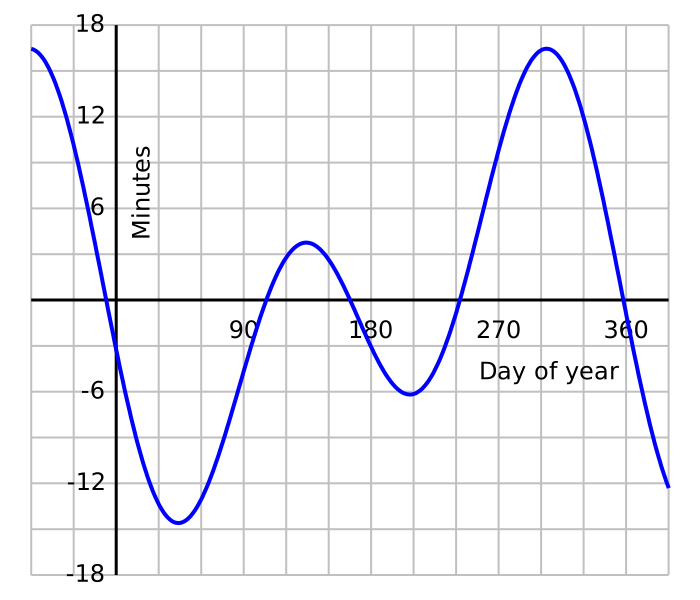
The difference between local mean time and local apparent time is the equation of time.
Past use
Local solar time or sundial time was used until the early 19th century when accurate mechanical clocks became commonplace. Local mean time continued in use until various countries adopted a national standard time. Each town or city kept its own meridian, so locations one degree of longitude apart had times four minutes apart. This became a problem in the mid 19th century when railways needed clocks for railway time that were synchronized between stations, while local people needed to match their clock (or the church clock) to the time tables. Standard time means that the same time is used throughout some regional time zone—usually, it is at an offset from Greenwich Mean Time or the local mean time of the capital of the region.
References
de:Mittlere Ortszeit
References
- (2013). "Explanatory Supplement to the Astronomical Almanac". University Science Books.
- Finch, Vernor C.. (1943). "Elementary Meteorology". McGraw-Hill Book Company, Inc..
This article was imported from Wikipedia and is available under the Creative Commons Attribution-ShareAlike 4.0 License. Content has been adapted to SurfDoc format. Original contributors can be found on the article history page.
Ask Mako anything about Local mean time — get instant answers, deeper analysis, and related topics.
Research with MakoFree with your Surf account
Create a free account to save articles, ask Mako questions, and organize your research.
Sign up freeThis content may have been generated or modified by AI. CloudSurf Software LLC is not responsible for the accuracy, completeness, or reliability of AI-generated content. Always verify important information from primary sources.
Report