From Surf Wiki (app.surf) — the open knowledge base
Loam
Soil composed of similar proportions of sand and silt, and somewhat less clay

Soil composed of similar proportions of sand and silt, and somewhat less clay
Loam (in geology and soil science) is soil composed mostly of sand (particle size 63 µm), silt (particle size 2 µm), and a smaller amount of clay (particle size
In the United States Department of Agriculture, textural classification triangle, the only soil that is not predominantly sand, silt, or clay is called "loam". Loam soils generally contain more nutrients, moisture, and humus than sandy soils, have better drainage and infiltration of water and air than silt- and clay-rich soils, and are easier to till than clay soils. In fact, the primary definition of loam in most dictionaries is soils containing humus (organic content) with no mention of particle size or texture, and this definition is used by many gardeners. The different types of loam soils each have slightly different characteristics, with some draining liquids more efficiently than others. The soil's texture, especially its ability to retain nutrients and water, are crucial. Loam soil is suitable for growing most plant varieties.
Bricks made of loam, mud, sand, and water, with an added binding material such as rice husks or straw, have been used in construction since ancient times.
Classifications
Loam soils can be classified into more specific subtypes. Some examples are sandy loam, silt loam, clay loam, and silty clay loam. Different soil phases have some variation in characteristics like stoniness and erosion that are too minor to affect native vegetative growth but can be significant for crop cultivation.
Use in farming
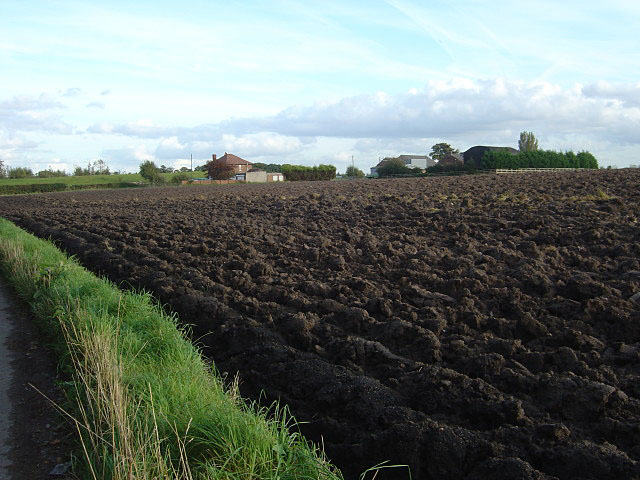
Loam is considered ideal for gardening and agricultural uses because it retains nutrients well and retains water while still allowing excess water to drain away. A soil dominated by one or two of the three particle size groups can behave like loam if it has a strong granular structure, promoted by a high content of organic matter. However, a soil that meets the textural (geological) definition of loam can lose its characteristic desirable qualities when it is compacted, depleted of organic matter, or has clay dispersed throughout its fine-earth fraction.
For example, pea can be cultivated in sandy loam and clay loam soils, but not more compacted sandy soils.
Use in house construction
Main article: Earth structure
Loam is traditionally widely used for the construction of houses, for example in loam post and beam construction. Other techniques are e.g. rammed earth or adobe (unfired loam bricks). Loam is well known for its capalibity to control air humidty. In countries with a high temperature like Morocco, thick walls built with loam help to keep the houses cool.
File:Michelau Fachwerkdetail.JPG|Loam with timber framing (Michelau in Oberfranken, Germany, 2007) File:000410 Lehmhütte in der Nähe von Baligród.JPG|House with loam ground floor (Baligród, Poland, 2012) File:Biesenthal eldest house from 1707 (1).jpg|Loam-timber-framed 1707 house, under restoration (Biesenthal, Germany, 2006) File:Djenné Moschee.jpg|Great Mosque of Djenné (Mali, 2004)
References
References
- Kaufmann, Robert K.. (2008). "Environmental Science". McGraw-Hill.
- R. B. Brown. (September 2007). "Soil Texture". [[Cornell University]], Department of Crop and Soil Sciences.
- [[United States Department of Agriculture]] Soil Survey, 1943
- B. Rosie Lerner, "[https://www.purdue.edu/hla/sites/yardandgarden/what-is-loam/ What is Loam?]", [[Purdue University]] Consumer Horticulture, 6 January 2000. Retrieved 5 March 2017.
- "Field Pea: Agronomy".
- Schittich (Ed), Christian Schittich. (2001). "Building Simply". Birkhäuser Architecture.
- ejpwallin. (2016-09-19). "Keeping cool: the use of evaporative cooling in vernacular Moroccan architecture.".
This article was imported from Wikipedia and is available under the Creative Commons Attribution-ShareAlike 4.0 License. Content has been adapted to SurfDoc format. Original contributors can be found on the article history page.
Ask Mako anything about Loam — get instant answers, deeper analysis, and related topics.
Research with MakoFree with your Surf account
Create a free account to save articles, ask Mako questions, and organize your research.
Sign up freeThis content may have been generated or modified by AI. CloudSurf Software LLC is not responsible for the accuracy, completeness, or reliability of AI-generated content. Always verify important information from primary sources.
Report