From Surf Wiki (app.surf) — the open knowledge base
Llandudno Pier
Pier in Conwy County Borough, Wales

Pier in Conwy County Borough, Wales
| Field | Value |
|---|---|
| name | Llandudno Pier |
| image | LlandudnoPier-P6140188.JPG |
| official_name | Llandudno Pier |
| type | Pleasure Pier |
| designer | James Brunlees |
| constructor | Walter Macfarlane of Glasgow |
| length | 2295ft (700m) |
| locale | Llandudno, Wales |
| owner | Tir Prince Leisure Group |
| open | 1 August 1877 |
| listed | 24 March 1969 (Grade II*) |
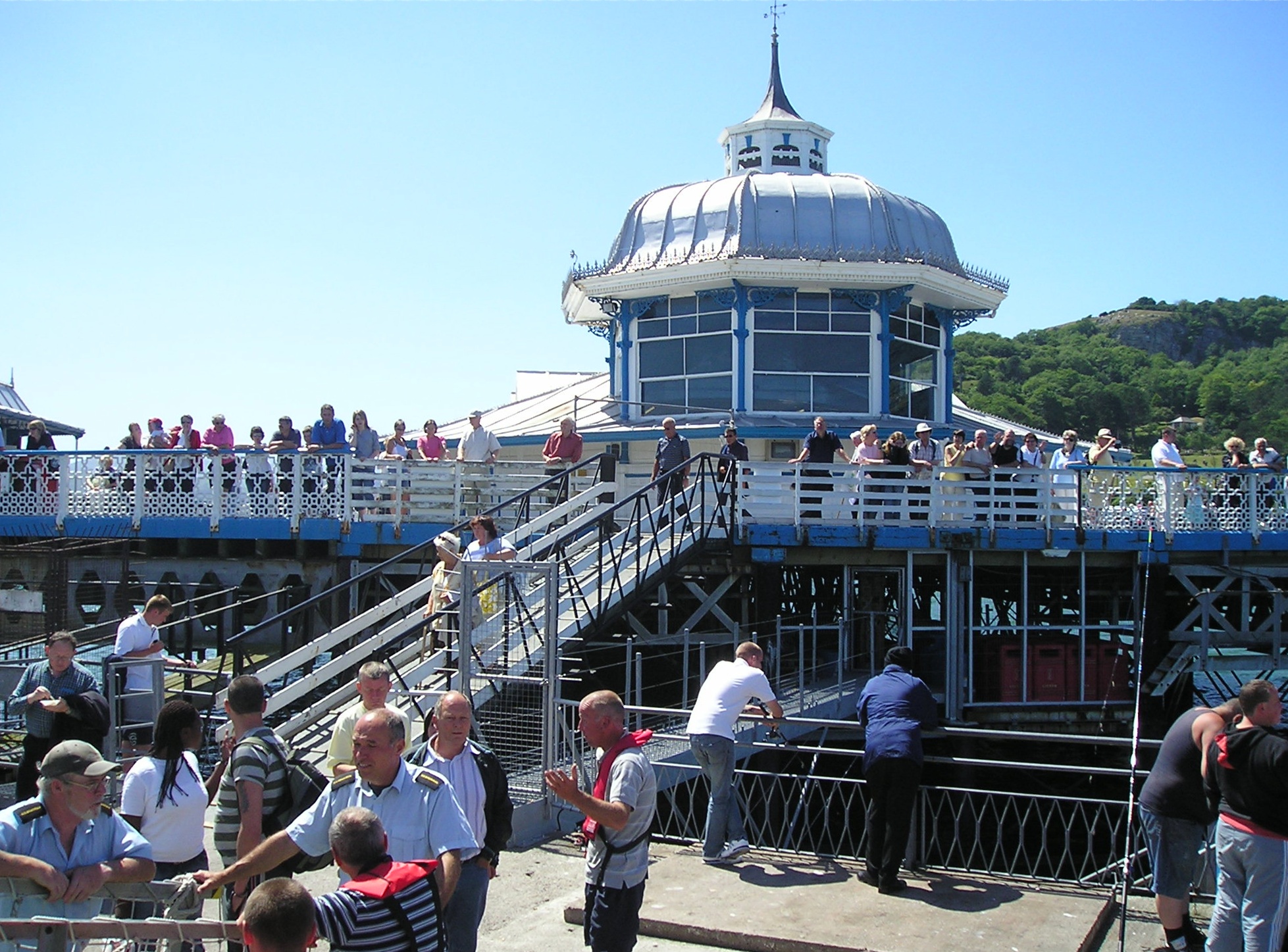
Llandudno Pier is a Grade II* listed pier in the seaside resort of Llandudno, North Wales. At 2,295 ft, the pier is the longest in Wales and the fifth longest in England and Wales. In 2005 and 2025, it was voted "Pier of the Year" by the members of the National Piers Society.
At the end of the pier is a deep-water landing stage, completely rebuilt for the third time in 1969, which is used by the Isle of Man Steam Packet Company for occasional excursions to Douglas, Isle of Man, and for an annual visit of the PS Waverley or the MV Balmoral preserved steamers.
History
Early wooden pier
The pier had its origins in a much shorter pier of just 242 ft built on 16 wooden piles, opened in 1858 by the St George's Harbour and Railway Company, which had just completed its branch line from Llandudno to Conwy via a junction with the Chester and Holyhead Railway near the present Llandudno Junction railway station to which the branch was soon diverted. That short pier was built to protect the rights of its owners to a much more ambitious scheme to build a major port in Llandudno Bay. The pier was severely damaged in the Royal Charter Storm of 25 October 1859, which caused the loss of 223 ships and 800 people in British coastal waters. Although repaired and used for a further 16 years, the pier was too short and could only be used by steam ships at high tide.
Construction

The pier was rebuilt through the efforts of the Llandudno Pier Company Limited (registered on 11 November 1875 by the firm Corser, Fowler, and Perks of 147 Leadenhall Street, London). This companys prospectus (offering 30,000 shares at ten pounds each) was published in early December 1875. The notice of application for a provisional order to authorize the project was published in *The London Gazette* of 23 November 1875 (pp. 5773-5774). The "principal mover" in this company was George Perks (1824-1892) of Perry Barr, Staffordshire. George was assisted by his cousins son Robert William Perks (1849-1934) who was the company's solicitor. it was R.W. Perks who did most of the speaking at the Company`s first meeting of shareholders held in March 1876.
The pier was unusual in having two entrances, one on the promenade at North Parade and the other, the original entrance, on Happy Valley Road (Which is no longer used and is locked permanently). Between the two entrances is the Grand Hotel.
It was designed by civil engineers Sir James William Brunlees (1816–92, knighted 1886) and Alexander McKerrow (1837–1920) and built by the contractor John Dixon for the Llandudno Pier Company. After the original designs were approved in the Llandudno Pier Order 1876 on 29 May 1876 by Parliament passing the Pier and Harbour Orders Confirmation Act 1876 (39 & 40 Vict. c. xl), the town's Improvement Commissioners and the Mostyn Estate, revised designs for the ornamental ironwork and elaborate kiosks were worked on by the architects Charles Henry Driver (1832–1900) and Charles H. Rew for Brunlees and McKerrow, in close collaboration with the Glasgow Elmbank foundry.
The new pier was reported to have cost around £30,000 () to construct. The first pile was driven by Lord Arthur Hill-Trevor on 16 September 1876, initiating the start of a 10-month construction period. By this time, 110 ft of pier had already been completed.
Opening
The pier was opened to the public on 1 August 1877 by director Dr Nicol. Although not completely finished by this time, the pier directors considered it was sufficiently complete to allow public access. According to the North Wales Chronicle, upon opening, "a throng of visitors flocked upon it and it presented quite a lively appearance". The first steamboat to land passengers on the new pier was the Prince Authur, which arrived in Llandudno at the start of May 1878.
Operation
The pier sustained its first damage during a heavy storm in November 1878, when the landing stage under the pier sustained light damage. The landward extension to the same design, still in deep water and also supported on iron columns, was approved by the Llandudno Pier Order 1880 and opened in 1884; a new landing stage was added in 1891.
Towards the end of 1907, the owners announced intentions through an application to the Board of Trade to widen the pier, extend it by sea dredging and to construct pavilions and a tramway; these were approved in the Llandudno Pier Order 1908 By 1908, the pier would often be overcrowded during the summer season, causing inconvenience to passengers boarding and alighting from steamboats.
By the start of 1910, the pier was very profitable, allowing the directors to carry out extensive improvements to the pier at a cost of £10,000 (), which included widening most of the pier. Reports suggested that neighbouring towns were envious of the success of the pier and the revenue it was bringing to Llandudno. Concerts in the pier's pavilion were very popular and profitable, with an average surplus of approximately £25 () reported in November 1910, despite expenses of around £620 () which included financing a music festival.
20th century
In 1969, the landing stage was totally rebuilt in concrete and steel, which enabled its use by the largest Isle of Man steamers then in use. By 1972, the pier was well known for day trips by ferry to the Isle of Man, although at this time could itself boast pavilion concerts, vintage car rides and various amusements. The wooden decking has been extensively renewed in recent years, and the superstructure is maintained systematically.
In March 2015, the pier was put up for sale by then owners Cuerden Leisure, who reported that there was "strong interest" from investors in the £4.5m pier. It was one of three piers being sold by the company, the others being Central Pier, Blackpool and South Pier, Blackpool, although Llandudno Pier was attracting the strongest interest. The pier was purchased in May 2015 by leisure entrepreneur Adam Williams for the £4.5m asking price and his company Tir Prince Leisure Group, after having attracted a large amount of interest.
21st century
The June 2007 sailings of the MV Balmoral were rescheduled to start at Menai Bridge Pier, after it emerged that Llandudno Pier's landing stage was no longer safe to use. The landing stage was rebuilt in 2012 and the MV Balmoral called there, the first ship since 2006, on 2 July 2015. In the present day the landing stage is no longer used for steamers but has its use as a platform for anglers to fish off the end of the pier and is not accessible to the general public.
The pier suffered heavy damage as a result of Storm Darragh.
The Pier Pavilion
Main article: Llandudno Pier Pavilion Theatre
Until the Second World War, the public were charged admission to access the pier. Admission allowed the promenaders access to musical entertainment from a bandstand at the pierhead. A small orchestra was established in 1877. The notable French musician Jules Rivière was appointed to take charge of the orchestra in 1887.
The orchestral performances moved to the Pier Pavilion, built on land adjacent to the main entrance from the promenade, which opened in September 1886. Rivière's Orchestra at the Llandudno Pier Pavilion trebled in size to symphony proportions. The young Henry Wood came to Llandudno to observe the then elderly Rivière at work. The pavilion was destroyed by fire in 1994 and not rebuilt.
Cultural references
Llandudno Pier is known to be chosen for Victorian and Edwardian seaside filming locations, such as the 2002 TV production of The Forsyte Saga. It also featured on a 2013 advert for Volkswagen. It is the setting of an episode in Arnold Bennett's 1911 comic novel The Card.
Awards
- 2005 — National Piers Society — Pier of the Year
- 2025 — National Piers Society — Pier of the Year
References
Citations
Sources
References
- "The Pier, including Stone Lodge, Pier End Pavilions, Kiosks and remains of Pier Pavilion". British Listed Buildings.
- "Llandudno Pier, Engineering Timelines". Engineering Timelines.
- "Victorian Llandudno Pier". Visit Llandudno.
- The North Wales Chronicle, 11 December 1875, page 8, col. 5.
- The North Wales Chronicle, 10 July 1875, page 5, columns 4-5
- The North Wales Chronicle, 11 March 1876, page 7, col. 4.
- "Obituary". The Builder.
- Dobraszczyk, P.. (2014). "Iron, Ornament and Architecture in Victorian Britain: Myth and Modernity, Excess and Enchantment". Routledge.
- (16 September 1876). "New Promenade Pier for Llandudno". Aberystwith Observer.
- (22 September 1876). "Inauguration of the Promenade Pier". Llangollen Advertiser Denbighshire Merionethshire and North Wales Journal.
- (11 August 1877). "The opening of the new Llandudno Pier". North Wales Chronicle and Advertiser for the Principality.
- (3 May 1878). "First Landing on the new pier". North Wales Express.
- (1 November 1878). "The Recent Storms". North Wales Express.
- (22 November 1907). "Llandudno Pier: Application to Parliament". Weekly News and Visitors' Chronicle.
- (12 March 1908). "Llandudno Pier: Board of Trade and the new works". Welsh Coast Pioneer and Review for North Cambria.
- (27 January 1910). "Llandudno Pier Company in profit". Welsh Coast Pioneer and Review for North Cambria.
- (5 November 1910). "The Autumn Concerts". Rhyl Journal.
- (24 June 1972). "Llandudno Pier has many attractions". Liverpool Echo.
- Chris Pyke. (17 March 2015). "Llandudno pier attracting 'strong interest' from interest from investors ahead of £4.5m sale". Wales Online.
- Denholm-Hall, Rupert. (6 May 2015). "Llandudno Pier sold for £4.5m in a deal which will ensure visitors will enjoy the attraction for years to come". Wales Online.
- (6 May 2015). "Llandudno Pier acquired by TIR Prince". TIR Prince Leisure Group.
- Slater, Chris. (2024-12-07). "Boss of Llandudno Pier fears 'it will take a miracle' to survive Storm Darragh".
- (n.d.). "Pier Improvement Works". Llandudno Pier.
- (24 February 2016). "What you didn't know about Britain's quirkiest piers". The Telegraph.
This article was imported from Wikipedia and is available under the Creative Commons Attribution-ShareAlike 4.0 License. Content has been adapted to SurfDoc format. Original contributors can be found on the article history page.
Ask Mako anything about Llandudno Pier — get instant answers, deeper analysis, and related topics.
Research with MakoFree with your Surf account
Create a free account to save articles, ask Mako questions, and organize your research.
Sign up freeThis content may have been generated or modified by AI. CloudSurf Software LLC is not responsible for the accuracy, completeness, or reliability of AI-generated content. Always verify important information from primary sources.
Report