From Surf Wiki (app.surf) — the open knowledge base
Liverpool Blitz
German bombing of British port city during WWII

German bombing of British port city during WWII
| Field | Value |
|---|---|
| conflict | Liverpool Blitz |
| partof | the Strategic bombing campaign of World War II |
| image | Memorial_to_the_Heroes_of_the_Engine_Room-_stokers.jpg |
| caption | Bomb damage visible on the Memorial to Heroes of the Marine Engine Room (photographed 2018) |
| date | 1940–1942 |
| place | Liverpool |
| result | Liverpool heavily damaged by German air raids |
| combatant1 | Nazi Germany |
| combatant2 | United Kingdom |
| casualties1 | Unknown |
| casualties2 | 4,000 |
The Liverpool Blitz was the heavy and sustained bombing of the British city of Liverpool and its surrounding area, during the Second World War by the German Luftwaffe.
Liverpool was the most heavily bombed area of the country outside London, due to the city having, along with Birkenhead, the largest port on the west coast and being of significant importance to the British war effort. Descriptions of damage were kept vague to hide information from the Germans, and downplayed in the newspapers for propaganda purposes;{{cite journal |access-date=12 June 2020 |archive-date=20 February 2019 |archive-url=https://web.archive.org/web/20190220003352/https://core.ac.uk/download/pdf/42477391.pdf |url-status=live
Liverpool, Bootle and the Wallasey Pool complex were strategically very important locations during the Second World War. The Port of Liverpool had for many years been the United Kingdom's main link with North America, and proved to be a key part in the British participation in the Battle of the Atlantic. As well as providing anchorage for naval ships from many nations, the port's quays and dockers handled over 90 per cent of all the war material brought into Britain from abroad with some 75 million tons passing through its 11 mi of quays. Liverpool was the eastern end of a Transatlantic chain of supplies from North America. Other industries were also heavily concentrated in Liverpool and across the Mersey in Birkenhead.
.jpg)
Preparations for war
The evacuation of children (Operation Pied Piper) at the start of the war, in September 1939, was a pre-emptive measure to save the population of urban or military areas from German aerial bombing. Between 1–6 September the evacuations, organised by Liverpool Corporation, saw 8,500 children, parents and teachers moved from the city to rural areas and small towns in Lancashire, Wales, Cheshire, Shrewsbury and Shropshire.
As months went by with no signs of an air-raid by the Luftwaffe, many parents brought their children back to Liverpool and, by January 1940, 40% of the evacuated children were back in the city.
Beginning of the Blitz
The first major air raid on Liverpool took place in August 1940, when 160 bombers attacked the city on the night of 28 August.
This assault continued over the next three nights, then regularly for the rest of the year. There were 50 raids on the city during this three-month period. Some of these were minor, comprising a few aircraft, and lasting a few minutes, with others comprising up to 300 aircraft and lasting over ten hours. On 18 September, 22 inmates at Walton Gaol were killed when high-explosive bombs demolished a wing of the prison.
28 November saw a heavy raid on the city, and the most serious single incident, when a hit on an air-raid shelter in Durning Road caused 166 fatalities. Winston Churchill described it as the "single worst incident of the war".
The air assault in 1940 came to a peak with the Christmas Blitz, a three-night bombardment from 20–22 December.
Christmas Blitz
A series of heavy raids took place in December 1940, referred to as the Christmas Blitz, when 365 people were killed between 20–22 December. The raids saw several instances of direct hits on air raid shelters; on 20 December, 42 people died when a shelter was hit, while another 40 died when a bomb struck railway arches on Bentinck Street, where local people were sheltering. On 21 December, another hit on a shelter which killed 74 people.
In her memoir Lime Street at Two, Helen Forrester described trying to get home from her job at Bootle during the Christmas Blitz:

The bombing decreased in severity after the new year.
May Blitz
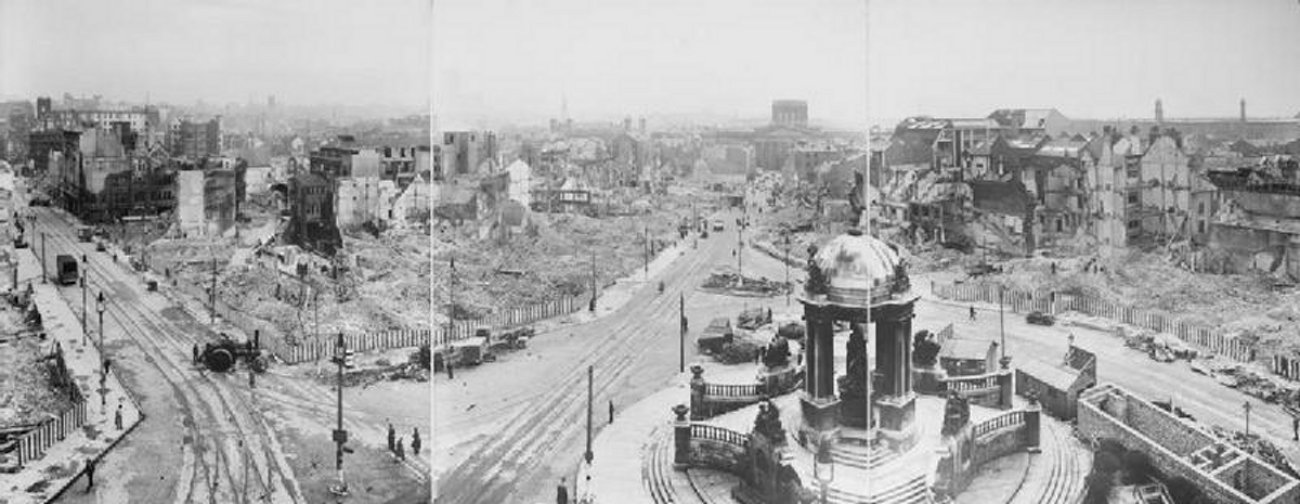
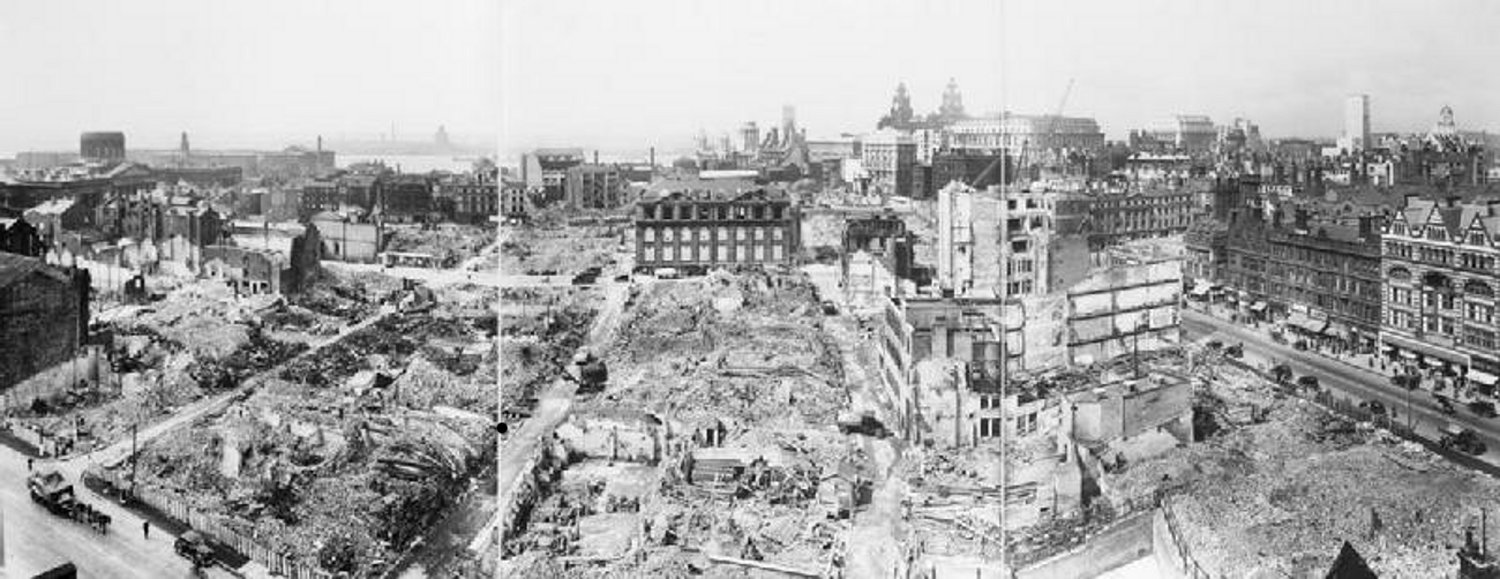
May 1941 saw a renewal of the air assault on the region; a seven-night bombardment that devastated the city. The first bomb landed upon Seacombe, Wallasey, Wirral, at 22:15 on 1 May. The peak of the bombing occurred from 1–7 May 1941. It involved 681 Luftwaffe bombers; 2,315 high explosive bombs and 119 other explosives such as incendiaries were dropped. The raids put 69 out of 144 cargo berths out of action and inflicted 2,895 casualties.
Liverpool Cathedral was hit by a high explosive bomb which pierced the roof of the south-east transept before being deflected by an inner brick wall and exploding mid-air, damaging many stained glass windows. Another landed on the front steps without exploding but incendiaries destroyed equipment in the contractor's yard at the west end.
One incident on 3 May involved the , a ship carrying munitions which was berthed in the Huskisson Dock. Although its eventual explosion is often attributed to a burning barrage balloon, this fire was put out. However flames from dock sheds that had been bombed spread to the Malakand, and this fire could not be contained. Despite valiant efforts by the fire brigade to extinguish the flames, they spread to the ship's cargo of 1,000 tons of bombs, which exploded a few hours after the raid had ended. The entire Huskisson No. 2 dock and the surrounding quays were destroyed and four people were killed. The explosion was so violent that some pieces of the ship's hull plating were blasted into a park over 1 mi away. It took seventy-four hours for the fire to burn out.
The seven night bombardment resulted in over 6,500 homes being completely demolished by aerial bombing and a further 190,000 damaged leaving 70,000 people homeless. 500 roads were closed to traffic as well as railways and tram lines being destroyed. 700 water mains and 80 sewers were damaged alongside gas, electricity and telephone services. 9,000 workers from outside the city and 2,700 troops helped to remove debris from streets. On the night of the 3rd and 4th of May alone, 400 fires were attended to by the fire brigade.
Bootle, to the north of the city, suffered heavy damage and loss of life. One notable incident here was a direct hit on a Co-op air raid shelter on the corner of Ash Street and Stanley Road. The exact total of casualties is unclear, though dozens of bodies were recovered and placed in a temporary mortuary which itself was later destroyed by incendiaries with over 180 corpses inside.
The Times on 5 May 1941 carried the following report: "The Germans stated that Saturday night's attack on Liverpool was one of the heaviest ever made by their air force on Britain. Several hundred bombers had been used, visibility was good and docks and industrial works, storehouses and business centres, had been hit. In addition to many smaller fires, one conflagration, it was claimed, was greater than any hitherto observed during a night attack."

End of the Blitz
After the raids in May 1941, the German air assault diminished, as Hitler's attention turned towards attacking the Soviet Union. The last German air raid on Liverpool took place on 10 January 1942, destroying several houses on Upper Stanhope Street. By a quirk of fate one of the houses destroyed was number 102, which had been the home of Alois Hitler, Jr, half brother of Adolf Hitler and the birthplace of Hitler's nephew, William Patrick Hitler. The house was never rebuilt and the whole site was eventually cleared of housing and grassed over.

By the end German bombs had killed 2,716 people in Liverpool, 442 people in Birkenhead, 409 people in Bootle and 332 people in Wallasey.
Aftermath

Today one of the most vivid symbols of the Liverpool Blitz is the burnt outer shell of St Luke's Church, located in the city centre, which was destroyed by an incendiary bomb on 5 May 1941. The church was gutted during the firebombing but remained standing and, in its prominent position in the city, was a stark reminder of what Liverpool and the surrounding area had endured. It eventually became a garden of remembrance to commemorate the thousands of local men, women and children who died as a result of the bombing of their city and region.
Other architectural casualties of the Blitz included the Custom House, Bluecoat Chambers, and Liverpool Museum. However, many buildings were restored after the War, while the Custom House was controversially demolished.
British Prime Minister Winston Churchill in May 1941 said after visiting Liverpool and the surrounding area, "I see the damage done by the enemy attacks, but I also see ... the spirit of an unconquered people."
Notable victims
- Mary Lawson, film and stage actress{{cite news
- Francis William Beaumont, her husband; heir to the Seigneur of Sark and an RAF officer
References
Notes
Citations
References
- "CITiZAN - Blogs - Raiders over the River Mersey".
- "Spirit of the Blitz - Merseyside Maritime Museum, Liverpool museums".
- "Coming danger - Merseyside Maritime Museum, Liverpool museums".
- Whittington-Egan, Richard. (1987). "The Great Liverpool Blitz". The Gallery Press, Liverpool Dossier Series.
- Waddington, Marc. (25 November 2010). "70th anniversary of Durning Road bomb disaster that claimed 166 Liverpool lives". [[Liverpool Echo]].
- "Studenten Karriere Portal Ausbildung | NWLG-BLOG |".
- "CITiZAN - Blogs - Blitz defence at Formby".
- "CITiZAN - Blogs - The scars of war".
- (2011-04-30). "Liverpool May Blitz remembered with parade and ceremony". Liverpool Echo.
- link. (15 June 2008)
- "E. Chambré Hardman Archive".
- "The Liverpool Blitz".
- "May Blitz - Merseyside Maritime Museum, Liverpool museums".
- [http://www.liverpoolmuseums.org.uk/nof/blitz/0500_info.html The Liverpool Blitz at liverpool museums] {{webarchive. link. (29 September 2007)
- "Bombing of the Co-op Shelter, Bootle". LIVERPOOL BLITZ 70.
- "The Scouse Hitler".
- "E. Chambré Hardman Archive".
- [http://www.liverpoolmuseums.org.uk/maritime/exhibitions/blitz/may.asp The May Blitz at liverpool museums] {{webarchive. link. (25 September 2005)
This article was imported from Wikipedia and is available under the Creative Commons Attribution-ShareAlike 4.0 License. Content has been adapted to SurfDoc format. Original contributors can be found on the article history page.
Ask Mako anything about Liverpool Blitz — get instant answers, deeper analysis, and related topics.
Research with MakoFree with your Surf account
Create a free account to save articles, ask Mako questions, and organize your research.
Sign up freeThis content may have been generated or modified by AI. CloudSurf Software LLC is not responsible for the accuracy, completeness, or reliability of AI-generated content. Always verify important information from primary sources.
Report