From Surf Wiki (app.surf) — the open knowledge base
Little finger
Smallest finger of the human hand
Smallest finger of the human hand
| Field | Value |
|---|---|
| Name | Little finger |
| Latin | digitus minimus manus, |
| digitus quintus manus, | |
| digitus V manus | |
| Image | File:Little finger.jpg |
| Width | 200 |
| Caption | Human little finger |
| Artery | Proper palmar digital arteries, |
| dorsal digital arteries | |
| Vein | Palmar digital veins, |
| dorsal digital veins | |
| Nerve | Dorsal digital nerves of ulnar nerve |
| Lymph | Supratrochlear |
digitus quintus manus, digitus V manus dorsal digital arteries dorsal digital veins The little finger or pinkie, also known as the baby finger, fifth digit, or pinky finger, is the most ulnar and smallest digit of the human hand, and next to the ring finger.
Etymology of "pinky"
The word "pinky" is derived from the Dutch word pink, meaning "little finger".
The earliest recorded use of the term "pinkie" is from Scotland in 1808. The term (sometimes spelled "pinky") is common in Scottish English and American English, and is also used extensively in other Commonwealth countries such as New Zealand, Canada, and Australia.
Nerves and muscles
There are nine muscles that control the fifth digit: Three in the hypothenar eminence, two extrinsic flexors, two extrinsic extensors, and two more intrinsic muscles:
- Hypothenar eminence:
- Opponens digiti minimi muscle
- Abductor minimi digiti muscle (adduction from third palmar interossei)
- Flexor digiti minimi brevis (the "longus" is absent in most humans)
- Two extrinsic flexors:
- Flexor digitorum superficialis
- Flexor digitorum profundus
- Two extrinsic extensors:
- Extensor digiti minimi muscle
- Extensor digitorum
- Two intrinsic hand muscles:
- Fourth lumbrical muscle
- Third palmar interosseous muscle Note: the dorsal interossei of the hand muscles do not have an attachment to the fifth digit
Cultural significance
Gestures
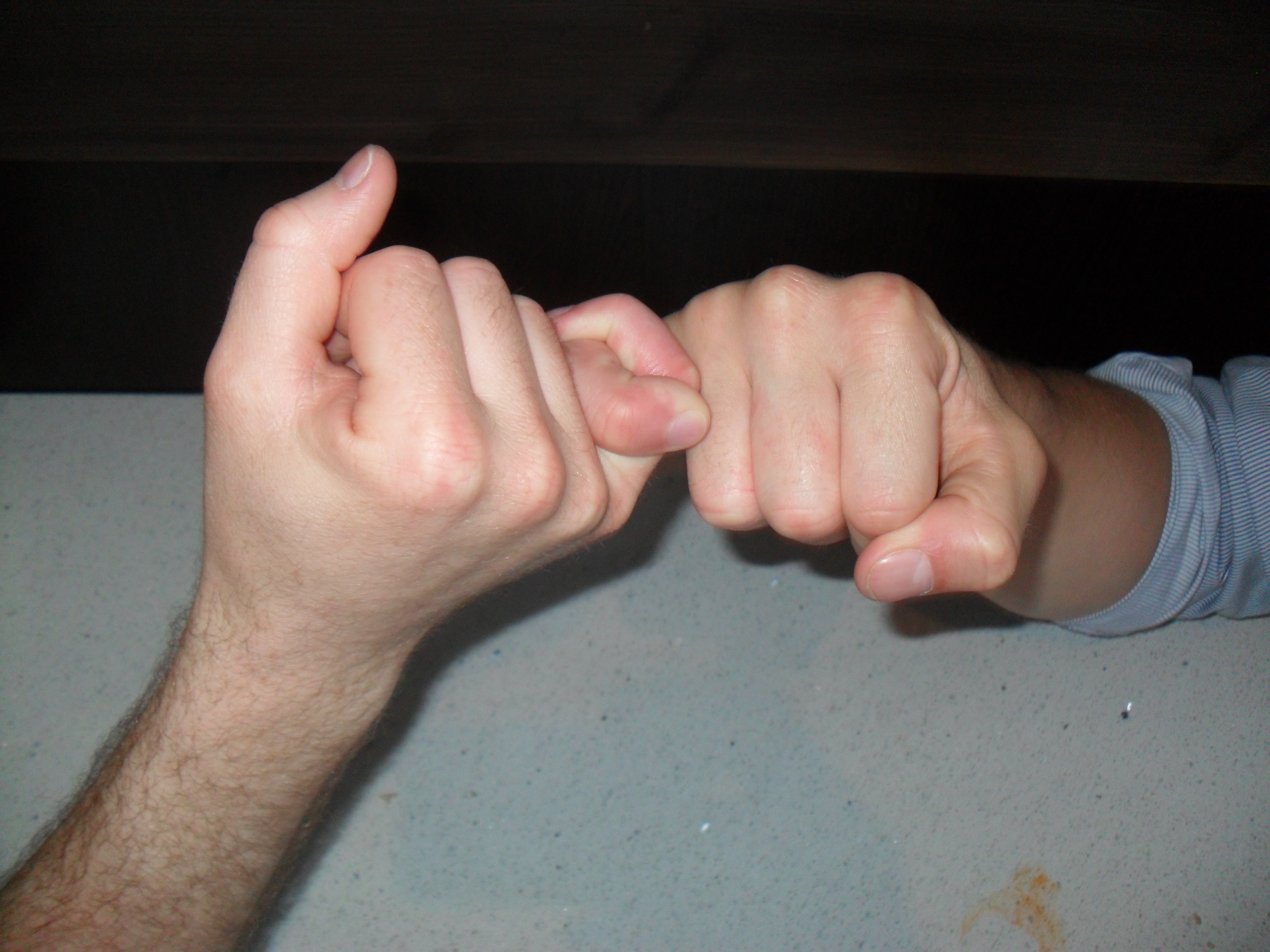
Among American children, a "pinky swear" or "pinky promise" is made when a person wraps one of their pinky fingers around another person's pinky and makes a promise. Something similar is also seen in China and Korea, where people link their pinky fingers and then stamp their thumbs together to make a yaksok (promise).
Other gestures where the little finger is extended include the shaka sign and sign of the horns.
Among members of the Japanese yakuza (gangsters), the penalty for various offenses is removal of parts of the little finger (known as yubitsume).
It is a common joke that one should extend their little finger when drinking from a teacup in imitation of a passé upper-class tradition. This practice is generally deprecated by etiquette guides as a sign of snobbery amongst the socially inferior, with various cultural theories as to the origin of the practice including the idea that finger food should be eaten with only the first three digits.
Rings

The signet ring is traditionally worn on the little finger of a gentleman's left hand, a practice still common especially in the United Kingdom, Australia, and European cultures. A signet ring is considered part of the regalia of many European monarchies, and also of the Pope, with the ring always worn on the left little finger. In modern times the location of the signet ring has relaxed, with examples worn on various different digits, although little fingers still tend to be the most usual.
The Iron Ring is a symbolic ring worn by most Canadian engineers. The Ring is a symbol of both pride and humility for the engineering profession, and is always worn on the little finger of the dominant hand. In the United States, the Engineer's Ring is a stainless steel ring worn on the fifth digit of the working hand by engineers who belong to the Order of the Engineer and have accepted the Obligation of an Engineer.
Utility
The little finger is often used as a support when smartphone users type one-handed. The little finger is positioned underneath the phone, allowing it to be propped with the three middle fingers, and the user to type with their thumb.
Some users reported dents on their little finger and pain in the hand after prolonged use in this way, doctors referred to this as "iPhone pinky" or "smartphone pinky". The skin indentations were reported to be nothing of alarm, as they disappeared on their own after a short while without cell phone use.
References
References
- "Pinkie". World Wide Words.
- (May 2008). "Scots word of the season: pinkie". Association for Scottish Literary Studies.
- "Little Finger". Cambridge English Dictionary.
- (21 January 2016). "Has your smartphone given you 'smartphone pinky'?".
- (15 February 2018). "Woman cuts off finger, names it 'Wiggles' and wears it as pendant necklace".
- Roud, Steve. [https://books.google.com/books?id=HY9I1e21AJcC&dq=%22pinky+promise%22+finger&pg=PA371 The Lore of the Playground]. Random House. 2010.
- Hill, Peter B. E.: "The Japanese Mafia: Yakuza, law, and the state", p. 75. [[Oxford University Press. Oxford Univ. Press]], 2003
- "Tea Etiquette". Tea Laden.
- "Etiquette and History of Afternoon Tea". An Afternoon to Remember.
- (2014-11-21). "Raised pinky fingers, scone slicing and other tea faux pas".
- "Engineer's Ring".
- "Obligation".
- Schlitz, Heather. (Nov 6, 2021). "People are sharing pictures of their dented 'smartphone pinky' after holding their phones, so asked doctors what the deal is".
- (Oct 29, 2021). "How to avoid 'smartphone pinkie' and other pains and problems from being glued to your phone". Washington Post.
This article was imported from Wikipedia and is available under the Creative Commons Attribution-ShareAlike 4.0 License. Content has been adapted to SurfDoc format. Original contributors can be found on the article history page.
Ask Mako anything about Little finger — get instant answers, deeper analysis, and related topics.
Research with MakoFree with your Surf account
Create a free account to save articles, ask Mako questions, and organize your research.
Sign up freeThis content may have been generated or modified by AI. CloudSurf Software LLC is not responsible for the accuracy, completeness, or reliability of AI-generated content. Always verify important information from primary sources.
Report