From Surf Wiki (app.surf) — the open knowledge base
List of St. Louis Cardinals owners and executives
None
None
The St. Louis Cardinals, a professional baseball franchise based in St. Louis, Missouri, compete in the National League (NL) of Major League Baseball (MLB).
Owners, transactions and valuation
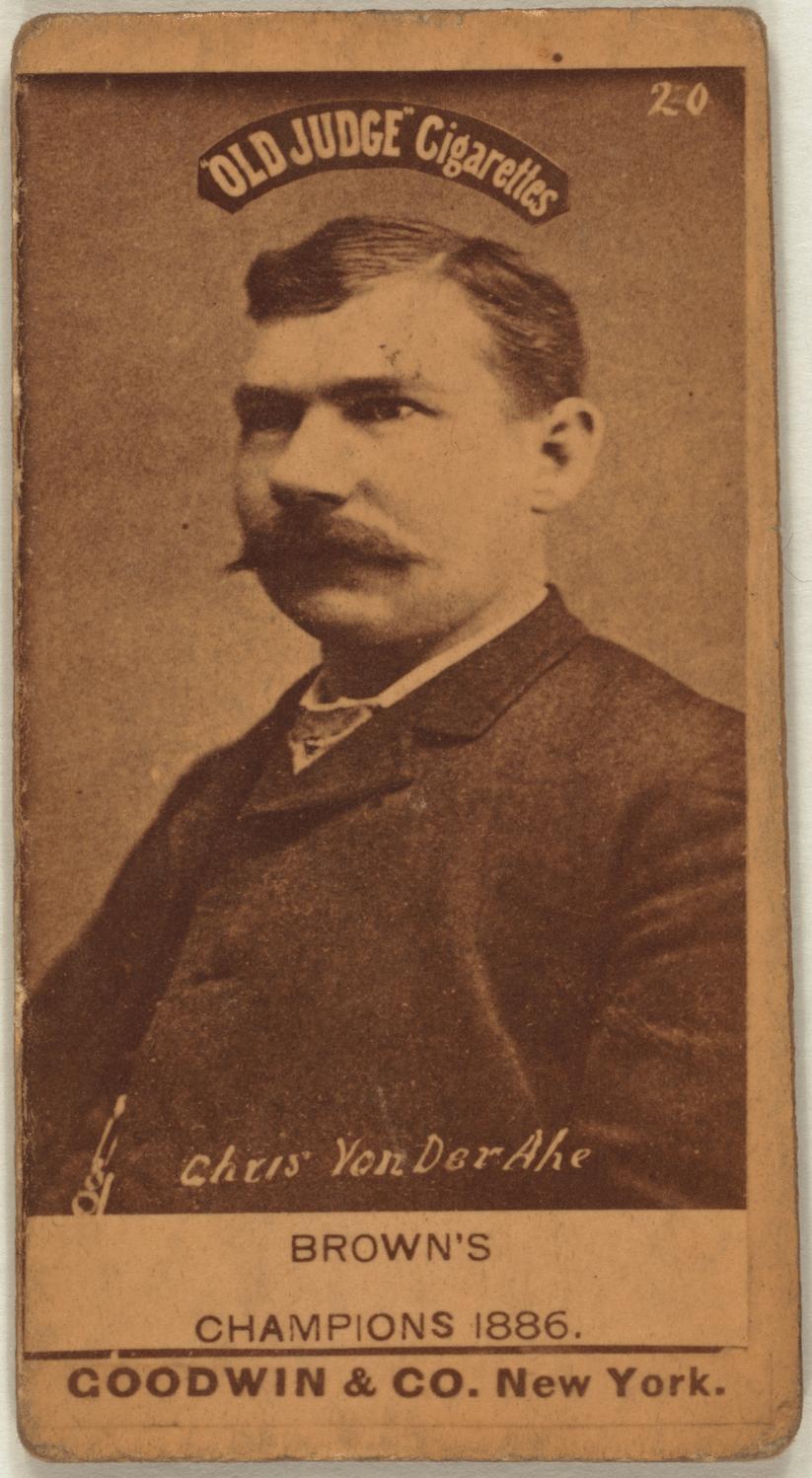
Chris von der Ahe (1882–1898)
In 1882, the St. Louis Brown Stockings were purchased by Chris von der Ahe, a German immigrant who became a grocer and saloon owner. He had no background in baseball but saw moneymaking potential in the sport. After the Browns profited $25,000 from playing a season's worth of informal contests, Von der Ahe bought out the team's remaining stockholders for $1,800. In 1882, Von der Ahe joined other owners to form the American Association of Base Ball Clubs.
Von der Ahe was a flamboyant and magnanimous entrepreneur who gained enormous popularity in St. Louis. He was willing to charge lower admission rates, encouraged play on Sundays, and sold beer at the stadium, a practice that the National League prohibited at the time. But he was reviled by owners,such Albert Spalding, who bristled at promotional techniques that are today common. Charlie O. Finley, Larry MacPhail, and Bill Veeck eventually employed sideshow attractions such as the "stadium club" and the shoot-the-chute.
Von der Ahe was one of the few owners to make a profit during his time. The American Association eventually collapsed due to bankruptcy. In 1899, Von der Ahe himself was forced to sell the Browns due to bankruptcy.
Sam Breadon (1920–1947)
Automobile dealer Sam Breadon purchased a minority stake in the Cardinals in 1917 for $2,000. Three years later, Breadon bought the majority stake in the club. He extinguished the futility that surrounded the Cardinals' first three decades in the National League: between 1926 and 1946, the Cardinals won six World Series titles and nine National League pennants. Between 1920 and 1947, the Cardinals compiled a record of 2,470-1,830, a winning percentage of .574.
Breadon was conservative with his finances, highly demanding of his teams' success on the field, and a maker of bold moves. When he became minority owner, the Cardinals were $150,000 in debt. In 1925, he moved Branch Rickey from the dugout to the front office and promoted second baseman Rogers Hornsby to player-manager. Breadon convinced cross-town American League rival St. Louis Browns owner Phil Ball to allow the Cardinals to move into Sportsman's Park. This allowed him to sell the dilapidated Robison Field property for a total of $275,000 to the city and a trolley company, clear the team's debts, and, with Rickey's oversight, establish an official, contractually-linked minor league farm system, the predecessor of today's minor league system. The Cardinals used it to circumvent the practice of bidding against the more affluent Major League teams such as the New York Yankees and New York Giants for players from minor league teams, which at that time were unaffiliated. It was the first player development system of its kind in professional sport.
In 1947, Breadon sold the Cardinals to Fred Saigh and Robert Hannegan for $3 million, at the time the largest transaction in baseball history.
Fred Saigh (1947–1953)
At the end of the 1947 baseball season, Saigh got wind that longtime Cardinals owner Sam Breadon wanted to sell. Breadon faced two problems. He was ill with prostate cancer, and he had been unable to find land on which to build a planned new ballpark. The Cardinals had rented Sportsman's Park from the city's other major league team, the American League Browns, since 1920. The Cardinals had long since surpassed the Browns as the city's most popular team, and Breadon wanted to build a park of his own. He had set aside $5 million to build a park, and was facing the end of a five-year deadline to build it before having to pay taxes on that money. Saigh persuaded Breadon to sell the Cardinals to him, with the assurance that he wouldn't have to pay taxes on his $5 million fund. To further put him at ease, Saigh brought in Robert Hannegan as a minority partner. Hannegan was a prominent St. Louis businessman, former United States Postmaster General, and confidante of President Harry Truman. The $4 million deal closed in late 1947.
Saigh inherited a team in transition. The Cardinals, though then just one year removed from their ninth National League pennant and sixth World Series championship since 1926, had begun to decay as an organization. Five years before, Breadon had forced out legendary general manager Branch Rickey, who had quickly resurfaced with the Brooklyn Dodgers. Meanwhile, the Browns, under new owner Bill Veeck, began a concerted effort to drive the Cardinals out of town.
In January 1949, Hannegan, suffering from poor health, sold his share of the team to Saigh. Hannegan died that October of heart disease. As sole owner, Saigh's notable actions included leading other baseball owners to oust (by not renewing his contract) Commissioner of Baseball Happy Chandler in December 1950 and proposing revenue-sharing of local television revenues.
However, the tax dodge Saigh used soon came to light, as well as other questionable practices on his part. Saigh was indicted on federal charges of evading $49,260 in income taxes between 1946 and 1949. In January 1953, he pleaded no contest to two counts involving more than $19,000 in tax underpayments, and was sentenced to 15 months in prison. He served five months at the federal penitentiary in Terre Haute, Indiana, leaving in November 1953 when he was given parole for good behavior.
In February 1953, under pressure from Commissioner Ford Frick, Saigh put the Cardinals up for sale. Saigh almost certainly would have been thrown out of baseball if he hadn't sold the team. For a time, no credible offers surfaced from St. Louis interests, making it seem likely that the team would be purchased by someone interested in moving them to another city. The most promising offer came from a consortium of businessmen in Houston, Texas. The Cardinals owned the Houston Buffaloes of the Texas League; under major-league rules of the time, that meant they also held the major-league rights to Houston. The only question was whether Buffalo Stadium could be upgraded to major-league standards.
However, just before he was due to reach a final agreement with the Houston group, Saigh sold the Cardinals to Anheuser-Busch, the St. Louis-based brewery. Although Anheuser-Busch's offer was far less ($3.75 million) than what out-of-town suitors had on the table, Anheuser-Busch president Gussie Busch persuaded Saigh that civic pride was more important than money. This all but assured that the Cardinals would stay in St. Louis. Shortly afterward, the Cardinals bought Sportsman's Park from the Browns. With their remaining leverage gone, it was the Browns who left town by the end of the season, becoming the Baltimore Orioles.
August "Gussie" Busch Jr. (1953–1989)
Anheuser-Busch (1989–1995)
DeWitt, Baur and Hanser (1996–present)

As with other periods of the Cardinals' transaction history, doubt loomed as to whether the purchaser would keep the team in St. Louis, due to the city's status as a "small market," which appear to handicap a club's competitiveness. Such was the case when Sam Breadon sold the Cardinals in 1947: then-NL President Ford Frick had proposed to Breadon the idea of moving the Cardinals to Chicago. When AB placed the Cardinals for sale in 1995, they publicly expressed intention to find a buyer who would keep the club in St. Louis. In March 1996, AB sold the team for $147 million to a partnership headed by Southwest Bank's Drew Baur, Hanser and DeWitt Jr. Civic Center Redevelopment, a subsidiary of AB, held the parking garages and adjacent property and also transferred them to the Baur ownership group. Baur's group then sold the garages to another investment group, making the net cost of the franchise purchase about $100 million, making the net purchase price about $10 million less than Financial World's value of the team at the time $110 million.
Current Cincinnati Reds owner Bob Castellini and brothers Thomas Williams and W. Joseph Williams Jr. each once owned a stake in the Cardinals dating back to the Baur-DeWitt group's purchase of the team. To allow their purchase of the Reds in 2005, the rest of the group bought out Castellini's and the Williams brothers' shares, totaling an estimated 13%. At that time, the Forbes valued the Cardinals at about $370 million. However, after reabsorbing that stake into the remainder of the group, they decided to make it available to new investors in 2010. Amid later allegations that the Cardinals owed the city profit shares, DeWitt revealed that their profitability had not reached the threshold to trigger that obligation.
Recent annual financial records
As of 2013, according to Forbes, the Cardinals are the tenth-most valuable franchise of 30 in MLB at $716.2 million, with a revenue of $239 million. They play "in the best single-team baseball market in the country and are among the league's leaders in television ratings and attendance every season." Concurrent with the growth of Major League Baseball, the Cardinals value has increased significantly since the Baur-DeWitt purchase. In 2000, the franchise was valued at $219 million, a growth rate of 327%. Since 2012, the franchise's value grew 21%.
| 2013 Baseball Team Valuations 2013: Yankees On Top At $2.3 Billion, Forbes (Mar. 27, 2013) | $716 | $239 | $19.9 | $134 | 102 |
|---|
Valuation per Forbes.
1 Based on current stadium deal (unless new stadium is pending) without deduction for debt, other than stadium debt. (2013: Market $291 mil., Stadium $182 mil., Sport $151 mil., Brand Management $91 mil.) (2012: Market $240 mil., Stadium $157 mil., Sport $119 mil., Brand Management $78 mil.)
(2011: Market $206 mil., Stadium $136 mil., Sport $111 mil., Brand Management $65 mil.)
2 Net of stadium revenues used for debt payments.
3 Earnings before interest, taxes, depreciation and amortization.
4 Includes benefits and bonuses.
5 Compares the number of wins per player payroll relative to the rest of MLB. Playoff wins count twice as much as regular season wins. A score of 120 means that the team achieved 20% more victories per dollar of payroll compared with the league average in 2010.
Principal owners
| Tenure |
|---|
| Tenure refers to MLB seasons, not necessarily dates hired and fired |
| St. Louis Cardinals}}; | Principal franchise owners showing eras of ownership | St. Louis Cardinals}}; | Name | St. Louis Cardinals}}; | Tenure | St. Louis Cardinals}}; | Ref(s) | & | The Cardinal Idea | & | Anheuser-Busch |
|---|---|---|---|---|---|---|---|---|---|---|---|
| 1882–1898 | |||||||||||
| 1899–1908 | |||||||||||
| 1909–1911 | |||||||||||
| 1911–1916 | |||||||||||
| 1917–1919 | |||||||||||
| 1920–1947 β | |||||||||||
| 1948 | |||||||||||
| 1949–1952 | |||||||||||
| 1953–1989 | |||||||||||
| 1989–1995 | |||||||||||
| 1996–present |
- Note: β – Breadon was co-owner from 1917 to 1920 with no majority team owners at that time, but became principal owner in 1920 when he became president and the largest shareholder. He bought controlling interest in 1922 and held it until 1947, when he sold the team to Saigh and Hannegan.
Presidents
The president typically reports direct to the owner in the case where the two positions were not held by the same person.
| St. Louis Cardinals}}; | List of presidents and their eras | St. Louis Cardinals}}; | Name | St. Louis Cardinals}}; | Tenure | St. Louis Cardinals}}; | Ref(s) |
|---|---|---|---|---|---|---|---|
| 1919–1920 | |||||||
| 1920–1947 | |||||||
| 1953–1989 | |||||||
| 1989–1991 | |||||||
| 1992–1994 | |||||||
| 1994–2008 | |||||||
| 2008–present |
Presidents of baseball operations
| St. Louis Cardinals}}; | List of presidents of baseball operations and their eras | St. Louis Cardinals}}; | Name | St. Louis Cardinals}}; | Tenure | St. Louis Cardinals}}; | Ref(s) |
|---|---|---|---|---|---|---|---|
| 2017–2025 | |||||||
| 2025–present |
General managers
A total of 14 general managers have served for the Cardinals. Branch Rickey was the Cardinals' first official GM – however, his role initially called for him to function more as a business manager – as he pioneered certain functions attributed to the contemporary GM, such as developing the forerunner of the minor league farm system that all Major League Baseball franchises use today. Rickey is also the longest-tenured GM in franchise history with 23 years. Notable Cardinals who have served as GM but gained their notoriety through other roles while with the Cardinals include former outfielder Stan Musial and manager Whitey Herzog. Rickey, William Walsingham Jr., Musial, Joe McDonald, Walt Jocketty and Mozeliak each won at least one World Series as Cardinals GM. Rickey won the most with four. Hall of Fame inductees who have served as GM for the Cardinals include Herzog, Musial, and Rickey.
| St. Louis Cardinals}}; | List of general managers and their eras | St. Louis Cardinals}}; | Name | St. Louis Cardinals}}; | Tenure | St. Louis Cardinals}}; | Ref(s) |
|---|---|---|---|---|---|---|---|
| 1919–1942 | |||||||
| 1942–1953 | |||||||
| 1953–1955 | |||||||
| 1955–1957 | |||||||
| 1957–1964, | |||||||
| 1967–1978 | |||||||
| 1964–1967 | |||||||
| 1967 | |||||||
| 1978–1980 | |||||||
| 1980–1982 | |||||||
| 1982–1984 | |||||||
| 1984–1994 | |||||||
| 1994–2007 | |||||||
| 2007–2017 | |||||||
| 2017–2024 |
Other executives
Prior executives
- Sheldon "Chief" Bender
- Bob Gebhard
- Marty Hendin
- Fred Koenig
- Fred McAlister
- Joe McDonald
- George Silvey
- Lee Thomas, Director of player personnel (1980–1988)
- Dick Wagner
- Jerry Walker
Other current team executives
- Moisés Rodríguez, Assistant General Manager
- Randy Flores, Assistant General Manager & Director of Scouting
- Gary LaRocque, Assistant General Manager & Director of Player Development
- Matt Slater, Special Assistant to GM/Player Procurement
- John Vuch, Director, Baseball Administration
References
References
- [[List of St. Louis Cardinals owners and executives#Het99. Hetrick1999]]: 8
- [[List of St. Louis Cardinals owners and executives#Het99. Hetrick1999]]: 9
- (April 30, 2013). "The man who invented the St. Louis Cardinals". [[St. Louis Post-Dispatch]].
- "Chris Von der Ahe: Baseball's Pioneering Huckster". [[Society for American Baseball Research.
- Muder, Craig. (November 13, 2009). "Cardinal Rule: Breadon helped create St. Louis dynasty". [[National Baseball Hall of Fame and Museum]].
- (May 11, 1949). "Sam Breadon dies in St. Louis at 72". [[The New York Times]].
- (November 25, 2012). "Top 5 reasons Sam Breadon should be in Hall". Retrosimba.
- (May 11, 1949). "Sam Breadon made Cardinals great". [[Toledo Blade]].
- Purdy, Dennis (2006). The Team-by-Team Encyclopedia of Major League Baseball. New York City: Workman Publishing. {{ISBN. 0-7611-3943-5.
- "The School of Engineering salutes its newest endowed professors ... and the donors who made the professorships possible" (pdf), Engineering News, School of Engineering & Applied Science at Washington University in St. Louis, Spring 2005
- "Surprise!". Time. December 25, 1950.
- The Sporting News. May 16, 1951.
- Goldstein, Richard (January 2, 2000)"Fred Saigh, who helped Cardinals stay put, dies at 94". ''The New York Times''
- Veeck, Bill. Veeck--As in Wreck. New York City: G. P. Putnam's Sons. {{ISBN. 9780226027210.
- (October 26, 1995). "Anheuser-Busch Puts Cardinals Up for Sale". Eugene Register-Guard.
- [[#Jud02. Judd 2002]]: 91
- (November 20, 2005). "Cardinals group to buy up departing owners' stakes". St. Louis Business Journal.
- (December 7, 2010). "DeWitt III defends Cardinals; releases owner names". St. Louis Business Journal.
- (March 26, 2013). "#10 St. Louis Cardinals". Forbes.
- (March 26, 2013). "St. Louis Cardinals, LLC". Privco.
- (April 7, 2010). "#8 St. Louis Cardinals". Forbes.
- (March 23, 2011). "#11 St. Louis Cardinals". Forbes.
- (March 21, 2012). "#11 St. Louis Cardinals". Forbes.
- (March 27, 2013). "#10 St. Louis Cardinals". Forbes.
- Stark, Jayson. (June 19, 1988). "So who is Lee Thomas, and where did he come from?". [[The Philadelphia Inquirer]].
This article was imported from Wikipedia and is available under the Creative Commons Attribution-ShareAlike 4.0 License. Content has been adapted to SurfDoc format. Original contributors can be found on the article history page.
Ask Mako anything about List of St. Louis Cardinals owners and executives — get instant answers, deeper analysis, and related topics.
Research with MakoFree with your Surf account
Create a free account to save articles, ask Mako questions, and organize your research.
Sign up freeThis content may have been generated or modified by AI. CloudSurf Software LLC is not responsible for the accuracy, completeness, or reliability of AI-generated content. Always verify important information from primary sources.
Report