From Surf Wiki (app.surf) — the open knowledge base
List of numeral systems
none
none
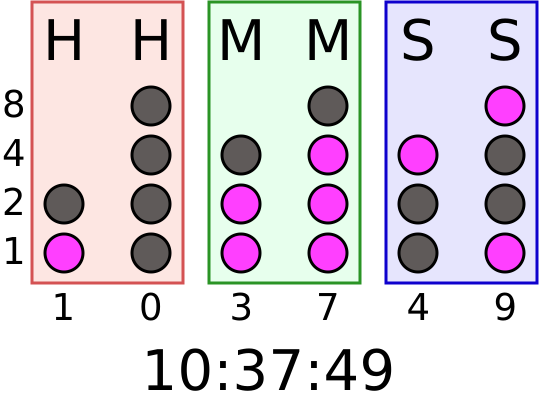
There are many different numeral systems, that is, writing systems for expressing numbers.
By culture / time period
"A base is a natural number B whose powers (B multiplied by itself some number of times) are specially designated within a numerical system." The term is not equivalent to radix, as it applies to all numerical notation systems (not just positional ones with a radix) and most systems of spoken numbers. Some systems have two bases, a smaller (subbase) and a larger (base); an example is Roman numerals, which are organized by fives (V=5, L=50, D=500, the subbase) and tens (X=10, C=100, M=1,000, the base).
| Name | Base | Sample | Approx. First Appearance | ||||||||||||||||||||||||||
|---|---|---|---|---|---|---|---|---|---|---|---|---|---|---|---|---|---|---|---|---|---|---|---|---|---|---|---|---|---|
| Proto-cuneiform numerals | 1060 | ||||||||||||||||||||||||||||
| Indus numerals | unknown | ||||||||||||||||||||||||||||
| Proto-Elamite numerals | 1060 | ||||||||||||||||||||||||||||
| Sumerian numerals | 1060 | ||||||||||||||||||||||||||||
| Egyptian numerals | 10 | Z1 V20 V1 M12 D50 I8 I7 C11 | |||||||||||||||||||||||||||
| Babylonian numerals | 1060 | [[File:Babylonian 1.svg | 15px]] [[File:Babylonian 2.svg | 15px]] [[File:Babylonian 3.svg | 15px]] [[File:Babylonian 4.svg | 15px]] [[File:Babylonian 5.svg | 15px]] [[File:Babylonian 6.svg | 15px]] [[File:Babylonian 7.svg | 15px]] [[File:Babylonian 8.svg | 15px]] [[File:Babylonian 9.svg | 15px]] [[File:Babylonian 10.svg | 15px]] | |||||||||||||||||
| Aegean numerals | 10 | 𐄇 𐄈 𐄉 𐄊 𐄋 𐄌 𐄍 𐄎 𐄏 ( [[File:Aegean numeral 1.svg | 10px | frameless | 1]] [[File:Aegean numeral 2.svg | 10px | frameless | 2]] [[File:Aegean numeral 3.svg | 10px | frameless | 3]] [[File:Aegean numeral 4.svg | 10px | frameless | 4]] [[File:Aegean numeral 5.svg | 10px | frameless | 5]] [[File:Aegean numeral 6.svg | 10px | frameless | 6]] [[File:Aegean numeral 7.svg | 10px | frameless | 7]] [[File:Aegean numeral 8.svg | 10px | frameless | 8]] [[File:Aegean numeral 9.svg | 10px | frameless | 9]] ) |
| 𐄐 𐄑 𐄒 𐄓 𐄔 𐄕 𐄖 𐄗 𐄘 ( [[File:Aegean numeral 10.svg | 10px | frameless | 10]] [[File:Aegean numeral 20.svg | 10px | frameless | 20]] [[File:Aegean numeral 30.svg | 10px | frameless | 30]] [[File:Aegean numeral 40.svg | 10px | frameless | 40]] [[File:Aegean numeral 50.svg | 10px | frameless | 50]] [[File:Aegean numeral 60.svg | 10px | frameless | 60]] [[File:Aegean numeral 70.svg | 10px | frameless | 70]] [[File:Aegean numeral 80.svg | 10px | frameless | 80]] [[File:Aegean numeral 90.svg | 10px | frameless | 90]] ) | ||
| 𐄙 𐄚 𐄛 𐄜 𐄝 𐄞 𐄟 𐄠 𐄡 ( [[File:Aegean numeral 100.svg | 10px | frameless | 100]] [[File:Aegean numeral 200.svg | 10px | frameless | 200]] [[File:Aegean numeral 300.svg | 10px | frameless | 300]] [[File:Aegean numeral 400.svg | 10px | frameless | 400]] [[File:Aegean numeral 500.svg | 10px | frameless | 500]] [[File:Aegean numeral 600.svg | 10px | frameless | 600]] [[File:Aegean numeral 700.svg | 10px | frameless | 700]] [[File:Aegean numeral 800.svg | 10px | frameless | 800]] [[File:Aegean numeral 900.svg | 10px | frameless | 900]] ) | ||
| 𐄢 𐄣 𐄤 𐄥 𐄦 𐄧 𐄨 𐄩 𐄪 ( [[File:Aegean numeral 1000.svg | 10px | frameless | 1000]] [[File:Aegean numeral 2000.svg | 10px | frameless | 2000]] [[File:Aegean numeral 3000.svg | 10px | frameless | 3000]] [[File:Aegean numeral 4000.svg | 10px | frameless | 4000]] [[File:Aegean numeral 5000.svg | 10px | frameless | 5000]] [[File:Aegean numeral 6000.svg | 10px | frameless | 6000]] [[File:Aegean numeral 7000.svg | 10px | frameless | 7000]] [[File:Aegean numeral 8000.svg | 10px | frameless | 8000]] [[File:Aegean numeral 9000.svg | 10px | frameless | 9000]] ) | ||
| 𐄫 𐄬 𐄭 𐄮 𐄯 𐄰 𐄱 𐄲 𐄳 ( [[File:Aegean numeral 10000.svg | 10px | frameless | 10000]] [[File:Aegean numeral 20000.svg | 10px | frameless | 20000]] [[File:Aegean numeral 30000.svg | 10px | frameless | 30000]] [[File:Aegean numeral 40000.svg | 10px | frameless | 40000]] [[File:Aegean numeral 50000.svg | 10px | frameless | 50000]] [[File:Aegean numeral 60000.svg | 10px | frameless | 60000]] [[File:Aegean numeral 70000.svg | 10px | frameless | 70000]] [[File:Aegean numeral 80000.svg | 10px | frameless | 80000]] [[File:Aegean numeral 90000.svg | 10px | frameless | 90000]] ) | ||
| Chinese numerals | |||||||||||||||||||||||||||||
| Japanese numerals | |||||||||||||||||||||||||||||
| Korean numerals (Sino-Korean) | |||||||||||||||||||||||||||||
| Vietnamese numerals (Sino-Vietnamese) | 10 | ||||||||||||||||||||||||||||
| Roman numerals | 510 | I V X L C D M | |||||||||||||||||||||||||||
| Hebrew numerals | 10 | ||||||||||||||||||||||||||||
| Indian numerals | 10 | ||||||||||||||||||||||||||||
| Greek numerals | 10 | ō α β γ δ ε ϝ ζ η θ ι | |||||||||||||||||||||||||||
| ο Αʹ Βʹ Γʹ Δʹ Εʹ Ϛʹ Ζʹ Ηʹ Θʹ | {{sort | -400 | |||||||||||||||||||||||||||
| Kharosthi numerals | 410 | 𐩇 𐩆 𐩅 𐩄 𐩃 𐩂 𐩁 𐩀 | {{sort | -401 | |||||||||||||||||||||||||
| Phoenician numerals | 10 | 𐤙 𐤘 𐤗 𐤛𐤛𐤛 𐤛𐤛𐤚 𐤛𐤛𐤖 𐤛𐤛 𐤛𐤚 𐤛𐤖 𐤛 𐤚 𐤖 | {{sort | -250 | |||||||||||||||||||||||||
| Chinese rod numerals | 10 | 𝍠 𝍡 𝍢 𝍣 𝍤 𝍥 𝍦 𝍧 𝍨 𝍩 | |||||||||||||||||||||||||||
| Coptic numerals | 10 | Ⲁ Ⲃ Ⲅ Ⲇ Ⲉ Ⲋ Ⲍ Ⲏ Ⲑ | |||||||||||||||||||||||||||
| Ge'ez numerals | 10 | ፩ ፪ ፫ ፬ ፭ ፮ ፯ ፰ ፱ | |||||||||||||||||||||||||||
| ፲ ፳ ፴ ፵ ፶ ፷ ፸ ፹ ፺ | |||||||||||||||||||||||||||||
| ፻ | |||||||||||||||||||||||||||||
| ፼ | |||||||||||||||||||||||||||||
| 15th Century (Modern Style) | |||||||||||||||||||||||||||||
| Armenian numerals | 10 | Ա Բ Գ Դ Ե Զ Է Ը Թ Ժ | |||||||||||||||||||||||||||
| Khmer numerals | 10 | ០ ១ ២ ៣ ៤ ៥ ៦ ៧ ៨ ៩ | |||||||||||||||||||||||||||
| Thai numerals | 10 | ๐ ๑ ๒ ๓ ๔ ๕ ๖ ๗ ๘ ๙ | |||||||||||||||||||||||||||
| Abjad numerals | 10 | غ ظ ض ذ خ ث ت ش ر ق ص ف ع س ن م ل ك ي ط ح ز و هـ د ج ب ا | {{sort | 680 | |||||||||||||||||||||||||
| Chinese numerals (financial) | 10 | 零壹貳參肆伍陸柒捌玖拾佰仟萬億 (T. Chinese) | |||||||||||||||||||||||||||
| 零壹贰叁肆伍陆柒捌玖拾佰仟萬億 (S. Chinese) | |||||||||||||||||||||||||||||
| Eastern Arabic numerals | 10 | ٩ ٨ ٧ ٦ ٥ ٤ ٣ ٢ ١ ٠ | |||||||||||||||||||||||||||
| Vietnamese numerals (Chữ Nôm) | 10 | 𠬠 𠄩 𠀧 𦊚 𠄼 𦒹 𦉱 𠔭 𠃩 | {{sort | 799 | |||||||||||||||||||||||||
| Western Arabic numerals | 10 | 0 1 2 3 4 5 6 7 8 9 | |||||||||||||||||||||||||||
| Glagolitic numerals | 10 | Ⰰ Ⰱ Ⰲ Ⰳ Ⰴ Ⰵ Ⰶ Ⰷ Ⰸ ... | |||||||||||||||||||||||||||
| Cyrillic numerals | 10 | а в г д е ѕ з и ѳ і ... | |||||||||||||||||||||||||||
| Rumi numerals | 10 | [[File:Rumi numerals 1-9.svg | left | 150px]] | |||||||||||||||||||||||||
| Burmese numerals | 10 | ၀ ၁ ၂ ၃ ၄ ၅ ၆ ၇ ၈ ၉ | |||||||||||||||||||||||||||
| Tangut numerals | 10 | ||||||||||||||||||||||||||||
| Cistercian numerals | 10 | [[File:Cistercian numerals.svg | frameless | upright]] | |||||||||||||||||||||||||
| Maya numerals | 520 | [[Image:0 maia.svg | 15px]] [[Image:1 maia.svg | 15px]] [[Image:2 maia.svg | 15px]] [[Image:3 maia.svg | 15px]] [[Image:4 maia.svg | 15px]] [[Image:5 maia.svg | 15px]] [[Image:6 maia.svg | 15px]] [[Image:7 maia.svg | 15px]] [[Image:8 maia.svg | 15px]] [[Image:9 maia.svg | 15px]] [[Image:10 maia.svg | 15px]] [[Image:11 maia.svg | 15px]] [[Image:12 maia.svg | 15px]] [[Image:13 maia.svg | 15px]] [[Image:14 maia.svg | 15px]] [[Image:15 maia.svg | 15px]] [[Image:16 maia.svg | 15px]] [[Image:17 maia.svg | 15px]] [[Image:18 maia.svg | 15px]] [[Image:19 maia.svg | 15px]] | |||||||
| 𝋠 𝋡 𝋢 𝋣 𝋤 𝋥 𝋦 𝋧 𝋨 𝋩 𝋪 𝋫 𝋬 𝋭 𝋮 𝋯 𝋰 𝋱 𝋲 𝋳 | {{sort | 1400 | |||||||||||||||||||||||||||
| Muisca numerals | 20 | [[File:Muisca cyphers acc acosta humboldt zerda.svg | frameless | upright=1.5]] | {{sort | 1399 | |||||||||||||||||||||||
| Korean numerals (Hangul) | 10 | 영 일 이 삼 사 오 육 칠 팔 구 | |||||||||||||||||||||||||||
| Aztec numerals | 20 | [[Image:Uno Nahuatl.svg | x25px]] [[Image:Cinco Nahuatl.svg | x25px]] [[Image:Mexica 20.svg | x25px]] [[Image:Mexica 100.svg | x25px]] [[Image:Mexica 400.svg | x25px]] [[Image:Mexica 800.svg | x25px]] [[Image:Mexica 8000.svg | x30px]] | ||||||||||||||||||||
| (1, 5, 20, 100, 400, 800, 8000) | |||||||||||||||||||||||||||||
| Sinhala numerals | 10 | ෦ ෧ ෨ ෩ ෪ ෫ ෬ ෭ ෮ ෯ 𑇡 𑇢 𑇣 | |||||||||||||||||||||||||||
| 𑇤 𑇥 𑇦 𑇧 𑇨 𑇩 𑇪 𑇫 𑇬 𑇭 𑇮 𑇯 𑇰 𑇱 𑇲 𑇳 𑇴 | {{sort | 1699 | |||||||||||||||||||||||||||
| Pentadic runes | 10 | [[File:Pentimal Runes 1 through 10.svg | frameless | upright]] | |||||||||||||||||||||||||
| Cherokee numerals | 10 | [[File:Cherokee Numbers – cropped (1-20).png | frameless | upright=2]] | |||||||||||||||||||||||||
| Vai numerals | 10 | ꘠ ꘡ ꘢ ꘣ ꘤ ꘥ ꘦ ꘧ ꘨ ꘩ | |||||||||||||||||||||||||||
| Bamum numerals | 10 | ꛯ ꛦ ꛧ ꛨ ꛩ ꛪ ꛫ ꛬ ꛭ ꛮ | |||||||||||||||||||||||||||
| Mende Kikakui numerals | 10 | 𞣏 𞣎 𞣍 𞣌 𞣋 𞣊 𞣉 𞣈 𞣇 | |||||||||||||||||||||||||||
| Osmanya numerals | 10 | 𐒠 𐒡 𐒢 𐒣 𐒤 𐒥 𐒦 𐒧 𐒨 𐒩 | |||||||||||||||||||||||||||
| Medefaidrin numerals | 20 | 𖺀 𖺁/𖺔 𖺂/𖺕 𖺃/𖺖 𖺄 𖺅 𖺆 𖺇 𖺈 𖺉 𖺊 𖺋 𖺌 𖺍 𖺎 𖺏 𖺐 𖺑 𖺒 𖺓 | |||||||||||||||||||||||||||
| N'Ko numerals | 10 | ߉ ߈ ߇ ߆ ߅ ߄ ߃ ߂ ߁ ߀ | |||||||||||||||||||||||||||
| Hmong numerals | 10 | ||||||||||||||||||||||||||||
| Garay numerals | 10 | [[File:Garay numbers.png | Garay numbers]] | ||||||||||||||||||||||||||
| Adlam numerals | 10 | 𞥙 𞥘 𞥗 𞥖 𞥕 𞥔 𞥓 𞥒 𞥑 𞥐 | |||||||||||||||||||||||||||
| Kaktovik numerals | 520 | ||||||||||||||||||||||||||||
| 𝋀 𝋁 𝋂 𝋃 𝋄 𝋅 𝋆 𝋇 𝋈 𝋉 𝋊 𝋋 𝋌 𝋍 𝋎 𝋏 𝋐 𝋑 𝋒 𝋓 | |||||||||||||||||||||||||||||
| Sundanese numerals | 10 | ᮰ ᮱ ᮲ ᮳ ᮴ ᮵ ᮶ ᮷ ᮸ ᮹ | 20th Century (1996) |
By type of notation
Positional numeral systems Numeral systems are classified here as to whether they use positional notation (also known as place-value notation), and further categorized by radix or base.
Standard positional numeral systems
The common names are derived somewhat arbitrarily from a mix of Latin and Greek, in some cases including roots from both languages within a single name. There have been some proposals for standardisation.
| Base | Name | Usage | ||||||||||||||
|---|---|---|---|---|---|---|---|---|---|---|---|---|---|---|---|---|
| 2 | Binary | Digital computing, imperial and customary volume (bushel-kenning-peck-gallon-pottle-quart-pint-cup-gill-jack-fluid ounce-tablespoon) | ||||||||||||||
| 3 | Ternary, trinary | Cantor set (all points in [0,1] that can be represented in ternary with no 1s); counting Tasbih in Islam; hand-foot-yard and teaspoon-tablespoon-shot measurement systems; most economical integer base | ||||||||||||||
| 4 | Quaternary | Chumashan languages and Kharosthi numerals | ||||||||||||||
| 5 | Quinary | Gumatj, Ateso, Nunggubuyu, Kuurn Kopan Noot, and Saraveca languages; common count grouping e.g. tally marks | ||||||||||||||
| 6 | Senary, seximal | Diceware, Ndom, Kanum, and Proto-Uralic language (suspected) | ||||||||||||||
| 7 | Septimal, Septenary | |||||||||||||||
| 8 | Octal | Charles XII of Sweden, Unix-like permissions, Squawk codes, DEC PDP-11, Yuki, Pame, compact notation for binary numbers, Xiantian (I Ching, China) | ||||||||||||||
| 9 | Nonary, nonal | Compact notation for ternary | ||||||||||||||
| 10 | Decimal, denary | Most widely used by contemporary societies | ||||||||||||||
| 11 | Undecimal, unodecimal, undenary | A base-11 number system was mistakenly attributed to the Māori (New Zealand) in the 19th century and one was reported to be used by the Pangwa (Tanzania) in the 20th century, but was not confirmed by later research and is believed to also be an error. Briefly proposed during the French Revolution to settle a dispute between those proposing a shift to duodecimal and those who were content with decimal. Used as a check digit in ISBN for 10-digit ISBNs. Applications in computer science and technology. | ||||||||||||||
| 12 | Duodecimal, dozenal | Languages in the Nigerian Middle Belt Janji, Gbiri-Niragu, Piti, and the Nimbia dialect of Gwandara; Chepang language of Nepal, and the Mahl dialect of Maldivian; dozen-gross-great gross counting; 12-hour clock and months timekeeping; years of Chinese zodiac; foot and inch; Roman fractions. | ||||||||||||||
| 13 | Tredecimal, tridecimal | Conway's base 13 function. | ||||||||||||||
| 14 | Quattuordecimal, quadrodecimal | Programming for the HP 9100A/B calculator and image processing applications. | ||||||||||||||
| 15 | Quindecimal, pentadecimal | Telephony routing over IP, and the Huli language. | ||||||||||||||
| 16 | Hexadecimal, sexadecimal, sedecimal | Compact notation for binary data; tonal system of Nystrom. | ||||||||||||||
| 17 | Heptadecimal, septendecimal | |||||||||||||||
| 18 | Octodecimal | |||||||||||||||
| 19 | Undevicesimal, nonadecimal | |||||||||||||||
| 20 | Vigesimal | Basque, Celtic, Muisca, Inuit, Yoruba, Tlingit, and Dzongkha numerals; Santali, and Ainu languages. | ||||||||||||||
| 5&20 | first=Alois Richard | last=Nykl | date=September 1926 | title=The Quinary-Vigesimal System of Counting in Europe, Asia, and America | pages=165–173 | journal=Language | volume=2 | issue=3 | url=https://books.google.com/books?id=1GwUAAAAIAAJ&q=Nykl&pg=RA1-PA165 | quote-page=165 | quote=A student of the American Indian languages is naturally led to investigate the wide-spread use of the quinary-vigesimal system of counting which he meets in the whole territory from Alaska along the Pacific Coast to the Orinoco and the Amazon. | doi=10.2307/408742 | oclc=50709582 | jstor=408742 | via=Google Books}} | Greenlandic, Iñupiaq, Kaktovik, Maya, Nunivak Cupʼig, and Yupʼik numerals – "wide-spread... in the whole territory from Alaska along the Pacific Coast to the Orinoco and the Amazon" |
| 21 | The smallest base in which all fractions to have periods of 4 or shorter. | |||||||||||||||
| 23 | last=Laycock | first=Donald | author-link1=Donald Laycock | date=1975 | editor-last=Wurm | editor-first=Stephen | editor-link1=Stephen Wurm | series=Pacific Linguistics C-38 | title=New Guinea Area Languages and Language Study, I: Papuan Languages and the New Guinea Linguistic Scene | publisher=Canberra: Research School of Pacific Studies, Australian National University | pages=219–233 | chapter=Observations on Number Systems and Semantics}} | ||||
| 24 | Quadravigesimal | 24-hour clock timekeeping; Greek alphabet; Kaugel language. | ||||||||||||||
| 25 | Sometimes used as compact notation for quinary. | |||||||||||||||
| 26 | Hexavigesimal | Sometimes used for encryption or ciphering, using all letters in the English alphabet | ||||||||||||||
| 27 | Telefol, Oksapmin, Wambon, and Hewa languages. Mapping the nonzero digits to the alphabet and zero to the space is occasionally used to provide checksums for alphabetic data such as personal names, to provide a concise encoding of alphabetic strings, or as the basis for a form of gematria. Compact notation for ternary. | |||||||||||||||
| 28 | Months timekeeping. | |||||||||||||||
| 30 | The Natural Area Code, this is the smallest base such that all of to terminate, a number n is a regular number if and only if terminates in base 30. | |||||||||||||||
| 32 | Duotrigesimal | Found in the Ngiti language. | ||||||||||||||
| 34 | The smallest base where terminates and all of to have periods of 4 or shorter. | |||||||||||||||
| 36 | Hexatrigesimal | |||||||||||||||
| 40 | DEC RADIX 50/MOD40 encoding used to compactly represent file names and other symbols on Digital Equipment Corporation computers. The character set is a subset of ASCII consisting of space, upper case letters, the punctuation marks "$", ".", and "%", and the numerals. | |||||||||||||||
| 42 | Largest base for which all minimal primes are known. | |||||||||||||||
| 47 | Smallest base for which no generalized Wieferich primes are known. | |||||||||||||||
| 49 | Compact notation for septenary. | |||||||||||||||
| 50 | SQUOZE encoding used to compactly represent file names and other symbols on some IBM computers. Encoding using all Gurmukhi characters plus the Gurmukhi digits. | |||||||||||||||
| 60 | Sexagesimal | Babylonian numerals and Sumerian; degrees-minutes-seconds and hours-minutes-seconds measurement systems; Ekari; covers base 62 apart from I, O, and l, but including _(underscore). | ||||||||||||||
| 64 | ||||||||||||||||
| 72 | The smallest base greater than binary such that no three-digit narcissistic number exists. | |||||||||||||||
| 80 | Used as a sub-base in Supyire. | |||||||||||||||
| 89 | Largest base for which all left-truncatable primes are known. | |||||||||||||||
| 90 | Related to Goormaghtigh conjecture for the generalized repunit numbers (111 in base 90 = 1111111111111 in base 2). | |||||||||||||||
| 97 | Smallest base which is not perfect odd power (where generalized Wagstaff numbers can be factored algebraically) for which no generalized Wagstaff primes are known. | |||||||||||||||
| 185 | Smallest base which is not a perfect power (where generalized repunits can be factored algebraically) for which no generalized repunit primes are known. | |||||||||||||||
| 210 | Smallest base such that all fractions to terminate. |
[[Non-standard positional numeral systems]]
[[Bijective numeration]]
| Base | Name | Usage |
|---|---|---|
| 1 | Unary(Bijectivebase1) | Tally marks, Counting. Unary numbering is used as part of some data compression algorithms such as Golomb coding. It also forms the basis for the Peano axioms for formalizing arithmetic within mathematical logic. A form of unary notation called Church encoding is used to represent numbers within lambda calculus. |
| 10 | Bijective base-10 | To avoid zero |
| 26 | Bijective base-26 | Spreadsheet column numeration. Also used by John Nash as part of his obsession with numerology and the uncovering of "hidden" messages. |
[[Signed-digit representation]]
| Base | Name | Usage |
|---|---|---|
| 2 | Balanced binary (Non-adjacent form) | |
| 3 | Balanced ternary | Ternary computers |
| 4 | Balanced quaternary | |
| 5 | Balanced quinary | |
| 6 | Balanced senary | |
| 7 | Balanced septenary | |
| 8 | Balanced octal | |
| 9 | Balanced nonary | |
| 10 | Balanced decimal | John Colson |
| Augustin Cauchy | ||
| 11 | Balanced undecimal | |
| 12 | Balanced duodecimal |
[[Complex-base system|Complex bases]]
| Base | Name | Usage |
|---|---|---|
| 2i | Quater-imaginary base | related to base −4 and base 16 |
| i\sqrt{2} | Base i\sqrt{2} | related to base −2 and base 4 |
| i \sqrt[4]{2} | Base i \sqrt[4]{2} | related to base 2 |
| 2 \omega | Base 2 \omega | related to base 8 |
| \omega \sqrt[3]{2} | Base \omega \sqrt[3]{2} | related to base 2 |
| −1 ± i | Twindragon base | Twindragon fractal shape, related to base −4 and base 16 |
| 1 ± i | Negatwindragon base | related to base −4 and base 16 |
[[Non-integer representation|Non-integer bases]]
| Base | Name | Usage |
|---|---|---|
| \frac{3}{2} | Base \frac{3}{2} | a rational non-integer base |
| \frac{4}{3} | Base \frac{4}{3} | related to duodecimal |
| \frac{5}{2} | Base \frac{5}{2} | related to decimal |
| \sqrt{2} | Base \sqrt{2} | related to base 2 |
| \sqrt{3} | Base \sqrt{3} | related to base 3 |
| \sqrt[3]{2} | Base \sqrt[3]{2} | |
| \sqrt[4]{2} | Base \sqrt[4]{2} | |
| \sqrt[12]{2} | Base \sqrt[12]{2} | usage in 12-tone equal temperament musical system |
| 2\sqrt{2} | Base 2\sqrt{2} | |
| -\frac{3}{2} | Base -\frac{3}{2} | a negative rational non-integer base |
| -\sqrt{2} | Base -\sqrt{2} | a negative non-integer base, related to base 2 |
| \sqrt{10} | Base \sqrt{10} | related to decimal |
| 2\sqrt{3} | Base 2\sqrt{3} | related to duodecimal |
| φ | Golden ratio base | early Beta encoder |
| ρ | Plastic number base | |
| ψ | Supergolden ratio base | |
| 1+\sqrt{2} | Silver ratio base | |
| e | Base e | best radix economy |
| π | Base \pi | |
| e[](pi) | Base e\pi | |
| e^\pi | Base e^\pi |
[[p-adic number|''n''-adic number]]
| Base | Name | Usage |
|---|---|---|
| 2 | Dyadic number | |
| 3 | Triadic number | |
| 4 | Tetradic number | the same as dyadic number |
| 5 | Pentadic number | |
| 6 | Hexadic number | not a field |
| 7 | Heptadic number | |
| 8 | Octadic number | the same as dyadic number |
| 9 | Enneadic number | the same as triadic number |
| 10 | Decadic number | not a field |
| 11 | Hendecadic number | |
| 12 | Dodecadic number | not a field |
[[Mixed radix]]
- Factorial number system {1, 2, 3, 4, 5, 6, ...}
- Even double factorial number system {2, 4, 6, 8, 10, 12, ...}
- Odd double factorial number system {1, 3, 5, 7, 9, 11, ...}
- Primorial number system {2, 3, 5, 7, 11, 13, ...}
- Fibonorial number system {1, 2, 3, 5, 8, 13, ...}
- {60, 60, 24, 7} in timekeeping
- {60, 60, 24, 30 (or 31 or 28 or 29), 12, 10, 10, 10} in timekeeping
- (12, 20) traditional English monetary system (£sd)
- (20, 18, 13) Maya timekeeping
Other
- Quote notation
- Redundant binary representation
- Hereditary base-n notation
- Asymmetric numeral systems optimized for non-uniform probability distribution of symbols
- Combinatorial number system
Non-positional notation
All known numeral systems developed before the Babylonian numerals are non-positional, as are many developed later, such as the Roman numerals. The French Cistercian monks created their own numeral system.
References
References
- (2004). "A cognitive typology for numerical notation". Cambridge Archaeological Journal.
- (2003-09-18). "Proposal to Encode Kharoṣ ṭhī in Plane 1 of ISO/IEC 10646".
- (2007-07-25). "Proposal to add two numbers for the Phoenician script". Unicode Consortium.
- (Sep 1928). "A History Of Mathematical Notations Vol I". The Open Court Company.
- "Ethiopic (Unicode block)". Unicode Consortium.
- (2010). "Numerical Notation: A Comparative History". [[Cambridge University Press]].
- Guo, Xianghe. (2009-07-27). "武则天为反贪发明汉语大写数字——中新网".
- "Burmese/Myanmar script and pronunciation".
- "Vai (Unicode block)". Unicode Consortium.
- "The invention, transmission and evolution of writing: Insights from the new scripts of West Africa".
- "Bamum (Unicode block)". Unicode Consortium.
- "Mende Kikakui (Unicode block)". Unicode Consortium.
- (2011-10-21). "Proposal for encoding the Mende script in the SMP of the UCS". Unicode Consortium.
- "Medefaidrin (Unicode block)". Unicode Consortium.
- (2015-07-17). "Preliminary proposal for encoding the Medefaidrin (Oberi Okaime) script in the SMP of the UCS (Revised)". Unicode Consortium.
- "NKo (Unicode block)". Unicode Consortium.
- (2017-01-01). "Clear Language: Script, Register And The N'ko Movement Of Manding-Speaking West Africa". UPenn.
- "Consideration of the encoding of Garay with updated user feedback (revised)". Unicode Consortium.
- (2016-03-22). "Proposal for encoding the Garay script in the SMP of the UCS". Unicode Consortium.
- "Adlam (Unicode block)". Unicode Consortium.
- (2014-10-28). "Revised proposal for encoding the Adlam script in the SMP of the UCS". Unicode Consortium.
- "Kaktovik Numerals (Unicode block)". Unicode Consortium.
- (2020-02-09). "Exploratory proposal to encode the Kaktovik numerals". Unicode Consortium.
- (2008). "Direktori Aksara Sunda untuk Unicode". Pemerintah Provinsi Jawa Barat.
- Epp, Susanna. (2010). "Discrete Mathematics with Applications". Cengage Learning.
- [http://www.dozenal.org/drupal/sites_bck/default/files/MultiplicationSynopsis.pdf Multiplication Tables of Various Bases], p. 45, Michael Thomas de Vlieger, [[Dozenal Society of America]]
- (2022). "Research and Development of Trinary Power Cycles". Inventions.
- "Definition of SEPTENARY".
- ''The History of Arithmetic'', [[Louis Charles Karpinski]], 200pp, Rand McNally & Company, 1925.
- ''Histoire universelle des chiffres'', [[Georges Ifrah]], Robert Laffont, 1994.
- ''The Universal History of Numbers: From prehistory to the invention of the computer'', [[Georges Ifrah]], {{isbn. 0-471-39340-1, John Wiley and Sons Inc., New York, 2000. Translated from the French by David Bellos, E.F. Harding, Sophie Wood and Ian Monk
- Overmann, Karenleigh A. (2020). "The curious idea that Māori once counted by elevens, and the insights it still holds for cross-cultural numerical research". Journal of the Polynesian Society.
- Thomas, N.W. (1920). "Duodecimal base of numeration". Man.
- (2010). "Rethinking Universals".
- Ulrich, Werner. (November 1957). "Non-binary error correction codes". Bell System Technical Journal.
- (January 2012). "Realistic Approach of Strange Number System from Unodecimal to Vigesimal". Sysbase Solution Ltd..
- (May 2013). "Subtraction in Traditional and Strange Number System by r's and r-1's Compliments". International Journal of Computer Applications.
- [http://www.hpmuseum.org/prog/hp9100pr.htm HP 9100A/B programming, HP Museum]
- "Image processor and image processing method".
- Nykl, Alois Richard. (September 1926). "The Quinary-Vigesimal System of Counting in Europe, Asia, and America". [[Language (journal).
- Eells, Walter Crosby. (October 14, 2004). "Sherlock Holmes in Babylon: And Other Tales of Mathematical History". [[Mathematical Association of America]].
- Laycock, Donald. (1975). "New Guinea Area Languages and Language Study, I: Papuan Languages and the New Guinea Linguistic Scene". Canberra: Research School of Pacific Studies, Australian National University.
- Dibbell, Julian. (2010). "The Best Technology Writing 2010". [[Yale University Press]].
- (2019). "A nomenclature for sequence-based forensic DNA analysis". Forensic Science International.
- "Base 26 Cipher (Number ⬌ Words) - Online Decoder, Encoder".
- (1982). "The development of measurement operations among the Oksapmin of Papua New Guinea". Child Development.
- "Безымянный палец • Задачи".
- ''[[Nauka i Zhizn]]'', 1992, issue 3, p. 48.
- (2002). "Analysis of identifier performance using a deterministic linkage algorithm". Proceedings. AMIA Symposium.
- Stephens, Kenneth Rod. (1996). "Visual Basic Algorithms: A Developer's Sourcebook of Ready-to-run Code". Wiley.
- Sallows, Lee. (1993). "Base 27: the key to a new gematria". [[Word Ways]].
- Gódor, Balázs. (2006). "Networks 2006: 12th International Telecommunications Network Strategy and Planning Symposium". IEEE.
- (2016). "The Structured Compact Tag-Set for Luganda". International Journal on Natural Language Computing.
- "NewBase60".
- Nasar, Sylvia. (2001). "A Beautiful Mind". Simon and Schuster.
This article was imported from Wikipedia and is available under the Creative Commons Attribution-ShareAlike 4.0 License. Content has been adapted to SurfDoc format. Original contributors can be found on the article history page.
Ask Mako anything about List of numeral systems — get instant answers, deeper analysis, and related topics.
Research with MakoFree with your Surf account
Create a free account to save articles, ask Mako questions, and organize your research.
Sign up freeThis content may have been generated or modified by AI. CloudSurf Software LLC is not responsible for the accuracy, completeness, or reliability of AI-generated content. Always verify important information from primary sources.
Report