From Surf Wiki (app.surf) — the open knowledge base
List of marine aquarium fish species
none
none
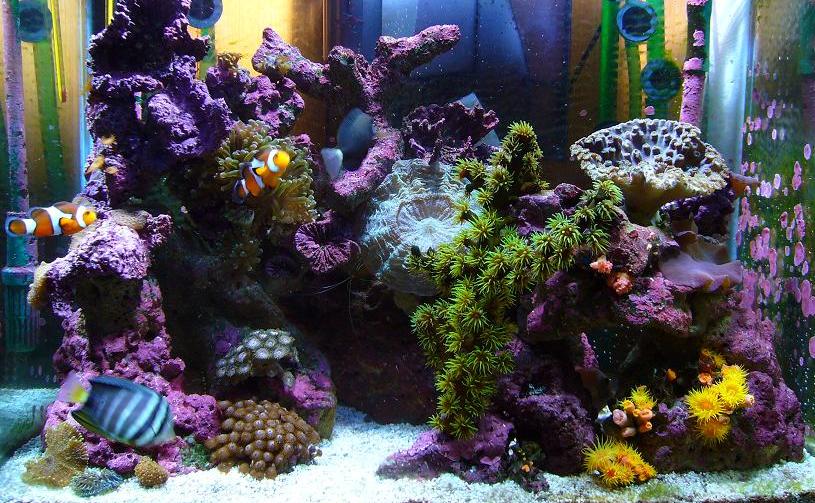
The following list of marine aquarium fish species commonly available in the aquarium trade is not a completely comprehensive list; certain rare specimens may be available commercially but not yet listed here. A brief section on each, with a link to the page about the particular species is provided along with references for further information.
Reef-safe fish do not consume corals or invertebrates, while fish categorized as not safe do. Fish labelled as "with caution" may have individuals within the species that could potentially eat invertebrates or cause damage to corals.
Angelfish (large)
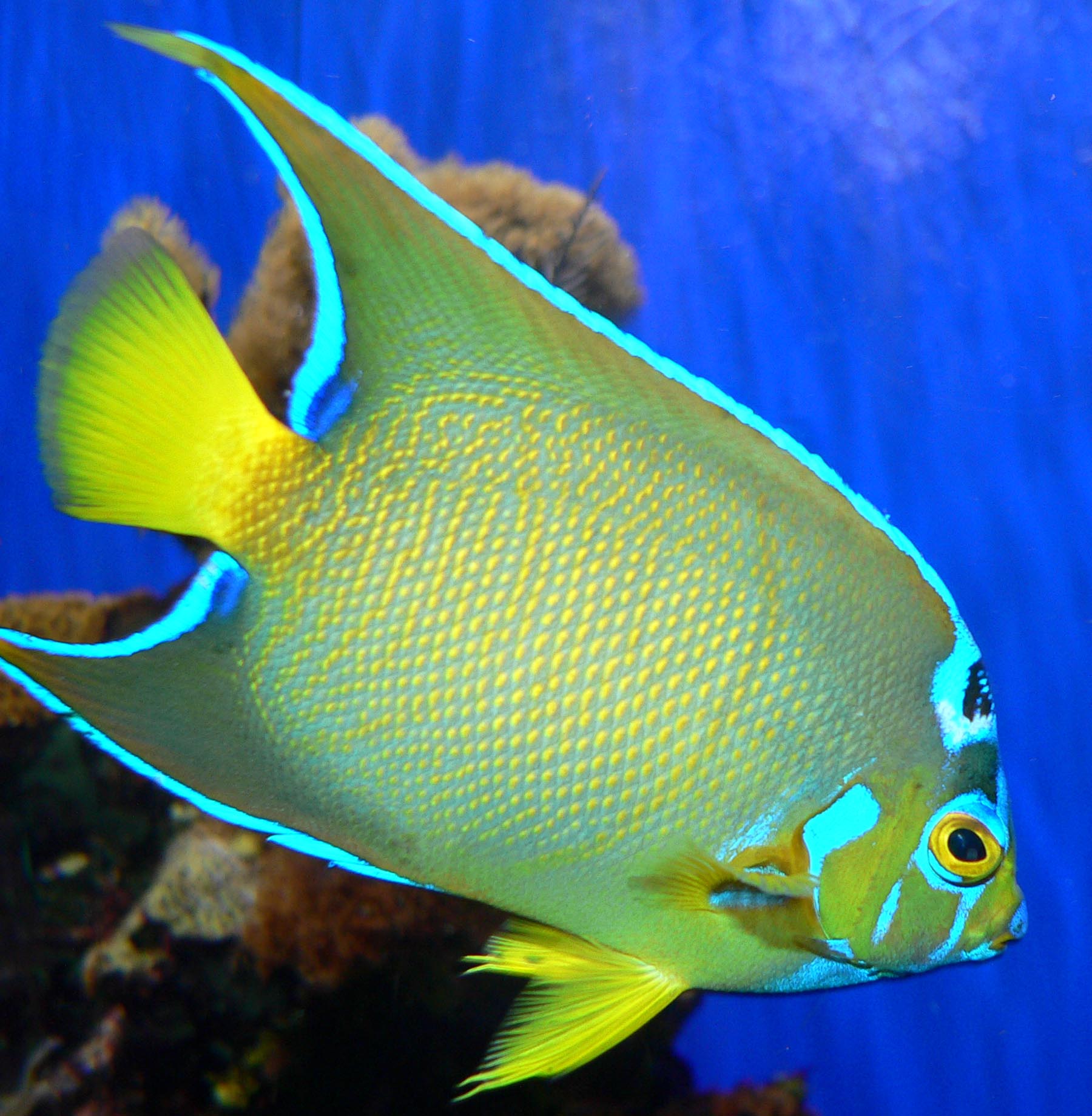
These large fish are considered to be quite hardy, but because of their size may present a significant challenge to the keeper. They need huge aquariums, up to 180 gallons to house one for its entire lifespan. Two angels might be kept in the same aquarium provided it is a large aquarium, they are properly acclimated as juveniles, and they have very different colouring and body shape. However, because all Angelfish have essentially the same diet, mixing them is a feat that should be left to only advanced keepers. Most are not reef safe, and a potential owner should be aware that they need to have plenty of vegetable matter in their diet. They undergo major changes in colouration while maturing, and unless specified given descriptions are for adult specimens.
| Common name | Image | Taxonomy | Reef safe | Description | Max size | ||
|---|---|---|---|---|---|---|---|
| Blue ring angelfish, annularis angelfish | [[File:Pomacanthus annularis.JPG | 120px | center]] | Pomacanthus annularis | No | 30 cm | |
| Arabian angelfish, Asfur angelfish | [[File:Pomacanthus maculosus, Toledo Zoo.jpg | 120px | center]] | Pomacanthus asfur | No | 40 cm | |
| Bellus angelfish | [[File:Genicanthus bellus.jpg | 120px | center]] | Genicanthus bellus | Yes | Light blue all over. Exhibits strong sexual dimorphism: females have wide black bands, males' bands are orange. | 18 cm |
| Blue angelfish | [[File:Bermuda blue angelfish.jpg | 120px | center]] | Holacanthus bermudensis | No | Blue Angelfish has an overall aqua hue with a yellow shimmer and yellow edges on the fins and scales. The Blue Angelfish does not have the striking blue crown or other blue highlights of the Queen Angelfish. This species has been known to reproduce with the Queen Angelfish, making a half breed that looks like a mixture between the two species. | 45 cm |
| Bluespotted angelfish | [[File:Chaetodontoplus caeruleopunctatus.jpg | 120px | center]] | Chaetodontoplus caeruleopunctatus | No | 21 cm | |
| Blueface angelfish | [[File:Euxiphipops xanthometopon.jpg | 120px | center]] | Pomacanthus xanthometopon | With Caution | 40 cm | |
| Cortez angelfish | [[File:Pomacanthus zonipectus.jpg | 120px | center]] | Pomacanthus zonipectus | No | Darkly hued with yellow stripes. | 46 cm |
| Emperor angelfish | [[File:Pomacanthus imperator crop.jpg | 120px | center]] | Pomacanthus imperator | No | Juveniles are black with blue-white spiraling; adults are blue with yellow stripes, accented with white and black and a blue mask. Will easily be the dominant angelfish if housed with other angels. | 40 cm |
| French angelfish | [[File:French Angelfish off Grand Cayman.JPG | 120px | center]] | Pomacanthus paru | No | Juveniles are black with 3 yellow vertically running stripes, may also display blue on pelvic fins. Adults lard black with white vertical stripes. | 41 cm |
| Gray angelfish | [[File:Gray angelfish.jpg | 120px | center]] | Pomacanthus arcuatus | No | Light grey with dark spots and bluish/grey mask over face. Closely related to French Angelfish. | 60 cm |
| Griffis angelfish | [[File:Corl0166 (28304650305).jpg | 120px | center]] | Apolemichthys griffisi | No | An ashen white angel with thick black bands and spots, it is a rare find within the aquarium trade. | 25 cm |
| Half-moon angelfish, Yellow bar angelfish | [[File:Pomacanthus maculosus.jpg | 120px | center]] | Pomacanthus maculosus | No | Blue with yellow splotch-like marking on side. | 50 cm |
| Koran angelfish | [[File:Pomacanthus semicirculatus 1.jpg | 120px | center]] | Pomacanthus semicirculatus | No | Grey towards the face, becoming a navy blue towards the caudal fin with striking iridescent blue accents throughout. | 40 cm |
| Majestic angelfish or blue girdled angelfish | [[File:1 Pomacanthus navarchus Blue-gridled angelfish.jpg | 120px | center]] | Pomacanthus navarchus | No | Yellow dorsal and caudal fins connecting to "saddal" with dark blue dots. Dark blue underside and anal fin. Electric blue separating yellow and dark blue. | 30 cm |
| Passer angelfish or King angelfish | [[File:Holacanthus passer 1.jpg | 120px | center]] | Holacanthus passer | No | Very dark blue with yellow caudal fin and distinctive white stripe. | 36 cm |
| Personifer angelfish or Queensland yellowtail angelfish | [[File:Chaetodontoplus meredithi Kuiter.jpg | 120px | center]] | Chaetodontoplus meridithii | No | 37 cm | |
| Queen angelfish | [[File:Holacanthus ciliaris 2.jpg | 120px | center]] | Holacanthus ciliaris | No | Tan coloured with yellow caudal fin and neon blue outlined fins. This species has been known to reproduce with the Blue Angelfish, making a half breed that looks like a mixture between the two species. | 45 cm |
| Rock beauty | [[File:Holacanthus tricolor 1.jpg | 120px | center]] | Holacanthus tricolor | No | 25 cm | |
| Royal angelfish | [[File:1 Pygoplites diacanthus.jpg | 120px | center]] | Pygoplites diacanthus | No | Orange and blue striped with dark blue dorsal fin and lemon yellow caudal fin. | 25 cm |
| Scribbled angelfish | [[File:Chaetodontoplus duboulayi.jpg | 120px | center]] | Chaetodontoplus duboulayi | No | 25 cm | |
| Japanese swallow angelfish | [[File:Genicanthus semifasciatus.jpg | 120px | center]] | Genicanthus semifasciatus | Yes | Black and tan striped back with yellow blaze beginning at the mouth and tapering off towards the centre of the side, with light blueish grey underside. Has distinctively shaped tail resembling that of a swallow. | 21 cm |
| Yellowtail angelfish | [[File:Apolemichthys xanthurus.JPG | 120px | center]] | Apolemichthys xanthurus | No | 15 cm |
Angelfish (dwarf)

Although Dwarf Angelfish are smaller and generally more manageable than their larger counterparts, they still have some specific care requirements. They are omnivores, but plenty of vegetable matter, preferably in the form of macroalgae, should be provided for their grazing pleasure. Their suitability for reef tanks is hotly debated, so add at your own risk. Specimens that have been successfully maintained in reef aquaria include the Flame and Coral Beauty angels. However, for obvious reasons they should not be put into tanks with expensive decorative macroalgae.
| Common name | Image | Taxonomy | Reef safe | Description | Max size | ||
|---|---|---|---|---|---|---|---|
| Barred angelfish | [[File:Paracentropyge multifasciatus.jpg | 120px | center]] | Centropyge multifasciata | With caution | White fish with vertical black stripes that change to yellow at the belly | 12 cm |
| Bicolor angelfish | [[File:1 centropyge bicolor Bicolor angelfish.jpg | 120px | center]] | Centropyge bicolor | With caution | 15 cm | |
| Blue Velvet Angelfish | Centropyge deborae | ||||||
| Brazilian flameback angelfish | [[File:Centropyge aurantonotus.JPG | 120px | center]] | Centropyge aurantonotus | With caution | 8 cm | |
| Coral beauty angelfish | [[File:Centropyge bispinosa 1.jpg | 120px | center]] | Centropyge bispinosa | With caution | Reddish body with blue back and orange fins. A shy fish that prefers multiple hiding locations. | 10 cm |
| Cherubfish or Pygmy angelfish | [[File:Cherub fish Centropyge argi.jpg | 120px | center]] | Centropyge argi | With caution | Blue colored body with an orange yellow head. | 8 cm |
| Eibli angelfish | [[File:Centropyge eibli.jpg | 120px | center]] | Centropyge eibli | With caution | Tan coloured body with vertical brown stripes and large distinctive black splotch covering the back of the fish, including the caudal fin. | 15 cm |
| Flame angelfish | [[File:Centropyge loricula.jpg | 120px | center]] | Centropyge loricula | Yes | Vivid orange-red with vertical black stripes and blue patches toward the end of the dorsal and anal fins. | 15 cm |
| Pearlscale angelfish | [[File:Centropyge vrolikii.jpg | 120px | center]] | Centropyge vroliki | With caution | Anterior is gray to pearly white with orange accent around eye, posterior is deep black. | 12 cm |
| Herald's angelfish | [[File:Centropyge heraldi.jpg | 120px | center]] | Centropyge heraldi | With caution | Completely lemon yellow, with a brown marking around the eye. | 10 cm |
| Keyhole angelfish | [[File:Centropyge tibicens.jpg | 120px | center]] | Centropyge tibicen | No | Centropyge type species. Overall black with an elongate vertical black blotch on the middle of the upper sides. When small, mainly black with a white bar. Dorsal and anal fins with submarginal blue line; most of the pelvic and the anterior portion of the anal fin yellow. Caudal fin with submarginal blue line. | 19 cm |
| Lemonpeel angelfish | [[File:Centropyge flavissima.JPG | 120px | center]] | Centropyge flavissima | With caution | Bright yellow with distinctive dark semicircle by operculum. | 14 cm |
| Multicolor angelfish | [[File:Centropyge multicolor.jpg | 120px | center]] | Centropyge multicolor | With caution | 9 cm | |
| Orange-back angelfish | [[File:Centropyge acanthops Réunion.JPG | 120px | center]] | Centropyge acanthops | With caution | Dark blue with golden yellow blaze running from the face down the dorsal fin, with a colourless caudal fin. | 8 cm |
| Pacific pygmy angelfish | [[File:ChairoYK.jpg | 120px | center]] | Centropyge flavicauda | With caution | 8 cm | |
| Potter's angelfish | [[File:Centropyge potteri Angelfish.jpg | 120px | center]] | Centropyge potteri | With caution | Similarly coloured to the Coral Beauty, but with a blue body and reddish fins. | 10 cm |
| Rusty angelfish | [[File:Centropyge ferrugata.jpg | 120px | center]] | Centropyge ferrugata | Yes | Tan coloured body with dark spots and a reddish tint around the anal fin. | 10 cm |
| Venustus angelfish | [[File:Juvenile_Centropyge_venusta.jpg | 120px | center]] | Centropyge venustus | With caution | 12 cm |
Anthias

Although Anthias resemble damsels in shape and size, the two should never be confused. Anthias (also known as "fairy basslets") are finicky and many starve to death in captivity. In the wild, they eat zooplankton, and will not accept anything else in the aquarium. They also need to be fed nearly constantly, three times a day at least. The best way to ensure the health and longevity of an Anthias is to attach a refugium where copepods can be grown to "drip" into the display tank. Unlike many other saltwater aquarium inhabitants, they can be kept in groups.
| Common name | Image | Taxonomy | Reef safe | Description | Max size | ||
|---|---|---|---|---|---|---|---|
| Bartlett's anthias | [[File:Bartlett's anthias Pseudanthias bartlettorum.jpg | 120px | center]] | Pseudanthias bartlettorum | Yes | Back and face light yellow, underside pink with a swallowtail-shaped caudal fin. | 9 cm |
| Bicolor anthias | [[File:HutairoHGmaido.jpg | 120px | center]] | Pseudanthias bicolor | Yes | Similarly shaped and coloured to Bartlett's Anthias, but with a slightly more rounded back. | 13 cm |
| Cooper's anthias | [[File:KashiwaHDym.jpg | 120px | center]] | Pseudanthias cooperi | Yes | Orange back and finnage with white patch below the mouth running down toward the anal fin with pink sides. | 14 cm |
| Diadem anthias | [[File:KorinHD.jpg | 120px | center]] | Pseudanthias parvirostris | Yes | Pink fish with yellow streak on top of head running along the lateral line. Caudal fin is red with yellow tips. | 7 cm |
| Orangehead anthias | Pseudanthias heemstrai | Yes | Pink underside with orange back and mask, dark red splotch on caudal fin, along with iridescent blue anal and pelvic fins. | 13 cm | |||
| Redbar anthias | [[File:AkaobiHDmesu.jpg | 115px | center]] | Pseudanthias rubrizonatus | Yes | Tannish-pink with a single vertical red stripe and a dorsal fin with the skin between the rays pulled back like on a lionfish. | 12 cm |
| Lyretail anthias, Sea Goldie | [[File:Juwelen-Fahnenbarsch Pseudanthias squamipinnis 0511173 Weibc.jpg | 120px | center]] | Pseudanthias squamipinnis | Yes | Females are orange with lyre-shaped caudal fin. Males are fuchsia with red markings on fins | 15 cm |
| Squareback anthias | [[File:Pseudanthias pleurotaenia.jpg | 120px | center]] | Pseudanthias pleurotaenia | Yes | Red back and pink underside with distinctive blue square shaped marking and blue fins. | 20 cm |
| Stocky anthias | [[File:KeramaHDfeb.jpg | 120px | center]] | Pseudanthias hypselosoma | Yes | Orange back with cream colored underside. As its name suggests, slightly stockier than other Anthias. | 19 cm |
| Threadfin anthias | [[File:Threadfin anthias male.jpg | 120px | center]] | Pseudanthias huchtii | Yes | Olive green with black caudal fin and red stripe running from the eye to the pectoral fin. | 12 cm |
Bass and groupers

In this exceedingly large group of fish, few are considered proper aquarium inhabitants, for various reasons including diet and size. Basses vary greatly from species to species. Appropriate research should be done before purchasing a specimen. Many unsuspecting hobbyists bring home cute little specimens of popular aquarium fish such as the lyretail grouper, only to realize several months later that they do not have the resources to care for a meter-long that may cost hundreds of dollars a month to feed.
| Common name | Image | Taxonomy | Reef safe | Description | Max size | ||
|---|---|---|---|---|---|---|---|
| African grouper | Cephalopholis taeniops | No | 69 cm | ||||
| Vermillion seabass | [[File:Cephalopholis miniatus.jpg | 120px | center]] | Cephalopholis miniata | 50 cm | ||
| Blacktip grouper | [[File:Blacktip grouper epinephelus fasciatus.JPG | 120px | center]] | Epinephelus fasciatus | No | The tips of the spines of the dorsal fin are black, and it may have a dark red cap above the eyes. There is a variant with a uniformly pale body except for the frontal part. | 40 cm |
| Blue and Yellow grouper | [[File:Epinephelus flavocaeruleus juvénile.JPG | 120px | center]] | Epinephelus flavocaeruleus | No | 90.0 cm | |
| Blue dot grouper | [[File:Blue-spotted.grouper.arp.jpg | 120px | center]] | Cephalopholis argus | No | Deep black to tan fish with blue spots throughout. | 50 cm |
| Blue line grouper | [[File:Cephalopholis formosa Ko Tao, Thailand 1476.jpg | 120px | center]] | Cephalopholis formosa | No | Dark tan with horizontal blue stripes that are not particularly straight. The caudal fin has more of these stripes, and they radiate from the base of the fin out to the tips. | 34 cm |
| Chalk bass | [[File:Serranus tortugarum - pone.0010676.g063.png | 120px | center]] | Serranus tortugarum | Yes | Blue iridescent body with distinctive black topside that is interrupted by small vertical blue stripes. | 8 cm |
| Coney grouper | [[File:Cephalopholis fulva02.jpg | 120px | center]] | Cephalopholis fulva | No | 41 cm | |
| Golden grouper | [[File:Mycteroperca rosacea2.jpg | 120px | center]] | Mycteroperca rosacea | No | 86 cm | |
| Golden stripe soapfish | [[File:Sixstriped soapfish grammistes sexlineatus.JPG | 120px | center]] | Grammistes sexlineatus | No | Chocolate brown with light yellow horizontal stripes. Similar in patterning to C. argus (with exception to the coloration). | 30 cm |
| Harlequin bass | [[File:Serannus tigrinus.jpg | 120px | center]] | Serranus tigrinus | Yes | Very striking black and white checkerboard pattern all over, with very long tapering nose. | 29 cm |
| Leaflip grouper | [[File:Pogonoperca punctata.jpg | 120px | center]] | Pogonoperca punctata | No | Sports a large, hinged mouth and is tan with little spots. Has brown triangle shaped markings down the spine. | 35 cm |
| Marine beta | [[File:Calloplesiops altivelis Comet.jpg | 120px | center]] | Calloplesiops altivelis | Yes | 15 cm | |
| Pacific graysby | Cephalopholis panamensis | No | 30 cm | ||||
| Panther grouper | [[File:Panther.grouper.arp.jpg | 120px | center]] | Cromileptes altivelis | No | Gorgeous pure white fish with black spots and a distinctive "hump" on the head, leading to a popular common name, "Humpback Grouper". | 75 cm |
| Painted comber | [[File:Serranus scriba by Line1.jpg | 120px | center]] | Serranus scriba | No | Large fish with classic Bass body, Silvery in colour with vertical tan stripes and a blue underside. | 36 cm |
| Polleni grouper | Cephalopholis polleni | No | 43 cm | ||||
| Red flag grouper | [[File:Cephalopholis urodeta Brevoort.jpg | 120px | center]] | Cephalopholis urodeta | No | Very similar to C. miniatus, but the caudal fin is dark. | 28 cm |
| Lyretail grouper | [[File:Variola louti 1.jpg | 120px | center]] | Variola louti | No | Silver back changing to red around the underside, darkening toward the caudal fin, which is lyre-shaped with neon green edging. | 80 cm |
| Saddle grouper | [[File:Plectropomus laevis.jpg | 120px | center]] | Plectropomus laevis | No | 125 cm | |
| Spotted grouper | [[File:Epinephelus summana at El Gouna Aquarium by Hatem Moushir 2.JPG | 120px | center]] | Epinephelus summana | No | Dark black fish with many light green spots all over body, increasing in number toward the posterior. | 52 cm |
| Strawberry grouper | Cephalopholis spiloparaea | No | 30 cm | ||||
| V tail grouper | Cephalopholis urodelus | No | 28 cm |
Basslets and assessors

Basslets and Assessors are small, long bodied fish strongly resembling Anthias. Their care requirements, however, are closer to those of damsels. They should be kept individually, and generally not with other fish of similar shape and colour. Feeding is easy: they will generally eat any meaty foods offered. Good water quality should be maintained at all times.
| Common name | Image | Taxonomy | Reef safe | Description | Max size | ||
|---|---|---|---|---|---|---|---|
| Black cap gramma | [[File:Black Cap Basslet.jpg | 120px | center]] | Gramma melacara | Yes | Purple with a black mask beginning at the mouth and ending at the base of the dorsal fin. | 6 cm |
| Blue assessor | [[File:AssessMacneilRStuartSmith.jpg | 120px | center]] | Assessor macneilli | Yes | Entirely navy blue with white edging of the dorsal fin. | 7 cm |
| Royal gramma | [[File:3757 aquaimages.jpg | 120px | center]] | Gramma loreto | Yes | Purple head and anterior, abruptly changing to yellow about halfway down the body. Has black marking through eye and another on the dorsal fin. Do not confuse with the Brazilian Gramma or the Bicolor Dottyback. | 5 cm |
| Brazilian gramma | Gramma brasiliensis | Yes | Very similar to the royal gramma, however the change from purple to yellow occurs farther down the body and the black markings are absent. | 6 cm | |||
| Yellow assessor | Assessor flavissimus | Yes | Bright lemon yellow with peach fringing of the dorsal fin and around the eye. | 7 cm |
Batfish

Batfish are gorgeous and striking fish that are not common in aquaria for one major reason: they get huge. A two or three hundred gallon tank is needed for one, minimum, and larger is better. They start out as tiny, manageable-looking cuties, which often fools aquarists into purchasing them for their small aquariums. However they quickly grow to gargantuan proportions, and require large amounts of food as well as space, so beware. They are not reef safe and should be fed plenty of large meaty foods. Batfish change greatly as they grow, however the potential aquarist is most likely to see them in their juvenile form, so that is the description of the colouration here. They all have generally the same body shape: disk-like with tall dorsal and anal fins, similar to a Freshwater Angelfish.
| Common name | Image | Taxonomy | Reef safe | Description | Max size | ||
|---|---|---|---|---|---|---|---|
| Orbiculate batfish | [[File:Platax orbicularis.jpg | 120px | center]] | Platax orbicularis | No | Brown with generally random black markings resembling a rotting leaf. | 50 cm |
| Dusky batfish | [[File:Plataxpinnatus.jpg | 120px | center]] | Platax pinnatus | No | Dark black body completely edged by distinctive yellow and orange. | 45 cm |
| Teira batfish | [[File:Platax teira 2.jpg | 120px | center]] | Platax teira | No | Silver with black fins and a black stripe across the face. | 70 cm |
Blennies and the Engineer Goby

Blennies are popular aquarium fish, and for good reason. Most of them are peaceful to other fish, while very aggressive to other blennies which has a similar shape. Some blennies are colorful, and many are downright helpful. For example, the aptly named Lawnmower Blenny will keep your green algae well trimmed and presentable. With the exception of Fang Blennies, Blennies are totally reef safe- in fact a reef environment is really best for them because they can be shy and the intricate rockwork of a reef provides ample hiding spaces. They are omnivores and should be fed a varied diet of frozen or live foods and plant matter. Blennies do not have teeth or functional jaw, so food must be small enough for them to swallow whole.
Blennies are often confused with Gobies, but there is an easy way to tell the difference. Gobies have two distinct dorsal fins, Blennies have a single dorsal fin that runs the length of their body. Also, Gobies' pelvic fins are fused to form a sucker, similar to Remoras.
The engineer goby is a close relative of cichlids and leaf fishes, the juvenile can often be found in aquarium trade, while the adult is rare.
| Common name | Image | Taxonomy | Reef safe | Description | Max size | ||
|---|---|---|---|---|---|---|---|
| Spinyhead blenny | [[File:Acanthemblemaria spinosa (Spiny Headed Blenny).jpg | 120px | center]] | Acanthemblemaria spinosa | Yes | Brown checkered body with distinctive yellow frills on head. | 2 cm |
| Bicolor blenny | [[File:Bicolor blenny Ecsenius bicolor.jpg | 120px | center]] | Ecsenius bicolor | Yes | Characterized by the striking contrast of a blue head and upper torso followed by a yellow orange lower torso. | 11 cm |
| Black combtooth blenny | [[File:NiramiGP.jpg | 120px | center]] | Ecsenius namiyei | Yes | 10 cm | |
| Blackline fang blenny | [[File:Meiacanthus_nigrolineatus.jpg | 128x128px | Meiacanthus nigrolineatus]] | Meiacanthus nigrolineatus | No | Yellow bodied with bright blue mask and dark black line running from the eye to the caudal fin. | 9 cm |
| Black sailfin blenny | Atrosalarias fuscus | Yes | 10 cm | ||||
| Blue & gold blenny | Enchelyurus flavipes | Yes | 5 cm | ||||
| Bundoon blenny | Meiacanthus bundoon | No | Black with lighter patch over caudal fin. Very distinctive swallowtail caudal fin. | 8 cm | |||
| Canary fang blenny | [[File:Meiacanthus oualanensis.jpg | 120px | center]] | Meiacanthus oualanensis | Yes | Similarly shaped to M. bundoon, but canary yellow. | 5 cm |
| Diamond blenny | [[File:Malacoctenus boehlkei (Diamond Blenny).jpg | 120px | center]] | Malacoctenus boehlkei | Yes | Gray with black splotches, and a yellow mask. Shaped more like hawkfish than a blenny. | 6.5 cm |
| Ember blenny | [[File:Cirripectes stigmaticus Réunion.jpg | 120px | center]] | Cirripectes stigmaticus | No | 12 cm | |
| Harptail blenny | Meiacanthus mossambicus | Yes | Pale pinkish-grey body with jet-black dorsal and anal fins. Eyes are primarily white, sometimes seen with brown segmentation. | 10cm | |||
| Lawnmower blenny | [[File:Algae blenny.jpg | 120px | center]] | Salarias fasciatus | Yes | Tan and brown striped and spotted with iridescence. Requires Mature Tank. | 14 cm |
| Linear blenny | [[File:XRF-Ecsenius lineatus.png | 120px | center]] | Ecsenius lineatus | Yes | 9 cm | |
| Midas blenny | [[File:Ecsenius midas001.jpg | 120px | center]] | Ecsenius midas | Yes | Although often seen yellow, this fish has the ability to change its color to match the surroundings. It has a very distinctive swallowtail shaped caudal fin. | 13 cm |
| Molly Miller blenny | [[File:Scartella cristata 25-09-07 DSCF1035.jpg | 120px | center]] | Scartella cristata | Yes | Mottled tan, white, and black covering the body and fins. | 12 cm |
| One spot blenny | Crossosalarias macrospilus | No | 10 cm | ||||
| Red lip blenny | [[File:Ophioblennius atlanticus.jpg | 120px | center]] | Ophioblennius atlanticus | Yes | Black to grayish yellow with red patch over mouth. | 19 cm |
| Red Sea mimic blenny | [[File:Copie de El Gouna 02.2009 971.jpg | 120px | center]] | Ecsenius gravieri | Sky blue anterior fading to yellow towards the tail, with a black stripe running the eye to the base of the caudal fin. | 8 cm | |
| Sailfin blenny | [[File:Sailfin Blennys Temper Flaring.jpg | 120px | center]] | Emblemaria pandionis | Yes | Very similar to Salarias fasciatus but slightly darker and with a much larger dorsal fin. | 5 cm |
| Segmented sailfin blenny | Salarias segmentatus | Yes | 10 cm | ||||
| Starry blenny | [[File:Starry Blenny.png | 120px | center]] | Salarias ramosus | Yes | 14 cm | |
| Striped blenny | [[File:Meiacanthus grammistes.JPG | 120px | center]] | Meiacanthus grammistes | Yes | 12 cm | |
| Tail spot blenny | [[File:Ecsenius stigmatura.jpg | 120px | center]] | Ecsenius stigmatura | Yes | Drab tan all over with dark spot at the base of the caudal fin and a light yellow line through eye. | 6 cm |
| Two-spot blenny | Ecsenius bimaculatus | Yes | The top half of this fish is black towards the front and fades to white closer to the tail. The bottom half is white with two distinctive black spots right under the pectoral fins. | 4.5 cm | |||
| Engineer goby | [[File:Pholidichthys leucotaenia 1.jpg | 120px | center]] | Pholidichthys leucotaenia | Yes | Not actually a blenny but from closely related family Pholidichthys. Juvenile has black eel-shaped body with a distinctive white stripe running down the body. Adults are yellow and black striped. | 34 cm |
Boxfish and blowfish

Members of the family Tetraodontidae, Boxfish, Blowfish or Pufferfish and their cousins Cowfishes and Porcupinefishes can be very personable and quirky pets, for the prepared.
They are not thought of as an ordinary aquarium tank mate, but are quickly gaining popularity. They do pose a hazard in the community tank however. They are capable of releasing a very powerful toxin which can kill other fish and in some cases, the boxfish itself. They generally only use it when threatened or dying, but can become disturbed easily with aggressive tank mates or overcrowded aquarium. Generally they are reef safe, though they will pick at invertebrates if not fed well enough.
Many people think puffed up Pufferfish, like in the picture, are cute, but an owner should never subject their pet to this as they are often unable to expel the air should they be out of the water. To prevent this, never remove a puffer from the water.
| Common name | Image | Taxonomy | Reef safe | Description | Max size | ||
|---|---|---|---|---|---|---|---|
| Golden puffer | [[File:Arothron meleagris by NPS.jpg | 120px | center]] | Arothron meleagris | No | 48 cm | |
| Hawaiian blue puffer | [[File:Canthigaster papua.jpg | 120px | center]] | Canthigaster papua | No | 10 cm | |
| Hawaiian saddle puffer | [[File:Canthigaster coronata.jpg | 120px | center]] | Canthigaster coronata | No | 14.0 cm | |
| Hawaiian spotted puffer | [[File:Canthigaster jactator by NPS.jpg | 120px | center]] | Canthigaster jactator | No | 9 cm | |
| Helmet cowfish | [[File:Humpback Turretfish - Tetrosomus gibbosus.jpg | 120px | center]] | Tetrosomus gibbosus | Caution | Tan with dark speckles and brown spots at the base of the caudal fin. | 30 cm |
| Immaculate puffer | [[File:Arothron immaculatus, livrée de camouflage.jpg | 120px | center]] | Arothron immaculatus | No | 28 cm | |
| Longhorn cowfish | [[File:Lactoria cornuta.002 - Aquarium Finisterrae.JPG | 120px | center]] | Lactoria cornuta | Caution | Grayish tan with very distinctive "horns" near the eyes and under the caudal fin. | 46 cm |
| Scribbled boxfish | Ostracion solorensis | Caution | Dark navy blue with iridescent "scribbling" and spots. | 12 cm | |||
| Dogface pufferfish | [[File:Black-spotted.puffer.arp.jpg | 120px | center]] | Arothron nigropunctatus | Caution | Tan with a brown mask over eyes and other over mouth. Also has yellow markings on the pectoral and dorsal fins. | 33 cm |
| Map puffer | [[File:Arothron mappa.JPG | 120px | center]] | Arothron mappa | No | 65 cm | |
| Porcupine pufferfish | [[File:Long-spine porcupinefish (Diodon holocanthus).jpg | 120px | center]] | Diodon holocanthus | No | Tan with slightly darker spots throughout and very conspicuous spines that lay flat against the body. When puffed up, the spikes stand up and make the fish completely inedible. | 50 cm |
| Spotfin porcupinefish | [[File:TucacasDiodonHystrix colour adjusted.jpg | 120px | center]] | Diodon hystrix | No | White and covered in small black spots. | 91 cm |
| Sharpnose pufferfish | [[File:Canthigaster rostrata.jpg | 120px | center]] | Canthigaster rostrata | Caution | Cream, with reddish purple topside and underside, and yellow on the caudal fin. | 12 cm |
| Star puffer | [[File:Arothron stellatus 1.jpg | 120px | center]] | Arothron stellatus | No | 120 cm | |
| Stars and stripes puffer | [[File:Arothron hispidus.jpg | 120px | center]] | Arothron hispidus | No | 50 cm | |
| Striped dogface puffer | [[File:Arothron manilensis.jpg | 120px | center]] | Arothron manilensis | No | 31 cm | |
| Valentini pufferfish | [[File:Valentinni's Sharpnose Puffer.jpg | 120px | center]] | Canthigaster valentini | Caution | Tan with giraffe-like spots and dark brown markings that resemble saddles over the back. Has distinctive bright green eyes. | 11 cm |
| Whitebelly puffer | [[File:Canthigaster bennetti.jpg | 120px | center]] | Canthigaster bennetti | No | 10 cm | |
| Yellow boxfish | [[File:Ostracion cubicus.JPG | 120px | center]] | Ostracion cubicus | Caution | Usually seen as a juvenile, bright yellow with little black spots. When it reaches maturity it is gray with yellow lines and pink lips. | 45 cm |
Butterflyfish
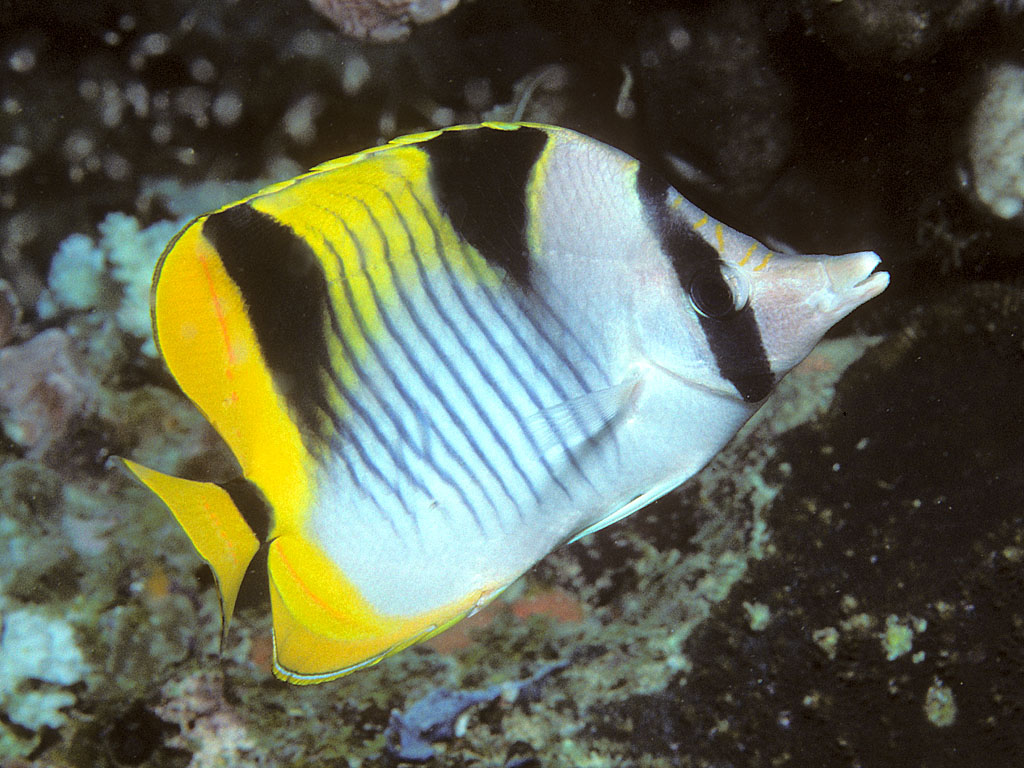
When properly cared for, Butterflyfish can make beautiful and distinctive additions to fish only marine aquariums. Specimens often grow to large sizes and are not well suited to smaller aquariums. Butterflyfish can be fussy and overparticular, but when fed a varied diet and kept in pristine conditions they will usually thrive. Some species in this family do not do well in captivity, and potential keepers must take care to purchase only those species that have a fighting chance. When selecting Butterflyfish especially, specimens presenting any sign or signs of mishandling are to be avoided.
The following species are relatively hardy and experienced aquarists should have no trouble with them, so long as they are diligent.
| Common name | Image | Taxonomy | Reef safe | Description | Max size | ||
|---|---|---|---|---|---|---|---|
| Copperband butterflyfish | [[File:Copperband Butterflyfish.jpg | 120px | center]] | Chelmon rostratus | Caution | Silver with black edged gold stripes, a long nose, and a black eyespot on the dorsal fin. | 20 cm |
| Schooling bannerfish | [[File:Heniochus diphreutes by NPS.jpg | 120px | center]] | Heniochus diphreutes | No | Sometimes referred to as the "Poor Man's Moorish Idol" because of the resemblance to one. White and black striped with yellow caudal fin and a dorsal fin that forms a long, thin banner. | 21 cm |
| Longnose butterflyfish | [[File:Forcipiger flavissimus.jpg | 120px | center]] | Forcipiger flavissimus | No | From the pectoral fins forward, black above the eye and silver below, with an exceptionally mouth. Past the pectoral fins, bright yellow with an eyespot on the anal fin. | 22 cm |
| Raccoon butterflyfish | [[File:Raccoon butterflyfish.jpg | 120px | center]] | Chaetodon lunula | No | Very distinctive and complexly colored. Is mostly yellow with a darker saddle and a black and white mask. | 20 cm |
| Redback butterflyfish | [[File:Bep chaetodon paucifasciatus.jpg | 120px | center]] | Chaetodon paucifasciatus | No | White with black stripes that form chevrons on the side and a bright red patch on the posterior. | 14 cm |
| Merten's butterflyfish | [[File:Bep chaetodon madagaskariensis.jpg | 120px | center]] | Chaetodon mertensii | No | White with fuzzy black stripes and a yellow posterior. Also has a black line through the eye. | 12.5 cm |
| Teardrop butterflyfish | [[File:Chaetodon unimaculatus 1.jpg | 120px | center]] | Chaetodon unimaculatus | No | Completely yellow with the exception of black stripes at the base of the caudal fin and through the eye, and an eyespot directly below the dorsal fin. | 20 cm |
| Latticed butterflyfish | [[File:Bep chaetodon rafflesii.jpg | 120px | center]] | Chaetodon rafflesii | No | Very similar to C. unimaculatus, but with scales that are brighter than the body, forming a lattice-like pattern, and lacking the eyespot. | 18 cm |
| Pacific double saddle butterflyfish | [[File:Chaetodon ulietensis.jpg | 120px | center]] | Chaetodon ulietensis | No | Silver with two dark saddles over the body (plus a dark mask) and yellow dorsal and caudal fins. | 15 cm |
| Sickle butterflyfish | [[File:Bep chaetodon falcula.jpg | 120px | center]] | Chaetodon falcula | No | Often confused with C. ulietensis, but easily distinguished. The saddles are wedge shaped rather than stripes and do not reach the underside. Overall more yellow coloring. | 20 cm |
| Threadfin butterflyfish | [[File:Threadfin Butterflyfish.jpg | 120px | center]] | Chaetodon auriga | No | White anterior with thin black stripes at 45 and 120 degree angles from the head. Posterior is yellow, but with a black wedge shape where the stripes meet the yellow coloring. | 23 cm |
| Tinker's butterflyfish | [[File:Tinker's Butterflyfish.jpg | 120px | center]] | Chaetodon tinkeri | No | White with small black spots, a yellow mask, and a black dorsal fin. | 15 cm |
| Masked butterflyfish | [[File:Chaetodon semilarvatus by Konstanze Löwe.JPG | 120px | center]] | Chaetodon semilarvatus | No | Bright lemon yellow with subtle vertical orange stripes and a black splotch behind the eye. | 23 cm |
| Reef butterflyfish | [[File:BEPBS 4977.jpg | 120px | center]] | Chaetodon sedentarius | Yes | 15 cm | |
| Four-eyed butterflyfish | [[File:Chaetodon capistratus1.jpg | 120px | center]] | Chaetodon capistratus | No | 15 cm | |
| Banded butterflyfish | [[File:Chaetodon striatus Brasil.jpg | 120px | center]] | Chaetodon striatus | No | 16 cm | |
| Saddleback butterflyfish | [[File:Chaetodon_ephippium_PLW_edit.jpg | 120px | center]] | Chaetodon ephippium | Caution | 30 cm |
Cardinalfish

One of the few groups of shoaling fish commonly available to marine aquarists, Cardinalfish are nocturnal and tend to be quite shy. They require meaty foods and will often not take prepared foods such as flakes and tablets. For the best chance of success, keep a wide variety of frozen foods on hand. In the event of a hunger strike, they will almost always take adult brine shrimp. As far as other care requirements they are similar to damsels: not picky. So long as they are properly acclimated, they tolerate a wide range of parameters. A marine aquarist should watch the ammonia/nitrite levels of the environment, as cardinalfish are particularly sensitive to these chemicals.
| Common name | Image | Taxonomy | Reef safe | Description | Max size | ||
|---|---|---|---|---|---|---|---|
| Fragile cardinalfish | Apogon fragilis | Yes | 5 cm | ||||
| Banggai cardinal | [[File:Banggai Cardinalfish Schoal Cropped.jpg | 120px | center]] | Pterapogon kauderni | Yes | Black and silver striped with very tall fins and many white spots. Wild populations have been decimated, consider captive bred specimens. Banggai Cardinalfish are mouthbrooders. | 8 cm |
| Blackstripe cardinalfish | [[File:Apogon nigrofasciatus2.jpg | 120px | center]] | Apogon nigrofasciatus | Yes | Body completely covered in horizontal yellow and black stripes, with red fins. | 10 cm |
| Bluebarred cardinalfish | Apogon flores | Yes | 5 cm | ||||
| Bluestreak cardinalfish | [[File:Apogon leptacanthus.JPG | 120px | center]] | Apogon leptacanthus | Yes | 6.5 cm | |
| Flamefish | [[File:Apogon maculatus.jpg | 120px | center]] | Apogon maculatus | Yes | Bright red with black spots at the base of the caudal fin, under the second dorsal fin, and on the operculum. | 11 cm |
| Frostfin cardinalfish | Apogon hoeveni | Yes | 5 cm | ||||
| Gilbert's cardinalfish | Apogon gilberti | Yes | 5 cm | ||||
| Girdled cardinalfish | Archamia zosterophora | Yes | 8 cm | ||||
| Orange-striped cardinalfish | [[File:Apogon cyanosoma 1.jpg | 120px | center]] | Ostorhinchus cyanosoma | Yes | Light yellow with iridescent yellow horizontal stripes. | 8 cm |
| Orbic cardinalfish | [[File:Sphaeramia orbicularis-Orbic Cardinal.jpg | 120px | center]] | Sphaeramia orbicularis | Yes | A thin, dark vertical 'waistband' with scattered dark spots toward the tail. | 10 cm |
| Pajama cardinalfish | [[File:Pajama cardinalfish, Boston Aquarium.jpg | 120px | center]] | Sphaeramia nematoptera | Yes, caution with small shrimp | This fish displays three distinct color bands: the first, stretching from the nose to base of the first dorsal fin, is a tannish peach. The second, a thin band which runs down the center of the fish, is chocolate brown, and the posterior of the fish is white with brown spots. | 8.5 cm |
| Ochre-striped cardinalfish | Ostorhinchus compressus | Yes | Almost identical to A. nigrofasticus, but with blue eyes. | 12 cm | |||
| Ringtailed cardinalfish | [[File:Apogon aureus.jpg | 120px | center]] | Ostorhinchus aureus | Yes | Yellow body with a black stripe (ring) at the base of the caudal fin and iridescent blue streaks across the eye. | 14.5 cm |
Chromis

Chromis are perhaps the ultimate reef fish. Generally peaceful, most species are easy to take care of and quite colorful. Like anthias, they will school, but in many cases this tendency disappears as they age. They are, nevertheless, at least ambivalent with their own species, as well as completely reef safe. Like Damsels and Anemonefish, their close cousins, Chromis are omnivores and will accept most foods offered. A flake staple is usually sufficient, but for best color and health supplement with frozen and live foods when possible.
| Common name | Image | Taxonomy | Reef safe | Description | Max size | ||
|---|---|---|---|---|---|---|---|
| Ambon chromis | Chromis amboinensis | Yes | 8 cm | ||||
| Barrier reef chromis | [[File:Chromis nitida.jpg | 120px | center]] | Chromis nitida | Yes | 10 cm | |
| Black and gold chromis | [[File:Neoglyphidodon nigroris - Behn's damsel.jpg | 120px | center]] | Neoglyphidodon nigroris | Yes | Mostly silver, but with a large patch of yellow around the caudal fin and a distinct black line on the operculum. | 13 cm |
| Black bar chromis | Chromis retrofasciata | Yes | Yellowish with bright blue iridescent pelvic fins and a distinct black bar at the base of the caudal fin. | 5 cm. | |||
| Blue chromis | [[File:Chromis cyanea.jpg | 120px | center]] | Chromis cyanea | Yes | Bright blue all over, although lighter toward the front. | 13 cm |
| Damselfish | [[File:Chromis chromis 2.jpg | 120px | center]] | Chromis chromis | Yes | Completely black. Despite the name, this is actually a chromis, in fact, it is the chromis. | 25 cm |
| Green chromis | [[File:Chromis viridis 2011.jpg | 120px | center]] | Chromis viridis | Yes | Generally bluish green, but some specimens may be spring green. | 8 cm |
| Half and half chromis | [[File:Chromis iomelas RLS.jpg | 120px | center]] | Chromis iomelas | Yes | Completely black from the middle of the dorsal fin to the nose, completely white from the middle of the dorsal fin to the end of the caudal fin. | 9 cm |
| Limbaughi chromis | Chromis limbaughi | Yes | Dark navy blue with bright yellow spot that covers the dorsal fin and much of the posterior. | 10 cm | |||
| Lined chromis | Chromis lineata | Yes | 5 cm | ||||
| Paletail chromis | Chromis xanthura | Yes | 15 cm | ||||
| Black-axil chromis | [[File:Chromis atripectoralis2.jog.jpg | 120px | center]] | Chromis atripectoralis | Yes | 12 cm | |
| Spiny chromis | [[File:Acanthochromis polyacanthus.jpg | 120px | center]] | Acanthochromis polyacanthus | Yes | Dark chocolate brown, slightly lighter around the pectoral fins. | 14 cm |
| Sunshine chromis | Chromis insolatus | Yes | Rather drab tannish-orange throughout. | 16 cm | |||
| Yellowspotted chromis | [[File:KihoshiSD.jpg | 120px | center]] | Chromis flavomaculata | Yes | 15 cm | |
| Black and white chromis | [[File:ShikokuSDfin.jpg | 120px | center]] | Chromis margaritifer | Yes | Similar to half and half chromis, but there is more black. | 3 in |
Clownfish
.jpg)
Clownfish, more technically known as Anemonefish, are the classic aquarium fish. Both hardy and attractive, they are perhaps best known for their symbiotic relationship with Sea Anemones, a relative of coral. In the wild, Anemonefish are always found with a host, leading many potential keepers to believe that an anemone is necessary to keep them. Anemonefish are easy to keep, but their cnidarian counterparts are inordinately finicky and need high light levels, and luckily Anemonefish will thrive without them. Aquarists often find that Anemonefish will host in other things, from corals and Feather Duster Worms to powerheads and other equipment. Anemonefish care is identical to that of Damselfish, as they are actually very closely related.
| Common name | Image | Taxonomy | Reef safe | Description | Max size | ||
|---|---|---|---|---|---|---|---|
| Cinnamon anemonefish | [[File:Amphiprion melanopus in Entacmaea quadricolor.jpg | 120px | center]] | Amphiprion melanopus | Yes | Dark orange body becoming black towards the caudal fin, with a bright white stripe running from the front of the dorsal fin to the pectoral fins and golden colored fins. | 12 cm |
| Clarkii anemonefish | [[File:Amphiprion clarkii.jpg | 120px | center]] | Amphiprion clarkii | Yes | Black or dark brown with bright yellow finnage and two thick white stripes running perpendicular to the body. | 15 cm |
| Ocellaris | [[File:Clownfish (Amphiprion ocellaris).jpg | 120px | center]] | Amphiprion ocellaris | Yes | Bright orange or yellow body with white stripes. Fins are orange, rimmed with black. A. ocellaris from northern Australia are black. | 11 cm |
| Maroon clownfish | [[File:Premnas biaculeatus juvenile.jpg | 120px | center]] | Premnas biaculeatus | Yes but aggressive | Maroon to bright red with three very thin white stripes. | 17 cm |
| True Percula | [[File:Amphiprion percula.JPG | 120px | center]] | Amphiprion percula | Yes | Nearly identical to A. ocellaris, but the white stripes are edged with black. | 11 cm |
| Pink skunk anemonefish | [[File:Amphiprion perideraion.jpg | 120px | center]] | Amphiprion perideraion | Yes | Pink to orange body with one white stripe over the operculum and another running from the tip of the snout, along the back to the dorsal fin. All fins are white. | 10 cm |
| Tomato clownfish | [[File:Tomato clownfish Amphiprion frenatus.jpg | 120px | center]] | Amphiprion frenatus | Yes | Bright red with a single white stripe running from the front of the dorsal fin to the bottom of the head. | 14 cm |
| Saddleback anemonefish | [[File:Amphiprion Species.JPG | 120px | center]] | Amphiprion polymnus | Yes | Similar to A. ocellaris and percula, but the second stripe does not extend the full with of the body and instead resembles a saddle. | 13 cm |
| Sebae anemonefish | [[File:Clownfish-mileswu.jpg | 120px | center]] | Amphiprion sebae | Yes | Black or dark brown body from above the pectoral fin, yellow below. Has two white stripes, the second resembling that of A. polymnus. | 16 cm |
Damselfish

All Damselfish can be considered reef-safe, sometimes excluding larger, more aggressive Dascyllus varieties. Some Damselfish will host in anemones like clownfish. Most Damselfish are aggressive and difficult to catch once you put them in an aquarium.
Damselfish change gender as they grow larger and older. Small damselfish are ungendered. Eventually, they become males if no males prevent them from doing so. One or sometimes two males live with a female and guard over the eggs. Females are the largest fish and dominant over the males and juveniles. They will not allow other females into an area they have claimed as their territory without a fight. They may not allow new males or juveniles, either. Aggression increases with each change.
| Common name | Image | Taxonomy | Reef safe | Description | Max size | ||
|---|---|---|---|---|---|---|---|
| Ambon damsel | [[File:Pomacentrus amboinensis.jpg | 120px | center]] | Pomacentrus amboinensis | Yes | 10 cm | |
| Azure damsel | [[File:Crysiptera hemicyanea.jpg | 120px | center]] | Chrysiptera hemicyanea | Yes | A beautiful fish with neon blue on its body and a gold underside and caudal fin. Easy to care for and does best on a good diet. Fairly aggressive so choose tankmates carefully. | 10 cm |
| Black and gold damsel | [[File:Neoglyphidodon nigroris.jpg | 120px | center]] | Neoglyphidodon nigroris | Yes | 13 cm | |
| Blackmargined damsel | Pomacentrus nigromarginatus | Yes | 9 cm | ||||
| Blue damsel, Orangetail damsel | [[File:Chrysipteracyanea2.JPG | 120px | center]] | Chrysiptera cyanea | Yes | An orange tail indicates breeding success. The males have orange on their tails while the females do not. This fish is hardy and aggressive. | 8.5 cm |
| Blue and gold damsel | [[File:Neon damselfish.jpg | 120px | center]] | Pomacentrus coelestis | Yes | 9 cm | |
| Blue velvet damsel | [[File:Neoglyphidodon oxyodon.1 - Aquarium Finisterrae.JPG | 120px | center]] | Paraglyphidodon oxyodon | Yes | 15 cm | |
| Blueback damsel | Pomacentrus simsiang | Yes | 9 cm | ||||
| Blueline demoiselle, Yellowfin demoiselle | Chrysiptera caeruleolineata | Yes | 6 cm | ||||
| Bluefin damsel | [[File:Neoglyphidodon melas.jpg | 120px | center]] | Neoglyphidodon melas | Yes | 18 cm | |
| Caerulean damsel | [[File:Pomacentrus caeruleus.jpg | 120px | center]] | Pomacentrus caeruleus | Yes | 8 cm | |
| Canary deep water damsel | Chrysiptera galba | Yes | 9 cm | ||||
| Cloudy damsel | [[File:Dascyllus carneus Maldives.JPG | 120px | center]] | Dascyllus carneus | Yes | 7 cm | |
| Cross' damsel | Neoglyphidodon crossi | Yes | 13 cm | ||||
| Domino damsel | [[File:Dascyllus trimaculatus.JPG | 120px | center]] | Dascyllus trimaculatus | Yes | also known as the three spot damsel, this fish is easy to care for, but is also very aggressive. The fish is black except for three distinct white spots that fade as the fish ages. | 14 cm |
| Fiji blue devil damsel | [[File:Chrysiptera taupou.jpg | 120px | center]] | Chrysiptera taupou | Yes | This striking blue damsel is one of the most popular beginner fish. Like other damsels, it is very hardy, and very aggressive when mature. | 8 cm |
| Four stripe damsel | [[File:Dascyllus melanurus 1.jpg | 120px | center]] | Dascyllus melanurus | Yes | The four stripe damsel is a perfect beginner marine fish as it is very hardy. This fish is highly territorial and is best suited for a semi-aggressive to aggressive tank. | 10 cm |
| Garibaldi damsel | [[File:Hypsypops rubicundus adult.jpg | 120px | center]] | Hypsypops rubicunda | Yes | These are temperate fish and require cooler water. They are much larger than most other damsels. | 30 cm |
| Honey head damsel | Dischistodus prosopotaenia | Yes | 17 cm | ||||
| Hawaiian Dascyllus | [[File:Dascyllus albisella 2.jpg | 120px | center]] | Dascyllus albisella | Yes | 12.5 cm | |
| Jewel damsel | [[File:Microspathodon chrysurus.jpg | 120px | center]] | Microspathodon chrysurus | Yes | Among the largest and most aggressive Damsels | 20 cm |
| King demoiselle | [[File:Chrysiptera rex - Zoo Frankfurt.jpg | 120px | center]] | Chrysiptera rex | Yes | 7 cm | |
| Lemon damsel | [[File:Pomacentrus moluccensis 1.jpg | 120px | center]] | Pomacentrus moluccensis | Yes | 9 cm | |
| Longfin gregory | [[File:Does nature's pallete....jpg | 120px | center]] | Stegastes diencaeus | Caution | Turns brown, and becomes highly territorial as it ages | 12.5 cm |
| Marginated damsel | [[File:Dascyllus marginatus (Rüppell, 1829).png | 120px | center]] | Dascyllus marginatus | Yes | The marginated damsel is noted for blue fins as well as the yellow head and white body. This fish is hardy like most damsels and is also highly aggressive when mature. | 6 cm |
| Neon damsel | Pomacentrus alleni | Yes | 6 cm | ||||
| Ocellate damsel | [[File:Pomacentrus vaiuli.jpg | 120px | center]] | Pomacentrus vaiuli | Yes | 9 cm | |
| Pavo damsel | [[File:Pomacentrus pavo.jpg | 120px | center]] | Pomacentrus pavo | Yes | 11 cm | |
| Pink Smith damsel | [[File:Pomacentrus smithi1.jpg | 120px | center]] | Pomacentrus smithi | Yes | 7 cm | |
| Rolland's demoiselle | Chrysiptera rollandi | Yes | 6 cm | ||||
| Sergeant major damsel | [[File:Abudefduf saxatilis.jpg | 120px | center]] | Abudefduf saxatilis | Yes | 15 cm | |
| Speckled damsel | [[File:MeganeSD.jpg | 120px | center]] | Pomacentrus bankanensis | Yes | 9 cm | |
| Springer's damsel | [[File:Chrysiptera springeri.jpg | 120px | center]] | Chrysiptera springeri | Yes | 5.5 cm | |
| Stark's damsel | [[File:SenakiRS.jpg | 120px | center]] | Chrysiptera starcki | Yes | 7 cm | |
| Talbots damsel | [[File:Chrysiptera talboti - Demoiselle de Talbot - Aqua Porte Dorée 02.JPG | 120px | center]] | Chrysiptera talboti | Yes | This damselfish is somewhat a little more delicate than other. It does best in small groups in large tanks with good water quality and an SG of 1.026. Feed on a good diet for best results. Fairly peaceful. | 8 cm |
| Three stripe damsel | [[File:Dascyllus aruanus 3.jpg | 120px | center]] | Dascyllus aruanus | Yes | Highly aggressive and territorial. Will harass fish many times its size. Best kept in an aggressive/semi-aggressive tank. | 10 cm |
| Three Spot damsel | [[File:Threespot damselfish in a pillar coral.jpg | 120px | center]] | Stegastes planifrons | Yes | 13 cm | |
| Tuxedo damsel | [[File:MisujiSD.jpg | 120px | center]] | Chrysiptera tricincta | Yes | 6 cm | |
| Two stripe damsel | [[File:Dascyllus reticulatus (Reticulated dascyllus) in Acropora loripa (Hard coral).jpg | 120px | center]] | Dascyllus reticulatus | Yes | the two stripe damsel is a very hardy fish. This fish is perfect for the beginner marine aquarist, as it can tolerate substandard water quality. This fish is highly aggressive, and requires many hiding places. | 10 cm |
| Yellow damsel | [[File:Monaco.Musée océanographique026.jpg | 120px | center]] | Amblyglyphidodon aureus | Yes | 13 cm | |
| Yellow threespot Dascyllus | [[File:Dascyllus auripinnis.jpg | 120px | center]] | Dascyllus auripinnis | Yes | 14.5 cm | |
| Yellowbelly damsel | [[File:Pomacentrus auriventris1.jpg | 120px | center]] | Pomacentrus auriventris | Yes | 5.5 cm | |
| Yellowtail Dascyllus | [[File:Dascyllus flavicaudus.jpg | 120px | center]] | Dascyllus flavicaudus | Yes | 12 cm | |
| Yellowtail damsel | [[File:Chrysiptera parasema.JPG | 120px | center]] | Chrysiptera parasema | Yes | The yellowtail damsel possess an all blue body with a striking yellow tail. This damsel is a good beginner fish as it is very hardy and can tolerate substandard water quality. This damsel is also less aggressive than some other damsel species. | 8 cm |
| Yellowtail demoiselle | [[File:Neopomacentrus azysron.jpg | 120px | center]] | Neopomacentrus azysron | Yes | 7.5 cm |
Dartfish

Most should be kept as pairs or small groups where all individuals are added at once.
| Common name | Image | Taxonomy | Reef safe | Description | Max size | ||
|---|---|---|---|---|---|---|---|
| Blue gudgeon dartfish | [[File:HanaHZyg.jpg | 120px | center]] | Ptereleotris hanae | Yes | 13 cm | |
| Fire fish | [[File:Nemateleotris magnifica2.jpg | 120px | center]] | Nemateleotris magnifica | Yes | 9 cm | |
| Purple fire fish | [[File:Nemateleotris decora.jpg | 120px | center]] | Nemateleotris decora | Yes | 9 cm | |
| Scissortail dartfish | [[File:Blackfin Dart Gobies in front of their hole.jpg | 120px | center]] | Ptereleotris evides | Yes | 14 cm | |
| Zebra barred dartfish | [[File:Ptereleotris zebra.jpg | 120px | center]] | Ptereleotris zebra | Yes | 10 cm |
Dragonets

Dragonets are often mis-categorized as gobies or blennies by fish sellers. They are bottom-dwelling fish that constantly hunt tiny invertebrates for food. Most starve to death in a marine aquarium unless you provide a refugium or place for the invertebrates to reproduce safely without any fish being able to reach them.
| Common name | Image | Taxonomy | Reef safe | Description | Max size | ||
|---|---|---|---|---|---|---|---|
| Mandarinfish | [[File:Synchiropus splendidus 2 Luc Viatour.jpg | 120px | center]] | Synchiropus splendidus | Yes | A brightly colored member of the dragonet family. Eats only copepods and will die in captivity without an adequate supply, which can only be had in very large, well established reef tanks | 6 cm |
| Starry dragonet | Synchiropus stellatus | Yes | Also known as red scooter blenny though not a true blenny. Will often only eat live copepods and amphipods. | 12 cm | |||
| Ocellated dragonet | [[File:Scooter blenny - by BJ Beggerly.jpg | 120px | center]] | Synchiropus ocellatus | Yes | Also known as scooter blenny though not a true blenny. Will often only eat live copepods and amphipods. | 8 cm |
| Spotted mandarin | [[File:Synchiropus picturatus.jpg | 120px | center]] | Synchiropus picturatus | Yes | Often only eats live copepods and amphipods. | 10 cm |
Eels

Most eels are easily kept in a large aquarium, although several species such as the blue ribbon eel should usually be avoided. With any moray eel care must be taken to secure the lid as one of the most common causes of death is escaping from the tank, and onto the floor.
| Common name | Image | Taxonomy | Reef safe | Description | Max size | ||
|---|---|---|---|---|---|---|---|
| Banded snake eel | [[File:Banded snake eel Nick Hobgood.jpg | 120px | center]] | Myrichthys colubrinus | No | 97 cm | |
| Banded eel | [[File:Ecpol_u0.png | 120px | center]] | Echidna polyzona | No | 69 cm | |
| Black edge moray eel | [[File:Gymnothorax saxicola.jpg | 120px | center]] | Gymnothorax saxicola | No | 60 cm | |
| Blue ribbon eel, black ribbon eel | Rhinomuraena quaesita | No | 130 cm | ||||
| Chainlink moray eel | [[File:Chain moray eel.jpg | 120px | center]] | Echidna catenata | No | Can be kept with fish too small to swallow | 165 cm |
| Dragon moray eel | [[File:ToraUB.jpg | 120px | center]] | Enchelycore pardalis | No | A fish eater that will eat anything it can fit in its mouth. When available is typically quite expensive | 92 cm |
| Golden dwarf eel | Gymnothorax melatremus | Yes | Rarely available, among the smallest of the moray eels | 26 cm | |||
| Golden moray eel | [[File:Moray eel and fish.JPG | 120px | center]] | Gymnothorax miliaris | May eat fish and shrimp | These fish should only be kept in fish-only tanks as any small invertebrates will be looked on as food. Keep with fish large enough not to be eaten. Feed on a diet of whitefish, cockles, cod roe, haddock and frozen foods. | 70.0 cm |
| Green moray eel | [[File:Muraene.jpg | 120px | center]] | Gymnothorax funebris | No | Requires a 180-gallon tank with tight fitting lid. Compatible with rays, sharks, and other large fish. | 250 cm |
| Jeweled moray eel | [[File:Muraena lentiginosa.jpg | 120px | center]] | Muraena lentiginosa | No | 61 cm | |
| Kidako moray eel | [[File:Kidako moray.JPG | 120px | center]] | Gymnothorax kidako | No | 91 cm | |
| Peppered moray | [[File:Pseudoechidna brummeri.jpg | 120px | center]] | Gymnothorax picta | No | 135 cm | |
| Snowflake eel | [[File:Snowflake moray in kona close up.jpg | 120px | center]] | Echidna nebulosa | May eat shrimp if underfed | A pebble-tooth moray that generally eats crustaceans and similar. Safer in reef aquariums than other species but be prepared to remove it in case it starts to eat desired invertebrates. | 100 cm |
| Spotted garden-eel | Heteroconger hassi | With Caution | NEEDS a very deep substrate (8 inches) and only eats plankton, when housing multiple make sure that there is enough space for each eels to be far enough away from each other | 40 cm | |||
| Spotted Snake eel | [[File:Myrichthys maculosus.JPG | 120px | center]] | Myrichthys maculosus | No | Requires at least six in of substrate | 100 cm |
| Tessalata eel, or laced moray | [[File:Gymnothorax favagineus 2.jpg | 120px | center]] | Gymnothorax favagineus | No | 300 cm | |
| Yellowhead moray eel | [[File:Gymnothorax fimbriatus.JPG | 120px | center]] | Gymnothorax fimbriatus | No | 80 cm | |
| Yellow mouth moray eel | [[File:Gymnothorax nudivomer.jpg | 120px | center]] | Gymnothorax nudivomer | No | 178 cm | |
| Whitemouth moray eel | [[File:Gymnothorax meleagris.jpg | 120px | center]] | Gymnothorax meleagris | With Caution | 120 cm | |
| Zebra moray | [[File:Gymnomuraena zebra by NPS.jpg | 120px | center]] | Gymnomuraena zebra | No | One of the easier moray eels to keep, is usually safe with most fish but will eat most invertebrates. | 150 cm |
Filefish

Less often kept than their relatives the triggerfish and puffers, there are many filefish that make good aquarium residents, and a few that require specialized diets, making it hard to sustain them in an aquarium.
| Common name | Image | Taxonomy | Reef safe | Description | Max size | ||
|---|---|---|---|---|---|---|---|
| Clown filefish | [[File:Cantherhines dumerili.jpg | 120px | center]] | Cantherhines dumerili | Caution | 38 cm | |
| Colored filefish | Pervagor melanocephalus | Caution | 15 cm | ||||
| Fantail orange filefish | Pervagor spilosoma | No | 18 cm | ||||
| Horseshoe filefish | [[File:Meuschenia hippocrepis P1020936.JPG | 120px | center]] | Meuschenia hippocrepis | No | 51 cm | |
| Japanese filefish | [[File:Yosogi2013123001.jpg | 120px | center]] | Paramonacanthus japonicus | No | 13 cm | |
| Mimic filefish | [[File:Paraluteres prionurus.JPG | 120px | center]] | Paraluteres prionurus | No | 11 cm | |
| Orange spotted filefish | [[File:Oxymonacanthus longirostris 1.jpg | 120px | center]] | Oxymonacanthus longirostris | No | 13 cm | |
| Tassle filefish | [[File:Chaetodermis penicilligerus.2 - Aquarium Finisterrae.JPG | 120px | center]] | Chaetodermis penicilligerus | Caution | 30 cm |
Flatfish
| Common name | Image | Taxonomy | Reef safe | Care Level | Description | Max size | ||
|---|---|---|---|---|---|---|---|---|
| Peacock flounder | [[File:Bothus lunatus.jpg | 120px | center]] | Bothus lunatus | No | Moderate | 46 cm | |
| Flowery (Indo-Pacific peacock) flounder | [[File:Bothidae - Bothus mancus.jpg | 120px | center]] | Bothus mancus | with caution | Moderate | 45 cm | |
| Banded sole | [[File:Blue Edged Sole - Soleichthys heterorhinos.jpg | 120px | center]] | Soleichthys heterorhinos | Will eat shrimp and other invertebrates, will not harm coral | Moderate | 18 cm |
Frogfish

A type of Anglerfish, Frogfish are ambush predators with huge mouths. They are capable of eating fish up to twice their length so care should be taken in choosing tank mates.
| Common name | Image | Taxonomy | Reef safe | Description | Max size | ||
|---|---|---|---|---|---|---|---|
| Longlure frogfish | [[File:6903 aquaimages.jpg | 120px | center]] | Antennarius multiocellatus | No | 20 cm | |
| Giant anglerfish | [[File:Commerson's Frogfish, Kona, Hawaii.jpg | 120px | center]] | Antennarius commerson | No | 38 cm | |
| Sargassum frogfish | [[File:Sargassumfish.jpg | 120px | center]] | Histrio histrio | No | 20 cm | |
| Striated frogfish | [[File:Antennarius striatus2.JPG | 120px | center]] | Antennarius striatus | No | 15 cm | |
| Wartskin frogfish | [[File:Clown frogfish.jpg | 120px | center]] | Antennarius maculatus | No | Has the ability to change color to match its surrounding. | 10 cm |
Goatfish
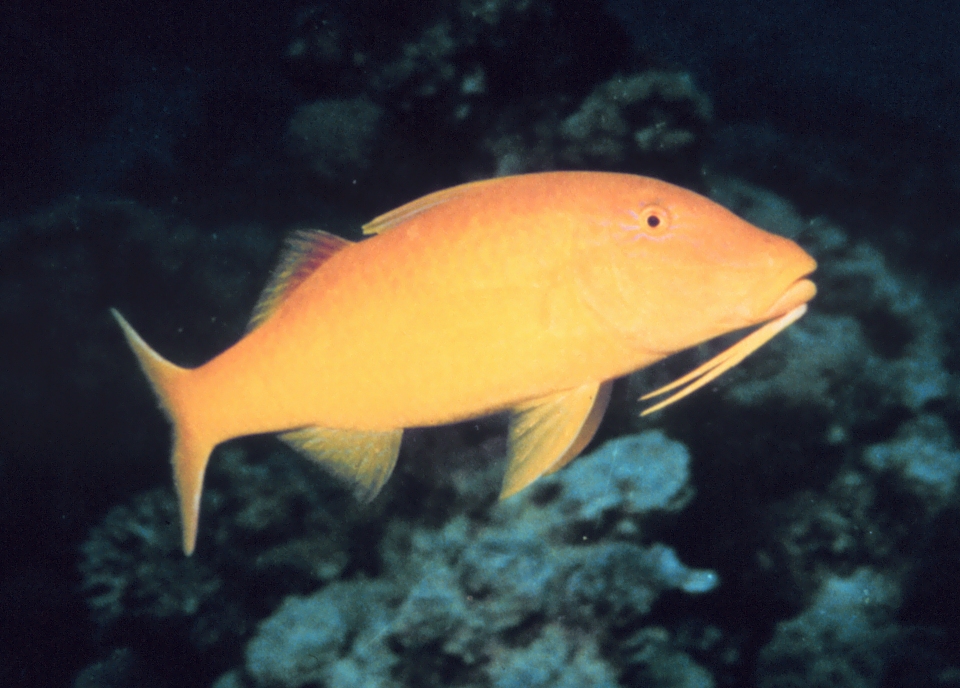
While not as common a choice for aquariums as many other species, they are typically hardy and brightly colored
| Common name | Image | Taxonomy | Reef safe | Description | Max size | ||
|---|---|---|---|---|---|---|---|
| Bicolor goatfish | [[File:IndoHJ.jpg | 120px | center]] | Parupeneus barberinoides | With Caution | 25 cm | |
| Goldsaddle goatfish | [[File:Parupeneus cyclostomos.jpg | 120px | center]] | Parupeneus cyclostomus | With Caution | 51 cm | |
| Manybar goatfish | [[File:Parupeneus multifasciatus.jpg | 120px | center]] | Parupeneus multifasciatus | With Caution | 30 cm | |
| Yellow back goatfish | [[File:Parupeneus barberinus.JPG | 120px | center]] | Parupeneus barberinus | With Caution | 41 cm |
Gobies and clingfishes
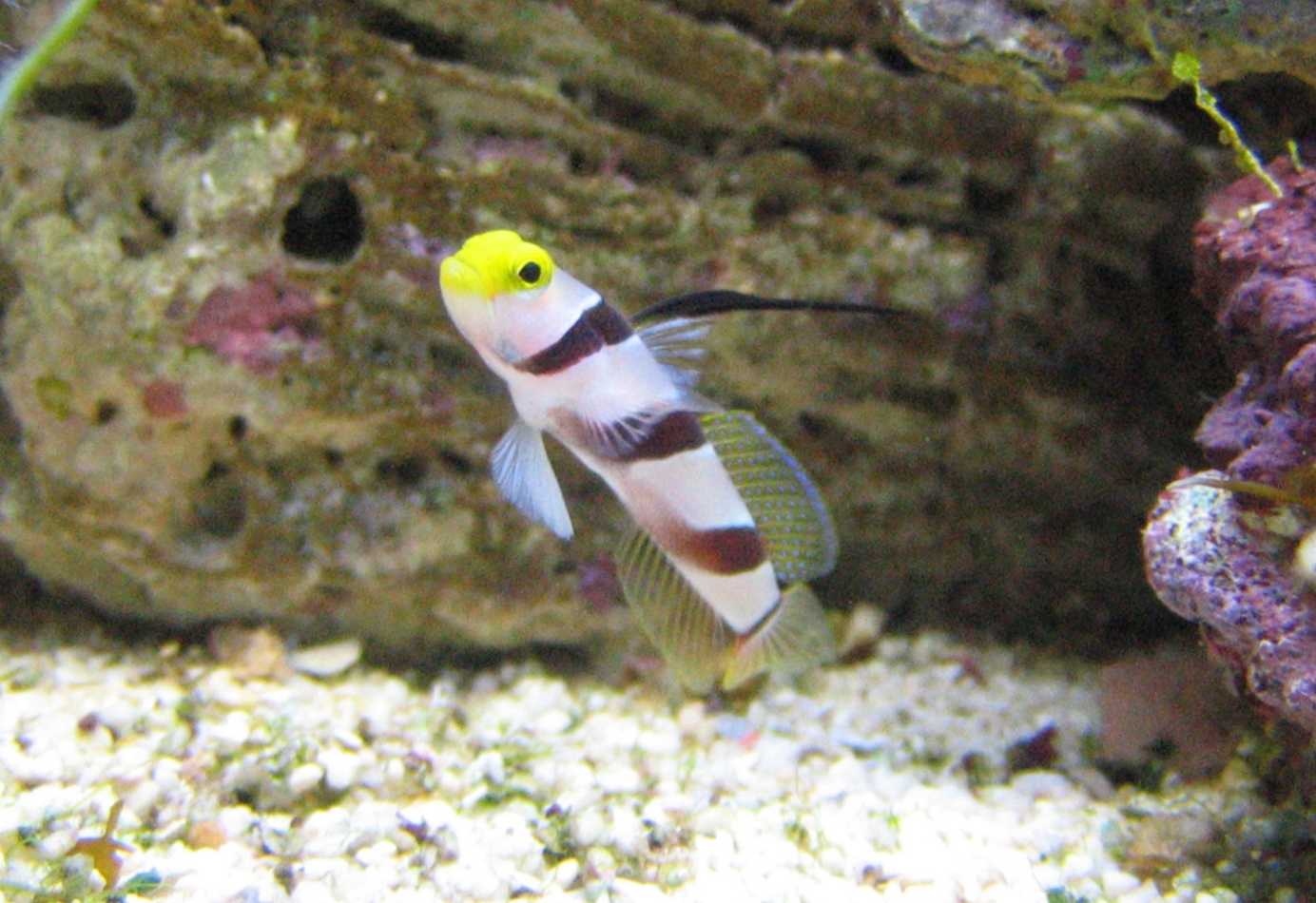
Are typically hardy and do not harm invertebrates which makes them a good choice of fish for a reef tank.
| Common name | Image | Taxonomy | Reef safe | Description | Max size | ||
|---|---|---|---|---|---|---|---|
| Black barred convict goby | Priolepis nocturna | Yes | 4 cm | ||||
| Black clown goby | Gobiodon acicularis | Mostly; can destroy unhealthy Acropora by laying its eggs in the coral's tissue | Similar to Yellow clown goby, but black | ||||
| Bluespotted watchman goby | Cryptocentrus pavoninoides | Yes | 12 cm | ||||
| Catalina goby | [[File:Bluebanded Gobies.jpg | 120px | center]] | Lythrypnus dalli | Yes | A cold water species that doesn't live long at reef temperatures. | 5 cm |
| Cave transparent goby | [[File:Coryphopterus glaucofraenum.jpg | 120px | center]] | Coryphopterus glaucofraenum | Yes | 8 cm | |
| Citron clown goby | [[File:Lemon Goby.jpg | 120px | center]] | Gobiodon citrinus | Mostly; can destroy unhealthy Acropora by laying its eggs in the coral's tissue | 8 cm | |
| Court jester goby | [[File:Rainfordi.jpg | 120px | center]] | Amblygobius rainfordi | 6 cm | ||
| Diagonal bar prawn goby | [[File:HachimakiDHZ.jpg | 120px | center]] | Amblyeleotris diagonalis | Yes | 8 cm | |
| Diamond watchman goby | [[File:Valenciennea puellaris.jpg | 120px | center]] | Valenciennea puellaris | Yes | Burrow and sift sand constantly; very good algae eaters | 20 cm |
| Dracula goby | Stonogobiops dracula | Yes | 8 cm | ||||
| Gold neon eviota goby | Eviota pellucida | Yes | 3 cm | ||||
| Green banded goby | [[File:GreenBandedGoby.jpg | 120px | center]] | Elacatinus multifasciatus | Yes | Small burrowing goby with green vertical stripes | 3.5 cm |
| Green clown goby | Gobiodon atrangulatus | Yes | 4 cm | ||||
| Hector's goby | [[File:Hector's Goby.jpg | 120px | center]] | Amblygobius hectori | Yes | 8 cm | |
| Hi fin red banded goby | [[File:Black-ray goby.jpg | 120px | center]] | Stonogobiops nematodes | Yes | 5 cm | |
| Neon goby | [[File:Elacatinus evelynae.jpg | 120px | center]] | Elacatinus oceanops | Yes | A Caribbean cleaner species that sometimes eats larger parasites from other fish. | |
| Orange marked goby | Amblygobius decussatus | Yes | 8 cm | ||||
| Orange spotted goby | [[File:Amblyeleotris guttata-Orange Spotted Goby.jpg | 120px | center]] | Amblyeleotris guttata | Yes | 9 cm | |
| Orange stripe prawn goby | [[File:Amblyeleotris randalli.jpg | 120px | center]] | Amblyeleotris randalli | Yes | 9 cm | |
| Pinkspotted shrimp goby | [[File:Gobius melanopus - 1.jpg | 120px | center]] | Gobius melanopus | May eat ornamental shrimp | White fish with pink bands around the body and pink spots on face and fins. One of the most handsome members of the group. | 15 cm |
| Pinkbar goby | Cryptocentrus aurora | Yes | 10 cm | ||||
| Red head goby | [[File:Elacatinus puncticulatus.JPG | 120px | center]] | Elacatinus puncticulatus | Yes | A small goby that can clean like the neon goby but is easily frightened. Often said to 'disappear' in a larger tank, as it never swims out into view. | 5 cm |
| Red striped goby | [[File:Candycane Dwarfgoby, Bunaken Island.jpg | 120px | center]] | Trimma cana | Yes | 3 cm | |
| Sleeper banded goby | [[File:Amblygobius phalaena.jpg | 120px | center]] | Amblygobius phalaena | Yes | 15 cm | |
| Sleeper blue dot goby | [[File:Valenciennea sexguttata-6 Spot Sleeper Goby.jpg | 120px | center]] | Valenciennea sexguttata | Yes | 13 cm | |
| Sleeper gold head goby | [[File:Valenciennea strigata.jpg | 120px | center]] | Valenciennea strigata | Yes | 13 cm | |
| Sleeper railway glider goby | Valenciennea helsdingenii | Yes | 15 cm | ||||
| Sleeper striped goby | Valenciennea longipinnis | Yes | 15 cm | ||||
| Steinitz goby | [[File:Amblyeleotris steinitzi.jpg | 120px | center]] | Amblyeleotris steinitzi | Yes | 8 cm | |
| Tangaroa goby | [[File:Ctenogobiops tangaroai.JPG | 120px | center]] | Ctenogobiops tangaroai | Yes | 5 cm | |
| Tiger watchman goby | [[File:SasaHZ.jpg | 120px | center]] | Valenciennea wardii | Yes | 12 cm | |
| Two spot goby | [[File:Signigobius biocellatus.jpg | 120px | center]] | Signigobius biocellatus | Yes | 8 cm | |
| Violet goby | [[File:Gobioides broussonnetii.jpg | 120px | center]] | Gobioides broussonnetii | No | Also a freshwater and brackish water fish and often sold as Dragon Fish or Dragon Goby | 21" |
| Wheeler's watchman goby | [[File:Wheeler's Goby.jpg | 120px | center]] | Amblyeleotris wheeleri | Yes | 8 cm | |
| Yellow watchman goby | [[File:Cryptocentrus cinctus.JPG | 120px | center]] | Cryptocentrus cinctus | Yes | A species of "watchman" or "shrimp" goby that can form a symbiotic relationship with pistol shrimp | 7 cm |
| Yasha goby | [[File:Stonogobiops yasha-Yasha Goby.jpg | 120px | center]] | Stonogobiops yasha | Yes | A species of "watchman" or "shrimp" goby that will form a symbiotic relationship with the red and white banded pistol shrimp, Alpheus randalli. | 6 cm |
| Yellow clown goby | [[File:Yellow clown goby.jpg | 120px | center]] | Gobiodon okinawae | Yes | Small yellow fish that likes branching corals | 3.5 cm |
| Yellow priolepis goby | Priolepis aureoviridis | Yes | 6 cm | ||||
| Yellow stripe clingfish | [[File:HashinagaUU.jpg | 120px | center]] | Diademichthys lineatus | Yes | 5 cm | |
| Flaming Prawn Goby | [[File:Spikefin Goby.jpg | center | 146x146px]] | Discordipinna griessingeri | Yes | A very small goby species with bright colors and a large dorsal fin. Hides in crevices and holes during the day and is nocturnal. | 1.8 cm (0.7in) |
Grunts

| Common name | Image | Taxonomy | Reef safe | Description | Max size | ||
|---|---|---|---|---|---|---|---|
| Crescent banded grunt | [[File:XRF-Terapon jarbua.jpg | 120px | center]] | Terapon jarbua | No | ||
| Dogfish prientalis | [[File:Plectorhinchus lineatus.jpg | 120px | center]] | Plectorhinchus lineatus | No | 86 cm | |
| Oriental sweetlips | [[File:Plectorhinchus orientalis by NPS.jpg | 120px | center]] | Plectorhinchus orientalis | No | 84 cm | |
| Painted sweetlips | [[File:Plectorhinchus picus.jpg | 120px | center]] | Plectorhinchus picus | No | 84 cm | |
| Porkfish | [[File:Anisotremus virginicus photo.jpg | 120px | center]] | Anisotremus virginicus | No | 41 cm | |
| Spotted sweetlips | [[File:Plectorhinchus chaetodonoides.JPG | 120px | center]] | Plectorhinchus chaetodonoides | No | 74 cm | |
| Striped sweetlips | Plectorhinchus diagrammus | No | 51 cm | ||||
| Twostriped sweetlips | Plectorhinchus albovittatus | No | 99 cm |
Hamlet
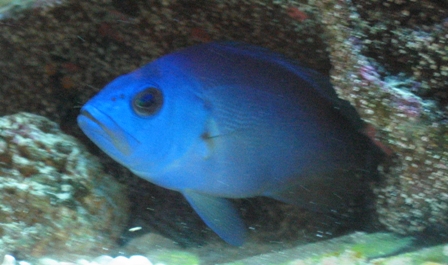
| Common name | Image | Taxonomy | Reef safe | Description | Max size | ||
|---|---|---|---|---|---|---|---|
| Barred hamlet | [[File:Hypoplectrus puella.jpg | 120px | center]] | Hypoplectrus puella | No | 15 cm | |
| Black hamlet | [[File:Hypoplectrus nigricans - pone.0010676.g052.png | 120px | center]] | Hypoplectrus nigricans | No | 15 cm | |
| Blue hamlet | [[File:Blue Hamlet.jpg | 120px | center]] | Hypoplectrus gemma | Not with shrimp | 13 cm | |
| Butter hamlet | [[File:Butterhamlet1.jpg | 120px | center]] | Hypoplectrus unicolor | Not with shrimp | 13 cm | |
| Golden hamlet | Hypoplectrus gummigutta | Not with shrimp | |||||
| Indigo hamlet | [[File:Indigo Hamlet.JPG | 120px | center]] | Hypoplectrus indigo | 14 cm | ||
| Shy hamlet | [[File:Shy Hamlet.jpg | 120px | center]] | Hypoplectrus guttavarius | Not with shrimp | 13 cm |
Hawkfish

Attractive and relatively small, Hawkfish make excellent additions to fish only or FOWLR aquariums. With extreme caution taken, they could be kept in reef aquariums, but because of their propensity to eat small ornamental shrimps and other mobile invertebrates (usually leaving sessile invertebrates alone) they are not considered reef safe. Lacking a swim bladder, Hawkfish can often be found resting in crevices of rocks or among the branches of corals or gorgonians. Hawkfish are easy to care for and not picky at all about water quality. A varied diet, including spirulina and small meaty foods like Mysis is recommended.
| Common name | Image | Taxonomy | Reef safe | Description | Max size | ||
|---|---|---|---|---|---|---|---|
| Arc eye hawkfish | [[File:Arc-Eye Hawkfish.jpg | 120px | center]] | Paracirrhites arcatus | Caution; will eat shrimp | Brown to yellow body with reddish dorsal fin, distinctive white caudal fin, and small semicircular marking behind eye. | 20 cm |
| Blood red hawkfish | Cirrhitichthys fasciatus | Caution; will eat shrimp | 12.7 cm | ||||
| Coral hawkfish | [[File:Cirrhitichthys oxycephalus 1.jpg | 120px | center]] | Cirrhitichthys oxycephalus | Caution; may eat small shrimp | 8.5 cm | |
| Falco's hawkfish | [[File:Dwarfhawkfish.jpg | 120px | center]] | Cirrhitichthys falco | Caution; may eat small shrimp | 7 cm | |
| Flame hawkfish | [[File:Flame Hawkfish Neocirrhites armatus.jpg | 120px | center]] | Neocirrhitus armatus | Caution; may eat small shrimp | Striking red body with black on fin tips and yellow lips. | 9 cm |
| Freckled hawkfish | [[File:Paracirrhites forsteri 3.jpg | 120px | center]] | Paracirrhites forsteri | Caution; will eat shrimp | 22.5 cm | |
| Golden hawkfish | Paracirrhites xanthus | Caution; will eat shrimp | 12 cm | ||||
| Longnose hawkfish | [[File:Long-nose Hawkfish.jpg | 120px | center]] | Oxycirrhites typus | Caution; may eat small shrimp | White with red lattice-like markings resembling a grid. Nose is elongated and tissue between the spines of the dorsal fin is missing. | 13 cm |
| Lyretail hawkfish | Cirrhitichthys polyactis | Caution; may eat small shrimp | 14 cm | ||||
| Redspotted hawkfish | [[File:Amblycirrhitus pinos - pone.0010676.g105.png | 120px | center]] | Amblycirrhitus pinos | Caution; may eat small shrimp | 9.5 cm | |
| Spotted hawkfish | [[File:Cirrhitichthys aprinus.JPG | 120px | center]] | Cirrhitichthys aprinus | Caution; may eat small shrimp | Bright red with distinctive diamond shaped markings down back, becoming darker towards the topside of body. | 12.5 cm |
| Whitespot hawkfish | Paracirrhites hemistictus | Caution; will eat shrimp | 29 cm | ||||
| Yellow hawkfish | [[File:Cirrhitichthys aureus by OpenCage.jpg | 120px | center]] | Cirrhitichthys aureus | Caution; may eat small shrimp | 7 cm |
Hogfish
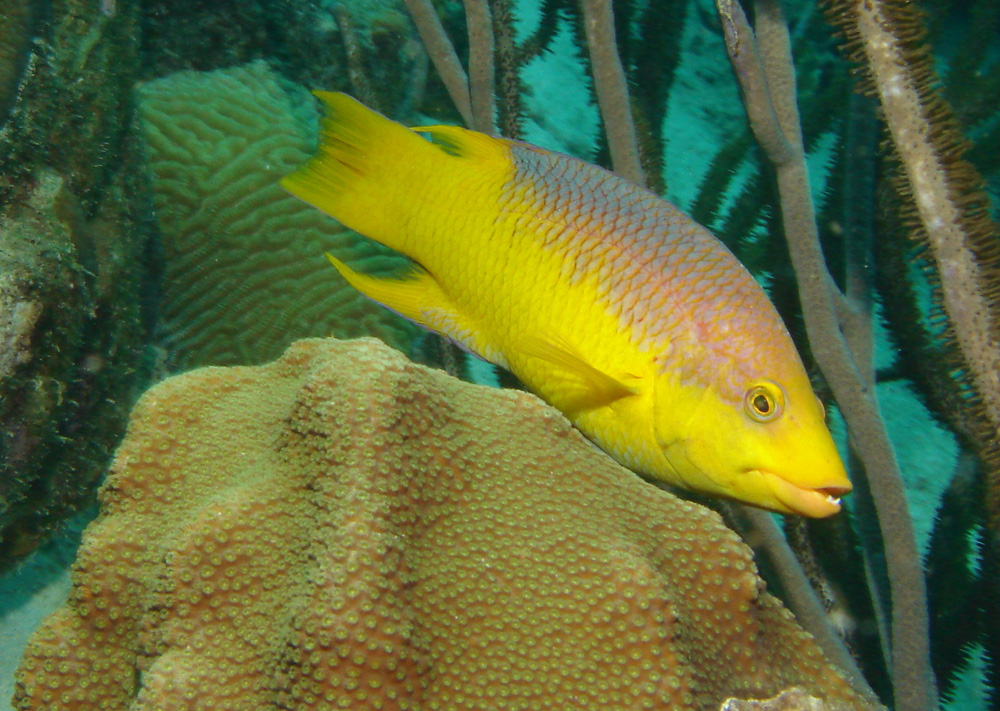
| Common name | Image | Taxonomy | Reef safe | Description | Max size | ||
|---|---|---|---|---|---|---|---|
| Coral hogfish | [[File:Splitlevel hogfish001.jpg | 120px | center]] | Bodianus mesothorax | No | 20 cm | |
| Cuban hogfish | [[File:Spotfin Hogfish.jpg | 120px | center]] | Bodianus pulchellus | Caution | 28.5 cm | |
| Hawaiian hogfish | [[File:Bodianus albotaeniatus by NPS.jpg | 120px | center]] | Bodianus bilunulatus | Caution | 55 cm | |
| Red diana hogfish | [[File:Bodianus diana.jpg | 120px | center]] | Bodianus diana | No | 60 cm | |
| Spanish hogfish | [[File:Spanish-hogfish.jpg | 120px | center]] | Bodianus rufus | No | 40 cm | |
| Twin spot hogfish | [[File:Bodianus cf. bimaculatus.jpg | 120px | center]] | Bodianus bimaculatus | No | 10 cm |
Idols

| Common name | Image | Taxonomy | Reef safe | Description | Max size | ||
|---|---|---|---|---|---|---|---|
| Moorish idol | [[File:Zanclus cornutus in Kona.jpg | 120px | center]] | Zanclus cornutus | With Caution | 23 cm |
Jacks
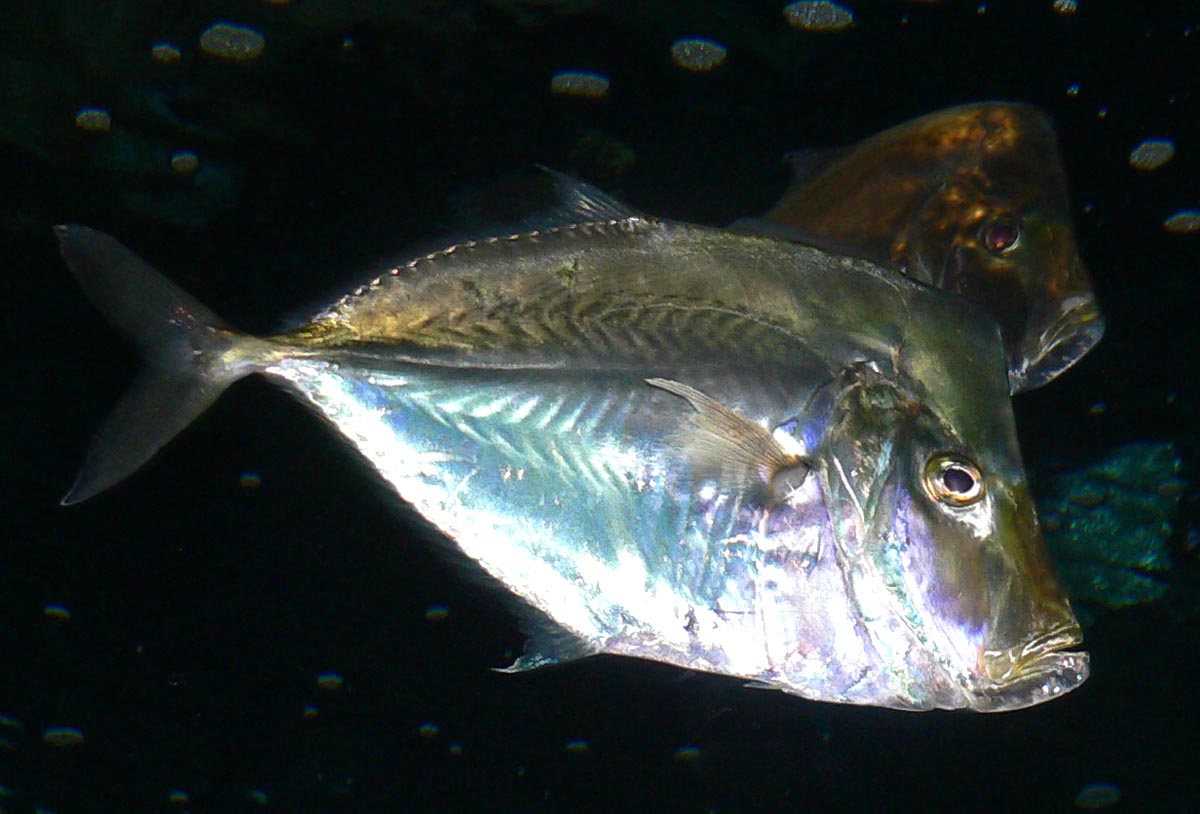
| Common name | Image | Taxonomy | Reef safe | Description | Max size | ||
|---|---|---|---|---|---|---|---|
| Pilot fish | [[File:Carcharhinus longimanus 1.jpg | 120px | center]] | Naucrates ductor | ? | Pilot fish - Wikipedia]] and eat food scraps, ectoparasites, and possibly the feces of their host. Juvenile Golden trevally are occasionally sold as Pilot fish. In the picture, the Pilot fish are hosting an Oceanic whitetip shark. | 70 cm |
| Golden trevally | [[File:Golden trevally (Gnathanodon speciosus) (47728328672).jpg | 120px | center]] | Gnathanodon speciosus | No | ||
| Indian threadfin | [[File:Diamond trevally 2.jpg | 120px | center]] | Alectis indicus | No | 165 cm | |
| Threadfin lookdown | [[File:Selene vomer Nice 226 Lookdown C.jpg | 120px | center]] | Selene vomer | No | 48 cm |
Jawfish
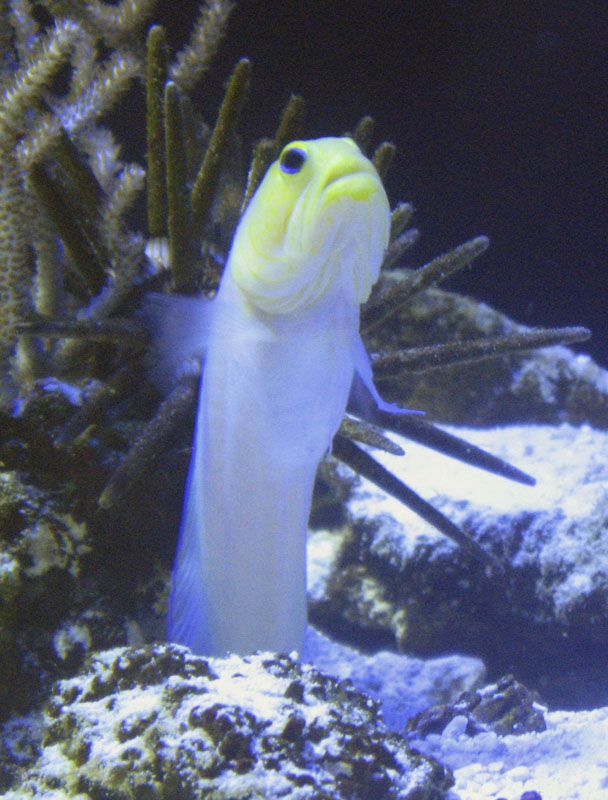
Jawfish are burrowers and require a sandy substrate of sufficient depth.
| Common name | Image | Taxonomy | Reef safe | Description | Max size | ||
|---|---|---|---|---|---|---|---|
| Black cap jawfish | [[File:5 moustache jawfish 220.jpg | 120px | center]] | Opistognathus lonchurus | Almost always | Requires a 30-gallon tank and 3 in substrate. Tank should remain tightly lidded. May eat small shrimp. | 10 cm |
| Blue dot jawfish | Opistognathus rosenblatti | Yes | 9 cm | ||||
| Dusky jawfish | [[File:Opistognathus whitehursti - pone.0010676.g066.png | 120px | center]] | Opistognathus whitehurstii | Yes | Requires a 30-gallon tank and 3 in sand substrate. Tank should remain tightly lidded. | 14 cm |
| Yellowhead jawfish | [[File:Opistognathus aurifrons.jpg | 120px | right]] | Opistognathus aurifrons | Yes | Requires a 30-gallon tank and 5 - soft substrate. Tank should remain tightly lidded. | 10 cm |
Lionfish

"Lionfish" specifically refer to the genus Pterois within the family Scorpaenidae. They have venomous spines and should be treated with caution. Other species within Scorpaenidae but outside Pterois may also have "lionfish" in their common names. Feeder goldfish are not the proper nutrition for a lion fish.
| Common name | Image | Taxonomy | Reef safe | Description | Max size | ||
|---|---|---|---|---|---|---|---|
| Antenneta lionfish | [[File:Pterois antennata 1.jpg | 120px | center]] | Pterois antennata | Caution | 20 cm | |
| Blackfoot lionfish | [[File:SetoMKhire.jpg | 120px | center]] | Parapterois heterura | Caution | 23.0 cm | |
| Devil lionfish | [[File:Fish Aquarium Barcelona.jpg | 120px | center]] | Pterois mombasae | Caution | 20 cm | |
| Fu Man Chu lionfish | [[File:Dendrochirus biocellatus1.JPG | 120px | center]] | Dendrochirus biocellatus | Caution | 13.0 cm | |
| Fuzzy dwarf lionfish | [[File:Dendrochirus brachypterus.jpg | 120px | center]] | Dendrochirus brachypterus | Caution | Carnivore; Males 66 | 18 cm |
| Green lionfish | [[File:Hawaiian Lionfish (Dendrochirus barberi) at the Waikiki Aquarium.JPG | 120px | center]] | Dendrochirus barberi | Caution | 16.5 cm | |
| Radiata lionfish | [[File:Clearfin Lionfish.jpg | 120px | center]] | Pterois radiata | 24 cm | ||
| Russell's lionfish | Pterois russelii | 30 cm | |||||
| Volitan lionfish | [[File:Red Lionfish Pterois volitans Left Side 2460px.jpg | 120px | center]] | Pterois volitans | Caution | Semi-aggressive; carnivore | 43 cm |
| Zebra lionfish | [[File:Pterois zebra.JPG | 120px | center]] | Dendrochirus zebra | Caution | 25 cm |
Parrotfish
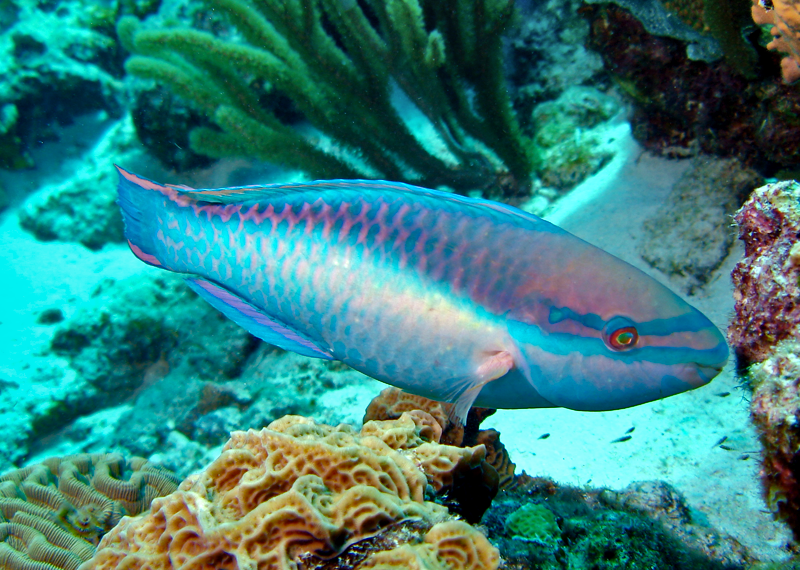
| Common name | Image | Taxonomy | Reef safe | Description | Max size | ||
|---|---|---|---|---|---|---|---|
| Bicolor parrotfish | [[File:Cetoscarus ocellatus.jpg | 120px | center]] | Cetoscarus bicolor | No | 76 cm | |
| Princess parrotfish | [[File:Princess-parrotfish.png | 120px | center]] | Scarus taeniopterus | No | 25 cm |
Pipefish

Pipefish are relatives of seahorses and require a similar level of care. They should only be bought by experienced aquarium owners. Captive bred specimens are sometimes available, and are significantly more likely to survive.
| Common name | Image | Taxonomy | Reef safe | Description | Max size | ||
|---|---|---|---|---|---|---|---|
| Banded pipefish | [[File:Broadbanded Pipefish.jpg | 120px | center]] | Doryrhamphus dactyliophorus | Yes | 20 cm | |
| Dragonface pipefish | [[File:PipeFish.jpg | 120px | center]] | Corythoichthys haematopterus | Yes | 18 cm | |
| Janss' pipefish | Doryrhamphus janssi | Yes | 20 cm | ||||
| Yellow multibanded pipefish | [[File:Banded Pipefish - Doryrhamphus pessuliferus.jpg | 120px | center]] | Doryrhamphus pessuliferus | Yes | 18 cm |
Pseudochromidae
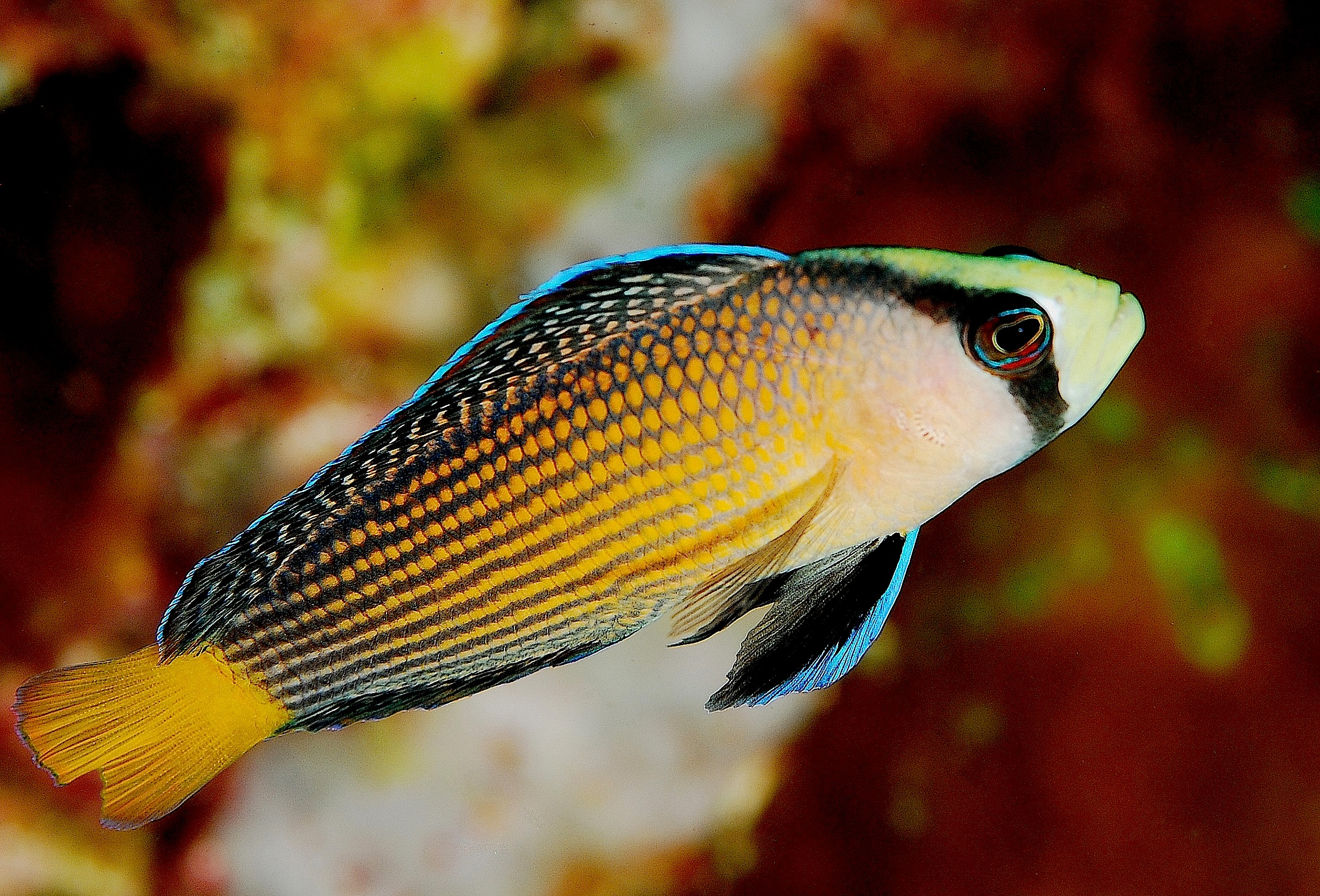
Usually only a single specimen can be kept in an aquarium. Sometimes multiple specimens can be kept in larger aquariums, but usually this requires them to be added at the same time or they will be too territorial.
| Common name | Image | Taxonomy | Reef safe | Description | Max size | ||
|---|---|---|---|---|---|---|---|
| Allen's dottyback | Manonichthys alleni | May eat shrimps | 12 cm | ||||
| Australian multicolor pseudochromis | Ogilbyina novaehollandiae | May eat shrimps | 10 cm | ||||
| Bicolor pseudochromis | [[File:Pictichromis paccagnellae.jpg | 120px | center]] | Pseudochromis paccagnellae | May eat shrimps | Resembles royal gramma in coloration. The bicolor pseudochromis is semi-aggressive and will defend its territory against fish several times its size. This fish is fairly hardy, and is a good beginner fish. | 6 cm |
| Blue flavivertex pseudochromis | [[File:Pseudochromis flavivertex.jpg | 120px | center]] | Pseudochromis flavivertex | May eat shrimps | Captive bred specimens are sometimes available | 8 cm |
| Bluelined dottyback | [[File:Pseudochromis cyanotaenia juvenile.jpg | 120px | center]] | Pseudochromis cyanotaenia | May eat shrimps | 6.1 cm | |
| Brown dottyback or yellow pseudochromis | Pseudochromis aureus | May eat shrimps | 10 cm | ||||
| Cherry dottyback | Pholidochromis cerasina | May eat shrimps | 7.9 cm | ||||
| Dilectus dottyback | Pseudochromis dilectus | May eat shrimps | |||||
| Dusky dottyback | [[File:Pseudochromis fuscus.jpg | 120px | center]] | Pseudochromis fuscus | May eat shrimps | 10 cm | |
| Elongate dottyback | Pseudochromis elongatus | May eat shrimps | 6.4 cm | ||||
| Firetail dottyback | Pseudochromis flammicauda | May eat shrimps | 5.6 cm | ||||
| Fridmani pseudochromis or orchid dottyback | [[File:Pseudochromis fridmani.JPG | 120px | center]] | Pseudochromis fridmani | May eat shrimps | Community fish does well in most aquariums. is not nearly as aggressive as other dottybacks. | 8 cm |
| Longfin dottyback | Manonichthys polynemus | May eat shrimps | 12 cm | ||||
| Lyretail dottyback | Pseudochromis steenei | May eat shrimps | 12 cm | ||||
| Neon pseudochromis, Arabian dottyback or neon dottyback | [[File:Pseudochromis aldabraensis 1.JPG | 120px | center]] | Pseudochromis aldabraensis | May eat shrimps | Captive bred specimens are sometimes available | 10 cm |
| Oblique-lined dottyback | [[File:Cypho purpurascens.jpg | 120px | center]] | Cypho purpurascens | May eat shrimps | 7.4 cm | |
| Orangetail dottyback | Pseudochromis coccinicauda | May eat shrimps | 5.8 cm | ||||
| Purple stripe pseudochromis or diadema basslet | [[File:Pseudochromis Diadema Larry.JPG | 120px | center]] | Pseudochromis diadema | May eat shrimps | 6 cm | |
| Red dottyback | [[File:Labracinus cyclophthalmus.jpg | 120px | center]] | Labracinus cyclophthalmus | With Caution | Large and aggressive for a dottyback | 22 cm |
| Sailfin pseudochromis | Pseudochromis veliferus | May eat shrimps | 12 cm | ||||
| Splendid pseudochromis | [[File:Manonichthys splendens.jpg | 120px | center]] | Pseudochromis splendens | May eat shrimps | 13 cm | |
| Springeri pseudochromis | [[File:Pseudochromis springeri.JPG | 120px | center]] | Pseudochromis springeri | May eat shrimps | Captive bred species are sometimes available | 5 cm |
| Striped dottyback | [[File:Dottyback in a hole.jpg | 120px | center]] | Pseudochromis sankeyi | May eat shrimps | Captive bred specimens are sometimes available | 8 cm |
| Strawberry pseudochromis or purple pseudochromis | [[File:Magenta dottyback, Pictichromis porphyrea.jpg | 120px | center]] | Pseudochromis porphyreus | May eat shrimps | A generally hardy fish, resembles the orchid dottyback, in that the body is a solid purple (sometimes pink), but is missing the black line/marking through the eye characteristic of orchids. This fish semi-aggressive in a home aquarium. | 6 cm |
| Twolined dottyback | Pseudochromis bitaeniatus | May eat shrimps | 6.9 cm | ||||
| Carpet eel-blenny | [[File:Congrogadus subducens 1.jpg | 120px | center]] | Congrogadus subducens | with caution | Despite being eel-like in appearance, Carpet eel-blennies are part of the family pseudochromidae. | 45 cm |
Rabbitfish and Foxfaces

Less commonly kept than some other species, many still make hardy and colorful aquarium residents.
| Common name | Image | Taxonomy | Reef safe | Description | Max size | ||
|---|---|---|---|---|---|---|---|
| Bicolor Foxface | [[File:Fiji rabbitfish Siganus uspi (7594109780).jpg | 120px | center]] | Siganus uspi | With Caution | 24 cm | |
| Blue-Lined Rabbitfish | [[File:Siganus doliatus edit.jpg | 120px | center]] | Siganus doliatus | With Caution | 25 cm | |
| Foxface | [[File:Siganus vulpinus 1 edit.jpg | 120px | center]] | Siganus vulpinus | they have venomous spines | 23 cm | |
| Magnificent foxface | [[File:Siganus magnificus 1.jpg | 120px | center]] | Siganus magnificus | 24 cm | ||
| One Spot Foxface | [[File:Siganus unimaculatus.jpg | 120px | center]] | Siganus unimaculatus | With Caution | 18 cm | |
| Yellow Blotch Rabbitfish | [[File:Siganus guttatis 2.jpg | 120px | center]] | Siganus guttatus | With Caution | 42 cm |
Rays

Most rays have a venomous spine near the base of the tail. Care must be taken to avoid this animal when performing tank maintenance and during capture.
| Common name | Image | Taxonomy | Reef safe | Description | Max size | ||||||||
|---|---|---|---|---|---|---|---|---|---|---|---|---|---|
| Round stingray | [[File:Round stingray.jpg | 120px | center]] | Urobatis halleri | No | Saltwaterfish.com. https://forums.saltwaterfish.com/index.php?threads/cortez-round-stingray-care.382407/ . In: Saltwaterfish.com. https://forums.saltwaterfish.com/index.php | 58 cm | ||||||
| Cortez round stingray | [[File:Urobatis maculatus danzante.jpg | 120px | center]] | Urobatis maculatus | No | date=February 2019}}. May be misidentified with Urobatis halleri as that species is occasionally called the Cortez ray. | 42 cm | ||||||
| Bullseye round stingray | [[File:Urobatis concentricus pescadero.jpg | 120px | center]] | Urobatis concentricus | No | Requires a minimum 180 gallon aquarium. An occasionally available. A hardy species. | 47.5 cm | ||||||
| Leopard round stingray | [[File:Urobatis halleri.jpg | 120px | center]] | Urobatis pardalis | No | Probably is a hardy species. | 46.2 cm | ||||||
| Yellow stingray | [[File:Yellow stingray oregon aquarium.jpg | 120px | center]] | Urobatis jamaicensis | No | Requires a minimum 180 gallon aquarium and readily acclimates to suitable captive environments. It is also readily available in the aquarium trade and will eat any small fish that it can catch. | 76 cm | ||||||
| Chilean round ray | [[File:Urotrygon chilensis.jpg | 120px | center]] | Urotrygon chilensis | No | Requires a minimum 180 gallon aquarium. It is small and well suited for captivity. | 41.9 cm | ||||||
| Bluespotted ribbontail ray | [[File:House reef blue spotted ray 1.jpg | 120px | center]] | Taeniura lymma | No | Requires a minimum 260 gallon aquarium. It is notorious for doing terribly in aquarium confines. Many individuals never eat and others may die or stop feeding for no apparent reason. Force-feeding shows promise with this species. Not to confused with the Bluespotted stingray Neotrygon kuhlii. | 35 cm | ||||||
| Bluespotted stingray | [[File:Bluespotted Stingray (14280727049).jpg | 120px | center]] | Neotrygon kuhlii | No | Requires a minimum 260 gallon aquarium and is quite hardy, however it should not be disturbed as it acclimates to aquarium life (which takes around 2–3 days). Provide it with a 5 cm (2 in) deep fine sand bed. Do not confuse this species with the much less hardy Bluespotted ribbontail ray Taeniura lymma. | 70 cm | ||||||
| Southern stingray | [[File:Dasyatis americana (southern stingray) (San Salvador Island, Bahamas) 7 (16152781622).jpg | 120px | center]] | Hypanus americanus | No | Requires a minimum 4,200 gallon aquarium as this ray grows to a very large size. It is quite hardy, yet it will devour any fish or invertebrate it can capture. | 200 cm | ||||||
| Atlantic stingray | [[File:Hypanus Sabinus.jpg | 120px | center]] | Hypanus sabinus | No | Requires a minimum 135 gallon aquarium. Is relatively small yet may or may not easily adapt to life in an aquarium. It is best kept in saltwater or brackish systems although they can survive in freshwater. | 61 cm | ||||||
| Bluntnose Stingray | [[File:Mandalay Bay Shark Reef Las Vegas - 8114508384.jpg | 120px | center]] | Hypanus say | No | Requires a minimum 560 gallon aquarium. Well suited to captive life. | 100 cm | ||||||
| Reticulated whiptail ray | [[File:Ray at California Academy of Sciences.jpg | 120px | center]] | Himantura uarnak | No | Due to its massive proportions, this occasionally available ray should be avoided. | 200 cm | ||||||
| Red stingray | [[File:Japan stingrays.jpg | 120px | center]] | Hemitrygon akajei | No | Requires a water temperature of in between 15 °C and 25 °C. | 200 cm | ||||||
| Cowtail stingray | [[File:Pastinachus sephen.jpg | 120px | center]] | Pastinachus sephen | No | Like other Whiptail stingrays, Pastinachus sephen should be provided with an aquarium containing a sand bed and little aquascaping. | 183 cm | ||||||
| Common stingaree | [[File:Stingaree gordons bay2.jpg | 120px | center]] | Trygonoptera testacea | No | Seems to be well suited to captive life. | 47 cm | ||||||
| Striped stingaree | [[File:Stingaree in seagrass.jpg | 120px | center]] | Trygonoptera ovalis | No? | Seems to be well suited to captive life although it should be kept at cool temperatures. | 61 cm | ||||||
| Spotted stingaree | [[File:Urolophus gigas museum victoria.jpg | 120px | center]] | Urolophus gigas | No | Seems to be well suited to captive life. | 70 cm | ||||||
| Shovelnose guitarfish | [[File:Pseudobatos productus Aquarium of the Pacific.jpg | 120px | center]] | Pseudobatos productus | No | Requires a minimum 825 gallon aquarium with a 7 cm (2.7 in) deep sand bed and no rockwork. May live for 8 to 10 years in an aquarium. | 119 cm | ||||||
| Atlantic guitarfish | [[File:Rhinobatos lentiginosus panama city.jpg | 120px | center]] | Pseudobatos lentiginosus | No | Requires a minimum 200 gallon aquarium preferably with no aquascaping. Uncommon in the aquarium trade. | 76 cm | ||||||
| Speckled guitarfish | Pseudobatos glaucostigmus | No | Like other guitarfish, it should be kept in an aquarium with a sand bed, much open swimming area, and little rockwork. | 89 cm | |||||||||
| Eastern shovelnose ray | [[File:Aptychotrema rostrata murrays beach.jpg | 120px | center]] | Aptychotrema rostrata | No | Like other guitarfish, it should be kept in an aquarium with a sand bed, much open swimming area, and little rockwork. | 100 cm | ||||||
| Giant shovelnose ray | [[File:Glaucostegus typus.jpg | 120px | center]] | Glaucostegus typus | No | Like other guitarfish, it should be kept in an aquarium with a sand bed, much open swimming area, and little rockwork. | 270 cm | ||||||
| Bowmouth guitarfish | [[File:Rhina ancylostoma okinawa churaumi aquarium.jpg | 120px | center]] | Rhina ancylostoma | No | url = http://www.edgeofexistence.org/species/bowmouth-guitarfish/ | title = Bowmouth Guitarfish Rhina ancylostoma | work = EDGE of Existence | access-date = 2019-07-29 | archive-date = 2019-07-29 | archive-url = https://web.archive.org/web/20190729200506/http://www.edgeofexistence.org/species/bowmouth-guitarfish/ | url-status = live}} | 300 cm |
| Eastern fiddler ray | [[File:Trygonorrhina fasciata jervis bay 2.jpg | 120px | center]] | Trygonorrhina fasciata | No | Requires a minimum 560 gallon aquarium. It is durable but it may have trouble feeding with more agile bony fish tankmates. | 126 cm. | ||||||
| Thornback ray | [[File:Platyrhinoidis triseriata at the Monterey Bay Aquarium.png | 120px | center]] | Platyrhinoidis triseriata | No | Requires a minimum 360 gallon aquarium without any aquascaping. It may consume benthic fishes and its thorns are tangled in nets easily. | 91 cm | ||||||
| Shortnose guitarfish | [[File:Zapteryx brevirostris.jpg | 120px | center]] | Zapteryx brevirostris | No | Requires a minimum 200 gallon aquarium with little aquascaping and preferably a sand bed. Given such an environment, it will readily adapt to captive life. It can create a cave by lifting the center of its body off the ground to lure in potential prey. | 59.3 cm | ||||||
| Banded guitarfish | Zapteryx exasperata | No | Requires a minimum 300 gallon aquarium with a sand bed, much open swimming area, and little rockwork, and a ledge under which to hide under. Under such conditions, it is somewhat hardy. It is rarely encountered in the aquarium trade. | 97 cm | |||||||||
| Southern banded guitarfish | [[File:Zapteryx xyster 2.jpg | 120px | center]] | Zapteryx xyster | No | Is rarely available. Like other guitarfish, it should be kept in an aquarium with a sand bed, much open swimming area, and little rockwork. | 78 cm | ||||||
| Leopard torpedo ray | [[File:Torpedo panthera , Panther electric ray. DSCF2222BE.jpg | 120px | center]] | Torpedo panthera | No | Requires a minimum 180 gallon aquarium with a thick sand bed and little to no decoration. Like other species in the genus Torpedo, Large individuals should be carefully handled as they are capable of shocking their owners. This ray should be kept alone. | 100 cm | ||||||
| Marbled electric ray | [[File:Torpedo marmorata2.jpg | 120px | center]] | Torpedo marmorata | No | It is relatively hardy although it usually will only target moving food. Like other species in the genus Torpedo, Large individuals should be carefully handled as they are capable of shocking their owners. It should also be kept in an aquarium with a thick sand bed and little to no decoration. Not to be confused with the Marbled electric ray (Torpedo sinuspersici). | 100 cm | ||||||
| Marbled electric ray | [[File:Torpedo musandam.jpg | 120px | center]] | Torpedo sinuspersici | No | Torpedo]], Large individuals should be carefully handled as they are capable of shocking their owners. It should also be kept in an aquarium with a thick sand bed and little to no decoration. Not to be confused with the Marbled electric ray (Torpedo marmorata). | 130 cm | ||||||
| Bullseye electric ray | [[File:Bullseye Electric Ray, Diplobatis ommata, Baja California, Mexico.jpg | 120px | center]] | Diplobatis ommata | No | Requires a minimum 40 gallon aquarium and is hard to feed. Like the Lesser electric ray, it can be sustained if fed live food including small grass shrimp and annelid worms and should also be provided with a sand bed 6 cm (2.3 in) deep. Also like the Lesser electric ray, it may shock other tankmates, yet it can be kept with others of its own kind. It is rarely encountered in the aquarium trade. | 25 cm | ||||||
| Lesser electric ray | [[File:Fish4345 - Flickr - NOAA Photo Library.jpg | 120px | center]] | Narcine bancroftii | No | Requires a minimum 70 gallon aquarium. Like the Bullseye electric ray, it can be kept successfully if fed live food such as annelid worms and provided with a layer of sand 6 cm (2.3 in) deep. This ray may shock tankmates although they can be kept with other Lesser electric rays. | 100 cm | ||||||
| Brown numbfish | [[File:Narcine brunnea.jpg | 120px | center]] | Narcine brunnea | No | Like other rays in the genus Narcine, it is difficult to feed (should be fed annelid worms) and should not be kept with rough surfaced rocks. It can be kept with others of its own kind. | 22 cm | ||||||
| Unknown electric ray | Narcine barinnus | No | Like other rays in the genus Narcine, it is difficult to feed (should be fed annelid worms) and should not be kept with rough surfaced rocks. It can be kept with others of its own kind. | ? | |||||||||
| Elat electric ray | Heteronarce bentuviai | No? | Also known as the Eilat Sleeper Ray. | 17.6 cm | |||||||||
| Spiny butterfly ray | [[File:Gymnura altavela.jpg | 120px | center]] | Gymnura altavela | No | Requires a minimum 8,750 gallon aquarium. Like most butterfly rays, it usually does not do well in aquarium confines as it is often hard to feed (thus force feeding shows promise with this species). Also like most butterfly rays, it is an active ray that requires much swimming space like some active sharks. It is rarely available. | 400 cm | ||||||
| Smooth butterfly ray | [[File:Gymnura micrura .jpg | 120px | center]] | Gymnura micrura | No | Like most butterfly rays, it usually does not do well in aquarium confines as it is often hard to feed (thus force feeding shows promise with this species). Also like most butterfly rays, it is an active ray that requires much swimming space like some active sharks. It is rarely available. | 137 cm | ||||||
| California butterfly ray | [[File:Gymnura marmorata huntington beach.jpg | 120px | center]] | Gymnura marmorata | No | Like most butterfly rays, it usually does not do well in aquarium confines as it is often hard to feed (thus force feeding shows promise with this species). Also like most butterfly rays, it is an active ray that requires much swimming space like some active sharks. | 100 cm | ||||||
| Bat ray | [[File:Myliobatis californica monterey bay aquarium.jpg | 120px | center]] | Myliobatis californica | No | Requires a minimum 4,850 gallon aquarium and if given the space, does quite successfully. Unfortunately, they host large amounts of parasites, requiring quarantine and treatments. May jump out of an open aquarium. | 180 cm | ||||||
| Bullnose eagle ray | [[File:Myliobatis freminvillii SI.jpg | 120px | center]] | Myliobatis freminvillei | No | Requires a large system as it is quite large and active. | 100 cm | ||||||
| Southern eagle ray | [[File:Myliobatis goodei, brown topside, clear body shot facing sideways.png | 120px | center]] | Myliobatis goodei | No | Requires a large system as it is quite large and active. | 125 cm | ||||||
| Spotted eagle ray | [[File:Aetobatus narinari 001.jpg | 120px | center]] | Aetobatus narinari | No | Requires a covered, large system as it is quite large, active, and is capable of leaping out of the water. It can be difficult to feed and is very sensitive to trichlorfon. | 330 cm | ||||||
| Cownose ray | [[File:Rhinoptera bonasus Brest.jpg | 120px | center]] | Rhinoptera bonasus | No | saltwatersmarts.com. **. In: Saltwater Smarts. It is also quite active. | 213 cm |
Scorpionfish
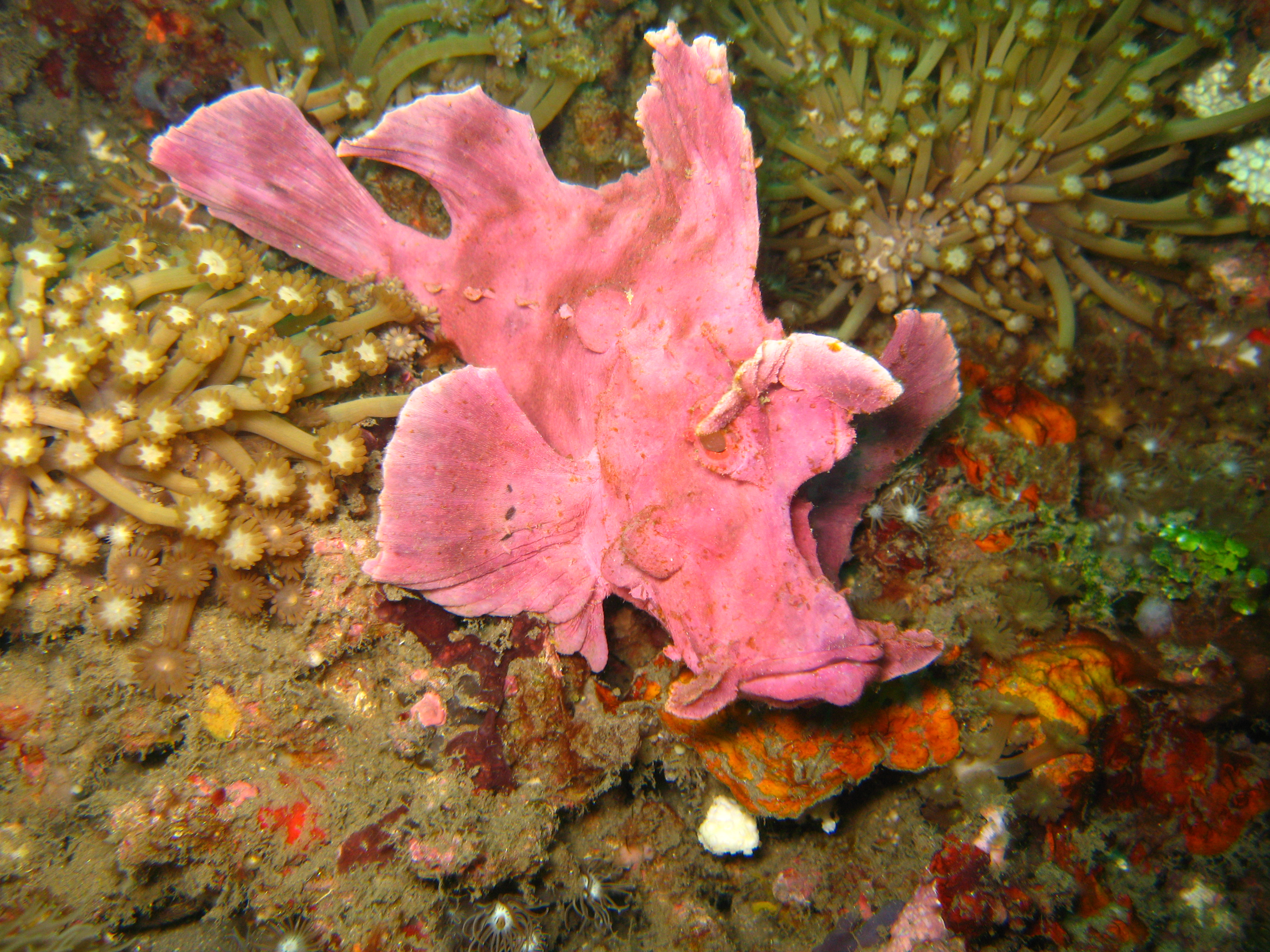
Because they are relatively inactive fishes, most species can be kept in smaller aquariums than other equally large fish, and 30 gallon tanks are not unusual. Because they are capable of eating fish that are surprisingly large, but will often be picked at by fish that eat invertebrates a species tank is often set up for them. Some fish will never accept anything but live food, typically these specimens are fed on gut packed guppies, mollies, or ghost shrimp. Similarly to the lionfish, care should be taken when handling these fish as they are also venomous.
| Common name | Image | Taxonomy | Reef safe | Description | Max size | ||
|---|---|---|---|---|---|---|---|
| Ambon scorpionfish | [[File:Pteroidichthys amboinensis.jpg | 120px | center]] | Pteroidichthys amboinensis | Not with shrimp or small fish | 12 cm | |
| Decoy scorpionfish | Iracundus signifer | Not with shrimp or small fish | 13 cm | ||||
| Eschmeyer's scorpionfish | [[File:Rhinopias eschmeyeri JRM.jpg | 120px | center]] | Rhinopias eschmeyeri | Not with shrimp or small fish | 19 cm | |
| Flasher scorpionfish | Scorpaenopsis macrochir | Not with shrimp or small fish | 13 cm | ||||
| Lacey scorpionfish | [[File:Rhinopias frondosa 3.jpg | 120px | center]] | Rhinopias aphanes | Not with shrimp or small fish | 24 cm | |
| Leaf scorpionfish | [[File:Taenianotus triacanthus.jpg | 120px | center]] | Taenianotus triacanthus | With Caution | 10 cm | |
| Mozambique scorpionfish | Parascorpaena mossambica | Not with shrimp or small fish | 10 cm | ||||
| Papuan scorpionfish | [[File:Papuan Scorpionfish, Bunaken Island.jpg | 120px | center]] | Scorpaenopsis papuensis | Not with shrimp or small fish | 20 cm | |
| Poss's scorpionfish | Scorpaenopsis possi | Not with shrimp or small fish | 19.3 cm | ||||
| Rogue scorpion | Amblyapistus taenianotus | With Caution | 10 cm | ||||
| Sea goblin | [[File:Inimicus didactylus 01.JPG | 120px | center]] | Inimicus didactylus | Not with shrimp or small fish | 18 cm | |
| Stone fish | [[File:Stone Fish at AQWA SMC2006.jpg | 120px | center]] | Synanceja verrucosa | No | Highly venomous! Have caused human deaths | 40 cm |
| Weedy scorpionfish | [[File:Rhinopias_frondosa2.JPG | 120px | center]] | Rhinopias frondosa | Not with shrimp or small fish | 23 cm | |
| Yellowspotted scorpionfish | Sebastapistes cyanostigma | Not with shrimp or small fish | 8 cm |
Seahorses
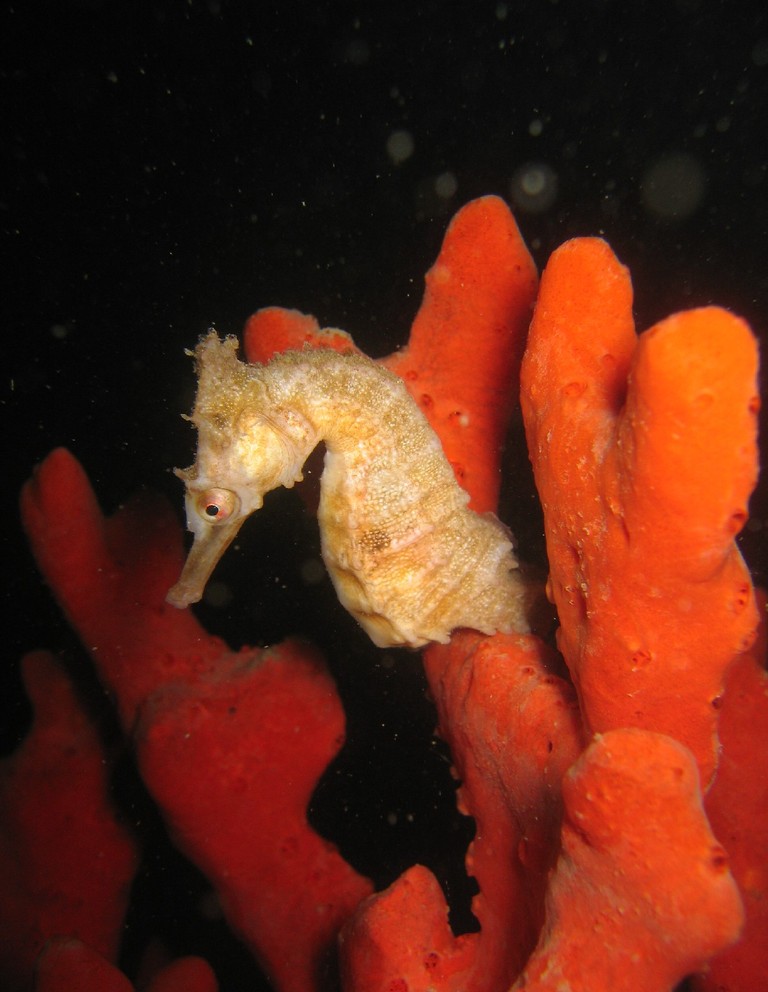
It takes a special aquarist to maintain these delicate beauties. A potential keeper must be dedicated and willing to throw artistic creativity to the winds- as what seahorses need is not always beautiful. They require taller tanks, live/frozen food, and many hitching posts, as well as very peaceful tankmates. In fact, beginners would be well-advised not to mix seahorses with any other species until they have more experience. Good tank mates would include other peaceful, microfauna consuming species such as pipefish and dragonets.
Seahorses found in stores are generally Captive Bred, but occasionally one might find a wild caught (WC) specimen. WC Seahorses should only be purchased by seahorse experts who are going to breed them, as they tend to be finicky and most are endangered in the wild.
One of the advantages of Seahorses is that many species stay small and can (in fact, some should) be kept in smaller tanks, making them ideal for aquarists who are pressed for space or money.
Seahorses are among the few popular marine aquarium species that can be temperate. Species vary in their temperature requirement, so here an extra category has been added.
TR=Tropical ST=Sub-Tropical TM=Temperate
| Common name | Image | Taxonomy | Reef safe | Temp. | Description | Max size | ||
|---|---|---|---|---|---|---|---|---|
| Brazilian seahorse | [[File:Hippocampus reidi by Line1.jpg | 120px | center]] | Hippocampus reidi | Caution | ST | Usually bright yellow, with a particularly long snout. | 17 cm |
| Spotted seahorse | [[File:Seahorse1.JPG | 120px | center]] | Hippocampus kuda | Caution | TR | Generally yellow, but can also range from tan to dark black. | 30 cm |
| Great seahorse | [[File:Hippocampus kelloggi by OpenCage.jpg | 120px | center]] | Hippocampus kelloggi | Caution | ST | Light tan, with some darker specimens. | 28 cm |
| Pot-bellied seahorse | [[File:Hippocampus abdominalis by Zureks.jpg | 120px | center]] | Hippocampus abdominalis | Caution | TM | Light-colored with dark spots and a large abdomen. | 25 cm |
| Pygmy seahorse | [[File:Hippocampus bargibanti3.JPG | 120px | center]] | Hippocampus bargibanti | Caution | TR | White with pink (occasionally yellow) knobby protrusions. | 2.4 cm |
| Short-snouted seahorse | [[File:Hippocampus breviceps 1.jpg | 120px | center]] | Hippocampus breviceps | Caution | TM | Grayish to tan with short snout and a spiny head. | 15 cm |
| Tiger tail seahorse | Hippocampus comes | Caution | TR | Varying colors with dark striped tail. | 18 cm | |||
| Lined Seahorse | [[File:Seahorse-aquarium.jpg | 120px | center]] | Hippocampus erectus | Caution | ST | Dark colored with lighter belly and white ridges. | 19 cm |
| White's Seahorse | [[File:Hippocampus whitei 1.jpg | 120px | center]] | Hippocampus whitei | Caution | TM | Fuller bodied with a comparatively larger head. | 13 cm |
| Dwarf Seahorse | [[File:Hippocampuszosterae.jpg | 120px | center]] | Hippocampus zosterae | Caution | ST | Similar to H. reidi but much smaller. | 5 cm |
| Thorny Seahorse | [[File:Hippocampus hystrix (Spiny seahorse) yellow.jpg | 120px | center]] | Hippocampus histrix | Caution | TR | Varying colors with distinctive spines all over body. | 17 cm |
Squirrelfish

Typically are hardy fish that can be kept with a wide variety of tankmates.
| Common name | Image | Taxonomy | Reef safe | Description | Max size | ||
|---|---|---|---|---|---|---|---|
| Big eye soldierfish | [[File:XRF-Myripristis vittatus.png | 120px | center]] | Myripristis vittata | With Caution | 25 cm | |
| Blackbar soldierfish | [[File:Monaco.Musée océanographique039.jpg | 120px | center]] | Myripristis jacobus | With Caution | 25 cm | |
| Glass eye squirrelfish | [[File:Priacanthus cruentatus.jpg | 120px | center]] | Heteropriacanthus cruentatus | With Caution | 30 cm | |
| Popeye catalufa soldierfish | [[File:Pristigenys serrula 01.jpg | 120px | center]] | Pristigenys serrula | With Caution | 34 cm | |
| Scarlet squirrelfish | Sargocentron tiere | With Caution | 33 cm | ||||
| Striped squirrelfish | [[File:Red Fish at Papahānaumokuākea (cropped).jpg | 120px | center]] | Sargocentron xantherythrum | With Caution | 18 cm |
Sharks
Main article: Sharks in captivity

Many sharks will outgrow most home aquariums and/or adapt poorly to captivity. In a shark aquarium setup (preferably an oval-shaped tank for more active species), there should be much surface area (wide and long tanks with good gas exchange/more room for biological filtration and room for sharks to swim, glide, and turn with little constraint opposed to tall, thin tanks), fine substrate (coarse substrate can irritate the shark's underside), little décor and rockwork (which should be secure) for swimming space (sharks in the orders Orectolobiformes and Heterodontiformes however, feel more secure in tanks with caves and ledges), excellent filtration (sharks are messy eaters and need good water conditions), protected heaters, filter intakes, etc. by surrounding them in polyurethane foam barriers (unprotected equipment can be dangerous to active sharks), and a secure canopy (sharks can jump out of the water) Many sharks feed on invertebrates to a great degree along with fish (even ones that are larger than themselves), and although they don't eat coral, they can knock them over and rest on them. There are also many fish and invertebrates that can harm/irritate sharks such as Scorpionfish, Butterflyfish, Angelfish (large), Filefish, Triggerfish, Pufferfish, Suckerfish (over time), Porcupinefish, certain other sharks, large crabs, Hermit crabs, sea anemones, and stinging corals. Also, sharks need iodine which can be provided through regular water changes or supplements for sharks (iodine deficiencies and possibly the buildup of nitrates can result in goiter), and feeding frequency is species-specific. Copper treatments should not be administered to most shark species.
| Common name | Image | Taxonomy | Reef safe | Description | Max size | |||||||||
|---|---|---|---|---|---|---|---|---|---|---|---|---|---|---|
| Whitespotted bamboo shark | [[File:Chiloscyllium plagiosum head.jpg | 120px | center]] | Chiloscyllium plagiosum | No | last=Michael | first=Scott | title=Aquarium Sharks & Rays | publisher=T.F.H Publications, Inc. | date=2001 | location=Neptune City, NJ}} Does well in home aquaria and will mate/reproduce in larger aquariums. | 83 cm | ||
| Brownbanded bamboo shark | [[File:Brownbanded Bambooshark 2 (5730521104).jpg | 120px | center]] | Chiloscyllium punctatum | No | Requires a minimum 170 gallon aquarium. One of the most common sharks in the North American aquarium trade and does well in home aquaria as it will easily acclimate to captivity and will mate/reproduce in aquariums. Juveniles may take a while to begin feeding if newly acquired. Sometimes called the Banded catshark. | 132 cm | |||||||
| Epaulette shark | [[File:Epaulette shark camden.jpg | 120px | center]] | Hemiscyllium ocellatum | with caution (eats inverts) | Requires a minimum 260 gallon aquarium. One of the best sharks for home aquaria as it will easily acclimate to captivity and will mate/reproduce in aquariums. Adult males might behave aggressively to other male sharks including male Epualette sharks, and harass females. they aren't very active so a 200-gallon may be acceptable | 107 cm | |||||||
| Horn shark | [[File:Heterodontus francisci catalina cropped.jpg | 120px | center]] | Heterodontus francisci | No | Requires a minimum 240 gallon aquarium. A sub-tropical species of shark. The most common bullhead shark in the North American aquarium trade. | 122 cm | |||||||
| Port Jackson shark | [[File:Heterodontus portusjacksoni wilsons promontory.jpg | 120px | center]] | Heterodontus portusjacksoni | No | Requires a minimum 750 gallon aquarium. A sub-tropical species of shark which may be a host to numerous parasites. It will also eat small fish at night. | 165 cm | |||||||
| Coral catshark | [[File:Atelomycterus marmoratus 2.jpg | 100px | center]] | Atelomycterus marmoratus | No | url = http://eol.org/pages/218461/hierarchy_entries/24918945/details | title = Marbled Cat Shark - Atelomycterus marmoratus | access-date = 2018-11-15 | archive-date = 2018-11-16 | archive-url = https://web.archive.org/web/20181116001009/http://eol.org/pages/218461/hierarchy_entries/24918945/details | url-status = live}} which is a different species of shark (Atelomycterus macleayi). | 70 cm | ||
| Marbled catshark | [[File:Atelomycterus macleayi.gif | 120px | center]] | Atelomycterus macleayi | No | Requires a minimum 70 gallon aquarium. Uncommon in the aquarium trade although it is an ideal aquarium species of shark. Commonly confused with the Coral catshark (Atelomycterus marmoratus). Unlike the Coral catshark which is black with white spots and bars, the Marbled catshark is pale with black spots and seven grey saddles and is smaller and more docile. | 60 cm | |||||||
| Nurse shark | [[File:Nurse shark with remoras (cropped).jpg | 120px | center]] | Ginglymostoma cirratum | No | Requires a minimum 4,800 gallon aquarium. Although durable, the Nurse shark will grow too large for most home aquariums. It is an aggressive feeder which will make it harder for you to feed more reclusive sharks and it can knock over/rearrange aquarium decorations in a small aquarium. | 430 cm | |||||||
| Zebra shark | [[File:Zebra Shark Baby.jpeg | 120px | center]] | Stegostoma fasciatum | No | url = https://www.freshmarine.com/zebra-shark.html | title = FreshMarine.com - Zebra Shark - Stegostoma varium | access-date = 2018-11-05 | archive-date = 2018-11-05 | archive-url = https://web.archive.org/web/20181105062024/https://www.freshmarine.com/zebra-shark.html | url-status = live}} A juvenile Zebra shark is shown in the picture while adults are much larger and have pale coloration with black spots. Also called the Leopard shark which is a different species of shark (Triakis semifasciata). | 354 cm | ||
| Leopard shark | [[File:Triakis semifasciata Gratwicke.jpg | 120px | center]] | Triakis semifasciata | No | Requires a minimum 4,500 gallon aquarium. A sub-tropical species of shark and may live a long time in captivity (there are reports of over 20 years). | 198 cm | |||||||
| Banded houndshark | [[File:Triakis scyllium himeji.jpg | 120px | center]] | Triakis scyllium | With Caution | Requires a minimum 750 gallon aquarium. Markings on the shark fade with age but not completely. | 150 cm | |||||||
| Gray smooth-hound | [[File:Smoothhound5.jpg | 120px | center]] | Mustelus californicus | No | Requires a minimum 1,700 gallon aquarium. A sub-tropical and active species of shark that requires a tank with plenty of room to swim which will do better in circular and oval shaped tanks rather than rectangular ones. It will jump out of uncovered aquariums. | 116 cm | |||||||
| Brown smooth-hound | [[File:Mustelus henlei SI.jpg | 120px | center]] | Mustelus henlei | No | Requires a minimum 1,200 gallon aquarium. A sub-tropical and active species of shark that requires a tank with plenty of room to swim. This shark will do better in circular and oval shaped tanks where they can have an uninterrupted swimming pattern rather than rectangular tanks. It will jump out of uncovered aquariums and it is more likely to suffer from shipping stress than its less active relatives. | 100 cm | |||||||
| Tasselled wobbegong | [[File:Eucrossorhinus dasypogon.jpg | 120px | center]] | Eucrossorhinus dasypogon | No | Requires a minimum 360 gallon aquarium. Will eat any fish or crustacean housed with it that can be swallowed entirely. Slow-growing when not overfed. | 125 cm | |||||||
| Japanese wobbegong | [[File:Orectolobus japonicus oita.jpg | 120px | center]] | Orectolobus japonicus | No | Requires a minimum 170 gallon aquarium. Rare in the North American aquarium trade. | 118 cm | |||||||
| Ornate wobbegong | [[File:Orectolobus ornatus 01 Pengo.jpg | 120px | center]] | Orectolobus ornatus | No | Requires a minimum 3,150 gallon aquarium. The Ornate wobbegong will grow too large for most home aquariums and will eat other elasmobranchs. It is the most common wobbegong in the North American aquarium trade. | 290 cm | |||||||
| Spotted wobbegong | [[File:Orectolobus maculatus cod ground.jpg | 120px | center]] | Orectolobus maculatus | No | Requires a minimum 3,150 gallon aquarium. Although durable, the Spotted wobbegong will grow too large for most home aquariums and will eat other elasmobranchs. | 320 cm | |||||||
| Northern wobbegong | [[File:Orectolobus wardi torquoise bay.jpg | 120px | center]] | Orectolobus wardi | No | Requires a minimum 110 gallon aquarium. The Northern wobbegong has a passive personality and a small maximum size, and may not eat initially when it has been added to an aquarium and is rarely collected. An aquarist can handle this shark without a lot fear of getting bitten. | 63 cm | |||||||
| Blacktip reef shark | [[File:Carcharhinus melanopterus mirihi.jpg | 120px | center]] | Carcharhinus melanopterus | No | url = https://www.aquariumbcn.com/especies/en/b-en/blacktip-reef-shark/ | title = » Blacktip reef shark | access-date = 2018-10-21 | archive-date = 2018-10-21 | archive-url = https://web.archive.org/web/20181021111617/https://www.aquariumbcn.com/especies/en/b-en/blacktip-reef-shark/ | url-status = dead}} thus requiring a very large aquarium. | 200 cm | ||
| Whitetip reef shark | [[File:Triaenodon obesus at Red Sea Aquarium by Hatem Moushir 9.JPG | 120px | center]] | Triaenodon obesus | No | Requires a minimum 8,400 gallon aquarium. Can destroy aquarium decorations when moving through the décor to find food. Often has goiter. | 213 cm | |||||||
| Bonnethead shark | [[File:Sphyrna tiburo boston.jpg | 120px | center]] | Sphyrna tiburo | No | Bonnethead - Wikipedia]] | 213 cm | |||||||
| Shark egg case | [[File:Chiloscyllium punctatum egg sunshine international.jpg | 70px | center]][[File:Shark egg capsules.jpg | 70px | center]] | Selachimorpha sp. Egg case (Chondrichthyes) | N/A | url = https://www.liveaquaria.com/product/294/?pcatid=294 | title = Saltwater Aquarium Fish for Marine Aquariums: Shark Egg | access-date = 2018-10-14 | archive-date = 2020-09-30 | archive-url = https://web.archive.org/web/20200930015716/https://www.liveaquaria.com/product/294/?pcatid=294 | url-status = live}} Heterodontus, Scyliorhinidae, and Stegostoma shark egg cases are also available. | Mixed |
Snappers
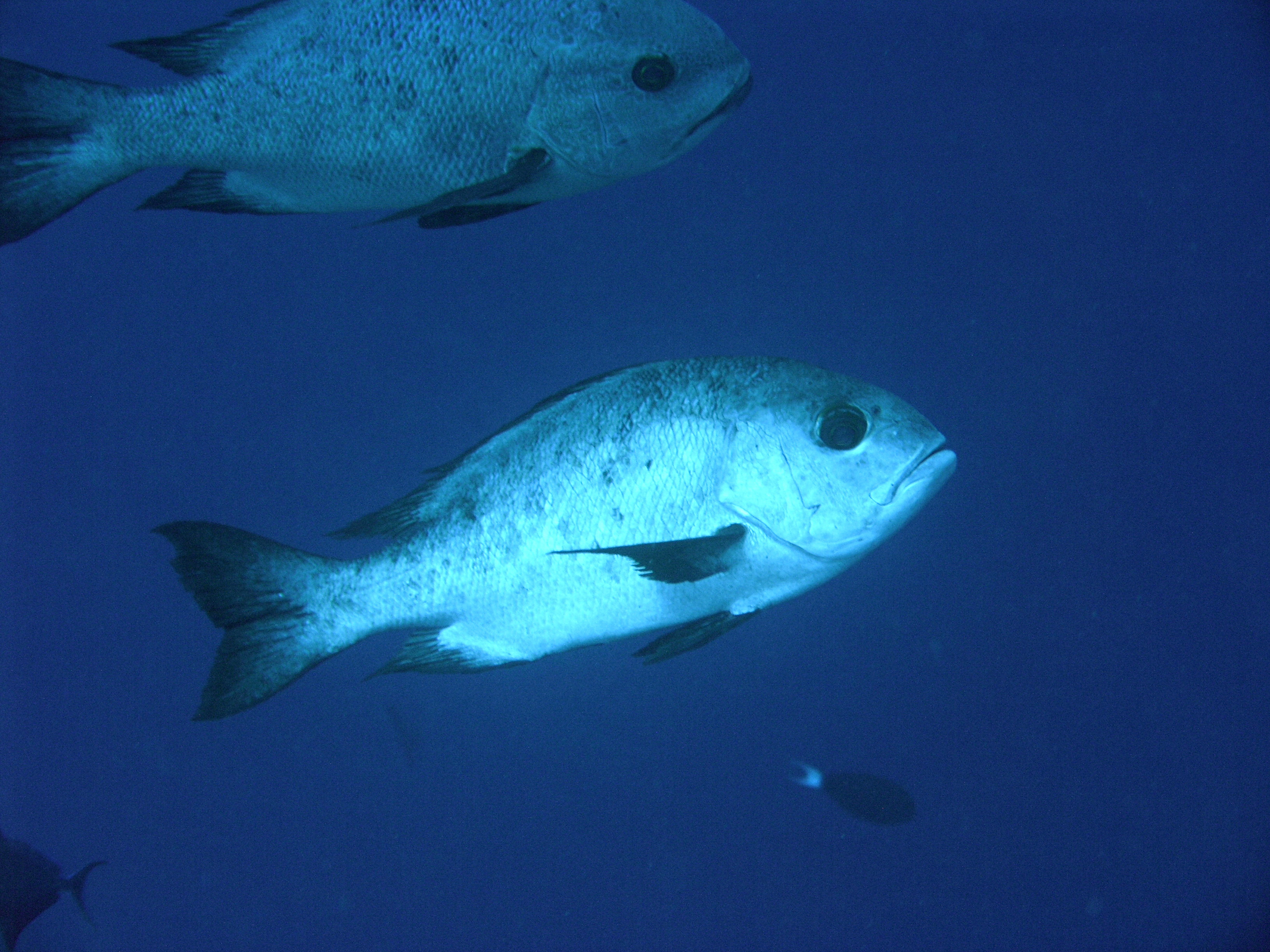
| Common name | Image | Taxonomy | Reef safe | Description | Max size | ||
|---|---|---|---|---|---|---|---|
| Black snapper, black and white snapper | [[File:Macolor niger.JPG | 120px | center]] | Macolor niger | No | 76 cm | |
| Emperor snapper | [[File:Lutjanus sebae.jpg | 120px | center]] | Lutjanus sebae | No | 114 cm | |
| Threadfin snapper | [[File:Monaco.Musée océanographique050.jpg | 120px | center]] | Symphorichthys spilurus | No | 58 cm | |
| Yellowback fusilier | [[File:XRF-Caesio xanthonota.png | 120px | center]] | Caesio xanthonota | No | 38 cm | |
| Yellow-Banded Snapper, Hussar Emperor Snapper | [[File:Luade u0.gif | 120px | center]] | Lutjanus adetii | No | 50 cm |
Tangs

Tangs generally feed on algae, though there are a few carnivorous species. Most tangs will not tolerate other fish the same color and/or shape as them. They have a spine on their tails that can cut open other fish and unprotected hands. All tangs should be given plenty of swimming room; try to have at least a 4' tank. Contrary to popular belief they will tolerate smaller (4' to 5') tanks just fine but tend to live better in larger tanks, over 5'.
| Common name | Image | Taxonomy | Reef safe | Description | Max size | ||
|---|---|---|---|---|---|---|---|
| Achilles tang | [[File:Acanthurus achilles1.jpg | 120px | center]] | Acanthurus achilles | Yes | Passive aggressive. This fish is native to the waters of Hawaii and the South Pacific and therefore requires substantial turbulent flow and circulation to be kept in an aquarium. This fish should only be kept in a six-foot or large aquarium as it requires a large amount of swim room. Very prone to Cryptocaryon irritans | 28 cm |
| Atlantic blue tang | [[File:Blue Tang.jpg | 120px | center]] | Acanthurus coeruleus | Yes | Less aggressive than Achilles or Powder Blue | 16 in |
| Blue eyed tang | [[File:KokutenSHGya.jpg | 120px | center]] | Ctenochaetus binotatus | Yes | ||
| Blue lined surgeonfish | [[File:Acanthurus nigroris by NPS.jpg | 120px | center]] | Acanthurus nigroris | Yes | ||
| Bristletooth tang | [[File:Ctenochaetus striatus.jpg | 120px | center]] | Ctenochaetus striatus | Yes | ||
| Chevron tang | [[File:Ctenochaetus hawaiiensis - Hawaii-Borstenzahndoktorfisch.jpg | 120px | center]] | Ctenochaetus hawaiiensis | Yes | Bright orange when young and dark olive green when transitioned fully to juvenile. | |
| Clown tang | [[File:Acanthurus lineatus Flynn Reef crop.jpg | 120px | center]] | Acanthurus lineatus | Yes | One of the most aggressive tangs | 15 inches |
| Convict tang | [[File:Acanthurus_triostegus_and_Labroides_phthirophagus.jpg | 120px | center]] | Acanthurus triostegus | Yes | ||
| Desjardini tang | [[File:Zebrasoma desjardinii 1.jpg | 120px | center]] | Zebrasoma desjardinii | Yes | ||
| Doctorfish | [[File:Achanturus chirurgs.jpg | 120px | center]] | Acanthurus chirurgus | Yes | ||
| Dussumieri tang | [[File:Acanthurus dussumieri 1.jpg | 120px | center]] | Acanthurus dussumieri | Yes | 53 cm | |
| Eibli mimic tang | Acanthurus tristis | Yes | |||||
| Gold rim tang | [[File:Acanthurus nigricans by NPS.jpg | 120px | center]] | Acanthurus nigricans | Yes | ||
| Regal / Hippo tang | [[File:Blue tang (Paracanthurus hepatus) 02.jpg | 120px | center]] | Paracanthurus hepatus | Yes | Very prone to Cryptocaryon irritans. More tolerant of other tangs than most other species. | |
| Kole tang | [[File:Ctenochaetus strigosus 1.jpg | 120px | center]] | Ctenochaetus strigosus | Yes | ||
| Lavender tang | [[File:Acanthurus nigrofuscus by NPS.jpg | 120px | center]] | Acanthurus nigrofuscus | Yes | ||
| Lopezi tang | Naso lopezi | Yes | |||||
| Mimic tang, Chocolate tang | [[File:Chocolate tang - Acanthurus pyroferus.jpg | 120px | center]] | Acanthurus pyroferus | Yes | ||
| Naso tang, blonde naso tang | [[File:Naso lituratus 2.jpg | 120px | center]] | Naso lituratus | Yes | ||
| Orange shoulder tang | [[File:Acanthurus olivaceus 1.jpg | 120px | center]] | Acanthurus olivaceus | Yes | ||
| Powder blue tang | [[File:Acanthurusleucosternon-Weißkehl.jpg | 120px | center]] | Acanthurus leucosternon | Yes | Very prone to Cryptocaryon irritans. | |
| Powder brown tang | [[File:Acanthurus japonicus.jpg | 120px | center]] | Acanthurus japonicus | Yes | ||
| Purple tang | [[File:Zebrasoma xanthurum pair.jpg | 120px | center]] | Zebrasoma xanthurum | Yes | ||
| Sailfin tang | [[File:Zebrasoma veliferum by NPS.jpg | 120px | center]] | Zebrasoma veliferum | Yes | ||
| Scopas tang | [[File:Zebrasoma scopas.1 - Aquarium Finisterrae.JPG | 120px | center]] | Zebrasoma scopas | Yes | Similar to the yellow tang in shape and feeding. | |
| Sohal tang | [[File:Acanthurussohal-ArabischerDoktor.jpg | 120px | center]] | Acanthurus sohal | Yes | One of the larger more aggressive tangs | 40 cm |
| Tennent tang | [[File:Acanthurus tennenti Kreisdorn-Doktorfisch3.jpg | 120px | center]] | Acanthurus tennenti | Yes | ||
| Thompson's surgeonfish | [[File:XRF-Acanthurus thompsoni.png | 120px | center]] | Acanthurus thompsoni | Yes | 28 cm | |
| Tomini tang | [[File:Ctenochaetus tominiensis 3.JPG | 120px | center]] | Ctenocheatus tominiensis | Yes | This fish requires ample swimming room and is difficult to feed. | |
| Unicorn tang | [[File:Nasounicornis-Blauklingen.jpg | 120px | center]] | Naso unicornis | Yes | ||
| Vlamingi tang | [[File:Acanthuridae - Naso vlamingii.jpg | 120px | center]] | Naso vlamingii | Yes | ||
| White freckled surgeon | Acanthurus maculiceps | Yes | |||||
| Yellow tang | [[File:Zebrasoma flavescens Luc Viatour.jpg | 120px | center]] | Zebrasoma flavescens | Yes | ||
| Yellowfin surgeon | [[File:Acanthurus xanthopterus by NPS.jpg | 120px | center]] | Acanthurus xanthopterus | Yes |
Tilefish
Though often categorized as gobies, tilefish are a separate species.
| Common name | Image | Taxonomy | Reef safe | Description | Max size | ||
|---|---|---|---|---|---|---|---|
| Blue-headed tilefish | [[File:Bluehead tilefish.jpg | 120px | center]] | Hoplolatilus starcki | 10 cm | ||
| Purple tilefish | Hoplolatilus purpureus | 15 cm | |||||
| Yellow tilefish | Hoplolatilus luteus | 15 cm | |||||
| Redlined tilefish | Hoplolatilus marcosi |
Triggerfish

While they are generally considered monsters that will chomp invertebrates, a few species can make great reef fish. Other more aggressive species such as the undulated trigger, and clown trigger will sometimes be so aggressive that it is necessary to keep as the sole inhabitant of the aquarium. All will require large tanks, with good filtration.
| Common name | Image | Taxonomy | Reef safe | Description | Max size | ||
|---|---|---|---|---|---|---|---|
| Assasi trigger | [[File:Rhinecanthus assasi - Rotmeer-Picassodrueckerfisch 0532a.jpg | 120px | center]] | Rhinecanthus assasi | No | 30 cm | |
| Blue jaw trigger / blue throat trigger | [[File:2005-03-01 - Gilded triggerfish.jpg | 120px | center]] | Xanthichthys auromarginatus | Widely regarded as the only reef safe trigger. | 30 cm | |
| Blue line trigger | [[File:Pseudobalistes fuscus, Blue triggerfish.jpg | 120px | center]] | Pseudobalistes fuscus | No | 55 cm | |
| Bursa trigger | [[File:Rhinecanthus verrucosus.jpg | 120px | center]] | Rhinecanthus verrucosus | No | 23 cm | |
| Clown trigger | [[File:Clown Triggerfish Balistoides conspicillum Side 1888px.jpg | 120px | center]] | Balistoides conspicillum | No | 50 cm | |
| Crosshatch trigger | Xanthichthys mento | No | A shy reserved fish when first added to the aquarium, comes into its own when it associates itself with the aquarist. Infrequently available | 29 cm | |||
| Goldenback trigger | Xanthichthys caeruleolineatus | No | Rarely available | 35 cm | |||
| Golden heart trigger | [[File:Balistespunctatus.jpg | 120px | center]] | Balistes punctatus | No | 61 cm | |
| Halfmoon trigger | [[File:Sufflamen chrysopterum.jpg | 120px | center]] | Sufflamen chrysopterum | No | 30 cm | |
| Hawaiian black trigger | [[File:Melichthys niger on Kona.jpg | 120px | center]] | Melichthys niger | No | 50 cm | |
| Lei trigger | [[File:Sufflamen bursa.jpg | 120px | center]] | Sufflamen bursa | No | 25 cm | |
| Indian black trigger | [[File:Black triggerfish.jpg | 120px | center]] | Melichthys indicus | No | 25 cm | |
| Niger trigger | [[File:Redtoothed triggerfish.jpg | 120px | center]] | Odonus niger | No | Among the more peaceful of triggers, can usually be kept in a community tank | 50 cm |
| Picasso trigger | [[File:Picasso.triggerfish.arp.jpg | 120px | center]] | Rhinecanthus aculeatus | No | 30 cm | |
| Pinktail trigger | [[File:Pink Tail Triggerfish in kona.jpg | 120px | center]] | Melichthys vidua | No | 40 cm | |
| Queen trigger | [[File:Balistes vetula - 01.jpg | 120px | center]] | Balistes vetula | No | A large fish that should only be kept in very large aquariums. | 60 cm |
| Rectangular trigger | [[File:Reef Triggerfish 1.JPG | 120px | center]] | Rhinecanthus rectangulus | No | 30 cm | |
| Sargassum trigger | [[File:Sargassum triggerfish Xanthichthys ringens.jpg | 120px | center]] | Xanthichthys ringens | No | A shy reserved fish when first added to the aquarium, comes into its own when it associates itself with the aquarist. Infrequently available | 25 cm |
| Starry trigger | [[File:Abalistes stellatus.jpg | 120px | center]] | Abalistes stellatus | No | 60 cm | |
| Titan trigger | [[File:Titan triggerfish (Balistoides viridescens).jpg | 120px | center]] | Balistoides viridescens | No | Can only be housed in the largest of marine aquariums | 75 cm |
| Undulated trigger | [[File:Pez ballesta ondulado (Balistapus undulatus), mar Rojo, Egipto, 2023-04-15, DD 45.jpg | 120px | center]] | Balistapus undulatus | No | Probably the most aggressive fish kept in marine aquariums. Older specimens should be housed alone. | 30 cm |
| Whitetail trigger | [[File:Blue-throated triggerfish (Xanthichthys auromarginatus).jpg | 120px | center]] | Sufflamen albicaudatum | With Caution | 22 cm |
Wrasse

A diverse group of fish with an equally wide range of characteristics. Some wrasse species are aggressive towards small fish and invertebrates, others are reef safe. Some are quite hardy, some typically die within weeks.
| Common name | Image | Taxonomy | Reef safe | Description | Max size | ||
|---|---|---|---|---|---|---|---|
| Banana wrasse | [[File:Thalassoma lutescens.jpg | 120px | center]] | Thalassoma lutescens | No | 30 cm | |
| Bicolor cleaner wrasse | [[File:Labroides bicolor.jpg | 120px | center]] | Labroides bicolor | Yes | ||
| Bird wrasse | [[File:Bird Wrasse.jpg | 120px | center]] | Gomphosus varius | No | 28 cm | |
| Bluehead wrasse | [[File:Blue-headed wrasse det.jpg | 120px | center]] | Thalassoma bifasciatum | With Caution | 28 cm | |
| Bluestreak cleaner wrasse | [[File:Bluestreak Cleaner Wrasse (6997583331).jpg | 120px | center]] | Labroides dimidiatus | Yes | as the names suggests it is a cleaner fish and will eat some parasites | |
| Carpenter's flasher wrasse | [[File:Paracheilinus carpenteri.jpg | 120px | center]] | Paracheilinus carpenteri | Yes; feeds on tiny organisms | 8 cm | |
| Cheeklined maori wrasse | Cheilinus diagrammus | No | 36 cm | ||||
| Christmas wrasse | [[File:Thalassoma trilobatum by NPS.jpg | 120px | center]] | Thalassoma trilobatum | No | 15 cm | |
| Cortez rainbow wrasse | [[File:Thalassomalucasanumcropped.JPG | 120px | center]] | Thalassoma lucasanum | No | 15 cm | |
| Dragon wrasse | [[File:Cleaning station konan.jpg | 120px | center]] | Novaculichthys taeniourus | No | 30 cm | |
| Eight line wrasse | [[File:Wrasse55.jpg | 120px | center]] | Pseudocheilinus octotaenia | Yes; feeds on tiny organisms | ||
| Exquisite fairy wrasse | Cirrhilabrus exquisitus | Yes; feeds on tiny organisms | 10 cm | ||||
| Fine-spotted fairy wrasse | Cirrhilabrus punctatus | Yes; feeds on tiny organisms | 10 cm | ||||
| Flame wrasse | [[File:Cirrhilabrus jordani.jpg | 120px | center]] | Cirrhilabrus jordani | Yes | 10 cm | |
| Formosa wrasse | [[File:XRF-Coris formosa.png | 120px | center]] | Coris formosa | No | 61 cm | |
| Four line wrasse | [[File:Pseudocheilinus tetrataenia.jpg | 120px | center]] | Pseudocheilinus tetrataenia | Yes; feeds on tiny organisms | ||
| Goldbar wrasse | [[File:Wrasse Seychelles.jpg | 120px | center]] | Thalassoma hebraicum | With Caution | 23 cm | |
| Greenback fairy wrasse | Cirrhilabrus scottorum | Yes; feeds on tiny organisms | 15 cm | ||||
| Harlequin tusk | [[File:Choerodon fasciatus.jpg | 120px | center]] | Choerodon fasciatus | Generally, yes, but may eat shrimp | ||
| Hawaiian cleaner wrasse | [[File:Hawaiian cleaner wrasse.jpg | 120px | center]] | Labroides phthirophagus | Yes | ||
| Hoeven's wrasse | [[File:Halichoeresmelanurus1.jpg | 120px | center]] | Halichoeres melanurus | With Caution | 13 cm | |
| Jansen saddle wrasse | [[File:YansenNBR.jpg | 120px | center]] | Thalassoma jansenii | No | 20 cm | |
| Labout's fairy wrasse | Cirrhilabrus laboutei | Yes | 8 cm | ||||
| Leopard wrasse | [[File:Macropharyngodon meleagris.jpg | 120px | center]] | Macropharyngodon meleagris | Yes | 15 cm | |
| Lineatus fairy wrasse | Cirrhilabrus lineatus | Yes | 13 cm | ||||
| Longfin fairy wrasse | Cirrhilabrus rubriventralis | Yes | 8 cm | ||||
| Lyretail wrasse/Moon wrasse | [[File:Thalassoma lunare.jpg | 120px | center]] | Thalassoma lunare | No | 25 cm | |
| Marble wrasse | [[File:Halichoeres hortulanus 1.JPG | 120px | center]] | Halichoeres hortulanus | No | 28 cm | |
| McCosker's flasher wrasse | Paracheilinus mccoskeri | Yes | 15 cm | ||||
| Multicolor lubbock's wrasse | [[File:Labre de Lubbock (Cirrhilabrus lubbocki).jpg | 120px | center]] | Cirrhilabrus lubbocki | Yes; feeds on tiny organisms | 8 cm | |
| Multicolor velvet wrasse | [[File:Bluehead Fairy Wrasse – Cirrhilabrus cyanopleura crop.jpg | 120px | center]] | Cirrhilabrus cyanopleura | Yes; feeds on tiny organisms | ||
| Mystery wrasse | [[File:MysteryWrasse.jpg | 120px | center]] | Pseudocheilinus ocellatus | Yes | ||
| Orange-back fairy wrasse | Cirrhilabrus aurantidorsalis | Yes | 13 cm | ||||
| Pastel-green wrasse | [[File:Halichoeres chloropterus.jpg | 120px | center]] | Halichoeres chloropterus | With Caution | 20 cm | |
| Pinkface wrasse | [[File:Labridae - Thalassoma quinquevittatum-001.JPG | 120px | center]] | Thalassoma quinquevittatum | With Caution | 15 cm | |
| Potter's wrasse | [[File:Shortnose Wrasse.jpg | 120px | center]] | Macropharyngodon geoffroyi | Yes; feeds on tiny organisms | ||
| Red coris wrasse | [[File:Coris gaimard real.jpg | 120px | center]] | Coris gaimard | No | 36 cm | |
| Red-head fairy wrasse | [[File:Cirrhilabrus solorensis-2.jpg | 120px | center]] | Cirrhilabrus solorensis | Yes; feeds on tiny organisms | 13 cm | |
| Red velvet wrasse | Cirrhilabrus rubrisquamis | Yes | 8 cm | ||||
| Scarlet pin stripe wrasse | [[File:Pseudocheilinus evanidus.jpg | 120px | center]] | Pseudocheilinus evanidus | Yes | 8 cm | |
| Six line wrasse | [[File:Six-line wrasse.jpg | 120px | center]] | Pseudocheilinus hexataenia | Yes | Small pink fish with six purple horizontal lines. Sometimes added to help control flatworms or parasitic snail populations. Semi-aggressive and may pick on shy fish. | 8 cm |
| Radiant wrasse | [[File:Halichoeres iridis 2.jpg | 120px | center]] | Halichoeres iridis | Yes | 15 cm | |
| Rhomboid fairy wrasse | Cirrhilabrus rhomboidalis | Yes | Golden body with purple horizontal stripes on head. | 13 cm | |||
| Whip fin fairy wrasse | Cirrhilabrus filamentosus | Yes | 9 cm | ||||
| Yellow wrasse | [[File:Halichoeres chrysus-Yellow Wrasse.jpg | 120px | center]] | Halichoeres chrysus | Yes | Yellow body with three or occasionally four black dots on dorsal fins. Require sand bed for sleeping. | 13 cm |
| Yellow & purple wrasse | Halichoeres trispilus | Yes | 13 cm | ||||
| Yellowband wrasse | Cirrhilabrus luteovittatus | Yes | 13 cm | ||||
| Yellow fin fairy wrasse | [[File:Cirrhilabrus flavidorsalis.jpg | 120px | center]] | Cirrhilabrus flavidorsalis | Yes | 8 cm | |
| Yellow-flanked fairy wrasse | Cirrhilabrus lyukyuensis | Yes | 10 cm |
References
References
- Michael, Scott. (December 2003). "Beautiful Holocanthus Angels". Aquarium Fish Magazine.
- Fenner, Robert. (2001). "The Conscientious Marine Aquarist: A Commonsense Handbook for Successful Saltwater Hobbyists". THF Publications.
- "Aquarium Fish: Large Angels in the Home Aquarium, Part 1".
- "Aquarium Fish: Large Angels in the Home Aquarium, Part II".
- "Marine Angelfishes, Family Pomacanthidae".
- {{FishBase. (2008)
- {{FishBase. (2008)
- {{FishBase. (2008)
- {{FishBase. (2008)
- {{FishBase. (2008)
- {{FishBase. (2008)
- {{FishBase. (2008)
- {{FishBase. (2008)
- {{FishBase. (2008)
- {{FishBase. (2008)
- {{FishBase. (2008)
- {{FishBase. (2008)
- {{FishBase. (2008)
- {{FishBase. (2011)
- Hargreaves, Vincent. (2006). "The Complete Book of the Marine Aquarium". Thunder Bay Press.
- "What a Darling Little Angel: The Genus Centropyge".
- "The Pygmy Angelfishes".
- {{FishBase. (2008)
- {{FishBase. (2008)
- {{FishBase. (2008)
- {{FishBase. (2008)
- {{FishBase. (2008)
- {{FishBase. (2008)
- {{FishBase. (2008)
- {{FishBase. (2008)
- {{FishBase. (2008)
- {{FishBase. (2008)
- {{FishBase. (2008)
- {{FishBase. (2008)
- "Anthiinae - the Fancy Basses".
- "Aquarium Fish: The Hinds of the Genus Cephalopholis".
- "The Basses, Family Serranidae".
- "The Basses Called Hinds, Genus Cephalopholis".
- "The Soapfishes, Family Grammistidae, or Tribe Grammistini of the Serranidae, in part, or...".
- "Some Guys Like 'em Big:The Genus Plectropomus".
- "The Comet (Calloplesiops altivelis)".
- "The Roundhead Called the Marine Betta, Calloplesiops altivelis, Family Plesiopsidae".
- "Grammas".
- "Yellow Assessor, Assessor flavissimus".
- "Blennioids: Blennies and Blenny-Like Fishes".
- "All My Puffers, Tobies, Box, Porcupine, Cowfishes".
- "Butterflyfishes; Separating the Good Ones and Those You Don't Want".
- "Cardinals Not Named Pujols, Womack, or Edmonds:The Genus Cheilodipterus".
- Michael, Scott. (2005). "Reef Aquarium Fishes, 500+ Essential-To-Know Species". T.F.H Publications, Inc..
- "Friendly Damsels? It Can't be Possible!… The Genus Chromis".
- "The Damsel and Anemonefishes, Family Pomacentridae".
- "Time to Quit Clownin' Around: The Subfamily Amphiprioninae".
- "Tiny (and one not so tiny) Terrors of the Sea: Damsels of the Genus Dascyllus".
- "Small-Man's Complex: The Genus Stegastes".
- "Firefishes, Dartfishes, Wormfishes, Family Microdesmidae, Subfamily Ptereleotrinae".
- "Worms Not Found in the Sandbed: The Genus Ptereleotris".
- "Mandarins, Psychedelic "Gobies", Dragonets, Scooter Blennies....YAH! Family Callionymidae".
- (December 2017). "...I'd like to buy a Mandarin!".
- "Mandarinfish, Synchiropus splendidus (syn. Pterosynchiropus splendidus)".
- "The Moray Eels, Family Muraenidae".
- "A Serpent For Your Reef Tank:A Look at Fish-Safe Eels".
- "Behold the Dragon!".
- "Filefishes, Family Monacanthidae".
- "Files Not Meant For Your Toolbox (or Reef Aquarium!):The Genus Pervagor".
- "The Bizarre Frogfishes, Anglerfishes, Order".
- "Mulling Over the Goatfishes, Family Mullidae".
- "Aquarium Fish: Gobies of the Genus Amblygobius".
- "The Fish Of Which Dreams (or Nightmares) Are Made: The Genus Valenciennea".
- "Hawkfishes, Family Cirrhitidae".
- Pilot fish - Wikipedia]]
- "Naucrates doctor, Pilotfish : fisheries, gamefish, aquarium".
- "Let's Jaw About Jawfish".
- "The Scorpionfishes We Call Lions, Family Scorpaenidae, subfamily Pteroinae".
- "Twinspot Lionfish (Dendrochirus biocellatus)".
- "There's More to Pipes Than Just PVC:The Genus Doryrhamphus and Other Pipefish".
- "The Dottybacks".
- "The Fishes We Call Rabbits, Family Siganidae".
- "You Silly Rabbit: The Genus Siganus".
- "Blue-Lined Rabbitfish, Siganis doliatus".
- "Urolophus halleri, Haller's round ray : fisheries, gamefish".
- (2017): Leopard Round Stingray - Profile. link. (2019-02-14 ''. In: Shark & Ray Central. [https://www.tapatalk.com/groups/sharksandrays/] {{Webarchive). link. (2018-12-20)
- "Urobatis pardalis".
- "Saltwater Aquarium Fish for Marine Aquariums: Chilensis Round Stingray".
- (2014): ID me please. link. (2019-02-16 ''. In: Shark & Ray Central. [https://www.tapatalk.com/groups/sharksandrays/] {{Webarchive). link. (2018-12-20)
- "Urotrygon chilensis, Blotched stingray".
- "Himantura uarnak, Honeycomb stingray : fisheries, gamefish".
- "Stingray baby Dasyatis akajei (8-10 cm) 1 animal".
- "Hemitrygon akajei, Whip stingray : fisheries, aquarium".
- "Rhina ancylostoma, Bowmouth guitarfish : fisheries".
- "Torpedo sinuspersici, Variable torpedo ray : gamefish".
- (9 February 2017). "Heteronarce bentuviai (Eilat Sleeper Ray)". IUCN Red List of Threatened Species.
- "Heteronarce bentuviai, Elat electric ray".
- (2014): Elasmobranch Enthusiasts (Part 1): Modern Husbandry – Space. saltwatersmarts.com. ''{{usurped
- "The Rhinopias spp. The Ultimate Scorpionfishes".
- "Scorpionfish: Masters of Camouflage".
- "Aquarium Fish: Leaf Scorpionfish (Taenianotus triacanthus)".
- Michael, Scott. (2005). "Reef Aquarium Fishes, 500+ Essential-To-Know Species". T.F.H Publications, Inc..
- "Seahorse Care: A basic guide to starting your first herd".
- "Saddle Up, Cowboy! The Genus Hippocampus".
- "Squirrel- & Soldierfishes, Family Holocentridae".
- "But They Don't Look Like a Rat with a Fuzzy Tail:The Family Holocentridae".
- "KEEPING SHARKS IN THE HOME AQUARIUM".
- "Sharks For The Home Aquarium?".
- Michael, Scott. (2001). "Aquarium Sharks & Rays". T.F.H Publications, Inc..
- "Chiloscyllium plagiosum, Whitespotted bambooshark, fisheries".
- "Info » Horn Shark » Aquarium Hobbyist Resource and Social Networking Community".
- "Atelomycterus marmoratus, Coral catshark : fisheries".
- (16 January 2007). "Marbled Catshark - Bio Profile - Shark & Ray Central".
- "FreshMarine.com - Zebra Shark - Stegostoma varium".
- [[Zebra shark. Zebra shark - Wikipedia]]
- (4 August 2023). "Leopard Shark, Triakis semifasciata".
- "Banded houndshark (Triakis scyllium) Saltwater Fish For Sale".
- "Triakis scyllium, Banded houndshark : fisheries".
- "Smooth Hound Shark (Mustelus californicus) Saltwater Fish For Sale".
- "BlackTipShark".
- "Carcharhinus melanopterus, Blacktip reef shark : fisheries, aquarium".
- (4 August 2023). "Horned Shark, Bullhead Shark, Pig Shark, Heterodontus francisci".
- "Marbled Cat Shark Egg / Shark and Reef".
- "Surgeons, Tangs and Doctorfishes, Family Acanthuridae".
- "Dussumieri Tang, Acanthurus dussumieri".
- "The Venerable Scopas Tang".
- "Redoing the Seafloor with Tile: The Subfamily Malacanthinae, Part I".
- "Redoing the Seafloor with Tile: The Subfamily Malacanthinae, Part II".
- "Aquarium Fish: Triggerfish".
- "Bruisers and Cruisers, the Triggerfishes, Family Balistidae".
- "Triggerfishes".
- (December 2017). "The Crosshatch Triggerfish (Xanthichthys mento)".
- "The Wrasses, Family Labridae".
- "Everybody Sing Together!:The Genus Coris".
- "The Cheeklined Maori Wrasse (Cheilinus diagrammus)".
- "Leopard wrasses (Macropharyngodon spp.)".
- Michael, Scott W.. (1999). "Marine fishes : 500+ essential-to-know aquarium species". Microcosm.
This article was imported from Wikipedia and is available under the Creative Commons Attribution-ShareAlike 4.0 License. Content has been adapted to SurfDoc format. Original contributors can be found on the article history page.
Ask Mako anything about List of marine aquarium fish species — get instant answers, deeper analysis, and related topics.
Research with MakoFree with your Surf account
Create a free account to save articles, ask Mako questions, and organize your research.
Sign up freeThis content may have been generated or modified by AI. CloudSurf Software LLC is not responsible for the accuracy, completeness, or reliability of AI-generated content. Always verify important information from primary sources.
Report