From Surf Wiki (app.surf) — the open knowledge base
List of galaxy groups and clusters
None
None
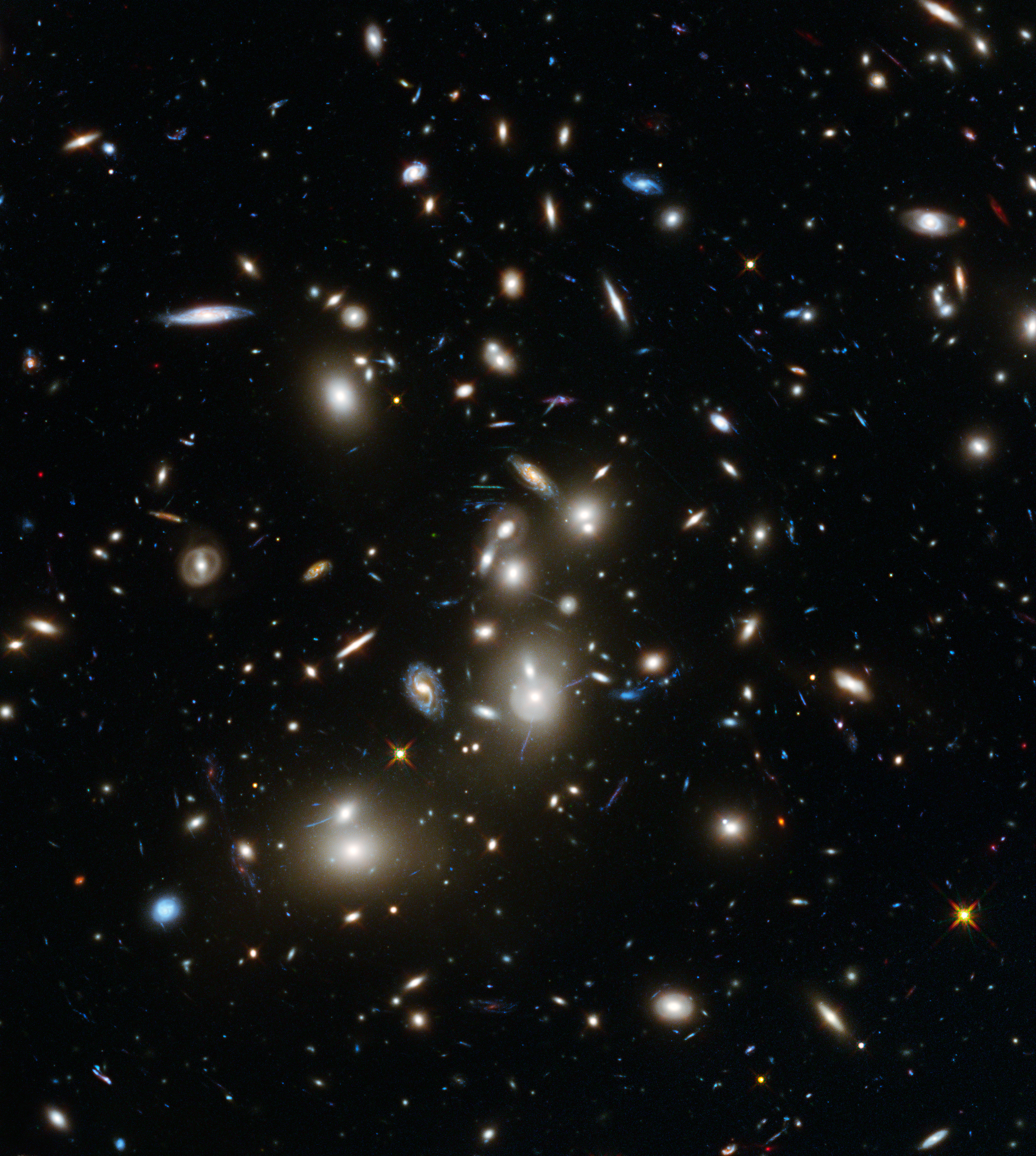
This article lists some galaxy groups and galaxy clusters.
Defining the limits of galaxy clusters is imprecise as many clusters are still forming. In particular, clusters close to the Milky Way tend to be classified as galaxy clusters even when they are much smaller than more distant clusters.
Clusters exhibiting strong evidence of dark matter
Some clusters exhibiting strong evidence of dark matter.
| Galaxy cluster | Notes |
|---|---|
| Bullet Cluster | In this collision between two clusters of galaxies, the stars pass between each other unhindered, while the hot, diffuse gas experiences friction and is left behind between the clusters. The gas dominates the visible mass budget of the clusters, being several times more massive than all the stars. Yet the regions with the stars show more gravitational lensing than the gas region, indicating that they are more massive than the gas. Some dark (since we don't see it), collision-less (or it would have been slowed, like the gas) matter is inferred to be present to account for the extra lensing around otherwise low-mass regions. |
| Abell 520 | This is actually a collision between two galaxy clusters. The galaxies and the dark matter seems to have separated out into separate dark and light cores. |
| Abell 2142 | A collision between two massive, X-ray luminous galaxy clusters. |
| Cl 0024+17 | |
| (ClG 0024+16, ZwCl 0024+1652) | This is a recently coalesced merger of galaxy clusters, which has resulted in a ring of dark matter around the galaxies, yet to be redistributed. |
Named groups and clusters
This is a list of galaxy groups and clusters that are well known by something other than an entry in a catalog or list, or a set of coordinates, or a systematic designation.
Clusters
| Galaxy cluster | Origin of name | Notes |
|---|---|---|
| Bullet Cluster | The cluster is named for the merger of two clusters colliding like a bullet. | Also has a systematic designation of 1E 0657-56 |
| El Gordo | Named for its size, El Gordo ("the fat one") is the biggest cluster found in the distant universe (at its distance and beyond), at the time of discovery in 2011, with a mass of 3 quadrillion suns. The second most massive galaxy cluster next to El Gordo is RCS2 J2327, a galaxy cluster with the mass of 2 quadrillion suns. | Also has a systematic designation of ACT-CL J0102-4915. |
| Musket Ball Cluster | Named in comparison to the Bullet Cluster, as this one is older and slower galaxy cluster merger than the Bullet Cluster. | Also has a systematic designation of DLSCL J0916.2+2951. |
| Pandora's Cluster | Named because the cluster resulted from a collision of clusters, which resulted in many different and strange phenomena. | Also has a catalogue entry of Abell 2744. |
Groups
| Galaxy group | Origin of name | Notes |
|---|---|---|
| Local Group | The galaxy group that includes the Milky Way. | |
| Bullet Group | Named in comparison with the Bullet Cluster, being of similar formation, except smaller. | Also has a systematic catalogue name SL2S J08544-0121. As of 2014, it was the lowest mass object that showed separation between the concentrations of dark matter and baryonic matter in the object. |
| Burbidge Chain | ||
| Copeland Septet | Discovered by British astronomer Ralph Copeland in 1874. | |
| Deer Lick Group | Coined by Tom Lorenzin (author of "1000+ The Amateur Astronomers' Field Guide to Deep Sky Observing") to honor Deer Lick Gap in the mountains of North Carolina, from which he had especially fine views of the galaxy group. | Also referred to as the NGC 7331 Group, after the brightest member of the group. |
| Leo Triplet | Named for the fact it contains only three galaxies. | This small group of galaxies lies in the constellation Leo. |
| Markarian's Chain | This stretch of galaxies forms part of the Virgo Cluster. | |
| Robert's Quartet | It was named by Halton Arp and Barry F. Madore, who compiled A Catalogue of Southern Peculiar Galaxies and Associations in 1987. | This compact group of galaxies lies 160 million light-years away in the Phoenix constellation. |
| Seyfert's Sextet | Named after its discoverer, Carl Seyfert. At the time it appeared to contain six external nebulae. It is also called the NGC 6027 Sextet, after its brightest member. | There are actually only five galaxies in the sextet, and only four galaxies in the compact group. One of the galaxies is an ungravitationally bound background object. The other "galaxy" is instead an extension of the interacting system — a tidal stream caused by the merger. The group is, therefore, more properly called HCG 79; the name refers to the visual collection and not the group. HCG 79 lies 190 million light-years away in the Serpens Caput constellation. |
| Stephan's Quintet (Stephan's Quartet) | Named after its discoverer, Édouard Stephan. | There are actually only four galaxies in the compact group, the other galaxy is a foreground galaxy. The group is therefore more properly called HCG 92, because the name refers to a visual collection and not a group. Thus, the real group is also called Stephan's Quartet. |
| Wild's Triplet | Named after the British-born and Australia-based astronomer Paul Wild (1923–2008), who studied the trio in the early 1950s. | |
| Zwicky's Triplet |
The major nearby groups and clusters are generally named after the constellation they lie in. Many groups are named after the leading galaxy in the group. This represents an ad hoc systematic naming system.
Groups and clusters visible to the unaided eye
The Local Group contains the largest number of visible galaxies with the naked eye. However, its galaxies are not visually grouped together in the sky, except for the two Magellanic Clouds. The IC342/Maffei Group, the nearest galaxy group, would be visible by the naked eye if it were not obscured by the stars and dust clouds in the Milky Way's spiral arms.
| Galaxy group | Visible galaxies | Notes | |||||
|---|---|---|---|---|---|---|---|
| Local Group | 5 | Apart from the Milky Way, only 4 galaxies are visible to the naked eye. | |||||
| Centaurus A/M83 Group | 2 | The Centaurus A galaxy has been spotted with the naked eye by Stephen James O'Meara and M83 has also reportedly been seen with the naked eye. | |||||
| M81 Group | 1 | url=http://www.uitti.net/stephen/astro/essays/farthest_naked_eye_object.shtml | title=Farthest Naked Eye Object | publisher=Uitti.net | author=Stephen Uitti | date=27 May 2005 | access-date=2008-11-01}} |
- No galaxy cluster is visible to the unaided eye.
Firsts
| First discovered | Name | Date | Notes | |||||||||||
|---|---|---|---|---|---|---|---|---|---|---|---|---|---|---|
| Galaxy cluster | Virgo Cluster | 1784 | arxiv = astro-ph/0010409 | bibcode = 2000cucg.confE...1B | last1 = Biviano | first1 = Andrea | chapter = From Messier to Abell: 200 years of science with galaxy clusters | title=Constructing the Universe with Clusters of Galaxies, IAP 2000 meeting, Paris, France, July 2000 | journal = Constructing the Universe with Clusters of Galaxies | page = 1 | editor=Florence Durret | editor2=Daniel Gerbal | display-authors=etal | year = 2000}} |
| Galaxy group | ||||||||||||||
| Compact group | The four brightest members of Stephan's Quintet | 1877 | Discovered by Edouard Stephan. | |||||||||||
| Proto-cluster | ||||||||||||||
| Double galaxy | Magellanic Clouds | antiquity |
Extremes
| Title | Name | Data | Notes | time | |||||||||||||||||||||||||||||||||||||||||||||||||||
|---|---|---|---|---|---|---|---|---|---|---|---|---|---|---|---|---|---|---|---|---|---|---|---|---|---|---|---|---|---|---|---|---|---|---|---|---|---|---|---|---|---|---|---|---|---|---|---|---|---|---|---|---|---|---|---|
| Most distant galaxy cluster | CL J1001+0220 | redshift z=2.506 | Announced August 2016. | arxiv=1604.07404 | doi=10.3847/0004-637X/828/1/56 | title=Discovery of a galaxy cluster with a violently starbursting core at z=2.506 | journal=The Astrophysical Journal | volume=828 | number=1 | year=2016 | last1=Wang | first1=Tao | display-authors=etal | bibcode = 2016ApJ...828...56W | page=56 | s2cid=8771287 | doi-access=free }} | ||||||||||||||||||||||||||||||||||||||
| Nearest galaxy cluster | Virgo Cluster | The Virgo Cluster is at the core of the Virgo Supercluster. The Local Group is a member of the supercluster, but not the cluster. | |||||||||||||||||||||||||||||||||||||||||||||||||||||
| Most distant galaxy group | |||||||||||||||||||||||||||||||||||||||||||||||||||||||
| Nearest galaxy group | Local Group | 0 distance | This is the galaxy group that our galaxy belongs to. | ||||||||||||||||||||||||||||||||||||||||||||||||||||
| Nearest neighbouring galaxy group | IC 342/Maffei Group | ||||||||||||||||||||||||||||||||||||||||||||||||||||||
| Most distant proto-cluster | A2744z7p9OD | z=7.88 | title= Early results from GLASS-JWST. XVIII: A spectroscopically confirmed protocluster 650 million years after the Big Bang | author1=Morishita, Takahiro | author2=Roberts-Borsani, Guido | author3=Treu, Tommaso | author4=Brammer, Gabriel | author5=Mason, Charlotte A. | author6=Trenti, Michele | author7=Vulcani, Benedetta | author8=Wang, Xin | author9=Acebron, Ana | author10=Bahé, Yannick | author11=Bergamini, Pietro | author12=Boyett, Kristan | author13=Bradac, Marusa | author14=Calabrò, Antonello | author15=Castellano, Marco | author16=Chen, Wenlei | author17=De Lucia, Gabriella | author18=Filippenko, Alexei V. | author19=Fontana, Adriano | author20=Glazebrook, Karl | author21=Grillo, Claudio | author22=Henry, Alaina | author23=Jones, Tucker | author24=Kelly, Patrick L. | author25=Koekemoer, Anton M. | author26=Leethochawalit, Nicha | author27=Lu, Ting-Yi | author28=Marchesini, Danilo | author29=Mascia, Sara | author30=Mercurio, Amata | author31=Merlin, Emiliano | author32=Metha, Benjamin | author33=Nanayakkara, Themiya | author34=Nonino, Mario | author35=Paris, Diego | author36=Pentericci, Laura | author37=Santini, Paola | author38=Strait, Victoria | author39=Vanzella, Eros | author40=Windhorst, Rogier A. | author41=Rosati, Piero | author42=Xie, Lizhi | date= 30 January 2023 | arxiv= 2211.09097 | journal= Astrophysical Journal Letters | volume=947 | issue=2 | doi=10.3847/2041-8213/acb99e | s2cid=253553396 | doi-access=free | bibcode=2023ApJ...947L..24M }} | |
| Nearest proto-cluster | |||||||||||||||||||||||||||||||||||||||||||||||||||||||
| Most distant massive proto-cluster | z66OD | z=6.585 | At time of discovery in 2019, the object had 12 members, including Himiko. | url= https://www.sciencedaily.com/releases/2019/09/190927074941.htm | title= Oldest galaxy protocluster forms 'queen's court' | date= 27 September 2019 | author= National Institutes of Natural Sciences | work= ScienceDaily}} | |||||||||||||||||||||||||||||||||||||||||||||||
| Least massive galaxy group | |||||||||||||||||||||||||||||||||||||||||||||||||||||||
| Most massive galaxy cluster | RX J1347.5-1145 | mass= 2.0 ± 0.4 × 10¹⁵ MSun |
Closest groups
| Galaxy group | Distance | Redshift (z) | Recession velocity (km/s) | Notes | |
|---|---|---|---|---|---|
| Local Group | - | - | - | Our Galaxy, the Milky Way, belongs to the Local Group. | |
| LGG 104 (IC 342/Maffei Group, IC 342 / Maffei 1 Group, IC 342 Maffei 1-2 Group) | 0.000868 | The IC 342/Maffei Group contains two subgroups, the IC 342 subgroup (IC 342 Group) and the Maffei 1 subgroup (Maffei subgroup, Maffei 1 Group, Maffei Group). | |||
| M81 Group (NGC 3031 Group) | 3.5 Mpc | 0.001115 | url=https://web.archive.org/web/20080819184054/http://haydenplanetarium.org/universe/duguide/exgt_abell.php | date=2008-08-19 }} | |
| Centaurus A/M83 Group (Centaurus A Group, M83 Group) | 3.66 Mpc | 0.000999 | The Centaurus A/M83 Group contains two subgroups, the Centaurus A subgroup (Centaurus A Group, NGC 5128 Group, LGG 344) and the M83 subgroup (M83 Group, NGC 5236 Group, LGG 355). | ||
| Sculptor Group (South Polar Group) | 3.9 Mpc | ||||
| Canes Venatici Group (Canes Venatici I Group, Canes I Group, M94 Group, NGC 4736 Group, LGG 291) | 4 Mpc | 0.001612 | |||
| NGC 1023 Group (LGG 70) | 6.12 Mpc | 0.002926 | |||
| M101 Group (NGC 5457 Group, LGG 371) | 7.33 Mpc | 0.001288 | |||
| NGC 2997 Group (LGG 180) | 7.66 Mpc | 0.002615 | |||
| Canes Venatici II Group (Canes II Group) | 8 Mpc | ||||
| M51 Group (NGC 5194 Group, LGG 347) | 9.5 Mpc | 0.001850 | |||
| Leo Triplet (M66 Group, NGC 3627 Group, LGG 231) | 10.75 Mpc | 0.002207 | |||
| Leo Group (Leo I Group, M96 Group, NGC 3379 Group, LGG 217) | 11.66 Mpc | 0.002267 | |||
| Draco Group | 12.25 Mpc | ||||
| LGG 396 (NGC 5866 Group, NGC 5907 Group) | 0.003020 | ||||
| Ursa Major Group (Ursa Major I Group, M109 Group, NGC 3992 Group, NGC 3726 Group, LGG 258) | 16.88 Mpc | 0.003388 |
Closest clusters
| Galaxy cluster | Distance | Redshift (z) | Recession velocity (km/s) | Notes | |
|---|---|---|---|---|---|
| Virgo Cluster | 18 Mpc | 0.0038 | url=https://web.archive.org/web/20080828194802/http://haydenplanetarium.org/universe/duguide/exgt_twomass.php | date=2008-08-28 }} | |
| Fornax Cluster (Abell S 373, AM 0336-353, MCL 52) | 19 Mpc | 0.0046 | |||
| Antlia Cluster (Abell S 636) | 40.7 Mpc | 0.0087 | Also called the Antlia Group. | ||
| Centaurus Cluster (Abell 3526, Cl 1247-4102) | 52.4 Mpc | 0.0110 | |||
| Hydra Cluster (Hydra I Cluster, Abell 1060, Cl 1034-2716) | 58.3 Mpc | 0.0114 | |||
| Perseus Cluster (Abell 426, NGC 1275 Cluster) | 0.0179 |
Farthest clusters
| Galaxy cluster | Distance | Notes |
|---|---|---|
| No entries yet |
| Galaxy cluster | Date | Redshift (z) | Recession Velocity | |||||||||||||
|---|---|---|---|---|---|---|---|---|---|---|---|---|---|---|---|---|
| (km/s) | Notes | |||||||||||||||
| CL J1001+0220 | 2016 − | 2.506 | ||||||||||||||
| CL J1449+0856 | ||||||||||||||||
| (ClG J1449+0856) | 2011–2016 | 2.07 | arxiv=1011.1837 | bibcode=2011A&A...526A.133G | doi=10.1051/0004-6361/201016084 | title=A mature cluster with X-ray emission at z= 2.07 | journal=Astronomy & Astrophysics | volume=526 | pages=A133 | year=2011 | last1=Gobat | first1=R. | s2cid=39625321 | display-authors=etal }} | ||
| JKCS 041 | 2009–2011 | 1.9 | ||||||||||||||
| XMMXCS 2215-1738 (XMMXCS 2215.9-1738) | 2006–2009 | 1.45 | XMM-XCS 2215-1738 was also the most massive early cluster so far discovered. | |||||||||||||
| ISCS J143809+341419 | 2005–2006 | 1.41 | ||||||||||||||
| XMMU J2235.3-2557 | 2005 | 1.393 | url=https://web.archive.org/web/20080209185233/http://www.astro.lsa.umich.edu/~cmullis/research/xmmuj2235/index.html | date=2008-02-09 }} | ||||||||||||
| RDCS 0848+4453 ( RDCS0848.6+4453, RX J0848+4453, ClG 0848+4453 ) | 1997– | 1.276 | arxiv = astro-ph/0012250 | doi = 10.1086/320583 | title = The Intracluster Medium inz 1 Galaxy Clusters | journal = The Astrophysical Journal | volume = 552 | issue = 2 | pages = 504–507 | year = 2001 | last1 = Stanford | first1 = S. A. | bibcode = 2001ApJ...552..504S | s2cid = 5109074 | display-authors=etal}} | |
| galaxy cluster around 3C 324 (3C 234 Cluster) | 1984– | 1.206 | At the time, the BCG, 3C324 was the most distant non-quasar galaxy. | |||||||||||||
| Cl 0016+16 | 1980 − | z=0.54 | In 1981, this cluster was the most distant cluster studied photometrically. | |||||||||||||
| Cl 1305+2952 | 1977 − | 0.947 | This was not generally accepted as the redshift for this cluster. This was the first cluster beyond about z~0.5 | |||||||||||||
| Cl 1409+524 | 1960–1975 | 0.461 | bibcode = 1961ApJ...133..355S | title = The Ability of the 200-INCH Telescope to Discriminate Between Selected World Models | journal = The Astrophysical Journal | volume = 133 | page = 355 | last1 = Sandage | first1 = Allan | year = 1961 | doi = 10.1086/147041}} | |||||
| Abell 732 (fainter Hydra Cluster Cl 0855+0321) | 1951–1960 | 0.2 | 61 000 | bibcode = 1953Obs....73...97. | title = 1053 May 8 meeting of the Royal Astronomical Society | journal = The Observatory | volume = 73 | page = 97 | year = 1953}} | |||||||
| Abell 1930 (Bootes Cluster) | 1936–1951 | 0.13 | 39 000 | bibcode = 1936ApJ....83...10H | title = The Apparent Radial Velocities of 100 Extra-Galactic Nebulae | journal = The Astrophysical Journal | volume = 83 | page = 10 | last1 = Humason | first1 = M. L. | year = 1936 | doi = 10.1086/143696 | doi-access = free}} | |||
| Gemini Cluster (Abell 568) | 1932 − 1936 | 0.075 | 23 000 | bibcode = 1932JRASC..26..180C | title = Notes and Queries (Doings at Mount Wilson-Ritchey's Photographic Telescope-Infra-red Photographic Plates) | journal = Journal of the Royal Astronomical Society of Canada | volume = 26 | page = 180 | last1 = Chant | first1 = C. A. | year = 1932}} | |||||
| WH Christie's Leo Cluster | 1931–1932 | 19 700 | bibcode = 1931ApJ....74...35H | title = Apparent Velocity-Shifts in the Spectra of Faint Nebulae | journal = The Astrophysical Journal | volume = 74 | page = 35 | last1 = Humason | first1 = Milton L. | year = 1931 | doi = 10.1086/143287}} | |||||
| Baede's Ursa Major Cluster | 1930–1931 | 11 700 | bibcode = 1930ApJ....71..351H | title = The Rayton short-focus spectrographic objective | journal = The Astrophysical Journal | volume = 71 | page = 351 | last1 = Humason | first1 = M. L. | year = 1930 | doi = 10.1086/143255 | doi-access = free}} | ||||
| Coma Cluster | 1929–1930 | 0.026 | 7 800 | bibcode = 1929PASP...41..244. | title = The Berkeley Meeting of the Astronomical Society of the Pacific, June 20-21, 1929 | journal = Publications of the Astronomical Society of the Pacific | volume = 41 | issue = 242 | page = 244 | year = 1929 | doi = 10.1086/123945 | doi-access = free}} | ||||
| Pegasus Group (LGG 473, NGC 7619 Group) | 1929 | 0.012 | 3 779 | The BCG for this group was used to measure its redshift. Shortly after this was publicized, it was accepted that redshifts were an acceptable measure of inferred distance. | ||||||||||||
| Cetus Group (Holmberg 45, LGG 27) | 1921–1929 | 0.006 | 1 800 | bibcode = 1920BHarO.739....1B | title = Comet Skjellerup | journal = Harvard College Observatory Bulletin | volume = 739 | page = 1 | last1 = Bailey | first1 = S. I. | year = 1920}} | |||||
| Virgo Cluster | 1784–1921 | 59 Mly (18 Mpc) | ||||||||||||||
| z=0.003 | 1 200 | This was the first noted cluster of "nebulae" that would become galaxies. The first redshifts to galaxies in the cluster were measured in the 1910s. Galaxies were not identified as such until the 1920s. The distance to the Virgo Cluster would have to wait until the 1930s. |
- In 2003 RDCS 1252-29 (RDCS1252.9–2927) at z=1.237, was found to be the most distant rich cluster, which lasted until 2005.
- In 2000, a cluster was announced in the field of quasar QSO 1213-0017 at z=1.31 (the quasar lies at z=2.69)
- In 1999, cluster RDCS J0849+4452 (RX J0849+4452, RXJ0848.9+4452) was found at z=1.261
- In 1995 and 2001, the cluster around 3C 294 was announced, at z=1.786
- In 1992, observations of the field of cluster Cl 0939+4713 found what appears to be a background cluster near a quasar, also in the background. The quasar was measured at z=2.055 and it was assumed that the cluster would be as well.
- In 1975, 3C 123 and its galaxy cluster was incorrectly determined to lie at z=0.637 (actually z=0.218)
- In 1958, cluster Cl 0024+1654 and Cl 1447+2619 were estimated to have redshifts of z=0.29 and z=0.35 respectively. However, they were not spectroscopically determined.
Farthest protoclusters
| Galaxy protocluster | Distance | Notes |
|---|---|---|
| No entries yet |
| Galaxy protocluster | Date | Redshift (z) | Notes | |||||||
|---|---|---|---|---|---|---|---|---|---|---|
| BoRG-58 | 2012 | ~ 8 | ||||||||
| COSMOS-AzTEC3 | 2011– | 5.3 | last=Naeye | first=Robert | date=13 January 2011 | url=http://www.skyandtelescope.com/news/113460379.html | title=The Most Distant Galaxy Cluster | website=Sky & Telescope | archive-url=https://archive.today/20130202090546/http://www.skyandtelescope.com/news/113460379.html | archive-date=2013-02-02 }} |
| Protocluster around radio-galaxy TN J1338-1942 | 2002– | 4.11 | It was described as the most distant cluster. | |||||||
| Protocluster around 3C 368 | 1982– | 1.13 |
- In 2002, a very large, very rich protocluster, or the most distant protosupercluster was found in the field of galaxy cluster MS 1512+36, around the gravitationally lensed galaxy MS 1512-cB58, at z=2.724
False clusters
Sometimes clusters are put forward that are not genuine clusters or superclusters. Through the researching of member positions, distances, peculiar velocities, and binding mass, former clusters are sometimes found to be the product of a chance line-of-sight superposition.
| Former cluster | Notes |
|---|---|
| Cancer Cluster | The Cancer Cluster was found to be a random assortment of galaxy groups, and not a true cluster. |
| Coma-Virgo Cloud | The early identification of the Coma-Virgo Cloud of Nebulae was actually a mistaken identification due to the superposition of the Virgo Supercluster and Coma Supercluster, and not a Coma-Virgo Supercluster |
References
References
- (7 January 2014). "NASA's Hubble and Spitzer Team up to Probe Faraway Galaxies". [[NASA]].
- (2006-08-21). "Galaxy Collision Separates Out the Dark Matter".
- (2007-08-16). "Galaxy Cluster Collision Creates a Dark Matter Core".
- (2007-05-15). "Ring of Dark Matter Discovered Around a Galaxy Cluster".
- SIMBAD, [http://simbad.u-strasbg.fr/simbad/sim-id?Ident=ClG+0024%2B17&NbIdent=1&Radius=2&Radius.unit=arcmin&submit=submit+id "ClG 0024+17"]
- Schilling, Govert. (12 January 2012). "When Galaxies Crash".
- (2012-01-11). "Humongous 'El Gordo' galaxy cluster packs mass of 2 quadrillion stars". Christian Science Monitor.
- NASA, [http://www.nasa.gov/mission_pages/chandra/multimedia/elgordo_photo.html "El Gordo Galaxy Cluster"], 10 January 2012 (accessed 7 July 2012)
- "Discovery of the Musket Ball Cluster, a system of colliding galaxy clusters".
- ESO, [http://www.eso.org/public/news/eso1120/ "A Galactic Crash Investigation"], 22 June 2011 (accessed 7 July 2012)
- XMM-Newton. (6 June 2014). "Cosmic collision in the Bullet Group". European Space Agency.
- (2014). "Dark matter–baryons separation at the lowest mass scale: The Bullet Group". Monthly Notices of the Royal Astronomical Society: Letters.
- Saratoga Skies, [http://www.saratogaskies.com/image.pl?i=52 "NGC 7331 (Deer Lick Group and Stephan's Quintet)"], '''Jim Solomon''' (accessed 7 May 2009)
- "Wild's Triplet".
- "Aintno Catalog".
- (2007). "Astrophysics is Easy! An Introduction for the Amateur Astronomer".
- Stephen Uitti. (27 May 2005). "Farthest Naked Eye Object". Uitti.net.
- SEDS, [http://messier.seds.org/m/m081.html Messier 81]
- A. Schwope. (2013). "Galaxy Clusters". Arches Project.
- (2000). "Constructing the Universe with Clusters of Galaxies, IAP 2000 meeting, Paris, France, July 2000". Constructing the Universe with Clusters of Galaxies.
- (2016). "Discovery of a galaxy cluster with a violently starbursting core at z=2.506". The Astrophysical Journal.
- (30 January 2023). "Early results from GLASS-JWST. XVIII: A spectroscopically confirmed protocluster 650 million years after the Big Bang". Astrophysical Journal Letters.
- National Institutes of Natural Sciences. (27 September 2019). "Oldest galaxy protocluster forms 'queen's court'". ScienceDaily.
- Yuichi Harikane. (25 February 2019). "SILVERRUSH. VIII. Spectroscopic Identifications of Early Large Scale Structures with Protoclusters Over 200 Mpc at z~6-7: Strong Associations of Dusty Star-Forming Galaxies". Astrophysical Journal.
- (27 September 2019). "Astronomers spot oldest galactic protocluster, a giant of the early universe".
- "080827 XMM discovers monster galaxy cluster".
- (2004). "XMM-Newtonobservation of the most X-ray-luminous galaxy cluster RX J1347.5-1145". Astronomy & Astrophysics.
- Hayden Planetarium, [http://haydenplanetarium.org/universe/duguide/exgt_abell.php Galaxy Clusters and Superclusters] {{webarchive. link. (2008-08-19)
- Hayden Planetarium, [http://haydenplanetarium.org/universe/duguide/exgt_twomass.php The 2MASS Galaxies] {{webarchive. link. (2008-08-28)
- (2011). "A mature cluster with X-ray emission at ''z''= 2.07". Astronomy & Astrophysics.
- ABC News (Australia), [http://www.abc.net.au/science/articles/2011/03/10/3159483.htm "Astronomers find old heads in a young crowd"], Stuart Gary, 10 March 2011
- SIMBAD, [http://simbad.u-strasbg.fr/simbad/sim-basic?Ident=CLg+J1449%2B0856&submit=SIMBAD+search "ClG J1449+0856"]
- (December 2017). "XMM Cluster Survey - discovering the most distant galaxy clusters }}{{dead link".
- University of Portsmith - Institute of Cosmology and Gravitation; [http://www.icg.port.ac.uk/archive/0611_stanford_cluster_prt.htm ICG in team that detects the most distant galaxy cluster] {{webarchive. link. (2007-08-12 , 15 June 2006)
- NASA - Spitzer Space Telescope, [http://www.spitzer.caltech.edu/Media/mediaimages/sig/sig06-006.shtml Great Galactic Buddies] {{webarchive. link. (2008-05-11)
- (2005). "An IR-selected Galaxy Cluster at ''z'' = 1.41". The Astrophysical Journal.
- New Scientist, [https://www.newscientist.com/article.ns?id=dn7087 Most distant galaxy cluster yet is revealed], 08:00 02 March 2005
- link. (2008-02-09)
- ESO Press Release 04/05; [http://www.eso.org/public/outreach/press-rel/pr-2005/pr-04-05.html Surprise Discovery of Highly Developed Structure in the Young Universe] {{webarchive. link. (2008-06-11 ; 2 March 2005)
- (2001). "The Intracluster Medium inz > 1 Galaxy Clusters". The Astrophysical Journal.
- (1997). "An IR-Selected Galaxy Cluster at ζ=1.27". The Astronomical Journal.
- (1984). "3C 324 - an extremely distant cluster radio galaxy". The Astrophysical Journal.
- (1981). "Multicolor photometry of the red cluster 0016+16 at z = 0.54". The Astrophysical Journal.
- (1977). "Observations of a distant cluster of galaxies". The Astrophysical Journal.
- (1961). "The Ability of the 200-INCH Telescope to Discriminate Between Selected World Models". The Astrophysical Journal.
- Palomar Skies, [https://palomarskies.blogspot.com/2008/03/pushing-limit.html Pushing the limit], Saturday, March 29, 2008
- (1953). "1053 May 8 meeting of the Royal Astronomical Society". The Observatory.
- Annu. Rev. Astron. Astrophys. 1988. 26: 561-630; OBSERVATIONAL TESTS OF WORLD MODELS - [http://nedwww.ipac.caltech.edu/level5/Sept01/Sandage/Sand6.html 6. THE m(z) HUBBLE DIAGRAM]; Allan Sandage
- (1958). "From Atoms to Galaxies". Leaflet of the Astronomical Society of the Pacific.
- (1936). "The Apparent Radial Velocities of 100 Extra-Galactic Nebulae". The Astrophysical Journal.
- (1932). "Notes and Queries (Doings at Mount Wilson-Ritchey's Photographic Telescope-Infra-red Photographic Plates)". Journal of the Royal Astronomical Society of Canada.
- (1931). "The Velocity-Distance Relation among Extra-Galactic Nebulae". The Astrophysical Journal.
- (1931). "The Large Apparent Velocities of Extra-Galactic Nebulae". Leaflet of the Astronomical Society of the Pacific.
- (1930). "The Rayton short-focus spectrographic objective". The Astrophysical Journal.
- (1929). "The Berkeley Meeting of the Astronomical Society of the Pacific, June 20-21, 1929". Publications of the Astronomical Society of the Pacific.
- From the Proceedings of the National Academy of Sciences; Volume 15 : March 15, 1929 : Number 3; [http://antwrp.gsfc.nasa.gov/diamond_jubilee/d_1996/hum_1929.html THE LARGE RADIAL VELOCITY OF N. G. C. 7619]; January 17, 1929
- (1920). "Comet Skjellerup". Harvard College Observatory Bulletin.
- New York Times, [https://query.nytimes.com/gst/abstract.html?res=9906E2DA153CE533A2575AC1A9679C946095D6CF DREYER NEBULA NO. 584 INCONCEIVABLY DISTANT; Dr. Slipher Says the Celestial Speed Champion Is 'Many Millions of Light Years' Away.]; January 19, 1921, Wednesday
- New York Times, [https://query.nytimes.com/gst/abstract.html?res=9F06E1DB153CE533A2575BC1A9679C946095D6CF NEBULA DREYER BREAKS ALL SKY SPEED RECORDS; Portion of the Constellation of Cetus Is Rushing Along at Rate of 1,240 Miles a Second.]; January 18, 1921, Tuesday
- "GALAXY CLUSTER ARCHAEOLOGY".
- (2004). "ChandraandXMM-Newton ''Observations'' of RDCS 1252.9-2927, A Massive Cluster atz=1.24". The Astronomical Journal.
- (2000). "Extremely Red Objects in the Field of QSO 1213-0017: A Galaxy Concentration at Z=1.31". The Astronomical Journal.
- (2002). "An X-Ray–Selected Galaxy Cluster at z = 1.11 in the ROSAT Deep Cluster Survey". The Astronomical Journal.
- (1999). "An X-Ray–Selected Galaxy Cluster at z = 1.26". The Astronomical Journal.
- (2001). "Chandra detection of the intracluster medium around 3C 294 at ''z'' = 1.786". Monthly Notices of the Royal Astronomical Society.
- (1993). "The Spectra and Morphology of Galaxies in High-Redshift Clusters". Observational Cosmology.
- European Space Agency; [http://smart.esa.int/science-e/www/object/printfriendly.cfm?fobjectid=39833 Peering Far Back in Time to Uncover the Secrets of Galaxy Evolution]; 01 Dec 1992
- (1993). "Galaxies Far Away and Long Ago". Sky and Telescope.
- (1993). "A Cluster of Nascent Galaxies at Z = 2?". The Astrophysical Journal.
- NED, [http://nedwww.ipac.caltech.edu/cgi-bin/nph-objsearch?objname=3c123&extend=no&out_csys=Equatorial&out_equinox=J2000.0&obj_sort=RA+or+Longitude&of=pre_text&zv_breaker=30000.0&list_limit=5&img_stamp=YES Searching NED for object "3C 123"]
- (1975). "3C 123: A distant first-ranked cluster galaxy at z = 0.637". The Astrophysical Journal.
- SpaceTelescope.org (ESA), [http://www.spacetelescope.org/images/heic1201a/ "Hubble Spies Building Blocks of Most Distant Galaxy Cluster"], 10 January 2012 (accessed March 2012)
- Naeye, Robert. (13 January 2011). "The Most Distant Galaxy Cluster".
- BBC News, [https://www.bbc.co.uk/news/science-environment-12178936 "Galaxy clusters' ancient light shows young cosmic city"], Jason Palmer, 13 January 2011
- Associated Press, [https://www.nbcnews.com/id/wbna3881727 Oldest, most distant galaxy clusters found], 4:37 p.m. ET, Mon., Jan. 5, 2004
- (2002). "The Most Distant Structure of Galaxies Known: A Protocluster at z = 4.1". The Astrophysical Journal.
- Science, [http://bric.postech.ac.kr/science/97now/02_4now/020412a.html Oldest Galaxy Cluster Found], 12 April 2002
- ESO Press Release 07/02; [http://www.eso.org/public/outreach/press-rel/pr-2002/pr-07-02.html Most Distant Group of Galaxies Known in the Universe] {{webarchive. link. (2008-09-16 ; 9 April 2002)
- Publications of the Astronomical Society of the Pacific, vol. 94, June–July 1982, p. 397-403. [http://articles.adsabs.harvard.edu/full/1982PASP...94..397S Redshifts and spectroscopy of very distant radio galaxies with strong emission lines] 1982PASP...94..397S
- ESO Press Release 03/02; [http://www.eso.org/public/outreach/press-rel/pr-2002/pr-03-02.html UVES Investigates the Environment of a Very Remote Galaxy] {{webarchive. link. (2008-10-02 ; 11 March 2002)
This article was imported from Wikipedia and is available under the Creative Commons Attribution-ShareAlike 4.0 License. Content has been adapted to SurfDoc format. Original contributors can be found on the article history page.
Ask Mako anything about List of galaxy groups and clusters — get instant answers, deeper analysis, and related topics.
Research with MakoFree with your Surf account
Create a free account to save articles, ask Mako questions, and organize your research.
Sign up freeThis content may have been generated or modified by AI. CloudSurf Software LLC is not responsible for the accuracy, completeness, or reliability of AI-generated content. Always verify important information from primary sources.
Report