From Surf Wiki (app.surf) — the open knowledge base
List of cocaine analogues
none
Summary
none
Middle: Cocaine with its numerical substitution position locants.
2′ (6′) = ortho, 3′ (5′) = meta & 4′ = para
Bottom: Alternate two-dimensional molecular diagram of cocaine; shown specifically as a protonated, NH+, hydrochloride, and disregarding 3D stereochemistry
This is a list of cocaine analogues. A cocaine analogue is an (usually) artificial construct of a novel chemical compound from (often the starting point of natural) cocaine's molecular structure, with the result product sufficiently similar to cocaine to display similarity in, but alteration to, its chemical function. Within the scope of analogous compounds created from the structure of cocaine, so named "cocaine analogues" retain 3β-benzoyloxy or similar functionality (the term specifically used usually distinguishes from phenyltropanes, but in the broad sense generally, as a category, includes them) on a tropane skeleton, as compared to other stimulants of the kind. Many of the semi-synthetic cocaine analogues proper which have been made & studied have consisted of among the nine following classes of compounds:
stereoisomers of cocaine
3β-phenyl ring substituted analogues
2β-substituted analogues
N-modified analogues of cocaine
3β-carbamoyl analogues
3β-alkyl-3-benzyl tropanes
6/7-substituted cocaines
6-alkyl-3-benzyl tropanes
piperidine homologues of cocaine
However strict analogues of cocaine would also include such other potential combinations as phenacyltropanes & other carbon branched replacements not listed above. The term may also be loosely used to refer to drugs manufactured from cocaine or having their basis as a total synthesis of cocaine, but modified to alter their effect & QSAR. These include both intracellular sodium channel blocker anaesthetics and stimulant dopamine reuptake inhibitor ligands (such as certain, namely tropane-bridged-excised, piperidines). Additionally, researchers have supported combinatorial approaches for taking the most promising analogues currently elucidated and mixing them to the end of discovering novel & efficacious compounds to optimize their utilization for differing distinct specified purposes.
There are eight stereoisomers of cocaine (excluding mesomers and modifications to the internal portion of the tropane ring). Due to the presence of four asymmetric carbon atoms in the 1- & 5- to 8 (N) position bond bridge that could adopt R- & S- configurations, cocaine can be considered to have as many as sixteen stereoisomers. However, geometric constraints imparted by the bridgehead amine allow only eight to be created.
The natural isomerism of cocaine is unstable and prone to epimerization. For example, the end product of cocaine biosynthesis contains an axial C2-carbomethoxy moiety which readily undergoes epimerization to the equatorial position via saponification.
For any 2D structural diagrams where stereochemistry is not indicated, it should be assumed the analogue depicted shares the stereochemical conformation of R-cocaine unless noted otherwise.
vauthors=Gatley SJ, Yu DW, Fowler JS, MacGregor RR, Schlyer DJ, Dewey SL, Wolf AP, Martin T, Shea CE, Volkow ND
title=Studies with differentially labeled [11C]cocaine, [11C]norcocaine, [11C]benzoylecgonine, and [11C]- and 4′-[18F]fluorococaine to probe the extent to which [11C]cocaine metabolites contribute to PET images of the baboon brain
The MAT binding pocket analogous to the lipophilic place on cocaine-like compounds, inclusive of the benzene ring, is approximate to 9 Å in length. Which is only slightly larger than a phenyl ring by itself.
The hydroxylated 2′-OH analogue exhibited a tenfold increase in potency over cocaine.
Manifold and termination benzoyloxy phenyl-substitutions
Vanillylmethylecgonine
186b
[[File:Hydroxymethoxycocaine.svg
x150px
class=skin-invert-image]]
[[File:Cocaine analog 186.svg
x150px
class=skin-invert-image]]
Multi-substitutions (substitutions of substitutions; e.g. meta- & para-) or manifold ("many-fold") substituted analogues are analogues where more than one modification from the parent molecule takes place (having numerous intermediary constituents). These are created with often surprising structure–activity relationship results extrapolated therefrom. It is even a common case where two separate substitutions can each yield a weaker, lower affinity or even wholly non-efficacious compound respectively; but due to findings that oftentimes, when used together, such two mutually inferior changes being added in tandem to one analogue has the potential to make the resultant derivative display much greater efficacy, affinity, selectivity &/or strength than even the parent compound; which otherwise was compromised by either of those two alternations when made alone.
Structure
S. Singh's
alphanumeric
assignation
(name)
ortho-2′=R
meta-3′=R
para-4′=R
DAT
5-HTT
NET
Selectivity
Selectivity
[[File:Cocaine analog 186.svg
x150px
class=skin-invert-image]]
186
HO
H
I
215 ± 19
195 ± 10
1021 ± 75
0.9
4.7
[[File:Hydroxymethoxycocaine.svg
x70px
class=skin-invert-image]]
(Vanillylmethylecgonine)
H
OCH3
OH
-
-
-
-
-
Structure
S. Singh's
alphanumeric
assignation
(name)
C=R
DAT
[[File:Cocaine analog 187.svg
x150px
class=skin-invert-image]]
187
1-naphthalene
742 ± 48
[[File:Cocaine analog 188.svg
x150px
class=skin-invert-image]]
188
2-naphthalene
327 ± 63
Benzoyl and carbomethoxy branch modifications
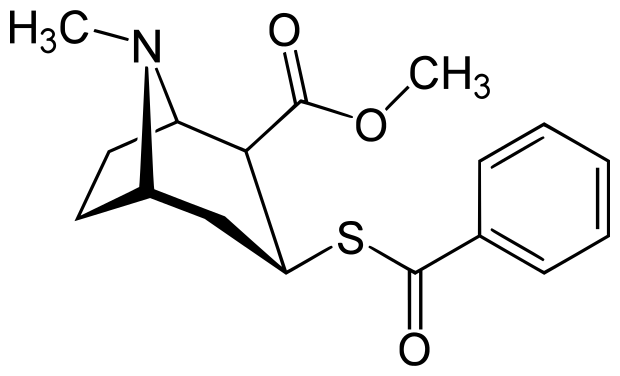
Benzoylthiomethylecgonine
A sulfur in place of the oxygen at the benzoyl ester single bond results in a lower electronegativity than that of cocaine.
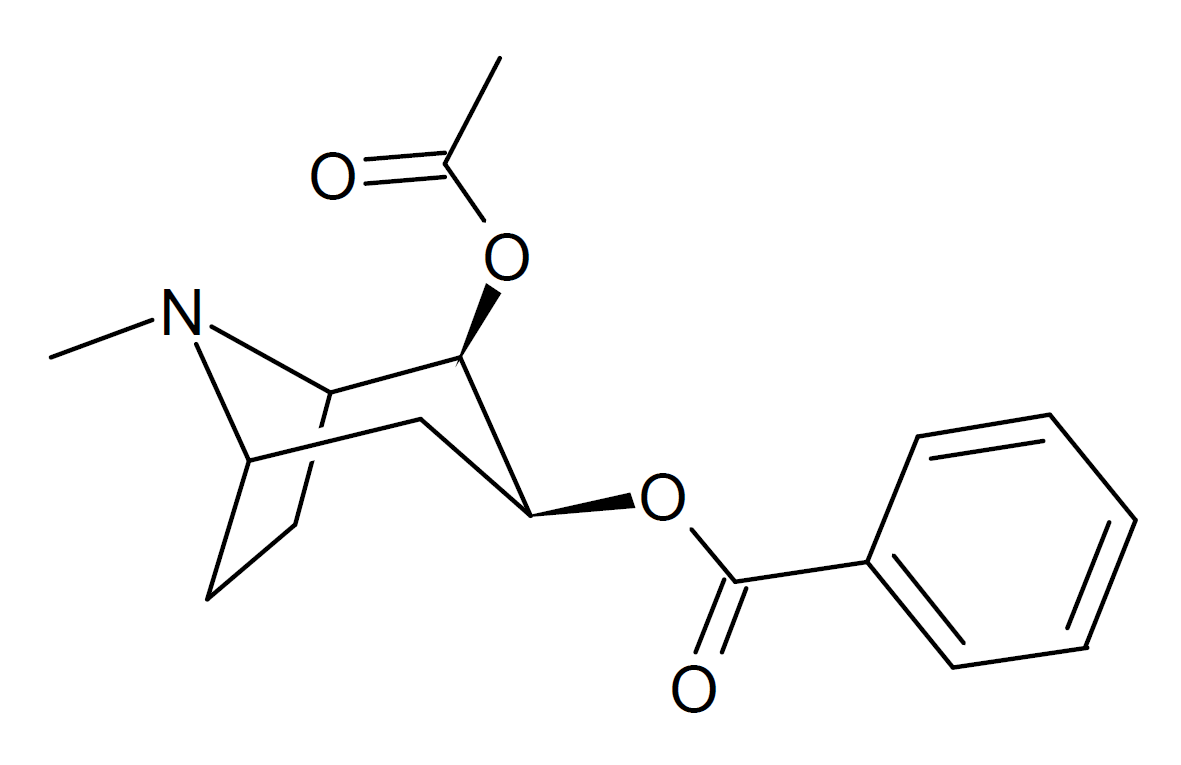
Cocaine reverse ester (REC)
REC is a cocaine analogue which contains a "reversed" C2 carbomethoxy moiety. In animal studies, REC lacked cocaine-like stimulant effects.
C1-tropane-ring hydrogen—substitutions
Structure
Trivial name
Ki (nM) @ DAT
Ki (nM) @ SERT
Ki (nM) @ NET
σ1 affinity
Ki
σ2 affinity
Ki
IC50 (μM) Na+ inhibition
(Vertridine-Stimulated
influx of sodium channels
in Neocortical neurons)c
(—)-Cocaine
H
326 ± 106
513 ± 143
358 ± 69
6.7 ± 0.3 μMd
last1=Nuwayhid
first1=Samer J.
last2=Werling
first2=Linda L.
title=Sigma2 (σ2) receptors as a target for cocaine action in the rat striatum
journal=European Journal of Pharmacology
volume=535
issue=1–3
year=2006
pages=98–103
issn=0014-2999
doi=10.1016/j.ejphar.2005.12.077
pmid=16480713}}
[[File:1-methylcocaine.svg
x120px
class=skin-invert-image]]
(—)-1-methyl-cocaine
Me
163 ± 23
435 ± 77
488 ± 101
"unappreciable"
1.13 μM
[[File:1-ethylcocaine.svg
x120px
class=skin-invert-image]]
(—)-1-ethyl-cocaine
Et
95.1 ± 17.0ɑ
1,106 ± 112
598 ± 179
—
—
[[File:1-propylcocaine.svg
x150px
class=skin-invert-image]]
(—)-1-n-propyl-cocaine
n-Pr
871 ± 205ɑ
2,949 ± 462b
796 ± 195
—
—
[[File:1-pentylcocaine.svg
x160px
class=skin-invert-image]]
(—)-1-n-pentyl-cocaine
n-C5H11
1,272 ± 199b
1,866 ± 400ɑ
1,596 ± 21b
—
—
[[File:1-phenylcocaine.svg
x150px
class=skin-invert-image]]
(—)-1-phenyl-cocaine
Ph
32.3 ± 5.7b
974 ± 308
1,980 ± 99b
524 nM
198 nM
ɑ, P
b, P
cLidocaine was found to have a value of 39.6 ± 2.4, the weakest of all tested.
dSame reference gives 25.9 ± 2.4 μM for (+)-cocaine and 13.6 ± 1.3 μM for norcocaine. Comparably it gives 12.7 ± 1.5 μM for the sigmaergic affinity of (+)-amphetamine. Another reference gives 1.7-6.7 μM for (—)-cocaine. All values Ki.
Using same data-set as above table, the following compounds were found to compare as:
CFT @ DAT = 39.2 ± 7.1 (n = 5)
fluoxetine @ SERT = 27.3 ± 9.2 (n = 3)
desipramine @ NET = 2.74 ± 0.59 (n = 3)
Cocaine analogs substituting the C1-tropane ring position, requiring sulfinimine (N-sulfinyl-imine) chemistry (before the innovation of which were untenable) which bind unlike the typical configuration at DAT (open to out) as cocaine (with its terminal D79-Y156 distance of 6.03 Å), or in the atypical (closed to out) conformation of the benztropines (3.29 Å). Though closer to the open to out: (—)-1-methyl-cocaine = 4.40 Å & (—)-1-phenyl-cocaine = 4.89 Å, and exhibiting preferential interaction with outward facing DAT conformation, they appear to have the lack of behavioral stimulation as-like the closed to out type. Despite having non-stimulant behavior profiles, they still seem to have anti-depressant behavioral profiles.
The C1 phenyl analog is ten times stronger than cocaine as a dopamine reuptake pump ligand, and twenty four times stronger as a local anesthetic (voltage-dependent Na+ channel blocker), whereas the C1 methyl analog is 2.3 times less potent as a local anesthetic.
cf. hydroxytropacocaine for a natural alkaloid (lacking however, the 2-position carbmethoxy) that is a C1 substituent with a hydroxy group.
2''β''-substitutions
Structure
S. Singh's
alphanumeric
assignation
(name)
R
DAT
5-HTT
NET
Selectivity
Selectivity
[[File:Cocaine analog 196a-o.svg
200px
class=skin-invert-image
Satendra Singh Rev]]
(Cocaine)
Me
89 ± 4.8
1045 ± 89
3298 ± 293
11.7
37.0
196a
(Cocaethylene)
Et
195 ± 45
5801 ± 493
10000 ± 751
29.7
51.3
196b
n-Pr
196 ± 46
4517 ± 430
6124 ± 262
23.3
31.2
196c
i-Pr
219 ± 48
25224 ± 1498
30384 ± 1685
115
139
196d
Ph
112 ± 31
33666 ± 3330
31024 ± 1909
300
277
196e
Bn
257 ± 14
302 ± 23
20794 ± 950
1.2
80.9
196f
β-phenethyl
181 ± 10
615 ± 52
19944 ± 1026
3.4
110
196g
γ-phenylpropyl
147 ± 19
374 ± 15
4893 ± 344
2.5
33.3
196h
cinnamyl
371 ± 15
368 ± 6.3
68931 ± 3476
1.0
186
196i
p-NO2-β-phenethyl
601 ± 28
-
-
-
-
196j
p-Cl-β-phenethyl
271 ± 12
-
-
-
-
196k
p-NH2-β-phenethyl
72 ± 7
-
-
-
-
196l
p-NCS-β-phenethyl
196 ± 14
-
-
-
-
196m
p-azido-β-phenethyl
227 ± 19
-
-
-
-
196n
(p-NHCOCH2Br)β-phenethyl
61 ± 6
-
-
-
-
196o
(p-NHCO(CH2)2CO2Et)β-phenethyl
86 ± 4
-
-
-
-
[[File:Cocaine analog 197a-d.svg
200px
class=skin-invert-image
Satendra Singh Rev]]
197a
NH2
753 ± 41.3
13725 ± 1256
3981 ± 229
18.2
5.3
197b
-NMe2
127 ± 6.36
143713 ± 8854
7329 ± 158
1131
57.7
197c
-N(OMe)Me
60 ± 6.4
28162 ± 2565
3935 ± 266
469
65.6
197d
-NHMe
2424 ± 118
44798 ± 2105
4213 ± 206
18.5
1.7
197e
(Benzoylecgonine)
-OH
195000
-
-
-
-
[[File:Cocaine analog 196-197.svg
200px
class=skin-invert-image
Satendra Singh Rev]]
197f
HOCH2-
561 ± 149
-
-
-
-
197g
(Tropacocaine)
H
5180 ± 1160
-
-
-
-
196a (Cocaethylene)
196b
196c
196d
196e
196f
196g
196h
196i
196j
196k
196l
196m
196n
196o
197a
197b
197c
197d
197e
197f
197g
[[File:Cocaine analog 196a.svg
x145px
class=skin-invert-image]]
[[File:Cocaine analog 196b.svg
x145px
class=skin-invert-image]]
[[File:Cocaine analog 196c.svg
x145px
class=skin-invert-image]]
[[File:Cocaine analog 196d.svg
x145px
class=skin-invert-image]]
[[File:Cocaine analog 196e.svg
x145px
class=skin-invert-image]]
[[File:Cocaine analog 196f.svg
x165px
class=skin-invert-image]]
[[File:Cocaine analog 196g.svg
x165px
class=skin-invert-image]]
[[File:Cocaine analog 196h.svg
x165px
class=skin-invert-image]]
[[File:Cocaine analog 196i.svg
x165px
class=skin-invert-image]]
[[File:Cocaine analog 196j.svg
x165px
class=skin-invert-image]]
[[File:Cocaine analog 196k.svg
x165px
class=skin-invert-image]]
[[File:Cocaine analog 196l.svg
x165px
class=skin-invert-image]]
[[File:Cocaine analog 196m.svg
x165px
class=skin-invert-image]]
[[File:Cocaine analog 196n.svg
x165px
class=skin-invert-image]]
[[File:Cocaine analog 196o.svg
x165px
class=skin-invert-image]]
[[File:Cocaine analog 197a.svg
x145px
class=skin-invert-image]]
[[File:Cocaine analog 197b.svg
x145px
class=skin-invert-image]]
[[File:Cocaine analog 197c.svg
x145px
class=skin-invert-image]]
[[File:Cocaine analog 197d.svg
x145px
class=skin-invert-image]]
[[File:Cocaine analog 197e.svg
x145px
class=skin-invert-image]]
[[File:Cocaine analog 197f.svg
x145px
class=skin-invert-image]]
[[File:Cocaine analog 197g.svg
x145px
class=skin-invert-image]]
Compounds 196e-h possess greater SERT affinity than cocaine, but possess weaker NET/DAT affinities (with the exception of 196g at NET). Compounds 196k, 196n, 196o, and 197c all possess greater DAT affinity than cocaine. Compound 197b (dimethyl amide) displayed a 1,131-fold increased selectivity in affinity over the serotonin transporter, with only slight reductions in potency for the dopamine & norepinephrine transporters. Whereas 197c (Weinreb amide, N-methoxy-N-methyl amide) had a 469× increase at SERT, with greater affinity for DAT than cocaine and an equal NET affinity. 197b was 137×, and 196c 27× less potent at binding to the serotonin transporter, but both had a NET / DAT ratio that made for a better dopaminergic than cocaine. The consideration that large, bulky C2 substituents would alter the spatial conformation of the tropane ring system by distorting the piperidine portion of the system and thus hamper binding appears to be unfounded.
Benzoylecgonine (197e) is the inactive primary metabolite of cocaine generated through hydrolysis of the C2 methyl ester. In vitro binding studies indicate that benzoylecgonine is ~2,200x less potent than cocaine at the dopamine transporter, possibly due to zwitterion formation preventing strong DAT binding. In contrast to in vitro studies, the lack of activity observed in in vivo studies is likely the result of reduced blood–brain barrier penetration than formation of a zwitterion.
Compounds 201b & 201c were significantly more potent than cocaine while compounds 201a, 201d & 201e were significantly less potent. This finding indicates that the presence of a hydrogen bond acceptor (i.e. carbomethoxy) at the 2β position is not absolutely necessary for the creation of high affinity cocaine analogues.
[2H5-phenyl]-cocaine
HPBE
[2H3-N-methyl]-cocaine
C2-ethyl-OSO2CF2
cocaine
2-[(2-methoxy-2-oxoethoxy)methyl]
cocaine
[[File:D5-phenyl cocaine.svg
x130px
Reagent analogue rendered from its cocaine parent by replacing a cluster of several adjacent hydrogens (from among the hydrogens that comprise the entire circumference common to every basic molecular perimeter) with deuterium, in an equivalent but localized spread or cluster.]]
[[File:Hydroxypropyl benzoylecgonine.svg
x130px
Hydroxypropylbenzoylecgonine (HPBE), which imparts the topical analgesic effect in the preparation [[Esterom]].]]
[[File:D3-methyl cocaine.svg
x150px
Reagent analogue used in radio-labeling ligand binding sites.]]
Back-bridged cocaine analogues are considered more akin to untethered cocaine analogs & phenyltropane derivatives (where the nitrogen lone pair is not fixed or constrained) and better mimics their affinities. This is due to when the eighth carbon tropane position is freely rotatable and unbound it preferably occupies the axial position as defining its least energy & most unhindered state. In front-bridged analogs the nitrogen lone pairings rigid fixity makes it reside in an equatorial placing for the piperidine ring-part of the tropane nucleus, pointing to the two-carbon & three methylene unit bridgehead; giving the attested front-bridged cocaine analogues preference for SERT over DAT.
8 to 3 tethered analogues
Structure
Compound
R
X
[3H]DA Uptake
[3H]5-HT Uptake
[3H]NE Uptake
5-HT/DA Selectivity
NE/DA Selectivity
Cocaine
259 ± 19.9
155 ± 0.4
108 ± 3.5
0.60
0.42
[[File:Zhang thiophene tropane.svg
120px
class=skin-invert-image]]
5a
H
CO2Me
268 ± 16.6
2046 ± 42
26.4 ± 1.9
7.63
0.10
5b
Me
CO2Me
403 ± 20
179 ± 38
4.9 ± 0.2
0.44
0.01
5c
I
CO2Me
368 ± 1.6
29 ± 1.6
5 ± 1.3
0.08
0.01
7
H
CO2iPr
428 ± 45.7
1150 ± 1.6
52.3 ± 12.0
2.69
0.12
8
H
CH2OH
~3000
~1000
~300
~0.33
~ 0.1
9
H
CH2OAc
610 ± 53
1530 ± 150
283 ± 16
2.51
0.46
10
H
CH2OCOC(CH3)3
1020 ± 70
168 ± 53.5
1180 ± 130
0.16
1.16
11
H
CH2OCOPh
1750 ± 140
1.53 ± 0.19
894 ± 126
0.0009
0.51
12
H
CH2OCO-2-naphthyl
1678 ± 124
169 ± 16
1234 ± 166
0.10
0.74
13
H
CH2NHCOCH3
6140 ± 50
13330 ± 3150
2430 ± 340
2.17
0.39
14
H
CH2NHCO2C(CH3)3
2300 ± 380
2360 ± 30
1700 ± 60
1.03
0.74
Structure
Compound
R
X
[3H]DA Uptake
[3H]5-HT Uptake
[3H]NE Uptake
DA/5-HT Selectivity
NE/DA Selectivity
Cocaine
423 ± 147
155 ± 0.4
108 ± 3.5
2.7
0.26
[[File:Zhang tricyclic tropane.svg
120px
class=skin-invert-image]]
8a
4-F
CO2Me
6620 ± 460
335 ± 45
584 ± 163
2.7
0.26
8b
4-Cl
CO2Me
853 ± 58
34.3 ± 2.9
208 ± 111
24.8
0.24
8c
3-Cl
CO2Me
7780 ± 1580
53.6 ± 17.2
231 ± 44
145
0.03
8d
4-Br
CO2Me
495 ± 13
11 ± 3
178 ± 9
45
0.36
8e
4-I
CO2Me
764 ± 11
21.9 ± 0.3
213 ± 31
34.9
0.28
8f
4-CF3
CO2Me
N/T
12.6 ± 0.5
1830 ± 211
N/T
N/T
8g
H
CO2Me
481 ± 11
1140 ± 70
53 ± 16
0.42
0.11
8h
4-Me
CO2Me
649 ± 2
15 ± 0.4
146 ± 28
43.3
0.22
8i
4-OCH3
CO2Me
3130 ± 160
56 ± 4
187 ± 5
55.9
0.06
8j
4-iPr
CO2Me
N/T
10.2 ± 0.4
1110 ± 200
N/T
N/T
8k
3,4-Cl2
CO2Me
1920 ± 260
20 ± 1
1000 ± 280
96
0.52
8l
2,3-Cl2
CO2Me
950 ± 107
354 ± 188
1210 ± 358
2.4
1.42
8m
3,5-Cl2
CO2Me
5600 ± 400
437 ± 0.3
4100 ± 500
12.8
0.73
8n
3,4-F2
CO2Me
7440 ± 19
101 ± 8.7
394 ± 98
73.7
0.05
8o
4-Br-3-Cl
CO2Me
5420 ± 940
2.3 ± 0.1
459 ± 80
2360
0.08
8p
3-Cl-4-I
CO2Me
3140 ± 450
1.8 ± 0.3
272 ± 55
1740
0.09
8q
2-Cl-4-I
CO2Me
6640 ± 2080
74 ± 12.2
508 ± 21
89.7
0.08
8r
3-Cl-4-Me
CO2Me
10000
6.4 ± 1.3
198 ± 10
1560
8s
3,4-Me2
CO2Me
N/T
10.1 ± 1.1
659 ± 128
N/T
N/T
[[File:Zhang tricyclic tropane 2.svg
120px
class=skin-invert-image]]
8t
1-Naphthyl
CO2Me
9720 ± 700
121 ± 3
5370 ± 580
80.3
0.55
8u
2-Naphthyl
CO2Me
735 ± 235
21 ± 9.9
157 ± 13
35
0.21
8v
1-Pyrenyl
CO2Me
9920 ± 906
860 ± 20.6
N/T
11.5
N/T
8w
9-Phenanthryl
CO2Me
1640 ± 30
233 ± 44
13000 ± 1300
39.2
0.86
"N/T" = "not tested"
Tropane ring contraction (azabornane) analogues
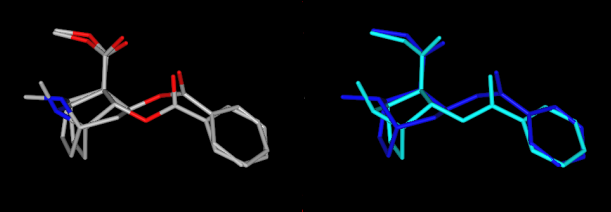
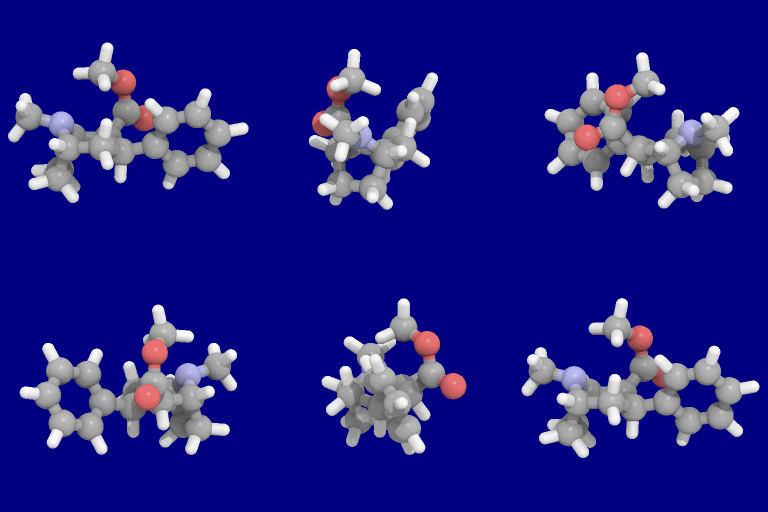
Comparison of tropane ring versus the norbornane in overlay emphasizing the conformational differences of the benzoyl branch between the tropane ring system (dark blue on right) and norbornane ring system (light blue on right).
Structure
S. Singh's
alphanumeric
assignation
(name)
DAT
[3H]WIN 35428
Ki (nM)
(Cocaine)
89 ± 4.8
[[File:Cocaine analogue 155a.svg
x140px
class=skin-invert-image]]
155a
60400 ± 4800
[[File:Cocaine analogue 155b.svg
x140px
class=skin-invert-image]]
155b
96500 ± 42
[[File:Cocaine analogue 155c.svg
x140px
class=skin-invert-image]]
155c
5620 ± 390
[[File:Cocaine analogue 155d.svg
x140px
class=skin-invert-image]]
155d
18900 ± 1700
6/7 tropane position methoxycocaine & methoxypseudococaine analogues
trans]]'' to optimize its functional stimulation.)
See: List of phenyltropanes (Many phenyltropanes are derived from cocaine metabolites, such as methylecgonidine, as precursors. Whereas fully synthetic methods have been devised from the starting material of vinylcarbenoids & pyrroles.)
The difference in the length of the benzoyloxy and the phenyl linkage contrasted between cocaine and phenyltropanes makes for a shorter distance between the centroid of the aromatic benzene and the bridge nitrogen of the tropane in the latter PTs. This distance being on a scale of 5.6 Å for phenyltropanes and 7.7 Å for cocaine or analogs with the benzoyloxy intact. This may account for PTs increased behavioral stimulation profile over cocaine. Differences in binding potency have also been explained considering solvation effects; cocaine containing 2β,3β-ester groups being calculated as more solvated than the WIN-type compounds (i.e. troparil). Higher pKɑs of the tropane nitrogen (8.65 for cocaine, 9.55 for troparil & 11.95 for vinyl analogue 43a), decreased aqueous solvation & decreased conformational flexibility added to increased binding affinity.
Despite the observation of increased stimulation, phenyltropanes lack the local anesthetic sodium channel blocking effect that the benzoyloxy imparts to cocaine. Beside topical affect, this gives cocaine an affinity for binding to sites on the dopamine and serotonin sodium dependent transport areas that are distinct & specific to MAT in contrast to the general sodium channels; creating a separate mechanism of relational affinity to the transporters in addition to its inhibition of the reuptake for those transporters; this is unique to the local anesthetic value in cocaine & analogues with a similar substitute for the benzoyloxy that leaves the sodium channel blockage ability intact. Rendering such compounds as different functionally in their relation to MAT contrasted to phenyltropane analogues which have the local anesthetic bridge removed. (Requiring some of the sodium ions to be pumped from the axon via Na+/K+-ATPase). In addition, it even has been postulated that a crucial role regarding the electron energy imparted via voltage sensitization (and thus action potential blockage with a molecule capable of intersecting its specific channel, in the case of cocaine a sodium channel, that potentially serves in re-quantifying its charge) upon a receptor binding site may attenuate the mediating influence of the inhibitory regulation that autoreceptors play by their slowing neurotransmitter release when an efflux is created through an instance of agonism by a compound; allowing said efflux to be continued without the body's attempt to maintain homeostasis enacting in as readily responsive a manner to its conformational change.
The compound 224e, the 3β-styrene analogue, had the highest potency in its group. While 224b & 224c showed the most selectivity, with 224b having a ten-fold greater potency for the dopamine transporter than cocaine.
6-Alkyl-3-benzyltropane analogues
Sub-category
(S. Singh compound #)
a
R=H
b
R=Me
c
R=Et
d
R=n-Pr
e
R=n-Bu
f
R=Bn
2β,6α-isomers:
*(229a—f)*
[[File:Cocaine analog 229a.svg
x120px
class=skin-invert-image]]
[[File:Cocaine analog 229b.svg
x120px
class=skin-invert-image]]
[[File:Cocaine analog 229c.svg
x120px
class=skin-invert-image]]
[[File:Cocaine analog 229d.svg
x120px
class=skin-invert-image]]
[[File:Cocaine analog 229e.svg
x120px
class=skin-invert-image]]
[[File:Cocaine analog 229f.svg
x120px
class=skin-invert-image]]
2α,6α-isomers:
*(230a—f)*
[[File:Cocaine analog 230a.svg
x110px
class=skin-invert-image]]
[[File:Cocaine analog 230b.svg
x110px
class=skin-invert-image]]
[[File:Cocaine analog 230c.svg
x110px
class=skin-invert-image]]
[[File:Cocaine analog 230d.svg
x120px
class=skin-invert-image]]
[[File:Cocaine analog 230e.svg
x120px
class=skin-invert-image]]
[[File:Cocaine analog 230f.svg
x120px
class=skin-invert-image]]
2β,6β-isomers:
*(231a—f)*
[[File:Cocaine analog 229a.svg
x110px
class=skin-invert-image]]
[[File:Cocaine analog 231b.svg
x110px
class=skin-invert-image]]
[[File:Cocaine analog 231c.svg
x110px
class=skin-invert-image]]
[[File:Cocaine analog 231d.svg
x100px
class=skin-invert-image]]
[[File:Cocaine analog 231e.svg
x100px
class=skin-invert-image]]
[[File:Cocaine analog 231f.svg
x100px
class=skin-invert-image]]
2α,6β-isomers:
*(232a—f)*
[[File:Cocaine analog 230a.svg
x110px
class=skin-invert-image]]
[[File:Cocaine analog 232b.svg
x110px
class=skin-invert-image]]
[[File:Cocaine analog 232c.svg
x110px
class=skin-invert-image]]
[[File:Cocaine analog 232d.svg
x100px
class=skin-invert-image]]
[[File:Cocaine analogue 232e.svg
x90px
class=skin-invert-image]]
[[File:Cocaine analog 232f.svg
x100px
class=skin-invert-image]]
Compound
S. Singh's
alphanumeric
assignation
(name/WIN number)
R
Ki (nM)
[3H]WIN 35428 binding
IC50 (nM)
[3H]DA uptake
Selectivity
Cocaine
32 ± 5
338 ± 221
405 ± 91
405 ± 91
12.6
1.2
WIN 35065-2
33 ± 17
314 ± 222
373 ± 10
11.3
[[File:229 Analogue Scaffold.svg
x140px
class=skin-invert-image]]
(−)-229a
H
33 ± 5
161 ± 100
4.9
229a
H
91 ± 10
94 ± 26
1.0
229b
Me
211 ± 23
-
-
229c
Et
307 ± 28
-
-
229d
n-Pr
4180 ± 418
-
-
229e
n-Bu
8580 ± 249
-
-
229f
Bn
3080 ± 277
-
-
[[File:230 Analogue Scaffold.svg
x140px
class=skin-invert-image]]
(+)-230a
H
60 ± 6
208 ± 63
3.5
230a
H
108 ± 14
457 ± 104
4.2
230b
Me
561 ± 64
-
-
230c
Et
1150 ± 135
-
-
230d
n-Pr
7240 ± 376
-
-
230e
n-Bu
19700 ± 350
-
-
230f
Bn
7590 ± 53
-
-
[[File:231 Analogue Scaffold.svg
x140px
class=skin-invert-image]]
231b
Me
57 ± 5
107 ± 36
1.9
231c
Et
3110 ± 187
-
-
231d
n-Pr
5850 ± 702
-
-
231f
Bn
1560 ± 63
-
-
[[File:232 Analogue Scaffold.svg
x140px
class=skin-invert-image]]
232b
Me
294 ± 29
532 ± 136
1.8
232c
Et
6210 ± 435
-
-
232d
n-Pr
57300 ± 3440
-
-
232f
Bn
3080 ± 277
-
-
241
Bn
4830 ± 434
-
-
Sub-category
(S. Singh compound #)
a
R=H
b
R=Me
c
R=Et
d
R=n-Pr
e
R=n-Bu
f
R=Bn
6α-isomers:
*(237a—f)*
[[File:Cocaine analog 237a.svg
x95px
class=skin-invert-image]]
[[File:Cocaine analog 237b.svg
x105px
class=skin-invert-image]]
[[File:Cocaine analog 237c.svg
x110px
class=skin-invert-image]]
[[File:Cocaine analog 237d.svg
x125px
class=skin-invert-image]]
[[File:Cocaine analog 237e.svg
x135px
class=skin-invert-image]]
[[File:Cocaine analog 237f.svg
x135px
class=skin-invert-image]]
6β-isomers (exo):
*(238a—f)*
[[File:Cocaine analog 238a.svg
x77px
class=skin-invert-image]]
[[File:Cocaine analog 238b.svg
x85px
class=skin-invert-image]]
[[File:Cocaine analog 238c.svg
x85px
class=skin-invert-image]]
[[File:Cocaine analog 238d.svg
x85px
class=skin-invert-image]]
[[File:Cocaine analog 238e.svg
x85px
class=skin-invert-image]]
3β-benzyl derivatives:
*(239a—f)*
[[File:Cocaine analog 239a.svg
x115px
class=skin-invert-image]]
[[File:Cocaine analog 239b.svg
x110px
class=skin-invert-image]]
[[File:Cocaine analog 239c.svg
x110px
class=skin-invert-image]]
[[File:Cocaine analog 239d.svg
x130px
class=skin-invert-image]]
[[File:Cocaine analog 239e.svg
x135px
class=skin-invert-image]]
[[File:Cocaine analog 239f.svg
x135px
class=skin-invert-image]]
intermediate
alkylidene esters:
*(240a—f)*
[[File:Cocaine analog 240a.svg
x115px
class=skin-invert-image]]
[[File:Cocaine analog 240b.svg
x115px
class=skin-invert-image]]
[[File:Cocaine analog 240c.svg
x115px
class=skin-invert-image]]
[[File:Cocaine analog 240d.svg
x130px
class=skin-invert-image]]
[[File:Cocaine analog 240e.svg
x135px
class=skin-invert-image]]
[[File:Cocaine analog 240f.svg
x135px
class=skin-invert-image]]
N.B. The benzylidene derivatives serve as synthetic intermediates for 6-Alkyl-3-benzyltropanes and have not been assayed for biological activity. Compounds 237a and 238a are the same compound as both are the parent for either series with a hydrogen saturated in their respective substitution place.
Direct 2,3-pyrimidino fused
below: Chalcostrobamine
cf. strobamine (at right) for a more efficacious compound as like the below.
Cocaine haptens that create catalytic anti-bodies require transitional states as affected in vivo. Monoclonal antibodies generated against BSA-coupled 402e accelerated the rate of cocaine hydrolysis by ~23,000x and eliminated the reinforcing effects of cocaine administration in rats.
K1-KLH/BSA
K2-KLH/BSA
[[File:K1-KLH-BSA.svg
x200px
class=skin-invert-image]]
[[File:K2-KLH-BSA.svg
x110px
class=skin-invert-image]]
Structural/Functional intermediate analogues
Piperidine Analogues
JZ-IV-10 (a "Modafinil hybrid" with nocaine. cf. List of modafinil analogues)
title=Relationship between Conformational Changes in the Dopamine Transporter and Cocaine-Like Subjective Effects of Uptake Inhibitors
journal=Molecular Pharmacology
volume=73
issue=3
year=2007
pages=813–823
issn=0026-895X
doi=10.1124/mol.107.039800
pmid=17978168
s2cid=5061034}}
CH2CH=CH2
-
-
-
(JHW 007)
CH2CH2CH2CH3
-
-
-
(GA 2-99)
CH2CH2NH2
-
-
-
(GA 103)
CH2CH2CH2CH2Ph
-
-
-
[[File:Cocaine analog 266.svg
200px
class=skin-invert-image]]
266
108 ± 12
130
1.2
ɑInhibition at 10 μM
Compound
S. Singh's
alphanumeric
assignation
(name)
IC50 (nM)
DAT
(Binding of [3H]WIN 35428)
IC50 (nM)
5-HTT
(Binding of [3H]Citalopram)
[[File:Cocaine analog 268.svg
200px
class=skin-invert-image]]
R/S-268
2β,3β
10000
R/S-269
2α,3β
20300
R/S-270
2α,3α
22300
[[File:Cocaine analog 271.svg
200px
class=skin-invert-image]]
R/S-271
2β,3α
520
Benzatropine
Etybenzatropine
Difluoropine (O-620)
PG01053
276
277
MFZ 4-86
MFZ 2-71
3-CPMT
JHW 007-d9
GA 103
AHN 1-055
[[File:Benzatropine.svg
x165px
Benzatropine]]
[[File:Etybenzatropine.svg
x165px
Etybenzatropine]]
[[File:Difluoropine Structure.svg
x185px
Difluoropine is a stimulant drug which acts as a more selective dopamine reuptake inhibitor than cocaine.]]
[[File:PG01053.svg
x165px
PG01053]]
[[File:Benztropine 276.svg
x165px
Compound 276]]
[[File:Benztropine 277.svg
x165px
Compound 277]]
[[File:MFZ 4-86.svg
x165px
class=skin-invert-image]]
[[File:MFZ 2-71.svg
x165px
class=skin-invert-image]]
[[File:3-CPMT.svg
x165px
3-CPMT]]
[[File:JHW-007-d9 Structure.svg
x165px
Deuterium labeled radio-ligand of benztropine analog [[JHW-007]]; a di-para-fluoro benztropine, and hybrid between benzatropine & difluoropine (with fluorine groups in the former to breach the difference or the latter being descarbmethoxy to approach identification with the former)]]
[[File:GA 103 Structure.svg
x165px
N-phenylpropyl bis-4-fluorobenztropine.]]
[[File:AHN 1-055 Structure.svg
x165px
The 4′,4′-bisfluorinated analogue of benztropine.]]
The binding of benztropine analogues to the DAT differs significantly from that of cocaine and the phenyltropanes. Benztropines are considered to be "atypical" DAT ligands because they stabilize the DAT in an inward-facing (closed-to-out) conformation, whereas cocaine and the phenyltropanes stabilize the DAT in an outward-facing (open-to-out) conformation. This difference in DAT binding may be responsible for the lack of cocaine-like behavioral effects observed in animal and human studies of the benztropine analogues and other “atypical” DAT inhibitors. Studies of the structure-activity relationships of benztropine have shown that DAT affinity and selectivity over other monoamine transporters is enhanced by 4′,4′-difluorination. Modification of the tropane n-substituent was found to mitigate the anticholinergic effects of benztropine analogues by reducing M1 affinity.
Tropanyl Isoxazoline Analogues
4a
4c
5a
5c
6a
6b
6c
7a
7b
7c
8a
8b
8c
9a
9b
9c
10a
10b
10c
11a
11b
12a
12b
[[File:Dallanoce 4a.svg
x200px
class=skin-invert-image]]
[[File:Dallanoce 4c.svg
x210px
class=skin-invert-image]]
[[File:Dallanoce 5a.svg
x190px
class=skin-invert-image]]
[[File:Dallanoce 5c.svg
x210px
class=skin-invert-image]]
[[File:Dellancoe 6a.svg
x170px
class=skin-invert-image]]
[[File:Dallanoce 6b.svg
x170px
class=skin-invert-image]]
[[File:Dallanoce 6c.svg
x170px
class=skin-invert-image]]
[[File:Dallanoce 7a.svg
x170px
class=skin-invert-image]]
[[File:Dallanoce 7b.svg
x170px
class=skin-invert-image]]
[[File:Dallanoce 7c.svg
x190px
class=skin-invert-image]]
[[File:Dallanoce 8a.svg
x190px
class=skin-invert-image]]
[[File:Dallanoce 8b.svg
x170px
class=skin-invert-image]]
[[File:Dallanoce 8c.svg
x170px
class=skin-invert-image]]
[[File:Dallanoce 9a.svg
x170px
class=skin-invert-image]]
[[File:Dallanoce 9b.svg
x170px
class=skin-invert-image]]
[[File:Dallanoce 9c.svg
x190px
class=skin-invert-image]]
[[File:Dallanoce 10a.svg
x170px
class=skin-invert-image]]
[[File:Dallanoce 10b.svg
x170px
class=skin-invert-image]]
[[File:Dallanoce 10c.svg
x190px
class=skin-invert-image]]
[[File:Dallanoce 11a.svg
x180px
class=skin-invert-image]]
[[File:Dallanoce 11b.svg
x180px
class=skin-invert-image]]
[[File:Dallanoce 12a.svg
x180px
class=skin-invert-image]]
[[File:Dallanoce 12b.svg
x180px
class=skin-invert-image]]
Compound 7a (3′-methoxy-8-methyl-spiro(8-azabicyclo(3.2.1)octane-3,5′(4′H)-isoxazole) allosterically enhances SERT binding of other reuptake ligands. Compound **7a ** construed as a potentiating allosteric effect (by unveiling occluded configured serotonin uptake-area ligand-site on surface of transporter that allows for binding by exogenous ligand, when SERT is otherwise conformed in a transitional manner where a SERT ligand cannot bind, this effect with compound in question occurs) at concentrations of 10μM—30μM (wherein it acts by interconverting the conformational state of unexposed SERTs to ones exposing the SSRI binding site via a shift to the equilibrium of the MAT) while exerting an inhibitory orthosteric effect when concentrations reach 30μM and above.
7a is the only known compound to allosterically modulate SERT in such a way within in vitro conditions (tianeptine has been shown to do similar, but has only shown efficacy doing so in living in vivo tissue samples). Considering its noncompetitive inhibition of 5-HT transporters decreasing Vmax with small change in the Km for serotonin, putatively stabilizing the cytoplasm-facing conformation of SERT: in such respect it is considered to have the opposite effect profile of the anti-addiction drug ibogaine (save for the function by which its anti-addictive properties are thought to be mediated, i.e. α3β4 nicotinic channel blockage. cf.18-Methoxycornaridine for such nicotinergic activity without the likewise SERT affinity).
Compound 11a possesses similar effects, but acts on the DAT. Similarly, such peripheral DAT considerations (when, as often is, considered conformational rather than otherwise explained as being electrostatic) may constitute the difference in affinity, through allosertic occulsion, between cyclopentyl-ruthenium phenyltropane in its difference from the tricarbonyl-chromium
Alicyclic Amine Analogues
EXP-561
Butyltolylquinuclidine
[[File:EXPfivesixone.png
x160px
class=skin-invert-image]]
[[File:Butyltolylquinuclidine.png
x130px
class=skin-invert-image]]
Dihydroimidazoles
Possible substitutions of the [[Mazindol]] molecular structure.
See: List of Mazindol analogues
Mazindol is usually considered a non-habituating (in humans, and some other mammals, but is habituating for e.g. Beagles) tetracyclic dopamine reuptake inhibitor (of somewhat spurious classification in the former).
It is a loosely functional analog used in cocaine research; due in large part to N-Ethylmaleimide being able to inhibit approximately 95% of the specific binding of [3H]Mazindol to the residues of the MAT binding site(s), however said effect of 10 mM N-Ethylmaleimide was prevented in its entirety by just 10 μM cocaine. Whereas neither 300 μM dopamine or D-amphetamine afforded sufficient protection to contrast the efficacy of cocaine.
Local anesthetics (not usually CNS stimulants)
In animal studies, certain of the local anesthetics have displayed residual dopamine reuptake inhibitor properties, although not normally ones that are easily available. These are expected to be more cardiotoxic than phenyltropanes. For example, dimethocaine has behavioral stimulant effects (and therefore not here listed below) if a dose of it is taken that is 10 times the amount of cocaine. Dimethocaine is equipotent to cocaine in terms of its anesthetic equivalency. Intralipid "rescue" has been shown to reverse the cardiotoxic effects of sodium channel blockers and presumably those effects when from cocaine administered intravenously as well.
(1925). "Psicaine: An Artificial Cocaine". Br Med J.
(March 1994). "Studies with differentially labeled [11C]cocaine, [11C]norcocaine, [11C]benzoylecgonine, and [11C]- and 4′-[18F]fluorococaine to probe the extent to which [11C]cocaine metabolites contribute to PET images of the baboon brain". Journal of Neurochemistry.
(1992). "Cocaine Receptor: Biochemical Characterization and Structure-Activity Relationships of Cocaine Analogues at Dopamine Transporter". Journal of Medicinal Chemistry.
(1997). "2′-Substitution of cocaine selectively enhances dopamine and norepinephrine transporter binding". NeuroReport.
(1984). "Hydroxymethoxybenzoylmethylecgonines: New metabolites of cocaine from human urine". Journal of Analytical Toxicology.
(2000). "Synthesis of novel spirocyclic cocaine analogs using the Suzuki coupling". Tetrahedron Letters.
(2002). "Benzoylthio-. cocaine, analogue substitution. Synthesis, Properties, and Reactivity of Cocaine Benzoylthio Ester Possessing the Cocaine Absolute Configuration". J. Am. Chem. Soc..
(May 1972). "Compounds affecting the central nervous system. I. Tropane-2 ,3 -diol derivatives. A reverse ester of cocaine". The Journal of Organic Chemistry.
(2012). "Novel C-1 Substituted Cocaine Analogs Unlike Cocaine or Benztropine". Journal of Pharmacology and Experimental Therapeutics.
(1988). "Cocaine binding at sigma receptors". Eur J Pharmacol.
(2006). "Sigma2 (σ2) receptors as a target for cocaine action in the rat striatum". European Journal of Pharmacology.
[http://www.nature.com/npp/journal/v26/n4/full/1395834a.html Involvement of the Sigma1 Receptor in Cocaine-induced Conditioned Place Preference: Possible Dependence on Dopamine Uptake Blockade] Pascal Romieu et al. Neuropsychopharmacology (2002) 26 444-455.10.1038/S0893-133X(01)00391-8
(1999). "Synthesis of 8-oxa analogues of norcocaine endowed with interesting cocaine-like activity". Bioorganic & Medicinal Chemistry Letters.
(8 April 2002). "Thiophene derivatives: a new series of potent norepinephrine and serotonin reuptake inhibitors.". Bioorganic & Medicinal Chemistry Letters.
(April 2002). "Further Studies on Conformationally Constrained Tricyclic Tropane Analogues and Their Uptake Inhibition at Monoamine Transporter Sites: Synthesis of ( Z )-9-(Substituted arylmethylene)-7-azatricyclo[4.3.1.0 3,7 ]decanes as a Novel Class of Serotonin Transporter Inhibitors". Journal of Medicinal Chemistry.
(1993). "Novel 2-substituted cocaine analogs: binding properties at dopamine transport sites in rat striatum". Eur. J. Pharmacol..
(2012). "Voltage sensitivities and deactivation kinetics of histamine H3 and H4 receptors". Biochimica et Biophysica Acta (BBA) - Biomembranes.
[http://www.arkat-usa.org/get-file/36494/ Enantioselective synthesis of strobamine and its analogues] Xing Zhang et al. Center for Organic and Medicinal Chemistry, Research Triangle Institute. Issue in Honor of Prof. James M.Cook ARKIVOC 2010 (iv)96-103
[https://books.google.com/books?id=rjtEwOFM5owC&dq=Strobamine&pg=PA17 The Alkaloids; Vol. 44, Geoffrey Cordell]
(2002). "An Analysis of the Binding of Cocaine Analogues to the Monoamine Transporters Using Tensor Decomposition 3-D QSAR". Bioorganic & Medicinal Chemistry.
(2011). "Cocaine analog coupled to disrupted adenovirus: a vaccine strategy to evoke high-titer immunity against addictive drugs". Mol Ther.
(2010). "Active immunotherapy for the Treatment of Cocaine Dependence". Drugs of the Future.
(2011). "Novel cocaine vaccine linked to a disrupted adenovirus gene transfer vector blocks cocaine psychostimulant and reinforcing effects". Neuropsychopharmacology.
[https://patents.google.com/patent/US6566084 Catalytic antibodies against cocaine and methods of using and producing same] Google patents US 6566084 B1
(1 January 1996). "Anti-Cocaine Catalytic Antibodies: A Synthetic Approach to Improved Antibody Diversity". Journal of the American Chemical Society.
(18 August 1998). "A catalytic antibody against cocaine prevents cocaine's reinforcing and toxic effects in rats". Proceedings of the National Academy of Sciences.
(2003). "Inhibition of cocaine binding to the human dopamine transporter by a single chain anti-idiotypic antibody: its cloning, expression, and functional properties". Biochim Biophys Acta.
(2000). "Exploring the feasibility of an anti-idiotypic cocaine vaccine: analysis of the specificity of anticocaine antibodies (Ab1) capable of inducing Ab2beta anti-idiotypic antibodies". Immunology.
(2004). "Piperidine-Based Nocaine/Modafinil Hybrid Ligands as Highly Potent Monoamine Transporter Inhibitors: Efficient Drug Discovery by Rational Lead Hybridization". Journal of Medicinal Chemistry.
(2007). "Relationship between Conformational Changes in the Dopamine Transporter and Cocaine-Like Subjective Effects of Uptake Inhibitors". Molecular Pharmacology.
(September 2009). "Combinations of Cocaine with Other Dopamine Uptake Inhibitors: Assessment of Additivity". Journal of Pharmacology and Experimental Therapeutics.
(2013). "Nonclassical pharmacology of the dopamine transporter: atypical inhibitors, allosteric modulators, and partial substrates". J. Pharmacol. Exp. Ther..
(2008). "Dopamine transport inhibitors based on GBR12909 and benztropine as potential medications to treat cocaine addiction". Biochem Pharmacol.
(2006). "Dopamine transporter ligands: recent developments and therapeutic potential". Curr Top Med Chem.
C. Dallanoce et al. - Bioorg. Med. Chem. 20 (2012) 6344-6355
(2012). "A novel spirocyclic tropanyl-Δ2-isoxazoline derivative enhances citalopram and paroxetine binding to serotonin transporters as well as serotonin uptake". Bioorganic & Medicinal Chemistry.
(Aug 2001). "From cocaine to ropivacaine: the history of local anesthetic drugs". Curr Top Med Chem.
(2014). "Development of a New Photochromic Ion Channel Blocker via Azologization of Fomocaine". ACS Chemical Neuroscience.
{{US patent. 6479509 Patent inventor Frank Ivy Carroll, Assignee: Research Triangle Institute
[https://patentimages.storage.googleapis.com/US6479509B1/US06479509-20021112-C00016.png U.S. patent US6479509 B1 structures given for submission, 5th compound down in image.]
This content may have been generated or modified by AI. CloudSurf Software LLC is not responsible for the accuracy, completeness, or reliability of AI-generated content. Always verify important information from primary sources.

-4-chloro-8-methyl-3-(phenylsulfanyl)-8-azabicyclo(3.2.1)oct-2-ene-2-carboxylate.svg)


-8-methyl-3-(tricyclo(9.4.0.0³,⁸)pentadeca-1(11),3,5,7,12,14-hexaene-2-carbonyloxy)-8-azabicyclo(3.2.1)octane-2-carboxylate.svg)


-CPCA.svg)
