From Surf Wiki (app.surf) — the open knowledge base
List of causes of death by rate
none
none
The following is a list of the causes of human deaths worldwide for different years arranged by their associated mortality rates. Some causes listed include deaths also included in more specific subordinate causes, and some causes are omitted, so the percentages may only sum approximately to 100%. The causes listed are relatively immediate medical causes, but the ultimate cause of death might be described differently. For example, tobacco smoking often causes lung disease or cancer, and alcohol use disorder can cause liver failure or a motor vehicle accident. For statistics on preventable ultimate causes, see preventable causes of death.
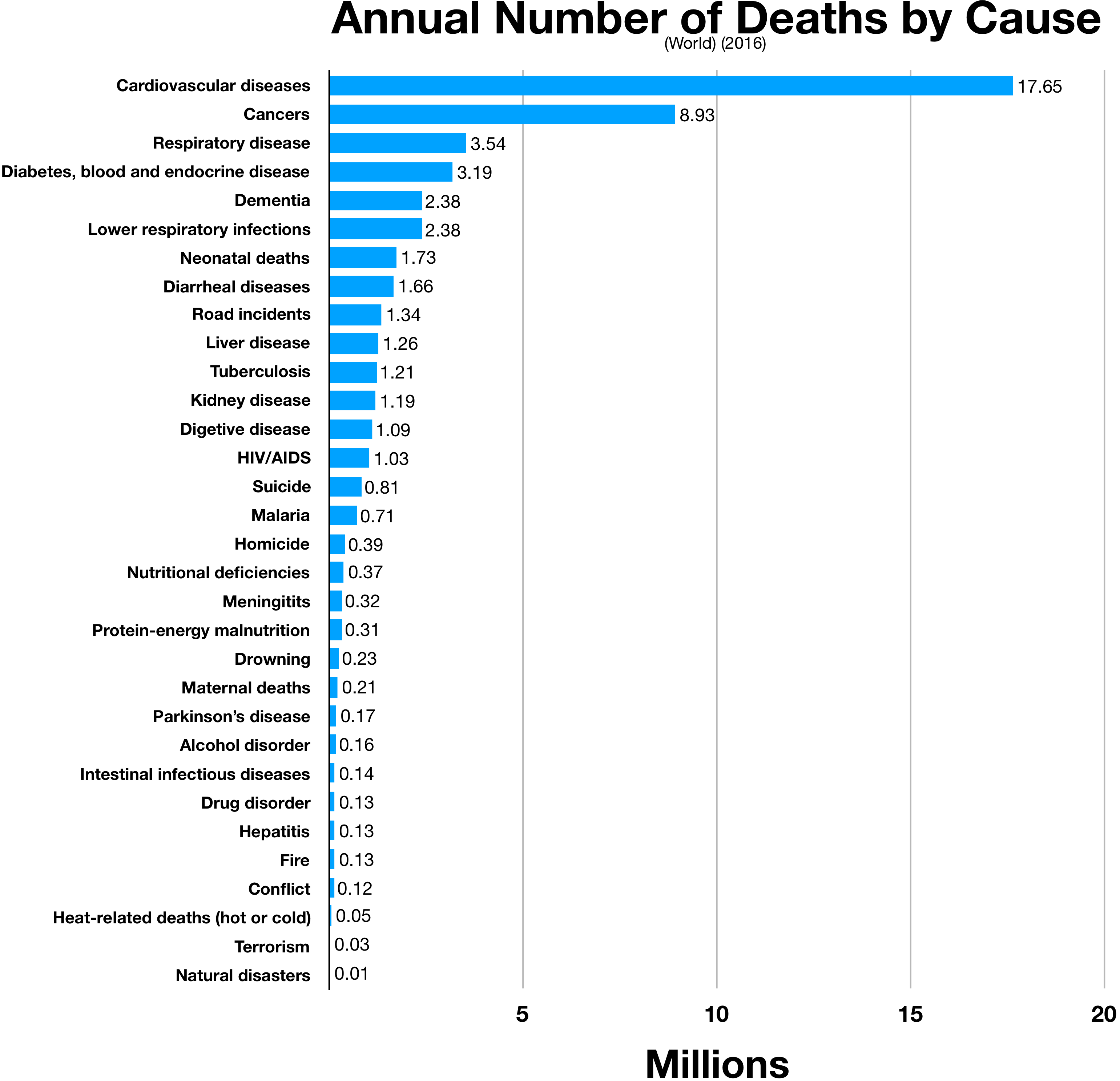
In 2002, there were about 57 million deaths. In 2005, according to the World Health Organization (WHO) using the International Classification of Diseases (ICD), about 58 million people died. In 2010, according to the Institute for Health Metrics and Evaluation, 52.8 million people died. In 2016, the WHO recorded 56.7 million deaths with the leading cause of death as cardiovascular disease causing more than 17 million deaths (about 31% of the total) as shown in the chart to the side. In 2021, there were approx. 68 million deaths worldwide, as per WHO report.
Besides frequency, other measures to compare, consider, and monitor trends of causes of deaths include disability-adjusted life year (DALY) and years of potential life lost (YPLL).
By frequency
Age standardized death rate, per 100,000, by cause, in 2017, and percentage change 2007–2017.
Overview table
This first table gives a convenient overview of the general categories and broad causes. The leading cause is cardiovascular disease at 31.59% of all deaths.
| Category | Cause | Percent | Percent |
|---|---|---|---|
| I. Communicable, maternal, neonatal, and nutritional disorders | Respiratory infections and tuberculosis | 6.85 | 19.49% |
| Enteric infections | 3.31 | ||
| Sexually transmitted infections | 1.88 | ||
| Tropical diseases and malaria | 1.37 | ||
| Other infectious diseases | 1.57 | ||
| Maternal and neonatal disorders | 4.00 | ||
| Nutritional deficiencies | 0.52 | ||
| II. Non-communicable diseases | Cardiovascular diseases | 31.59 | 72.67% |
| Neoplasms | 16.43 | ||
| Chronic respiratory diseases | 6.97 | ||
| Digestive diseases | 4.11 | ||
| Neurological disorders | 5.84 | ||
| Substance abuse | 0.58 | ||
| Diabetes and kidney diseases | 4.55 | ||
| Skin diseases | 0.18 | ||
| Musculoskeletal disorders | 0.22 | ||
| Other non-communicable | 2.22 | ||
| III. Injuries | Transport injuries | 2.30 | 7.85% |
| Unintentional injuries | 3.23 | ||
| Self harm and violence | 2.32 | ||
| Total | 100% | 100% |
Developed vs. developing economies
_and_YLLs_(B),_by_pathogen_and_GBD_super-region,_2019.jpg)
Top causes of death, according to the World Health Organization report for the calendar year 2001:
| Causes of death in developing countries | Number of deaths | Causes of death in developed countries | Number of deaths | |||
|---|---|---|---|---|---|---|
| HIV-AIDS | ||||||
| Lower respiratory infections | ||||||
| Ischaemic heart disease | ||||||
| Diarrhea | ||||||
| Cerebrovascular disease | ||||||
| Childhood diseases | ||||||
| Malaria | ||||||
| Tuberculosis | ||||||
| Chronic obstructive pulmonary disease | ||||||
| Measles |
Detailed table
This table gives a more detailed and specific breakdown of the causes for the year 2017. Figures have a margin of error of about 5% on average.
| Cause | Rate | % total | % change 2007–2017 | I. Communicable, maternal, neonatal and nutritional disorders | Respiratory infections and tuberculosis | Tuberculosis | Lower respiratory infections | Upper respiratory infections | Otitis media | Enteric infections | Sexually transmitted infections | HIV/AIDS | Sexually transmitted infections excluding HIV | Neglected tropical diseases and malaria | Other infectious diseases | Meningitis | Encephalitis | Diphtheria | Whooping cough (pertussis) | Tetanus | Measles | Varicella (chickenpox) and herpes zoster (shingles) | Acute hepatitis | Other unspecified infectious diseases | Maternal and neonatal disorders | Maternal disorders | Neonatal disorders | Nutritional deficiencies | II. Non-communicable diseases | Cardiovascular diseases | Stroke | Hypertensive heart disease | Non-rheumatic valvular heart disease | Cardiomyopathy and myocarditis | Atrial fibrillation and flutter | Aortic aneurysm | Peripheral vascular disease | Endocarditis | Other cardiovascular and circulatory diseases | Neoplasms | Leukaemia | Other malignant cancers | Other neoplasms | Chronic respiratory diseases | Digestive diseases | Cirrhosis and other chronic liver diseases | Upper digestive system diseases | Appendicitis | Paralytic ileus and intestinal obstruction | Inguinal, femoral, and abdominal hernia | Inflammatory bowel disease | Vascular intestinal disorders | Gallbladder and biliary diseases | Pancreatitis | Other digestive diseases | Neurological disorders | Mental disorders | Eating disorders | Substance use disorders | Alcohol use disorders | Drug use disorders | Diabetes and kidney diseases | Diabetes mellitus | Chronic kidney disease | Acute glomerulonephritis | Skin and subcutaneous diseases | Musculoskeletal disorders | Other non-communicable diseases | Congenital anomalies | Urinary diseases and male infertility | Gynecological diseases | Hemoglobinopathies and hemolytic anaemias | Endocrine, metabolic, blood, and immune disorders | Sudden infant death syndrome | III. Injuries | Transport injuries | Road injuries | Other transport injuries | Unintentional injuries | Self-harm and interpersonal violence | Self-harm | Interpersonal violence | Conflict and terrorism | Executions and police conflict | |||
|---|---|---|---|---|---|---|---|---|---|---|---|---|---|---|---|---|---|---|---|---|---|---|---|---|---|---|---|---|---|---|---|---|---|---|---|---|---|---|---|---|---|---|---|---|---|---|---|---|---|---|---|---|---|---|---|---|---|---|---|---|---|---|---|---|---|---|---|---|---|---|---|---|---|---|---|---|---|---|---|---|---|---|---|---|---|---|---|
| All causes | 737.7 | 100% | −14.2 | ||||||||||||||||||||||||||||||||||||||||||||||||||||||||||||||||||||||||||||||||||||
| 143.8 | 19.49% | −31.8 | |||||||||||||||||||||||||||||||||||||||||||||||||||||||||||||||||||||||||||||||||||||
| 50.5 | 6.85% | −24.5 | |||||||||||||||||||||||||||||||||||||||||||||||||||||||||||||||||||||||||||||||||||||
| 14.9 | 2.02% | −31.4 | |||||||||||||||||||||||||||||||||||||||||||||||||||||||||||||||||||||||||||||||||||||
| Drug-susceptible tuberculosis | 13.2 | 1.79% | −31.9 | ||||||||||||||||||||||||||||||||||||||||||||||||||||||||||||||||||||||||||||||||||||
| Multidrug-resistant tuberculosis without extensive drug resistance | 1.6 | 0.22% | −28.6 | ||||||||||||||||||||||||||||||||||||||||||||||||||||||||||||||||||||||||||||||||||||
| Extensively drug-resistant tuberculosis | 0.2 | 0.03% | −7.7 | ||||||||||||||||||||||||||||||||||||||||||||||||||||||||||||||||||||||||||||||||||||
| 35.4 | 4.80% | −21.1 | |||||||||||||||||||||||||||||||||||||||||||||||||||||||||||||||||||||||||||||||||||||
| 0.1 | 0.01% | −42.1 | |||||||||||||||||||||||||||||||||||||||||||||||||||||||||||||||||||||||||||||||||||||
| 0.0 | 0.00% | −50.4 | |||||||||||||||||||||||||||||||||||||||||||||||||||||||||||||||||||||||||||||||||||||
| 24.4 | 3.31% | −29.9 | |||||||||||||||||||||||||||||||||||||||||||||||||||||||||||||||||||||||||||||||||||||
| Diarrhoeal diseases | 21.6 | 2.93% | −30.2 | ||||||||||||||||||||||||||||||||||||||||||||||||||||||||||||||||||||||||||||||||||||
| Typhoid and paratyphoid | 1.9 | 0.26% | −27.8 | ||||||||||||||||||||||||||||||||||||||||||||||||||||||||||||||||||||||||||||||||||||
| (Typhoid fever) | 1.6 | 0.22% | −29.1 | ||||||||||||||||||||||||||||||||||||||||||||||||||||||||||||||||||||||||||||||||||||
| (Paratyphoid fever) | 0.3 | 0.04% | −18.9 | ||||||||||||||||||||||||||||||||||||||||||||||||||||||||||||||||||||||||||||||||||||
| iNTS | 0.8 | 0.11% | −24.8 | ||||||||||||||||||||||||||||||||||||||||||||||||||||||||||||||||||||||||||||||||||||
| Other intestinal infectious diseases | 0.0 | 0.00% | −44.7 | ||||||||||||||||||||||||||||||||||||||||||||||||||||||||||||||||||||||||||||||||||||
| 13.9 | 1.88% | −53.6 | |||||||||||||||||||||||||||||||||||||||||||||||||||||||||||||||||||||||||||||||||||||
| 12.1 | 1.64% | −56.5 | |||||||||||||||||||||||||||||||||||||||||||||||||||||||||||||||||||||||||||||||||||||
| HIV/AIDS – Drug-susceptible Tuberculosis | 2.5 | 0.34% | −61.1 | ||||||||||||||||||||||||||||||||||||||||||||||||||||||||||||||||||||||||||||||||||||
| HIV/AIDS – Multidrug-resistant Tuberculosis without extensive drug resistance | 0.3 | 0.04% | −58.1 | ||||||||||||||||||||||||||||||||||||||||||||||||||||||||||||||||||||||||||||||||||||
| HIV/AIDS – Extensively drug-resistant tuberculosis | 0.0 | 0.00% | −20.3 | ||||||||||||||||||||||||||||||||||||||||||||||||||||||||||||||||||||||||||||||||||||
| HIV/AIDS resulting in other diseases | 9.3 | 1.26% | −55.1 | ||||||||||||||||||||||||||||||||||||||||||||||||||||||||||||||||||||||||||||||||||||
| 1.8 | 0.24% | −14.4 | |||||||||||||||||||||||||||||||||||||||||||||||||||||||||||||||||||||||||||||||||||||
| Syphilis | 1.7 | 0.23% | −14.3 | ||||||||||||||||||||||||||||||||||||||||||||||||||||||||||||||||||||||||||||||||||||
| Chlamydial infection | 0.0 | 0.00% | −15.2 | ||||||||||||||||||||||||||||||||||||||||||||||||||||||||||||||||||||||||||||||||||||
| Gonococcal infection | 0.0 | 0.00% | −14.9 | ||||||||||||||||||||||||||||||||||||||||||||||||||||||||||||||||||||||||||||||||||||
| Other sexually transmitted infections | 0.0 | 0.00% | −15.9 | ||||||||||||||||||||||||||||||||||||||||||||||||||||||||||||||||||||||||||||||||||||
| 10.1 | 1.37% | −36.1 | |||||||||||||||||||||||||||||||||||||||||||||||||||||||||||||||||||||||||||||||||||||
| Malaria | 8.7 | 1.18% | −37.3 | ||||||||||||||||||||||||||||||||||||||||||||||||||||||||||||||||||||||||||||||||||||
| Chagas disease | 0.1 | 0.01% | −21.1 | ||||||||||||||||||||||||||||||||||||||||||||||||||||||||||||||||||||||||||||||||||||
| Leishmaniasis | 0.1 | 0.01% | −67.8 | ||||||||||||||||||||||||||||||||||||||||||||||||||||||||||||||||||||||||||||||||||||
| (Visceral leishmaniasis) | 0.1 | 0.01% | −67.8 | ||||||||||||||||||||||||||||||||||||||||||||||||||||||||||||||||||||||||||||||||||||
| African trypanosomiasis (sleeping sickness) | 0.0 | 0.00% | −82.8 | ||||||||||||||||||||||||||||||||||||||||||||||||||||||||||||||||||||||||||||||||||||
| Schistosomiasis | 0.1 | 0.01% | −28.5 | ||||||||||||||||||||||||||||||||||||||||||||||||||||||||||||||||||||||||||||||||||||
| Cysticercosis | 0.0 | 0.00% | −27.3 | ||||||||||||||||||||||||||||||||||||||||||||||||||||||||||||||||||||||||||||||||||||
| Cystic echinococcosis | 0.0 | 0.00% | −41.9 | ||||||||||||||||||||||||||||||||||||||||||||||||||||||||||||||||||||||||||||||||||||
| Dengue | 0.5 | 0.07% | 40.7 | ||||||||||||||||||||||||||||||||||||||||||||||||||||||||||||||||||||||||||||||||||||
| Yellow fever | 0.1 | 0.01% | −23.3 | ||||||||||||||||||||||||||||||||||||||||||||||||||||||||||||||||||||||||||||||||||||
| Rabies | 0.2 | 0.03% | −54.8 | ||||||||||||||||||||||||||||||||||||||||||||||||||||||||||||||||||||||||||||||||||||
| Intestinal nematode infections | 0.0 | 0.00% | −47.2 | ||||||||||||||||||||||||||||||||||||||||||||||||||||||||||||||||||||||||||||||||||||
| (Ascariasis) | 0.0 | 0.00% | −47.2 | ||||||||||||||||||||||||||||||||||||||||||||||||||||||||||||||||||||||||||||||||||||
| Ebola virus disease | 0.0 | 0.00% | −98.4 | ||||||||||||||||||||||||||||||||||||||||||||||||||||||||||||||||||||||||||||||||||||
| Zika virus disease | 0.0 | 0.00% | – | ||||||||||||||||||||||||||||||||||||||||||||||||||||||||||||||||||||||||||||||||||||
| Other neglected tropical diseases | 0.2 | 0.03% | −3.7 | ||||||||||||||||||||||||||||||||||||||||||||||||||||||||||||||||||||||||||||||||||||
| 11.6 | 1.57% | −33.8 | |||||||||||||||||||||||||||||||||||||||||||||||||||||||||||||||||||||||||||||||||||||
| 4.0 | 0.54% | −27.8 | |||||||||||||||||||||||||||||||||||||||||||||||||||||||||||||||||||||||||||||||||||||
| Pneumococcal meningitis | 0.6 | 0.08% | −22.4 | ||||||||||||||||||||||||||||||||||||||||||||||||||||||||||||||||||||||||||||||||||||
| H influenzae type B meningitis | 1.1 | 0.15% | −40.6 | ||||||||||||||||||||||||||||||||||||||||||||||||||||||||||||||||||||||||||||||||||||
| Meningococcal infection | 0.4 | 0.05% | −37.1 | ||||||||||||||||||||||||||||||||||||||||||||||||||||||||||||||||||||||||||||||||||||
| Other meningitis | 2.0 | 0.27% | −17.3 | ||||||||||||||||||||||||||||||||||||||||||||||||||||||||||||||||||||||||||||||||||||
| 1.2 | 0.16% | −14.3 | |||||||||||||||||||||||||||||||||||||||||||||||||||||||||||||||||||||||||||||||||||||
| 0.1 | 0.01% | −28.6 | |||||||||||||||||||||||||||||||||||||||||||||||||||||||||||||||||||||||||||||||||||||
| 1.4 | 0.19% | −27.1 | |||||||||||||||||||||||||||||||||||||||||||||||||||||||||||||||||||||||||||||||||||||
| 0.5 | 0.07% | −59.6 | |||||||||||||||||||||||||||||||||||||||||||||||||||||||||||||||||||||||||||||||||||||
| 1.4 | 0.19% | −59.3 | |||||||||||||||||||||||||||||||||||||||||||||||||||||||||||||||||||||||||||||||||||||
| 0.2 | 0.03% | −29.2 | |||||||||||||||||||||||||||||||||||||||||||||||||||||||||||||||||||||||||||||||||||||
| 1.6 | 0.22% | −24.5 | |||||||||||||||||||||||||||||||||||||||||||||||||||||||||||||||||||||||||||||||||||||
| Acute hepatitis A | 0.3 | 0.04% | −38.7 | ||||||||||||||||||||||||||||||||||||||||||||||||||||||||||||||||||||||||||||||||||||
| Acute hepatitis B | 1.1 | 0.15% | −19.6 | ||||||||||||||||||||||||||||||||||||||||||||||||||||||||||||||||||||||||||||||||||||
| Acute hepatitis C | 0.0 | 0.00% | −32.1 | ||||||||||||||||||||||||||||||||||||||||||||||||||||||||||||||||||||||||||||||||||||
| Acute hepatitis E | 0.2 | 0.03% | −25.8 | ||||||||||||||||||||||||||||||||||||||||||||||||||||||||||||||||||||||||||||||||||||
| 1.1 | 0.15% | −13.4 | |||||||||||||||||||||||||||||||||||||||||||||||||||||||||||||||||||||||||||||||||||||
| 29.5 | 4.00% | −26.6 | |||||||||||||||||||||||||||||||||||||||||||||||||||||||||||||||||||||||||||||||||||||
| 2.5 | 0.34% | −30.7 | |||||||||||||||||||||||||||||||||||||||||||||||||||||||||||||||||||||||||||||||||||||
| Maternal haemorrhage | 0.5 | 0.07% | −56.4 | ||||||||||||||||||||||||||||||||||||||||||||||||||||||||||||||||||||||||||||||||||||
| Maternal sepsis and other pregnancy related infections | 0.3 | 0.04% | −33.5 | ||||||||||||||||||||||||||||||||||||||||||||||||||||||||||||||||||||||||||||||||||||
| Maternal hypertensive disorders | 0.4 | 0.05% | −13.0 | ||||||||||||||||||||||||||||||||||||||||||||||||||||||||||||||||||||||||||||||||||||
| Maternal obstructed labour and uterine rupture | 0.2 | 0.03% | −25.2 | ||||||||||||||||||||||||||||||||||||||||||||||||||||||||||||||||||||||||||||||||||||
| Maternal abortive outcome | 0.2 | 0.03% | −15.7 | ||||||||||||||||||||||||||||||||||||||||||||||||||||||||||||||||||||||||||||||||||||
| Ectopic pregnancy | 0.1 | 0.01% | −19.2 | ||||||||||||||||||||||||||||||||||||||||||||||||||||||||||||||||||||||||||||||||||||
| Indirect maternal deaths | 0.4 | 0.05% | −12.5 | ||||||||||||||||||||||||||||||||||||||||||||||||||||||||||||||||||||||||||||||||||||
| Late maternal deaths | 0.0 | 0.00% | −9.5 | ||||||||||||||||||||||||||||||||||||||||||||||||||||||||||||||||||||||||||||||||||||
| Maternal deaths aggravated by HIV/AIDS | 0.0 | 0.00% | −32.1 | ||||||||||||||||||||||||||||||||||||||||||||||||||||||||||||||||||||||||||||||||||||
| Other maternal disorders | 0.3 | 0.04% | −16.5 | ||||||||||||||||||||||||||||||||||||||||||||||||||||||||||||||||||||||||||||||||||||
| 27.1 | 3.67% | −26.2 | |||||||||||||||||||||||||||||||||||||||||||||||||||||||||||||||||||||||||||||||||||||
| Neonatal preterm birth | 9.9 | 1.34% | −28.1 | ||||||||||||||||||||||||||||||||||||||||||||||||||||||||||||||||||||||||||||||||||||
| Neonatal encephalopathy due to birth asphyxia and trauma | 8.1 | 1.10% | −26.5 | ||||||||||||||||||||||||||||||||||||||||||||||||||||||||||||||||||||||||||||||||||||
| Neonatal sepsis and other neonatal infections | 3.1 | 0.42% | −14.4 | ||||||||||||||||||||||||||||||||||||||||||||||||||||||||||||||||||||||||||||||||||||
| Hemolytic disease and other neonatal jaundice | 0.7 | 0.09% | −39.3 | ||||||||||||||||||||||||||||||||||||||||||||||||||||||||||||||||||||||||||||||||||||
| Other neonatal disorders | 5.3 | 0.72% | −25.7 | ||||||||||||||||||||||||||||||||||||||||||||||||||||||||||||||||||||||||||||||||||||
| 3.8 | 0.52% | −33.6 | |||||||||||||||||||||||||||||||||||||||||||||||||||||||||||||||||||||||||||||||||||||
| Protein-energy malnutrition | 3.3 | 0.45% | −34.6 | ||||||||||||||||||||||||||||||||||||||||||||||||||||||||||||||||||||||||||||||||||||
| Other nutritional deficiencies | 0.5 | 0.07% | −25.8 | ||||||||||||||||||||||||||||||||||||||||||||||||||||||||||||||||||||||||||||||||||||
| 536.1 | 72.67% | −7.9 | |||||||||||||||||||||||||||||||||||||||||||||||||||||||||||||||||||||||||||||||||||||
| 233.1 | 31.60% | −10.3 | |||||||||||||||||||||||||||||||||||||||||||||||||||||||||||||||||||||||||||||||||||||
| Rheumatic heart disease | 3.7 | 0.50% | −21.3 | ||||||||||||||||||||||||||||||||||||||||||||||||||||||||||||||||||||||||||||||||||||
| Ischaemic heart disease | 116.9 | 15.85% | −9.7 | ||||||||||||||||||||||||||||||||||||||||||||||||||||||||||||||||||||||||||||||||||||
| 80.5 | 10.91% | −13.6 | |||||||||||||||||||||||||||||||||||||||||||||||||||||||||||||||||||||||||||||||||||||
| Ischaemic stroke | 36.6 | 4.96% | −11.8 | ||||||||||||||||||||||||||||||||||||||||||||||||||||||||||||||||||||||||||||||||||||
| Intracerebral hemorrhage | 38.2 | 5.18% | −15.7 | ||||||||||||||||||||||||||||||||||||||||||||||||||||||||||||||||||||||||||||||||||||
| Subarachnoid hemorrhage | 5.7 | 0.77% | −9.4 | ||||||||||||||||||||||||||||||||||||||||||||||||||||||||||||||||||||||||||||||||||||
| 12.3 | 1.67% | 7.5 | |||||||||||||||||||||||||||||||||||||||||||||||||||||||||||||||||||||||||||||||||||||
| 2.0 | 0.27% | −5.3 | |||||||||||||||||||||||||||||||||||||||||||||||||||||||||||||||||||||||||||||||||||||
| Non-rheumatic calcific aortic valve disease | 1.4 | 0.19% | −1.0 | ||||||||||||||||||||||||||||||||||||||||||||||||||||||||||||||||||||||||||||||||||||
| Non-rheumatic degenerative mitral valve disease | 0.5 | 0.07% | −14.0 | ||||||||||||||||||||||||||||||||||||||||||||||||||||||||||||||||||||||||||||||||||||
| Other non-rheumatic valve diseases | 0.1 | 0.01% | −17.8 | ||||||||||||||||||||||||||||||||||||||||||||||||||||||||||||||||||||||||||||||||||||
| 4.8 | 0.65% | −16.6 | |||||||||||||||||||||||||||||||||||||||||||||||||||||||||||||||||||||||||||||||||||||
| Myocarditis | 0.6 | 0.08% | −13.3 | ||||||||||||||||||||||||||||||||||||||||||||||||||||||||||||||||||||||||||||||||||||
| Alcoholic cardiomyopathy | 1.1 | 0.15% | −40.5 | ||||||||||||||||||||||||||||||||||||||||||||||||||||||||||||||||||||||||||||||||||||
| Other cardiomyopathy | 3.1 | 0.42% | −3.6 | ||||||||||||||||||||||||||||||||||||||||||||||||||||||||||||||||||||||||||||||||||||
| 4.0 | 0.54% | 2.6 | |||||||||||||||||||||||||||||||||||||||||||||||||||||||||||||||||||||||||||||||||||||
| 2.2 | 0.30% | −8.5 | |||||||||||||||||||||||||||||||||||||||||||||||||||||||||||||||||||||||||||||||||||||
| 1.0 | 0.14% | 10.5 | |||||||||||||||||||||||||||||||||||||||||||||||||||||||||||||||||||||||||||||||||||||
| 1.1 | 0.15% | 1.0 | |||||||||||||||||||||||||||||||||||||||||||||||||||||||||||||||||||||||||||||||||||||
| 4.7 | 0.64% | −7.9 | |||||||||||||||||||||||||||||||||||||||||||||||||||||||||||||||||||||||||||||||||||||
| 121.2 | 16.43% | −4.4 | |||||||||||||||||||||||||||||||||||||||||||||||||||||||||||||||||||||||||||||||||||||
| Lip and oral cavity cancer | 2.4 | 0.33% | 4.0 | ||||||||||||||||||||||||||||||||||||||||||||||||||||||||||||||||||||||||||||||||||||
| Nasopharynx cancer | 0.9 | 0.12% | −3.0 | ||||||||||||||||||||||||||||||||||||||||||||||||||||||||||||||||||||||||||||||||||||
| Other pharynx cancer | 1.4 | 0.19% | 7.9 | ||||||||||||||||||||||||||||||||||||||||||||||||||||||||||||||||||||||||||||||||||||
| Oesophageal cancer | 5.5 | 0.75% | −14.5 | ||||||||||||||||||||||||||||||||||||||||||||||||||||||||||||||||||||||||||||||||||||
| Stomach cancer | 11.0 | 1.49% | −17.1 | ||||||||||||||||||||||||||||||||||||||||||||||||||||||||||||||||||||||||||||||||||||
| Colon and rectum cancer | 11.5 | 1.56% | −4.3 | ||||||||||||||||||||||||||||||||||||||||||||||||||||||||||||||||||||||||||||||||||||
| Liver cancer | 10.2 | 1.38% | −2.5 | ||||||||||||||||||||||||||||||||||||||||||||||||||||||||||||||||||||||||||||||||||||
| (Liver cancer due to hepatitis B) | 4.0 | 0.54% | −6.2 | ||||||||||||||||||||||||||||||||||||||||||||||||||||||||||||||||||||||||||||||||||||
| (Liver cancer due to hepatitis C) | 3.0 | 0.41% | −2.1 | ||||||||||||||||||||||||||||||||||||||||||||||||||||||||||||||||||||||||||||||||||||
| (Liver cancer due to alcohol use) | 1.6 | 0.22% | 0.6 | ||||||||||||||||||||||||||||||||||||||||||||||||||||||||||||||||||||||||||||||||||||
| (Liver cancer due to NASH) | 0.8 | 0.11% | 7.6 | ||||||||||||||||||||||||||||||||||||||||||||||||||||||||||||||||||||||||||||||||||||
| (Liver cancer due to other causes) | 0.8 | 0.11% | −0.9 | ||||||||||||||||||||||||||||||||||||||||||||||||||||||||||||||||||||||||||||||||||||
| Gallbladder and biliary tract cancer | 2.2 | 0.30% | −6.7 | ||||||||||||||||||||||||||||||||||||||||||||||||||||||||||||||||||||||||||||||||||||
| Pancreatic cancer | 5.6 | 0.76% | 4.8 | ||||||||||||||||||||||||||||||||||||||||||||||||||||||||||||||||||||||||||||||||||||
| Larynx cancer | 1.6 | 0.22% | −7.7 | ||||||||||||||||||||||||||||||||||||||||||||||||||||||||||||||||||||||||||||||||||||
| Tracheal, bronchus, and lung cancer | 23.7 | 3.21% | −2.0 | ||||||||||||||||||||||||||||||||||||||||||||||||||||||||||||||||||||||||||||||||||||
| Malignant skin melanoma | 0.8 | 0.11% | −5.1 | ||||||||||||||||||||||||||||||||||||||||||||||||||||||||||||||||||||||||||||||||||||
| Non-melanoma skin cancer | 0.8 | 0.11% | 2.7 | ||||||||||||||||||||||||||||||||||||||||||||||||||||||||||||||||||||||||||||||||||||
| (Non-melanoma skin cancer (squamous-cell carcinoma)) | 0.8 | 0.11% | 2.7 | ||||||||||||||||||||||||||||||||||||||||||||||||||||||||||||||||||||||||||||||||||||
| Breast cancer | 7.6 | 1.03% | −2.6 | ||||||||||||||||||||||||||||||||||||||||||||||||||||||||||||||||||||||||||||||||||||
| Cervical cancer | 3.2 | 0.43% | −7.2 | ||||||||||||||||||||||||||||||||||||||||||||||||||||||||||||||||||||||||||||||||||||
| Uterine cancer | 1.1 | 0.15% | −10.4 | ||||||||||||||||||||||||||||||||||||||||||||||||||||||||||||||||||||||||||||||||||||
| Ovarian cancer | 2.2 | 0.30% | −1.0 | ||||||||||||||||||||||||||||||||||||||||||||||||||||||||||||||||||||||||||||||||||||
| Prostate cancer | 5.5 | 0.75% | −2.5 | ||||||||||||||||||||||||||||||||||||||||||||||||||||||||||||||||||||||||||||||||||||
| Testicular cancer | 0.1 | 0.01% | −9.4 | ||||||||||||||||||||||||||||||||||||||||||||||||||||||||||||||||||||||||||||||||||||
| Kidney cancer | 1.8 | 0.24% | −1.3 | ||||||||||||||||||||||||||||||||||||||||||||||||||||||||||||||||||||||||||||||||||||
| Bladder cancer | 2.6 | 0.35% | −5.4 | ||||||||||||||||||||||||||||||||||||||||||||||||||||||||||||||||||||||||||||||||||||
| Brain and nervous system cancer | 3.1 | 0.42% | 3.8 | ||||||||||||||||||||||||||||||||||||||||||||||||||||||||||||||||||||||||||||||||||||
| Thyroid cancer | 0.5 | 0.07% | −1.2 | ||||||||||||||||||||||||||||||||||||||||||||||||||||||||||||||||||||||||||||||||||||
| Mesothelioma | 0.4 | 0.05% | −3.4 | ||||||||||||||||||||||||||||||||||||||||||||||||||||||||||||||||||||||||||||||||||||
| Hodgkin lymphoma | 0.4 | 0.05% | −16.8 | ||||||||||||||||||||||||||||||||||||||||||||||||||||||||||||||||||||||||||||||||||||
| Non-Hodgkin's lymphoma | 3.2 | 0.43% | 0.1 | ||||||||||||||||||||||||||||||||||||||||||||||||||||||||||||||||||||||||||||||||||||
| Multiple myeloma | 1.4 | 0.19% | −0.4 | ||||||||||||||||||||||||||||||||||||||||||||||||||||||||||||||||||||||||||||||||||||
| 4.5 | 0.61% | −9.6 | |||||||||||||||||||||||||||||||||||||||||||||||||||||||||||||||||||||||||||||||||||||
| Acute lymphoid leukaemia | 0.7 | 0.09% | −1.5 | ||||||||||||||||||||||||||||||||||||||||||||||||||||||||||||||||||||||||||||||||||||
| Chronic lymphoid leukaemia | 0.5 | 0.07% | −10.3 | ||||||||||||||||||||||||||||||||||||||||||||||||||||||||||||||||||||||||||||||||||||
| Acute myeloid leukaemia | 1.3 | 0.18% | −1.0 | ||||||||||||||||||||||||||||||||||||||||||||||||||||||||||||||||||||||||||||||||||||
| Chronic myeloid leukaemia | 0.3 | 0.04% | −19.9 | ||||||||||||||||||||||||||||||||||||||||||||||||||||||||||||||||||||||||||||||||||||
| Other leukaemia | 1.8 | 0.24% | −15.6 | ||||||||||||||||||||||||||||||||||||||||||||||||||||||||||||||||||||||||||||||||||||
| 4.6 | 0.62% | 0.1 | |||||||||||||||||||||||||||||||||||||||||||||||||||||||||||||||||||||||||||||||||||||
| 1.3 | 0.18% | 7.4 | |||||||||||||||||||||||||||||||||||||||||||||||||||||||||||||||||||||||||||||||||||||
| Myelodysplastic, myeloproliferative and other hematopoietic neoplasms | 1.3 | 0.18% | 7.1 | ||||||||||||||||||||||||||||||||||||||||||||||||||||||||||||||||||||||||||||||||||||
| Other benign and in situ neoplasms | 0.1 | 0.01% | 15.5 | ||||||||||||||||||||||||||||||||||||||||||||||||||||||||||||||||||||||||||||||||||||
| 51.4 | 6.97% | −14.2 | |||||||||||||||||||||||||||||||||||||||||||||||||||||||||||||||||||||||||||||||||||||
| Chronic obstructive pulmonary disease | 42.2 | 5.72% | −13.6 | ||||||||||||||||||||||||||||||||||||||||||||||||||||||||||||||||||||||||||||||||||||
| Pneumoconiosis | 0.3 | 0.04% | −16.7 | ||||||||||||||||||||||||||||||||||||||||||||||||||||||||||||||||||||||||||||||||||||
| (Silicosis) | 0.1 | 0.01% | −15.5 | ||||||||||||||||||||||||||||||||||||||||||||||||||||||||||||||||||||||||||||||||||||
| (Asbestosis) | 0.0 | 0.00% | −8.3 | ||||||||||||||||||||||||||||||||||||||||||||||||||||||||||||||||||||||||||||||||||||
| (Coal workers pneumoconiosis) | 0.0 | 0.00% | −26.6 | ||||||||||||||||||||||||||||||||||||||||||||||||||||||||||||||||||||||||||||||||||||
| (Other pneumoconiosis) | 0.0 | 0.00% | −17.5 | ||||||||||||||||||||||||||||||||||||||||||||||||||||||||||||||||||||||||||||||||||||
| Asthma | 6.3 | 0.85% | −23.9 | ||||||||||||||||||||||||||||||||||||||||||||||||||||||||||||||||||||||||||||||||||||
| Interstitial lung disease and pulmonary sarcoidosis | 1.9 | 0.26% | 11.4 | ||||||||||||||||||||||||||||||||||||||||||||||||||||||||||||||||||||||||||||||||||||
| Other chronic respiratory diseases | 0.7 | 0.09% | −3.2 | ||||||||||||||||||||||||||||||||||||||||||||||||||||||||||||||||||||||||||||||||||||
| 30.3 | 4.11% | −10.7 | |||||||||||||||||||||||||||||||||||||||||||||||||||||||||||||||||||||||||||||||||||||
| 16.5 | 2.24% | −9.7 | |||||||||||||||||||||||||||||||||||||||||||||||||||||||||||||||||||||||||||||||||||||
| Cirrhosis and other chronic liver diseases due to hepatitis B | 4.8 | 0.65% | −14.3 | ||||||||||||||||||||||||||||||||||||||||||||||||||||||||||||||||||||||||||||||||||||
| Cirrhosis and other chronic liver diseases due to hepatitis C | 4.2 | 0.57% | −8.4 | ||||||||||||||||||||||||||||||||||||||||||||||||||||||||||||||||||||||||||||||||||||
| Cirrhosis and other chronic liver diseases due to alcohol use | 4.1 | 0.56% | −8.8 | ||||||||||||||||||||||||||||||||||||||||||||||||||||||||||||||||||||||||||||||||||||
| Cirrhosis due to NASH | 1.5 | 0.20% | −1.4 | ||||||||||||||||||||||||||||||||||||||||||||||||||||||||||||||||||||||||||||||||||||
| Cirrhosis and other chronic liver diseases due to other causes | 1.9 | 0.26% | −8.6 | ||||||||||||||||||||||||||||||||||||||||||||||||||||||||||||||||||||||||||||||||||||
| 3.8 | 0.52% | −21.6 | |||||||||||||||||||||||||||||||||||||||||||||||||||||||||||||||||||||||||||||||||||||
| Peptic ulcer disease | 3.1 | 0.42% | −23.5 | ||||||||||||||||||||||||||||||||||||||||||||||||||||||||||||||||||||||||||||||||||||
| Gastritis and duodenitis | 0.7 | 0.09% | −11.7 | ||||||||||||||||||||||||||||||||||||||||||||||||||||||||||||||||||||||||||||||||||||
| 0.6 | 0.08% | −17.0 | |||||||||||||||||||||||||||||||||||||||||||||||||||||||||||||||||||||||||||||||||||||
| 3.2 | 0.43% | −5.8 | |||||||||||||||||||||||||||||||||||||||||||||||||||||||||||||||||||||||||||||||||||||
| 0.6 | 0.08% | −8.9 | |||||||||||||||||||||||||||||||||||||||||||||||||||||||||||||||||||||||||||||||||||||
| 0.5 | 0.07% | −10.5 | |||||||||||||||||||||||||||||||||||||||||||||||||||||||||||||||||||||||||||||||||||||
| 1.3 | 0.18% | −10.2 | |||||||||||||||||||||||||||||||||||||||||||||||||||||||||||||||||||||||||||||||||||||
| 1.5 | 0.20% | −5.0 | |||||||||||||||||||||||||||||||||||||||||||||||||||||||||||||||||||||||||||||||||||||
| 1.3 | 0.18% | −5.7 | |||||||||||||||||||||||||||||||||||||||||||||||||||||||||||||||||||||||||||||||||||||
| 1.2 | 0.16% | −7.1 | |||||||||||||||||||||||||||||||||||||||||||||||||||||||||||||||||||||||||||||||||||||
| 43.1 | 5.84% | 0.1 | |||||||||||||||||||||||||||||||||||||||||||||||||||||||||||||||||||||||||||||||||||||
| Alzheimer's disease and other dementias | 35.4 | 4.80% | 0.6 | ||||||||||||||||||||||||||||||||||||||||||||||||||||||||||||||||||||||||||||||||||||
| Parkinson's disease | 4.6 | 0.62% | 0.8 | ||||||||||||||||||||||||||||||||||||||||||||||||||||||||||||||||||||||||||||||||||||
| Epilepsy | 1.7 | 0.23% | −10.7 | ||||||||||||||||||||||||||||||||||||||||||||||||||||||||||||||||||||||||||||||||||||
| Multiple sclerosis | 0.3 | 0.04% | −3.9 | ||||||||||||||||||||||||||||||||||||||||||||||||||||||||||||||||||||||||||||||||||||
| Motor neuron disease | 0.4 | 0.05% | 1.2 | ||||||||||||||||||||||||||||||||||||||||||||||||||||||||||||||||||||||||||||||||||||
| Other neurological disorders | 0.7 | 0.09% | 2.0 | ||||||||||||||||||||||||||||||||||||||||||||||||||||||||||||||||||||||||||||||||||||
| 0.0 | 0.00% | 7.5 | |||||||||||||||||||||||||||||||||||||||||||||||||||||||||||||||||||||||||||||||||||||
| 0.0 | 0.00% | 7.5 | |||||||||||||||||||||||||||||||||||||||||||||||||||||||||||||||||||||||||||||||||||||
| Anorexia nervosa | 0.0 | 0.00% | 5.5 | ||||||||||||||||||||||||||||||||||||||||||||||||||||||||||||||||||||||||||||||||||||
| Bulimia nervosa | 0.0 | 0.00% | 13.5 | ||||||||||||||||||||||||||||||||||||||||||||||||||||||||||||||||||||||||||||||||||||
| 4.3 | 0.58% | 2.0 | |||||||||||||||||||||||||||||||||||||||||||||||||||||||||||||||||||||||||||||||||||||
| 2.3 | 0.31% | −16.5 | |||||||||||||||||||||||||||||||||||||||||||||||||||||||||||||||||||||||||||||||||||||
| 2.1 | 0.28% | 34.1 | |||||||||||||||||||||||||||||||||||||||||||||||||||||||||||||||||||||||||||||||||||||
| Opioid use disorders | 1.4 | 0.19% | 49.4 | ||||||||||||||||||||||||||||||||||||||||||||||||||||||||||||||||||||||||||||||||||||
| Cocaine use disorders | 0.1 | 0.01% | 19.6 | ||||||||||||||||||||||||||||||||||||||||||||||||||||||||||||||||||||||||||||||||||||
| Amphetamine use disorders | 0.1 | 0.01% | 8.7 | ||||||||||||||||||||||||||||||||||||||||||||||||||||||||||||||||||||||||||||||||||||
| Other drug use disorders | 0.6 | 0.08% | 11.3 | ||||||||||||||||||||||||||||||||||||||||||||||||||||||||||||||||||||||||||||||||||||
| 33.6 | 4.55% | 1.3 | |||||||||||||||||||||||||||||||||||||||||||||||||||||||||||||||||||||||||||||||||||||
| 17.5 | 2.37% | 1.2 | |||||||||||||||||||||||||||||||||||||||||||||||||||||||||||||||||||||||||||||||||||||
| Diabetes mellitus type 1 | 4.3 | 0.58% | −11.0 | ||||||||||||||||||||||||||||||||||||||||||||||||||||||||||||||||||||||||||||||||||||
| Diabetes mellitus type 2 | 13.2 | 1.79% | 5.9 | ||||||||||||||||||||||||||||||||||||||||||||||||||||||||||||||||||||||||||||||||||||
| 15.9 | 2.16% | 1.5 | |||||||||||||||||||||||||||||||||||||||||||||||||||||||||||||||||||||||||||||||||||||
| Chronic kidney disease due to diabetes mellitus type 1 | 0.9 | 0.12% | −1.2 | ||||||||||||||||||||||||||||||||||||||||||||||||||||||||||||||||||||||||||||||||||||
| Chronic kidney disease due to diabetes mellitus type 2 | 4.5 | 0.61% | 4.2 | ||||||||||||||||||||||||||||||||||||||||||||||||||||||||||||||||||||||||||||||||||||
| Chronic kidney disease due to hypertension | 4.6 | 0.62% | 3.2 | ||||||||||||||||||||||||||||||||||||||||||||||||||||||||||||||||||||||||||||||||||||
| Chronic kidney disease due to glomerulonephritis | 2.4 | 0.33% | −1.3 | ||||||||||||||||||||||||||||||||||||||||||||||||||||||||||||||||||||||||||||||||||||
| Chronic kidney disease due to other and unspecified causes | 3.4 | 0.46% | −1.4 | ||||||||||||||||||||||||||||||||||||||||||||||||||||||||||||||||||||||||||||||||||||
| 0.1 | 0.01% | −9.5 | |||||||||||||||||||||||||||||||||||||||||||||||||||||||||||||||||||||||||||||||||||||
| 1.3 | 0.18% | 8.1 | |||||||||||||||||||||||||||||||||||||||||||||||||||||||||||||||||||||||||||||||||||||
| Bacterial skin diseases | 1.0 | 0.14% | 12.7 | ||||||||||||||||||||||||||||||||||||||||||||||||||||||||||||||||||||||||||||||||||||
| (Cellulitis) | 0.2 | 0.03% | 19.6 | ||||||||||||||||||||||||||||||||||||||||||||||||||||||||||||||||||||||||||||||||||||
| (Pyoderma) | 0.8 | 0.11% | 10.5 | ||||||||||||||||||||||||||||||||||||||||||||||||||||||||||||||||||||||||||||||||||||
| Decubitus ulcer | 0.3 | 0.04% | −5.1 | ||||||||||||||||||||||||||||||||||||||||||||||||||||||||||||||||||||||||||||||||||||
| Other skin and subcutaneous diseases | 0.1 | 0.01% | 3.3 | ||||||||||||||||||||||||||||||||||||||||||||||||||||||||||||||||||||||||||||||||||||
| 1.6 | 0.22% | −0.1 | |||||||||||||||||||||||||||||||||||||||||||||||||||||||||||||||||||||||||||||||||||||
| Rheumatoid arthritis | 0.6 | 0.08% | −5.9 | ||||||||||||||||||||||||||||||||||||||||||||||||||||||||||||||||||||||||||||||||||||
| Other musculoskeletal disorders | 1.0 | 0.14% | 3.9 | ||||||||||||||||||||||||||||||||||||||||||||||||||||||||||||||||||||||||||||||||||||
| 16.3 | 2.21% | −11.2 | |||||||||||||||||||||||||||||||||||||||||||||||||||||||||||||||||||||||||||||||||||||
| 8.7 | 1.18% | −18.2 | |||||||||||||||||||||||||||||||||||||||||||||||||||||||||||||||||||||||||||||||||||||
| Neural tube defects | 0.9 | 0.12% | −16.5 | ||||||||||||||||||||||||||||||||||||||||||||||||||||||||||||||||||||||||||||||||||||
| Congenital heart anomalies | 3.9 | 0.53% | −21.8 | ||||||||||||||||||||||||||||||||||||||||||||||||||||||||||||||||||||||||||||||||||||
| Orofacial clefts | 0.1 | 0.01% | −41.9 | ||||||||||||||||||||||||||||||||||||||||||||||||||||||||||||||||||||||||||||||||||||
| Down syndrome | 0.4 | 0.05% | −5.2 | ||||||||||||||||||||||||||||||||||||||||||||||||||||||||||||||||||||||||||||||||||||
| Other chromosomal abnormalities | 0.3 | 0.04% | 0.3 | ||||||||||||||||||||||||||||||||||||||||||||||||||||||||||||||||||||||||||||||||||||
| Congenital musculoskeletal and limb anomalies | 0.2 | 0.03% | −12.8 | ||||||||||||||||||||||||||||||||||||||||||||||||||||||||||||||||||||||||||||||||||||
| Urogenital congenital anomalies | 0.2 | 0.03% | −8.5 | ||||||||||||||||||||||||||||||||||||||||||||||||||||||||||||||||||||||||||||||||||||
| Digestive congenital anomalies | 0.8 | 0.11% | −19.3 | ||||||||||||||||||||||||||||||||||||||||||||||||||||||||||||||||||||||||||||||||||||
| Other congenital anomalies | 2.1 | 0.28% | −15.9 | ||||||||||||||||||||||||||||||||||||||||||||||||||||||||||||||||||||||||||||||||||||
| 3.6 | 0.49% | 5.7 | |||||||||||||||||||||||||||||||||||||||||||||||||||||||||||||||||||||||||||||||||||||
| Urinary tract infections | 2.7 | 0.37% | 10.9 | ||||||||||||||||||||||||||||||||||||||||||||||||||||||||||||||||||||||||||||||||||||
| Urolithiasis (Kidney stone disease) | 0.2 | 0.03% | −1.2 | ||||||||||||||||||||||||||||||||||||||||||||||||||||||||||||||||||||||||||||||||||||
| Other urinary diseases | 0.7 | 0.09% | −9.9 | ||||||||||||||||||||||||||||||||||||||||||||||||||||||||||||||||||||||||||||||||||||
| 0.1 | 0.01% | −2.6 | |||||||||||||||||||||||||||||||||||||||||||||||||||||||||||||||||||||||||||||||||||||
| Uterine fibroids | 0.0 | 0.00% | 8.1 | ||||||||||||||||||||||||||||||||||||||||||||||||||||||||||||||||||||||||||||||||||||
| Polycystic ovarian syndrome | 0.0 | 0.00% | 1.0 | ||||||||||||||||||||||||||||||||||||||||||||||||||||||||||||||||||||||||||||||||||||
| Endometriosis | 0.0 | 0.00% | −3.2 | ||||||||||||||||||||||||||||||||||||||||||||||||||||||||||||||||||||||||||||||||||||
| Genital prolapse | 0.0 | 0.00% | −24.1 | ||||||||||||||||||||||||||||||||||||||||||||||||||||||||||||||||||||||||||||||||||||
| Other gynecological diseases | 0.1 | 0.01% | −3.6 | ||||||||||||||||||||||||||||||||||||||||||||||||||||||||||||||||||||||||||||||||||||
| 1.4 | 0.19% | −11.3 | |||||||||||||||||||||||||||||||||||||||||||||||||||||||||||||||||||||||||||||||||||||
| Thalassemias | 0.1 | 0.01% | −27.9 | ||||||||||||||||||||||||||||||||||||||||||||||||||||||||||||||||||||||||||||||||||||
| Sickle cell disorders | 0.5 | 0.07% | −3.1 | ||||||||||||||||||||||||||||||||||||||||||||||||||||||||||||||||||||||||||||||||||||
| G6PD deficiency | 0.2 | 0.03% | −7.1 | ||||||||||||||||||||||||||||||||||||||||||||||||||||||||||||||||||||||||||||||||||||
| Other hemoglobinopathies and hemolytic anaemias | 0.6 | 0.08% | −16.1 | ||||||||||||||||||||||||||||||||||||||||||||||||||||||||||||||||||||||||||||||||||||
| 1.9 | 0.26% | 0.8 | |||||||||||||||||||||||||||||||||||||||||||||||||||||||||||||||||||||||||||||||||||||
| 0.6 | 0.08% | −20.2 | |||||||||||||||||||||||||||||||||||||||||||||||||||||||||||||||||||||||||||||||||||||
| 57.9 | 7.85% | −13.7 | |||||||||||||||||||||||||||||||||||||||||||||||||||||||||||||||||||||||||||||||||||||
| 17.0 | 2.30% | −17.0 | |||||||||||||||||||||||||||||||||||||||||||||||||||||||||||||||||||||||||||||||||||||
| 15.8 | 2.14% | −17.1 | |||||||||||||||||||||||||||||||||||||||||||||||||||||||||||||||||||||||||||||||||||||
| Pedestrian road injuries | 6.2 | 0.84% | −21.4 | ||||||||||||||||||||||||||||||||||||||||||||||||||||||||||||||||||||||||||||||||||||
| Cyclist road injuries | 0.9 | 0.12% | −8.8 | ||||||||||||||||||||||||||||||||||||||||||||||||||||||||||||||||||||||||||||||||||||
| Motorcyclist road injuries | 2.9 | 0.39% | −12.4 | ||||||||||||||||||||||||||||||||||||||||||||||||||||||||||||||||||||||||||||||||||||
| Motor vehicle road injuries | 5.8 | 0.79% | −15.6 | ||||||||||||||||||||||||||||||||||||||||||||||||||||||||||||||||||||||||||||||||||||
| Other road injuries | 0.1 | 0.01% | −19.4 | ||||||||||||||||||||||||||||||||||||||||||||||||||||||||||||||||||||||||||||||||||||
| 1.2 | 0.16% | −15.5 | |||||||||||||||||||||||||||||||||||||||||||||||||||||||||||||||||||||||||||||||||||||
| 23.8 | 3.23% | −15.3 | |||||||||||||||||||||||||||||||||||||||||||||||||||||||||||||||||||||||||||||||||||||
| Falls | 9.2 | 1.25% | −2.8 | ||||||||||||||||||||||||||||||||||||||||||||||||||||||||||||||||||||||||||||||||||||
| Drowning | 4.0 | 0.54% | −27.3 | ||||||||||||||||||||||||||||||||||||||||||||||||||||||||||||||||||||||||||||||||||||
| Fire, heat, and hot substances | 1.6 | 0.22% | −22.9 | ||||||||||||||||||||||||||||||||||||||||||||||||||||||||||||||||||||||||||||||||||||
| Poisonings | 0.9 | 0.12% | −20.8 | ||||||||||||||||||||||||||||||||||||||||||||||||||||||||||||||||||||||||||||||||||||
| (Poisoning by carbon monoxide) | 0.5 | 0.07% | −26.6 | ||||||||||||||||||||||||||||||||||||||||||||||||||||||||||||||||||||||||||||||||||||
| (Poisoning by other means) | 0.5 | 0.07% | −14.4 | ||||||||||||||||||||||||||||||||||||||||||||||||||||||||||||||||||||||||||||||||||||
| Exposure to mechanical forces | 1.8 | 0.24% | −20.3 | ||||||||||||||||||||||||||||||||||||||||||||||||||||||||||||||||||||||||||||||||||||
| (Unintentional firearm injuries) | 0.3 | 0.04% | −16.4 | ||||||||||||||||||||||||||||||||||||||||||||||||||||||||||||||||||||||||||||||||||||
| (Other exposure to mechanical forces) | 1.5 | 0.20% | −21.0 | ||||||||||||||||||||||||||||||||||||||||||||||||||||||||||||||||||||||||||||||||||||
| Adverse effects of medical treatment | 1.6 | 0.22% | −6.2 | ||||||||||||||||||||||||||||||||||||||||||||||||||||||||||||||||||||||||||||||||||||
| Animal contact | 1.1 | 0.15% | −16.0 | ||||||||||||||||||||||||||||||||||||||||||||||||||||||||||||||||||||||||||||||||||||
| (Venomous animal contact) | 0.9 | 0.12% | −16.0 | ||||||||||||||||||||||||||||||||||||||||||||||||||||||||||||||||||||||||||||||||||||
| (Non-venomous animal contact) | 0.1 | 0.01% | −16.1 | ||||||||||||||||||||||||||||||||||||||||||||||||||||||||||||||||||||||||||||||||||||
| Foreign body | 1.7 | 0.23% | −14.1 | ||||||||||||||||||||||||||||||||||||||||||||||||||||||||||||||||||||||||||||||||||||
| (Pulmonary aspiration and foreign body in airway) | 1.6 | 0.22% | −13.9 | ||||||||||||||||||||||||||||||||||||||||||||||||||||||||||||||||||||||||||||||||||||
| (Foreign body in other body part) | 0.1 | 0.01% | −15.8 | ||||||||||||||||||||||||||||||||||||||||||||||||||||||||||||||||||||||||||||||||||||
| Environmental heat and cold exposure | 0.7 | 0.09% | −29.4 | ||||||||||||||||||||||||||||||||||||||||||||||||||||||||||||||||||||||||||||||||||||
| Exposure to forces of nature | 0.1 | 0.01% | −45.8 | ||||||||||||||||||||||||||||||||||||||||||||||||||||||||||||||||||||||||||||||||||||
| Other unintentional injuries | 1.2 | 0.16% | −25.8 | ||||||||||||||||||||||||||||||||||||||||||||||||||||||||||||||||||||||||||||||||||||
| 17.1 | 2.32% | −7.6 | |||||||||||||||||||||||||||||||||||||||||||||||||||||||||||||||||||||||||||||||||||||
| 10.0 | 1.36% | −14.8 | |||||||||||||||||||||||||||||||||||||||||||||||||||||||||||||||||||||||||||||||||||||
| Self-harm by firearm | 0.8 | 0.11% | −10.3 | ||||||||||||||||||||||||||||||||||||||||||||||||||||||||||||||||||||||||||||||||||||
| Self-harm by other specified means | 9.2 | 1.25% | −15.2 | ||||||||||||||||||||||||||||||||||||||||||||||||||||||||||||||||||||||||||||||||||||
| 5.2 | 0.70% | −11.1 | |||||||||||||||||||||||||||||||||||||||||||||||||||||||||||||||||||||||||||||||||||||
| Assault by firearm | 2.2 | 0.30% | −3.6 | ||||||||||||||||||||||||||||||||||||||||||||||||||||||||||||||||||||||||||||||||||||
| Assault by sharp object | 1.2 | 0.16% | −22.3 | ||||||||||||||||||||||||||||||||||||||||||||||||||||||||||||||||||||||||||||||||||||
| Assault by other means | 1.8 | 0.24% | −11.5 | ||||||||||||||||||||||||||||||||||||||||||||||||||||||||||||||||||||||||||||||||||||
| 1.7 | 0.23% | 98.4 | |||||||||||||||||||||||||||||||||||||||||||||||||||||||||||||||||||||||||||||||||||||
| 0.2 | 0.03% | 172.4 |
By lost years
Underlying causes
Causes of death can be structured into immediate causes of death or primary causes of death, conditions leading to cause of death, underlying causes, and further relevant conditions that may have contributed to fatal outcome.
According to the WHO, underlying causes are "the disease[s] or injury[ies] which initiated the train[s] of morbid events leading directly to death, or the circumstances of the accident or violence which produced the fatal injury".
Malnutrition
Malnutrition can be identified as an underlying cause for shortened life. 70% of childhood deaths (age 0–4) are reportedly due to diarrheal illness, acute respiratory infection, malaria and immunizable disease. However 56% of these childhood deaths can be attributed to the effects of malnutrition as an underlying cause. The effects of malnutrition include increased susceptibility to infection, musculature wasting, skeletal deformities and neurologic development delays. According to the World Health Organization, malnutrition is named as the biggest contributor to child mortality with 36 million deaths in 2005 related to malnutrition.
Obesity and unhealthy diets
Beyond undernutrition and micronutrient deficiencies, malnutrition also includes obesity, which predisposes towards several chronic diseases, including 13 different types of cancer, cardiovascular diseases, and type 2 diabetes. According to the WHO, being "chronically overweight and obesity are among the leading causes of death and disability in Europe", with estimates suggesting they cause more than 1.2 million deaths annually, corresponding to over 13% of total mortality in the region. Various types of health policy could counter the trend and reduce obesity.
Diets, not just in terms of obesity but also of food composition, can have a major impact on underlying factors , with reviews suggesting i.a. that a 20-years old male in Europe who switches to the "optimal diet" could gain a mean of ~13.7 years of life and a 60-years old female in the U.S. switching to the "optimal diet" could gain a mean of ~8.0 years of life. It found the largest gains would be made by eating more legumes, whole grains, and nuts, and less red meat and processed meat. It also contains no consumption of sugar-sweetened beverages (moving from "typical Western diet" of 500 g/day to 0 g/day).
Pollution
A review concluded that pollution was responsible for 9 million premature deaths in 2019 (one in six deaths, ¾ from air pollution). It concluded that little real progress against pollution can be identified.
Air pollution
Overall, air pollution causes the deaths of around ca. 7 million people worldwide each year, and is the world's largest single environmental health risk, according to the WHO (2012) and the IEA (2016).
The IEA notes that many of root causes and cures can be found in the energy industry and suggests solutions such as retiring polluting coal-fired power plants and to establishing stricter standards for motor vehicles. In September 2020 the European Environment Agency reported that environmental factors such as air pollution and heatwaves contributed to around 13% of all human deaths in EU countries in 2012 (~630,000). A 2021 study using a high spatial resolution model and an updated concentration-response function finds that 10.2 million global excess deaths in 2012 and 8.7 million in 2018 – or – were due to air pollution generated by fossil fuel combustion, significantly higher than earlier estimates and with spatially subdivided mortality impacts.
A 2020 study indicates that the global mean loss of life expectancy (LLE) from air pollution in 2015 was 2.9 years, substantially more than, for example, 0.3 years from all forms of direct violence, albeit a significant fraction of the LLE is considered to be unavoidable.
Uses of nervous system drugs
According to the WHO, worldwide, about 0.5 million deaths are attributable to uses of drugs, with more than 70% of these being related to opioids, with overdose being the direct cause of more than 30% of those deaths.
Various uses of various opioids accounts for many deaths worldwide, termed opioid epidemic. Nearly 75% of the 91,799 drug overdose deaths in 2020 in the United States involved an opioid.
Not all nervous system drugs are associated with risks for contributing to deaths as an underlying factor or for uses that are. In some cases, potentially harmful or harmful drugs can be substituted or weaned off with the help of pharmacological alternatives – such as potentially NAC and modafinil in the case of cocaine dependence – whose uses are not considered to be underlying causes of deaths. In some cases, they – including caffeine – can help improve general health such as, directly and indirectly, physical fitness and mental health either in general or in specific ranges of informed administrations.
Smoking
Smoking is the leading cause of preventable death in the United States. It is an underlying cause of many cancers, cardiovascular diseases, stroke, and respiratory diseases.
Smoking usually refers to smoking of tobacco products. E-cigarettes also pose large risks to health. The health impacts of tobacco-alternative products such as various herbs and the use of charcoal filters are often investigated less, with existing research suggesting only limited benefits over tobacco smoking. Some smokers may benefit from switching to a vaporizer as a harm reduction measure if they do not quit, which however also only has little robust evidence. Frequency of use is a major factor in the level of risks or permanence and extent of health impacts.
A review found smoking and second-hand smoke to be a global underlying cause of death as large as pollution, which in that analysis was the largest major underlying factor.
Alcohol
Globally, alcohol use was the seventh leading risk factor for both deaths and DALY in 2016. A review found that the "risk of all-cause mortality, and of cancers specifically, rises with increasing levels of consumption, and the level of consumption that minimises health loss is zero".
Non-optimal ambient temperatures
A study found that 9.4% of global deaths between 2000 and 2019 – ~5 million annually – can be attributed to extreme temperature with cold-related ones making up the larger share and decreasing and heat-related ones making up ~0.91% and increasing. Incidences of heart attacks, cardiac arrests and strokes increase under such conditions.
Antimicrobial resistance
In a global assessment, scientists reported, based on medical records, that antibiotic resistance may have contributed to ~4.95 million (3.62–6.57) deaths in 2019, with 1.3 million directly attributed – the latter being more than deaths than from e.g. AIDS or Malaria, despite being project to rise substantially.
Comorbidities, general health, social factors and infectious diseases
Co-existing diseases can but don't necessarily contribute to death to various degrees in various ways.
In some cases, comorbidities can be major causes with complex underlying mechanisms, and a range of comorbidities can be present once.
Pandemics and infectious diseases or epidemics can be major underlying causes of deaths. In a small study of 26 decedents, the pandemized COVID-19 and infection-related disease were "major contributors" to patients' death. Such deaths are sometimes evaluated via excess deaths per capita – the COVID-19 pandemic deaths between January 1, 2020, and December 31, 2021, are estimated to be ~18.2 million. Research could help distinguish the proportions directly caused by COVID-19 from those caused by indirect consequences of the pandemic.
Mental health issues and related issues such as economic conditions and/or various uses of nervous system drugs can contribute to causes such as suicide or risky behavior related deaths.
Loneliness or insufficient social relationships is also a major underlying factor, which may be comparable to smoking and, according to one meta-analysis of 148 studies, "exceeds many well-known risk factors for mortality (e.g., obesity, physical inactivity)". Injuries and violence are "the leading causes of death among children, adolescents, and young adults in the US" with underlying risk factors for such including "detrimental community, family, or individual circumstances" that increase the likelihood of violence. Types of preventive measures may include support of "healthy development of individuals, families, schools, and communities, and build[ing] capacity for positive relationships and interactions".
Lifestyle factors – including physical inactivity, and tobacco smoking and excessive alcohol use , healthy eating – and/or general health – including fitness beyond healthy diet and non-obesity – can be underlying contributors to death. For example, in a sample of U.S. adults, ~9.9% deaths of adults aged 40 to 69 years and ~7.8% adults aged 70 years or older were attributed to inadequate levels of physical activity.
Aging
Traditionally aging is not considered as a cause of death. It is believed that there is always a more direct cause, and usually it is one of many age-related diseases. It is estimated that, as a root cause, the aging process underlies 2/3 of all death in the world (approximately 100,000 people per day in 2007). In highly developed countries this proportion can reach 90%. There are requests of granting aging an official status of a disease and treating it directly (such as via dietary changes and senolytics).
Economics and policies
Economics and policies may be factors underlying deaths at a more fundamental level. For example, economics may result in certain therapies or screenings being expensive rather than produced at an affordable price or medication costs being too high for an individual to afford them even if they are made available at low cost, poverty can affect nutrition, marketing can increase the consumption of unhealthy products, incentives and regulations for health and healthy environments may be weak or missing, and occupational safety and humans' environment can suffer due to economic pressures for low production costs and high consumption. Health policy and health systems can have impacts on deaths and thereby may also be a factor of deaths, also including for example education policy (e.g. health illiteracy), climate policy (e.g. future water scarcity impacts) and transportation policy (e.g. motor vehicle accidents, pollution and physical activity), as well as in/action on policy-influenceable physical inactivity. 'Recent financial difficulties' appears to be a factor of mortality. One study estimated how many people die from poverty in the U.S. Low socioeconomic status, as determined by economics, appears to reduce life expectancy. The current systemic incentive for maximized profits may inhibit global occupational health and safety. The negative externality of environmental damages can have substantial impacts on global healthcare.
Underlying factors by cause


Underlying factors can also be analyzed per cause of (or major contributor to) death and can be distinguished between "preventable" factors and other factors. For example, various Global Burden of Disease Studies investigate such factors and quantify recent developments – one such systematic analysis analyzed the (non)progress on cancer and its causes during the 2010–19-decade, indicating that 2019, ~44% of all cancer deaths – or ~4.5 M deaths or ~105 million lost disability-adjusted life years – were due to known clearly preventable risk factors, led by smoking, alcohol use and high BMI.
Determination and tracking of underlying factors
Electronic health records, death certificates as well as post-mortem analyses (such as post-mortem computed tomography and other other pathology) can and are often used to investigate underlying causes of deaths such as for mortality statistics, relevant to . Improvements to this reporting, where e.g. certain diseases are often under-reported or underlying cause-of-death (COD) statement are incorrect, could ultimately improve public health. One reason for this is that from "a public health point of view, preventing this first disease or injury will result in the greatest health gain".
By country
United States
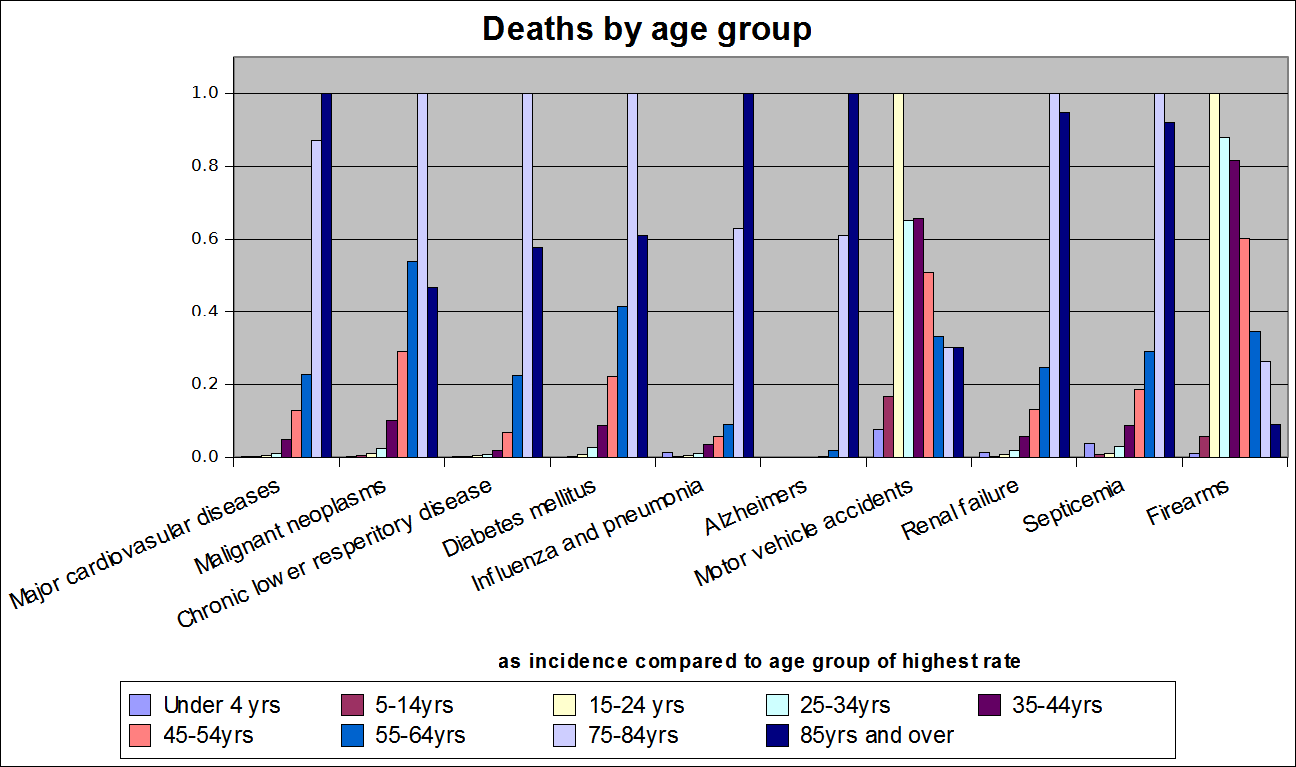
By age group (U.S.)

.png)
By occupation (U.S.)
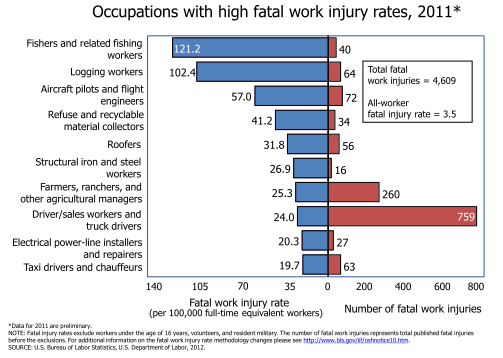
With an average of 123.6 deaths per 100,000 from 2003 through 2010 the most dangerous occupation in the United States is the cell tower construction industry.
References
References
- WHO. (2005). "Cancer".
- (December 2012). "Global and regional mortality from 235 causes of death for 20 age groups in 1990 and 2010: a systematic analysis for the Global Burden of Disease Study 2010". Lancet.
- "The top 10 causes of death".
- "The top 10 causes of death".
- GBD 2017 Causes of Death Collaborators. "Global, regional, and national age-sex-specific mortality for 282 causes of death in 195 countries and territories, 1980–2017: a systematic analysis for the Global Burden of Disease Study 2017". ''The Lancet''. November 8, 2018; 392:1736–88. {{doi. 10.1016/S0140-6736(18)32203-7. Table 1.
- (December 2022). "Global mortality associated with 33 bacterial pathogens in 2019: a systematic analysis for the Global Burden of Disease Study 2019". Lancet.
- (February 18, 2004). "Cause of Death". University of California, Santa Cruz.
- (February 2021). "Causes of death and comorbidities in hospitalized patients with COVID-19". Scientific Reports.
- "Cause of death".
- (June 3, 2014). "Mortality In Second And Third Degree Malnutrition". Tropej.oxfordjournals.org.
- (January 24, 2014). "The effects of malnutrition on child mortality in developing countries". Bulletin of the World Health Organization.
- (June 1974). "Some effects of malnutrition on the immune response in man". Ajcn.nutrition.org.
- (October 2009). "Protein energy malnutrition". Pediatric.theclinics.com.
- (January 24, 2008). "Malnutrition: The starvelings". The Economist.
- (2007). "[[L'Empire de la honte]]". Librairie générale française.
- "Fact sheets - Malnutrition".
- (2017). "The Metabolic Phenotype in Obesity: Fat Mass, Body Fat Distribution, and Adipose Tissue Function". Obesity Facts.
- (March 2019). "Obesity and cancer risk: Emerging biological mechanisms and perspectives". Metabolism.
- (March 2021). "Physical activity, obesity and sedentary behavior in cancer etiology: epidemiologic evidence and biologic mechanisms". Molecular Oncology.
- (November 2021). "Obesity, Diabetes, and Increased Cancer Progression". Diabetes & Metabolism Journal.
- (September 2020). "Central fatness and risk of all cause mortality: systematic review and dose-response meta-analysis of 72 prospective cohort studies". BMJ.
- (May 2021). "Obesity and Cardiovascular Disease: A Scientific Statement From the American Heart Association". Circulation.
- (May 3, 2022). "WHO warns of worsening obesity 'epidemic' in Europe". UN News.
- (August 2017). "The rising prevalence of obesity: part B-public health policy solutions". International Journal of Surgery. Oncology.
- (February 2022). "Changing your diet could add up to a decade to life expectancy, study finds". Public Library of Science.
- (April 2022). "Nutrition, longevity and disease: From molecular mechanisms to interventions". Cell.
- (May 18, 2022). "Pollution killing 9 million people a year, Africa hardest hit – study". Reuters.
- (June 2022). "Pollution and health: a progress update". The Lancet. Planetary Health.
- (March 25, 2014). "7 million premature deaths annually linked to air pollution". [[WHO]].
- "Energy and Air Pollution".
- (June 26, 2016). "Study Links 6.5 Million Deaths Each Year to Air Pollution". [[The New York Times]].
- (September 8, 2020). "One in eight deaths in Europe linked to pollution, environment, EU says". Reuters.
- (February 9, 2021). "Fossil fuel pollution causes one in five premature deaths globally: study". Reuters.
- (April 2021). "Global mortality from outdoor fine particle pollution generated by fossil fuel combustion: Results from GEOS-Chem". Environmental Research.
- (September 2020). "Loss of life expectancy from air pollution compared to other risk factors: a worldwide perspective". Cardiovascular Research.
- "Opioid overdose".
- (June 1, 2022). "Understanding the Opioid Overdose Epidemic {{!}} CDC's Response to the Opioid Overdose Epidemic {{!}} CDC".
- (May 1, 2011). "Pharmacological treatments for cocaine dependence: is there something new?". Current Pharmaceutical Design.
- (April 2019). "Smoking-attributable mortality by cause of death in the United States: An indirect approach". SSM – Population Health.
- "Tobacco: E-cigarettes".
- (April 2008). "Could charcoal filtration of cigarette smoke reduce smoking-induced disease? A review of the literature". Regulatory Toxicology and Pharmacology.
- (September 2006). "Influence of smoking charcoal filter tipped cigarettes on various biomarkers of exposure". Inhalation Toxicology.
- (November 2015). "Mull it over: cannabis vaporizers and harm reduction". Addiction.
- (February 2018). "Routes of administration for cannabis use - basic prevalence and related health outcomes: A scoping review and synthesis". The International Journal on Drug Policy.
- (November 2018). "Peering Through the Haze of Smoked vs Vaporized Cannabis-To Vape or Not to Vape?". JAMA Network Open.
- (September 2018). "Alcohol use and burden for 195 countries and territories, 1990–2016: a systematic analysis for the Global Burden of Disease Study 2016". Lancet.
- (July 7, 2021). "Extreme temperatures kill 5 million people a year with heat-related deaths rising, study finds". The Guardian.
- (July 2021). "Global, regional, and national burden of mortality associated with non-optimal ambient temperatures from 2000 to 2019: a three-stage modelling study". The Lancet. Planetary Health.
- "Antibiotic resistance killed more people than malaria or AIDS in 2019". New Scientist.
- (February 2022). "Global burden of bacterial antimicrobial resistance in 2019: a systematic analysis". Lancet.
- (September 10, 2020). "'Superbugs' a far greater risk than Covid in Pacific, scientist warns". The Guardian.
- (July 2004). "Medical Certification of Cause of Death". Medical Journal, Armed Forces India.
- (December 2006). "Mortality in COPD: Role of comorbidities". The European Respiratory Journal.
- (April 2021). "Place and Underlying Cause of Death During the COVID-19 Pandemic: Retrospective Cohort Study of 3.5 Million Deaths in England and Wales, 2014 to 2020". Mayo Clinic Proceedings.
- (January 2021). "Cardiovascular Deaths During the COVID-19 Pandemic in the United States". Journal of the American College of Cardiology.
- (March 2022). "COVID's true death toll: much higher than official records". Nature.
- (April 2022). "Estimating excess mortality due to the COVID-19 pandemic: a systematic analysis of COVID-19-related mortality, 2020-21". Lancet.
- (August 2022). "Suicide and mental health during the COVID-19 pandemic in Japan". Journal of Public Health.
- (October 2007). "Suicide-associated comorbidity among US males and females: a multiple cause-of-death analysis". Injury Prevention.
- (January 2008). "Youth suicide prevention". CMAJ.
- (July 2010). "Social relationships and mortality risk: a meta-analytic review". PLOS Medicine.
- (September 2016). "Communities are not all created equal: Strategies to prevent violence affecting youth in the United States". Journal of Public Health Policy.
- (August 31, 2021). "Lifestyle Risk Factors {{!}} Tracking {{!}} NCEH {{!}} CDC".
- (March 2018). "Percentage of Deaths Associated With Inadequate Physical Activity in the United States". Preventing Chronic Disease.
- (April 2009). "The preventable causes of death in the United States: comparative risk assessment of dietary, lifestyle, and metabolic risk factors". PLOS Medicine.
- (July 2012). "Healthy lifestyle behaviors and all-cause mortality among adults in the United States". Preventive Medicine.
- (March 2018). "Percentage of Deaths Associated With Inadequate Physical Activity in the United States". Preventing Chronic Disease.
- (2007). "Life Span Extension Research and Public Debate: Societal Considerations". [[Studies in Ethics, Law, and Technology]].
- (October 4, 2015). "Classifying aging as a disease in the context of ICD-11". Frontiers in Genetics.
- (October 2017). "Recognizing Degenerative Aging as a Treatable Medical Condition: Methodology and Policy". Aging and Disease.
- (August 2018). "Opening the door to treating ageing as a disease". The Lancet. Diabetes & Endocrinology.
- (November 2019). "To help aging populations, classify organismal senescence". Science.
- (July 2020). "Aging Fits the Disease Criteria of the International Classification of Diseases". Mechanisms of Ageing and Development.
- (January 2023). "The cost of inaction on physical inactivity to public health-care systems: a population-attributable fraction analysis". The Lancet. Global Health.
- (July 2020). "Predicting mortality from 57 economic, behavioral, social, and psychological factors". Proceedings of the National Academy of Sciences of the United States of America.
- (July 4, 2011). "Researchers Link Deaths to Social Ills". The New York Times.
- (March 2017). "Socioeconomic status and the 25 × 25 risk factors as determinants of premature mortality: a multicohort study and meta-analysis of 1·7 million men and women". Lancet.
- (November 25, 2014). "Global occupational health: current challenges and the need for urgent action". Annals of Global Health.
- (October 2019). "Economics of death and dying: a critical evaluation of environmental damages and healthcare reforms across the globe". Environmental Science and Pollution Research International.
- (August 2022). "The global burden of cancer attributable to risk factors, 2010-19: a systematic analysis for the Global Burden of Disease Study 2019". Lancet.
- (June 2021). "Validating reported cause of death using integrated electronic health records from a nation-wide database". Journal of Public Health.
- (July 2020). "Causes of Death and Cardiovascular Comorbidities in Adults With Congenital Heart Disease". Journal of the American Heart Association.
- (June 2015). "Principles and Pitfalls: a Guide to Death Certification". Clinical Medicine & Research.
- "Underlying Cause of Death, 1999-2020 Request".
- "Underlying and Multiple Cause of Death Codes".
- (July 2020). "Added value of post-mortem computed tomography (PMCT) to clinical findings for cause of death determination in adult "natural deaths"". International Journal of Legal Medicine.
- (December 29, 2021). "ICD - ICD-10 - International Classification of Diseases, Tenth Revision".
- (February 14, 2022). "When the Death Certificate Omits the True Cause of Death". The New York Times.
- "Guidance for doctors completing medical certificates of cause of death in England and Wales (accessible version)".
- (October 15, 2020). "Death certificates may not adequately report dementia as cause of death".
- (November 2017). "Death Certification Errors and the Effect on Mortality Statistics". Public Health Reports.
- (August 2021). "Common errors in reporting cause-of-death statement on death certificates: A systematic review and meta-analysis". Journal of Forensic and Legal Medicine.
- "Reporting Cause of Death: Quick Reference".
- (December 2, 2012). "Certified causes of death inaccurate in fifth of cases, study suggests". The Guardian.
- (2018). "Leading causes of death by age group: 2018, Both sexes, All ages, All races". National Center for Injury Prevention and Control.
- (September 2002). "Deaths: final data for 2000". National Vital Statistics Reports.
- (May 21, 2012). "Methodology: How We Calculated the Tower Industry Death Rate".
- "National Census of Fatal Occupational Injuries in 2006". Bureau of Labor Statistics.
This article was imported from Wikipedia and is available under the Creative Commons Attribution-ShareAlike 4.0 License. Content has been adapted to SurfDoc format. Original contributors can be found on the article history page.
Ask Mako anything about List of causes of death by rate — get instant answers, deeper analysis, and related topics.
Research with MakoFree with your Surf account
Create a free account to save articles, ask Mako questions, and organize your research.
Sign up freeThis content may have been generated or modified by AI. CloudSurf Software LLC is not responsible for the accuracy, completeness, or reliability of AI-generated content. Always verify important information from primary sources.
Report