From Surf Wiki (app.surf) — the open knowledge base
Liquid helium
Liquid state of the element helium
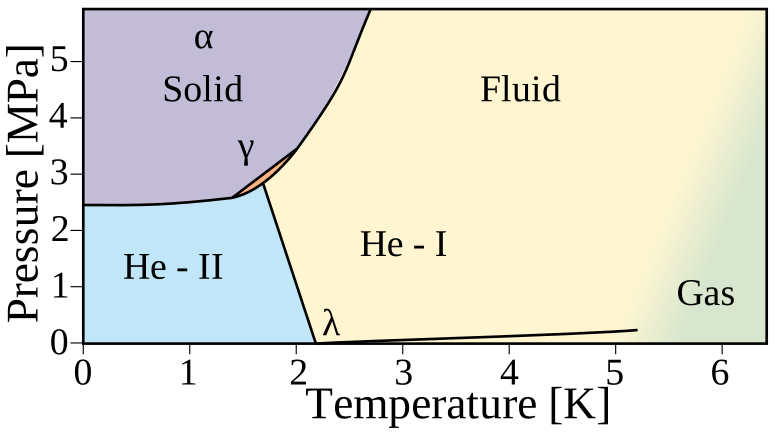
Liquid state of the element helium
Liquid helium is a physical state of helium at very low temperatures at standard atmospheric pressures. Liquid helium may show superfluidity.
At standard pressure, the chemical element helium exists in a liquid form only at the extremely low temperature of -269 C. Its boiling point and critical point depend on the isotope of helium present: the common isotope helium-4 or the rare isotope helium-3. These are the only two stable isotopes of helium. See the table below for the values of these physical quantities. The density of liquid helium-4 at its boiling point and a pressure of one atmosphere (101.3 kilopascals) is about 125 g/L, or about one-eighth the density of liquid water.
Liquefaction
Helium was first liquefied on July 10, 1908, by the Dutch physicist Heike Kamerlingh Onnes at the University of Leiden in the Netherlands. At that time, helium-3 was unknown because the mass spectrometer had not yet been invented. In more recent decades, liquid helium has been used as a cryogenic refrigerant (which is used in cryocoolers), and liquid helium is produced commercially for use in superconducting magnets such as those used in magnetic resonance imaging (MRI), nuclear magnetic resonance (NMR), magnetoencephalography (MEG), and experiments in physics, such as low temperature Mössbauer spectroscopy. The Large Hadron Collider contains superconducting magnets that are cooled with 120 tonnes of liquid helium.
Liquified helium-3
A helium-3 atom is a fermion and at very low temperatures, they form two-atom Cooper pairs which are bosonic and condense into a superfluid. These Cooper pairs are substantially larger than the interatomic separation.
Characteristics

Because of the very weak interatomic forces in helium, the element remains a liquid at atmospheric pressure all the way from its liquefaction point down to absolute zero. At temperatures below their liquefaction points, both helium-4 and helium-3 undergo transitions to superfluids. (See the table below.) Liquid helium can be solidified only under very low temperatures and high pressures.
Liquid helium-4 and the rare helium-3 are not completely miscible. This phase separation happens because the overall mass of liquid helium can reduce its thermodynamic enthalpy by separating.
At extremely low temperatures, the superfluid phase, rich in helium-4, can contain up to 6% helium-3 in solution. This makes the small-scale use of the dilution refrigerator possible, which is capable of reaching temperatures of a few millikelvins.
Superfluid helium-4 has substantially different properties from ordinary liquid helium.
History
In 1908, Kamerlingh-Onnes succeeded in liquifying a small quantity of helium. In 1923, he provided advice to the Canadian physicist John Cunningham McLennan, who was the first to produce quantities of liquid helium almost on demand.
Important early work on the characteristics of liquid helium was done by the Soviet physicist Lev Landau, later extended by the American physicist Richard Feynman.
In 1961, Vignos and Fairbank reported the existence of a different phase of solid helium-4, designated the gamma-phase. It exists for a narrow range of pressure between 1.45 and 1.78 K.
Data
| Properties of liquid helium | Helium-4 | Helium-3 |
|---|---|---|
| Critical temperature | 5.2 K | 3.3 K |
| Boiling point at one atmosphere | 4.2 K | 3.2 K |
| Minimum melting pressure | 25 bar | 29 bar at 0.3 K |
| Superfluid transition temperature at saturated vapor pressure | 2.17 K | 1 mK in the absence of a magnetic field |
Gallery
File:Liquid Helium.jpg|Liquid helium (in a vacuum bottle) at 4.2 K and 1 bar boiling slowly. File:Liquid helium lambda point transition.jpg|Lambda point transition: as the liquid is cooled down through 2.17 K, the boiling suddenly becomes violent for a moment. File:Liquid helium superfluid phase.jpg|Superfluid phase at temperature below 2.17 K. In this state, the thermal conductivity is extremely high. This causes heat in the body of the liquid to be transferred to its surface so quickly that vaporization takes place only at the free surface of the liquid. Thus, there are no gas bubbles in the body of the liquid. File:Liquid_helium_Rollin_film.jpg|The liquid helium is in the superfluid phase. A thin invisible film creeps up the inside wall of the bowl and down on the outside. A drop forms. It will fall off into the liquid helium below. This will repeat until the cup is empty—provided the liquid remains superfluid.
References
; General
- Freezing Physics: Heike Kamerlingh Onnes and the Quest for Cold, Van Delft Dirk (2007). Edita - The Publishing House Of The Royal Netherlands Academy of Arts and Sciences. .
References
- (2004). "The Observed Properties of Liquid Helium at the Saturated Vapor Pressure". [[University of Oregon]].
- (28 June 2023). "Cryogenics: Low temperatures, high performance". [[CERN]].
- (2004). "Refrigeration and Air-Conditioning". Encyclopedia of Energy.
- (16 January 1995). "Phase Separation of Liquid 3He–4He Mixtures: Effect of Confinement". Physical Review Letters.
- (1965). "Solubility of He3 in Liquid He4 at 0K". Phys. Rev. Lett..
- "THE LIFE OF SIR JOHN CUNNINGHAM McLENNAN Ph.D, F.R.S.C, F.R.S., O.B.E., K.B.E. (1867 - 1935)". University of Toronto Physics.
- (1961-03-15). "New Solid Phase in H4". Physical Review Letters.
- (1990). "The Superfluid Phases of Helium 3". Taylor and Francis.
This article was imported from Wikipedia and is available under the Creative Commons Attribution-ShareAlike 4.0 License. Content has been adapted to SurfDoc format. Original contributors can be found on the article history page.
Ask Mako anything about Liquid helium — get instant answers, deeper analysis, and related topics.
Research with MakoFree with your Surf account
Create a free account to save articles, ask Mako questions, and organize your research.
Sign up freeThis content may have been generated or modified by AI. CloudSurf Software LLC is not responsible for the accuracy, completeness, or reliability of AI-generated content. Always verify important information from primary sources.
Report