From Surf Wiki (app.surf) — the open knowledge base
Liqueur
Alcoholic beverage

Alcoholic beverage
.png)
A liqueur ( , ; ) is an alcoholic drink composed of spirits (often rectified spirit) and additional flavorings such as sugar, fruits, herbs, and spices. Often served with or after dessert, they are typically heavily sweetened and un-aged, beyond a resting period during production, when necessary, for their flavors to mingle.
Liqueurs are historical descendants of herbal medicines. They were made in France as early as the 13th century, often prepared by monks (for example, Chartreuse). Today they are produced all over the world, commonly served neat, over ice, with coffee, in cocktails, and used in cooking.
Etymology
The French word liqueur is derived from the Latin liquifacere, which means "to dissolve".
In some parts of the United States and Canada, liqueurs may be referred to as cordials, or schnapps. This can cause confusion as in the United Kingdom a cordial would refer to a non-alcoholic concentrated fruit syrup, typically diluted to taste and consumed as a non-carbonated soft drink. Schnapps, on the other hand, can refer to any distilled beverage in Germany and aquavit in Scandinavian countries.
Legal definitions
In the United States, where spirits are often called "liquor", there is often confusion discerning between liqueurs and liquors, due to the many different types of flavored spirits that are available today (e.g., flavored vodka). Liqueurs generally contain a lower alcohol content (15–30% ABV) than spirits and have a sweetener mixed, while some can have an ABV as high as 55%.
Canada
Under the Food and Drug Regulations (C.R.C., c. 870), liqueurs are produced from mixing alcohol with plant materials.
European Union
The European Union directive on spirit drinks provides guidelines applicable to all liqueurs. As such, a liqueur must
- contain a minimum of 15% alcohol by volume,
- in most cases, contain sweetening equivalent to at least 100 grams of inverted sugar per liter,
- be created using neutral grain alcohol and/or distillate(s) of agricultural origin,
- be flavored with natural, or nature-identical, flavorings, and
- be labeled with the alcohol content and a list of any food colorings.
United States
The Alcohol and Tobacco Tax and Trade Bureau regulates liqueurs similarly to Canada. Liqueurs (and also cordials) are defined as products created by mixing or redistilling distilled spirits with fruit, plant products, natural flavors, extracts, or sweeteners. These additives must be added in an amount not less than 2.5% by weight of the final product.
Preparation
Some liqueurs are prepared by infusing certain woods, fruits, or flowers in either water or alcohol and adding sugar or other items. Others are distilled from aromatic or flavoring agents.
Anise and Rakı liqueurs have the property of turning from transparent to cloudy when added to water: the oil of anise remains in solution in the presence of a high concentration of alcohol, but coalesces when the alcohol concentration is reduced; this is known as the ouzo effect.
Use
Cocktails
Adding liqueurs to a cocktail can change the flavour and appearance of the cocktail. Whilst some liqueurs are coloured and designed to make the cocktail pop in colour, others are clear to prevent the liqueur from taking over the colour of the base spirit or garnish.
Layered drinks
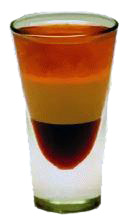
Layered drinks are made by floating different-colored liqueurs in separate layers. Each liqueur is poured slowly into a glass over the back of a spoon or down a glass rod, so that the liquids of different densities remain unmixed, creating a striped effect.
Gallery
File:Chartreuse-Liqueur 7586.JPG|Chartreuse has been made by French Carthusian monks since the 1740s File:Altvater Gessler.JPG|Altvater herbal liqueur produced in Austria File:Lapponia lakkalikööri, alun perin Chymos, nykyään Pernod Ricard Finland Ltd.jpg|Lapponia cloudberry liqueur produced in Finland File:DamianaLiqueur.jpg|Damiana-based liqueur of Mexico File:Wépion - liqueur de fraise.jpg|Fraise strawberry liqueur from the Ardennes, Belgium File:KoumQuatLiqueur.jpg|Kumquat liqueurs from Corfu File:Demanovka nowe.jpg|Demänovka is a traditional Slovak liqueur produced since 1867 File:Elder flower liqueur .jpg|Homemade elder flower liqueur File:Fish Shot.jpg|Fish Shot is a liqueur with a Fisherman's Friend flavour File:Poire Massenez.jpg|Poire William (Williams Pear) Liqueur by Massenez
Health concerns
Alcohol-based sugar-sweetened beverages, are closely linked to heavy episodic drinking in adolescents.
References
References
- "Definition of 'liqueur'".
- (2011). "The Art of Distilling Whiskey and Other Spirits: An Enthusiast's Guide to the Artisan Distilling of Potent Potables". Quarry Books.
- Etkin, N.L.. (2009). "Foods of Association: Biocultural Perspectives on Foods and Beverages that Mediate Sociability". University of Arizona Press.
- Lichine, Alexis. (1987). "Alexis Lichine's New Encyclopedia of Wines & Spirits". Alfred A. Knopf.
- (2010). "New Oxford American Dictionary". Oxford University Press.
- "9 Easily Confused Cocktail Terms You Should Know".
- (27 October 1985). "Schnapps, the Cordial Spirit". [[The New York Times]].
- "How to Tell Your Liquor From Your Liqueur".
- "Liquor alcohol content".
- (23 June 2021). "Consolidated federal laws of canada, Food and Drug Regulations".
- (25 May 2021). "Consolidated text: Regulation (EU) 2019/787 of the European Parliament and of the Council of 17 April 2019 on the definition, description, presentation and labelling of spirit drinks, the use of the names of spirit drinks in the presentation and labelling of other foodstuffs, the protection of geographical indications for spirit drinks, the use of ethyl alcohol and distillates of agricultural origin in alcoholic beverages, and repealing Regulation (EC) No 110/2008".
- The wording is: "a minimum content of sweetening products, expressed as invert sugar". The level is lowered to 70 grams per liter for cherry or sour cherry liqueurs, and 80 grams per liter for "liqueurs flavoured exclusively with gentian or a similar plant or wormwood".
- "27 CFR 5.22 – The standards of identity.".
- (2016). "Nanocolloids: A Meeting Point for Scientists and Technologists". Elsevier Science.
- (4 July 2022). "What are Liqueurs? Find out from the Experts!".
- "Know the Density of Your Liquor To Make the Best Layered Drinks".
- (September 2021). "The Sugars in Alcohol Cocktails Matter". ACS Chemical Neuroscience.
This article was imported from Wikipedia and is available under the Creative Commons Attribution-ShareAlike 4.0 License. Content has been adapted to SurfDoc format. Original contributors can be found on the article history page.
Ask Mako anything about Liqueur — get instant answers, deeper analysis, and related topics.
Research with MakoFree with your Surf account
Create a free account to save articles, ask Mako questions, and organize your research.
Sign up freeThis content may have been generated or modified by AI. CloudSurf Software LLC is not responsible for the accuracy, completeness, or reliability of AI-generated content. Always verify important information from primary sources.
Report