From Surf Wiki (app.surf) — the open knowledge base
Linear polarization
Electromagnetic radiation special case
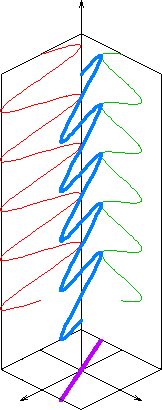
Electromagnetic radiation special case
In electrodynamics, linear polarization or plane polarization of electromagnetic radiation is a confinement of the electric field vector or magnetic field vector to a given plane along the direction of propagation. The term linear polarization (French: polarisation rectiligne) was coined by Augustin-Jean Fresnel in 1822. See polarization and plane of polarization for more information.
The orientation of a linearly polarized electromagnetic wave is defined by the direction of the electric field vector.{{cite book
Mathematical description
The classical sinusoidal plane wave solution of the electromagnetic wave equation for the electric and magnetic fields is (cgs units)
: \mathbf{E} ( \mathbf{r} , t ) = |\mathbf{E}| \mathrm{Re} \left { |\psi\rangle \exp \left [ i \left ( kz-\omega t \right ) \right ] \right }
: \mathbf{B} ( \mathbf{r} , t ) = \hat { \mathbf{z} } \times \mathbf{E} ( \mathbf{r} , t )/c
for the magnetic field, where k is the wavenumber,
: \omega_{ }^{ } = c k
is the angular frequency of the wave, and c is the speed of light.
Here \mid\mathbf{E}\mid is the amplitude of the field and
: |\psi\rangle \ \stackrel{\mathrm{def}}{=}\ \begin{pmatrix} \psi_x \ \psi_y \end{pmatrix} = \begin{pmatrix} \cos\theta \exp \left ( i \alpha_x \right ) \ \sin\theta \exp \left ( i \alpha_y \right ) \end{pmatrix}
is the Jones vector in the x-y plane.
The wave is linearly polarized when the phase angles \alpha_x^{ } , \alpha_y are equal,
: \alpha_x = \alpha_y \ \stackrel{\mathrm{def}}{=}\ \alpha .
This represents a wave polarized at an angle \theta with respect to the x axis. In that case, the Jones vector can be written
: |\psi\rangle = \begin{pmatrix} \cos\theta \ \sin\theta \end{pmatrix} \exp \left ( i \alpha \right ) .
The state vectors for linear polarization in x or y are special cases of this state vector.
If unit vectors are defined such that
: |x\rangle \ \stackrel{\mathrm{def}}{=}\ \begin{pmatrix} 1 \ 0 \end{pmatrix}
and
: |y\rangle \ \stackrel{\mathrm{def}}{=}\ \begin{pmatrix} 0 \ 1 \end{pmatrix}
then the polarization state can be written in the "x-y basis" as
: |\psi\rangle = \cos\theta \exp \left ( i \alpha \right ) |x\rangle + \sin\theta \exp \left ( i \alpha \right ) |y\rangle = \psi_x |x\rangle + \psi_y |y\rangle .
References
References
- A. Fresnel, "Mémoire sur la double réfraction que les rayons lumineux éprouvent en traversant les aiguilles de cristal de roche suivant les directions parallèles à l'axe", read 9 December 1822; printed in H. de Senarmont, E. Verdet, and L. Fresnel (eds.), ''Oeuvres complètes d'Augustin Fresnel'', vol. 1 (1866), pp.{{nnbsp731–51; translated as "Memoir on the double refraction that light rays undergo in traversing the needles of quartz in the directions parallel to the axis", {{Zenodo. 4745976, 2021 (open access); §9.
This article was imported from Wikipedia and is available under the Creative Commons Attribution-ShareAlike 4.0 License. Content has been adapted to SurfDoc format. Original contributors can be found on the article history page.
Ask Mako anything about Linear polarization — get instant answers, deeper analysis, and related topics.
Research with MakoFree with your Surf account
Create a free account to save articles, ask Mako questions, and organize your research.
Sign up freeThis content may have been generated or modified by AI. CloudSurf Software LLC is not responsible for the accuracy, completeness, or reliability of AI-generated content. Always verify important information from primary sources.
Report