From Surf Wiki (app.surf) — the open knowledge base
Light machine gun
Machine gun for an individual soldier

Machine gun for an individual soldier


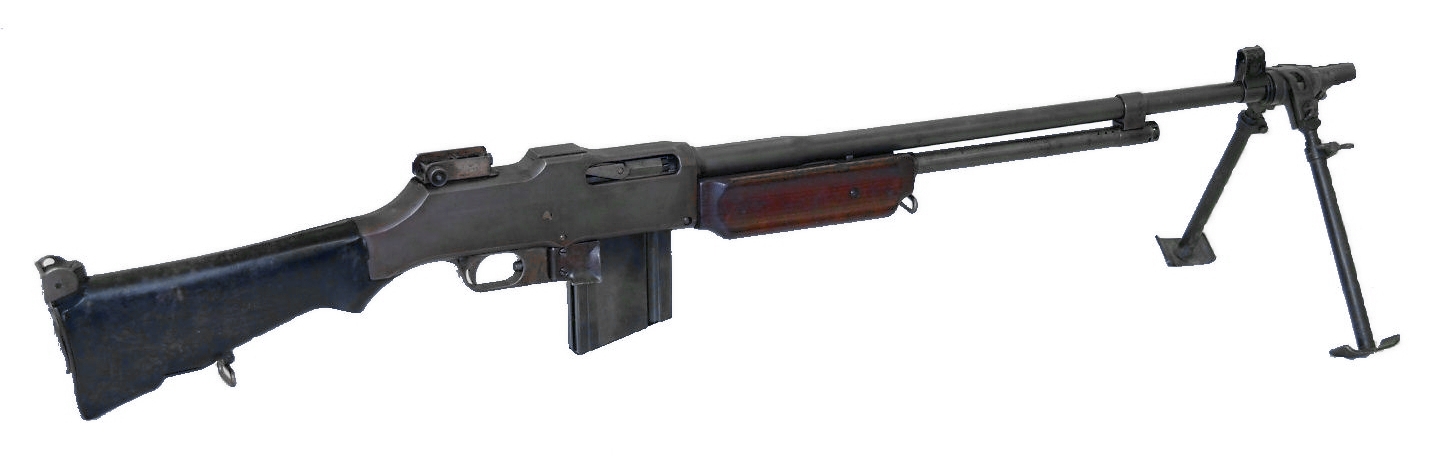
A light machine gun (LMG) is a light-weight machine gun designed to be operated by a single infantryman, with or without an assistant, as an infantry support weapon. LMGs firing cartridges of the same caliber as the other riflemen of the same combat unit are often referred to as squad automatic weapons. Unlike submachine guns, LMGs do not use pistol cartridges.
Characteristics
While early light machine guns fired full-powered rifle cartridges, modern light machine guns often fire smaller-caliber rifle cartridges than medium machine guns – generally the same intermediate cartridge fired by a service's standard assault rifle – and are usually lighter and more compact. Some LMGs, such as the Russian RPK, are modifications of existing designs and designed to share the same ammunition. Adaptations to the original rifle generally include a larger magazine, a heavier barrel to resist overheating, a more robust mechanism to support sustained fire and a bipod.
A light machine gun is also defined by its usage as well as its specifications: some machine guns – notably general-purpose machine guns – may be deployed either as a light machine gun or a medium machine gun. Deployed on a tripod and used for sustained fire, it is a medium machine gun; if deployed with a bipod with the operator in a prone position and firing short bursts, it is a light machine gun.
Light machine guns are also designed to be fired from the hip or on the move as a form of suppressive fire intended to pin down the enemy. Marching fire is a specific tactic that relies on this capability.
Lighter modern LMGs have enabled them to be issued down at the fireteam level, with two or three at the section/squad level.
Ammunition feed
Many light machine guns (such as the Bren gun or the M1918 Browning Automatic Rifle) were magazine-fed. Others, such as the Hotchkiss M1922, could be fed either from a belt/strip or from a box magazine. Modern light machine guns are designed to fire smaller caliber rounds and, as such, tend to be belt-fed (from a container attached to the gun) or from a detachable high-capacity drum magazine, but some, such as the FN Minimi, will also accept standard rifle magazine feeding as an auxiliary measure when belted ammunition has been exhausted.
History
In 1903, French military theorists noticed that the heavy machine guns of the day were of little use in infantry assaults. They determined that "the machine gun must learn to walk". They researched the possibility of a light machine gun which could be carried by troops. A marching fire tactic was theorised, using incidental suppressive fire, with the advancing troops considered a deadlier threat than the un-aimed bullets, causing the enemy to fall back. The prototype guns were not approved for production, and none were in service when World War I began. The French quickly brought the prototypes to mass production to boost the firepower of advancing infantry.
By the end of World War II, light machine guns were usually being issued on a scale of one per fire team or squad, and the modern infantry squad had emerged with tactics that were built around the use of the LMG to provide suppressive fire.
Selected examples
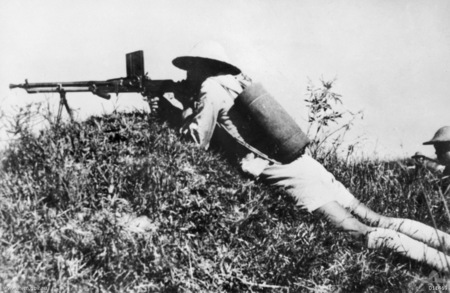

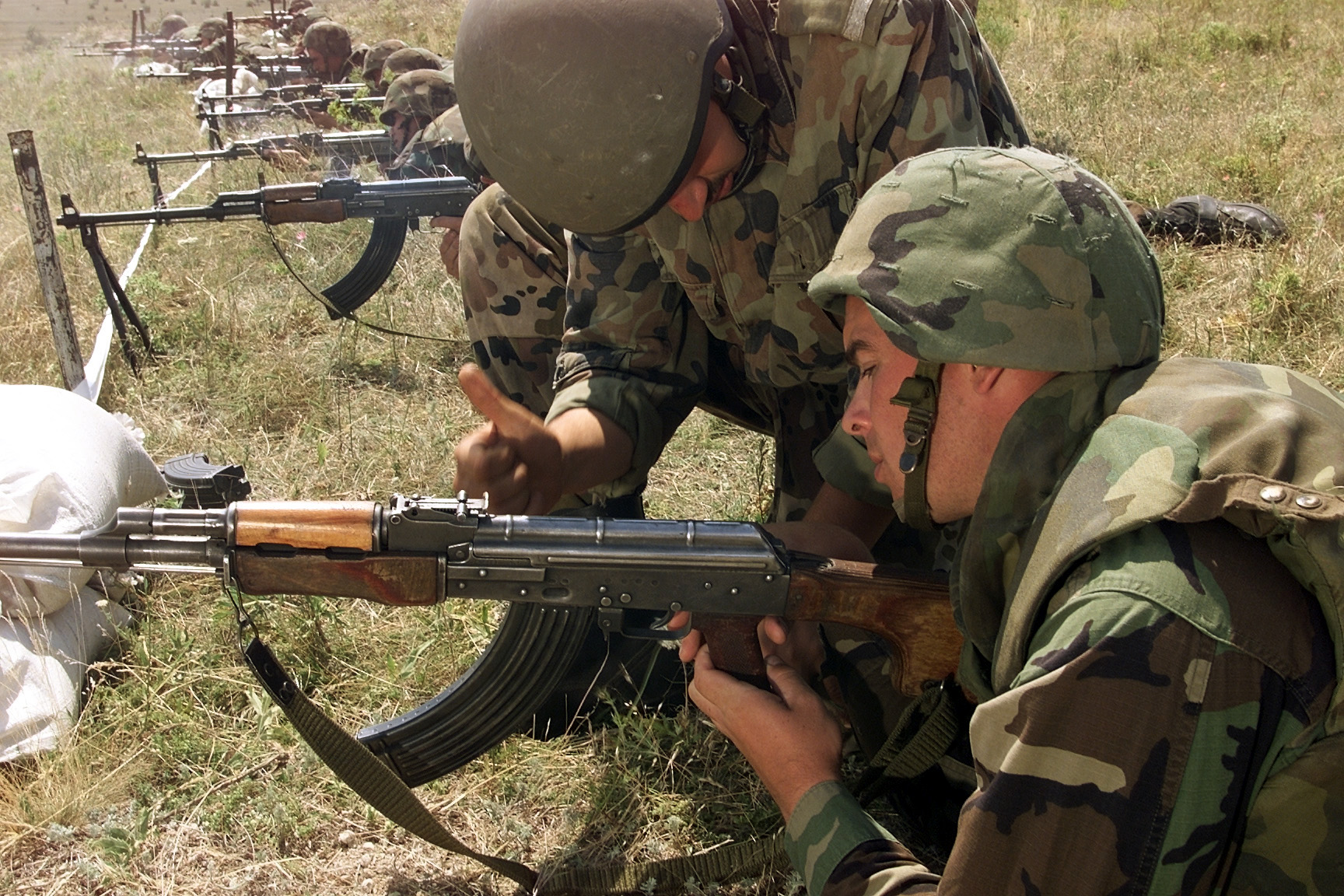
The following were either exclusively light machine guns, had a light machine gun variant or were employed in the light machine gun role with certain adaptations.
| Model | Country of origin | Design date | Caliber(s) | Weight (base model) | Feed system | Rate of fire (rounds/min) | Model variants |
|---|---|---|---|---|---|---|---|
| Madsen machine gun | Denmark | 1896 | Various | 9.07 kg | Box magazine | 450 | |
| Chauchat (Fusil-Mitrailleur Mle 1915 'CSRG') | France | 1907 | 8mm Lebel | ||||
| .30-06 Springfield | 9.07 kg | Magazine | 240/360 | M1918 CSRG Chauchat(USA) | |||
| Hotchkiss M1909 Benét–Mercié | United States | ||||||
| United Kingdom | 1909 | 8mm Lebel | |||||
| .303 British | |||||||
| .30-06 Springfield | 12 kg | Stripper clip fed | 400–600 | ||||
| Bergmann MG15 nA Gun | Germany | 1910 | 7.92×57mm Mauser | 12.9 kg | Belt fed | 500–600 | |
| Vickers-Berthier | France | ||||||
| United Kingdom | 1910 | .303 British | 11.07 kg | Box magazine | 450–600 | ||
| Lewis Gun | United States | ||||||
| United Kingdom | 1911 | .303 British | |||||
| .30-06 Springfield | |||||||
| 7.92×57mm Mauser | 13 kg | Pan magazine | 600 (cyclic) | ||||
| Huot automatic rifle | Canada | 1916 | .303 British | 5.9 kg | Drum magazine | 155/475 | |
| M1918 Browning Automatic Rifle | United States | 1917 | .30-06 Springfield | ||||
| 6.5×55mm | |||||||
| 7.92×57mm Mauser | 8.8 kg | Box magazine | 650 (cyclic) | Wz. 1928 (Poland) | |||
| Hotchkiss M1922 | France | 1922 | Various | 8.5 kg (18.7 lb) | Magazine | 450 | |
| Type 11 light machine gun | Japan | 1922 | 6.5×50mm Arisaka | 10.2 kg | Stripper clip fed, hopper magazine | 500 (cyclic) | |
| ZB vz. 26 | Czechoslovakia | 1923 | 7.92×57mm Mauser | 10.5 kg | Box magazine | 500 | |
| FM-24/29 | France | 1924 | 7.5×54mm French | 9.1 kg | Box magazine | 450 (cyclic) | |
| Maxim-Tokarev | Soviet Union | 1924 | 7.62×54mmR | 12.9 kg | Belt fed | ||
| Lmg 25 | Switzerland | 1925 | 7.5×55mm Swiss | 8.65 kg | Box magazine | ≈500 | |
| Lahti-Saloranta M/26 | Finland | 1925 | 7.62×53mmR | 9.3 kg | Magazine | 450–550 | |
| Degtyaryov machine gun | Soviet Union | 1927 | 7.62×54mmR | 9.12 kg | Pan magazine | 550 | |
| Mendoza RM2 | Mexico | 1928 | 7×57mm Mauser | ||||
| .30-06 Springfield | 6.3 kg | Box magazine | 450–650 | ||||
| Breda 30 | Italy | 1930 | 6.5×52mm Mannlicher–Carcano | 10.6 kg | Stripper clip fed, internal magazine | 500 (cyclic) | |
| ZB vz. 30 | Czechoslovakia | 1930 | 7.92×57mm | 9.1 kg | Box magazine | 550–650 | |
| Bren | United Kingdom | 1935 | .303 British | 10.35 kg | Box magazine | 500–520 | |
| Type 96 light machine gun | Japan | 1936 | 6.5×50mm Arisaka | 9 kg | Box magazine | 450 (cyclic) | |
| Type 99 light machine gun | Japan | 1939 | 7.7×58mm Arisaka | 10.4 kg | Box magazine | 800 | |
| RPK | Soviet Union | 1960 | 7.62×39mm | 4.8 kg (10.6 lb) | Drum or box magazine | 600 | RPK-74 |
| Heckler & Koch HK21 | West Germany | 1961 | 5.56×45mm NATO | ||||
| 7.62×51mm NATO | 8.15 kg | Belt fed or box magazine | 900 | HK11E | |||
| HK13E | |||||||
| Stoner 63 | United States | 1960s | 5.56×45mm NATO | 5.3 kg | Drum or box magazine | 1000 (cyclic) | |
| Colt Automatic Rifle | United States | 1970s | 5.56×45mm NATO | 5.78 kg | Drum or box magazine | 750 (cyclic) | Diemaco LSW (CAN) |
| L86 LSW | United Kingdom | 1970s | 5.56×45mm NATO | 6.58 kg | Box magazine | 775 (cyclic) | |
| FN Minimi | Belgium | 1974 | 5.56×45mm NATO (standard) | ||||
| 7.62×51mm NATO | 6.85 kg | Belt fed or box magazine | 1150 (cyclic) | M249 Squad Automatic Weapon (USA) | |||
| MK 46 machine gun (USA) | |||||||
| CETME Ameli | Spain | 1974 | 5.56×45mm NATO | 5.3 kg | Belt fed | 1200 (cyclic) | MG82 (Spain) |
| Ultimax 100 | Singapore | 1977 | 5.56×45mm NATO | 4.75 kg | Drum or box magazine | 600 (cyclic) | |
| Steyr AUG H-BAR | Austria | 1977 | 5.56×45mm NATO | 3.9 kg | Box magazine | 750 (cyclic) | |
| IWI Negev | Israel | 1985 | 5.56×45mm NATO | ||||
| 7.4 kg | Belt fed or magazine | 1150 (cyclic) | |||||
| Negev NG7 | Israel | 2012 | 7.62×51mm NATO | 7.9 kg | Belt fed or magazine | ||
| Heckler & Koch MG4 | Germany | 1990s | 5.56×45mm NATO | 8.55 kg | Belt fed | 885 (cyclic) | |
| Heckler & Koch MG36 | Germany | 1990s | 5.56×45mm NATO | 3.83 kg | Drum or box magazine | 750 (cyclic) | |
| INSAS LMG | India | 1990s | 5.56×45mm NATO | 6.7 kg | Box magazine | 650 (cyclic) | |
| SAR-21 LMG | Singapore | 1996 | 5.56×45mm NATO | 3.82 kg | Box magazine | 650 (cyclic) | |
| Ares Shrike 5.56 | United States | 2000s | 5.56×45mm NATO | 3.4 kg | Belt fed or magazine | 800 (cyclic) | |
| Type-81 LMG | China | 1981 | 7.62×39mm | 5.15 kg | 75-round drum or 30-round STANAG | 750 (cyclic) | BD-15 LMG (Bangladesh) |
| M27 IAR | Germany | 2008 | 5.56×45mm NATO | 3.6 kg | Drum or box magazine | 640 (cyclic) | |
| QJB-95 | China | 1997 | 5.8x42mm | 3.25 kg | 60 | 900 (cyclic) | |
| Colt IAR6940 | United States | 2008 | 5.56×45mm NATO | 4.32 kg | Drum or box magazine | 700 (cyclic) | Colt 6940E-SG (Singapore) |
| RPD | Soviet Union | 1944 | 7.62×39mm | 7.5 kg | Belt fed | 650 |
References
References
- (2003). "Fusil mitrailleur Chauchat. FM modèle 1915 C.S.R.G.". mitrailleuse.fr.
This article was imported from Wikipedia and is available under the Creative Commons Attribution-ShareAlike 4.0 License. Content has been adapted to SurfDoc format. Original contributors can be found on the article history page.
Ask Mako anything about Light machine gun — get instant answers, deeper analysis, and related topics.
Research with MakoFree with your Surf account
Create a free account to save articles, ask Mako questions, and organize your research.
Sign up freeThis content may have been generated or modified by AI. CloudSurf Software LLC is not responsible for the accuracy, completeness, or reliability of AI-generated content. Always verify important information from primary sources.
Report