From Surf Wiki (app.surf) — the open knowledge base
Lifebuoy
Buoy designed to be thrown to person in water, to prevent drowning

Buoy designed to be thrown to person in water, to prevent drowning
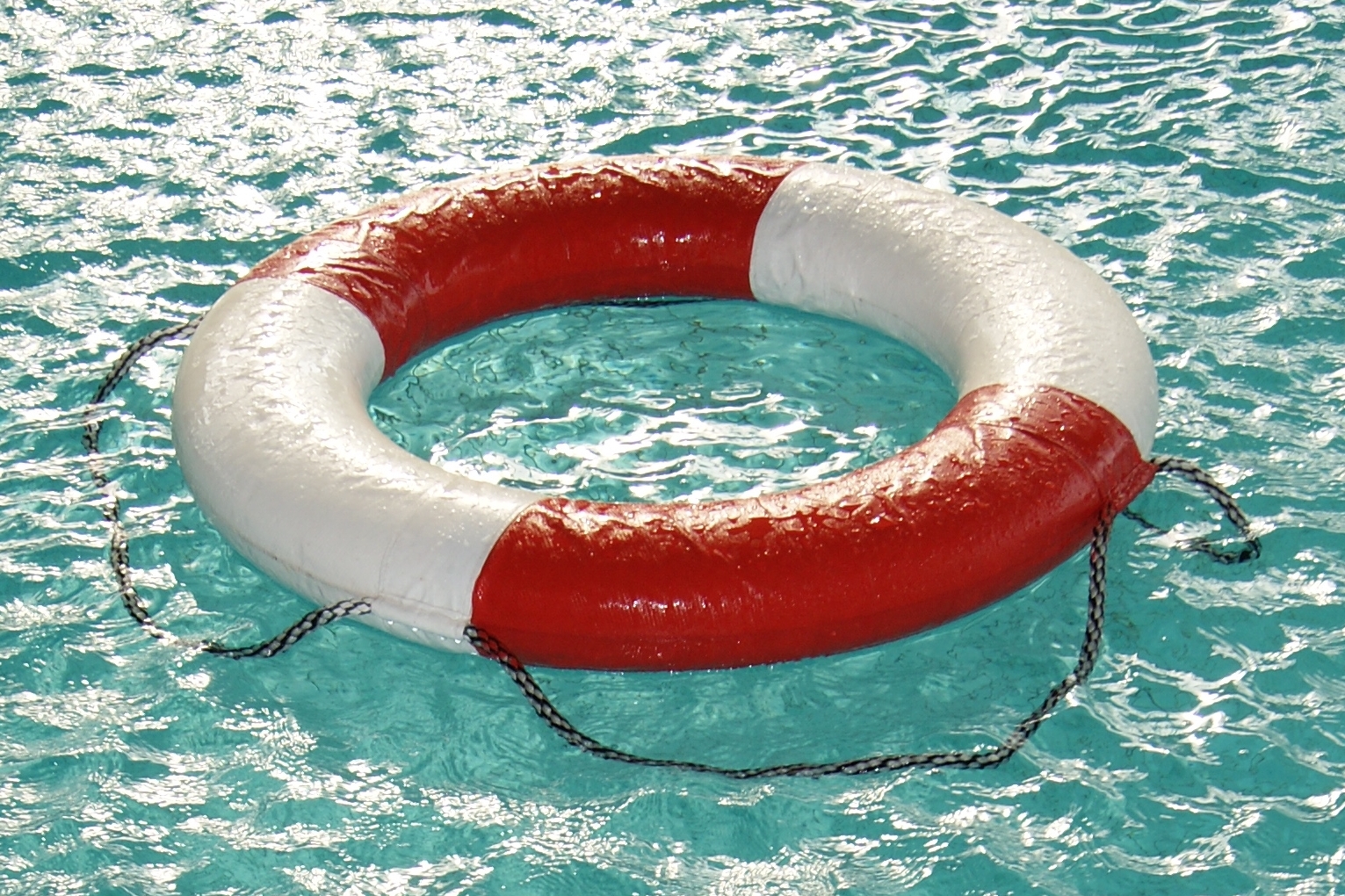
A lifebuoy or life ring, among many other names (see § Other names), is a life-saving buoy designed to be thrown to a person in water to provide buoyancy and prevent drowning. Some modern lifebuoys are fitted with one or more seawater-activated lights to aid rescue at night.
Other names
Other names for "lifebuoy" include:
- life-preserver
- life ring
- life-ring
- life-belt
- life-saver
- ring-buoy
- donut
- safety wheel
- Perry buoy
- Kisbee ring
Description
The lifebuoy is usually a ring- or horseshoe-shaped personal flotation device with a connecting line allowing the casualty to be pulled to the rescuer in a boat. They are carried by ships and boats and located beside bodies of water and swimming pools.
In the United States, Coast Guard approved lifebuoys are considered Type IV personal flotation devices. At least one Type IV PFD is required on all vessels 26 feet or more in length.
In the UK the Royal Life Saving Society considers lifebuoys unsuitable for use in swimming pools because throwing one into a busy pool could injure the casualty or other pool users. In these locations, lifebuoys have been superseded by devices such as the torpedo buoy, a low-drag device developed to be towed by lifeguards to those in danger.
History
Leonardo da Vinci sketched a concept for a safety wheel, as well as for buoyant shoes and balancing sticks for walking on water.
According to various sources the Knights of Malta were the first to use cork lifebuoys on their ships.
In the book Architectura naval antigua y moderna (1752) by Juan José Navarro, 1st Marquess of Victoria, two plates show "circular lifebuoys" and another plate includes a drawing of "a lifebuoy made of cork", called "salvenos". This is the type used systematically by the Knights of Malta on their ships. The lifebuoy was attached to a rope on one side and to the poop of the ship on the other, so that it may be deployed in case anyone should fall into the sea. Navarro was Captain General of the Navy and is credited with the systematic introduction of the lifebuoy on all ships of the Spanish navy.
In 1803, a device called the "Marine Spencer" from the name of its inventor, Knight Spencer of Bread Street, was described in the Philosophical Magazine. It was made of "800 old tavern corks" affixed to a band, "covered in canvass, and painted in oil, so as to render it waterproof." The invention gained Spencer the honorary silver medal from the Royal Humane Society.
Leonardo da Vinci, lifebelt (cropped).jpg|Leonardo da Vinci's design sketches for a safety wheel File:Acta Eruditorum - II medicina, 1691 – BEIC 13350590.jpg|First studies on the lifebuoy illustrated in the Acta Eruditorum, 1691 File:Illustration of the "Marine Spencer", a lifebuoy prototype from 1803.jpg|Illustration of the prototype of the "Marine Spencer", an early example of lifebuoy, from the Philosophical Magazine, 1803
Gallery
USCGC Eagle life preserver.JPG|Commercial use lifebuoy aboard Aqualiner_Aanlegplaats_Reddingboei.JPG|Containered lifebuoy with concealed rope "Life ring" in Newport Beach.JPG|Containered lifebuoy in Newport Beach, California Lifebuoy-Thames.jpg|Containered lifebuoy by the River Thames Lifebelt Commander British Forces Malta MMM.jpg|Older style of lifebuoy File:Frost-covered lifebuoy, Lake Siskiyou.jpg|Frost-covered lifebuoy, Lake Siskiyou, California File:Lifebuoy in Ireland.jpg|Lifebuoy in Ireland File:Lifering on beach.jpg|Lifebuoy on a beach File:Tutjusaaristo.jpg|Lifebuoy at Tutjuniemi of Saaristo Harbour in Liperi, North Karelia, Finland
References
References
- "The Kisbee Ring".
- "Boat Life Rings, Ring Buoys".
- "The Kisbee Ring".
- "46 CFR 25.25-5 Life Preservers and Other Lifesaving Equipment".
- "The Lifeguard". IQL UK Ltd.
- Wallace, Robert. (1972). "The World of Leonardo: 1452–1519". Time-Life Books.
- [[Hugo O'Donnell, 7th Duke of Tetuan]]. (2004). "El primer Marqués de la Victoria, personaje silenciado en la reforma dieciochesca de la armada: discurso leído el día 1 de febrero de 2004". Real Academia de la Historia.
- "Análisis y estudio del Album del Marques de la Victoria con proposito del su empleo en el modelismo de arsenal naval.".
- (1803). "The philosophical magazine. Volume 16".
- (September 1803). "The Cristian Observer".
This article was imported from Wikipedia and is available under the Creative Commons Attribution-ShareAlike 4.0 License. Content has been adapted to SurfDoc format. Original contributors can be found on the article history page.
Ask Mako anything about Lifebuoy — get instant answers, deeper analysis, and related topics.
Research with MakoFree with your Surf account
Create a free account to save articles, ask Mako questions, and organize your research.
Sign up freeThis content may have been generated or modified by AI. CloudSurf Software LLC is not responsible for the accuracy, completeness, or reliability of AI-generated content. Always verify important information from primary sources.
Report