From Surf Wiki (app.surf) — the open knowledge base
Libya national football team
Men's association football team

Men's association football team
| Field | Value |
|---|---|
| Name | Libya |
| Nickname | فُرْسَانُ الْمُتَوَّسِط (Fursan al-Mutawasit) (The Mediterranean Knights) |
| Badge_size | 145px |
| Association | Libyan Football Federation (LFF) |
| Confederation | CAF (Africa) |
| Sub-confederation | UNAF (North Africa) |
| Coach | Aliou Cissé |
| Captain | Moatasem Al-Musrati |
| Most caps | Ahmed Saad Osman (80) |
| Top scorer | Ahmed Ben Soueid (50) |
| Home Stadium | Tripoli Stadium |
| FIFA Trigramme | LBY |
| FIFA Rank | |
| FIFA max | 36 |
| FIFA max date | September 2012 |
| FIFA min | 187 |
| FIFA min date | July 1997 |
| Elo Rank | |
| Elo max | 46 |
| Elo max date | August 1985 |
| Elo min | 124 |
| Elo min date | June 2003 |
| pattern_la1 | _adidastiro24prw |
| pattern_b1 | _adidastiro24prw |
| pattern_ra1 | _adidastiro24prw |
| pattern_sh1 | _adidastiro24bw |
| pattern_so1 | _3_stripes_white |
| leftarm1 | FF0000 |
| body1 | FF0000 |
| rightarm1 | FF0000 |
| shorts1 | 000000 |
| socks1 | 000000 |
| pattern_la2 | _adidastiro24wb |
| pattern_b2 | _adidastiro24wb |
| pattern_ra2 | _adidastiro24wb |
| pattern_sh2 | _adidastiro24wb |
| pattern_so2 | _3_stripes_black |
| leftarm2 | FFFFFF |
| body2 | FFFFFF |
| rightarm2 | FFFFFF |
| shorts2 | FFFFFF |
| socks2 | FFFFFF |
| First game | 5–2 |
| (Alexandria, Egypt; 3 August 1953) | |
| Largest win | 21–0 Muscat and Oman Flag of Muscat.svg |
| (Baghdad, Iraq; 6 April 1966) | |
| Largest loss | 10–2 |
| (Alexandria, Egypt; 6 August 1953) | |
| Regional name | Africa Cup of Nations |
| Regional cup apps | 3 |
| Regional cup first | 1982 |
| Regional cup best | Runners-up (1982) |
the men's team
| Sub-confederation = UNAF (North Africa) (Alexandria, Egypt; 3 August 1953) (Baghdad, Iraq; 6 April 1966) (Alexandria, Egypt; 6 August 1953) The Libya national football team () represents Libya in men's international football and is controlled by the Libyan Football Federation. The team has never qualified for FIFA World Cup but has qualified for editions of the Africa Cup of Nations in 1982, 2006 and 2012. In 1982, the team was both the host and runner-up. In the Arab Cup, Libya finished second in 1964 and 2012, and third in 1966. The team is affiliated with both FIFA and Confederation of African Football (CAF).
Due to political circumstances, Libya has typically been less successful in international competition compared to other North African teams like Algeria, Morocco, Egypt and Tunisia. Libya has never qualified for the FIFA World Cup and its participation in AFCON is sporadic, having only qualified for three AFCON editions.
In the 2010s, Libya's global ranking improved due to the increasing number of Libyan players playing in foreign leagues. At the 2012 Africa Cup of Nations, the team recorded their first-ever win in the tournament outside Libya. Their FIFA world ranking rose to a high of 36 in September 2012; Libya then won a gold medal in the 2014 African Nations Championship. However, the Libyan Civil War caused the stoppage of the Libyan Premier League and severely disrupted domestic affairs. Libya was eliminated in the first round of the 2015 Africa Cup of Nations qualification by Rwanda and failed to qualify for the 2016 African Nations Championship as the defending champions.
History
Early history
Libya's national team was first initiated in 1918, but did not play an official international until 3 August 1953, when they defeated Palestine 5–2 in the first Arab Games in 1953. The team's first manager was Masoud Zantouny, and the first foreign manager was Englishman James Bingham, who took charge of the Libyan national team for the 1961 Arab Games. The first player ever to score for the Libyan national team in an official international was Mukhtar Ghonaay.
The first penalty ever scored by a member of the national team was in the 1953 Arab Games group stage; in the match against Egypt, Ali Zantouny scored in the 3–2 defeat. The national team's first participation in the Arab Cup was in 1964, the second edition of the competition, held in Kuwait.
The first ever player to score for the Libyan national team in a non-official international was Mustapha Makki in a warm-up friendly played prior to the 1953 Arab Games tournament, played against Palestine in Alexandria in 1952. The national team's first attempt to qualify for an Olympic football tournament was in 1967, where they played their first qualification match against Niger in an attempt to qualify for the 1968 Olympic football tournament in Mexico City.
World Cups
Libya first entered the FIFA World Cup qualifiers in 1970. Their early attempts failed, but during the 1980s the national side strengthened. The country's geopolitical position, however, affected the football team, who had to withdraw from qualifying for the 1982 and 1990 World Cups.
Libya came closest to qualifying for the World Cup in 1986. They came to within a game of reaching the finals in Mexico. After winning their match against Sudan in their first game, the Libyans beat Ghana in the next round before taking on Morocco for a place at the finals. Morocco won the first game 3–0 and went through, even though Libya won the return leg 1–0.
After not entering the 1994 and 1998 FIFA World Cup competition, Libya came back in the qualifying competition for Korea/Japan. The Libyans advanced to the second round at the expense of Mali, who were beaten 4–3 on aggregate. In the group stage, Libya managed only two draws in eight games.
In the qualifying for the 2006 FIFA World Cup, a 9–0 two-legged victory against São Tome and Principe put the Libyans through to the group stage. Libyan player Al-Saadi Gaddafi was banned from the team after failing a drug test.
A difficult group followed containing Egypt, Cameroon and Ivory Coast, the eventual group winners and qualifiers for the World Cup. However, The Knights were able to secure good results against these sides, as they beat Egypt 2–1 in Tripoli, and held Cameroon and Ivory Coast to 0–0 draws, helping them to a 4th-place finish and a place at the 2006 African Cup of Nations finals in Egypt.
During the qualifying campaign for the 2010 FIFA World Cup, Libya defeated each side in the second round during home matches (they also defeated Lesotho away). However they were defeated by Gabon in an away match, and failed to qualify to the next round on goal difference.
In the qualifying campaign for the 2014 FIFA World Cup, Libya reached the final match in the group stage without a defeat. They were defeated 1–0 by Cameroon and failed to advance to the final round.
In the qualifying campaign for the 2018 FIFA World Cup, Libya defeated Rwanda 4–1 on aggregate in the second round but were eliminated after losing the first three matches in the group stages.
African Cup Of Nations
Libya 1982
The biggest football tournament to be held in Libya was the 1982 African Cup of Nations. Libya qualified automatically as hosts and were put in a group alongside Ghana, Cameroon and Tunisia. The opening match of the tournament saw the hosts take on Ghana in Tripoli in a 2–2 draw. A 2–0 win over Tunisia and a goalless draw against Cameroon saw Libya topping the group.
In the semi-finals, Libya came from behind to beat Zambia 2–1 and set up another match with Ghana, this time in the final on 19 March. Ghana scored first in the 35th minute, but Libya equalised in the 70th. This was followed by a tense period of extra time in which no goals were scored. In a long penalty shootout, Ghana came out triumphant 7–6.
Egypt 2006
Libya's second African Cup of Nations saw a return to the higher levels of the international footballing scene at the 2006 African Cup of Nations finals in Egypt. They qualified for the competition after a goalless draw with Sudan in their ninth qualifying match.
Libya were drawn in Group A with Egypt (the hosts and eventual winners), 2006 World Cup-qualifiers Ivory Coast and Morocco. Libya lost 3–0 to Egypt in Cairo, then lost 2–1 to Ivory Coast. A goalless draw against Morocco saw Libya finish bottom of the group.
Post-Gaddafi era
Libya played its first match after the Battle of Tripoli (and thus the end of the Gaddafi era in Libya) on 3 September 2011, with a new uniform sporting the National Transitional Council flag of Libya.
The match, part of the 2012 Africa Cup of Nations qualification campaign, resulted in a 1–0 victory over Mozambique. The historic goal was scored by Rabee'a al Laafi. Like Libya's previous home match, a 3–0 defeat of Comoros in qualifying, played in Stade 26 mars in Bamako, Mali, a relocation was necessary due to the ongoing Libyan Civil War, and so the Petro Sport Stadium in Cairo, Egypt became the venue. The match was played behind closed doors for security reasons.
Prior to the team's final game in the qualification campaign, against Zambia, coach Marcos Paquetá claimed that the team was now "not only playing for football success but for a new government and a new country". The match was played on 8 October 2011, and resulted in a 0–0 draw which was good enough for both teams to qualify. Paquetá and his team danced and celebrated afterwards.
In November 2011 the team travelled to the United Arab Emirates to play a friendly match against Belarus organized by FIFA and broadcast Dubai Sports. The team members, along with the Libyan national chess team, also attended an event at the Libyan Consulate in Dubai organized to honour their contribution to their country in the field of sports.
On 7 June 2013, Libya met DR Congo in its first match on home ground in two years.
2012 Africa Cup of Nations
Having qualified, Libya were drawn into Group A with co-hosts Equatorial Guinea, qualification rivals Zambia and pre-tournament favourites Senegal.
The Mediterranean Knights' first game, the tournament's opening match, saw them lose to an 87th-minute winner from ex-Real Madrid winger Javier Ángel Balboa. Libya went on to secure a 2–2 draw with Zambia in terrible conditions at the Estadio de Bata, before two goals from Ihaab al Bousseffi guided them to a 2–1 victory over Senegal, their first Nations Cup win in 30 years and a first on foreign soil. After four points from three games Libya was eliminated at the group stage.
2014 African Nations Championship Final
Libya played Ghana in the 2014 CHAN final. Extra time was given (two 15 minutes), however both teams failed to score. It was taken to penalty shootouts, where the Libyan team scored the first three penalties, missed two others and scored the final sixth and their Ghanaian opponents missed the first two, scored the next three then missed the final sixth penalty (resulting in 3 penalties scored). The match finished (0–0) and was won by the Mediterranean Knights by penalties (4–3).
Coaching crisis
After Javier Clemente's dismissal in 2016, Jalal Damja took over the national team. He left in 2017 after his contract expired. Omar Almaryami was later appointed as coach and led Libya to the semi-finals of the 2018 African Nations Championship. After Libya's elimination by Morocco, Adel Amrouche was appointed in May 2018. His goal was to help Libya qualify for the 2019 Africa Cup of Nations. He led Libya to a 0–0 draw against South Africa away from home. However, days before Libya's match against Nigeria, Amrouche suddenly left the team's camp and later resigned. During an interview with Reuters, Amrouche said that the reason for his resignation was that the Libyan Football Federation was repeatedly interfering with his work as a coach. He also cited unpaid wages as a reason for his resignation.
Omar Almaryami was again appointed as a caretaker coach of Libya. The team lost twice to Nigeria (4–0 away, 3–2 home) and Almaryami was replaced by former striker Fawzi Al-Issawi, who led Libya to an 8–1 away win over Seychelles. However, Libya later lost to South Africa 2–1, and Libya failed to qualify for the 2019 Africa Cup of Nations. It was noted during the match that al-Issawi's assistant, Abu Bakr Bani was the one who made substitutions and instructed players, leaving many to wonder who was the actual coach.
.jpg)
After the match against South Africa, Jalal Damja was reappointed as the head coach for temporary matches in the 2021 Africa Cup of Nations qualification before Faouzi Benzarti was named as new coach of Libya. Under Benzarti, Libya opened their campaign with a disastrous 1–4 loss to Tunisia, the home of Benzarti, before managed to salvage an important 2–1 win over Tanzania to gain hope for qualifying to an AFCON tournament since 2012. Yet, managerial crisis once again erupted when Benzarti left the team and Libya had to appoint a local coach, Ali El Margini, in charge against Equatorial Guinea, a team that had not won a single game in the qualification. Internal instability proved to be a rupture, as Libya lost two consecutive games against the Central African opponent and fell out of top two position. El Margini left after losing all three of his games in charge. He was replaced by Zoran Filipović, who led a team of domestic players into the 2020 African Nations Championship. Libya were eliminated in the group stage after two draws and a loss in three games. Defeats in their final two AFCON qualifiers saw Filipovic sacked in May 2021. Javier Clemente was reappointed as head coach shortly afterwards.
Kits
In the Gaddafi era the National team used to play its home matches wearing the green coloured kit representing the Flag of Libyan Arab Jamahiriya. However, after the Libyan Civil War in 2011, Libya changed its flag to the new one which was used from 1951 to 1969 back when Libya was a Kingdom. This change resulted in changing the national team's kit in order to represent the new flag. The team played its home matches with colours: Red, Black and Green (as in the flag). Red dominates the strip and is the sole jersey colour. The away colours were white in both eras. Since 2011, the LFF emblem and the national team's badge was changed into the current design. The previous badge was two balls in front of green coloured Libya's map which is also in front of a sun.
During late 2011 and early 2012 the Libyan team wore white jerseys temporarily in their qualification games and 2012 Africa Cup of Nations. However, in mid-2012 the team began to use red jerseys. In 2014, Libya replaced the green socks worn by the players with black ones.
Adidas is the supplier of the official team strip.
Home stadium
Main article: Tripoli Stadium
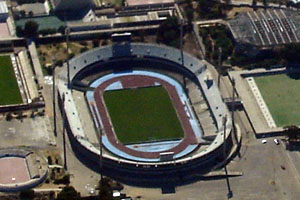
The Tripoli Stadium is a multi-purpose stadium in Tripoli, Libya. It can hold 80,000 spectators.
It was the main venue used by the Libyan national football team in its FIFA World Cup and African Nations Cup qualifying matches as well as friendlies and other international games.
The stadium hosted many games of the 1982 African Cup of Nations held in Libya along with the 28 March Stadium in Benghazi.
The 28 March Stadium in Benghazi was also used by the national team sometimes.
FIFA lifted the ban on Libyan stadiums in 2013, during the 2014 FIFA World Cup qualification. However, it was re-imposed in 2014 due to increased security concerns. The Libyan national team was forced to host games in neighboring countries such as Algeria, Morocco, Egypt or Tunisia (Tunisia the most popular choice due to its close distance to Libya).
Libya played their first home game since 2013 at the Martyrs of February Stadium in Benghazi against Tunisia on 25 March 2021, where they lost 2–5.
Rivalries
Libya's only real rivalries are with its fellow North African footballing nations, Algeria, Morocco, Egypt and, mainly, Tunisia. Matches between Libya and any one of these opponents are highly charged encounters. Libya defeated Egypt 2–1 in a World Cup qualifier on 8 October 2004, the Pharaohs only managed to beat the Libyans on their own turf twice. The rivalry was rekindled at the 2007 Arab Games, where the teams drew 0–0; Egypt eventually claimed the gold medal on goal difference from the Libyans.
Libya also has a rivalry with Morocco. Libya's last win against Morocco was during the 1986 World Cup qualifiers, which Libya won 1–0. A friendly was played between both countries on the 11th of October 2019 in which they tied. Matches between Libya and Tunisia are also very tense, the last time they played was a 5–2 win from the latter in the African Cup of Nations qualification group stage round.
Results and fixtures
Main article: Libya national football team results (2020–present)
The following is a list of match results in the last 12 months, as well as any future matches that have been scheduled.
2024
2025
- Ellafi
- Fredy Report (CAF)
- Mbeumo Report (CAF) Report (CAF)
- El Maremi Report (CAF)
- El Maremi
- Al-Shalui
- Cabral
- W. Semedo
- Dabagh
- Hemdan
- Saleh
- Termanini
- Mahajna
- Yusuf
- Ali
- Taqtaq
- Tajouri
- Al Hbeishi
Coaching history
- Libya Massoud Zantouny (1953)
- Libya Salim Faraj Balteb (1957–1960)
- England James Benjeham (1961)
- England Billy Elliott (1961–1963)
- Yugoslavia Vojin Božović (1964–1965)
- England George Skinner (1965–1966)
- Algeria Mokhtar Arribi (1966–1967)
- England Keith Spurgeon (1967–1968)
- Libya Ali Zantouny (1968–1969)
- Yugoslavia Milan Selbetishi (1969–1970)
- England George Ainsley (1970–1971)
- Romania Nicolae Oaidă (1971–1972)
- Libya Hassan Al-Amer (1972)
- Romania Titus Ozon (1972–1974)
- Libya Mohammed El-Khamisi (1974–1975)
- Libya Abed Ali Al-Aqili (1975–1976)
- Libya Mohammed El-Khamisi (1976–1977)
- Libya Ali Al-Zaqori (1977–1978)
- England Ron Bradley (1978–1980)
- Libya Mohammed El-Khamisi (1980–1982)
- Hungary Béla Gutal (1982)
- Romania Cicerone Manolache (1983–1984)
- Libya Mohammed El-Khamisi (1984)
- Libya Hashimi El-Bahlul (1984–1986)
- Libya Mohammed El-Khamisi (1988–1989)
- Libya Ahmed Ben Soueid (1989)
- Libya Hashimi El-Bahlul (1991–1997)
- Romania Ion Moldovan (1998)
- Scotland Danny McLennan (1998)
- Italy Eugenio Bersellini (1998–1999)
- Argentina Carlos Bilardo (1999–2000)
- Argentina Miguel Angel Lemme (2000–2001)
- Italy Francesco Scoglio (2002)
- Croatia Ilija Lončarević (2003–2004)
- Libya Mohammed El-Khamisi (2004–2005)
- Croatia Ilija Lončarević (2005–2006)
- Egypt Mohsen Saleh (2006)
- Libya Abou Bakr Bani (2006–2007)
- Tunisia Faouzi Benzarti (2007–2009)
- Serbia Branko Smiljanić (2009–2010)
- Brazil Marcos Paquetá (2010–2012)
- Libya Abdul-Hafeedh Arbeesh (2012–2013)
- Spain Javier Clemente (2013–2016)
- Libya Jalal Damja (2016–2017)
- Algeria Adel Amrouche (2017–2018)
- Libya Fawzi Al-Issawi (2018–2019)
- Libya Jalal Damja (2019)
- Tunisia Faouzi Benzarti (2019–2020)
- Libya Ali El Margini (2020)
- Montenegro Zoran Filipović (2020–2021)
- Spain Javier Clemente (2021–2022)
- Spain Ramon Catala (2022)
- France Corentin Martins (2022–2023)
- Libya Hamdi Bataw (2023)
- Libya Salim Al-Jalali (interim, 2023)
- Serbia Milutin Sredojević (2023–2024)
- Libya Nasser Al-Hadrininew (interim, 2024–2025)
- Senegal Aliou Cissé (2025–)
Players
Current squad
The following 28 players were called up for the 2026 FIFA World Cup qualification – CAF Group D matches against Angola and Cameroon on 20 and 25 March 2025.
Caps and goals correct as of 25 March 2025, after the match against Cameroon.
Recent call-ups
The following players have been called up to the Libya squad in the last 12 months.
WD ;Notes
- INJ Withdrew due to injury
- PRE Preliminary squad / standby
- WD Withdrew due to non-injury issue
Records
| 1961–1970 |
|---|
| 2 |
| 20 |
| 80 |
|
| 2001–2013 |
|---|
| 3 |
| 17 |
| 32 |
|
| 1998–2008 |
|---|
| 4 |
| 14 |
| 73 |
|
| 2011–present |
|---|
| 5 |
| 11 |
| 50 |
|
| 1997–2011 |
|---|
| 6 |
| 10 |
| 34 |
|
| 2001–2009 |
|---|
| 7 |
| 9 |
| 39 |
|
| 2014–present |
|---|
| 8 |
| 8 |
| 54 |
|
| 2011–2017 |
|---|
| 7 |
| 20 |
|
| 2009–present |
|---|
| 7 |
| 28 |
|
| 2013–2023 |
|---|
| } |
Competitive record
FIFA World Cup
| FIFA World Cup record | Qualification record | Year | Round | Position | Pld | W | D* | L | GF | GA | Pld | W | D | L | GF | GA | Total | 0/18 | 72 | 27 | 18 | 27 | 79 | 79 |
|---|---|---|---|---|---|---|---|---|---|---|---|---|---|---|---|---|---|---|---|---|---|---|---|---|
| Uruguay 1930 | Part of Italy Italy | Part of Italy Italy | ||||||||||||||||||||||
| Italy 1934 | ||||||||||||||||||||||||
| France 1938 | ||||||||||||||||||||||||
| Brazil 1950 | Not a FIFA member | Not a FIFA member | ||||||||||||||||||||||
| Switzerland 1954 | ||||||||||||||||||||||||
| Sweden 1958 | ||||||||||||||||||||||||
| Chile 1962 | ||||||||||||||||||||||||
| England 1966 | Withdrew | Withdrew | ||||||||||||||||||||||
| Mexico 1970 | Did not qualify | 2 | 1 | 0 | 1 | 3 | 5 | |||||||||||||||||
| West Germany 1974 | Did not enter | Declined participation | ||||||||||||||||||||||
| Argentina 1978 | Did not qualify | 2 | 0 | 1 | 1 | 0 | 1 | |||||||||||||||||
| Spain 1982 | Withdrew | 2 | 1 | 1 | 0 | 2 | 1 | |||||||||||||||||
| Mexico 1986 | Did not qualify | 6 | 3 | 2 | 1 | 7 | 3 | |||||||||||||||||
| Italy 1990 | Withdrew | 2 | 1 | 0 | 1 | 3 | 2 | |||||||||||||||||
| United States of America 1994 | Disqualified | Disqualified | ||||||||||||||||||||||
| France 1998 | Did not enter | Declined participation | ||||||||||||||||||||||
| South Korea Japan 2002 | Did not qualify | 10 | 1 | 2 | 7 | 11 | 22 | |||||||||||||||||
| Germany 2006 | 12 | 5 | 3 | 4 | 17 | 10 | ||||||||||||||||||
| South Africa 2010 | 6 | 4 | 0 | 2 | 7 | 4 | ||||||||||||||||||
| Brazil 2014 | 6 | 2 | 3 | 1 | 5 | 3 | ||||||||||||||||||
| Russia 2018 | 8 | 3 | 1 | 4 | 8 | 11 | ||||||||||||||||||
| Qatar 2022 | 6 | 2 | 1 | 3 | 4 | 7 | ||||||||||||||||||
| Canada Mexico United States of America 2026 | 10 | 4 | 4 | 2 | 12 | 10 | ||||||||||||||||||
| Morocco Portugal Spain Argentina Paraguay Uruguay 2030 | To be determined | To be determined | ||||||||||||||||||||||
| Saudi Arabia 2034 | ||||||||||||||||||||||||
| United Nations 2038 |
Africa Cup of Nations
Main article: Libya at the Africa Cup of Nations
| Africa Cup of Nations record | Qualification record | Year | Round | Position | Pld | W | D | L | GF | GA | Pld | W | D | L | GF | GA | Total | Runners-up | 3/35 | 11 | 3 | 5 | 3 | 12 | 13 | 90 | 30 | 16 | 47 | 106 | 116 | ||||||||
|---|---|---|---|---|---|---|---|---|---|---|---|---|---|---|---|---|---|---|---|---|---|---|---|---|---|---|---|---|---|---|---|---|---|---|---|---|---|---|---|
| Sudan 1957 | Not affiliated to CAF | Not affiliated to CAF | |||||||||||||||||||||||||||||||||||||
| United Arab Republic 1959 | |||||||||||||||||||||||||||||||||||||||
| Ethiopia 1962 | |||||||||||||||||||||||||||||||||||||||
| Ghana 1963 | |||||||||||||||||||||||||||||||||||||||
| Tunisia 1965 | |||||||||||||||||||||||||||||||||||||||
| Ethiopia 1968 | Did not qualify | 2 | 0 | 1 | 1 | 4 | 5 | ||||||||||||||||||||||||||||||||
| Sudan 1970 | Did not enter | Did not enter | |||||||||||||||||||||||||||||||||||||
| Cameroon 1972 | Did not qualify | 2 | 0 | 0 | 2 | 1 | 3 | ||||||||||||||||||||||||||||||||
| Egypt 1974 | Withdrew | Withdrew | |||||||||||||||||||||||||||||||||||||
| Ethiopia 1976 | Did not enter | Did not enter | |||||||||||||||||||||||||||||||||||||
| Ghana 1978 | |||||||||||||||||||||||||||||||||||||||
| Nigeria 1980 | |||||||||||||||||||||||||||||||||||||||
| Libya 1982 | Runners-up | 2nd | 5 | 2 | 3 | 0 | 7 | 4 | Qualified as hosts | ||||||||||||||||||||||||||||||
| Ivory Coast 1984 | Did not qualify | 2 | 1 | 0 | 1 | 2 | 2 | ||||||||||||||||||||||||||||||||
| Egypt 1986 | 4 | 2 | 0 | 2 | 5 | 4 | |||||||||||||||||||||||||||||||||
| Morocco 1988 | Withdrew | Withdrew | |||||||||||||||||||||||||||||||||||||
| Algeria 1990 | |||||||||||||||||||||||||||||||||||||||
| Senegal 1992 | Did not enter | Did not enter | |||||||||||||||||||||||||||||||||||||
| Tunisia 1994 | |||||||||||||||||||||||||||||||||||||||
| South Africa 1996 | |||||||||||||||||||||||||||||||||||||||
| Burkina Faso 1998 | |||||||||||||||||||||||||||||||||||||||
| Ghana Nigeria 2000 | Did not qualify | 2 | 0 | 0 | 2 | 1 | 6 | ||||||||||||||||||||||||||||||||
| Mali 2002 | 8 | 3 | 0 | 5 | 8 | 14 | |||||||||||||||||||||||||||||||||
| Tunisia 2004 | 6 | 3 | 1 | 2 | 12 | 8 | |||||||||||||||||||||||||||||||||
| Egypt 2006 | Group stage | 14th | 3 | 0 | 1 | 2 | 1 | 5 | 12 | 5 | 3 | 4 | 17 | 10 | |||||||||||||||||||||||||
| Ghana 2008 | Did not qualify | 6 | 2 | 2 | 2 | 7 | 6 | ||||||||||||||||||||||||||||||||
| Angola 2010 | 6 | 4 | 0 | 2 | 7 | 4 | |||||||||||||||||||||||||||||||||
| Equatorial Guinea Gabon 2012 | Group stage | 10th | 3 | 1 | 1 | 1 | 4 | 4 | 6 | 3 | 3 | 0 | 6 | 1 | |||||||||||||||||||||||||
| South Africa 2013 | Did not qualify | 2 | 0 | 0 | 2 | 0 | 3 | ||||||||||||||||||||||||||||||||
| Equatorial Guinea 2015 | 2 | 0 | 1 | 1 | 0 | 3 | |||||||||||||||||||||||||||||||||
| Gabon 2017 | 6 | 2 | 1 | 3 | 8 | 6 | |||||||||||||||||||||||||||||||||
| Egypt 2019 | 6 | 2 | 1 | 3 | 16 | 11 | |||||||||||||||||||||||||||||||||
| Cameroon 2021 | 6 | 1 | 0 | 5 | 7 | 15 | |||||||||||||||||||||||||||||||||
| Ivory Coast 2023 | 6 | 1 | 1 | 4 | 2 | 8 | |||||||||||||||||||||||||||||||||
| Morocco 2025 | 6 | 1 | 2 | 3 | 3 | 7 | |||||||||||||||||||||||||||||||||
| Kenya Tanzania Uganda 2027 | To be determined | To be determined | |||||||||||||||||||||||||||||||||||||
| African Union 2029 |
Olympic Games
| Olympic Games record | Appearances: 0 | Year | Round | Position | Pld | W | D | L | GF | GA | Total | 0/28 | |||||||||||||||
|---|---|---|---|---|---|---|---|---|---|---|---|---|---|---|---|---|---|---|---|---|---|---|---|---|---|---|---|
| 1896 – 1948 | Did not exist | ||||||||||||||||||||||||||
| Finland 1952 | Did not enter | ||||||||||||||||||||||||||
| Australia 1956 | |||||||||||||||||||||||||||
| Italy 1960 | |||||||||||||||||||||||||||
| Japan 1964 | |||||||||||||||||||||||||||
| Mexico 1968 | Did not qualify | ||||||||||||||||||||||||||
| West Germany 1972 | Did not enter | ||||||||||||||||||||||||||
| Canada 1976 | Did not qualify | ||||||||||||||||||||||||||
| Soviet Union 1980 | Withdrew during qualification | ||||||||||||||||||||||||||
| United States of America 1984 | Did not qualify | ||||||||||||||||||||||||||
| South Korea 1988 | Did not enter | ||||||||||||||||||||||||||
| Spain 1992 | |||||||||||||||||||||||||||
| United States of America 1996 | |||||||||||||||||||||||||||
| Australia 2000 | |||||||||||||||||||||||||||
| Greece 2004 | Did not qualify | ||||||||||||||||||||||||||
| China 2008 | |||||||||||||||||||||||||||
| United Kingdom 2012 | |||||||||||||||||||||||||||
| Brazil 2016 | Did not enter | ||||||||||||||||||||||||||
| Japan 2020 | Did not qualify | ||||||||||||||||||||||||||
| France 2024 |
- Football at the Summer Olympics has been an under-23 tournament since the 1992 edition.
All-Africa Games
| All-Africa Games record | Appearances: 1 | Year | Round | Position | Pld | W | D | L | GF | GA | Total | Group stage | 1/11 | 3 | 1 | 0 | 2 | 3 | 4 | ||||||||
|---|---|---|---|---|---|---|---|---|---|---|---|---|---|---|---|---|---|---|---|---|---|---|---|---|---|---|---|
| Congo 1965 | Did not enter | ||||||||||||||||||||||||||
| Nigeria 1973 | |||||||||||||||||||||||||||
| Algeria 1978 | Group stage | 8th | 3 | 1 | 0 | 2 | 3 | 4 | |||||||||||||||||||
| Kenya 1987 | Did not enter | ||||||||||||||||||||||||||
| Egypt 1991 | |||||||||||||||||||||||||||
| Zimbabwe 1995 | |||||||||||||||||||||||||||
| South Africa 1999 | |||||||||||||||||||||||||||
| Nigeria 2003 | Did not qualify | ||||||||||||||||||||||||||
| Algeria 2007 | |||||||||||||||||||||||||||
| Mozambique 2011 | Did not enter | ||||||||||||||||||||||||||
| Congo 2015 | |||||||||||||||||||||||||||
| Morocco 2019 | To be determined | ||||||||||||||||||||||||||
| Ghana 2023 |
- Prior to the Cairo 1991 campaign, the Football at the All-Africa Games was open to full senior national teams.
- Libya was disqualified from the tournament due to violence with the Egyptian team during the match in the group stage.
African Nations Championship
| African Nations Championship record | Appearances: 4 | Year | Round | Position | Pld | W | D | L | GF | GA | Total | 1 title | 5/7 | 21 | 4 | 11 | 6 | 16 | 17 | ||||||||
|---|---|---|---|---|---|---|---|---|---|---|---|---|---|---|---|---|---|---|---|---|---|---|---|---|---|---|---|
| CIV 2009 | Group stage | 7th | 3 | 0 | 2 | 1 | 1 | 3 | |||||||||||||||||||
| SUD 2011 | Did not qualify | ||||||||||||||||||||||||||
| RSA 2014 | Champions | 1st | 6 | 1 | 5 | 0 | 6 | 4 | |||||||||||||||||||
| RWA 2016 | Did not qualify | ||||||||||||||||||||||||||
| MAR 2018 | Fourth place | 4th | 6 | 2 | 2 | 2 | 7 | 6 | |||||||||||||||||||
| CMR 2020 | Group stage | 13th | 3 | 0 | 2 | 1 | 1 | 2 | |||||||||||||||||||
| ALG 2022 | 9th | 3 | 1 | 0 | 2 | 1 | 2 | ||||||||||||||||||||
| KEN TAN UGA 2024 | Withdrew |
Mediterranean Games
| Mediterranean Games record | Appearances: 9 | Year | Round | Position | Pld | W | D | L | GF | GA | Total | Bronze medalists | 9/18 | 30 | 3 | 10 | 17 | 21 | 55 | ||||||||
|---|---|---|---|---|---|---|---|---|---|---|---|---|---|---|---|---|---|---|---|---|---|---|---|---|---|---|---|
| Egypt 1951 | Did not enter | ||||||||||||||||||||||||||
| Spain 1955 | |||||||||||||||||||||||||||
| Lebanon 1959 | |||||||||||||||||||||||||||
| Italy 1963 | |||||||||||||||||||||||||||
| Tunisia 1967 | Group stage | 8th | 3 | 0 | 1 | 2 | 1 | 5 | |||||||||||||||||||
| Turkey 1971 | Did not enter | ||||||||||||||||||||||||||
| Algeria 1975 | Group stage | 7th | 4 | 1 | 0 | 3 | 4 | 8 | |||||||||||||||||||
| Yugoslavia 1979 | Did not enter | ||||||||||||||||||||||||||
| Morocco 1983 | Group stage | 9th | 2 | 0 | 0 | 2 | 2 | 5 | |||||||||||||||||||
| Syria 1987 | Did not enter | ||||||||||||||||||||||||||
| Greece 1991 | |||||||||||||||||||||||||||
| France 1993 | |||||||||||||||||||||||||||
| Italy 1997 | Group stage | 10th | 3 | 0 | 2 | 1 | 3 | 4 | |||||||||||||||||||
| Tunisia 2001 | 7th | 2 | 0 | 1 | 1 | 1 | 2 | ||||||||||||||||||||
| Spain 2005 | Bronze medalists | 3rd | 5 | 1 | 2 | 2 | 3 | 10 | |||||||||||||||||||
| Italy 2009 | 4 | 0 | 3 | 1 | 0 | 1 | |||||||||||||||||||||
| Turkey 2013 | Fourth place | 4th | 5 | 1 | 1 | 3 | 6 | 12 | |||||||||||||||||||
| Spain 2018 | Group stage | 9th | 2 | 0 | 0 | 2 | 1 | 8 | |||||||||||||||||||
| Algeria 2022 | Did not enter |
- Prior to the Athens 1991 campaign, the Football at the Mediterranean Games was open to full senior national teams.
FIFA Arab Cup
| FIFA Arab Cup record | Appearances: 4 | Year | Round | Position | Pld | W | D | L | GF | GA | Total | Runners-up | 4/9 | 18 | 7 | 6 | 3 | 42 | 21 | ||||||||
|---|---|---|---|---|---|---|---|---|---|---|---|---|---|---|---|---|---|---|---|---|---|---|---|---|---|---|---|
| Lebanon 1963 | Did not enter | ||||||||||||||||||||||||||
| Kuwait 1964 | Runners-up | 2nd | 4 | 2 | 2 | 0 | 9 | 5 | |||||||||||||||||||
| Iraq 1966 | Third place | 3rd | 5 | 2 | 2 | 1 | 20 | 4 | |||||||||||||||||||
| Saudi Arabia 1985 | Did not enter | ||||||||||||||||||||||||||
| Jordan 1988 | |||||||||||||||||||||||||||
| Syria 1992 | |||||||||||||||||||||||||||
| Qatar 1998 | Group stage | 11th | 4 | 0 | 0 | 2 | 2 | 4 | |||||||||||||||||||
| Kuwait 2002 | Withdrew | ||||||||||||||||||||||||||
| Saudi Arabia 2012 | Runners-up | 2nd | 5 | 3 | 2 | 0 | 11 | 8 | |||||||||||||||||||
| Qatar 2021 | Did not qualify | ||||||||||||||||||||||||||
| Qatar 2025 |
Arab Games
| Arab Games record | Appearances: 9 | Year | Round | Position | Pld | W | D | L | GF | GA | Total | Silver medalists | 9/11 | 35 | 15 | 8 | 12 | 97 | 73 | ||||||||
|---|---|---|---|---|---|---|---|---|---|---|---|---|---|---|---|---|---|---|---|---|---|---|---|---|---|---|---|
| Egypt 1953 | Bronze medalists | 3rd | 3 | 2 | 0 | 1 | 10 | 14 | |||||||||||||||||||
| Lebanon 1957 | Group stage | 8th | 3 | 0 | 0 | 3 | 5 | 12 | |||||||||||||||||||
| Morocco 1961 | Bronze medalists | 3rd | 5 | 2 | 1 | 2 | 13 | 13 | |||||||||||||||||||
| UAR 1965 | 6 | 4 | 0 | 2 | 44 | 18 | |||||||||||||||||||||
| Syria 1976 | Did not enter | ||||||||||||||||||||||||||
| Morocco 1985 | Group stage | 5th | 2 | 1 | 0 | 1 | 2 | 2 | |||||||||||||||||||
| Syria 1992 | Did not enter | ||||||||||||||||||||||||||
| Lebanon 1997 | Group stage | 6th | 3 | 0 | 2 | 1 | 4 | 5 | |||||||||||||||||||
| Jordan 1999 | Bronze medalists | 3rd | 6 | 3 | 2 | 1 | 11 | 6 | |||||||||||||||||||
| Algeria 2004 | No tournament | ||||||||||||||||||||||||||
| Egypt 2007 | Silver medalists | 2nd | 4 | 3 | 1 | 0 | 7 | 1 | |||||||||||||||||||
| Qatar 2011 | Group stage | 7th | 3 | 0 | 2 | 1 | 1 | 2 |
Palestine Cup of Nations
Main article: Palestine Cup of Nations
Honours
Continental
Regional
Friendly
- LG Cup (1): 2004
Summary
| Competition | Total | Total | 1 | 1 | 0 | 2 |
|---|---|---|---|---|---|---|
| CAF African Cup of Nations | 0 | 1 | 0 | 1 | ||
| CAF African Nations Championship | 1 | 0 | 0 | 1 |
Notes
References
References
- Anaman, Fiifi. (19 March 2017). "The Last Time: How Ghana managed an unlikely ascension unto the African football throne".
- 4 September 2011, [https://www.bbc.co.uk/news/world-africa-14778283 Libyan football enters post-Gaddafi era] {{Webarchive. link. (2018-10-31 , ''[[BBC News Online]]'', Accessed September 5, 2011.)
- 7 October 2011, [https://www.bbc.co.uk/sport/football/15220276 Libya eye unlikely qualification] , ''[[BBC Sport]]'', Accessed October 8, 2011.
- 8 October 2011, [https://www.bbc.co.uk/sport/football/15229395 Zambia, Libya make Nations Cup cut] , ''[[BBC Sport]]'', Accessed October 8, 2011.
- 29 November 2011, [http://snakhooda.smugmug.com/Other/Libyan-National-Football-Team/20336024_H4bn23#1608573361_BFp4H29 Libyan National Football Team and the Libyan National Chess Team Reception] {{Webarchive. link. (2012-05-09 , ''[SmugMug Sohail Nakhooda]'', Accessed 30 November 2011.)
- (26 May 2021). "Libya looking for a new men's football coach". BBC Sport.
- (30 May 2021). "Javier Clemente vuelve: "Necesito entrenar, es como un doping para mi"". ElDesmarque Bizkaia.
- (22 May 2021). "Javier Clemente: Libyan National Football Team's New Coach".
- [http://www.libertatea.ro/detalii/articol/ca-selectioner-al-libiei-cicerone-manolache-avea-un-salariu-de-2-000-dar-statul-roman-oprea-1-700-328558.html Ca selecţioner al Libiei, Cicerone Manolache avea un salariu de 2.000 $, dar statul român oprea 1.700 $] {{Webarchive. link. (2011-09-07 , www.libertatea.ro, 29 mars 2011.)
- Dakhil, Morad. (February 21, 2023). "Libya search for homegrown coach as Corentin Martins departs". BBC Sport.
- "Libya-Angola". FIFA.
- "Cameroon-Libya". FIFA.
- "Libya".
- Football, CAF-Confedération Africaine du. "Libya replaces Tunisia for Total CHAN Cameroon 2020".
- (7 July 2012). "Morocco wins Arab Cup 2012 title". Al Arabia News.
This article was imported from Wikipedia and is available under the Creative Commons Attribution-ShareAlike 4.0 License. Content has been adapted to SurfDoc format. Original contributors can be found on the article history page.
Ask Mako anything about Libya national football team — get instant answers, deeper analysis, and related topics.
Research with MakoFree with your Surf account
Create a free account to save articles, ask Mako questions, and organize your research.
Sign up freeThis content may have been generated or modified by AI. CloudSurf Software LLC is not responsible for the accuracy, completeness, or reliability of AI-generated content. Always verify important information from primary sources.
Report