From Surf Wiki (app.surf) — the open knowledge base
Libidibia coriaria
Species of legume

Species of legume
|Caesalpinia coriacea|Poit. |Caesalpinia coriaria|(Jacq.) Willd. |Caesalpinia thomaea|Spreng. |Poinciana coriaria|Jacq.
Libidibia coriaria, synonym Caesalpinia coriaria, is a leguminous tree or large shrub native to the Caribbean, Central America, Mexico, and northern and western South America. Common names include divi-divi, cascalote, guaracabuya, guatapana, nacascol, tan yong, and watapana (Aruba).
Description
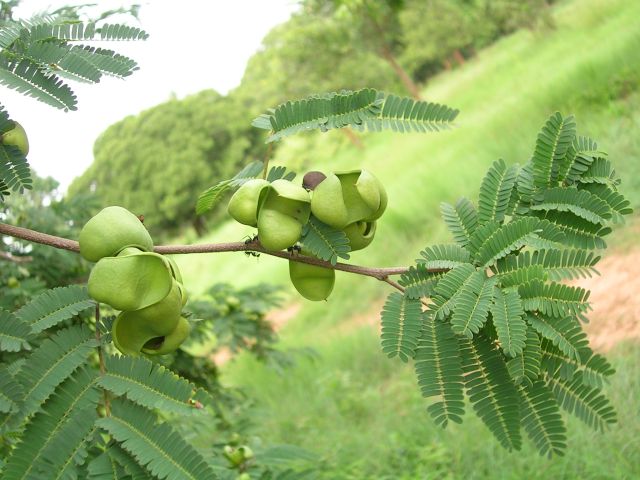

L. coriaria rarely reaches its maximum height of 9 m because its growth is contorted by the trade winds that batter the exposed coastal sites where it often grows. In other environments it grows into a low dome shape with a clear sub canopy space. Leaves are bipinnate, with 5–10 pairs of pinnae, each pinna with 15–25 pairs of leaflets; the individual leaflets are 7 mm long and 2 mm broad. The fruit is a twisted pod 5 cm long.
Taxonomy
The species was first described by Nikolaus Joseph von Jacquin in 1763, as Poinciana coriaria. In 1799, Carl Ludwig Willdenow transferred it to the genus Caesalpinia, and in 1830, Diederich von Schlechtendal transferred it to his newly created genus Libidibia. The genus Libidibia was not always accepted and the species was usually placed in Caesalpinia, until molecular phylogenetic studies led to the reinstatement of Libidibia.
Chemistry
Tannins are extracted from divi-divi pods for use in leather production.
Among the molecules isolated is corilagin, whose name comes from the specific epithet of the plant.
In culture
Divi-divi is the national tree of Curaçao. It is also very common and popular on Aruba.
Uses
According to the FAO's Ecocrop database, the pods provide tannin and a black dye used in the tanning industry and for ink. The pods also have medicinal properties. The hard, dark colored wood is used for carpentry. The tree can be planted for shade. Yields of pods may be 45–135 kg per tree per year.
References
References
- Botanic Gardens Conservation International (BGCI) & IUCN SSC Global Tree Specialist Group. (2019). "''Libidibia coriaria''".
- "((''Libidibia coriaria'' (Jacq.) Schltdl.))". Royal Botanic Gardens, Kew.
- "((''Poinciana coriaria'' Jacq.))". [[International Plant Names Index.
- "((''Libidibia'' Schltdl.))". Royal Botanic Gardens, Kew.
- (2011-03-10). "Vegetable tannins". Conservation OnLine.
- Perez-Tello, Carlos. (1995). "Recovery of Vegetable Tannins from Divi-divi Pods". Journal of Chemical Technology & Biotechnology.
- Sullivan, Lynne M.. (2006). "Adventure Guide to Aruba, Bonaire & Curaçao". Hunter Publishing Inc.
- {{GRIN. (('' Libidibia coriaria'' (Jacq.) Schltdl.)). 465145
This article was imported from Wikipedia and is available under the Creative Commons Attribution-ShareAlike 4.0 License. Content has been adapted to SurfDoc format. Original contributors can be found on the article history page.
Ask Mako anything about Libidibia coriaria — get instant answers, deeper analysis, and related topics.
Research with MakoFree with your Surf account
Create a free account to save articles, ask Mako questions, and organize your research.
Sign up freeThis content may have been generated or modified by AI. CloudSurf Software LLC is not responsible for the accuracy, completeness, or reliability of AI-generated content. Always verify important information from primary sources.
Report