From Surf Wiki (app.surf) — the open knowledge base
Liberal Party of Canada
Canadian political party
_-_medium_crop.jpg)
Canadian political party
| Field | Value | ||||||||||
|---|---|---|---|---|---|---|---|---|---|---|---|
| name | Liberal Party of Canada | ||||||||||
| logo | Liberal Party of Canada Logo 2014.svg | ||||||||||
| slogan | Canada Strong (2025) | ||||||||||
| logo_upright | 0.8 | ||||||||||
| colorcode | |||||||||||
| abbreviation | LPC | ||||||||||
| PLC | |||||||||||
| foundation | July 1, 1867 | ||||||||||
| () | |||||||||||
| membership | ~400,000 | ||||||||||
| membership_year | 2025 | ||||||||||
| ideology | Liberalism (Canadian) | ||||||||||
| Social liberalism{{bulleted list | |||||||||||
| {{cite book | author | Law Commission of Canada | title=Law and Citizenship | url=https://books.google.com/books?id=EK26Gbk1wjkC&pg=PA6 | year=2011 | publisher=UBC Press | page=6 | isbn=9780774840798 | quote=The party became infused with social liberalism in the 1940s and 1950s.}} | ||
| {{Cite journal | doi | 10.1177/0032329205275193 | title = Social Movements and Judicial Empowerment: Courts, Public Policy, and Lesbian and Gay Organizing in Canada | journal=Politics & Society | volume=33 | issue=2 | pages=327–353 | year = 2005 | last1 = Smith | first1 = Miriam | s2cid = 154613468}}}} |
| headquarters | |||||||||||
| international | Liberal International | ||||||||||
| website | |||||||||||
| founder | George Brown | ||||||||||
| country | Canada | ||||||||||
| native_name | Parti libéral du Canada | ||||||||||
| leader1_title | Leader | ||||||||||
| leader1_name | Mark Carney | ||||||||||
| leader2_title | President | ||||||||||
| leader2_name | Sachit Mehra | ||||||||||
| leader3_title | House leader | ||||||||||
| leader3_name | Steven MacKinnon | ||||||||||
| merger | Parti rouge | ||||||||||
| Clear Grits | |||||||||||
| youth_wing | Young Liberals of Canada | ||||||||||
| position | Centre to centre-left | ||||||||||
| <!-- IMPORTANT: Do not change party ideology or position without bringing reliable sources to the Talk page and garnering consensus. --> | colours | Red | |||||||||
| seats1 | |||||||||||
| seats1_title | Senate | ||||||||||
| seats2_title | House of Commons | ||||||||||
| seats2 |
PLC () Social liberalism{{bulleted list| | |Susan Prentice, "Manitoba's childcare regime: Social liberalism in flux". Canadian Journal of Sociology 29.2 (2004): 193–207. |Michael J. Prince, "Canadian disability activism and political ideas: In and between neo-liberalism and social liberalism". Canadian Journal of Disability Studies 1.1 (2012): 1–34. |}} Clear Grits The Liberal Party of Canada (LPC; , PLC) is a federal political party in Canada. The Liberal Party espouses the principles of liberalism, and generally sits at the centre to centre-left of the Canadian political spectrum, with their main rival, the Conservative Party, positioned to their right and the New Democratic Party positioned to their left. The party is often described as a "big tent", practising "brokerage politics", attracting support from a broad spectrum of voters. The Liberal Party is the oldest currently active federal political party in the country, and has dominated the federal politics of Canada for much of its history. As a result, it has sometimes been referred to as Canada's "natural governing party". It has been the governing party since 2015; Mark Carney has been its leader and the Prime Minister of Canada since March 2025.
The party has been in continual existence since the confederation of Canada in 1867. The party first came into power in 1873, with the party's first official leader Alexander Mackenzie leading the nation for five years. Following close to 20 years in opposition, Wilfrid Laurier led the party to victory in 1896 and facilitated many compromises between English and French Canada that shaped the bilingual nation during his 15-year premiership. During William Lyon Mackenzie King's 29 years as party leader, the party was in government from 1921 to 1926, from 1926 to 1930, and from 1935 to 1948. In the half century between 1935 and 1984, the party was in power for all but seven years, winning elections under King, Louis St. Laurent, Lester B. Pearson, and Pierre Trudeau, leading the country through a period of significant expansion of the Canadian welfare state and the emergence of Canada as an independent voice in international affairs. In more recent decades, the party was in government from 1993 to 2006 led by Jean Chrétien and then Paul Martin, leaders who combined social liberalism with fiscal conservatism through a Third Way philosophy. It suffered its worst electoral defeat in 2011, the only federal election as of 2026 in which the Liberals failed to attain the status of government or Official Opposition. The party returned to power in 2015 led by Justin Trudeau, son of the previous Prime Minister Trudeau. Trudeau was succeeded by Mark Carney as party leader in March 2025, who was appointed Prime Minister that month and, in the 2025 federal election, garnered the highest vote share of any party since 1984.
The Liberals' signature policies and legislative decisions include Canadian citizenship, universal health care, the Canada Pension Plan, Canada Student Loans, the establishment of the Royal Canadian Navy in 1910, the unification of the armed forces in 1968, Canadian peacekeeping, official bilingualism and multiculturalism, the patriation of the Constitution of Canada and the establishment of the Canadian Charter of Rights and Freedoms, the Clarity Act, gun control, expanded access to abortion, the legalization of same-sex marriage and of medical assistance in dying, national carbon pricing, a national early learning and child care program, a national school lunch program, the Canadian Dental Care Plan, and the beginning of national pharmacare.
History
Main article: History of the Liberal Party of Canada
19th century
Origins
The Liberals are descended from the mid-19th century Reformers who advocated for responsible government throughout British North America. These included George Brown, Alexander Mackenzie, Robert Baldwin, William Lyon Mackenzie and the Clear Grits in Upper Canada, Joseph Howe in Nova Scotia, and the Patriotes and Rouges in Lower Canada led by figures such as Louis-Joseph Papineau. The Clear Grits and Parti rouge sometimes functioned as a united bloc in the legislature of the Province of Canada beginning in 1854, but a united Liberal Party combining both English and French Canadian members was not formed until 1867. Their lineage from the Clear Grits led to modern Liberals being nicknamed "Grits".
Confederation
At the time of Confederation of the former British colonies of Canada (now Ontario and Quebec), New Brunswick, and Nova Scotia, the radical Liberals were marginalized by the more pragmatic Conservative coalition assembled under Sir John A. Macdonald. In the 29 years after Confederation, the Liberals were consigned to opposition, with the exception of one stint in government. Alexander Mackenzie was the de facto leader of the Official Opposition after Confederation and finally agreed to become the first official leader of the Liberal Party in 1873. He was able to lead the party to power for the first time in 1873, after the Macdonald government resigned over the Pacific Scandal. Mackenzie subsequently won the 1874 election and served as prime minister for an additional four years. During the five years the Liberal government brought in many reforms, including the replacement of open voting by secret ballot, confining elections to one day and the creation of the Supreme Court of Canada, the Royal Military College of Canada, and the Office of the Auditor General; however, the party was only able to build a solid support base in Ontario and in 1878 lost the government to Macdonald. The Liberals would spend the next 18 years in opposition.
Wilfrid Laurier
In their early history, the Liberals were the party of continentalism and opposition to imperialism. The Liberals also became identified with the aspirations of Quebecers as a result of the growing hostility of French Canadians to the Conservatives. The Conservatives lost the support of French Canadians because of the role of Conservative governments in the execution of Louis Riel and their role in the Conscription Crisis of 1917, and especially their opposition to French schools in provinces besides Quebec.
It was not until Wilfrid Laurier became leader that the Liberal Party emerged as a modern party. Laurier was able to capitalize on the Conservatives' alienation of French Canada by offering the Liberals as a credible alternative. Laurier was able to overcome the party's reputation for anti-clericalism that offended the still-powerful Quebec Roman Catholic Church. In English-speaking Canada, the Liberal Party's support for reciprocity made it popular among farmers, and helped cement the party's hold in the growing prairie provinces.
Laurier led the Liberals to power in the 1896 election (in which he became the first Francophone Prime Minister) and oversaw a government that increased immigration to settle Western Canada. Laurier's government created the provinces of Saskatchewan and Alberta out of the North-West Territories and promoted the development of Canadian industry.
20th century
Organization

Until the early part of the century, the Liberal Party was a loose coalition of local, provincial, and regional bodies with a strong national party leader and caucus, but with an informal and regionalized extra-parliamentary organizational structure. There was no national membership of the party. An individual became a member by joining a provincial Liberal party. Laurier called the party's first national convention in 1893 to unite Liberal supporters behind a programme and build the campaign that successfully brought the party to power in 1896, but no efforts were made to create a formal national organization outside Parliament.
As a result of the party's defeats in the 1911 and 1917 federal elections, Laurier attempted to organize the party on a national level by creating three bodies: the Central Liberal Information Office, the National Liberal Advisory Committee, and the National Liberal Organization Committee. However, the advisory committee became dominated by members of Parliament and all three bodies were underfunded and competed with both local and provincial Liberal associations and the national caucus for authority. The party did organize the national party's second convention in 1919 to elect William Lyon Mackenzie King as Laurier's successor (Canada's first leadership convention), yet following the party's return to power in the 1921 federal election the nascent national party organizations were eclipsed by powerful ministers and local party organizations largely driven by patronage.
As a result of both the party's defeat in the 1930 federal election and the Beauharnois scandal, which highlighted the need for distance between the Liberal Party's parliamentary wing and campaign fundraising, a central coordinating organization, the National Liberal Federation, was created in 1932 with Vincent Massey as its first president. With the Liberal return to power, the national organization languished except for occasional national committee meetings, such as in 1943 when Mackenzie King called a meeting of the federation (consisting of the national caucus and up to seven voting delegates per province) to approve a new platform for the party in anticipation of the end of World War II and prepare for a post-war election. No national convention was held, however, until 1948; the Liberal Party held only three national conventions prior to the 1950s – in 1893, 1919 and 1948. The National Liberal Federation remained largely dependent on provincial Liberal parties and was often ignored and bypassed the parliamentary party in the organization of election campaigns and the development of policy. With the defeat of the Liberals in the 1957 federal election and in particular 1958, reformers argued for the strengthening of the national party organization so it would not be dependent on provincial Liberal parties and patronage. A national executive and Council of presidents, consisting of the presidents of each Liberal riding association, were developed to give the party more co-ordination and national party conventions were regularly held in biennially where previously they had been held infrequently. Over time, provincial Liberal parties in most provinces were separated from provincial wings of the federal party and in a number of cases disaffiliated. By the 1980s, the National Liberal Federation was officially known as the Liberal Party of Canada.
Canadian sovereignty

Under Laurier, and his successor William Lyon Mackenzie King, the Liberals promoted Canadian sovereignty and greater independence within the British Commonwealth. In Imperial Conferences held throughout the 1920s, Canadian Liberal governments often took the lead in arguing that the United Kingdom and the dominions should have equal status, and against proposals for an 'imperial parliament' that would have subsumed Canadian independence. After the King–Byng Affair of 1926, the Liberals argued that the Governor General of Canada should no longer be appointed on the recommendation of the British government. The decisions of the Imperial Conferences were formalized in the Statute of Westminster, which was actually passed in 1931, the year after the Liberals lost power.
The Liberals also promoted the idea of Canada being responsible for its own foreign and defence policy. Initially, it was Britain which determined external affairs for the dominion. In 1905, Laurier created the Department of External Affairs, and in 1909 he advised Governor General Earl Grey to appoint the first Secretary of State for External Affairs to Cabinet. It was also Laurier who first proposed the creation of a Canadian Navy in 1910. Mackenzie King recommended the appointment by Governor General Lord Byng of Vincent Massey as the first Canadian ambassador to Washington in 1926, marking the Liberal government's insistence on having direct relations with the United States, rather than having Britain act on Canada's behalf.
Social safety net
In the period just before and after the Second World War, the party became a champion of 'progressive social policy'. As prime minister for most of the time between 1921 and 1948, King introduced several measures that led to the creation of Canada's social safety net. Bowing to popular pressure, he introduced the mother's allowance, a monthly payment to all mothers with young children. He also reluctantly introduced old age pensions when J. S. Woodsworth required it in exchange for his Co-operative Commonwealth Federation party's support of King's minority government.
Louis St. Laurent succeeded King as Liberal leader on August 7, 1948, and as prime minister on November 15, 1948. In the 1949 and 1953 federal elections, St. Laurent led the Liberal Party to two large majority governments. As prime minister he oversaw the joining of Newfoundland in Confederation as Canada's tenth province, he established equalization payments to the provinces, and continued with social reform with improvements in pensions and health insurance. In 1956, Canada played an important role in resolving the Suez Crisis, and contributed to the United Nations force in the Korean War. Canada enjoyed economic prosperity during St. Laurent's premiership and wartime debts were paid off. The Pipeline Debate proved the Liberal Party's undoing. Their attempt to pass legislation to build a natural gas pipeline from Alberta to central Canada was met with fierce disagreement in the House of Commons. In 1957, John Diefenbaker's Progressive Conservatives won a minority government and St. Laurent resigned as prime minister and Liberal leader.
.jpg)
Lester B. Pearson was easily elected Liberal leader at the party's 1958 leadership convention. However, only months after becoming Liberal leader, Pearson led the party into the 1958 federal election that saw Diefenbaker's Progressive Conservatives win the largest majority government, by percentage of seats, in Canadian history. The Progressive Conservatives won 208 of the 265 seats in the House of Commons, while the Liberals were reduced to just 48 seats. Pearson remained Liberal leader during this time and in the 1962 election managed to reduce Diefenbaker to a minority government. In the 1963 election Pearson led the Liberal Party back to victory, forming a minority government. Pearson served as prime minister for five years, winning a second election in 1965. While Pearson's leadership was considered poor and the Liberal Party never held a majority of the seats in parliament during his premiership, he left office in 1968 with an impressive legacy. Pearson's government introduced Medicare, a new immigration act, the Canada Pension Plan, Canada Student Loans, the Canada Assistance Plan, and adopted the Maple Leaf as Canada's national flag.
Pierre Trudeau
Main article: Premierships of Pierre Trudeau
_(cropped).jpg)
Under Pierre Trudeau, the mission of a progressive social policy evolved into the goal of creating a "just society". In the late 1970s, Trudeau stated that his Liberal Party adhered to the "radical centre".
The Liberal Party under Trudeau promoted official bilingualism and passed the Official Languages Act, which gave French and English languages equal status in Canada. Trudeau hoped that the promotion of bilingualism would cement Quebec's place in Confederation, and counter growing calls for an independent Quebec. The party hoped the policy would transform Canada into a country where English and French Canadians could live together, and allow Canadians to move to any part of the country without having to lose their language. Although this vision has yet to fully materialize, official bilingualism has helped to halt the decline of the French language outside of Quebec, and to ensure that all federal government services (including radio and television services provided by the government-owned Canadian Broadcasting Corporation/Radio-Canada) are available in both languages throughout the country.
The Trudeau Liberals are also credited with support for state multiculturalism as a means of integrating immigrants into Canadian society without forcing them to shed their culture, leading the party to build a base of support among recent immigrants and their children. This marked the culmination of a decades-long shift in Liberal immigration policy, a reversal of pre-war racial attitudes that spurred discriminatory policies such as the Chinese Immigration Act of 1923 and the MS St. Louis incident.[[File:Liberal Party logo 1968.svg|thumb|Trudeau-era wordmark and logo]]
The most lasting effect of the Trudeau years has been the patriation of the Constitution of Canada and the creation of the Canadian Charter of Rights and Freedoms. Trudeau's Liberals supported the concept of a strong, central government, and fought Quebec separatism, other forms of Quebec nationalism, and the granting of "distinct society" status to Quebec; however, such actions served as rallying cries for sovereigntists, and alienated many Francophone Quebeckers.
John Turner
.jpg)

After Trudeau's retirement in 1984, many Liberals, such as Jean Chrétien and Clyde Wells, continued to adhere to Trudeau's concept of federalism. Others, such as John Turner, supported the failed Meech Lake and Charlottetown Constitutional Accords, which would have recognized Quebec as a "distinct society" and would have increased the powers of the provinces to the detriment of the federal government.
Trudeau stepped down as prime minister and party leader in 1984, as the Liberals were slipping in polls. At that year's leadership convention, Turner defeated Chrétien on the second ballot to become party leader and (following Trudeau's resignation) prime minister. Immediately, upon taking office, Turner called a snap election, citing favourable internal polls. However, the party was hurt by numerous patronage appointments, many of which Turner had made supposedly in return for Trudeau retiring early. Also, they were unpopular in their traditional stronghold of Quebec because of the constitution repatriation which excluded that province. The Liberals lost power in the 1984 election, and were reduced to only 40 seats in the House of Commons. The Progressive Conservatives won a majority of the seats in every province, including Quebec. The 95-seat loss was the worst defeat in the party's history, and the worst defeat at the time for a governing party at the federal level. What was more, the New Democratic Party, successor to the Co-operative Commonwealth Federation, won only ten fewer seats than the Liberals, and some thought that the NDP under Ed Broadbent would push the Liberals to third-party status.
The party began a long process of reconstruction. A small group of young Liberal MPs, known as the Rat Pack, gained fame by criticizing the Progressive Conservative government of Brian Mulroney at every turn. Also, despite public and backroom attempts to remove Turner as leader, he managed to consolidate his leadership at the 1986 review.
The 1988 election was notable for Turner's strong opposition to the Canada-U.S. Free Trade Agreement negotiated by Progressive Conservative Prime Minister Brian Mulroney. Although most Canadians voted for parties opposed to free trade, Mulroney's "Tories" were returned with a majority government, and implemented the deal. The Liberals recovered from their near-meltdown of 1984, however, winning 83 seats and ending much of the talk of being eclipsed by the NDP, who won 43 seats.
Jean Chrétien
Main article: Premiership of Jean Chrétien

Turner announced that he would resign as leader of the Liberal Party on May 3, 1989. The Liberal Party set a leadership convention for June 23, 1990, in Calgary. Five candidates contested the leadership of the party, with former Deputy Prime Minister Jean Chrétien, who had served in every Liberal cabinet since 1965, and Paul Martin, MP and former CEO of Canada Steamship Lines, as the frontrunners. A key moment in that race took place at an all-candidates debate in Montreal, where the discussion quickly turned to the Meech Lake Accord. Martin, favouring Meech, attempted to force Chrétien to abandon his nuanced position on the deal and declare for or against it. When Chrétien refused to endorse the deal, young Liberal delegates crowding the hall began to chant "vendu" ("sellout" in French) and "Judas" at Chrétien. The incident damaged Chrétien's reputation in Quebec, and lead to a lasting animosity between Chrétien and Martin. Chrétien won on the first ballot.
Chrétien's Liberals campaigned in the 1993 election on the promise of renegotiating the North American Free Trade Agreement (NAFTA), and eliminating the Goods and Services Tax (GST). Just after the writ was dropped for the election, they issued the Red Book, an integrated and coherent approach to economic, social, environmental and foreign policy. This was unprecedented for a Canadian party. Taking full advantage of the inability of Mulroney's successor, Kim Campbell, to overcome a large amount of antipathy toward Mulroney, they won a strong majority government with 177 seats—the third-best performance in party history, and their best since 1949. The Progressive Conservatives were cut down to only two seats, suffering a defeat even more severe than the one they had handed the Liberals nine years earlier. The Liberals were re-elected with a considerably reduced majority in 1997, but nearly tied their 1993 total in 2000. To this date, Chrétien is the last Liberal Prime Minister to secure a majority in three federal elections.
For the next decade, the Liberals dominated Canadian politics in a fashion not seen since the early years of Confederation. This was because of the splintering of the Progressive Conservative's electoral coalition. The PCs' Western support, for all practical purposes, transferred en masse to the Western-based Reform Party, which replaced the PCs as the largest right-wing party in Canada; however, the party was unable to overcome perceptions of extremism and that it was merely a Western protest party, and was virtually non-existent east of Manitoba. Meanwhile, the Quebec nationalists who had once supported the Tories largely switched their support to the sovereigntist Bloc Québécois, while the Tories' Ontario support largely moved to the Liberals. With a divided opposition, the Liberals were able to reap large majorities—especially in Ontario, where the party won all but one seat in 1993, all but two in 1997 and all but three in 2000. However, there was some disappointment as Liberals were not able to recover their traditional dominant position in Quebec, despite being led by a Quebecer.
.svg)
While the Chrétien Liberals campaigned from the left, their time in power is most marked by the cuts made to many social programs, including health transfers, in order to balance the federal budget. Although Chrétien had supported the Charlottetown Accord while in opposition, in government he opposed major concessions to Quebec and other provincialist factions. In contrast to their promises during the 1993 campaign, they implemented only minor changes to NAFTA, embraced the free trade concept and—with the exception of the replacement of the GST with the Harmonized Sales Tax in some Atlantic provinces—broke their promise to replace the GST.
After a proposal for Quebec independence was narrowly defeated in the 1995 Quebec referendum, the Liberals passed the "Clarity Act", which outlines the federal government's preconditions for negotiating provincial independence. In Chrétien's final term, he supported same-sex marriage, decriminalizing the possession of small quantities of marijuana, and ratified the Kyoto Protocol. On March 17, 2003, Chrétien announced that Canada would not support the invasion of Iraq, which caused friction with the United States. However, a poll conducted by EKOS for the Toronto Star and La Presse shortly afterwards showed widespread approval of Chrétien's decision by the Canadian public: 71 per cent of those questioned approved of the government's decision to not enter the United States-led invasion, with 27 per cent expressing disapproval.
In Chrétien's final weeks as prime minister, he introduced legislation to reduce the maximum allowable donation to a political party or candidate to $5,000. The move came as a surprise even to Liberal supporters, as Chrétien had not done anything about election financing at any other point in his ten years in office. Political observers suggested that the move allowed Chrétien to retire on a positive note while saddling Martin, his longstanding rival and successor, with the burden of having to fight an election under the strict new rules.
21st century
Paul Martin
Main article: Premiership of Paul Martin
.jpg)
Martin succeeded Chrétien as party leader and prime minister in 2003. Despite the personal rivalry between the two, Martin was Minister of Finance during the 1990s and was the architect of the Liberals' economic policies. Chrétien left office with a high approval rating and Martin was expected to make inroads into Quebec and Western Canada, two regions of Canada where the Liberals had not attracted much support since the 1980s and 1990s, respectively.
The political situation changed with the revelation of the sponsorship scandal, in which advertising agencies supporting the Liberal Party received grossly inflated commissions for their services. Having faced a divided conservative opposition for the past three elections, Liberals were seriously challenged by competition from the newly united Conservative Party led by Stephen Harper. The infighting between Martin and Chrétien's supporters also dogged the party. Nonetheless, by criticizing the Conservatives' social policies, the Liberals were able to draw progressive votes from the NDP, which made the difference in several close races. In the 2004 election, the Liberals retained enough support to continue as the government, though they were reduced to a minority.
In the midst of various court rulings in 2003 and 2004 that allowed for the legalization of same-sex marriage in seven provinces and one territory, the Martin government proposed a bill to legalize same-sex marriage across Canada. The House of Commons passed the Civil Marriage Act in late June 2005 in a late-night, last-minute vote before Parliament closed down, the Senate passed it in July 2005, and it received Royal Assent on July 20. This made Canada the fourth country in the world to allow same-sex marriages. In November 2005, the Martin government brokered a deal between first ministers and aboriginal leaders known as the Kelowna Accord, which sought to improve the education, skills training, housing and health care of aboriginal peoples by providing $5 billion in funding over five years.
Following the release of the first Gomery Report, the Liberals dropped in polls. Nonetheless, Martin turned down the NDP's conditions for continued support, as well as rejecting an opposition proposal which would schedule a February 2006 election in return for passing several pieces of legislation. The Liberals thus lost a confidence vote on November 28, and Martin advised Governor General Michaëlle Jean to dissolve Parliament and call an election for January 2006.
The Liberal campaign was dogged from start to finish by the sponsorship scandal, which was brought up by a Royal Canadian Mounted Police (RCMP) criminal investigation into the leak of the income trust announcement. Numerous gaffes, contrasting with a smoothly run Conservative campaign, put Liberals as many as ten points behind the Conservatives in opinion polling. They managed to recover some of their momentum by election night, but not enough to retain power. They won 103 seats, a net loss of 30 from when the writs were dropped, compared to 124 for the Conservatives. Martin resigned as Liberal leader on March 18.
Struggles in opposition
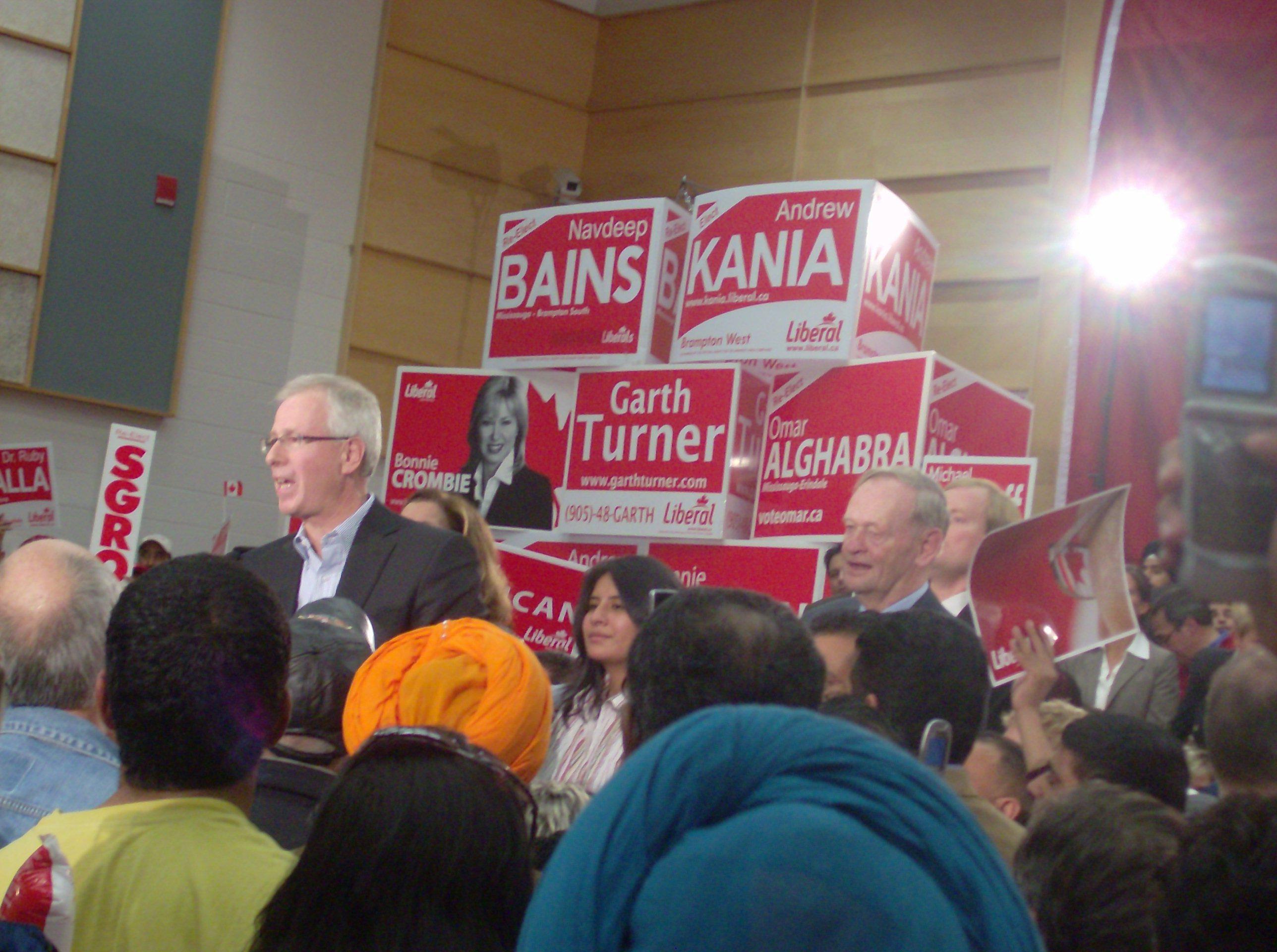
The ensuing leadership election was set for December 2, 2006, in Montreal. Eight candidates entered the contest, but only Michael Ignatieff, Bob Rae, Stéphane Dion and Gerard Kennedy were considered to be the capable of garnering enough support to be able to win the leadership, with Ignatieff and Rae being considered the front-runners. Although Ignatieff lead on the first two ballots, on the third ballot Dion picked up enough support from the eliminated Kennedy to leapfrog both Rae and Ignatieff, eliminating Rae. On the fourth and final ballot, Dion defeated Ignatieff to become leader of the Liberal Party.
Dion campaigned on environmental sustainability during the leadership race, which later evolved into the "Green Shift": a proposal for a national carbon tax that would be offset by reductions to income tax rates. The plan was a key policy for the party in the 2008 federal election, but it was not well received and was continuously attacked by both the Conservatives and NDP. On election night, the Liberal Party won 26.26 per cent of the popular vote and 77 of the 308 seats in the House of Commons. At that time, their popular support was the lowest in the party's history, and weeks later Dion announced he would step down as Liberal leader once his successor was chosen.
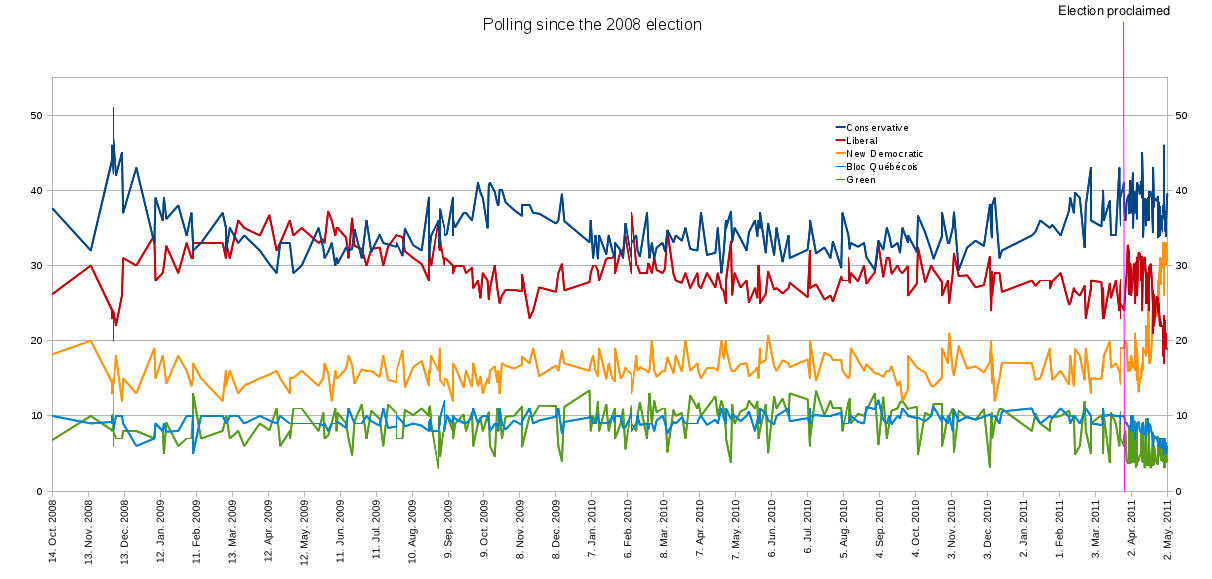
However, the 2008–2009 Canadian parliamentary dispute made Dion's continued leadership untenable: an agreement to form a coalition government between the with NDP faced public opposition if it meant Dion was to be become prime minister, even if only until the leadership election. Dion thus resigned as leader on December 8, with caucus selecting Ignatieff as interim leader. However, Harper prorogued Parliament before a confidence vote could be scheduled. When parliament resumed on January 28, 2009, the Ignatieff Liberals agreed to support the budget as long as it included regular accountability reports, which the Conservatives accepted. This ended the possibility of the coalition government with the New Democrats. Ignatieff was formally named leader on May 2, 2009.[[File:Liberal leader Michael Ignatieff speaks during a news conference in Toronto.jpg|thumb|left|[[Michael Ignatieff]] speaks during a news conference in Toronto on March 28, 2011]] By the time Ignatieff was confirmed as party leader, the Liberal Party had a comfortable lead over the governing Conservatives. Support fell over the summer as Ignatieff was characterized of "missing in action", and Ignatieff announced on August 31, 2009, that the Liberals would not support the minority Conservative government when Parliament resumed. A month later, on October 1, the Liberals put forth a non-confidence motion; however, the NDP abstained from voting and the Conservative government survived. The attempt to force an election, just a year after the previous one, was viewed as a miscalculation, as polls showed that most Canadians did not want another election. Afterwards, popularity for Ignatieff and his party continued to fall. Over the next year and a half, with the exception of a brief period in early 2010, support for the Liberals remained below 30 per cent, and behind the Conservatives.[[File:Liberale Partei Kanadas Logo.svg|thumb|The Liberal Party logo used from 2010 to 2014. In this and the subsequent logo, the stem of the maple leaf forms an [[acute accent]], used in the word Libéral in French|left]] Shortly after the Harper government was found to be in Contempt of Parliament over the Canadian Afghan detainee issue, Ignatieff successfully introduced a motion of no confidence against the government, beginning the 2011 election. The Liberals had considerable momentum when the writ was dropped, and Ignatieff successfully squeezed NDP leader Jack Layton out of media attention by issuing challenges to Harper for one-on-one debates. However, opponents frequently criticized Ignatieff's perceived political opportunism, particularly during the Leaders' debates when Layton criticized Ignatieff for having a poor attendance record for Commons votes: "You know, most Canadians, if they don't show up for work, they don't get a promotion." Ignatieff failed to defend himself against these charges, and the debates were said to be a turning point in the campaign.
On election day, the Liberals took the biggest loss in their history. The result was a third-place finish, with only 19 per cent of the vote and returning 34 seats in the House of Commons. Notably, their support in Toronto and Montreal, their power bases for the last two decades, all but vanished. The Conservatives won 40 per cent of the vote and formed a majority government, while the NDP won 31 per cent of the vote and formed the Official Opposition. It marked the first time the Liberals were unable to form either government or the official opposition. Ignatieff was defeated in his own riding and announced his resignation as Liberal leader shortly after. Bob Rae was chosen as the interim leader on May 25, 2011.
Pundits widely viewed the 2011 election as a political realignment and questioned the Liberal Party's viability.The Economist said, "the election represents the biggest realignment of Canadian politics since 1993"; Maclean's writer Andrew Coyne wrote that "the Conservatives are now in a position to replace the Liberals as the natural governing party in Canada." Books such as The Big Shift by John Ibbitson and Darrell Bricker, and Peter C. Newman's When the Gods Changed: The Death of Liberal Canada, asserted that the Liberals had become an "endangered species".
Justin Trudeau
Main article: Premiership of Justin Trudeau
_(cropped).jpg)
On April 14, 2013, Justin Trudeau, son of former prime minister Pierre Trudeau, was elected leader of the Liberal Party on the first ballot, winning 80% of the vote. Following his win, support for the Liberal Party increased considerably, and the party moved into first place in public opinion polls. In response, the Conservatives ran a series of ads attempting to "[paint] him as a silly dilettante unfit for public office" and the surge levelled off in the following year.
In 2014, Trudeau removed all Liberal senators from the Liberal Party caucus. In announcing this, Trudeau said the purpose of the unelected upper chamber is to act as a check on the power of the prime minister, but the party structure interferes with that purpose. Following this move, Liberal senators chose to keep the designation "Liberal" and sit together as a caucus, albeit not one supported by the Liberal Party of Canada. This independent group continued to refer to itself in publications as the Senate Liberal Caucus until 2019.
By the time the 2015 federal election was called, the Liberals had fallen back to third place. Trudeau and his advisors mounted a campaign based on economic stimulus in the hopes of regaining the mantle of being the party that best represented change from the New Democrats. The campaign was successful, and the Liberals won the election in a dramatic fashion: with 39.5 percent of the popular vote and 184 seats, it was the first time a party had won a parliamentary majority after placing third in a previous general election. Chantal Hébert deemed the result "a Liberal comeback that is headed straight for the history books", while Bloomberg's Josh Wingrove and Theophilos Argitis similarly described it as "capping the biggest political comeback in the country’s history." Spencer McKay, writing for the National Post, suggested that "maybe we've witnessed a revival of Canada's 'natural governing party'".
At the 2019 federal election, Trudeau's Liberal Party lost 20 seats in the House of Commons (lowering its total from 177 to 157) from the time of dissolution, they still won the most seats of any party—enough seats to allow Trudeau to form a minority government. For the first time since 1979, the party that garnered the largest share of the national popular vote did not win the most seats; the Liberals under Trudeau had 33.1 per cent of the popular vote, while the Conservatives under Andrew Scheer had 34.4 per cent. It was also the first time a government took power with less than 35 percent of the national popular vote since the Conservatives of John A. Macdonald, in 1867, who had 34.8 per cent of the votes.
In the 2021 federal election, Trudeau and the Liberals secured a third mandate and his second minority government after winning 160 seats. However, the Liberals again came in second in the national popular vote, behind the Conservatives. They received 32.6 percent of the popular vote, the lowest percentage of the national popular vote for a governing party in Canadian history.
In March 2022, Trudeau's Liberal Party agreed to a confidence and supply deal with the New Democratic Party. In September 2024, Jagmeet Singh announced that he was ending the confidence-and-supply agreement, with NDP sources saying they had "achieved all they could from the agreement." Throughout the year, the Liberals faced declining poll numbers and disappointing results in by-elections, including losses in safe seats such as Toronto—St. Paul's in Toronto and LaSalle—Émard—Verdun in Montreal, and battleground seats such as Cloverdale—Langley City in Vancouver. The months following these losses saw frequent media stories about internal frustration and discontent with Trudeau's leadership. This appeared to culminate in a caucus meeting where multiple members called on Trudeau to resign. Trudeau emerged from this meeting stating that the party remained "strong and united". On January 6, 2025, Trudeau prorogued parliament and announced his intent to resign as both party leader and prime minister following a leadership election.
Mark Carney
Main article: Premiership of Mark Carney

On March 9, 2025, Mark Carney was elected leader of the Liberal Party on the first ballot, winning 85.9% of the vote. In the 2025 Canadian federal election which was held on April 28, 2025, the Liberal Party under Carney's leadership which not only gain seats in the Canadian House of Commons, but would also win the popular vote for the first time since 2015, and over 40% of the popular vote for the first time since 2000. The Liberal Party would win 43.7% of the popular vote, the highest margin since 1980.
Systems and realignment model
Scholars and political experts have recently used a political realignment model to explain what was considered a collapse of a dominant party and put its condition in long-term perspective. According to recent scholarship, there have been four party systems in Canada at the federal level since Confederation, each with its own distinctive pattern of social support, patronage relationships, leadership styles, and electoral strategies. Steve Patten identifies four party systems in Canada's political history:
- The first party system emerged from pre-Confederation colonial politics, had its "heyday" from 1896 to 1911 and lasted until the Conscription Crisis of 1917, and was characterized by local patronage administered by the two largest parties, the Liberals and the Conservatives.
- The second system emerged following the First World War, and had its heyday from 1935 and 1957, was characterized by regionalism and saw the emergence of several protest parties, such as the Progressives, the Social Credit Party, and the Co-operative Commonwealth Federation.
- The third system emerged in 1963 and had its heyday from 1968 to 1983 and began to unravel thereafter. The two largest parties were challenged by a strong third party, the New Democratic Party (successor to the CCF). Campaigns during this era became more national in scope because of electronic media, and involved a greater focus on leadership. The dominant policy of the era was Keynesian economics.
- The fourth party system has involved the rise of the Reform Party, the Bloc Québécois, and the merger of the Canadian Alliance with the Progressive Conservatives. Most parties moved to one-member-one-vote leadership contests, and campaign finance laws were reformed in 2004. The fourth party system has been characterized by market-oriented policies that generally abandoned Keynesian policies but maintained the welfare state.
Stephen Clarkson (2005) shows how the Liberal Party has dominated all the party systems, using different approaches. It began with a "clientelistic approach" under Laurier, which evolved into a "brokerage" system of the 1920s, 1930s and 1940s under Mackenzie King. The 1950s saw the emergence of a "pan-Canadian system", which lasted until the 1990s. The 1993 election – categorized by Clarkson as an electoral "earthquake" which "fragmented" the party system, saw the emergence of regional politics within a four party-system, whereby various groups championed regional issues and concerns. Clarkson concludes that the inherent bias built into the first-past-the-post system, has chiefly benefited the Liberals.
Principles and policies
The principles of the party are based on liberalism as defined by various liberal theorists and include individual freedom for present and future generations, responsibility, human dignity, a just society, political freedom, religious freedom, national unity, equality of opportunity, cultural diversity, bilingualism, and multilateralism. From the early twentieth century, the Liberal Party has favoured a variety of "big tent" policies from both right and left of the political spectrum. When it formed the government from 1993 to 2006, it championed balanced budgets, and eliminated the budget deficit completely from the federal budget in 1995 by reducing spending on social programs or delegating them to the provinces, and promised to replace the Goods and Services Tax in the party's famous Red Book. It also federally legalized same-sex marriage in 2005.
The Liberal Party has historically been the primary architect and champion of the country's official multiculturalism policy. Historically, Canadian immigration policy openly favored immigrants of Caucasian ancestry from the United States, Britain, and Europe. The Liberal government of the 1960s was responsible for dismantling this racially biased system. The shift to race-neutral immigration admissions criteria in Canada was a landmark policy change that began in 1962 and culminated with the introduction of the points-based immigration system in 1967 under the Liberal government. During Pierre Trudeau's time as Prime Minister (1968-1979, 1980-1984), Canada's immigration levels were much lower and more stable, with total arrivals often in the tens of thousands annually, contrasting sharply with current figures. The government introduced official immigration quotas in the mid-1970s, with a target of 100,000 in 1979. In 2017, the Liberal government announced Canada would welcome nearly one million immigrants over the next three years. A record 483,390 immigrants were admitted in 2024.
2021 party platform
During the 2021 federal election, the Liberal Party of Canada introduced their platform, which included a "Gender and Diversity Impact Summary" for each chapter, as well as six key categories. These included: the pandemic, housing, health care, the economy, climate change, and reconciliation.
Key Liberal policies of the 2021 platform included:
- Requiring travellers on interprovincial trains, commercial flights, cruise ships, and other federally regulated vessels be vaccinated against COVID-19.
- An investment of $6 billion—on top of $4 billion already committed—to support the elimination of health system waitlists.
- Providing various investments in order to build, preserve, or revitalize 1.4 million new homes by 2025–26.
- Allocating funds to spend $2 billion over the next five years on measures to address the legacy of residential schools with "truth, justice, and healing" initiatives.
- Re-introducing legislation within the first 100 days in office to eliminate the practice of gay conversion therapy for everyone.
- Achieving net-zero emissions by 2050.
- Presenting a National Action Plan on Combating Hate by 2022 as part of a renewed Anti-Racism Strategy, including the Black Canadians Justice Strategy.
- Updating the committed number to receive 40,000 Afghan refugees.
- Creating a minimum tax rule so that everyone who earns enough to qualify for the top bracket pays at least 15% each year (the tax rate paid by people earning less than $49,000), removing their ability to artificially pay no tax through excessive use of deductions and credits.
- Establishing a permanent Council of Economic Advisors to provide independent advice to government on long-term growth. The council will be gender- balanced and reflect Canada's diversity.
- Reform economic immigration programs to expand pathways to permanent residence for temporary foreign workers and former international students through the Express Entry points system.
- Setting aside a minimum of $1 billion to support provinces or territories who implement a ban on handguns across their jurisdiction.
Provincial parties
Seven provinces and one territory in Canada have a "Liberal Party" in their legislatures. Neither Nunavut nor the Northwest Territories have party-based electoral and governing systems (both operate with consensus democracy). British Columbia had a Liberal Party whose name and ideology have shifted, BC United; Saskatchewan also had a Liberal Party whose name has changed, Saskatchewan Progress Party. Yukon, Alberta, Manitoba, Ontario and Quebec each have a Liberal Party that may align ideologically with the federal party but operates as a completely separate entity (though at one time were affiliated): Those provincial parties have separate policies, finances, memberships, constituency associations, executives, conventions and offices. The New Brunswick, Newfoundland and Labrador, Nova Scotia, and Prince Edward Island provincial Liberals are each semi-affiliated with the federal Liberal Party.
Election results
Main article: List of Canadian federal elections
The Liberal Party has been one of two principal contenders for power for most of Canada's history, most often with the Conservative Party (or its predecessor parties) as the primary rival. It is often referred to as Canada's "natural governing party" due to its electoral success and endurance.{{cite web | title=The Liberal Party at 150: The Centre Still Holds
House of Commons
| Election | Leader | Votes | % | Seats | +/– | Position | Status | 1867 | 1872 | 1874 | 1878 | 1882 | 1887 | 1891 | 1896 | 1900 | 1904 | 1908 | 1911 | 1917 | 1921 | 1925 | 1926 | 1930 | 1935 | 1940 | 1945 | 1949 | 1953 | 1957 | 1958 | 1962 | 1963 | 1965 | 1968 | 1972 | 1974 | 1979 | 1980 | 1984 | 1988 | 1993 | 1997 | 2000 | 2004 | 2006 | 2008 | 2011 | 2015 | 2019 | 2021 | 2025 |
|---|---|---|---|---|---|---|---|---|---|---|---|---|---|---|---|---|---|---|---|---|---|---|---|---|---|---|---|---|---|---|---|---|---|---|---|---|---|---|---|---|---|---|---|---|---|---|---|---|---|---|---|---|
| George Brown | 60,818 | 22.70 | 62 | 2nd | ||||||||||||||||||||||||||||||||||||||||||||||||
| Edward Blake | 110,556 | 34.70 | 33 | 2nd | ||||||||||||||||||||||||||||||||||||||||||||||||
| Alexander Mackenzie | 128,455 | 39.50 | 34 | 1st | ||||||||||||||||||||||||||||||||||||||||||||||||
| 180,074 | 33.10 | 66 | 2nd | |||||||||||||||||||||||||||||||||||||||||||||||||
| Edward Blake | 160,547 | 31.10 | 10 | 2nd | ||||||||||||||||||||||||||||||||||||||||||||||||
| 312,736 | 43.10 | 7 | 2nd | |||||||||||||||||||||||||||||||||||||||||||||||||
| Wilfrid Laurier | 350,512 | 45.20 | 10 | 2nd | ||||||||||||||||||||||||||||||||||||||||||||||||
| 401,425 | 41.40 | 27 | 1st | |||||||||||||||||||||||||||||||||||||||||||||||||
| 477,758 | 50.30 | 11 | 1st | |||||||||||||||||||||||||||||||||||||||||||||||||
| 521,041 | 50.90 | 9 | 1st | |||||||||||||||||||||||||||||||||||||||||||||||||
| 570,311 | 48.90 | 4 | 1st | |||||||||||||||||||||||||||||||||||||||||||||||||
| 596,871 | 45.82 | 48 | 2nd | |||||||||||||||||||||||||||||||||||||||||||||||||
| 729,756 | 38.80 | 3 | 2nd | |||||||||||||||||||||||||||||||||||||||||||||||||
| Mackenzie King | 1,285,998 | 41.15 | 36 | 1st | ||||||||||||||||||||||||||||||||||||||||||||||||
| 1,252,684 | 39.74 | 18 | 2nd | |||||||||||||||||||||||||||||||||||||||||||||||||
| 1,397,031 | 42.90 | 16 | 1st | |||||||||||||||||||||||||||||||||||||||||||||||||
| 1,716,798 | 45.50 | 27 | 2nd | |||||||||||||||||||||||||||||||||||||||||||||||||
| 1,967,839 | 44.68 | 84 | 1st | |||||||||||||||||||||||||||||||||||||||||||||||||
| 2,365,979 | 51.32 | **** | 6 | 1st | ||||||||||||||||||||||||||||||||||||||||||||||||
| 2,086,545 | 39.78 | 61 | 1st | |||||||||||||||||||||||||||||||||||||||||||||||||
| Louis St. Laurent | 2,874,813 | 49.15 | 73 | 1st | ||||||||||||||||||||||||||||||||||||||||||||||||
| 2,731,633 | 48.43 | 22 | 1st | |||||||||||||||||||||||||||||||||||||||||||||||||
| 2,702,573 | 40.50 | 64 | 2nd | |||||||||||||||||||||||||||||||||||||||||||||||||
| Lester Pearson | 2,432,953 | 33.40 | 57 | 2nd | ||||||||||||||||||||||||||||||||||||||||||||||||
| 2,846,589 | 36.97 | 51 | 2nd | |||||||||||||||||||||||||||||||||||||||||||||||||
| 3,276,996 | 41.48 | 29 | 1st | |||||||||||||||||||||||||||||||||||||||||||||||||
| 3,099,521 | 40.18 | 3 | 1st | |||||||||||||||||||||||||||||||||||||||||||||||||
| Pierre Trudeau | 3,686,801 | 45.37 | 23 | 1st | ||||||||||||||||||||||||||||||||||||||||||||||||
| 3,717,804 | 38.42 | 45 | 1st | |||||||||||||||||||||||||||||||||||||||||||||||||
| 4,102,853 | 43.15 | 32 | 1st | |||||||||||||||||||||||||||||||||||||||||||||||||
| 4,595,319 | 40.11 | 27 | 2nd | |||||||||||||||||||||||||||||||||||||||||||||||||
| 4,855,425 | 44.34 | 33 | 1st | |||||||||||||||||||||||||||||||||||||||||||||||||
| John Turner | 3,516,486 | 28.02 | 107 | 2nd | ||||||||||||||||||||||||||||||||||||||||||||||||
| 4,205,072 | 31.92 | 43 | 2nd | |||||||||||||||||||||||||||||||||||||||||||||||||
| Jean Chrétien | 5,647,952 | 41.24 | **** 94 | 1st | ||||||||||||||||||||||||||||||||||||||||||||||||
| 4,994,277 | 38.46 | 22 | 1st | |||||||||||||||||||||||||||||||||||||||||||||||||
| 5,252,031 | 40.85 | 17 | 1st | |||||||||||||||||||||||||||||||||||||||||||||||||
| Paul Martin | 4,982,220 | 36.73 | 37 | 1st | ||||||||||||||||||||||||||||||||||||||||||||||||
| 4,479,415 | 30.23 | 32 | 2nd | |||||||||||||||||||||||||||||||||||||||||||||||||
| Stéphane Dion | 3,633,185 | 26.26 | 26 | 2nd | ||||||||||||||||||||||||||||||||||||||||||||||||
| Michael Ignatieff | 2,783,175 | 18.91 | 43 | 3rd | ||||||||||||||||||||||||||||||||||||||||||||||||
| Justin Trudeau | 6,928,055 | 39.47 | 150 | 1st | ||||||||||||||||||||||||||||||||||||||||||||||||
| 6,018,728 | 33.12 | 27 | 1st | |||||||||||||||||||||||||||||||||||||||||||||||||
| 5,556,629 | 32.62 | 3 | 1st | |||||||||||||||||||||||||||||||||||||||||||||||||
| Mark Carney | 8,595,506 | 43.76 | 9 | 1st |
Party leadership
Main article: Leader of the Liberal Party of Canada
- George Brown (1867; unofficial)
- Edward Blake (1869–1870; unofficial)
- Alexander Mackenzie (1873–1880)
- Edward Blake (1880–1887)
- Wilfrid Laurier (1887–1919)
- Daniel Duncan McKenzie (1919; interim)
- William Lyon Mackenzie King (1919–1948)
- Louis St. Laurent (1948–1958)
- Lester B. Pearson (1958–1968)
- Pierre Trudeau (1968–1984)
- John Turner (1984–1990)
- Jean Chrétien (1990–2003)
- Paul Martin (2003–2006)
- Bill Graham (2006; interim)
- Stéphane Dion (2006–2008)
- Michael Ignatieff (2008–2011)
- Bob Rae (2011–2013; interim)
- Justin Trudeau (2013–2025)
- Mark Carney (since 2025)
Notes
References
References
- "Liberal Party of Canada announces nearly 400,000 Registered Liberals ahead of leadership vote {{!}} Liberal Party of Canada".
- (March 6, 2009). "Liberal Party of Canada Welcomes Liberal International to 2009 Convention". Liberal Party of Canada.
- (November 14, 2019). "One-time Liberal senators rename themselves as Progressive Senate Group". CTV News.
- Spencer, Christina. (January 29, 2014). "Justin Trudeau kicks all 32 Liberal senators out of caucus in bid for reform". National Post.
- McCall, Christina; Stephen Clarkson. [http://www.thecanadianencyclopedia.com/articles/liberal-party "Liberal Party".] {{Webarchive. link. (October 5, 2013 ''The Canadian Encyclopedia''.)
- Dyck, Rand. (2012). "Canadian Politics: Concise Fifth Edition". Nelson Education.
- (March 1, 2013). "Parties, Elections, and the Future of Canadian Politics". UBC Press.
- Andrea Olive. (2015). "The Canadian Environment in Political Context". University of Toronto Press.
- David Rayside. (2011). "Faith, Politics, and Sexual Diversity in Canada and the United States". UBC Press.
- (2012). "An Introduction to World Politics: Conflict and Consensus on a Small Planet". Rowman & Littlefield.
- (2015). "Parties, Polarization and Democracy in the United States". Taylor & Francis.
- (2015). "Liberal Party".
- R. Kenneth Carty. (2015). "Big Tent Politics: The Liberal Party's Long Mastery of Canada's Public Life". UBC Press.
- (2012). "Political Marketing in Canada". UBC Press.
- (2010). "The Oxford Handbook of Canadian Politics". OUP USA.
- Stephen Brooks. (2004). "Canadian Democracy: An Introduction". Oxford University Press.
- David Johnson. (2016). "Thinking Government: Public Administration and Politics in Canada, Fourth Edition". University of Toronto Press.
- Miriam Smith. (2014). "Group Politics and Social Movements in Canada: Second Edition". University of Toronto Press.
- Andrea Olive. (2015). "The Canadian Environment in Political Context". University of Toronto Press.
- Rodney P. Carlisle. (2005). "Encyclopedia of Politics: The Left and the Right". SAGE Publications.
- Cataneo, Julia. (May 27, 2025). "Canada's Liberals: The Most Resilient Establishment Party in the Western World".
- (2007). "Canadian Studies in the New Millennium". University of Toronto Press.
- Carty, R. Kenneth. (March 30, 2022). "The Government Party". Oxford University Press.
- "Liberal Party of Canada".
- Lévesque, Catherine. (September 13, 2019). "Justin Trudeau revient sur l'avortement à Montréal".
- "Gun Control — Our Platform".
- "Liberal Party of Canada – History". Newmarket-Aurora Federal Liberal Association.
- (2005). "Quebec History". [[Marianopolis College]].
- (2002). "Fights of our Lives Elections, Leadership, and the Making of Canada". [[HarperCollins]].
- "Sir Wilfrid Laurier Biography". Library and Archives Canada.
- link. (May 14, 2007 at ''The Canadian Encyclopedia'')
- (September 20, 1943). "Federal Election Question May Be Settled Shortly". Ottawa Citizen.
- link. (February 2, 2017 . ''The Canadian Journal of Economics and Political Science''. Vol. 16, No. 1 (Feb. 1950), pp. 42–52.)
- Koop, Ryan. "The Elusive Nature of National Party Organization in Canada and Australia". Paper Presented at the Canadian Political Science Association Annual Conference. University of British Columbia, Vancouver BC. 4–6 June 2008.
- David Johnson. (2006). "Thinking Government: Public Sector Management in Canada". University of Toronto Press.
- "Louis St. Laurent Biography". Library and Archives Canada.
- "John Diefenbaker Biography". Library and Archives Canada.
- "Lester Pearson Biography". Library and Archives Canada.
- Andrew Cohen. (2008). "Extraordinary Canadians: Lester B. Pearson". Penguin Canada.
- (September 29, 2000). "Former Canadian PM dies". Australian Broadcasting Corporation.
- Graham, Ron, ed. (1998). ''The Essential Trudeau''. McClelland & Stewart, p. 71. {{ISBN. 978-0-7710-8591-8.
- Thompson, Wayne C. (2017). ''Canada''. Rowman & Littlefield, p. 135. {{ISBN. 978-1-4758-3510-6.
- (June 22, 2012). "Is bilingualism still relevant in Canada?". The Globe and Mail.
- (2007). "Multiculturalism and the Canadian Constitution". UBC Press.
- link. (November 17, 2015 . ''Journal of Political Science,'' Dec 2005, Vol. 38#4. pp 821–840.)
- "Chinese Immigration Act, 1923". Canadian Museum of Immigration at Pier 21.
- Stephanie Levitz. (September 27, 2016). "Liberals working on apology for 1939 decision to turn away Jewish refugees". The Globe and Mail.
- (2015). "Patriation and Its Consequences: Constitution Making in Canada". UBC Press.
- McKay-Panos, Linda. (January 1, 2013). "The Canadian Charter of Rights and Freedoms: An Integral Part of our Constitution". LawNow.
- Terence McKenna. [http://www.cbc.ca/archives/entry/jean-chretien-losing-the-liberal-leadership "Jean Chrétien: Losing the Liberal leadership"] {{Webarchive. link. (November 19, 2015 . CBC's ''The Journal'', February 27, 1986. Retrieved November 12, 2015.)
- Brooke Jeffrey. (2010). "Divided Loyalties: The Liberal Party of Canada, 1984–2008". University of Toronto Press.
- "Jean Chrétien Bio". Library and Archives Canada.
- (April 2000). "Chrétien rejects health-care pleas from provinces". Globe and Mail.
- "Clarity Act". Government of Canada Privy Council Office.
- Melissa Cheung. (June 18, 2003). "Canada Will Legalize Gay Marriage". CBS News.
- Krauss, Clifford. (June 18, 2003). "Canadian leaders agree to propose gay marriage law". The New York Times.
- (October 3, 2003). "Chrétien jokes about trying pot once it's decriminalized". The Globe and Mail.
- (December 16, 2002). "Kyoto ratification 'important for future generations'". CBC News.
- (March 18, 2003). "Chrétien restates opposition to Iraq war". Canadian Broadcasting Corporation.
- Sayle, Timothy A.. (2015). ""But he has nothing on at all!" Canada and the Iraq War, 2003". Canadian Military History.
- Harper, Tim. (March 22, 2003). "Canadians back Chrétien on war, poll finds". Toronto Star.
- Gray, John. (June 13, 2006). "Realists and idealists and a bag of hammers". CBC News.
- CBC News. (June 29, 2005). "The Supreme Court and same-sex marriage". CBC.
- (May 29, 2009). "Same-sex marriage around the world".
- (March 4, 2007). "Charest calls on Harper to honour Kelowna aboriginal accord". Canada.com.
- (March 16, 2006). "Martin to officially resign as party leader". [[CBC News]].
- (February 3, 2006). "Rock says no to Liberal leadership". Ottawa Citizen.
- (October 20, 2006). "Canadians Place Rae as Best Liberal Leader". Angus Reid.
- (October 23, 2006). "Rae Seen as Best Future Liberal PM in Canada". Angus Reid.
- "The Liberal Leadership Race". Canadian Broadcasting Corporation.
- "The Green Shift". Liberal Party of Canada.
- Morris, Chris. (August 14, 2008). "Liberal Green Shift is 'green shaft,' says Harper". Toronto Star.
- (October 5, 2008). "Harper hopes Green Shift will turn Liberal voters Tory blue". Canwest News Service.
- Galloway, Gloria. (December 2017). "Layton lays into Green Shift". The Globe and Mail.
- (September 11, 2008). "Green Shift touted as both saviour and damnation". The Globe and Mail.
- (October 20, 2008). "Dion resigns but will remain as leader for now". Toronto Star.
- (December 4, 2008). "Results of CBC News Survey". EKOS Research.
- (December 10, 2008). "Ignatieff named interim Liberal leader". CBC News.
- (January 28, 2009). "Ignatieff okays budget, with conditions". The Globe and Mail.
- (May 2, 2009). "Ignatieff slams Harper for 'failure to unite Canada'". CBC News.
- (May 2, 2009). "Ignatieff slams Harper for 'failure to unite Canada'". CBC News.
- (May 2, 2009). "Close Federal Race Continues – Tories Down in Quebec Up in Ontario". Nanos Research.
- (June 27, 2009). "Close federal race continues". Nanos Research.
- Siddiqui, Haroon. (September 3, 2009). "If Harper is Bush, then Ignatieff is John Kerry". Toronto Star.
- Hebert, Chantal. (August 26, 2009). "Absent opposition gives the PM a holiday". Toronto Star.
- (September 2, 2009). "Liberals won't raise taxes: Ignatieff". Canadian Broadcasting Corporation.
- (October 1, 2009). "Canada's government survives non-confidence motion". Reuters.
- (September 4, 2009). "Parties Virtually Tied as Election Nears in Canada". Angus Reid.
- MacDonald, Ian. (October 9, 2009). "Harper tickles while Ignatieff burns". Montreal Gazette.
- (March 25, 2011). "Conservatives retain 7-point lead as parties enter election campaign". EKOS Politics.
- Austen, Ian. (March 25, 2011). "Canadian Government, Beset by Scandal, Collapses". The New York Times.
- (March 31, 2011). "Chance of Harper vs. Ignatieff debate fades". CTV News.
- Whittington, Les. (April 7, 2011). "Ignatieff's appeal improving but Harper still leads, poll says". Toronto Star.
- Galloway, Gloria. (April 8, 2011). "Layton remains game despite polls showing he's the odd man out". The Globe and Mail.
- (May 3, 2011). "Ignatieff's Liberals lose Official Opposition status". Canadian Broadcasting Corporation.
- "Official Voting Results – Forty-First General Election 2011". Elections Canada.
- Bryden, Joan. (June 19, 2011). "Federal Liberals won't pick new leader for full two years". The Globe and Mail.
- ''Economist'' May 3, 2011
- Andrew Coyne, "The West is in and Ontario has joined it: How the election led to an unprecedented realignment of Canadian politics", [http://www.macleans.ca/2011/05/06/a-new-power-couple/ ''Maclean's'' May 6, 2011] {{Webarchive. link. (June 1, 2013)
- McLeod, Paul. (October 22, 2015). "Book Review: The Big Shift Explains Why Stephen Harper Will Keep Winning". Buzzfeed.
- Valpy, Michael. (November 25, 2011). "Is a Liberal comeback mission impossible?". The Globe and Mail.
- (April 14, 2013). "Justin Trudeau sweeps Liberal leadership with 80% support". Canadian Broadcasting Corporation.
- Berthiaume, Lee. (May 7, 2013). "Tory attack ads may be backfiring in favour of Trudeau's Liberals as support rises, new poll shows". National Post.
- Visser, Josh. (May 23, 2013). "Trudeau's Liberals hit historic highs as senate scandal has 'drastic effect' on Tories: poll". National Post.
- (October 23, 2015). "The Liberal Resurrection: How a Liberal 'lightweight' faced with the longest election campaign in history beat down a Tory majority". National Post.
- (December 3, 2015). "Senate Liberals unsure how to work with Trudeau government". CBC News.
- (October 25, 2015). "Justin Trudeau's Liberals: 'We Had A Plan And We Stuck To It.' And They Won". Huffington Post.
- (October 20, 2015). "Canada election: Liberals sweep to power". BBC News.
- (October 20, 2015). "Canada election: Liberals win sweeping victory over Conservatives". The Daily Telegraph.
- (October 19, 2015). "Stunning Liberal gains in Quebec as Trudeau wins majority government". CBC News.
- (October 20, 2015). "Liberal comeback headed for history books". Toronto Star.
- (October 19, 2015). "Trudeau's Liberals Oust Harper With Surprise Canada Majority". Bloomberg News.
- Spencer McKay, "The Great Liberal Comeback" [https://nationalpost.com/opinion/spencer-mckay-the-great-liberal-comeback ''National Post'' Oct 29 2015]
- Da Silva, Chantal. (October 22, 2019). "Justin Trudeau wins minority government—what does this mean for America?".
- "Trudeau says no plans to form a coalition, will push ahead on Trans Mountain".
- (October 22, 2019). "Ontario and Quebec keep Liberals in power and Conservatives out". cbc.ca.
- Aiello, Rachel. (October 22, 2019). "'Historic opportunity': Opposition leaders take stock after Liberal minority win".
- (October 22, 2019). "All-time low share of popular vote is enough for Liberals to win power | National Post". National Post.
- "Federal election latest updates", CBC, September 20, 2021.".
- Hopper, Tristan. (September 22, 2021). "First Reading: The Least Popular Canadian Government Ever Elected". National Post.
- (March 22, 2022). "Liberals, NDP agree to confidence deal seeing Trudeau government maintain power until 2025".
- (September 4, 2024). "How the NDP's deal with the Liberals died". CBC News.
- (September 5, 2024). "Why Canadian politics just got more unpredictable". [[BBC News]].
- Major, Darren. (September 10, 2024). "Upcoming federal byelections will put Singh and the NDP brand to the test – NDP looking to both hold a Winnipeg seat and pull another away from the Liberals in Montreal".
- (October 23, 2024). "Trudeau says Liberals 'strong and united' despite caucus dissent".
- (January 6, 2025). "Canada's Trudeau Is Stepping Down as Party Leader and Prime Minister". [[The New York Times]].
- Major, Darren. (April 29, 2025). "5 key takeaways from Monday's historic vote". CBC News.
- (April 29, 2025). "How Canada voted – in charts".
- (April 28, 2025). "Canadian election results".
- (April 29, 2025). "Canada Election Highlights: Mark Carney Wins New Term as Prime Minister". The New York Times.
- "Canada Votes 2025". CBC.
- link. (July 8, 2023 . in Gagnon, and Tanguay, eds. ''Canadian Parties in Transition'' pp. 57–58)
- link. (January 3, 2016 (2005).)
- Apps, Alfred. "Building a Modern Liberal Party". Liberal Party of Canada.
- "2009 Constitution". Liberal Party of Canada.
- (November 21, 2011). "The lesson from Canada on cutting deficits". The Globe and Mail.
- (July 7, 2016). "What's the point? The countries that invented points-based immigration systems have concluded they do not work". [[The Economist]].
- Iconangelo, David. (March 2, 2017). "How would 'merit-based' systems change US immigration? Points-based immigration systems are in place in most wealthy countries. But if they function smoothly, it's because of bureaucrats.". [[Christian Science Monitor]].
- (2024). "An Immigration System for Canada's Future". [[Canada.ca]].
- (June 5, 2013). "The truth about Pierre Trudeau and immigration". [[Maclean's]].
- (October 31, 2018). "Canada to increase annual immigration admissions to 350,000 by 2021 {{!}} CTV News".
- (February 12, 2025). "Will Canada's Record 2024 Immigration Levels Ever Be Exceeded?". Immigration.ca.
- "Forward. For Everyone". Liberal Party of Canada.
- (September 1, 2021). "Liberals unveil 2021 election platform, promising total of $78 billion for post-pandemic rebuild".
- (September 1, 2021). "Liberals unveil 2021 election platform".
- Laanela, Mike. (March 24, 2009). "The BC Liberal Party". [[CBC News]].
- "Liberals no more: Saskatchewan Progress Party unveils new name". thestarphoenix.
- (October 21, 2007). "Alta. Liberals not just 'Liberals,' party says". CTVNews.
- (April 26, 1976). "Article clipped from The Ottawa Journal". The Ottawa Journal.
- (January 1, 2013). "Conservatism in Canada". University of Toronto Press.
- "Liberal Party of Newfoundland and Labrador".
- "The Liberal Party of Canada Constitution".
- "Liberal Party".
- (October 1, 2024). "Canadian Parties in Transition, Fifth Edition". University of Toronto Press.
- Carty, R. Kenneth. (2022). "The Government Party: Political Dominance in Democracy". Oxford University Press.
- Thomas, Paul G.. (May 17, 2025). "Opinion: Explaining the success of the federal Liberals".
This article was imported from Wikipedia and is available under the Creative Commons Attribution-ShareAlike 4.0 License. Content has been adapted to SurfDoc format. Original contributors can be found on the article history page.
Ask Mako anything about Liberal Party of Canada — get instant answers, deeper analysis, and related topics.
Research with MakoFree with your Surf account
Create a free account to save articles, ask Mako questions, and organize your research.
Sign up freeThis content may have been generated or modified by AI. CloudSurf Software LLC is not responsible for the accuracy, completeness, or reliability of AI-generated content. Always verify important information from primary sources.
Report