From Surf Wiki (app.surf) — the open knowledge base
LGV Sud-Est
French high-speed railway
French high-speed railway
| Field | Value | |
|---|---|---|
| box_width | auto | |
| name | LGV Sud-Est | |
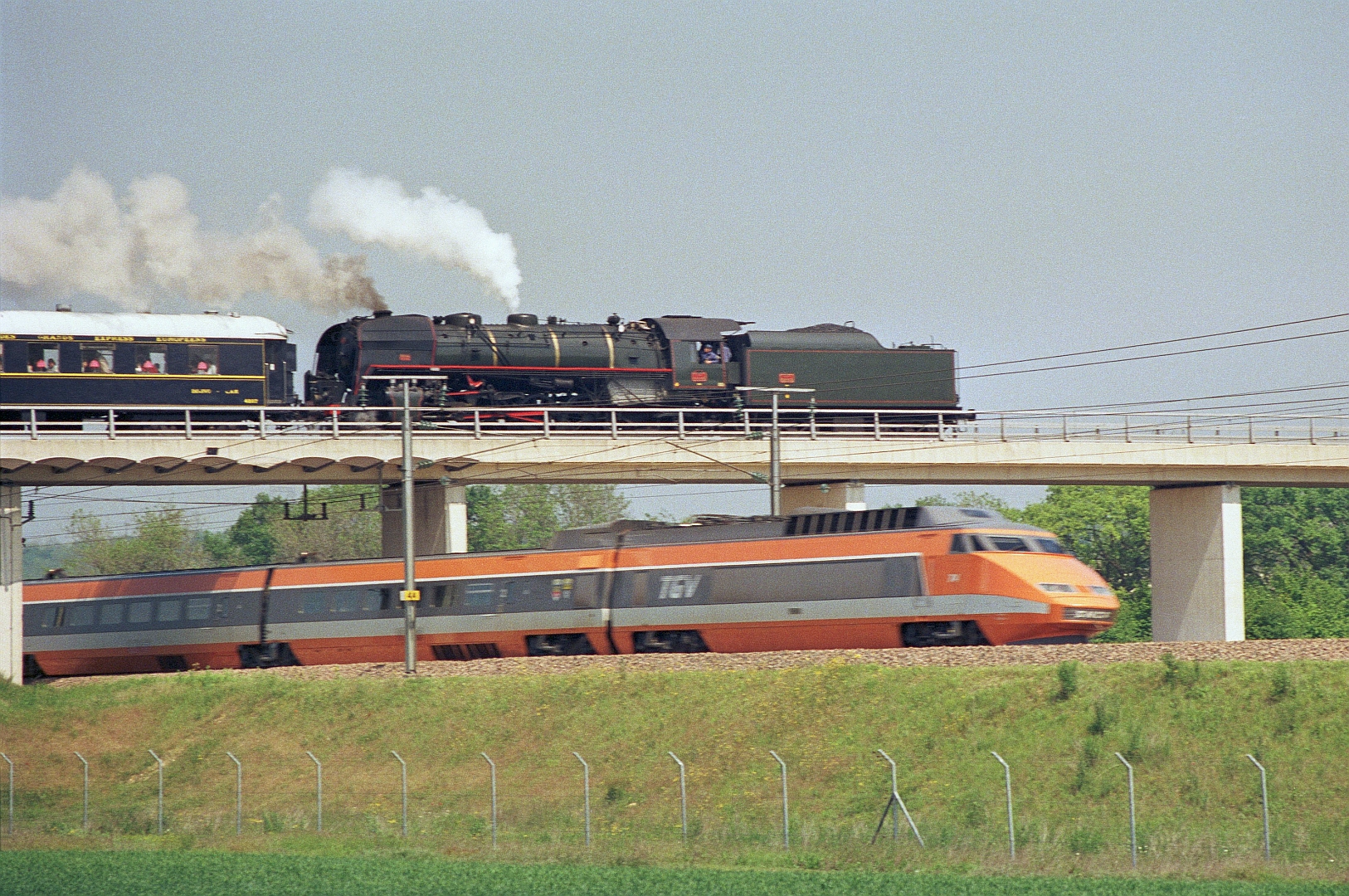
| image | LGV Cruzilles Mépillat 10.jpg | |
| caption | The LGV Sud-Est in Cruzilles-lès-Mépillat | |
| image_width | 300 | |
| system | SNCF | |
| status | Operational | |
| locale | {{plainlist | |
| start | Combs-la-Ville, Seine-et-Marne | |
| end | Sathonay-Camp, Metropolis of Lyon | |
| open | {{plainlist | |
| owner | {{plainlist | |
| operator | SNCF | |
| linelength | 409 km | |
| tracks | Double track | |
| gauge | ||
| electrification | 25 kV 50 Hz | |
| speed | 300 kph | |
| maxincline | 3.6% | |
| signalling | TVM-300 (current), ETCS Level 2 (future, in deployment) | |
| map | ||
| map_state | collapsed |
- Île-de-France
- Bourgogne-Franche-Comté
- Auvergne-Rhône-Alpes |}}
- 22 September 1981: Saint-Florentin–Sathonay-Camp
- 25 September 1983: Combs-la-Ville–Saint-Florentin |}}
- SNCF (1981–1997)
- RFF (1997–2014)
- SNCF Réseau (2015–present) |}}
The LGV Sud-Est (French: Ligne à Grande Vitesse Sud-Est; English: South East high-speed line) is a French high-speed rail line which connects the Paris and Lyon areas. It was France's first high-speed rail line, it has also been the most widely used line in France as well as being the busiest high-speed line in Europe.
Construction of LGV Sud-Est commenced in 1976, although development of the associated technologies had been underway for over a decade prior. Several key decisions, such as the use of overhead electrification instead of gas turbines, were influenced by geopolitical events as much as by innovations. On 22 September 1981, the inauguration of the first section between Saint-Florentin and Sathonay-Camp was attended by President François Mitterrand. It marked the beginning of the re-invigoration of French passenger rail service; ten million passengers travelled on the LGV Sud-Est within its first ten months of operation while domestic flights between Paris and Lyon declined substantially due to the effectiveness of TGV services.
The high rate of return generated by LGV Sud-Est quickly motivated the construction of other LGVs. Several of these have extended the reach of the high-speed trains that use LGV Sud-Est, such as the LGV Rhône-Alpes and LGV Méditerranée to the south and the LGV Interconnexion Est to the north; these connecting lines shortened journey times between Paris and the southeast of France (Marseille, Montpellier and Nice), Switzerland and Italy, as well as between the southeast and the north and west of France, the United Kingdom and Belgium. The LGV Rhône-Alpes, Sud-Est and Méditerranée, taken as a whole, were also nicknamed the City To Coast (C2C) Highway ("Ville à la Mer").
History
Following the creation of SNCF's research department in 1966, one of its primary endeavours was code-named "C03: Railways possibilities on new infrastructure (tracks)". In 1971, the "C03" project, which had been also garnered the name "TGV Sud-Est", was validated by the French government. Following the 1973 oil crisis, which had substantially increased oil prices, it was decided to favour electric traction over gas turbine propulsion; as a consequence, high-speed pantographs and overhead electrification was developed for use on what would become LGV Sud-Est.
During 1976, construction of infrastructure for LGV Sud-Est commenced. One year later, the SNCF placed its initial production order with the rolling stock manufacturing group Alstom–Francorail–MTE for 87 TGV Sud-Est trainsets that would later run on the line.
On 27 September 1981, LGV Sud-Est was opened to the public. It was an instant success, ten million passengers were recorded as travelling on the line within its first ten months. As a result, domestic flights between Paris and Lyon declined substantially as the travelling public switched to using the TGV instead.
By 2020, LGV Sud-Est was still reportedly the most widely used line in France as well as being the busiest high-speed line in Europe. The line carried a third of all railway traffic in France, including up to 300 TGVs per day, and carried 52 million passengers through 2019.
Timeline
- 10 July 1967: SNCF's research division launches project C03 on high-speed rail, titled "Rail Transport Possibilities through New Infrastructure"
- 26 March 1971: new line project approved by inter-ministerial committee
- 23 March 1976: declaration of public utility signed by Prime Minister Jacques Chirac
- 7 December 1976: works commence at Écuisses, Saône-et-Loire
- 14 June 1979: first rails laid near Montchanin, Saône-et-Loire
- 20 November 1980: track laying ends in Cluny, Saône-et-Loire
- 26 February 1981: trainset no. 16 (SNCF TGV Sud-Est) breaks the world record for rail speed at 380 km/h between Courcelles-Frémoy, Côte-d'Or and Dyé, Yonne in a gradually descending portion of the line
- 22 September 1981: inauguration of the first section (Saint-Florentin to Montchanin) by the President of the Republic, François Mitterrand
- 27 September 1981: commercial service begins
- 25 September 1983: service begins on the northern section (Combs-la-Ville to Saint-Florentin)
- 31 August 1992: derailment at 270 km/h of a TGV in Macon-Loché station; several passengers waiting on the platform are slightly injured by flying ballast
- 13 December 1992: service begins on northern section of LGV Rhône-Alpes (Montanay to Saint-Quentin-Fallavier)
- 26 May 1994: service begins on LGV Interconnexion Est (connection with LGV Nord)
- March 1996: beginning of line renovation works (replacement of ballast and points, works designed to last until 2006)
- 2 June 1996: service begins at the junction with Villeneuve-Saint-Georges by the Coubert triangle
Route
The line crosses six departments, from north to south:
- Seine-et-Marne
- Yonne
- Côte-d'Or
- Saône-et-Loire
- Ain
- Rhône
The TGV system is compatible with the regular rail network, avoiding the need for new infrastructure construction to reach existing train stations in the dense urban areas of Paris and Lyon.
The distance from Paris (Gare de Lyon) to Lyon (Part-Dieu) is 425 km. The LGV route is 409 km long; by avoiding built-up areas between Paris and Lyon (particularly Dijon) this enables a route 87 km shorter than the regular line, which is 512 km long. The route length was further shortened by using higher grades (up to 3.5%, compared to a maximum of 0.8% on the previous line) which allowed the line to follow a direct route rather than deviating to avoid hills. There are no tunnels.
The line includes various connectors to the regular rail network:
- at Pasilly-Aisy towards Dijon, and further through the Jura Mountains to Vallorbe and Lausanne or Neuchâtel and Zurich
- at Mâcon-Pont-de-Veyle towards Bourg-en-Bresse and the Savoie department
- at Saint-Florentin
- at Le Creusot station
- at Mâcon-Loché station These last three are used by service trains or in order to divert passenger trains if needed.
The line runs next to the A5 autoroute for 60 km and the N79 road for 15 km. For its full length, a 5 meter-wide area has been reserved for a telecommunication artery.
Line specifics
The line has a surface area of 16 sqkmin comparison Charles de Gaulle Airport occupies 32 sqkmwith an average width of 40 m. Platforms are 13 m wide, with a space between track centres of 4.2 m. The line was designed for a nominal speed of 300 km/h, with a minimum radius curve of 4000 malthough seven curves were made to a smaller radius, but no less than 3200 m.
In total, the line comprises 847 km of track. This is formed by UIC 60 (60.3 kg/m) rails placed in 288 m lengths, welded in place (with certain segmented sections). The 2.41 m concrete sleepers are formed of two blocks of concrete tied together by a metal strut. There are 1660 sleepers per kilometre.
Traction power is supplied by eight EDF substations at 25 kV AC, 50 Hz. The catenary is fed by an inverted phase "feeder" cable, which is equivalent to a 50 kV supply and reinforces the available power, enabling a single trainset to draw up to 14 MW.
Signalling relies on high-frequency track circuits that transmits signals directly to the driver's console, known as Transmission Voie-Machine (TVM). Drivers are unable accurately identify traditional track-side railway signals positioned. While there are lineside marker boards indicating the limits of each block section, there no traditional signals as such. The TVM system is set to be replaced by the newer European Rail Traffic Management System (ERTMS).
The highest point on the line is 489 m above sea level, near the town of Liernais, 55.5 km north of Gare du Creusot. This is near the range dividing the Seine and Loire river valleys, and not far from the Rhône river valley.
Stations
The LGV Sud-Est serves the following stations:
- Le Creusot
- Mâcon-Loché
- Lyon Part-Dieu
Le-Creusot and Mâcon-Loché are basic stations situated away from built-up areas. They have four tracks, with the two central tracks being reserved for through trains, and the side tracks serving stopping trains on two side platforms.
Costs
| Item | Cost, nominal | |
|---|---|---|
| (in 1984 francs) | Cost, real | |
| (in euros) | ||
| Construction of superstructure and infrastructure | ||
| Construction of superstructure and infrastructure, with land purchase | ||
| Rolling stock | ||
| Total |
LGV Sud-Est, akin to other early French high-speed lines, was financed mainly by debt held by SNCF. The decision to proceed with these early LGVs, and the order in which they were constructed, was heavily influenced by evaluations of their profitability, not only in pure financial terms but also the estimated social benefits. Expectations for LGV Sud Est had included a minimum 12 percent financial rate of return; this was exceeded as a result of the line's high rate of usage, both in terms of traffic and revenue generation. The achieved financial rates of return, which have been estimated to have been between 15 percent and 30 percent per year in socioeconomic terms, permitted the LGV to be fully amortised by the end of 1993 after 12 years of operational use; unlike several of France's later LGVs, no subsidies were used. The financial success of LGV Sud Est encouraged the French government commit further large financial contributions towards the construction of additional high-speed lines.
During the mid-to-late 1990s, the track of the LGV Sud-Est was renewed at a cost of FRF 2 billion, or about €300 million. Maintenance and renewal work is typically performed at night wherever possible to impact a minimal amount of traffic. Between 2020 and 2023, a comprehensive modernisation of the line was performed at a cost of 300 million euros; it was part of a wider programme of works aimed at increasing both traffic and regularity on key parts of France's LGV network.
References
Citations
Sources
References
- "RFF – Map of electrified railway lines".
- "2024 : une année clé pour le projet LGV+ Paris-Lyon". SNCF SA.
- "History of TGV".
- Lacôte, François. (1991). "TGVs: France's high-speed trains". Impact of science on society.
- "D'où viens tu TGV".
- "TGV Paris – Sud Est". ''[[Thomas Cook European Timetable. Thomas Cook Continental Timetable]]'' (September 27–October 31, 1981 edition), p. 65. [[Thomas Cook & Son. Thomas Cook Publishing]]. {{issn. 0144-7467.
- Guigueno, Vincent. (January 2008). "Building a High-Speed Society: France and the Aérotrain, 1962–1974". The Johns Hopkins University Press.
- Perren, Brian. (October 1983). "TGV: the completion of a dream". EMAP National Publications.
- [https://web.archive.org/web/20220129044123/https://www.trainweb.org/tgvpages/images/misc/index.html TGVweb - TGV Photos - Miscellaneous]
- (19 December 2019). "Hitachi Rail STS wins LGV Sud-Est interlocking contract". Railway Gazette International.
- Barrows, Keith. (26 April 2018). "EU funds LGV Sud Est ERTMS rollout". International Railway Journal.
- link. (2007-12-12)
- Liesel, Sloan and Douglas 2013, p. 9.
- Liesel, Sloan and Douglas 2013, pp. 9–11.
- Freemark, Yonah. (11 July 2010). "For French High-Speed Rail, a Lower-Cost Future Pondered".
- (22 April 2002). "TGV –The French High-speed Train Service". BBC.
- (7 September 2020). "Modernization of the Paris-Lyon high-speed line: an extraordinary project".
- Smith, Kevin. (17 October 2020). "Work underway on LGV Sud Est improvements". International Railway Journal.
This article was imported from Wikipedia and is available under the Creative Commons Attribution-ShareAlike 4.0 License. Content has been adapted to SurfDoc format. Original contributors can be found on the article history page.
Ask Mako anything about LGV Sud-Est — get instant answers, deeper analysis, and related topics.
Research with MakoFree with your Surf account
Create a free account to save articles, ask Mako questions, and organize your research.
Sign up freeThis content may have been generated or modified by AI. CloudSurf Software LLC is not responsible for the accuracy, completeness, or reliability of AI-generated content. Always verify important information from primary sources.
Report