From Surf Wiki (app.surf) — the open knowledge base
LGBTQ people and Islam
none
none
Within the Muslim world, sentiment towards LGBTQ people varies and has varied between societies and individual Muslims. While colloquial and often de facto official acceptance of at least some homosexual and gender variant behaviors were commonplace in pre-modern periods, later developments, starting from the 19th century, have created a predominantly hostile environment for LGBTQ people.
There are differences in how the Qur'an and later hadith traditions (orally transmitted collections of Muhammad's teachings) treat homosexuality, with the latter being far more explicitly negative. This has caused rifts in legalistic opinion, as while all major schools of jurisprudence broadly agreed that liwat (anal sex between men) was haram, opinions varied in terms of the legality, nature, and severity of punishment, as well as the legal situation of women's same-sex relations. Furthermore, these formulations largely remained theoretical, as historical evidence from the pre-modern period shows de facto tolerance of homosexual relationships. Historical records also suggest that in the rare event that laws against homosexuality were invoked in the pre-modern period, they were done so mainly in cases of rape or other "exceptionally blatant infringement on public morals" as defined by Islamic law. These factors allowed themes of homoeroticism and pederasty to be cultivated in Islamic poetry and other Islamic literary genres, despite the stances of religious scholars, from the 8th century CE into the modern era. The conceptions of homosexuality found in these texts resembled the traditions of ancient Greece and ancient Rome as opposed to the modern understanding of sexual orientation.
In the modern era, Muslim public attitudes towards homosexuality underwent a marked change beginning in the 19th century, largely due to the global spread of Islamic fundamentalist movements, namely Salafism and Wahhabism. The Muslim world was also influenced by the sexual notions and restrictive norms that were prevalent in the Christian world at the time, particularly with regard to anti-homosexual legislation prevalent throughout European societies; a number of Muslim-majority countries that were once colonies of European empires retain the criminal penalties against homosexuality that were originally implemented by European colonial authorities.
As Western culture eventually moved towards secularism and thus enabled a platform for the flourishing of many LGBTQ movements, many Muslim fundamentalists came to associate the Western world with "ravaging moral decay" and rampant homosexuality. In contemporary society, prejudice, anti-LGBTQ discrimination and anti-LGBTQ violence—including violence which is practiced within legal systems—persist in much of the Muslim world, exacerbated by socially conservative attitudes and the rise of Islamist ideologies in some countries; there are laws in place against homosexual activities in a larger number of Muslim-majority countries, with a number of them prescribing the death penalty for convicted offenders. In surveys of public opinion, the vast majority of Muslims across various countries currently reject the notion that homosexuality should be acceptable in society. Most Muslim-majority countries have also opposed moves to advance LGBTQ rights and recognition at the United Nations (UN), including within the UN General Assembly and the UN Human Rights Council.
Despite these developments, contemporary Islamic jurisprudence generally accepts the possibility for transgender people (mukhannith/mutarajjilah) to change their gender status, but only after surgery, linking one's gender to biological markers. Trans people are nonetheless confronted with stigma, discrimination, intimidation, and harassment in many ways in Muslim-majority societies. Transgender identities are often considered under the gender binary, although some pre-modern scholars had recognized effeminate men as a form of third gender, as long as their behaviour was natural and not a performance.
History
Muslim attitudes to LGBTQ practices has varied throughout Islamic history; legal scholars condemned and often formulated punishments for homosexual acts, yet lenient (or often non-existent) enforcement allowed for toleration, and sometimes celebration of such acts.
Homoeroticism was idealized in the form of poetry or artistic declarations of love, often from an older man to a younger man or adolescent boy. This was accepted in courtly settings as a system of pederasty, though egalitarian same-sex relations also occurred (with the threat of the social censure of the passive partner, if revealed). Accordingly, the Arabic language had an appreciable vocabulary of homoerotic terms, with multiple words to describe types of male prostitutes, including those pre-dating Islam. Schmitt identifies some twenty words in Arabic, Persian, and Turkish to identify those who are penetrated. Other related Arabic words includes mukhannathun (effeminate men), ma'bûn, halaqī, and baghghā.
Pre-modern era
The following centuries witnessed a continuation of this trend. The Abbasid caliphate Al-Amin (r. 809–813) was said to have required slave women to be dressed in masculine clothing so he could be persuaded to have sex with them, and a broader fashion for ghulamiyyat (boy-like girls) is reflected in literature of the period. Religious scholars were also influenced by this environment, but to a lesser extent; Chief Judge of the Abbasid Caliphate Yahya ibn Aktham permitted homosexual acts, despite being harsh on other sexual acts such as fornication.{{refn| Later on, in an eleventh-century discussion among the scholars of Baghdad, some scholars who showed traits of bisexuality argued that it is natural for a man to desire anal intercourse with a fellow man, but this would be only allowed in the afterlife. Similarly, El-Rouayheb suggests that as Islamic orthodoxy stabilized and religious scholars considered sodomy as an abhorrent sin more or less without exception, most of them did not believe that this prohibition covered falling in love or writing poetry.
Despite these exceptions in certain settings and periods however, homosexual practices present in courtly and 'respectable' settings in the Islamic world remained largely age-segregated. In the medical tradition, seeking to play a passive role was considered both unnatural and shameful for a mature man, and following Greek precedents, the Islamic world regarded this as pathological. Therefore, the medical term ubnah was used for the desire of a man to exclusively be on the receiving end of anal intercourse. Physicians that theorized on ubnah includes Rhazes, who thought that it was correlated with small genitals and that a treatment was possible provided that the subject was deemed to be not too effeminate and the behavior not "prolonged". Dawud al-Antaki, in contrast, advanced that it could have been caused by an acidic substance embedded in the veins of the anus, causing itchiness and thus the need to seek relief.
Modern era
A few decades later, in 1858, the Tanzimat reforms took effect in the Ottoman Empire. These reforms, in total, nullified much of the earlier legal systems' rulings. As a ruling on homosexuality was not included in the new sets of laws, the Ottomans had effectively annulled any prohibition of homosexuality, theoretical or otherwise. However, many authors claim that the effects of this reformist period were the repression, not further acceptance, of same-sex relations: Özsoy writes that before the 19th-century, Ottoman society had not effectively criminalized homosexuality to begin with, and Lapidus and Salaymeh claim that by the 1850s, via European influence, they began censoring same-sex relations that they had once seen as relatively normative.
According to Dror Ze'evi, these repressive processes shaped the nineteenth century in the Ottoman Empire, resulting in the reinterpretation of local cultural material and traditions. Ze'evi traces these processes to European travelers denouncing the Ottomans for their ostensibly 'corrupt' sexual proclivities, and Ze'evi argues that the literate classes of the empire responded by 'reinventing' their own sexual norms. A new discourse of an idealized, heteronormative Ottoman world that surpassed Europe in its ostensible sexual 'morality' was the product of this process, with local practices and discourses actively suppressed to align with this invented tradition. In terms of same-sex relations specifically, Ahmed Cevdet Pasha stated, at the time:"Woman-lovers (zendost) have increased in number, while boy-beloveds (mahbub) have decreased. It is as if the People of Lot have been swallowed by the earth. The love and affinity that were, in Istanbul, notoriously and customarily directed towards young men have now been redirected towards girls, in accordance with the state of nature."
With reference to the Muslim world more broadly, Tilo Beckers claims that while "endogenous changes" that sought to reinterpret religious and cultural texts were influential in the shift of attitudes seen in the 19th century Muslim world, "exogenous changes" from European countries also defined new social attitudes in the Muslim world. Bauer similarly writes that "although contemporary Islamist movements decry homosexuality as a form of Western decadence, the current prejudice against it among Muslim publics stems from an amalgamation of traditional Islamic legal theory with popular notions that were imported from Europe during the colonial era." In some Muslim-majority countries, current anti-LGBTQ laws were directly enacted by United Kingdom or Soviet organs and retained following independence. The 1860 Indian Penal Code, which included an anti-sodomy statute, was used as a basis of penal laws in other parts of the empire.
Contemporary developments
More recently, persecution of LGBTQ+ people have also been exacerbated by a rise in Islamic fundamentalism and the emergence of the gay-rights movement in the West, which allowed Islamists to paint homosexuality as a noxious Western import. Dynes and Donaldson point out that North African countries under French colonial tutelage lacked anti-sodomy statutes in their colonial laws, and that their anti-LGBTQ laws were only born afterwards, with the full weight of modern Muslim public opinion descending on those who, on the model of the gay liberationists of the West, would seek to make "homosexuality" (above all, adult men taking passive roles) publicly respectable.
Recent developments in many countries mirror this trend. In some countries like Iran and Iraq, the dominant discourse is that Western imperialism has spread homosexuality. In Iran, several hundred political opponents were executed in the aftermath of the 1979 Islamic Revolution and justified it by accusing them of homosexuality. Homosexual intercourse became a capital offense in Iran's Islamic Penal Code in 1991. Though the grounds for execution in Iran are difficult to track, there is evidence that several people were hanged for homosexual behavior in 2005–2006 and in 2016, mostly in cases of dubious charges of rape. In Iraq, where homosexuality is legal, the breakdown of law and order following the Second Gulf War allowed Islamist militias and vigilantes to act on their prejudice against gays, with ISIS gaining particular notoriety for the gruesome acts of anti-LGBTQ violence committed under its rule of parts of Syria and Iraq. In Egypt, though, again, homosexuality is not explicitly criminalized, it has been widely prosecuted under vaguely formulated "morality" laws. Under the current rule of Abdel Fattah el-Sisi, arrests of LGBTQ individuals have risen fivefold, apparently reflecting an effort to appeal to conservatives. In Uzbekistan, an anti-sodomy law, passed after World War II with the goal of increasing the birth rate, was invoked in 2004 against a gay rights activist, who was imprisoned and subjected to extreme abuse.
Scripture and Islamic jurisprudence
Same-sex relations
In the Quran
Main article: Islamic view of Lot, Liwat
The Quran contains several ostensible allusions to homosexual activity, which has prompted considerable exegetical and legal commentaries over the centuries. The subject is most clearly addressed in the story of Sodom and Gomorrah (seven verses) after the men of the city demand to have sex with the male messengers sent by God to Lot (or Lut). The Quranic narrative largely conforms to that found in Genesis. In one passage the Quran says that the men "solicited his guests of him" (Quran 54:37), using an expression that parallels phrasing used to describe the attempted seduction of Joseph, and in multiple passages they are accused of "coming with lust" to men instead of women (or their wives). The Quran terms this lewdness or fahisha () unprecedented in the history of the world:
The destruction of the "people of Lut" is generally thought to be explicitly associated with their sexual practices. Later exegetical literature built on these verses as writers attempted to give their own views as to what went on; and there was general agreement among exegetes that the "lewdness" alluded to by the Quranic passages was attempted sodomy, specifically anal intercourse.
Some Muslim scholars, however, such as the Ẓāhirī scholar (literalist) ibn Ḥazm, argued that the "people of Lut" were destroyed not because of participation in homosexuality per se, but because of disregarding prophets and messengers and attempting to rape one of them.Habib, S. (2008). Queer-Friendly Islamic Hermeneutics. Isim Review, 21(1), 32-33. Retrieved from https://hdl.handle.net/1887/17231
Nevertheless, the sins of the "people of Lut" () subsequently became proverbial and the Arabic words for the act of anal sex between men such as liwat () and for a person who performs such acts () both derive from his name, although Lut was not the one demanding sex.
''Zina'' verse
Only one passage in the Quran prescribes a strictly legal position. It is not restricted to homosexual behaviour, however, and deals more generally with zina (illicit sexual intercourse):
In the exegetical Islamic literature, this verse has provided the basis for the view that Muhammad took a lenient approach towards male homosexual practices. The Orientalist scholar Pinhas Ben Nahum has argued that "it is obvious that the Prophet viewed the vice with philosophic indifference. Not only is the punishment not indicated—it was probably some public reproach or insult of a slight nature—but mere penitence sufficed to escape the punishment". Most exegetes hold that these verses refer to illicit heterosexual relationships, although a minority view attributed to the Mu'tazilite scholar Abu Muslim al-Isfahani interpreted them as referring to homosexual relations. This view was widely rejected by medieval scholars, but has found some acceptance in modern times.
Cupbearers in paradise
Some Quranic verses describing the Islamic paradise refer to perpetually youthful attendants which inhabit it, and they are described as both male and female servants: the females are referred to as ḥūr, whereas the males are referred to as ghilmān, wildān, and suqāh. The slave boys are referred to in the Quran as "immortal boys" (, ) or "young men" () who serve wine and meals to the blessed. Although the tafsir literature does not interpret this as a homoerotic allusion, the connection was made in other literary genres, mostly humorously.
A beautiful lad came carrying the wine
With smooth hands and fingers dyed with henna
And with long hair of golden curls around his cheeks ...
I have a lad who is like the beautiful lads of paradise
And his eyes are big and beautiful}}
Jurists of the Hanafi school took up the question seriously, considering, but ultimately rejecting the suggestion that homosexual pleasures were, like wine, forbidden in this world but enjoyed in the afterlife.
In the hadith
The hadith (sayings and actions attributed to Muhammad) show that homosexual behaviour was not unknown in seventh-century Arabia. However, given that the Quran did not specify the punishment of homosexual practices, Islamic jurists increasingly turned to several "more explicit"
While there are no reports relating to homosexuality in the best known and authentic hadith collections of Sahih al-Bukhari and Sahih Muslim, other canonical collections record a number of condemnations of the "act of the people of Lut" (male-to-male anal intercourse).
According to Oliver Leaman, hadiths seem to permit homoerotic feelings as long as they are not translated into action. However, in one hadith attributed to Muhammad himself, which exists in multiple variants, the Islamic prophet acknowledged homoerotic temptation towards young boys and warned his Companions against it: "Do not gaze at the beardless youths, for verily they have eyes more tempting than the houris" or "... for verily they resemble the houris". These beardless youths are also described as wearing sumptuous robes and having perfumed hair. Consequently, Islamic religious leaders, skeptical of Muslim men's capacity of self-control over their sexual urges, have forbidden looking and yearning both at males and females. In addition, there is a number of "purported (but mutually inconsistent) reports" (athar) of punishments of sodomy ordered by some of the early caliphs. Abu Bakr apparently recommended toppling a wall on the culprit, or else burning him alive, while Ali ibn Abi Talib is said to have ordered death by stoning for one sodomite and had another thrown head-first from the top of the highest building in the town; according to Ibn Abbas, the latter punishment must be followed by stoning.
There are, however, fewer hadith mentioning homosexual behaviour in women; and punishment (if any) for lesbianism was not clarified.
In traditional jurisprudence
The scarcity of concrete prescriptions from hadith and the contradictory nature of information about the actions of early authorities resulted in the lack of agreement among classical jurists as to how homosexual activity should be treated. Classical Islamic jurists did not deal with homosexuality as a sexual orientation, since the latter concept is modern and has no equivalent in traditional law, which dealt with it under the technical terms of liwat and zina.
Broadly, traditional Islamic law took the view that homosexual activity could not be legally sanctioned because it takes place outside religiously recognised marriages. All major schools of Islamic law considered liwat (anal sex) as a punishable offence, and most legal schools treated homosexual intercourse with penetration similarly to unlawful heterosexual intercourse under the rubric of zina. From a practical standpoint, however, as a hadd punishment for zina requires testimony from four witnesses of the actual act of penetration or a confession from the accused repeated four times, the legal criteria for the prescribed punishments for homosexual acts were very difficult to fulfill in the pre-modern period. The debates of classical jurists were, therefore, "to a large extent theoretical, since homosexual relations have always been tolerated" in pre-modern Islamic societies. While it is difficult to determine to what extent the legal sanctions were enforced in different times and places, historical record suggests that the laws were invoked mainly in cases of rape or other "exceptionally blatant infringement on public morals".
Beyond these practical caveats, there were differences of opinion with respect to methods of punishment, if and when legal action was taken. Some legal schools "prescribed capital punishment for sodomy, but others opted only for a relatively mild discretionary punishment." The Hanbalites are the most severe among Sunni schools, insisting on capital punishment for anal sex in all cases, while the other schools generally restrict punishment to flagellation with or without banishment, unless the culprit is muhsan (Muslim free married adult), and Hanafis often suggest no physical punishment at all, leaving the choice to the judge's discretion. The founder of the Hanafi school Abu Hanifa refused to recognize the analogy between sodomy and zina, although his two principal students disagreed with him on this point. For unclear reasons, the treatment of homosexuality in Twelver Shi'ism jurisprudence is generally harsher than in Sunni fiqh, while Zaydi and Isma'ili Shia jurists took positions similar to the Sunnis.
Where capital punishment is prescribed and a particular method is recommended, the methods range from stoning (Hanbali, Maliki), to the sword (some Hanbalites and Shafi'ites), or leaving it to the court to choose between several methods, including throwing the culprit off a high building (Shi'ite). Where flogging is prescribed, there is a tendency for indulgence and some recommend that the prescribed penalty should not be applied in full, with Ibn Hazm reducing the number of strokes to 10. There was debate as to whether the active and passive partners in anal sex should be punished equally.
Beyond penetrative anal sex, there was "general agreement" that "other homosexual acts (including any between females) were lesser offenses, subject only to discretionary punishment." Some jurists viewed sexual intercourse as possible only for an individual who possesses a phallus; hence those definitions of sexual intercourse that rely on the entry of as little of the corona of the phallus into a partner's orifice. Since women do not possess a phallus and cannot have intercourse with one another, they are, in this interpretation, physically incapable of committing zinā.
Gender-variant people
Main article: Mukhannathun
In Classical Arabic and Islamic literature, the plural term mukhannathun (singular: mukhannath) was a term used to describe gender-variant people, and it has typically referred to effeminate men or people with ambiguous sexual characteristics, who appeared feminine and functioned sexually or socially in roles typically carried out by women. According to the Iranian scholar Mehrdad Alipour, "in the premodern period, Muslim societies were aware of five manifestations of gender ambiguity: This can be seen through figures such as the khasi (eunuch), the hijra, the mukhannath, the mamsuh and the khuntha (hermaphrodite/intersex)." Gender specialists Aisya Aymanee M. Zaharin and Maria Pallotta-Chiarolli give the following explanation of the meaning of the term mukhannath and its derivate Arabic forms in the hadith literature:
Moreover, within Islam, there is a tradition of the elaboration and refinement of extended religious doctrines through scholarship. This doctrine contains a passage by the scholar and hadith collector An-Nawawi:A mukhannath is the one ("male") who carries in his movements, in his appearance and in his language the characteristics of a woman. There are two types; the first is the one in whom these characteristics are innate, he did not put them on by himself, and therein is no guilt, no blame and no shame, as long as he does not perform any (illicit) act or exploit it for money (prostitution etc.). The second type acts like a woman out of immoral purposes and he is the sinner and blameworthy.The hadith collection of Bukhari (compiled in the 9th century from earlier oral traditions) includes a report regarding mukhannathun, effeminate men who were granted access to secluded women's quarters and engaged in other non-normative gender behavior.
Another hadith also mention the punishment of banishment, both in connection with Umm Salama's servant and a man who worked as a musician. Muhammad described the musician as a mukhannath and threatened to banish him if he did not end his unacceptable career.
According to Everett K. Rowson, professor of Middle Eastern and Islamic Studies at New York University, none of the sources state that Muhammad banished more than two mukhannathun, and it is not clear to what extent the action was taken because of their breaking of gender rules in itself or because of the "perceived damage to social institutions from their activities as matchmakers and their corresponding access to women".
Modern laws in Muslim-majority countries {{Anchor|Homosexuality_laws_in_majority-Muslim_countries}}

Criminalization
According to the International Lesbian and Gay Association (ILGA) seven countries retain capital punishment for homosexual behavior: Saudi Arabia, Yemen, Iran, Afghanistan, Mauritania, northern Nigeria, southern Somalia, and the United Arab Emirates. Afghanistan also has the death penalty for homosexuality since the 2021 Taliban takeover. In Qatar, Algeria, Uzbekistan, and the Maldives, homosexuality is punished with time in prison or a fine. This has led to controversy regarding Qatar, which hosted the 2022 FIFA World Cup. In 2010, human rights groups questioned the awarding of hosting rights to Qatar, due to concerns that gay football fans may be jailed. In response, Sepp Blatter, head of FIFA, joked that they would have to "refrain from sexual activity" while in Qatar. He later withdrew the remarks after condemnation from rights groups.
While Egypt does not have a de jure law explicitly criminalizing homosexual behavior, gay men (or people suspected of being gay) have been prosecuted under general public morality laws. (See Cairo 52.) "Sexual relations between consenting adult persons of the same sex in private are not prohibited as such. However, the Law on the Combating of Prostitution, and the law against debauchery have been used to imprison gay men in recent years."
The Sunni Islamist militant group and Salafi-jihadist terrorist organization ISIL/ISIS/IS/Daesh, which invaded and claimed parts of Iraq and Syria between 2014 and 2017, enacted the political and religious persecution of LGBT people and decreed capital punishment for them. ISIL/ISIS/IS/Daesh terrorists have executed more than two dozen men and women for suspected homosexual activity, including several thrown off the top of buildings in highly publicized executions.
In India, which has the third-largest Muslim population in the world, and where Islam is the largest minority religion, the largest Islamic seminary (Darul Uloom Deoband) has vehemently opposed recent government moves to abrogate and liberalize laws from the colonial era that banned homosexuality. As of September 2018, homosexuality is no longer a criminal act in India, and most of the religious groups withdrew their opposing claims against it in the Supreme Court.
In Iraq, homosexuality is allowed by the government, but terrorist groups often carry out illegal executions of gay people. Saddam Hussein was "unbothered by sexual mores". Ali Hili reports that "since the 2003 invasion more than 700 people have been killed because of their sexuality." He calls Iraq the "most dangerous place in the world for sexual minorities."
In Jordan, where homosexuality is legal, "gay hangouts have been raided or closed on bogus charges, such as serving alcohol illegally." Despite this legality, social attitudes towards homosexuality are still hostile and hateful.
In Pakistan, its law is a mixture of both British colonial law as well as Islamic law, both which prescribe criminal penalties for same-sex sexual acts. The Pakistan Penal Code of 1860, originally developed under colonial rule, punishes sodomy with a possible prison sentence. Yet, the more likely situation for gay and bisexual men is sporadic police fines, and jail sentences.
In Bangladesh, homosexual acts are illegal and punishable according to section 377. In 2009 and 2013, the Bangladeshi Parliament refused to overturn Section 377.
In Saudi Arabia, the maximum punishment for homosexual acts is public execution by beheading.
In Malaysia, homosexual acts are illegal and punishable with jail, fine, deportation, whipping or chemical castration. In October 2018, Prime Minister Mahathir Mohamad stated that Malaysia would not "copy" Western nations' approach towards LGBTQ rights, indicating that these countries were exhibiting a disregard for the institutions of the traditional family and marriage, as the value system in Malaysia is good. In May 2019, in response to the warning of George Clooney about intending to impose death penalty for homosexuals like Brunei, the Deputy Foreign Minister Marzuki Yahya pointed out that Malaysia does not kill gay people, and will not resort to killing sexual minorities. He also said, although such lifestyles deviate from Islam, the government would not impose such a punishment on the group.
Indonesia does not have a sodomy law and does not currently criminalize private, non-commercial homosexual acts among consenting adults, except in Aceh province where homosexuality is illegal for Muslims under Islamic Sharia law, and punishable by flogging. While it does not criminalise homosexuality, the country does not recognise same-sex marriage. In July 2015, the Minister of Religious Affairs stated that it is difficult in Indonesia to legalize Gay Marriage, because strongly held religious norms speak strongly against it. People's Representative Council (DPR) has dismissed the suggestion that the death penalty would be introduced for same-sex acts, citing that it is quite impossible to implement that policy by the government of Indonesia.
As the latest addition in the list of criminalizing Muslim countries, Brunei's has implemented penalty for homosexuals within Sharia Penal Code in stages since 2014. It prescribes death by stoning as punishment for sex between men, and sex between women is punishable by caning or imprisonment. The sultanate currently has a moratorium in effect on death penalty.
As of 2025, homosexuality is criminalized in 34 Muslim-majority countries, they are Afghanistan, Algeria, Bangladesh, Brunei, Burkina Faso, Chad, Comoros, Egypt, Gambia, Guinea, Iran, Iraq, Kuwait, Lebanon (de facto), Libya, Malaysia, Mali, Mauritania, Morocco, Nigeria, Oman, Pakistan, Qatar, Saudi Arabia, Senegal, Sierra Leone, Somalia, Sudan, Syria, Tunisia, Turkmenistan, United Arab Emirates, Uzbekistan, and Yemen. In Indonesia, homosexuality isn't criminalized, although there are severe prosecutions of homosexuals, especially in Aceh and South Sumatra. There is also an upcoming law in Indonesia that criminalizes sex outside of marriage that will be in effect in December 2025, and same-sex marriage is banned, which will de facto criminalize homosexuality. In Gaza, the legality of male homosexuality is unclear. In Western Sahara, a disputed territory claimed by Morocco, homosexuality is criminalized. In recent years, the number of Muslim-majority countries that criminalize homosexuality has been increasing, with the most recent ones being Chad in 2017, Iraq and Mali in 2024, and Burkina Faso in 2025.
Death penalty

All nations currently having capital punishment as a potential penalty for homosexual activity are Muslim-majority countries and base those laws on interpretations of Islamic teachings, with the exception of Uganda. In 2020, the International Lesbian, Gay, Bisexual, Trans and Intersex Association (ILGA) released its most recent State Sponsored Homophobia Report. The report found that eleven countries or regions impose the death penalty for "same-sex sexual acts" with reference to sharia-based laws. In Iran, according to article 129 and 131 there are up to 100 lashes of whip first three times and fourth time death penalty for lesbians. The death penalty is implemented nationwide in Brunei, Iran, Saudi Arabia, Afghanistan, Yemen, northern Nigeria, Mauritania, the United Arab Emirates, and southern Somalia. This punishment is also allowed by the law but not implemented in Qatar and Pakistan; and was back then implemented through non-state courts by ISIS in parts of Iraq and Syria (now no longer existing).
Due to Brunei's law dictating that gay sex be punishable by stoning, many of its targeted citizens fled to Canada in hopes of finding refuge. The law is also set to impose the same punishment for adultery among heterosexual couples. Despite pushback from citizens in the LGBTQ+ community, Brunei prime minister's office produced a statement explaining Brunei's intention for carrying through with the law. It has been suggested that this is part of a plan to separate Brunei from the western world and towards a Muslim one.
In the Chechen Republic, a part of the Russian Federation, Ramzan Kadyrov has actively discriminated against homosexual individuals and presided over a campaign of arbitrary detention and extrajudicial killing. It has been suggested that "to counteract popular support for an Islamist insurgency that erupted after the Soviet breakup, President Vladimir V. Putin of Russia has granted wide latitude to Kadyrov to co-opt elements of the Islamist agenda, including an intolerance of gays." Reports of the discrimination in Chechnya have in turn been used to stoke Islamophobic, racist, and anti-Russia rhetoric. Jessica Stern, executive director of OutRight Action International, has criticized this bigotry, noting: "Using a violent attack on men accused of being gay to legitimize Islamophobia is dangerous and misleading. It negates the experiences of queer Muslims and essentializes all Muslims as homophobic. We cannot permit this tragedy to be co-opted by ethno-nationalists to perpetuate anti-Muslim or anti-Russian sentiment. The people and their government are never the same."
Minor penalty
In Algeria, Bangladesh, Chad, Morocco, Aceh, Maldives, Oman, Pakistan, Qatar, Syria, and Tunisia, it is illegal, and penalties may be imposed. In Kuwait, Sierra Leone, Turkmenistan, Uzbekistan, homosexual acts between males are illegal, but homosexual relations between females are legal.
Legalization
Same-sex sexual intercourse is legal in Albania, Azerbaijan, Bahrain, Bosnia and Herzegovina, Côte d'Ivoire, Djibouti, Guinea-Bissau, Jordan, Kazakhstan, Kosovo, Kyrgyzstan, Niger, Tajikistan, Turkey, West Bank (State of Palestine), Indonesia (de jure; except Aceh), and in Northern Cyprus. In Albania and Turkey, there have been discussions about legalizing same-sex marriage.
In Lebanon, courts have ruled that the country's penal code must not be used to target homosexuals, but the law has yet to be changed by parliament.
Discrimination protections
Under the UN administration, Kosovo became the first Muslim-majority country to enact anti-discriminatory protections based on sexual identity. In 2009, similar protections were introduced in Bosnia and Herzegovina. The next year, a law adopted by Albania prohibited discrimination for sexual orientation and gender identity.
Since early 2000s, thanks to the EU accession bid, LGBTQ+ rights reforms were brought into consideration in Turkey. In 2013, in the course of the legislative efforts for a constitutional amendment, the main opposition CHP proposed a draft to provide employment protections, which was subsequently approved by all major parties in the Turkish Parliament, including the ruling AKP. It, however, was never enacted following conflict in other clauses, and the subsequent democratic backsliding of Turkey shut the door to further improvements. Even though legal protections are absent, the local governments held by the Kemalist opposition are signatories to a variety of international agreements, and they pledge to indiscriminate in employment. Some municipalities even have dedicated bodies to ensure equity for LGBTQ+ individuals.
In 2014, the Turkish Republic of Northern Cyprus, albeit a non-recognized entity, made history by introducing employment protections based on sexual identity, in addition to gender, on the Penal Law.
Same-sex marriage
In 2007, there was a gay party in the Moroccan town of al-Qasr al-Kabir. Rumours spread that this was a gay marriage and more than 600 people took to the streets, condemning the alleged event and protesting against leniency towards homosexuals. Several persons who attended the party were detained and eventually six Moroccan men were sentenced to between four and ten months in prison for "homosexuality".
In France, there was an Islamic same-sex marriage on 18 February 2012. In Paris in November 2012 a room in a Buddhist prayer hall was used by gay Muslims and called a "gay-friendly mosque". The French overseas department of Mayotte, which has a majority-Muslim population, legalized same-sex marriage in 2013, along with the rest of France.
The first American Muslim in the United States Congress, Keith Ellison (D-MN) said in 2010 that all discrimination against LGBTQ people is wrong. He further expressed support for gay marriage stating:
I believe that the right to marry someone who you please is so fundamental it should not be subject to popular approval any more than we should vote on whether blacks should be allowed to sit in the front of the bus.
In 2014, eight men were jailed for three years by a Cairo court after the circulation of a video of them allegedly taking part in a private wedding ceremony between two men on a boat on the Nile.
Transgender rights
In the late 1980s, Mufti Muhammad Sayyid Tantawy of Egypt issued a fatwa supporting the right for those who fit the description of mukhannathun and mukhannathin to have sex reassignment surgery; Ayatollah Khomeini of Iran issued similar fatwas around the same time. Khomeini's initial fatwa concerned intersex individuals as well, but he later specified that sex reassignment surgery was also permissible in the case of transgender individuals. Because homosexuality is illegal in Iran but gender transition is legal, some gay individuals have been forced to undergo sex reassignment surgery and transition into the opposite sex, regardless of their actual gender identity.
While Iran has outlawed homosexuality, Iranian thinkers such as Ayatollah Khomeini have allowed for transgender people to change their sex so that they can enter heterosexual relationships. Despite this, those who do not commit to reassignment surgery are not accepted to be trans. The government even provides up to half the cost for those needing financial assistance and a sex change is recognized on the birth certificate.
The secular yet Muslim majority country, Turkey, generally accepts gender adjustment surgery. Nonetheless, there is no financial support for transgender people and many transgender people are faced with prejudice.
On 26 June 2016, clerics affiliated to the Pakistan-based organization Tanzeem Ittehad-i-Ummat issued a fatwa on transgender people where a trans woman (born male) with "visible signs of being a woman" is allowed to marry a man, and a trans man (born female) with "visible signs of being a man" is allowed to marry a woman. Pakistani transgender persons can also change their (legal) sex. Muslim ritual funerals also apply. Depriving transgender people of their inheritance, humiliating, insulting or teasing them were declared haraam. In May 2018, the Pakistani parliament passed a bill giving transgender individuals the right to choose their legal sex and correct their official documents, such as ID cards, driver licenses, and passports. Today, transgender people in Pakistan have the right to vote and to search for a job free from discrimination. As of 2018, one transgender woman became a news anchor, and two others were appointed as Supreme Court clerks.
Public opinion among Muslims
Opinion polls
In 2013, the Pew Research Center conducted a study on the global acceptance of homosexuality and found a widespread rejection of homosexuality in many nations that are predominantly Muslim. In some countries, views were becoming more conservative among younger people.
2013 Pew Poll
| Country | Age group | 18–29 | 30–49 | 50+ | |||
|---|---|---|---|---|---|---|---|
| Lebanon | 27% | 17% | 10% | ||||
| Turkey | 9% | 7% | 10% | ||||
| Malaysia | 7% | 10% | 11% | ||||
| Jordan | 5% | 1% | 1% | ||||
| Palestine | 5% | 3% | – | ||||
| Senegal | 5% | 2% | 2% | ||||
| Indonesia | 4% | 2% | 3% | ||||
| Egypt | 3% | 2% | 3% | ||||
| Tunisia | 3% | 2% | 1% | ||||
| Pakistan | 2% | 2% | 2% |
2019 Arab Barometer Survey
| Country | Acceptance of Homosexuality |
|---|---|
| Algeria | 26% |
| Morocco | 19% |
| Sudan | 17% |
| Jordan | 7% |
| Tunisia | 7% |
| Lebanon | 6% |
| Palestine territories | 5% |
- A 2007 survey of British Muslims showed that 61% believe homosexuality should be illegal. A later Gallup poll in 2009 showed that none of the 500 British Muslims polled believed homosexuality to be "morally acceptable". In a 2016 ICM poll of 1,081 British Muslims, 52% of those polled disagreed with the statement "Homosexuality should be legal in Britain" while 18% agreed. In the same poll, 56% of British Muslims polled disagreed with the statement "Gay marriage should be legal in Britain" compared with 20% of the control group and 47% disagreed with the statement "It is acceptable for a homosexual person to be a teacher in a school" compared with 14% of the control group.
- According to a 2012 poll, 51% of the Turks in Germany, who account for nearly two thirds of the total Muslim population in Germany, believed that homosexuality is an illness. However, a more recent poll from 2015 found that more than 60% of Muslims in Germany support gay marriage. A poll in 2017 also found 60% support for gay marriage.
- American Muslims – in line with general public attitudes in the United States – have become much more accepting of homosexuality over recent years. In a 2007 poll conducted by Pew Research Center, only 27% of American Muslims believed that homosexuality should be accepted. In a 2011 poll, that rose to 39%. In a July 2017 poll, Muslims who say homosexuality should be accepted by society clearly outnumber those who say it should be discouraged (52% versus 33%), a level of acceptance similar to American Protestants (52% in 2016). According to research by the Public Religion Research Institute's 2017 American Values Atlas, 51% of American Muslims favor same-sex marriage, while 34% are opposed.
- The 2009 Gallup poll showed that 35% of the French Muslims believed homosexuality to be "morally acceptable".
- A 2016 iVOX survey of Belgian Muslims found that 53% agreed with the statement: "I have no issues with homosexuality." Approximately 30% disagreed with the statement while the rest refused to answer or were unsure.
- A 2016 survey of Canadian Muslims showed that 36% agreed with the statement homosexuality should be accepted by society with 47% young Canadian Muslims (18–34) holding this belief. The survey also stated that 43% of Canadian Muslims agreed with the statement homosexuality should not be accepted by society. The Muslim groups that mostly opposed acceptance of homosexuality by society were the older age group 45 to 59 (55%) and the lowest income group
- Turkish Muslims: According to the survey conducted by the Kadir Has University in Istanbul in 2016, 33% of people said that LGBT people should have equal rights. This increased to 45% in 2020. Another survey by Kadir Has University in 2018 found that 55.3% of people would not want a homosexual neighbour. This decreased to 46.5% in 2019.
Muslim leaders
Sunni
- In 2017, the Egyptian cleric, Sheikh Yusuf al-Qaradawi (who has served as chairman of the European Council for Fatwa and Research) was asked how gay people should be punished. He replied that "there is disagreement", but "the important thing is to treat this act as a crime."
Shia
- Iran's current Supreme Leader, Ayatollah Ali Khamenei has stated that "There is no worst form of moral degeneration than [homosexuality]. ... But it won't stop here. In the future, not sure exactly when, they will legalize incest and even worse." According to the conservative news website Khabaronline, Mohammad Javad Larijani, Khamenei's close adviser, stated "In our society, homosexuality is regarded as an illness and malady", and that "Promoting homosexuality is illegal and we have strong laws against it." He added, "It [homosexuality] is considered as a norm in the West and they are forcing us to accept it. We are strongly against this."
- Ayatollah Ali al-Sistani in Iraq has stated "It is not permissible for a man to look at another man with lust; similarly, it is not permissible for a woman to look at another woman with lust. Homosexuality (Ash-shudhûdh al-jinsi) is haram. Similarly, it is forbidden for a female to engage in a sexual act with another female, i.e. lesbianism."
LGBTQ-related movements within Islam
LGBTQ acceptance
Main article: Liberalism and progressivism within Islam
The coming together of "human rights discourses and sexual orientation struggles" has resulted in an abundance of "social movements and organizations concerned with gender and sexual minority oppression and discrimination." Today, most LGBTQ-affirming Islamic organizations and individual congregations are primarily based in the Western world and South Asian countries; they usually identify themselves with the liberal and progressive movements within Islam.
In France there was an Islamic same-sex marriage on February 18, 2012. The Ibn Ruschd-Goethe mosque in Berlin is a liberal mosque open to all types of Muslims, where men and women pray together and LGBTQ worshippers are welcomed and supported. Other significant LGBTQ-inclusive mosques or prayer groups include the El-Tawhid Juma Circle Unity Mosque in Toronto, Masjid Al-Rabia in Chicago, Unity Mosque in Atlanta, People's Mosque in Cape Town South Africa, Masjid Ul-Umam mosque in Cape Town, Al Ghurbaah mosque in South Africa, Qal'bu Maryamin in California, and the Nur Ashki Jerrahi Sufi Community in New York City.
Muslims for Progressive Values, based in the United States and Malaysia, is "a faith-based, grassroots, human rights organization that embodies and advocates for the traditional Qur'anic values of social justice and equality for all, for the 21st Century." The Mecca Institute is an LGBTQ-inclusive and progressive online Islamic seminary, and serves as an online center of Islamic learning and research.
Defunct movements
.jpg)
The Al-Fatiha Foundation was an organization which tried to advance the cause of gay, lesbian, and transgender Muslims. It was founded in 1998 by Faisal Alam, a Pakistani American, and was registered as a nonprofit organization in the United States. The organization was an offshoot of an internet listserve that brought together many gay, lesbian and questioning Muslims from various countries.
Active movements
- In 1996, Muhsin Hendricks founded the inner circle, a support network aiding gay Muslims in coming to terms with their sexual orientation. In 2011, he founded Al Ghurbaah foundation.
- In November 2012, a prayer room was set up in Paris by gay Islamic scholar and founder of the group 'Homosexual Muslims of France' Ludovic-Mohamed Zahed. It was described by the press as the first gay-friendly mosque in Europe. The reaction from the rest of the Muslim community in France has been mixed. The opening has been condemned by the Grand Mosque of Paris.
- In 2014, following the death of British born doctor Dr Nazim Mahmood, the charity Naz and Matt Foundation was launched to support LGBTQI+ individuals from predominantly Muslim backgrounds.
- In September 2019, a British charity known as Imaan attempted to crowdfund £5,000 to host a festival for LGBTQ+ Muslims to challenge homophobic laws and societal views of LGBTQ+ individuals in Middle Eastern countries and the larger Muslim community.
- The Ibn Ruschd-Goethe mosque in Berlin is a liberal mosque open to all types of Muslims, where men and women pray together and LGBTQ worshippers are welcomed and supported.
- Nur Warsame has been an advocate for LGBTQ Muslims. He founded Marhaba, a support group for queer Muslims in Melbourne, Australia. In May 2016, Wahrsage revealed that he is homosexual in an interview on SBS2's The Feed, being the first openly gay Imam in Australia.
- The Muslim Alliance for Sexual and Gender Diversity (MASGD) in the United States began on 23 January 2013. On 20 June 2016, an interview with Mirna Haidar (a member of the MASGD's steering committee) was published in The Washington Post. She described the MASGD as supporting "LGBT Muslims who want or need to embrace both their sexual and religious identities." Haidar said that the support which the MASGD provides is needed because a person who is "Muslim and queer " faces "two different systems of oppression": Islamophobia and homophobia.
- Muslims for Progressive Values, based in the United States and in Malaysia, is "a faith-based, grassroots, human rights organization that embodies and advocates for the traditional Qur'anic values of social justice and equality for all, for the 21st Century."
- The Safra Project for women is based in the UK. It supports and works on issues relating to prejudice LGBTQ Muslim women. It was founded in October 2001 by Muslim LBT women. The Safra Project's "ethos is one of inclusiveness and diversity."
- Salaam is the first gay Muslim group in Canada and second in the world. Salaam was found in 1993 by El-Farouk Khaki, who organized the Salaam/Al-Fateha International Conference in 2003.
- Sarajevo Open Centre (Sarajevski otvoreni centar), abbreviated SOC, is an independent feminist civil society organization and advocacy group which campaigns for lesbian, gay, bisexual, trans and intersex (LGBTI) people and women rights in Bosnia and Herzegovina. The organization also gives asylum and psychological support to victims of discrimination and violence. The Pink Report is an annual report made by the organization on the state of the Human Rights of LGBTI People in the country and is supported by the Norwegian Embassy.
- In May 2009, the Toronto Unity Mosque / el-Tawhid Juma Circle was founded by Laury Silvers, a University of Toronto religious studies scholar, alongside Muslim gay-rights activists El-Farouk Khaki and Troy Jackson. Unity Mosque/ETJC is a gender-equal, LGBTQ affirming, mosque. The mosque offers aims to eliminate gender segregation by removing a dress code for women. While it was the only mosques of its kind when it first opened, more communities and mosques have become more accepting of LGBTQ members. El-Farouk Khaki has been quoted as saying "more and more groups, communities and mosques that celebrate and embrace inclusion and diversity are forming".
- Imam Daayiee Abdullah, one of America's first openly gay Imams, argues that the existing view towards homosexuality among Muslims is based on tradition, not an interpretation of scriptures. In 2011, Abdullah created an LGBTQ+ mosque, known as the Light of Reform Mosque, to provide members of the LGBTQ+ community with marriage ceremonies. Abdullah opened the Mecca Institute in an attempt to open at least 50 LGBTQ+ friendly mosques by 2030.
Anti-LGBTQ
Ex-gay organizations
There are a number of Islamic ex-gay organizations, that is, those composed of people claiming to have experienced a basic change in sexual orientation from exclusive homosexuality to exclusive heterosexuality. These groups, like those based in socially conservative Christianity, are aimed at attempting to guide homosexuals towards heterosexuality. One of the leading LGBTQ reformatory Muslim organization is StraightWay Foundation, which was established in the United Kingdom in 2004 as an organization that provides information and advice for Muslims who struggle with homosexual attraction. They teach that the male-female pair is the "basis for humanity's growth" and that homosexual acts "are forbidden by God". NARTH has written favourably of the group. In 2004, Straightway entered into a controversy with the contemporary Mayor of London, Ken Livingstone, and the controversial Islamic cleric Yusuf al-Qaradawi. It was suggested that Livingstone was giving a platform to Islamic fundamentalists, and not liberal and progressive Muslims. Straightway responded to this by sending Livingstone a letter thanking him for his support of al-Qaradawi. Livingstone then ignited controversy when he thanked Straightway for the letter.
Actions against LGBTQ people
Several anti-LGBTQ incidents have occurred:
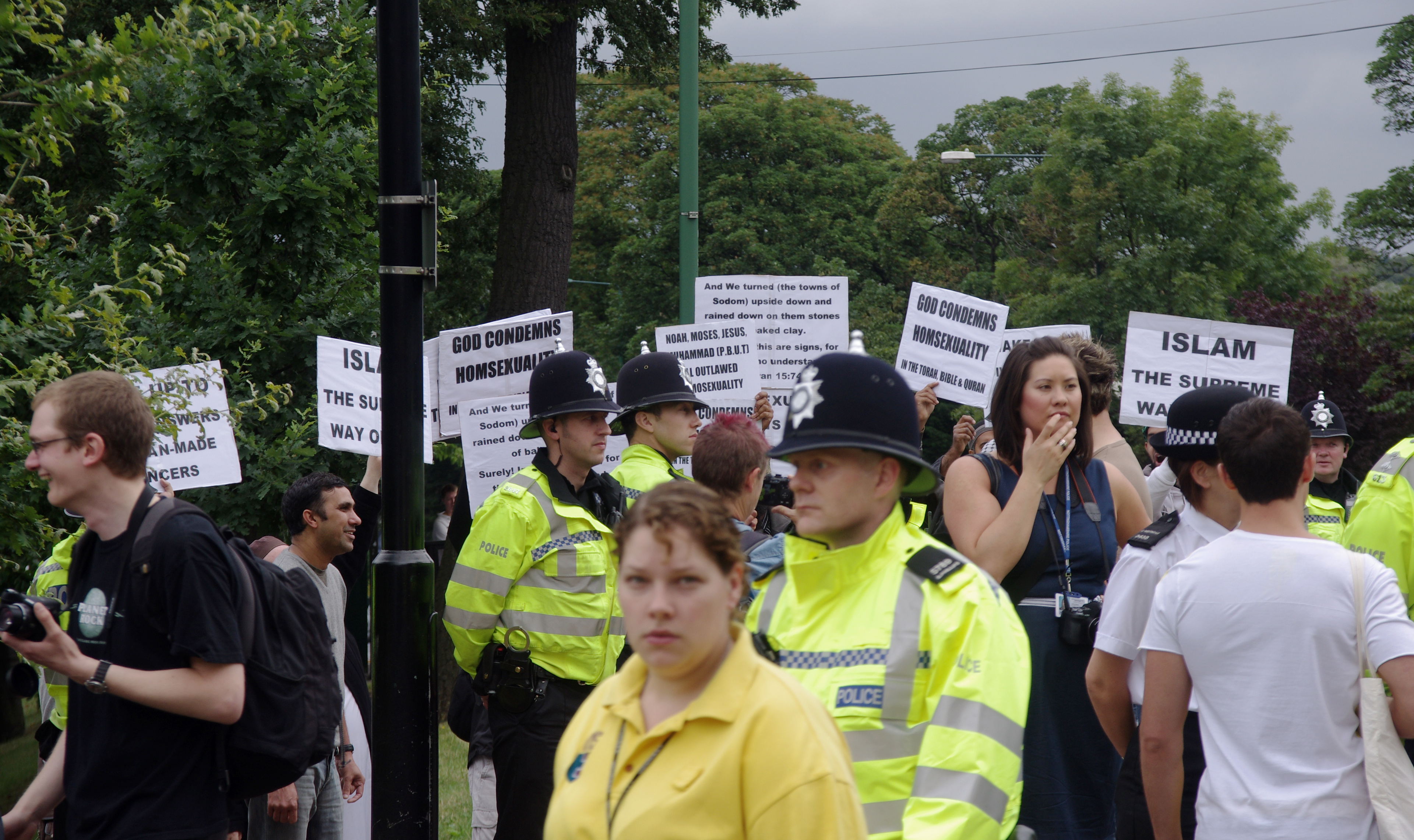
- In 2012, in the English city of Derby, some Muslim men "distributed ... leaflets depicting gay men being executed in an attempt to encourage hatred against homosexuals." The leaflets had such titles as "Turn or Burn" and "God abhors you" and they advocated a death penalty for homosexuality. The men were "convicted of hate crimes" on 20 January 2012. One of the men said that he was doing his Muslim duty.
- 31 December 2013 – New Year's Eve arson attack on gay nightclub in Seattle, packed with 300+ revelers, but no one injured. Subject charged prosecuted under federal terror and hate-crime charges.
- 12 February 2016 – Across Europe, gay refugees facing abuse at migrant asylum shelters are forced to flee shelters.
- 25 April 2016 – Xulhaz Mannan, an employee of the United States embassy in Dhaka and the editor of Bangladesh's first and only LGBTQ magazine, was killed in his apartment by a gang of Islamic militants.
- 12 June 2016 – At least 49 people were killed and 50 injured in a mass shooting at Pulse gay nightclub in Orlando, Florida, in the second deadliest mass shooting by an individual and the deadliest incident of violence against LGBTQ people in U.S. history. The shooter, Omar Mateen, pledged allegiance to ISIL. The act has been described by investigators as an Islamic terrorist attack and a hate crime. Upon further review, investigators indicated Omar Mateen showed few signs of radicalization, suggesting that the shooter's pledge to ISIL may have been a calculated move to garner more news coverage. Muslim American and their community leaders swiftly condemned the attack, and prayer vigils for the victims were held at mosques across the country. The Florida mosque where Mateen sometimes prayed issued a statement condemning the attack and offering condolences to the victims. The Council on American–Islamic Relations called the attack "monstrous" and offered its condolences to the victims. CAIR Florida urged Muslims to donate blood and contribute funds in support of the victims' families.
- During March 2019, British Muslim parents began protesting Parkfield Community School, a town where more than a third of the children are Muslim, due to the school's implementation of a "No Outsiders" sex-education program. The aim of this program was to provide students with lessons on same-sex relationships. The protest led to the school backing down by no longer following through with the "No Outsider" program. Regardless of this, the school's minister emphasized that the school tries to express equality.
Notes
References
References
- (2013). "Is Green a Part of the Rainbow? ''Sharia'', Homosexuality, and LGBT Rights in the Muslim World". [[Fordham University School of Law]].
- Schmidtke, Sabine. (June 1999). "Homoeroticism and Homosexuality in Islam: A Review Article". [[Cambridge University Press]] on behalf of the [[School of Oriental and African Studies]] ([[University of London]]).
- (1997). "[[Islamic Homosexualities". [[NYU Press]].
- (18 May 2020). "Forum: LGBTQ+ Issues in International Relations, Human Rights & Development – Same-Sex Narratives and LGBTI Activism in the Muslim World". [[Walsh School of Foreign Service]] at the [[Georgetown University]].
- Rowson, Everett K.. (30 December 2012). "HOMOSEXUALITY ii. IN ISLAMIC LAW". [[Columbia University]].
- (1997). "[[Islamic Homosexualities". [[NYU Press]].
- Everett K. Rowson. (2004). "Homosexuality". MacMillan Reference USA.
- Khaled El-Rouayheb. "Before Homosexuality in the Arab-Islamic World 1500–1800".
- Ali, Kecia. (2016). "Sexual Ethics And Islam". Oneworld Publications (Kindle edition).
- (October 2016). "Homophobic Muslims: Emerging Trends in Multireligious Singapore". [[Cambridge University Press]].
- (6 June 2018). "How homosexuality became a crime in the Middle East". The Economist.
- Siraj, Asifa. (September 2012). ""I Don't Want to Taint the Name of Islam": The Influence of Religion on the Lives of Muslim Lesbians". [[Taylor & Francis]].
- (June 2020). "Countering Islamic conservatism on being transgender: Clarifying Tantawi's and Khomeini's fatwas from the progressive Muslim standpoint". [[Taylor & Francis]].
- (26 January 2022). ""Even If You Go to the Skies, We'll Find You": LGBT People in Afghanistan After the Taliban Takeover". [[Human Rights Watch]].
- (June 4, 2013). "The Global Divide on Homosexuality".
- (2022). "Islamic Legal Status on Hajj for Transgender People according to Muslim Scholars in North Sulawesi". Mazahib Jurnal Pemikiran Hukum Islam.
- John Boswell. (2009). "Christianity, Social Tolerance, and Homosexuality: Gay People in Western Europe from the Beginning of the Christian Era to the Fourteenth Century". University of Chicago Press.
- Al-Rouayheb, Khaled. (2005). "Before Homosexuality in the Arab-Islamic World".
- Francis, Richard. (2007). "Shah Abbas I and his Page". [[Louvre.
- "Abu Nuwas | Persian poet".
- Habib, Samar. (2012-08-06). "Female Homosexuality in the Middle East". [[Routledge]].
- Lange, Christian. (2016). "Paradise and Hell in Islamic Traditions". Cambridge University Press.
- "Katerina Dalacoura (2014) p.4".
- Rowson, Everett K.. (23 March 2012). "HOMOSEXUALITY iii. IN PERSIAN LITERATURE". [[Columbia University]].
- Ze’evi, Dror. (2006). "Producing Desire: Changing Sexual Discourse in the Ottoman Middle East, 1500-1900". University of California Press.
- Murray, Stephen O.. (2007). "Homosexuality in the Ottoman Empire". Historical Reflections / Réflexions Historiques.
- Haug. (2019). "Ottoman And European Music In ʿAlī Ufuḳī 's Compendium, MS Turc 292".
- Schick, İrvin Cemil. (2004). "Representation of Gender and Sexuality in Ottoman and Turkish Erotic Literature". The Turkish Studies Association Journal.
- (2014). "A History of Islamic Societies". Cambridge University Press (Kindle edition).
- Massad, Joseph. (2007). "Desiring Arabs". University of Chicago Press.
- Khaled El-Rouayheb. (2009). "Before Homosexuality in the Arab-Islamic World, 1500–1800". University of Chicago Press.
- (2018). "Radical Islam, Tolerance, and the Enlightenment". Studies in Eighteenth-Century Culture.
- (2013). "Oppression and Subalternity: Homosexual and Transgender in Islam". Journal of the International Relations and Affairs Group.
- (13 May 2010). "Sexuality and Islam". The European Journal of Contraception & Reproductive Health Care.
- Tehmina Kazi. (7 October 2011). "The Ottoman empire's secular history undermines sharia claims". UK Guardian.
- Ishtiaq Hussain. (15 February 2011). "The Tanzimat: Secular Reforms in the Ottoman Empire". Faith Matters.
- (2021). "Decolonizing Decriminalization Analyses: Did the Ottomans Decriminalize Homosexuality in 1858?". Journal of Homosexuality.
- Ze'evi, Dror. (2005). "Hiding Sexuality: The Disappearance of Sexual Discourse in the Late Ottoman Middle East". Social Analysis: The International Journal of Social and Cultural Practice.
- Zeevi, Dror. "Hiding Sexuality - Disappearance of Sexual Discourse in the Late Ottoman Middle East". Social Analysis.
- Tilo Beckers, "Islam and the Acceptance of Homosexuality," in ''Islam and Homosexuality, Volume 1'', ed. Samar Habib, 64–65 (Praeger, 2009).
- Viola van Melis. (16 November 2011). "Islam tolerierte früher Homosexuelle". HPD Humanistischer Pressedienst.
- Shafiqa Ahmadi. (2012). "Islam and Homosexuality: Religious Dogma, Colonial Rule, and the Quest for Belonging". Journal of Civil Rights and Economic Development.
- Shanon Shah. "Islam's LGBT allies".
- (1992). "Asian homosexuality". Taylor & Francis.
- "Legal Path Dependence and the Long Arm of the Religious State: Sodomy Provisions and Gay Rights Across Nations and Over Time". State University of New York Press.
- (2006). "Homosexuality". [[Brill Publishers]].
- (1997). "[[Islamic Homosexualities". [[NYU Press]].
-
- 80-84; {{qref. 11. 77-83; {{qref. 21. 74; {{qref. 22. 43; {{qref. 26. 165–175; {{qref. 27. 56–59; and {{qref. 29. 27–33.
- Duran (1993) p. 179
- Kligerman (2007) pp. 53–54
- (2012). "Masculinity, Homosexuality and the Defence of Islam: A Case Study of Yusuf al-Qaradawi's Media Fatwa". Religion and Gender.
- Scott Siraj al-Haqq Kugle. (2003). "Progressive Muslims: On Justice, Gender, and Pluralism". Oneworld Publications.
- "Kugle, Scott Siraj al-Haqq (2010) Homosexuality in Islam: Critical Reflections on Gay, Lesbian, and Transgender Muslims. Oxford: Oneworld Publications".
- "Wunibald Müller, Homosexualität – eine Herausforderung für Theologie und Seelsorge, Mainz 1986, p. 64-65.".
- "Andreas Ismail Mohr: "Wie steht der Koran zur Homosexualität?", in: LSVD Berlin-Brandenburg e.V. (Hrsg.): Muslime unter dem Regenbogen. Homosexualität, Migration und Islam. Berlin: Querverlag, 2004, p. 16".
- "Noegel, Scott B.; Wheeler, Brannon M. (2010). Lot. The A to Z of Prophets in Islam and Judaism. Rowman & Littlefield Publishers, Incorporated. pp. 118–126. ISBN 978-0810876033".
- Wayne Dynes, ''Encyclopaedia of Homosexuality'', New York, 1990.
- (2017). "Roads to Paradise: Eschatology and Concepts of the Hereafter in Islam". [[Brill Publishers]].
- "Hadith Sahih on Behaviour of LGBT". [[Government of Malaysia]].
- {{cite encyclopedia. Oliver. Leaman. Oxford University Press. (2009). link
- Elyse Semerdjian. (2008). ""Off the Straight Path": Illicit Sex, Law, and Community in Ottoman Aleppo". Syracuse University Press.
- إسماعيل العجلوني(Ismail Ajlouni). "Kash Al-khafa".
- Elyse Semerdjian. (2007). "Islam". Greenwood Press.
- "Wasā'il al-Shīʿa".
- (2007). "Islamic bioethics problems and perspectives". Springer Science & Business Media.
- Habib, Samar. (2010). "Islam and Homosexuality". ABC-CLIO.
- (2014). "Homosexuality". Oxford University Press.
- Habib, Samar. (2010). "Islam and Homosexuality". ABC-CLIO.
- Peters, Rudolph. (2006). "Crime and Punishment in Islamic Law: Theory and Practice from the Sixteenth to the Twenty-First Century". Cambridge University Press.
- Omar, Sara. "The Oxford Encyclopedia of Islam and Law". Oxford Islamic Studies Online.
- Rowson, Everett K.. (October 1991). "The Effeminates of Early Medina". [[American Oriental Society]].
- (2021). "The Routledge Handbook of Islam and Gender". [[Routledge]].
- Alipour, Mehrdad. (2017). "Islamic shari'a law, neotraditionalist Muslim scholars and transgender sex-reassignment surgery: A case study of Ayatollah Khomeini's and Sheikh al-Tantawi's fatwas". [[Taylor & Francis]].
- "7 countries still put people to death for same-sex acts". ILGA.
- "and the United Arab Emirates".
- Mathews, Kevin. (November 21, 2013). "Man Accused of "Gay Handshake" Stands Trial in Dubai".
- (17 December 2010). "Fifa boss Sepp Blatter sorry for Qatar 'gay' remarks". BBC.
- (November 2025}} In 2019, an Egyptian TV host was sentenced to one year in prison on charges of promoting debauchery after interviewing a gay man.{{Cite web). "Egypt's LGBT Crackdown Expands to Stifle Journalists".
- Gamal El-Din, El-Sayed. (20 January 2019). "Egyptian court sentences TV presenter El-Gheity to 1 year in 'promoting debauchery on air' case".
- (15 June 2016). "Anti-Gay Rhetoric in English-Language ISIS and Al Qaeda Magazines". [[Anti-Defamation League]].
- Tharoor, Ishaan. "The Islamic State's shocking war on homosexuals". The Washington Post.
- (15 June 2016). "What ISIS Is Saying About the Orlando Shooter".
- "ISIS targets gay people using Facebook and phone contacts".
- (2 December 2015). "Inside look at ISIS' brutal persecution of gays".
- (6 March 2015). "Amid brazen, deadly attacks, gay Syrians tell of fear of ISIS persecution".
- Jeremy Page. (29 June 2009). "India to repeal anti-gay law as second Gay Pride is held". The Times Online.
- (1 July 2009). "After Deoband, other Muslim leaders condemn homosexuality". [[The Times of India]].
- (6 September 2018). "India Gay Sex Ban Is Struck Down. 'Indefensible,' Court Says.". [[The New York Times]].
- (4 February 2012). "Straight but narrow". The Economist.
- (16 February 2019). "In Jordan, the LGBTQ+ Community Is Not Criminalized But Still Stigmatized".
- Pawar, Yogesh. (2013). "Bangladesh Refuses to Abolish Criminalisation of Same-Sex Ties: In Denial about its 4.5 Million-Strong LGBT Community, Dhaka Shoots Down the United Nations Human Rights Commission Recommendations". [[Daily News and Analysis]].
- Signorile, Michelangelo. (19 December 2014). "Saudi Arabia Beheads Gays, but Marco Rubio Has No Problem With You Traveling There". [[HuffPost]].
- (26 October 2018). "Mahathir claims LGBT rights are 'Western values' not fit for Malaysia".
- Palansamy, Yiswaree. (14 May 2019). "LGBT culture against Islamic principles but Malaysia doesn't kill gays, deputy minister tells George Clooney {{!}} Malay Mail".
- (2021-01-28). "LGBT rights: Indonesia's Aceh flogs two men for having sex". BBC News.
- "Indonesia's LGBTQ community fears legal crackdown – DW – 06/02/2022".
- (2 July 2015). "Difficult for Indonesia to legalize gay marriage: Minister". The Jakarta Post.
- (18 March 2015). "Fatwa MUI Hukum Mati Kaum Homoseksual Dinilai Sulit Diterapkan". Tribunnews.
- Ellis-Petersen, Hannah. (28 March 2019). "Brunei introduces death by stoning as punishment for gay sex". The Guardian.
- (6 May 2019). "Brunei backs down on gay sex death penalty after international backlash". CNN.
- (3 April 2019). "Brunei enacts Islamic laws to punish gay sex with stoning to death — here's what you need to know". ABC.
- Stewart, Colin. (2024-06-21). "Homosexuality is now illegal in 64 nations".
- (14 December 2020). "State-Sponsored Homophobia Report: Global Legislation Overview Update, 2020". [[International Lesbian, Gay, Bisexual, Trans and Intersex Association.
- (March 2023). "Criminalisation of Same-Sex Sexual Acts". [[International Lesbian, Gay, Bisexual, Trans and Intersex Association]].
- (March 2021). "Shari'a and LGBTI Persons: The Use of Shari'a as Religious Justification for Capital Punishment Against LGBTI Persons". [[United States Commission on International Religious Freedom]].
- (18 March 2008). "Case Study in Iranian Criminal System".
- (May 2016). "State Sponsored Homophobia 2016: A world survey of sexual orientation laws: criminalisation, protection and recognition". International Lesbian, Gay, Bisexual, Trans and Intersex Association.
- Rebecca Wright and Alexandra Field. (2 April 2019). "Brunei's LGBT community flees 'inhumane' new stoning laws".
- Kramer, Andrew E.. (1 April 2017). "Chechen Authorities Arresting and Killing Gay Men, Russian Paper Says". The New York Times.
- Kramer, Andrew E.. (1 May 2017). "Russians Protesting Abuse of Gay Men in Chechnya Are Detained". The New York Times.
- "Russian LGBT Network evacuating 'at risk' people from Chechnya".
- "Satpol PP Palembang, Ungkap Sering Temukan Pasangan LGBT, Tapi Sulit Ditindak".
- "Maldives Penal Code, s411".
- "Pakistan Penal Code (Act XLV of 1860)". Pakistani.
- Ready, Freda. (4 December 2002). "Qatar's Gay Rights Policy Under Scrutiny". [[The Cornell Daily Sun]].
- "Syria: Treatment and human rights situation of homosexuals".
- Anderson, Ben. (2007). "The Politics of Homosexuality in Africa". Africana.
- Ottosson, Daniel. (2013). "State-sponsored Homophobia: A world survey of laws prohibiting same sex activity between consenting adults". International Lesbian and Gay Association (ILGA).
- (18 March 2015). "In response to anti-LGBT fatwa, Jokowi urged to abolish laws targeting minorities". The Jakarta Post.
- (8 July 2015). "Indonesia: Situation of sexual minorities, including legislation, treatment by society and authorities, state protection and support services available (2013– June 2015)". [[Immigration and Refugee Board of Canada]].
- (May 2014). "State-sponsored Homophobia – A world survey of laws: Criminalisation, protection and recognition of same-sex love". International Lesbian, Gay, Bisexual, Trans and Intersex Association.
- (2009). "Kuwait Law". ILGA Asia.
- "Law of the Republic of Uzbekistan On Enactment of the Criminal Code of the Republic of Uzbekistan". Legislationline.org.
- Lowen, Mark. (30 July 2009). "Albania 'to approve gay marriage'". BBC News.
- (August 2005). "Rough Guide to South East Asia". Rough Guides Ltd..
- (19 July 2018). "Activists hail Lebanon ruling that could protect gay rights". The Times of Israel.
- (23 July 2018). "Appeals court in Lebanon rules consensual same-sex relations are not unlawful".
- "Law No.2004/ 3 THE ANTI-DISCRIMINATION LAW".
- "Law on Prohibition of Discrimination".
- "Bay Area Reporter :: Article.php".
- "LGBT haklarına anayasada değil, gerekçede tahammül edebildiler". T24.
- Solaker, Gulsen. (2013-11-18). "Hopes fade for a new Turkish constitution". Reuters.
- Effy. "İzmir Büyükşehir Belediye Başkanı Tunç Soyer'den LGBTİ Bireyler İçin Daire Başkanlığı".
- "Northern Cyprus Decriminalizes Homosexuality and Protects LGBTs Against Hate Speech {{!}} Kaos GL News Portal".
- "Ceza Yasası".
- (2013-05-21). "Lawyer: Two Moroccans jailed for homosexuality".
- (12 December 2007). "Al Arabiya: "Morocco sentences gay 'bride' to jail"". alarabiya.net.
- (30 March 2012). "FRANCE – Concilier islam et homosexualité, le combat de Ludovic-Mohamed Zahed – France 24". France 24.
- (1 December 2010). "Bradlee Dean: Keith Ellison is advancing Sharia law through 'homosexual agenda'". Minnesota Independent.
- (9 June 2012). "Keith Ellison: Minnesota Anti-Gay Marriage Amendment Will Fail".
- (6 November 2014). "Crackdown As Men Jailed Over 'Gay Wedding'".
- Hamedani, Ali. (5 November 2014). "The gay people pushed to change their gender". [[BBC Persian]].
- Bagri, Neha Thirani. (19 April 2017). "In Iran, there's only one way to survive as a transgender person".
- Barford, Vanessa. (25 February 2008). "Iran's 'diagnosed transsexuals'". BBC News.
- (20 January 2020). "The heavy price to pay for a sex change in Turkey".
- "Situation report on discriminations against women in Turkey". [[EuroMed Rights]].
- (27 June 2016). "Clerics issue fatwa allowing transgender marriage in Pakistan". Samaa Web Desk.
- (9 May 2018). "Pakistan Passes Historic Transgender Rights Bill". NPR.
- (18 February 2019). "Transgenders in Pakistan; challenges and prospects".
- (4 June 2013). "The Global Divide on Homosexuality". [[Pew Research Center]].
- (23 June 2019). "The Arab world in seven charts: Are Arabs turning their backs on religion?". BBC News.
- (2007). "Living Apart Together: British Muslims and the Paradox of Multiculturalism". [[Policy Exchange]].
- Butt, Riazat. (7 May 2009). "Muslims in Britain have zero tolerance of homosexuality, says poll". The Guardian.
- (11 April 2016). "ICM Muslims Survey for Channel 4". [[ICM Research]].
- "Zusammenfassung 'Muslimisches Leben in Deutschland'". German [[Federal Ministry of the Interior (Germany).
- [[:de:Liljeberg Research International. Liljeberg Research International]]: ''[https://d171.keyingress.de/multimedia/document/228.pdf Deutsch-Türkische Lebens- und Wertewelten 2012] {{webarchive. link. (11 October 2012 '', July/August 2012, p. 73)
- (8 January 2015). "Muslime in Deutschland mit Staat und Gesellschaft eng verbunden". [[Bertelsmann]].
- "Weltanschauliche Vielfalt und Demokratie". [[Bertelsmann]].
- (26 July 2017). "U.S. Muslims Concerned About Their Place in Society, but Continue to Believe in the American Dream". [[Pew Research Center]].
- (5 January 2018). "Emerging Consensus on LGBT Issues: Findings From the 2017 American Values Atlas". [[Public Religion Research Institute]].
- (11 October 2016). "Humo's grote Islam-enquête (1): 'Eén op de vijf moslims heeft begrip voor IS'". [[HUMO]].
- (27 April 2016). "Muslim Canadians increasingly proud of and attached to Canada, survey suggests".
- "Almost half of people in Turkey think that LGBT+ people should have equal rights, nine percent more than last year, according to a survey".
- "Perceptions of Gender Equality".
- Ali, Ayaan Hirsi. (13 June 2016). "Islam's Jihad Against Homosexuals". Wall Street Journal.
- (27 May 2016). "Iran's Supreme Leader says "There is no worst form of moral degeneration than homosexuality"". Outrightinternational.org.
- Dehghan, Saeed Kamali. (14 March 2013). "Iranian human rights official describes homosexuality as an illness". The Guardian.
- "A Code of Practice For Muslims in the West". sistani.org.
- Beden Offord. (2016). "Queer Activist Intersections in Southeast Asia: Human Rights and Cultural Studies". Routledge.
- (2012). "Queer Religion: Homosexuality in Modern Religious History, Volume 1". [[Greenwood Publishing Group.
- (1998). "Liberal Islam: A Sourcebook". [[Oxford University Press]].
- Banerji, Robin. (November 30, 2012). "Gay-friendly 'mosque' opens in Paris".
- Sarac, Tugay. (2 May 2019). "My LGBT-friendly mosque saved me from being radicalised".
- "Meet America's first openly gay imam".
- (April 2019). "Affirming mosques help gay Muslims reconcile faith, sexuality".
- "A Mosque For LGBTQ Muslims". NPR.org.
- "Masjid al-Rabia Home".
- "Atlanta Unity Mosque".
- "Stances of Faiths on LGBTQ Issues: Islam".
- (2015-05-09). "Is Cape Town's women and gay-friendly mosque a sign of new Muslim attitudes?".
- "Gay Mosque in Cape Town – rainbopedia.org".
- (2019-02-05). "'Space to coexist': Inside South Africa's LGBT-friendly mosque". Reuters.
- (2018-06-14). "How Queer Muslims Are Working to End Stigma This Ramadan".
- (2018-06-14). "Queering Ramadan: Second Annual LGBTQAI+ Muslims and Allies Iftar".
- "Who We Are". MPVUSA.org.
- "SEXUAL DIVERSITY".
- "Home".
- (14 March 2000). "Cyber Mecca". The Advocate.
- (2016-11-02). "A gay mosque in Cape Town sounds the call to prayer for everyone".
- Fullerton, Jamie. (2022-10-19). "'I'm hoping there will be more queer imams'". The Guardian.
- Baggs, Cherry Wilson and Michael. (23 September 2019). "LGBT Muslims told to choose religion or sexuality".
- (3 May 2016). "Being gay and muslim: 'death is your repentance'". [[Star Observer]].
- "What you should know about being LGBT and Muslim, from a leading LGBT Muslim group". WashingtonPost.com.
- (11 April 2014). "The Safra Project – rabble.ca". Rabble.ca.
- Catherine Patch. (15 June 2006). "Queer Muslims find peace; El-Farouk Khaki founded Salaam Offers a place to retain spirituality". Toronto Star.
- Agan Uzunović. (18 May 2016). "Bosnian LGBTI Activists Demand: Equality Now!". Revolution News.
- (21 June 2013). "About us – Sarajevski Otvoreni Centar". Soc.ba.
- (19 May 2016). "Povećan broj slučajeva kršenja ljudskih prava LGBTI osoba – BUKA Magazin". 6yka.com.
- (17 May 2016). "Norwegian Embassy supports Sarajevo Open Centre's Pink Report". Norveska.ba.
- "El-tawhid juma circle".
- (4 April 2017). "What It's Like To Pray At A Queer-Inclusive Mosque". [[BuzzFeed]].
- (3 June 2016). "Queer and going to the mosque: 'I've never felt more Muslim than I do now'". [[The Guardian]].
- (25 August 2013). "Islamic scholars experience diversity of Muslim practices at U of T summer program". [[Toronto Star]].
- (April 2019). "Affirming mosques help gay Muslims reconcile faith, sexuality".
- Throckmorton, Warren. (June 2002). "Initial empirical and clinical findings concerning the change process for ex-gays". Professional Psychology: Research and Practice.
- (2010). "Islam and Homosexuality". ABC-CLIO.
- (2007). "Sexual Orientation Discrimination: An International Perspective". Routledge.
- (2011). "Unspeakable Love: Gay and Lesbian Life in the Middle East". Saqi.
- "The StraightWay Foundation Homepage".
- (February 8, 2008). "Help for Same-Sex Attracted Muslims".
- Sohaib, Saeed. (April 2005). "London mayor stands firm despite sustained campaign".
- Waugh, Paul. (3 March 2005). "Ken in Row Over Anti-gay Link".
- Caroline Fourest and Fiammetta Venner. (30 March 2005). "Ken le rouge vire au vert islam".
- (10 January 2012). "Muslims posted 'nasty and frightening' anti-gay leaflets demanding homosexuals 'turn or burn'". Telegraph.co.uk.
- "Man pleads guilty to arson at Seattle gay nightclub". SeattleTimes.com.
- (22 February 2016). "Across Europe, gay refugees facing abuse in asylum shelters". FoxNews.com.
- Al-Mahmood, Syed Zain. (26 April 2016). "Editor of Bangladesh Gay Magazine Hacked to Death in His Home". Wall Street Journal.
- (12 June 2016). "Orlando nightclub shooting: 50 killed in shooting rampage at gay club; gunman pledged allegiance to ISIS". The Washington Post.
- Ingraham, Christopher. (12 June 2016). "In the modern history of mass shootings in America, Orlando is the deadliest". Washington Post.
- Peralta, Eyder. (13 June 2016). "Putting 'Deadliest Mass Shooting In U.S. History' Into Some Historical Context". NPR.
- (15 June 2016). "Orlando Gay Nightclub Massacre a Hate Crime and Act of Terror, FBI Says". ABC News.
- (18 June 2016). "Investigators Say Orlando Shooter Showed Few Warning Signs Of Radicalization".
- Gunaratna, Shanika. (13 June 2016). "Muslim Americans rush to condemn Orlando massacre". CBS News.
- (13 June 2016). "Muslim leaders condemn Florida massacre, brace for backlash". Reuters.
- Lozano, Carlos. (12 June 2016). "Several vigils are planned around Southern California for the Orlando shooting victims". [[Los Angeles Times]].
- Mooney, Sean. (13 June 2016). "Tucson mosque condemns shootings in Orlando". KVOA.
- Warikoo, Niraj. (12 June 2016). "Metro Detroit Muslims strongly condemn Orlando shooting". USA Today.
- Galvez, Samantha. (13 June 2016). "Harrisburg mosque holds prayer vigil for Orlando victims". [[WHTM-TV]].
- Whitney Leaming. (13 June 2016). ["Orlando Muslims turn to prayer after shooting puts community 'on edge'"](https://www.washingtonpost.com/video/national/orlando-muslims-turn-to-prayer-after-shooting-puts-community-on-edge/2016/06/13/9c1c8aec-3134-11e6-ab9d-1da2b0f24f93_video.html). *The Washington Post*.
- DeAngelis, Jenna. (12 June 2016). "Muslim and LGBT community hold vigil for Orlando victims in Hartford". [[WTIC-TV]].
- Morris, Walter. (12 June 2016). "Local Muslim community condemns Orlando nightclub shooting". WSVN.
- Hutchison, Ben. (13 June 2016). "Milwaukee mosque holds prayer vigil for Orlando shooting victims". WISN.
- Blinder, Alan. (12 June 2016). "Fort Pierce Mosque in Florida Condemns Attack". The New York Times.
- (13 June 2016). "Muslim community condemns Orlando attack, calls for blood donations". [[WPLG]].
- (7 March 2019). "British Muslim parents oppose LGBT lessons in primary school". The Economist.
This article was imported from Wikipedia and is available under the Creative Commons Attribution-ShareAlike 4.0 License. Content has been adapted to SurfDoc format. Original contributors can be found on the article history page.
Ask Mako anything about LGBTQ people and Islam — get instant answers, deeper analysis, and related topics.
Research with MakoFree with your Surf account
Create a free account to save articles, ask Mako questions, and organize your research.
Sign up freeThis content may have been generated or modified by AI. CloudSurf Software LLC is not responsible for the accuracy, completeness, or reliability of AI-generated content. Always verify important information from primary sources.
Report