From Surf Wiki (app.surf) — the open knowledge base
Levinus Lemnius
Dutch physician and author (1505–1568)
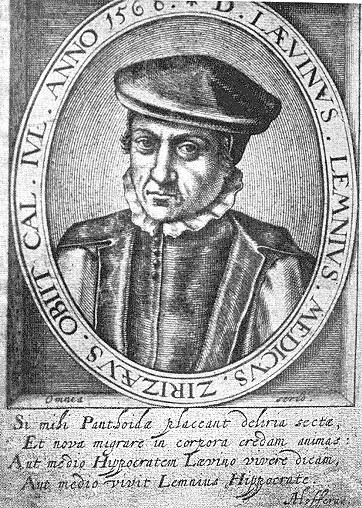
Dutch physician and author (1505–1568)
Levinus Lemnius (20 May 1505 in Zierikzee – 1 July 1568 in Zierikzee) was a Dutch physician and author.
Life
Lemnius studied medicine at the University of Leuven under Rembert Dodoens and Konrad Gesner; and under Vesalius at Padua. He also travelled to Switzerland and England. After his wife's death, he became a priest.
Works
- Occulta naturae miracula (1559, Antwerp) by the University and State Library Düsseldorf) This was translated as De gli occvlti miracoli, Les Occultes Merveilles et Secretz de Nature (online text, The secret miracles of nature, and Wunderbarliche Geheimnisse der Natur online text).
- De habitu et constitutione corporis (1561, Antwerp). As The Touchstone of Complexions (1576) (translation into English by Thomas Newton)
- Herbarum atque arborum quae in Bibliis passim obviae sunt et ex quibus sacri vates similitudines desumunt. In English as An Herbal for the Bible (1579, Newton translation).
- De miraculis occultis naturae : libri IIII (1611, Francofurti) by the University and State Library Düsseldorf His Occulta naturae miracula, a book of secrets, is his best-known work. It ran through many editions and was widely translated from Latin. It drew on classical sources, particularly Aristotle. Lemnius was influenced, too, by the "airs, waters, places" doctrine from the Hippocratic Corpus. The work attempted to reconcile natural philosophy as found in classical sources with Christian doctrine, particularly on generation and reproduction, while emphasising extraordinary aspects. His humoral theory was complex, with phlegm being divided into four, and the other humours also being subdivided.
He is credited with first mentioning in this work of staining of bone, with madder root. In the same work he gives credence to the theory of maternal impression; his theory of teratology connects the Aristotelian theory of generation with birth defects. He contributed to demonology, with Johann Weyer, by suggesting that mental illness and disturbance could be physically caused, rather than being a result of outside influence. He also credited Solomon with the invention of the magnetic compass.
This work in some form had a lifetime of nearly four centuries. It was later combined with a German manual on midwifery by Jakob Rüff, to create Aristotle's Masterpiece, a 17th-century work in English of advice on sex and reproduction, still sold in later editions in the 1930s.
Notes
References
- Also '''Lenneus''' or '''Lennius''', originally '''Lievin Lemnes''' or '''Lemmens''' or '''Lemse''' (and also Dutch '''Livinus of Lieven'''); in Italian known as '''Levinio Lennio''' or '''Lemmio'''; in England in the 16th century as Levine Lemnie.
- "CERL Thesaurus".
- "Nieuw Nederlandsch biografisch woordenboek. Deel 8 · dbnl".
- (January 1, 2000). "L'époque de la Renaissance: 1400-1600". John Benjamins Publishing.
- "Zierikzee Monumentenstad. Vroeger. Personen. Oud-Zierikzeeënaars. Lieven Lemse".
- Lemnius, Levinus. (December 25, 1583). "De miracvlis occvltis natvrae libri IIII : item, De vita cvm animi et corporis incolvmitate recte institvenda liber vnvs : illi quidem iam postremum emendati, & aliquot capitibus aucti : hic verò nunquam antehac editus". Coloniae Agrippinae : Apud Theodorum Baumium ....
- [https://www.worldcat.org/oclc/014301009 World Cat]; subsequent Latin editions as ''De occultis naturae miraculis''.
- "DFG-Viewer: Levini Lemnii occulta naturae miracula Occulta naturae miracula, ac varia rerum documenta <dt.> Wunderbarliche Geheimnisse der Natur in des Menschen Leibe und Seel, auch in vielen andern natürlichen Dingen als Steinen, Ertzt, Gewechs und Thieren ...".
- Lemnius, Levinus. (December 25, 1561). "De habitu et constitutione corporis, quam Greci kradin, triviales complexionem vocant, libri duo. Omnibus quibus secunda valetudo curae est, apprime necessarii, ex quibus cuique proclive erit corporis sui conditionem, animique motus, ac totius conservandae sanitatis rationem adamussim cognoscere ...". Apud Guilielmum Simonem.
- Braden, Gordon. "Newton, Thomas".
- "DFG-Viewer: De miraculis occultis naturae Occulta naturae miracula, ac varia rerum documenta".
- (2004). ""Foolishness" in early modern medicine and the concept of intellectual disability". Med Hist.
- "Books & Babies: Communicating Reproduction".
- From ''The Touchstone of Complexions''; [[John Bamborough. J. B. Bamborough]], ''The Little World of Man'' (1952), p. 59.
- Brian Keith Hall, ''Bones and Cartilage: developmental and evolutionary skeletal biology'' (2005), p. 433.
- "Linguaggio Globale - Indice Generale - Hotel Parigi".
- http://www.digitalsilesia.eu/Content/23006/inscription_on_the_body.pdf, pp.33–4.
- Adam Crabtree, ''The Transition to Secular Psychotherapy: Hypnosis and the Alternate-Consciousness Paradigm'', p. 555, Ch. 19 in History of Psychiatry and Medical Psychology 2008, Section Three, Part 4, 555-586, {{doi. 10.1007/978-0-387-34708-0_19
- Paul Fleury Mottelay, ''A Bibliographical History of Electricity and Magnetism'' (1922), p. 5; [https://archive.org/stream/bibliographicalh033138mbp#page/n29/mode/2up online.]
- "Books & Babies: Communicating Reproduction".
This article was imported from Wikipedia and is available under the Creative Commons Attribution-ShareAlike 4.0 License. Content has been adapted to SurfDoc format. Original contributors can be found on the article history page.
Ask Mako anything about Levinus Lemnius — get instant answers, deeper analysis, and related topics.
Research with MakoFree with your Surf account
Create a free account to save articles, ask Mako questions, and organize your research.
Sign up freeThis content may have been generated or modified by AI. CloudSurf Software LLC is not responsible for the accuracy, completeness, or reliability of AI-generated content. Always verify important information from primary sources.
Report