From Surf Wiki (app.surf) — the open knowledge base
Leviathan
Biblical sea monster
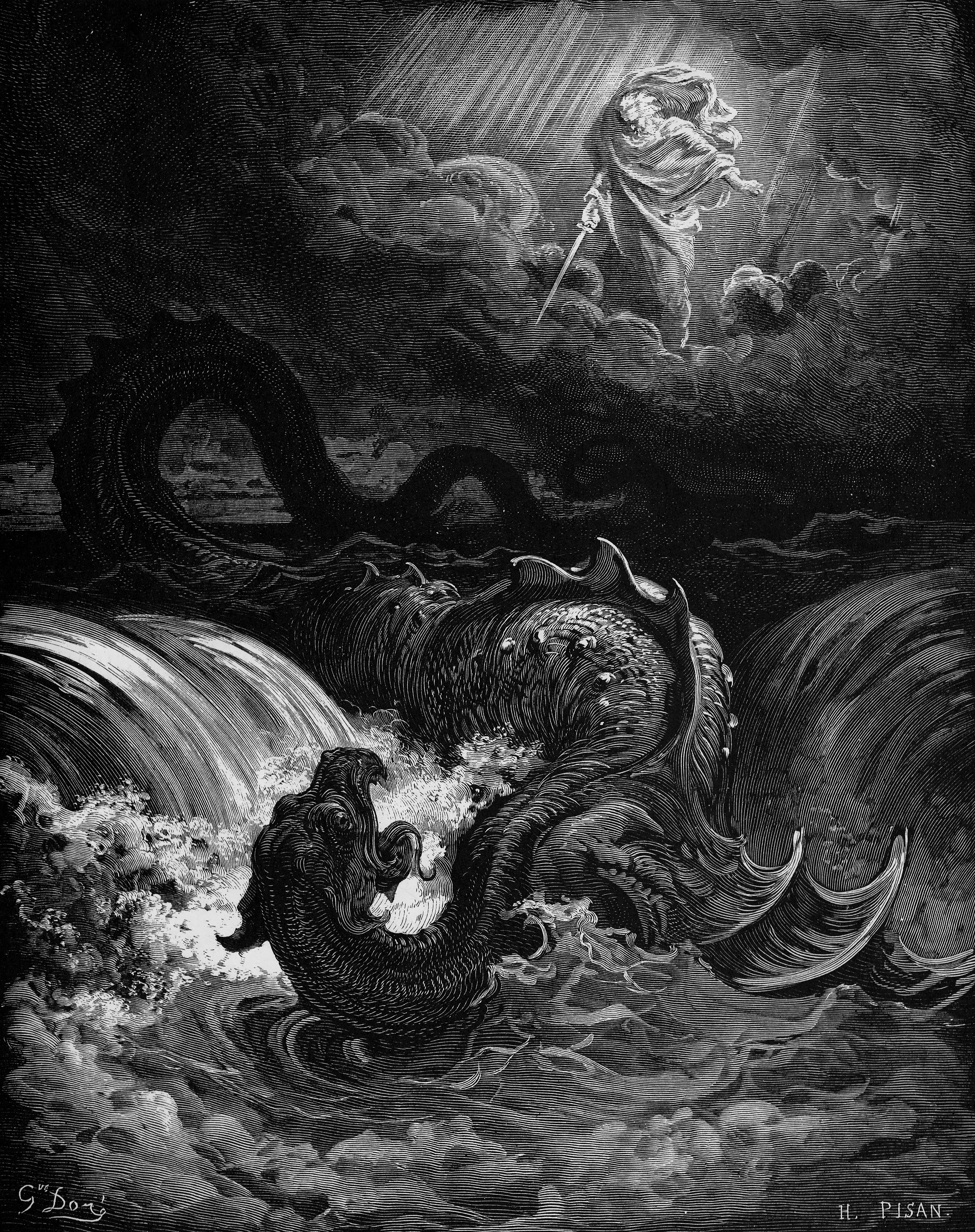
Biblical sea monster
the biblical creature

Leviathan ( ; ; ) is a sea serpent demon noted in theology and mythology. It is referenced in the Hebrew Bible, as a metaphor for a powerful enemy, notably Babylon. It is referred to in Psalms, the Book of Job, the Book of Isaiah, and the pseudepigraphical Book of Enoch. Leviathan is often an embodiment of chaos, threatening to eat the damned when their lives are over. In the end, it is annihilated. Christian theologians identified Leviathan with the demon of the deadly sin envy. According to Ophite Diagrams, Leviathan encapsulates the space of the material world.
In Gnosis, it encompasses the world like a sphere and incorporates the souls of those who are too attached to material things, so they cannot reach the realm of God's fullness beyond, from which all good emanates. In Hobbes, Leviathan becomes a metaphor for the omnipotence of the state, which maintains itself by educating children in its favour, generation after generation. This idea of eternal power that 'feeds' on its constantly self-produced citizens is based on a concept of conditioning that imprints the human's conscience in a mechanical manner. It deals in a good and evil dualism: a speculative natural law according to which man should behave towards man like a ravenous wolf, and the pedagogically transmitted laws of the state as Leviathan, whose justification for existence is seen in containing such frightening conditions.
Leviathan in the Book of Job is a reflection of the older Canaanite Lotan, a primeval monster defeated by the god Baal Hadad. Parallels to the role the primeval Sumerian sea goddess Tiamat, who was defeated by Marduk, have long been drawn in comparative mythology, as have been comparisons to dragon and world serpent narratives, such as Indra slaying Vritra or Thor slaying Jörmungandr. Some 19th-century scholars pragmatically interpreted it as referring to large aquatic creatures, such as the crocodile. The word later came to be used as a term for great whale and for sea monsters in general.
Etymology and origins
Both the name and the mythological figure are a direct continuation of the Ugaritic sea monster Lôtān, one of the servants of the sea god Yammu defeated by Hadad in the Baal Cycle. The Ugaritic account has gaps, making it unclear whether some phrases describe him or other monsters at Yammu's disposal such as Tunannu (the biblical Tannin). Most scholars agree on describing Lôtān as "the fugitive serpent" (bṯn brḥ) but he may or may not be "the wriggling serpent" (bṯn ʿqltn) or "the mighty one with seven heads" (šlyṭ d.šbʿt rašm). His role seems to have been prefigured by the earlier serpent Têmtum whose death at the hands of Hadad is depicted in Syrian seals of the 18th–16th century BC.
Sea serpents feature prominently in the mythology of the ancient Near East. They are attested by the 3rd millennium BC in Sumerian iconography depicting the god Ninurta overcoming a seven-headed serpent. It was common for Near Eastern religions to include a Chaoskampf: a cosmic battle between a sea monster representing the forces of chaos and a creator god or culture hero who imposes order by force. The Babylonian creation myth describes Marduk's defeat of the serpent goddess Tiamat, whose body was used to create the heavens and the earth. Recent scholarship has explored these sea-serpent traditions within the broader serpent symbolism of the ancient Mediterranean.
Tanakh
Leviathan specifically is mentioned six times in the Tanakh.
is dedicated to describing it in detail: "Behold, the hope of him is in vain; shall not one be cast down even at the sight of him?" Included in God's lengthy description of his indomitable creation is Leviathan's fire-breathing ability, his impenetrable scales, and his overall indomitability in . In , God is praised for having made all things, including Leviathan, and in , he is called the "tortuous serpent" who will be killed at the end of time.
The mention of the Tannins in the Genesis creation narrative (translated as "great whales" in the King James Version), in Job, and in the Psalm do not describe them as harmful but as ocean creatures who are part of God's creation. The element of competition between God and the sea monster and the use of Leviathan to describe the powerful enemies of Israel may reflect the influence of the Mesopotamian and Canaanite legends or the contest in Egyptian mythology between the Apep snake and the sun god Ra. Alternatively, the removal of such competition may have reflected an attempt to naturalize Leviathan in a process that demoted it from deity to demon to monster.
Judaism


Later Jewish sources describe Leviathan as a dragon who lives over the sources of the deep and who, along with the male land-monster Behemoth, will be served up to the righteous at the end of time. The Book of Enoch (60:7–9) describes Leviathan as a female monster dwelling in the watery abyss (as Tiamat), while Behemoth is a male monster living in the desert of Dunaydin ("east of Eden").
In the Jewish midrash (explanations of the Tanakh), it is stated that God originally produced a male and a female leviathan, but lest in multiplying the species should destroy the world, he slew the female, reserving her flesh for the banquet that will be given to the righteous on the advent of the Messiah. A similar description appears in Book of Enoch (60:24), which describes how the Behemoth and Leviathan will be prepared as part of an eschatological meal.
Rashi's commentary on repeats the tradition:
the ... sea monsters: The great fish in the sea, and in the words of the Aggadah (B.B. 74b), this refers to the Leviathan and its mate, for He created them male and female, and He slew the female and salted her away for the righteous in the future, for if they would propagate, the world could not exist because of them. הַתַּנִינִם is written.{{efn| The "הַתַּנִינִם is written" reference is to a missing final letter 'י' ("yud"), which would denote a plural, if used. Rashi uses this to infer that the leviathans did not remain two, but were reduced to just one leviathan, hence Hebrew grammatical singular spelling. }}
In the Talmud Baba Bathra 75 it is told that Leviathan will be slain and its flesh served as a feast to the righteous in [the] "time to come" and its skin used to cover the tent where the banquet will take place. Those who do not deserve to consume its flesh beneath the tent may receive various vestments of Leviathan varying from coverings (for the somewhat deserving) to amulets (for the least deserving). The remaining skin of Leviathan will be spread onto the walls of Jerusalem, thereby illuminating the world with its brightness. The festival of Sukkot (Festival of Booths) therefore concludes with a prayer recited upon leaving the sukkah (booth): : "May it be your will, Lord our God and God of our forefathers, that just as I have fulfilled and dwelt in this sukkah, so may I merit in the coming year to dwell in the sukkah of the skin of Leviathan. Next year in Jerusalem."
The enormous size of Leviathan is described by Johanan bar Nappaha, from whom proceeded nearly all the aggadot concerning this monster: : "Once we went in a ship and saw a fish which put his head out of the water. He had horns upon which was written: 'I am one of the meanest creatures that inhabit the sea. I am three hundred miles in length, and enter this day into the jaws of the Leviathan'".
When Leviathan is hungry, reports Rabbi Dimi in the name of Rabbi Johanan, he sends forth from his mouth a heat so great as to make all the waters of the deep boil, and if he would put his head into Paradise no living creature could endure the odor of him. His abode is the Mediterranean Sea.
In a legend recorded in the midrash called Pirke de-Rabbi Eliezer it is stated that the fish which swallowed Jonah narrowly avoided being eaten by Leviathan, which eats one whale each day.{{efn| The dragon is often represented in the act of partially wrapping itself on itself, with an apparent link with the commonly known snake; the combination of the dragon with the orbits of the constellations is evident, it also represents the incorruptible laws of creation and in this case the laws of the stars, as mentioned in the Book of Psalms and in particular in the kiddush levana, thereby indicating the ethical balance of who, being tzadik, would never allow himself to be tempted by sin. : The correlation with the fish Leviathan, as mentioned, thus concerns the attempt not to let oneself "be submerged by the sins of the world", so much so that in the same Pirkei Avot it is explicitly taught that God has mercy on His creatures and on Creation when the merits in the World exceed in quantity the sins of men. : Thus the principle of stability in the world together with "detachment from sin", while balanced by involvement in the good things that it presents to us, is sanctioned with what God says to King David, warning him about "the fundamental stone of the world in correspondence with Jerusalem": It is explained that God tells King David not to insist ... because : "otherwise the fundamental stone would have risen to the surface ... and the waters would have invaded the world again ...".
This is precisely the messianic struggle already prophesied about Leviathan.
The body of Leviathan, especially his eyes, possesses great illuminating power. This was the opinion of Rabbi Eliezer, who, in the course of a voyage in company with Rabbi Joshua, explained to the latter, when frightened by the sudden appearance of a brilliant light, that it probably proceeded from the eyes of Leviathan. He referred his companion to the words of Job 41:18: : "By his neesings a light doth shine, and his eyes are like the eyelids of the morning".
However, in spite of his supernatural strength, Leviathan is afraid of a small worm called "kilbit", which clings to the gills of large fish and kills them.
In the eleventh-century piyyut (religious poem), Akdamut, recited on Shavuot (Pentecost), it is envisioned that, ultimately, God will slaughter Leviathan, which is described as having "mighty fins" (and, therefore, a kosher fish, not an inedible snake or crocodile), and it will be served as a sumptuous banquet for all the righteous in heaven.
In the Zohar, Leviathan is a metaphor for enlightenment. The Zohar remarks that the legend of the righteous eating the flesh of Leviathan at the end of the days is not literal, and merely a metaphor for enlightenment. The Zohar also specifies in detail that the Leviathan has a mate. The Zohar also associates the metaphor of the leviathan with the "tzaddik" or righteous in Zohar 2:11b and 3:58a. The Zohar associates it with the "briach" the pole in the middle of the boards of the tabernacle in Zohar 2:20a. Both, are associated with the Sefira of Yesod.
According to Abraham Isaac Kook, Leviathan – a singular creature with no mate, "its tail is placed in its mouth" (Zohar) "twisting around and encompassing the entire world" (Rashi on Baba Batra 74b) – projects a vivid metaphor for the universe's underlying unity. This unity will only be revealed in the future, when the righteous will feast on Leviathan.
Christianity
Leviathan can also be used as an image of the devil, endangering both God's creatures — by attempting to eat them — and God's creation — by threatening it with upheaval in the waters of chaos. A "dragon" (drakon), being the usual translation for the leviathan in the Septuagint, appears in the Book of Revelation. Although the Old Testament nowhere identifies the leviathan with the devil, the seven-headed dragon in the Book of Revelation explicitly is. By this the battle between God and the primordial chaos monsters shifts to a battle between God and the devil. Only once, in the Book of Job, the leviathan is translated as "sea-monster" (κῆτος, ketos).
In the following chapter, a seven-headed beast, described with the same features as the dragon before, rises from the waters endowing a Beast of the Earth with power. Dividing the beasts into monster of water and one of dry earth is probably a recalling of the monstrous pair Leviathan and Behemoth. In accordance with , the dragon will be slain by God on the last day and cast into the abyss. The annihilation of the chaos-monster results in a new world of peace, without any trace of evil.[[File:Liber floridus-1120-Leviathan-p135.jpg|thumb|[[Antichrist]] on Leviathan, [[Liber floridus]], 1120]]
Jerome comments on Psalm 104:26 that "this is the dragon that was cast out of Paradise, that beguiled Eve, and is permitted in this world to make sport of us. How many monks and clerics has it dashed headlong! "They all look to you to give them food in due time," for all the creatures of God live at His bidding."
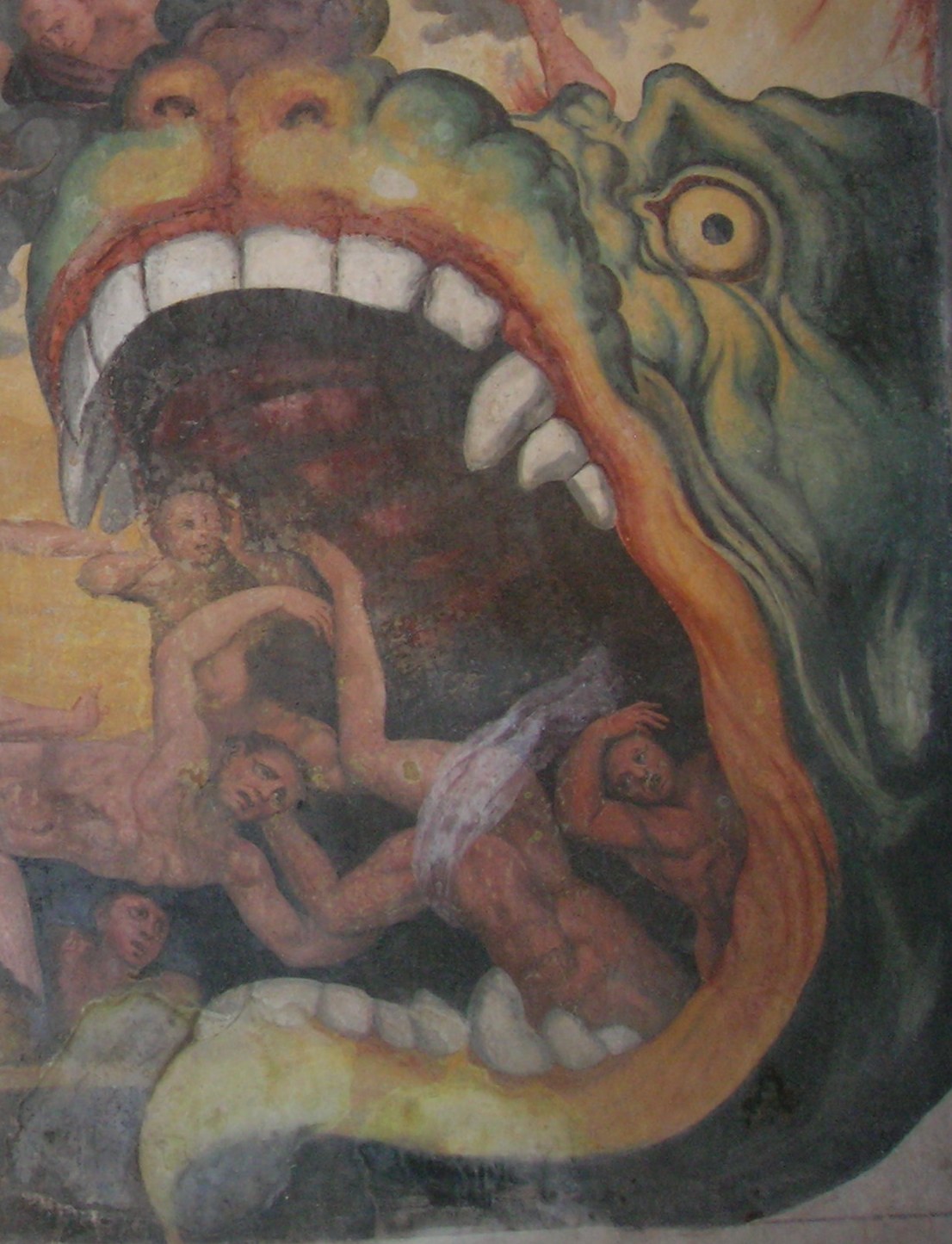
Peter Binsfeld classified Leviathan as the demon of envy, as one of the seven Princes of Hell corresponding to the seven deadly sins. Leviathan became associated with, and may originally have been referred to by, the visual motif of the Hellmouth, a monstrous animal into whose mouth the damned disappear at the Last Judgment, found in Anglo-Saxon art from about 800, and later all over Europe.
The Revised Standard Version of the Bible suggests in a footnote to Job 41:1 that Leviathan may be a name for the crocodile, and in a footnote to Job 40:15, that Behemoth may be a name for the hippopotamus.
Satanism

Anton LaVey in The Satanic Bible (1969) has Leviathan representing the element of water and the direction of west, listing it as one of the Four Crown Princes of Hell. This association was inspired by the demonic hierarchy from The Book of the Sacred Magic of Abra-Melin the Mage. The Church of Satan uses the Hebrew letters at each of the points of the sigil of Baphomet to represent Leviathan. Starting from the lowest point of the pentagram, and reading counter-clockwise, the word reads "לויתן": (Nun, Tav, Yod, Vav, Lamed) Hebrew for "Leviathan".
Gnosticism
The Church Father Origen accused a Gnostic sect of venerating the biblical serpent of the Garden of Eden. Therefore, he calls them Ophites, naming after the serpent they are supposed to worship. In this belief system, the Leviathan appears as an Ouroboros, separating the divine realm from humanity by enveloping or permeating the material world. It is unknown whether or not the Ophites actually identified the serpent of the Garden of Eden with Leviathan. However, since Leviathan is basically connoted negatively in this Gnostic cosmology, if they identified him with the serpent of the Book of Genesis, he was probably indeed considered evil and just its advice was good.
According to the cosmology of this Gnostic sect, the world is encapsulated by Leviathan, in form of a dragon-shaped archon, biting its own tail (ouroboros). Generating the intrinsic evil in the entire universe, the Leviathan separates the lower world, governed by the Archons, from the realm of God. After death, a soul must pass through the seven spheres of the heavens. If the soul does not succeed, it will be swallowed by the Leviathan, who holds the world captive and returns the soul into an animal body.
In Mandaeism, Leviathan is regarded as being coessential with a demon called Ur.
In Manichaeism, an ancient religion influenced by Gnostic ideas, Leviathan is killed by the sons of the fallen angel Shemyaza. This act is not portrayed as heroic, but as foolish, symbolizing the greatest triumphs as transient, since both are killed by archangels in turn after boasting about their victory. This reflects Manichaean criticism on royal power and advocates asceticism.
Secular use
The word "leviathan" has come to refer to any sea monster, and from the early 17th century has also been used to refer to overwhelmingly powerful people or things, comparable to Behemoth, also a biblical term as noted by Hobbes' book (1651).
As a term for sea monster, it has also been used of great whales in particular, e.g. in Herman Melville's Moby-Dick – although in the first Hebrew translation of the novel, translator Elyahu Burtinker chose to translate "whale" to "tanin" (intending to refer to another sea monster although in modern Hebrew usage tanin more commonly translates to "crocodile"), and leave the word "leviathan" as it is, nodding to the ambiguity of the word "לויתן" in modern Hebrew – in which the word now simply means "whale".
An extinct genus of sperm whales bears the name Livyatan. A major cryovolcanic feature on Neptune's largest moon Triton has been named Leviathan Patera.
Notes
References
Cited sources
References
- (2025). "The Oxford Handbook of Biblical Monsters". Oxford University Press.
- Goff, Graham. (2022-04-01). "Transforming Leviathan: Job, Hobbes, Zvyagintsev and Philosophical Progression". Journal of Religion & Film.
- Hobbes. "Leviathan".
- Pfeiffer, Charles F.. (1960). "Lotan and Leviathan".
- Sneed, Mark R.. (2022). "Taming the beast: a reception history of Behemoth and Leviathan". De Gruyter.
- Cirlot, Juan Eduardo. (1971). "A Dictionary of Symbols". Dorset Press.
- (1879). "Hebrew and Chaldee lexicon to the Old Testament".
- The British Museum. (2024-08-01). "The Babylonian Map of the World with Irving Finkel {{!}} Curator's Corner S9 Ep5".
- (1978). "Index to Brown, Driver and Briggs Hebrew Lexicon". [[Journal of Biblical Literature]].
- Suchard, Benjamin. (24 September 2019). "The Development of the Biblical Hebrew Vowels". [[Brill Publishers]].
- Schulz, Johann Christoph F.. (1792). "Io. Christ. Frid. Schulzii ... Scholia in Vetus Testamentum (continuata a G. L. Bauer).".
- Hermann Gunkel, Heinrich Zimmern; K. William Whitney Jr., trans., ''Creation And Chaos in the Primeval Era And the Eschaton: A Religio-historical Study of Genesis 1 and Revelation 12''. (Grand Rapids: MI: Eerdmans, 1895, 1921, 2006).
- Enuma Elish, Tablet IV, lines 104–105, 137–138, 144 from Alexander Heidel (1963) [1942], ''[https://oi.uchicago.edu/sites/oi.uchicago.edu/files/uploads/shared/docs/misc_genesis.pdf Babylonian Genesis]'', 41–42.
- Sannino, Stefano. (2025). "The Serpent in Mediterranean and Near Eastern Religious Thought".
- {{multiref. {{Bibleverse. Job. 3:8. HE. {{Bibleverse. Job. 40:25–41:26. HE. {{Bibleverse. Psalm. 74:14. HE. {{Bibleverse. Psalm. 104:26. HE. Twice in {{Bibleverse. Isaiah. 27:1. HE
- Jewish Publication Society translation (1917).
- (1999). "Dictionary of Deities and Demons in the Bible". Wm. B. Eerdmans Publishing.
- {{bibleref. Gen.. 1:21. HE.
- {{bibleref. Gen.. 1:21. KJV ([[King James Version. KJV]]).
- {{bibleref. Ps.. 104. HE.
- For example, in {{Bibleverse. Isaiah. 27:1. HE.
- Hermann Gunkel, Heinrich Zimmern; K. William Whitney Jr., trans., ''Creation And Chaos in the Primeval Era And the Eschaton: A Religio-historical Study of Genesis 1 and Revelation 12''. (Grand Rapids: MI: Eerdmans, 1895, 1921, 2006). p. 37-38.
- Watson, R.S. (2005). ''Chaos Uncreated: A Reassessment of the Theme of "chaos" in the Hebrew Bible''. Walter de Gruyter. {{ISBN. 3110179938, {{ISBN. 9783110179934
- ''Babylonian Talmud'', tractate ''Baba Bathra'' 74b.
- Gen. Rabbah 7:4, Midrash Chaseroth V'Yetheroth, Batei Midrashoth, vol 2, p. 225
- Chabad. "Rashi's Commentary on Genesis".
- Finkel, Avraham. (1993). "The Essence of the Holy Days: Insights from the Jewish sages". J. Aronson.
- Babylonian Talmud, ''Baba Bathra'' 74a.
- Babylonian Talmud, ''Baba Bathra'' 75a.
- Babylonian Talmud, ''Bekorot'' 55b; ''Baba Bathra'' 75a.
- Bava Batra l.c.
- Shabbat 77b
- "Leviathan and Behemoth".
- Zohar 1:140b. See also Zohar 3:279a
- Zohar 1:4b
- Matuk Midvash on Zohar 2:11b
- (2013). "Sapphire from the Land of Israel: A new light on weekly Torah portion from the writings of Rabbi Abraham Isaac HaKohen Kook". Chanan Morrison.
- Labriola, Albert C.. (1982). "Milton and the Middle Ages". [[Bucknell University Press]].
- Aquinas, Thomas. "Commentary on Job".
- Giblett, Rod. (2019). "Environmental Humanities and the Uncanny: Ecoculture, literature, and religion". Taylor & Francis.
- Wallace, Howard. (1948). "Leviathan and the Beast in Revelation". The Biblical Archaeologist.
- Bauckham, R. (1993). The Theology of the Book of Revelation. Vereinigtes Königreich: Cambridge University Press. p. 89
- (2020). "Leviathan to Lucifer: What Biblical Monsters (Still) Reveal". Interpretation: A Journal of Bible and Theology.
- Link, Luther. (1995). "The Devil: A Mask Without a Face". Reaktion Books.
- Hofmann, Petra. (2008). "Infernal Imagery in Anglo-Saxon Charters". St Andrews.
- (1959). "The Holy Bible Revised Standard Version". Thomas Nelson and Sons.
- "The History of the Origin of the Sigil of Baphomet and its Use in the Church of Satan". Church of Satan website.
- Tuomas Rasimus ''Paradise Reconsidered in Gnostic Mythmaking: Rethinking Sethianism in Light of the Ophite Evidence'' BRILL 2009 {{ISBN. 9789047426707 p. 68
- Kurt Rudolph ''Gnosis: The Nature and History of Gnosticism'' A&C Black 2001 {{ISBN. 9780567086402 p. 69
- April DeConick, Gregory Shaw, John D. Turner Practicing Gnosis: Ritual, Magic, Theurgy and Liturgy in Nag Hammadi, Manichaean and Other Ancient Literature. Essays in Honor of Birger A. Pearson BRILL 2013 {{ISBN. 9789004248526 p. 48
- Tuomas Rasimus ''Paradise Reconsidered in Gnostic Mythmaking: Rethinking Sethianism in Light of the Ophite Evidence'' BRILL 2009 {{ISBN. 9789047426707 p. 69
- Silviu Lupaşcu. "In the Ninth Heaven – the Gnostic Background of the Romanian Folklore tradition of the "Heaven's Custom Houses"". Danubius 1:309-325.
- (2009). "Paradise Reconsidered in Gnostic Mythmaking: Rethinking Sethianism in Light of the Ophite Evidence". [[Brill Publishers]].
- (2001). "The Gnostic Religion".
- (2008). "Manichaeism". [[University of Illinois Press]].
- Steve Dundas, [https://padresteve.com/2019/05/29/sinking-leviathan-the-death-of-the-bismarck/ 'Sinking Leviathan: The Death of the Bismarck']. Padre Steve, 29 May 2019. Retrieved 21 September 2024
- "לִוְיָתָן".
- {{gpn. 3368. Leviathan Patera (center latitude 17.00°, center longitude 28.50°)
- Streck, Maximilian. (1936). "Ḳāf". E.J. Brill.
This article was imported from Wikipedia and is available under the Creative Commons Attribution-ShareAlike 4.0 License. Content has been adapted to SurfDoc format. Original contributors can be found on the article history page.
Ask Mako anything about Leviathan — get instant answers, deeper analysis, and related topics.
Research with MakoFree with your Surf account
Create a free account to save articles, ask Mako questions, and organize your research.
Sign up freeThis content may have been generated or modified by AI. CloudSurf Software LLC is not responsible for the accuracy, completeness, or reliability of AI-generated content. Always verify important information from primary sources.
Report