From Surf Wiki (app.surf) — the open knowledge base
Leshan

| Field | Value | |
|---|---|---|
| name | Leshan | |
| native_name | 乐山市 | |
| native_name_lang | zh-Hans | |
| settlement_type | Prefecture-level city | |
| total_type | ||
| image_skyline | {{multiple image | |
| border | infobox | |
| total_width | 290 | |
| image_style | border:1; | |
| perrow | 2/2/2 | |
| image1 | 36275-Leshan (49067653383).jpg | |
| image2 | Leshan Lizheng Men 2014.04.24 20-59-31.jpg | |
| image3 | Mabian Dafengding National Nature Reserve (10.3897-zookeys.807.29237) Figure 10.jpg | |
| image4 | 乐山郭沫若故居照片.JPG | |
| image5 | 烏尤寺內.jpg | |
| image6 | Shizhong, Leshan, Sichuan, China - panoramio - jetsun (8).jpg | |
| caption1 | Leshan Giant Buddha | |
| caption2 | Lizheng Gate | |
| caption3 | Mabian Dafengding National Nature Reserve | |
| caption4 | Shawan District | |
| caption5 | Wuyou Temple | |
| caption6 | Shizhong Temple | |
| image_map | Sichuan subdivisions - Leshan.svg | |
| map_caption | Location of Leshan City jurisdiction in Sichuan | |
| dot_x | dot_y = | |
| subdivision_type | Country | |
| subdivision_name | People's Republic of China | |
| subdivision_type1 | Province | |
| subdivision_name1 | Sichuan | |
| subdivision_type2 | County-level divisions | |
| subdivision_name2 | 4 Counties, 2 Autonomous Counties, 1 County-level city and 4 Districts | |
| seat_type | Municipal seat | |
| seat | Shizhong District | |
| parts_style | ||
| parts | ||
| p2 | ||
| leader_title | ||
| leader_title1 | ||
| established_title | ||
| established_title1 | ||
| established_title2 | ||
| area_magnitude | ||
| unit_pref | ||
| area_total_km2 | 12827.49 | |
| area_land_km2 | ||
| area_urban_km2 | 1918.5 | |
| area_metro_km2 | 836.1 | |
| elevation_footnotes | ||
| population_as_of | 2020 census | |
| population_footnotes | ||
| population_total | 3160168 | |
| population_density_km2 | auto | |
| population_metro | 1236188 | |
| population_density_metro_km2 | auto | |
| population_urban | 1236188 | |
| population_density_urban_km2 | auto | |
| demographics_type2 | GDP | |
| demographics2_title1 | Prefecture-level city | |
| demographics2_info1 | CN¥ 130.1 billion | |
| US$ 20.9 billion | ||
| demographics2_title2 | Per capita | |
| demographics2_info2 | CN¥ 39,973 | |
| US$ 6,418 | ||
| timezone | China Standard | |
| utc_offset | +8 | |
| coor_pinpoint | Seat of Leshan municipal government | |
| coordinates | ||
| postal_code_type | Postal code | |
| postal_code | 614000 | |
| area_code | 0833 | |
| iso_code | CN-SC-11 | |
| blank_name | ||
| blank1_name | ||
| blank2_name | Licence Plate Prefixes | |
| blank2_info | 川L | |
| website |
Default is list if up to 5 items, coll if more than 5-- US$ 20.9 billion US$ 6,418 (locally) Leshan, formerly known as Jiading{{efn|Also previously romanized as Kea-ting or Kea-ting Foo.{{cite encyclopedia |title=The encyclopaedia britannica; a dictionary of arts, sciences, and general literature |editor=T. S. Baynes |editor-link=Thomas Spencer Baynes |entry=China |entry-url=https://archive.org/details/encyclopediabrit05newyrich/page/626
History
Leshan has a long history, with written records tracing back to around 700 BC during the Kai Ming dynasty of the Shu Kingdom. During the early part of what is termed the Spring and Autumn period, the Ba people, led by Kai Ming Bie Ling, migrated from western Hubei and settled at the confluence of the three rivers in what is now Leshan, including present-day Fengzhouba and the Dadu River. They established a tribal center. From the Qin and Han dynasties through to the Wei and Jin dynasties, the central government set up Nan'an County, laying the foundation for the present-day Leshan region.
After the Sui unification of China, Leshan was part of Meishan Prefecture (jun). In the third year of the Kaihuang reign (583 AD) of the Sui dynasty, the prefecture system was changed to a two-tier system of state (zhou) and counties. During the Tang dynasty's Zhenguan reign, Leshan became part of Jiazhou. In the Northern Song's Chongning reign, Leshan belonged to Jiading Prefecture, which administered five counties. During the reign of Emperor Ningzong of the Southern Song, Jiazhou was elevated to a prefecture and renamed Jiading Prefecture, marking the first use of the name "Jiading." During the Song and Yuan dynasties, Leshan's status rose from a prefecture to a province (lu), becoming the third-largest city in Sichuan, after Chengdu and Chongqing. In the twelfth year of Emperor Yongzheng's reign (1734 AD) of the Qing dynasty, Jiading Prefecture was established again.
In the early years of the Republic of China, from 1912 to 1917, Leshan was restructured into a county under the jurisdiction of the Sichuan Provincial Governor's Office. After Yuan Shikai's death, Sichuan broke away from central authority; by 1918, Xiong Kewu took control of Sichuan, implementing the "Defense Zone System," which decentralized military, political, financial, and tax powers to local garrisons, leading to warlordism and prolonged unrest in the region for 18 years. During this time, Leshan was successively controlled by Chen Hongfan, Liu Wenhui, and Liu Xiang, with local officials appointed by the stationed troops.
After the Mukden Incident, the Nationalist government relocated the treasures from the Forbidden City, Beijing to Shanghai, then Nanjing, and a significant portion eventually ended up in Leshan, including Emei and Angu, while the rest of them stored in Baxian (now Banan, Chongqing). The Forbidden City artifacts were stored in Leshan from July 1939, when the first batch arrived, until March 1947, when the last batch was transported out. In addition, during the Second Sino-Japanese War, Wuhan University and Jiangsu Sericulture College moved to Leshan, Sichuan University to Mount Emei, National Central Academy of Arts and Crafts was established at Renjiaba in Leshan, and Fuxing Academy was founded at Wuyou Temple in Leshan. Wuhan University left Leshan in June 1946.
After the founding of the People's Republic, some of the area of Leshan was ceded to Emeishan city in 1958. Until 1978, Leshan had three districts of Shizhong (means downtown), Wutongqiao (literally 5-"tong"-bridge) and Shawan (literally sand bay). In 1978, Leshan as a county-level city was formed. In 1985, Leshan became a prefecture-level city, with Emeishan and other county level cities under the administration of Leshan.
Culture
Tourist attractions
.jpg)
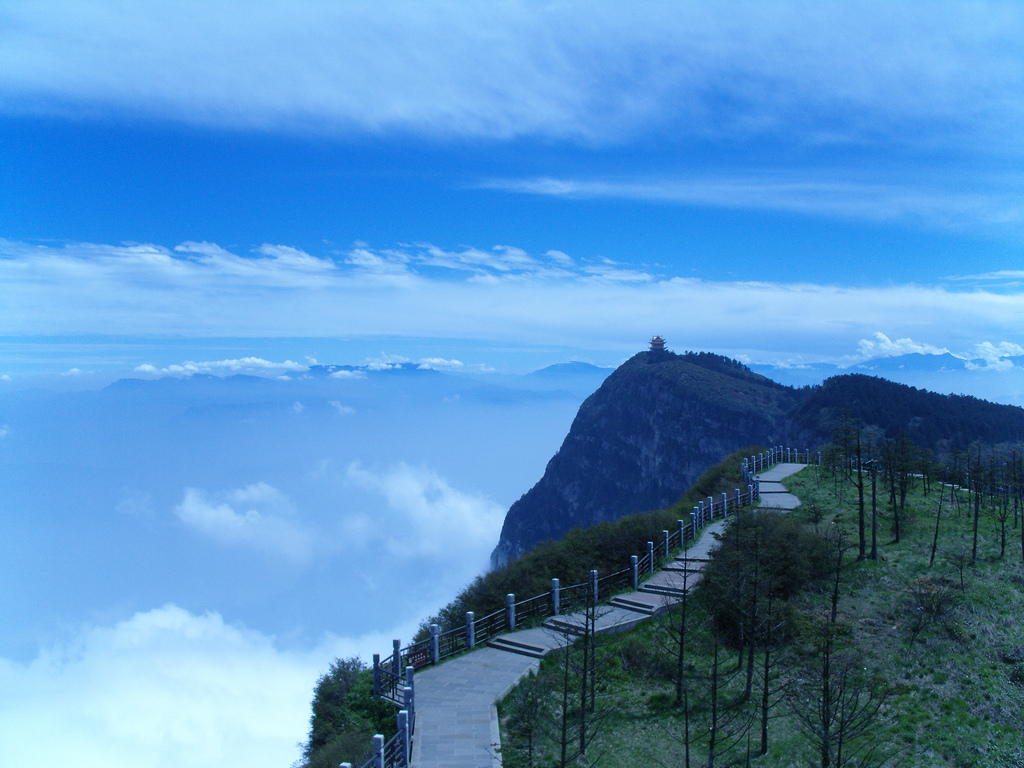
In 1996, the Mount Emei Scenic Area, including the Leshan Giant Buddha, the largest stone-carved buddha in the world, which was declared a World Heritage Site by UNESCO. Next to the Leshan Giant Buddha is the Oriental Buddha Park, a privately run cultural theme park, featuring thousands of reproductions of Buddha statues and Buddhist themed carvings. Mount Emei is located within the county-level city of Emeishan, which is under the administrative jurisdiction of Leshan.
The ancestral home of Chinese writer, academic and politician Guo Moruo is preserved in the Shawan District of Leshan.
Dialect
The Leshan dialect is distinct among the dialects in Sichuan province for retaining the entering tone, the fourth of the four tones in classical Chinese pronunciation, which most Sichuan dialects and Mandarin no longer uses. Unlike other Sichuan dialects, most of which are mutually understandable, the Leshan dialect is difficult for other Sichuan people to understand.
Food

Falling into the Sichuan cuisine family, Leshan is noted for its food culture, especially its variety of street foods. Typical specialties include:
- Malatang () - Hot and spicy soup
- Boboji () - Bobo chicken
- [[File:Shaokao.jpg|thumb|Shaokao]]Shaokao () - Street barbecue
- Qianwei Baobing () - Qianwei Pancakes
- Doufunao () - Leshan Style Tofu Soup
- Tianpiya () - Sweet-Skinned Duck
- Qiaojiao Niurou () Leshan Style Beef Hotpot
- Xiba Doufu () Xiba Tofu
- Mi Liang Gao () - A snack made with rice
- Leshan fried () - fried foods
Transport
There are Chengdu–Mianyang–Leshan intercity railway and Chengdu–Guiyang high-speed railway serving Leshan.
The G0512 Chengdu–Leshan Expressway with a total length of 160 kilometers, was finished on January 14, 2000. This Freeway has since become very important to the city's development.
Leshan Railway Station (乐山站), located in Leshan City, Sichuan Province, China, is also a comprehensive transportation hub integrating railway, bus, coach, taxi and other modes of transportation, which was put into use on December 20, 2014.
Education
Leshan Normal University (乐山师范学院) and Leshan Vocational & Technical College (乐山职业技术学院) are two government-funded colleges in the city.
The Engineering&Technical College of Chengdu University of Technology (成都理工大学工程技术学院) is a non-government college, which was established in 2003.
Administrative divisions
| Map | Name | Hanzi | Hanyu Pinyin | Population | ||
|---|---|---|---|---|---|---|
| (2020 census) | Area (km2) | Density | ||||
| (/km2) | ||||||
| Shizhong District | 市中区 | Shìzhōng Qū | 814,597 | 825 | 987 | |
| Shawan District | 沙湾区 | Shāwān Qū | 144,931 | 617 | 235 | |
| Wutongqiao District | 五通桥区 | Wǔtōngqiáo Qū | 237,933 | 474 | 502 | |
| Jinkouhe District | 金口河区 | Jīnkǒuhé Qū | 38,727 | 598 | 65 | |
| Emeishan City | 峨眉山市 | Éméishān Shì | 419,107 | 1,168 | 359 | |
| Qianwei County | 犍为县 | Qiánwéi Xiàn | 416,673 | 1,375 | 303 | |
| Jingyan County | 井研县 | Jǐngyán Xiàn | 280,641 | 841 | 334 | |
| Jiajiang County | 夹江县 | Jiājiāng Xiàn | 305,441 | 749 | 408 | |
| Muchuan County | 沐川县 | Mùchuān Xiàn | 192,313 | 1,401 | 130 | |
| Ebian Yi Autonomous County | 峨边彝族自治县 | Ébiān Yízú | ||||
| Zìzhìxiàn | 121,554 | 2,395 | 51 | |||
| Mabian Yi Autonomous County | 马边彝族自治县 | Mǎbiān Yízú | ||||
| Zìzhìxiàn | 188,251 | 2,383 | 79 |
Population

According to the Seventh national census in 2020, the city's resident population stood at 3,160,168, a decrease of 75,591 or 2.34% over the Sixth national census. The average annual decrease was 0.24 per cent. Of these, the male population is 1,585,671, or 50.18 per cent, and the female population is 1,574,497 or 49.82 per cent. The Seven ratio of the total population (100 females) is 100.71, a 0.95 decrease from the Sixth census.The population aged 0–14 years is 446,056, or 14.11 per cent; the population aged 15–59 years is 774,179, or 24.50 per cent; and the population aged 65 and over is 606,448, or 19.19 per cent. The Han Chinese population is 2,953,987, accounting for 93.48 percent; the ethnic minorities are 206,181 or 6.52 percent; and the Yi population is 193,199 or 6.11 percent. In 2020, the city's registered population was 1,678,367, accounting for 53.11 percent of the province's total population.Compared with the Sixth national census in 2010, the city's registered population increased by 401,052 people, the rural population decreased by 476,643 people, and the proportion of city's registered population increased by 13.64 percentage points.
There are 41 ethnic groups in Leshan City. Han, Yi, Hui and Miao live in the world. Han nationality is the main, followed by Yi nationality, ethnic minorities about 113,000 people, accounting for 3.2 percent of the total population. Yi Nationality: A major minority nationality concentrated in the south of Ma Bian, Ebian Yi Autonomous County, and Jinkouhe District.
Geography and climate
Leshan City is located in central Sichuan Province, southwest of the Sichuan Basin. Meishan borders on the north, Zigong and Yibin in the east, Liangshan in the south, and Ya'an in the west. Leshan city is located in the transition zone from Sichuan basin to southwest mountainous area, the overall trend is high in southwest, low in northeast, with wide difference in height. Landforms are mountainous, hilly, Pingba three types, mainly mountainous.
Leshan has a monsoon-influenced humid subtropical climate (Köppen Cwa) and is largely mild and humid. Winter is short, mild and dry, with a January average of 7.4 °C, and while frost may occur, snow is rare. Summers are long, hot and humid, with highs often exceeding 30 °C, yet extended heat waves are rare. The daily average in July and August is around 26 °C. Rainfall is light in winter and can be heavy in summer, and more than 70% of the annual total occurs from June to September.
The climate in the southwest mountainous area has obvious vertical differences and the climatic conditions are very complex, which is a region for the development of comprehensive agricultural management and three-dimensional agriculture in the region, the main production area of wood, tea, Chinese medicinal materials and other crops, and also a valuable tourism resource. Affected by the monsoon and the uplift of the terrain, the climate is humid and the rainfall is abundant.
| Jan record high C = 20.1 | Jan record low C = −1.7 | Feb record high C = 23.9 | Feb record low C = -1.9 | Mar record high C = 32.5 | Mar record low C = 0.2 | Apr record high C = 36.2 | Apr record low C = 4.9 | May record high C = 37.2 | May record low C = 10.5 | Jun record high C = 38.2 | Jun record low C = 15.3 | Jul record high C = 37.7 | Jul record low C = 17.6 | Aug record high C = 41.3 | Aug record low C = 17.3 | Sep record high C = 36.5 | Sep record low C = 13.6 | Oct record high C = 32.0 | Oct record low C = 5.3 | Nov record high C = 25.7 | Nov record low C = 2.2 | Dec record high C = 20.2 | Dec record low C = −2.9 all-time extreme temperature{{cite web |access-date= 2024-11-22 | script-title=zh:乐山 - 气象数据 -中国天气网 | access-date = 21 November 2022}}
Natural resources
Leshan City, located at the confluence point of Minjiang River, Dadu River, Qing Yi River, is a water-rich area.
- Water resources: 85.51 billion cubic metres
- Theoretical reserves of hydraulic resources: 7.9 million kilowatts
- Developable capacity: 5.75 million kilowatts
- Main hydropower stations: Gongzui hydropower station (700,000 kW), Tongjiezi hydropower station (600,000 kW) Apart from water resources, Leshan has rich mineral reserves of phosphorus, halite, limestone, kaolin, natural gas, gypsum, dolomite, mineral water and mirabilite.
Gallery
File:JPG 3726.JPG|Night view File:烏尤寺內.jpg|Buddhist temple File:Leshan Buddha Statue View.JPG|The Leshan Giant Buddha File:Leshan China Buddhist-Monk-01.jpg|Buddhist Monk in Leshan Image:Lingbao Pagoda1.jpg|Lingbao Pagoda
Sister cities
- AUS Hervey Bay, Queensland, Australia
- US Gilbert, Arizona, United States
- Japan Ichikawa, Chiba, Japan, established due to Leshan native Guo Moruo residing there for 10 years with his wife, Sato Tomiko.
- Thailand Prachuap Khiri Khan, Thailand
- France Issy-les-Moulineaux, France
Notable people
- Dylan Wang
- Guo Moruo
- Zheng Shaoxiong
Famous place
- Leshan Buddha
- Reclining Buddha
- Mount Emei
- Mahaoya Tomb
- Thousand Buddha Rock in the Jiajiang River
- Ebian Black Bamboo Gou
- Luocheng Ancient Town
- Wutong Bridge
Notes
References
References
- "China: Sìchuān (Prefectures, Cities, Districts and Counties) - Population Statistics, Charts and Map".
- 四川省统计局、国家统计局四川调查总队. (2016). "《四川统计年鉴-2016》". [[China Statistics Press]].
- "行政区划- 中共乐山市委乐山市人民政府".
- "Mount Emei Scenic Area, including Leshan Giant Buddha Scenic Area".
- "乐山简史".
- www.fractal-technology.com. "故宫文物南迁史料馆".
- link. (18 May 2013)
- link. (20 April 1985). [[State Council of the People's Republic of China. State Council]]. 中华人民共和国国务院公报 [People's Republic of China State Council Gazette]
- "Leshan -- Home of World's Largest Stone Buddha Statue".
- "Leshan Food, Best Dishes and Snack of Leshan".
- "Leshan Cuisine".
- (2021-06-07). "乐山市第七次全国人口普查公报(第1-6号)".
- "乐山市统计局".
- "四川省人口普查年鉴-2020".
- link. [[China Meteorological Administration]]
- "Sina Visitor System". weatherman_信欣 on [[Weibo]].
- link. Ichikawa City Government
- City of Ichikawa: [http://www.city.ichikawa.chiba.jp/koku/homon/raku_e.htm Leshan City] {{webarchive. link. (2009-08-28)
This article was imported from Wikipedia and is available under the Creative Commons Attribution-ShareAlike 4.0 License. Content has been adapted to SurfDoc format. Original contributors can be found on the article history page.
Ask Mako anything about Leshan — get instant answers, deeper analysis, and related topics.
Research with MakoFree with your Surf account
Create a free account to save articles, ask Mako questions, and organize your research.
Sign up freeThis content may have been generated or modified by AI. CloudSurf Software LLC is not responsible for the accuracy, completeness, or reliability of AI-generated content. Always verify important information from primary sources.
Report