From Surf Wiki (app.surf) — the open knowledge base
Leptis Magna
Ancient city in modern Libya

Ancient city in modern Libya
| Field | Value | |
|---|---|---|
| name | Leptis Magna | |
| alternate_name | Lepcis Magna, Neapolis, Lpqy | |
| image | [[File:Leptis Magna (29) (8288918733).jpg | 250px]] |
| alt | Arch of Septimus Severus | |
| map_type | Libya | |
| relief | yes | |
| coordinates | ||
| location | Khoms, Libya | |
| region | Tripolitania | |
| type | Settlement | |
| built | 1000 BC | |
| abandoned | 7th c. AD | |
| epochs | Iron Age to Byzantine | |
| cultures | Carthaginian | |
| Roman | ||
| website | ||
| designation1 | WHS | |
| designation1_offname | Archaeological Site of Leptis Magna | |
| designation1_date | 1982 (6th session) | |
| designation1_number | 183 | |
| designation1_criteria | i, ii, iii | |
| designation1_type | Cultural | |
| designation1_free1name | Region | |
| designation1_free1value | North Africa |
Roman
Leptis or Lepcis Magna, () also known by other names in antiquity, was a prominent city of the Carthaginian Empire and Roman Libya at the mouth of the Wadi Lebda in the Mediterranean.
Established as a Punic settlement prior to 500 BC, the city experienced significant expansion under Roman Emperor Septimius Severus (), who was born in the city. The 3rd Augustan Legion was stationed here to defend the city against Berber incursions. After the legion's dissolution under Gordian III in 238, the city was increasingly open to raids in the later part of the 3rd century. Diocletian reinstated the city as provincial capital, and it grew again in prosperity until it fell to the Vandals in 439. It was reincorporated into the Eastern Empire in 533 but continued to be plagued by Berber raids and never recovered its former importance. It fell to the Muslim invasion in and was subsequently abandoned.
After being abandoned, the city was remarkably preserved as it lay buried beneath layers of sand dunes. In the 1920s, the city was unearthed by Italian archaeologists during Italy's occupation of Libya. Its ruins are within present-day Al-Khums, Libya, 130 km east of Tripoli. They are among the best-preserved Roman sites in the Mediterranean.
Name
Names
The Punic name of the settlement was written () or (𐤋𐤐𐤒𐤉). This has been tentatively connected to the Semitic root (present in Arabic) , meaning "to build" or "to piece together", presumably in reference to the construction of the city.
This name was hellenized as Léptis (), also known as Léptis Megálē (Λέπτις μεγάλη, "Greater Leptis") distinguishing it from the "Lesser Leptis" closer to Carthage in modern-day Tunisia. It was also known by the Greeks as Neápolis (Νεάπολις, "New Town"). The latinization of these names was Lepcis or Leptis Magna ("Greater Leptis"), which also appeared as the "Leptimagnese City" (). The Latin demonym was "Leptitan" (Leptitanus). It was also known as UlpiaTraiana as a Roman colony, after Emperor Trajan of the Ulpia gens. Its Italian name is LeptiMaggiore, and in Arabic it is named Labdah (لَبْدَة).
History
Punics
The Punic city was founded in the second half of the 7th centuryBC. Little is known about Leptis during this time, but it appears to have been powerful enough to repel Dorieus's attempt to establish a Greek colony nearby around 515BC. Like most Punic settlements, Leptis became part of the Carthaginian Empire and fell under Rome's control with Carthage's defeat in the Punic Wars. Leptis remained highly independent for a period after about 111BC.
Roman Republic
The Roman Republic sent some colonists together with a small garrison in order to control the city. The city prospered and was even allowed to coin its own money in silver and bronze. Reflecting its blend of cultures, its coins bore Punic inscriptions but images of Hercules and Dionysus. Soon Italian merchants settled in the city and started a profitable commerce with the Libyan interior. The city depended primarily on the fertility of its surrounding farmland, where many olive-presses have been excavated. By 46BC, its olive oil production was of such an extent that the city was able to provide three million pounds of oil annually to Julius Caesar as tax.
Roman Empire
Kenneth D. Matthews Jr. writes:

Leptis Magna remained as such until the reign of the Roman emperor Tiberius, when the city and the surrounding area were formally incorporated into the empire as part of the province of Africa. It soon became one of the leading cities of Roman Africa and a major trading post. The city grew rapidly under Roman administration. During the reign of Nero, an amphitheater was constructed. The settlement was elevated to municipium in AD 64 or 65 and to colonia under Trajan (). The first known bishop of Leptis Magna was a certain priest called Victor who became pope in 189.
Leptis achieved its greatest prominence beginning in AD193, as the hometown of emperor Septimius Severus. Septimius favored his hometown above all other provincial cities, and the buildings and wealth he lavished on it made Leptis Magna the third-most important city in Africa, rivaling Carthage and Alexandria. In AD205, he and the imperial family visited the city and bestowed great honors. Among the changes that Severus introduced were the creation of a magnificent new forum and the rebuilding of the docks. The natural harbor had a tendency to silt up, but the Severan changes made this worse, and the eastern wharves are extremely well preserved, since they were scarcely used.
Leptis prospered through trans-Saharan trade in various valuable goods, including ivory, wild animals for the gladiatorial arena, gold dust, carbuncle, precious woods like ebony, and ostrich feathers.
Leptis overextended itself during this period. During the Crisis of the 3rd Century, when trade declined precipitously, Leptis Magna's importance also fell into a decline, and by the middle of the 4th century, even before it was completely devastated by the 365 tsunami, large parts of the city had been abandoned. Ammianus Marcellinus recounts that the crisis was worsened by a corrupt Roman governor named Romanus, who demanded bribes to protect the city during a major tribal raid. The ruined city could not pay these and complained to the emperor Valentinian I. Romanus then bribed people at court and arranged for the Leptan envoys to be punished "for bringing false accusations". It enjoyed a minor renaissance beginning in the reign of the emperor Theodosius I.
Vandal Kingdom
In 439, Leptis Magna and the rest of the cities of Tripolitania fell under the control of the Vandals when their king, Gaiseric, captured Carthage from the Romans and made it his capital. Unfortunately for the future of Leptis Magna, Gaiseric ordered the city's walls demolished so as to dissuade its people from rebelling against Vandal rule. The people of Leptis and the Vandals both paid a heavy price for this in AD523 when a group of Berber raiders sacked the city.
Byzantine Empire
Belisarius, general of Emperor Justinian I, recaptured Leptis Magna in the name of the Roman Empire ten years later, and in 533–4 it was re-incorporated into the empire. Leptis became a provincial capital of the Eastern Empire, but never recovered from the destruction wreaked upon it by the Berbers. In 544, under the prefecture of Sergius, the city came under intensified attack of Berber tribes, and after some successes, Sergius was reduced to retreating into the city, with the Leuathae tribal confederation camped outside the gate demanding payments. Sergius admitted eighty deputies into the city to present their demands, but when Sergius moved to leave the conference he was detained by the robe by one deputy and crowded by others. This provoked an officer of the prefect's guard to kill the deputy laying hands on the prefect, which resulted in a general massacre. The Berbers reacted with an all-out attack and Sergius was eventually forced to abandon Leptis and retreat to Carthage.
Islamic conquest
By the 6th century, the city was fully Christianized. During the decade 565–578 AD, Christian missionaries from Leptis Magna even began to move once more among the Berber tribes as far south as the Fezzan in the Libyan desert and converted the Garamantes. Numerous new churches were built in the 6th century, but the city continued to decline, and by the time of the Arab conquest around 647 the city was mostly abandoned except for a Byzantine garrison force and a population of less than 1,000 inhabitants. By the 10th century, the city of Al-Khums had fully absorbed it.
Excavation
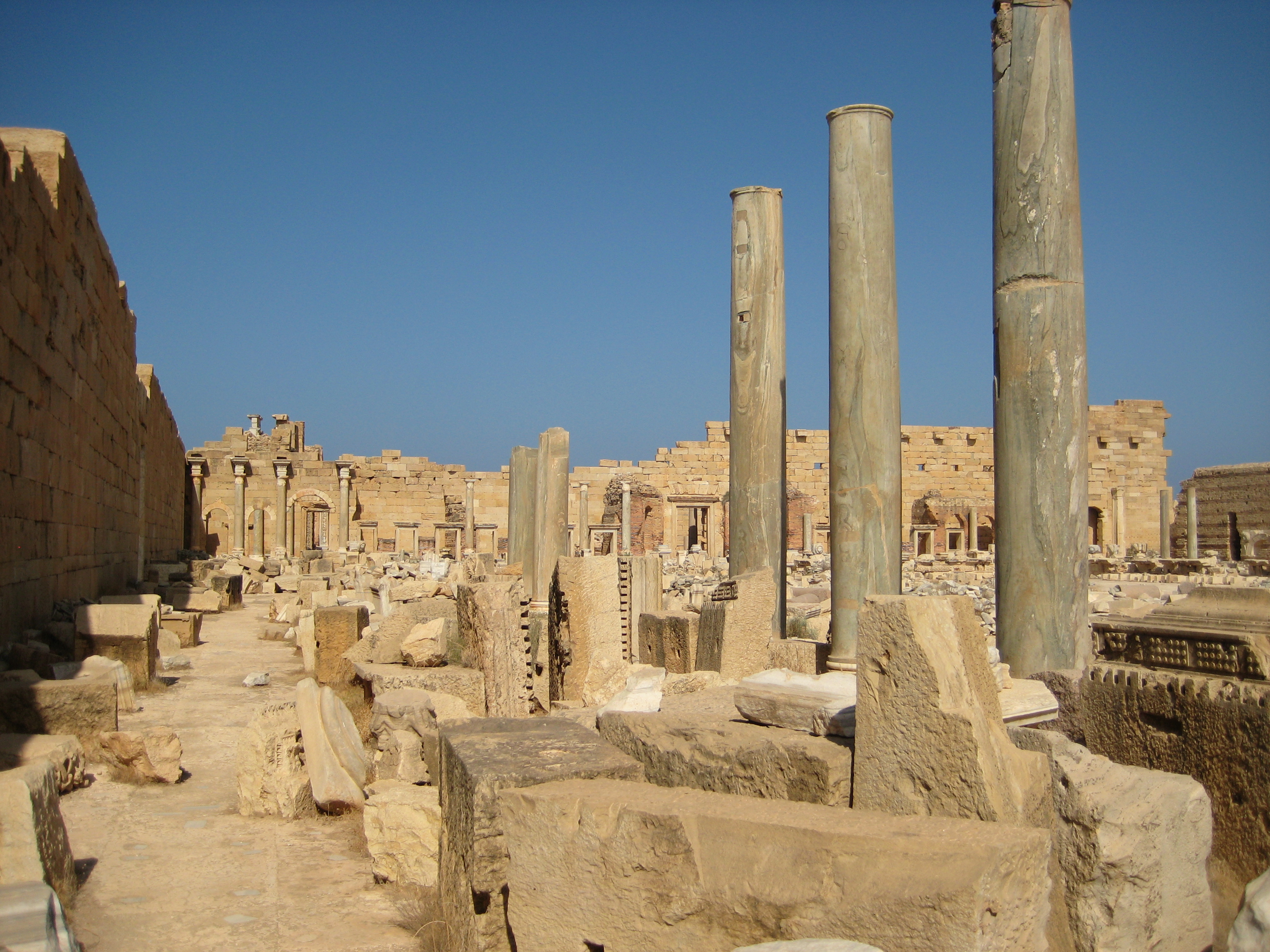
Today, the site of Leptis Magna is the site of some of the most impressive ruins of the Roman period.
_(geograph_3935706).jpg)
Part of an ancient temple was brought from Leptis Magna to the British Museum in 1816 and installed at the Fort Belvedere royal residence in England in 1826. It now lies in part of Windsor Great Park. The ruins are located between the south shore of Virginia Water and Blacknest Road close to the junction with the A30 London Road and Wentworth Drive.
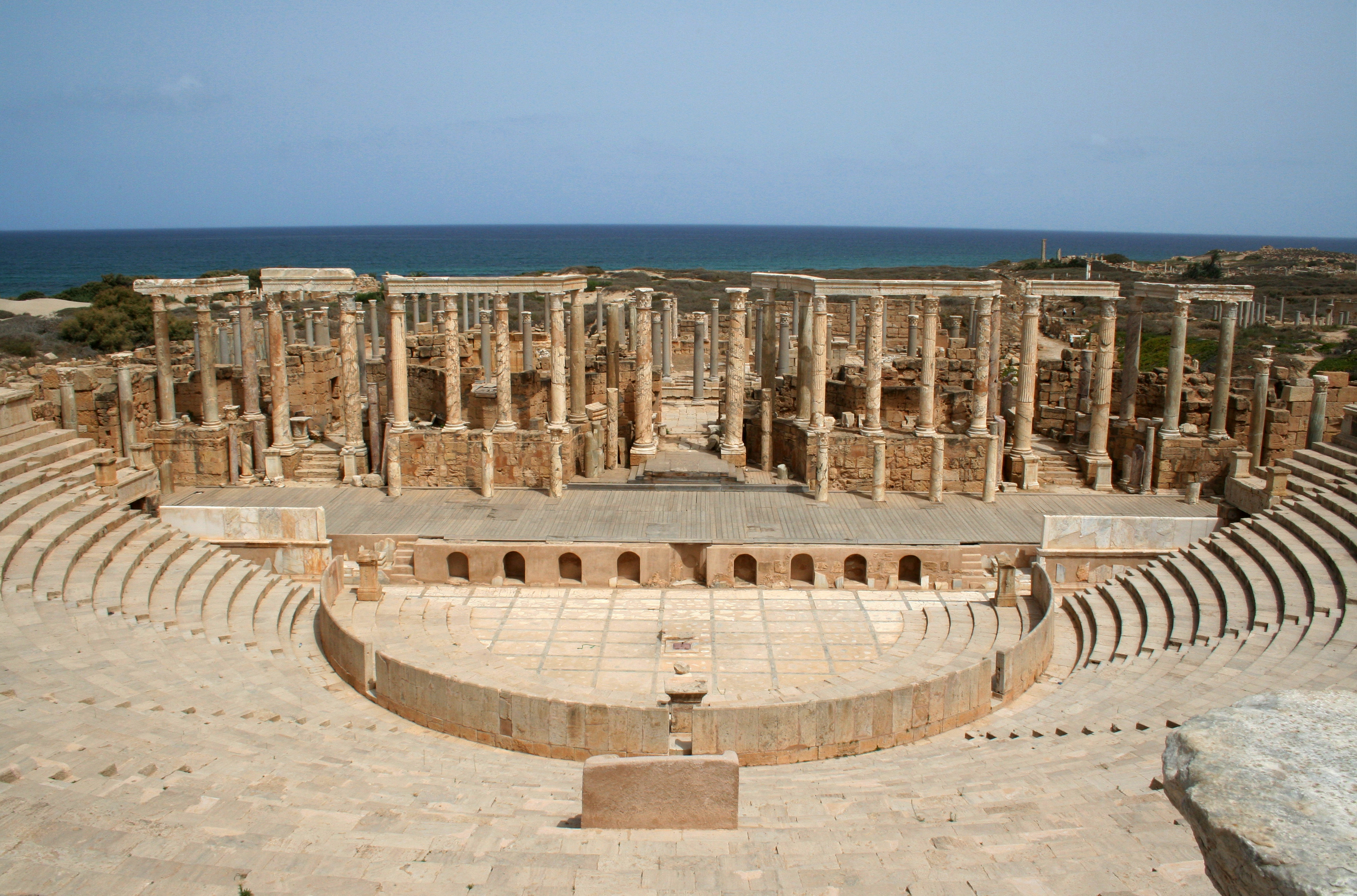
When Italians conquered Italian Libya in the early 20th century, they dedicated huge efforts to the rediscovery of Leptis Magna. In the early 1930s, Italian archeological research was able to show again the buried remains of nearly all the city. A 4th to 3rd centuryBC necropolis was found under the Roman theatre.
In June 2005, it was revealed that archaeologists from the University of Hamburg had been working along the coast of Libya when they uncovered a 30 ft length of five colorful mosaics created during the 1st or 2nd century. The mosaics show with exceptional clarity depictions of a warrior in combat with a deer, four young men wrestling a wild bull to the ground, and a gladiator resting in a state of fatigue and staring at his slain opponent. The mosaics decorated the walls of a cold plunge pool in a balneae within a Roman villa at Wadi Lebda in Leptis Magna. The gladiator mosaic is noted by scholars as one of the finest examples of representational mosaic art ever seen—a "masterpiece comparable in quality with the Alexander Mosaic in Pompeii." The mosaics were originally discovered in the year 2000 but were kept secret in order to avoid looting. They are currently on display in the Leptis Magna Museum.
There were reports that Leptis Magna was used as a cover for tanks and military vehicles by pro-Gaddafi forces during the First Libyan Civil War in 2011. When asked if the historic site could be targeted in an airstrike, NATO refused to rule out the possibility of such an action, saying that it had not been able to confirm the rebels' report that weapons were being hidden at the location. Shortly after the war, Libyan archaeologist Hafed Walda reported that Leptis Magna, along with nearby Rasaimergib Fort and the western Tripolis of Sabratha, had "so far seen no visible loss" from either fighting on the ground or bombings conducted by international forces.
In the midst of the Second Libyan Civil War and the disappearance of governmental and international support for the site, people living in the area organized to voluntarily protect and maintain Leptis Magna.
Climate change
Main article: Sea level rise
Since they are located on the coast, Leptis Magna ruins are vulnerable to sea level rise. In 2022, the IPCC Sixth Assessment Report included them in the list of African cultural sites which would be threatened by flooding and coastal erosion by the end of the century, but only if climate change followed RCP 8.5, which is the scenario of high and continually increasing greenhouse gas emissions associated with the warming of over 4°C., and is no longer considered very likely. The other, more plausible scenarios result in lower warming levels and consequently lower sea level rise: yet, sea levels would continue to increase for about 10,000 years under all of them. Even if the warming is limited to 1.5°C, global sea level rise is still expected to exceed 2-3 m after 2000 years (and higher warming levels will see larger increases by then), consequently exceeding 2100 levels of sea level rise under RCP 8.5 (~0.75 m with a range of 0.5-1 m) well before the year 4000. Thus, it is a matter of time before the Leptis Magna ruins are threatened by rising water levels, unless they can be protected by adaptation efforts such as sea walls.
Gallery
Image:Leptis magna pillar.jpg|Some of Leptis Magna yet to be excavated Image:Leptis Magna - Marktgebäude (macellum).jpg|Market place Image:Leptis Magna amphitheatre - panoramio.jpg|Amphitheater Image:Libya_5458_Leptis_Magna_Luca_Galuzzi_2007.jpg|Arch of Septimius Severus Image:Archaeological Site of Leptis Magna-108958.jpg|Severan Basilica Image:Leptis Magna view.JPG|View on Leptis Magna from the theater wall Image:Market Leptis Magna 03.JPG|Measure converter, Market (founded 8 or 9 BC) (Phoenician colony) Image:Severan Basilica 02.JPG|Decorative columns inside Basilica of Septimius Severus File:Villa of the Nile Mosaic fishermen.jpg|Angling in the 1st century AD. Villa of the Nile Mosaic, Leptis Magna, Tripoli National Museum
References
Citations
Bibliography
References
- "Leptis Magna | Archiqoo".
- Gates, Charles. (2011). "Ancient cities: the archaeology of urban life in the ancient Near East and Egypt, Greece and Rome". Routledge.
- (30 June 2006). "لَبْدَة, Libya".
- {{Britannica. 336898. Leptis Magna
- (22 December 2015). "Routledge Companion to Christianity in Africa". Routledge.
- Trisos, C.H., I.O. Adelekan, E. Totin, A. Ayanlade, J. Efitre, A. Gemeda, K. Kalaba, C. Lennard, C. Masao, Y. Mgaya, G. Ngaruiya, D. Olago, N.P. Simpson, and S. Zakieldeen 2022: [https://www.ipcc.ch/report/ar6/wg2/downloads/report/IPCC_AR6_WGII_Chapter09.pdf Chapter 9: Africa]. In [https://www.ipcc.ch/report/ar6/wg2/ Climate Change 2022: Impacts, Adaptation and Vulnerability] [H.-O. Pörtner, D.C. Roberts, M. Tignor, E.S. Poloczanska, K. Mintenbeck, A. Alegría, M. Craig, S. Langsdorf, S. Löschke, V. Möller, A. Okem, B. Rama (eds.)]. Cambridge University Press, Cambridge, United Kingdom and New York, NY, US, pp. 2043–2121
- (29 January 2020). "Emissions – the 'business as usual' story is misleading". Nature.
- (20 October 2020). "RCP8.5 is a problematic scenario for near-term emissions". PNAS.
- (August 2021). "Technical Summary. In: Climate Change 2021: The Physical Science Basis. Contribution of Working Group I to the Sixth Assessment Report of the Intergovernmental Panel on Climate Change". IPCC.
- IPCC, 2021: [https://www.ipcc.ch/report/ar6/wg1/downloads/report/IPCC_AR6_WGI_SPM.pdf Summary for Policymakers]. In: [https://www.ipcc.ch/report/ar6/wg1/ Climate Change 2021: The Physical Science Basis. Contribution of Working Group I to the Sixth Assessment Report of the Intergovernmental Panel on Climate Change] [Masson-Delmotte, V., P. Zhai, A. Pirani, S.L. Connors, C. Péan, S. Berger, N. Caud, Y. Chen, L. Goldfarb, M.I. Gomis, M. Huang, K. Leitzell, E. Lonnoy, J.B.R. Matthews, T.K. Maycock, T. Waterfield, O. Yelekçi, R. Yu, and B. Zhou (eds.)]. Cambridge University Press, Cambridge, United Kingdom and New York, NY, US, pp. 3−32, doi:10.1017/9781009157896.001.
This article was imported from Wikipedia and is available under the Creative Commons Attribution-ShareAlike 4.0 License. Content has been adapted to SurfDoc format. Original contributors can be found on the article history page.
Ask Mako anything about Leptis Magna — get instant answers, deeper analysis, and related topics.
Research with MakoFree with your Surf account
Create a free account to save articles, ask Mako questions, and organize your research.
Sign up freeThis content may have been generated or modified by AI. CloudSurf Software LLC is not responsible for the accuracy, completeness, or reliability of AI-generated content. Always verify important information from primary sources.
Report